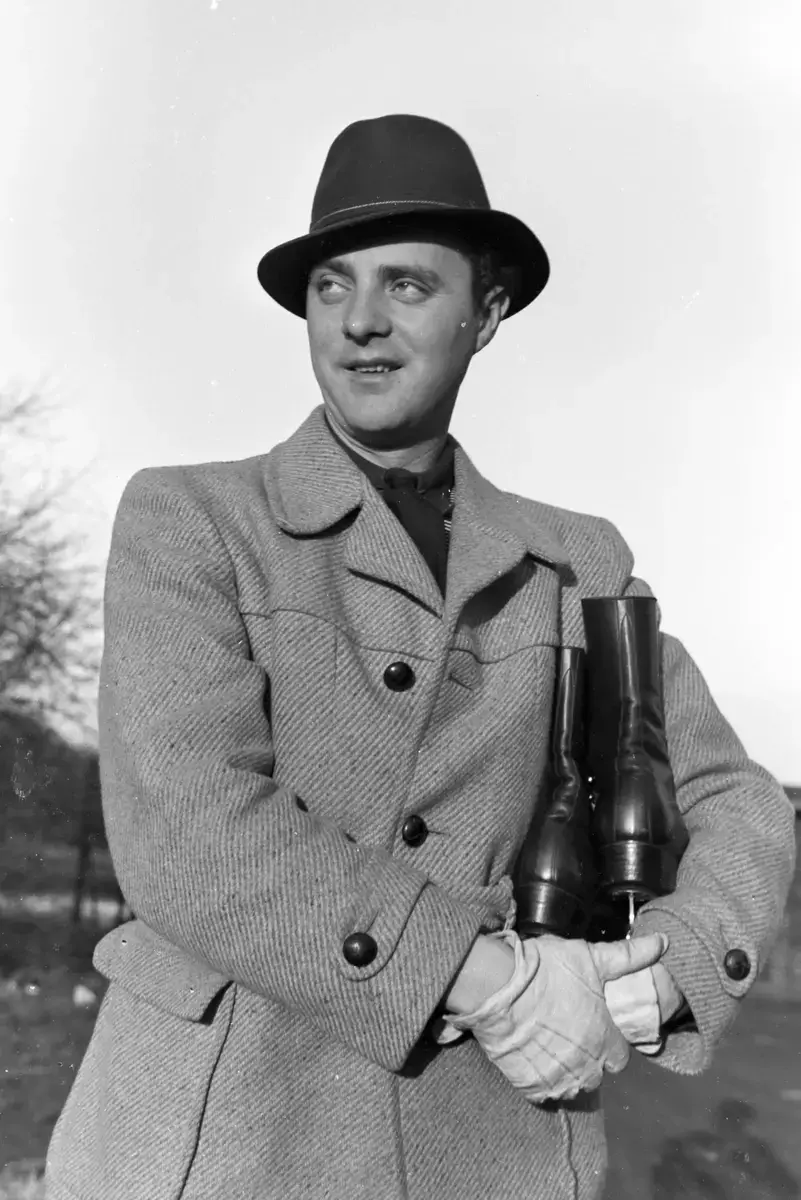
Karl Schäfer: The Scholar of the Ice
Few figure skaters in history have embodied the blend of athletic brilliance and intellectual achievement quite like Karl Schäfer. A dominant force in the early 20th century, Schäfer not only redefined men’s figure skating but also pursued a distinguished career outside the rink—making him one of the sport’s most fascinating and well-rounded champions.
Early Life and Rise to Prominence
Born on May 17, 1909, in Vienna, Schäfer grew up in a culturally rich environment that nurtured both discipline and creativity. He initially trained under the legendary Willy Böckl, who himself was a four-time World Champion. Under Böckl’s guidance, Schäfer developed a refined style marked by strong compulsory figures and elegant free skating—an essential combination in that era.
By the late 1920s, Schäfer had emerged as a serious contender on the international stage, quickly distinguishing himself with his precision, musicality, and athletic control.
Olympic and World Dominance
Schäfer’s competitive record is nothing short of extraordinary. He won two Olympic gold medals at the 1932 Winter Olympics and the 1936 Winter Olympics, solidifying his place among the sport’s elite.
Even more impressive was his reign at the World Figure Skating Championships, where he claimed the title seven consecutive times from 1930–1936. This streak remains one of the most dominant runs in figure skating history. He also won the European Championship title eight times (1929–1936).
Schäfer’s skating stood out for its exceptional edge quality and control in compulsory figures, fluid, expressive movement in free skating, and seamless integration of athleticism and artistry.
At a time when figures carried significant weight in scoring, Schäfer’s technical mastery gave him a decisive advantage over his rivals.
Historical Context: Competing Before WWII
Schäfer’s career unfolded during a turbulent period in European history when he medaled at the 1936 Winter Olympics in Nazi Germany.
Shortly after, the political climate in Austria changed dramatically with the 1938 Anschluss (annexation by Nazi Germany). Like many Austrian athletes of his generation, Schäfer’s career and life were shaped by these events, and his competitive retirement came just before World War II reshaped international sport.
After the Anschluss, Austrian sports—including figure skating—were absorbed into Nazi-controlled structures. During this period, youth sports programs were often integrated into or aligned with the Hitler Youth system. Coaches working in clubs or national programs could end up training athletes who were members of Nazi youth organizations, sometimes by default rather than choice.
A Skater with Showmanship and Style
Schäfer wasn’t just dominant—he was charismatic, something that set him apart in an era when skating could be very rigid due to the heavy emphasis on compulsory figures. While many competitors focused almost entirely on precision, Schäfer brought a more theatrical and expressive quality to his free skating.
He helped push the sport toward what we now recognize as modern figure skating:
- Greater emphasis on performance and interpretation
- More fluid transitions and choreography
- A stronger connection between music and movement
Compulsory figures were a defining strength of Karl Schäfer, who was also widely admired for his refined style and sharp sense of humor. Blending athletic skill with a dancer’s sensibility, he pioneered the “blur spin” (now called the scratch spin) and enriched skating with choreographic elements inspired by dances like the waltz and tango. He is especially remembered for inventing the Schäfer push—a backward outside push to start loops.
In many ways, he bridged the gap between the strict “figures era” and the more artistic evolution that followed.
A Multifaceted Athlete
In addition to his skating success, Schäfer was also an accomplished swimmer, representing Austria in international competitions. He competed at the 1928 Summer Olympics in the 200 metre breaststroke. His versatility as an athlete contributed to his exceptional conditioning and balance on the ice.
Life Beyond the Ice
What truly sets Karl Schäfer apart from many champions is what he achieved after retiring from competition. He pursued higher education and became a medical doctor, specializing in sports medicine. His academic achievements earned him the nickname “the skating doctor,” reflecting a rare dual excellence in sport and science.
After competing at the 1936 Winter Olympics in Garmisch, Karl Schäfer stepped away from amateur competition and became a professional the next year, touring across the United States. In 1940, he helped establish the Wiener Eisrevue, which was originally known as the Karl-Schäfer-Revue.
Following the WWII, he worked as a figure skating coach, first in the United States and later back in his home country of Austria. His strong sense of musicality was rooted in formal music training, which he completed with a director of music qualification.
Schäfer remained connected to the skating world, contributing as a coach and official, helping to shape future generations of athletes. He continued teaching until his death on April 23, 1976, at the age of sixty-six.
Film Career in the 1930s
At the height of his fame, Schäfer crossed into popular culture. He appeared in several European films, including skating-themed productions, capitalizing on his Olympic success. Notable films were: Symphonie in Gold (1956) and The White Stadium (1928).
This wasn’t unusual for elite skaters of the time—but Schäfer stood out because he was already a household name in Austria and parts of Europe. His film appearances helped popularize figure skating beyond competitive audiences.
Legacy and Impact
Schäfer’s influence extends far beyond his medals. He helped define the standard for what a complete figure skater should be—technically precise, artistically expressive, and intellectually disciplined. His legacy is still physically present in Vienna through the Karl-Schäfer-Stadion, a stadium named in his honor. It stands as a testament to how significant he was to Austrian sport—not just skating.
In recognition, the annual Vienna Cup competition was renamed the Karl Schäfer Memorial in 1997.
His legacy includes:
- Setting a benchmark for sustained competitive dominance
- Elevating the importance of both figures and free skating
- Demonstrating that elite athletes can excel in demanding academic fields
Today, Schäfer is remembered as one of the greatest skaters of all time and a pioneer of the sport during its formative years.
Conclusion
In an era long before modern skating’s jumps-driven focus, Karl Schäfer exemplified balance—between sport and art, competition and intellect. His achievements on the ice and in medicine make him a singular figure in sports history, and his story remains a powerful reminder that excellence need not be confined to one arena.
