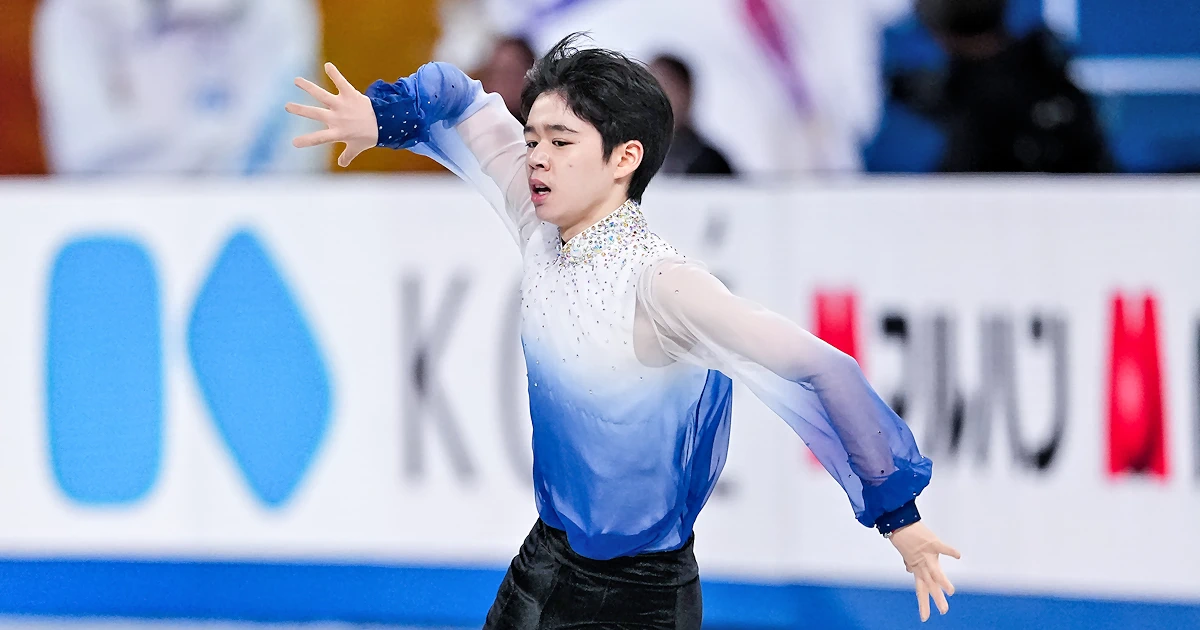
Minkyu Seo competes during the 2025-26 Junior Grand Prix Final. The Korean skater is preparing for his first season of senior competition after winning World Junior gold in 2024 and silver medals in 2025 and 2026.
Minkyu Seo Focused on Growth Ahead of Senior Debut
After winning World Junior gold in 2024 and adding silver medals in 2025 and 2026, Minkyu Seo is setting his sights on the figure skating senior ranks.
Following a season marked by both success and adversity, the Korean skater has decided to leave the junior ranks behind. He plans to compete as a senior both domestically and internationally.
The move will include his senior Grand Prix debut, with assignments to Grand Prix de France in October and Cup of China in November.
“I know there will be many things to learn, but I’m excited because I believe competing against higher-level skaters will help me grow a lot,” said Seo.
The decision was not an easy one. Technically, Seo remains age-eligible for junior competition, but he felt the time was right to push beyond his comfort zone.
“I wanted to challenge myself at the senior level,” he explained. “Competing against stronger and more experienced skaters will help me grow not only as an athlete, but also as a person.”
Learning Through Adversity
Seo’s gold medal at the 2024 World Junior Championships and subsequent silver medals in 2025 and 2026 established him as one of the sport’s brightest young talents.
A serious ankle injury complicated his preparations for the 2026 World Junior Championships, and a difficult domestic competition shortly before Worlds tested his confidence. To protect his ankle, Seo significantly limited his jump training leading into the event.
The injury was not a new one. Seo has been managing it for quite some time. Increased strain in recent months has made rehabilitation a larger part of his training.
“Although my recovery has not progressed as quickly as I had hoped, I am continuing my on-ice training within a manageable range while avoiding excessive strain,” he said. “As I prepare for the upcoming season, I am balancing rehabilitation and training with the goal of returning in the best possible condition.”
Despite mistakes in the free skate, the experience became one of the most meaningful of his season.
“Through that competition, I realized once again how much I truly love skating and how desperately I want to continue improving,” he said. “I learned that enduring difficult situations and not giving up can be just as important as the final result.”
The injury also changed his perspective on training and competition.
“I sometimes took training and skating for granted in the past,” Seo reflected. “Now I appreciate every moment on the ice much more. I realized how meaningful it is just to be healthy enough to stand on the rink and skate.”
Becoming a More Complete Skater
Looking back on the season, Seo believes his greatest improvements came in performance quality and competitive maturity. They were not necessarily technical.
“In the past, if I made a mistake on an early jump, there were times when I couldn’t fully show my skating afterward,” he said. “This season, even when mistakes happened, I tried to stay focused and continue the flow of the entire program until the very end.”
He also feels he has developed a deeper understanding of music and performance.
“I became more aware of how to connect emotionally with the program,” he said. “Overall, I feel like I became a more complete skater this season, not only technically but also artistically.”
Building for the Future
Recovery remains a major focus this offseason. Rather than attending international training camps, Seo plans to remain in Korea. There, he will balance rehabilitation with preparation for the upcoming season.
His coaching team consists of Eun-Ju Kim and HyungKyung Choi, and much of his current training centers around new programs and an ambitious technical goal: landing a quadruple toe loop in competition.
“My ankle condition is still not fully recovered,” Seo said. “But one of my biggest goals for next season is to successfully perform the quadruple toe loop in competition.”
He acknowledges the challenge ahead but remains patient.
“I want to prepare carefully and patiently so that I can perform it more consistently and confidently when the time comes.”
New Programs, New Opportunities
Seo will debut two new programs next season choreographed by Yea-ji Shin. His short program combines “El Toque De Rafa“ by Andrés Cantú with “Canción del Mariachi“ from the Desperado soundtrack. For his free skate, he will perform to selections from The Umbrellas of Cherbourg, including recordings by the Peter Breiner Symphonic Pop Orchestra and “I Will Wait for You” by Mario Pelchat.
“I was drawn to the powerful energy and atmosphere of the music,” he said of the short program. “It had been a piece I wanted to skate to for a long time. That is why I chose it for my short program this season.”
Both programs were selected after discussions with his coaches. While Desperado appealed to him because of its dramatic energy, The Umbrellas of Cherbourg was inspired by the performances of ice dancers Hannah Lim and Ye Quan.
“Through their interpretation, I came to appreciate the beauty and emotion of the music,” Seo explained. “I began to hope that I could skate to it myself someday.”
Rather than portraying a specific character in either program, he plans to focus on expressing the emotions and atmosphere of the music in his own way.
Seo is heavily involved in the creative process. He often works closely with his mother and coaches when selecting music and developing program concepts.
Looking ahead, he hopes to continue expanding his artistic range.
“Until now, I have often skated to programs with strong emotional intensity or lyrical styles,” Seo said. “In the future, I would like to try more modern music and programs with a very clear storyline or character.”
More Than Results
Although Seo’s competitive ambitions remain high, his long-term vision extends beyond medals and placements.
He believes lasting success is built on strong fundamentals, mental resilience, and continuous growth.
“I don’t want to be a skater who performs well for only one season,” he said. “I want to become someone who can consistently show stable and high-quality performances for many years.”
Most importantly, he hopes audiences remember him not simply for difficult jumps, but for the emotions he conveys on the ice.
“If someone watches my skating for the first time, I hope they remember me as a skater who creates a strong sense of immersion and connection with the audience,” Seo said.
Looking two or three years into the future, Seo envisions a version of himself who has grown both technically and emotionally. However, he doesn’t just want to be remembered as a successful competitor.
“I want to become a skater who is remembered for his performances and the emotions he shares through them.”
As Seo prepares for his first full season in the senior ranks, he will take the next step in his career on the Grand Prix circuit armed with the experience gained from three World Junior Championship medals and a renewed appreciation for the sport.
Related Info: