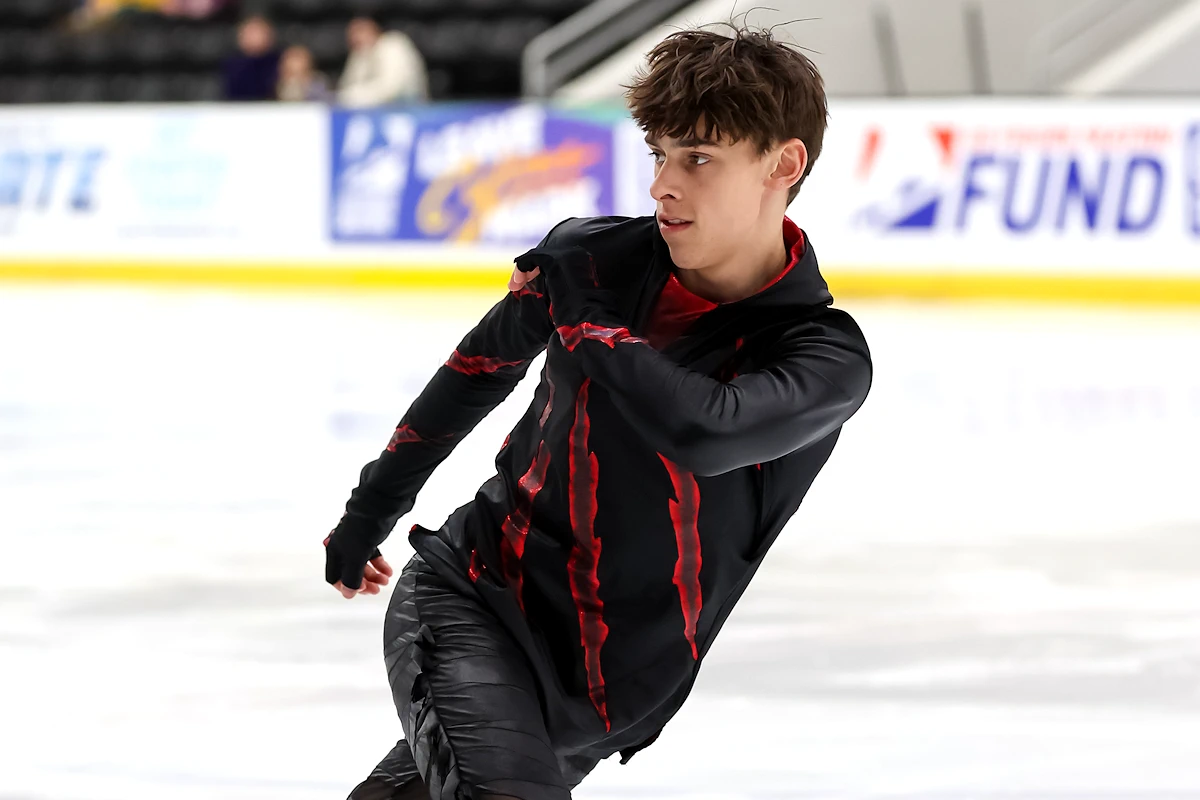
Patrick Blackwell performs his free skate at the 2026 U.S. Figure Skating Championships at the Enterprise Center, Centene Community Ice Center in Saint Louis, MO. Photo © Melanie Heaney | U.S. Figure Skating
Patrick Blackwell Looks Beyond the Jumps
Patrick Blackwell spent much of last season changing the way he thought about figure skating. By the time he captured the junior men’s title at the 2026 U.S. Figure Skating Championships in St. Louis, Mo., he had begun to look beyond the jumps, placing greater emphasis on mindset, skating skills, performance and enjoying the process.
“I would have to say it was mainly a mentality thing,” Blackwell told Golden Skate. “Both competitions were a lot of pressure, but the way I looked at competing and the way I handled myself this year compared to the year before really changed. I looked at the competition as an opportunity to enjoy the process, trust my training and have that time alone on the ice.”
A year earlier, his approach to competition had been very different.
“My mindset was, ‘I’ve done this before—do the jumps,'” Blackwell recalled. “Then, when one element went wrong, it kind of tumbled down. I trace that back to mindset. Once you change your mindset and take it element by element, one mistake doesn’t have to cost you anything.”
Rather than defining his season, the result became a turning point. Blackwell used his third-place finish in the junior men’s event at the 2025 U.S. Figure Skating Championships in Wichita, Kan., as motivation.
“It gave me the drive that I wanted redemption by being able to handle myself and put out a good skate,” he said. “If I looked at my competitions before nationals, they kept getting better and better, taking Bangkok out of the picture. I wanted to stay on that path of progressing upward.”
Between those two championships, Blackwell gained valuable international experience on the ISU Junior Grand Prix (JGP) circuit, earning a silver medal in Bangkok before finishing fourth in Baku.
“I really wanted to make the Junior World team,” he said. “That helped me focus on the things I needed to focus on to succeed at nationals. A lot of things came together this year that I realized after kind of bombing the year before.”
“It was very important for me to have a good skate there and finally show what I’m capable of,” he added. “I was very nervous going back to nationals because of what had happened the year before. But I was able to go in with a fresh mindset and focus on that season, not the previous one. I’m really happy with the way I handled myself and performed.”
His time on the JGP circuit also taught him lessons that extended beyond competition.
“It was mainly how strong your mind is, but also what your body can handle,” Blackwell said. “Your body can only handle so much, but your mind is always stronger.”
Looking back, he believes the quick turnaround between Bangkok and Baku left him physically drained.
“The timing between Bangkok and Baku was really difficult,” Blackwell explained. “I only had about three days in the U.S. Looking back, I definitely would have done some things differently when it came to resting and preparing for Baku.”
“I know I can do the elements,” he added. “But at the time, just hammering quads and doing repetition after repetition didn’t help me.”
Eventually, the physical demands caught up with him.
“My mind really wanted it, and I had the drive,” he said. “But after the traveling and the amount of force I demanded from my body, it really wore me down right before the free skate.”
In the end, Bangkok became one of the most meaningful competitions of his season—not because of the silver medal, but because of what it taught him.
“I had terrible training there—the worst I’ve ever seen for myself,” Blackwell recalled. “I remember thinking, ‘I may as well just go home. There’s nothing I can take out of Bangkok. I’m not going to medal.’ I had so many thoughts like that in my mind.”
Instead of allowing those doubts to define the competition, he delivered one of his strongest performances.
“To be able to deliver what I did meant a lot to me,” he said.
Lessons from Junior Worlds
The lessons Blackwell learned throughout the previous season prepared him for his biggest challenge yet—his first appearance at the 2025 ISU World Junior Figure Skating Championships, where he gained an even broader perspective on what it takes to become an elite skater.
The skater arrived at the 2025 ISU World Junior Figure Skating Championships competing against the world’s best junior men. He viewed the event as a chance to learn rather than a test of where he belonged.
“I had no expectations of placing,” he said. “I had no thoughts of where I might place compared to all the other guys. In reality, it’s Junior Worlds. All of the best junior guys in the world came together to compete, but also to have fun. My mindset was, again, to have fun, take it element by element and enjoy the experience.”
One unexpected conversation the day before the short program shifted that mindset. A conversation with another skater turned to qualifying for the free skate.
“My mind knew it, but it hadn’t processed it,” he said. “I was so immersed in training that I didn’t put two and two together. Then I thought, ‘I need to qualify for the free first. I can’t have a regular competition where I bomb the short and still skate the free. If I bomb the short here, I may be going home.'”
“That wasn’t on my mind until he mentioned it,” Blackwell admitted. “Then it was on my mind. It happened so quickly that it weighed on me a little during the short program, and I made some mistakes.”
Looking back, Blackwell considers the experience an important turning point.
“It taught me how to deal with that because I’d never been in that situation before,” he said. “It also made me realize how much I could enjoy skating the free program once I knew I had qualified.”
Qualifying for the free skate also gave him an opportunity he rarely experiences at competitions.
“I had been in some of the last groups in most of my competitions,” he said. “To be in one of the first groups for the free skate at Junior Worlds was very different because it was one of the first times I was able to finish competing and then watch everyone else.”
Rather than leaving once he had skated, he stayed to observe the rest of the field.
“That meant a lot,” he said. “I learned from watching the others—how they warmed up, how they skated and how every skater managed competition differently.”
When asked what separated many of the top junior men, Blackwell didn’t hesitate: “For sure, skating skills,” he said. “At the time—and even now—I would say a lot of them were better than me in some aspects, mainly skating skills, glide, depth of edge and looking at a program as the complete package.”
Blackwell finished 13th in his Junior Worlds debut, but the experience ultimately proved more valuable than the result itself.
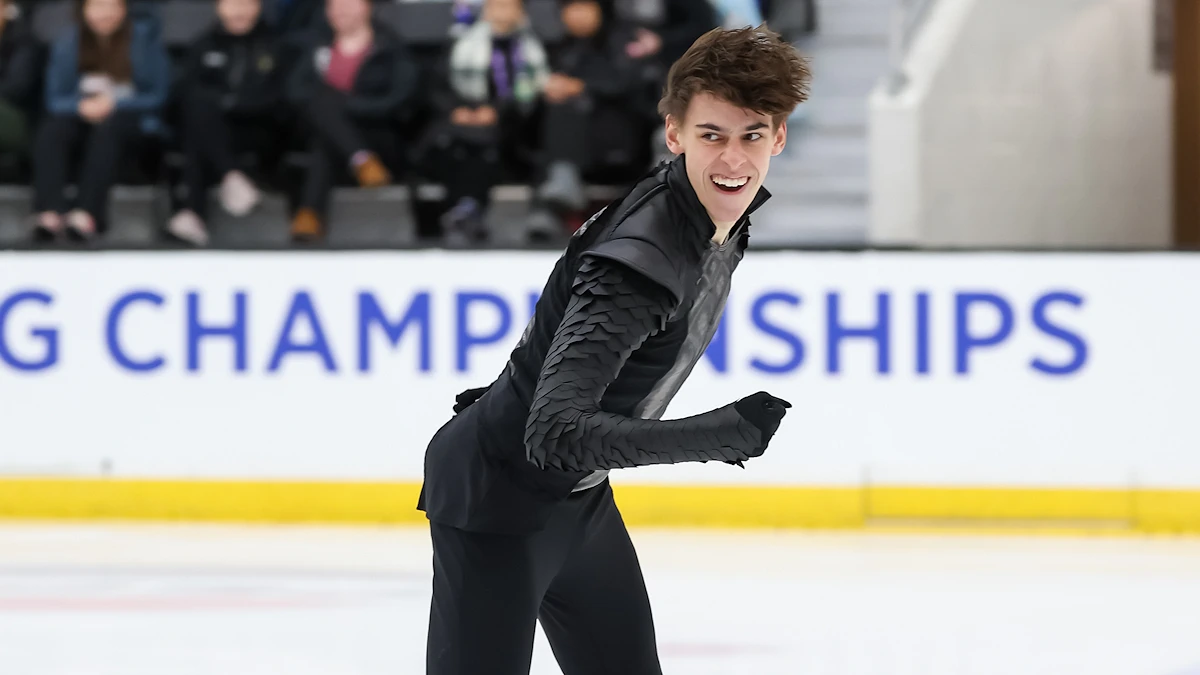
Patrick Blackwell performs his free skate at the 2026 U.S. Figure Skating Championships at the Enterprise Center, Centene Community Ice Center in Saint Louis, MO. Photo © Melanie Heaney | U.S. Figure Skating
Beyond the Jumps
Earlier in his career, Blackwell measured success largely through technical content.
“I think I was looking at jumps a lot and how much they counted,” he reflected. “Of course they count, but if you only look at the jumps, it can bring you down in components and really hurt your total score. You have to look at the program as a whole—the skating skills, the depth of edge, everything together. In my mind, everyone there was looking at everything as a whole rather than just jumping.”
Asked where that perspective comes from, Blackwell credits both his upbringing and the lessons he’s learned through skating.
“I have to bring some of it onto my upbringing with my parents,” he said. “They’ve done a great job raising me, building my confidence and teaching me never to give up. Good things don’t come easy, and as long as you’re able to get through something that’s difficult, there’s usually a positive outcome. Even if you have a bad competition, it doesn’t mean anything because it just sets you up better for the next one.”
That perspective has also changed the way Blackwell approaches his training.
“At the start of the season, I’ve been getting through program run-throughs with just the spins and really focusing on the skating skills and the impression I want to portray,” he said. “I can take what is basically a naked program—with no jumps, just spins and skating skills—and slowly build the jumps back in without losing the image I’m trying to create.”
Preparing for What’s Next
The lessons Blackwell took from Junior Worlds have carried into every aspect of his preparation for the 2026–27 season.
Although Blackwell remains eligible for international junior competition, he will also compete domestically at the senior level this season. Rather than changing his overall philosophy, he sees the transition as another opportunity to develop.
“I’ll have mainly the same mindset going into training,” he said. “The senior program gives me different things that I can work on every day. In the short program, I don’t always have to do the junior jump layout—I can switch to the senior layout, and it’s going to build my stamina the same way, if not better. The free skate is the same way with the extra step sequence and additional time. It’ll be interesting to see how that impacts my training and how I’m able to switch between junior and senior during the season.”
His training has also become more structured. Working with strength and conditioning coach Brandon Siakel, Blackwell has replaced an approach built largely on repetition with one that balances workload and recovery.
“The last couple of years were kind of just, ‘Get through the week—power, power, power,'” he said. “This season, the main change is having more of a set plan for what I’m doing every day. That means a moderate day on Monday, a high day on Tuesday and building a schedule that hopefully preserves my energy over weeks and weeks of training. I think that’s going to help me compete better.”
His technical goals reflect that approach.
“There’s always the hope,” he said. “But especially at the beginning of the season, I just want to make my quad toe and my quad Sal more consistent, as well as my other triples.”
Although he has landed both a quad loop and a quad Lutz in practice, he believes neither jump is ready for competition.
“I have landed quad loop and I have landed quad Lutz, but they’re not quite ready to put into a program. I might land two out of ten, and that’s just not worth the risk compared to the other quads I can do pretty consistently.”
“The quad toe is the most consistent right now,” he added.
He’s also adjusting to this season’s ISU rule changes, particularly the addition of the choreographic spin.
“At first, I wasn’t the biggest fan of it,” he admitted. “But after putting it into the program and practicing it, it’s changed my mind. It gives every skater the opportunity to be unique and find something that fits their program.”
He’s less enthusiastic about reducing the number of jumping passes.
“There is one less jump, which I’m not a fan of,” he said with a laugh. “I like my jumps, and I’d like to keep my jumps. But I completely understand why they changed it. You can really see what the ISU wants out of the program.”
The changes aren’t limited to the way Blackwell trains. They’re also reflected in the programs he’ll bring to the ice this season.
New Programs, Lasting Tribute
Blackwell trains at The Skating Club of Boston under his mother, Annette Blackwell, alongside coaches Olga Ganicheva and Alexei Letov. This season, choreographer Adam Blake created both of his programs after scheduling made it difficult to reunite with Ivan Righini.
“I loved working with Ivan,” Blackwell said. “I really hope we can work together again in the future because I love what he does. But it was much easier to work with Adam this season, and I’m really happy with what we’ve created.”
His new short program explores a different side of his skating.
“I wanted something unique,” he said. “I wanted something different.”
Created with music by two composers, the short program blends Spanish influences with rock. The opening section features music by Émile Dallaire before transitioning into “Puertas de la Libertad“ by Karl Hugo.
“The image I’m trying to portray is strong and powerful,” he said. “It’s more of a flamenco-style character—a different side of me.”
The inspiration came from one of his earliest programs.
“When I was younger, I watched myself skate to more of a flamenco-style program,” he explained. “I thought I portrayed that style pretty well for my age, so I wanted to revisit something similar and see how much I’ve grown.”
One of the most meaningful decisions Blackwell made this season, however, had nothing to do with technical content or choreography.
While his short program is entirely new, Blackwell chose to retain much of his free skate, adding a new opening section while preserving its emotional core as a tribute to his late friend Spencer Lane, who died in the January 2025 plane crash near Washington, D.C.
The program now opens with “The Day We Choose to Die” by Trailer Rebel before transitioning into “Autumn Moon” by Eternal Eclipse and Neal Acree, “Polaris” by Judah Earl & Boda, and “Warriors” by League of Legends Music and Alex da Kid.
“So, technically I’m keeping my free skate,” Blackwell explained. “The ending music is completely the same because I was skating to Spencer Lane’s piece of music. I wanted to keep him in our thoughts for another year. Just because he’s gone doesn’t mean he’s not with us anymore.”
“I wanted a little more of a powerful beginning and something a little more mature,” he said. “Most of the choreography is also new. I wanted the same program, but I wanted a change as well, so I don’t burn out on it.”
Their friendship extended well beyond the rink.
“It was obviously a very tragic moment to find out that one of my friends from the rink had passed,” Blackwell said. “We were always pushing each other. It was amazing to see him not only as a friend, but also to watch how much he progressed.”
Lane’s skating journey began after watching Blackwell perform in an outdoor show in Providence.
“He watched me skate and decided, ‘Hey, I’m going to try skating,'” Blackwell recalled. “That’s how his journey started.”
For Blackwell, continuing to skate to “Autumn Moon” is a way to carry that friendship forward.
“Just because he passed doesn’t mean it has to end,” he said. “That’s why I kept his piece of music. I want to continue his legacy and his skating journey. The slower section also lets me focus on the emotional side of the program.”
Looking Ahead
Away from the rink, Blackwell enjoys mountain biking, surfing and spending time outdoors. Over the past year, he has also developed an interest in hiking, climbing and canyoneering.
“I’ve really gotten into hiking and climbing,” he said. “I went out to Utah and did canyoneering along with a bunch of climbing and other outdoor activities.”
The time away from skating provides more than just a change of scenery.
“They give me a break from skating—not because I get tired of it, but because everyone can get burned out,” he said. “Sometimes the rink can start to feel like a job instead of something I do for fun. Being able to get away and do those other things really helps me reset.”
Blackwell also graduated from high school this year and plans to take a gap year before deciding where to continue his education.
“I definitely plan on taking a gap year to focus on skating and figure out which career path interests me,” he said. “I don’t want to rush into something I might not enjoy later. It’s also important to find a college that’s going to balance well with skating because that won’t be easy.”
For now, though, his focus remains firmly on the season ahead.
“Progress as much as I can and be smart with my decisions,” Blackwell said.
His goals are straightforward: earn two JGP assignments, qualify for nationals at the senior level and return to the World Junior Figure Skating Championships. He has already partially met one of these goals after being assigned to the first JGP event in China which takes place this week.
“I definitely want to make Junior Worlds again,” he said. “I really want to be able to show up there one more time.”
He also has one technical goal in mind.
“By the end of the season, I really want to land three quads in a competition,” he noted.
Looking ahead, Blackwell hopes to establish himself among the world’s top senior men—not simply through results, but by becoming the kind of skater fans make a point to watch.
“I hope to continue to progress and see myself in the conversation as a top-10 senior in the world,” he said. “But more than that, I want to be that skater people want to watch. There are a lot of really good skaters who don’t always get the attention they deserve. I want people to think, ‘He’s competing—I want to watch him.'”