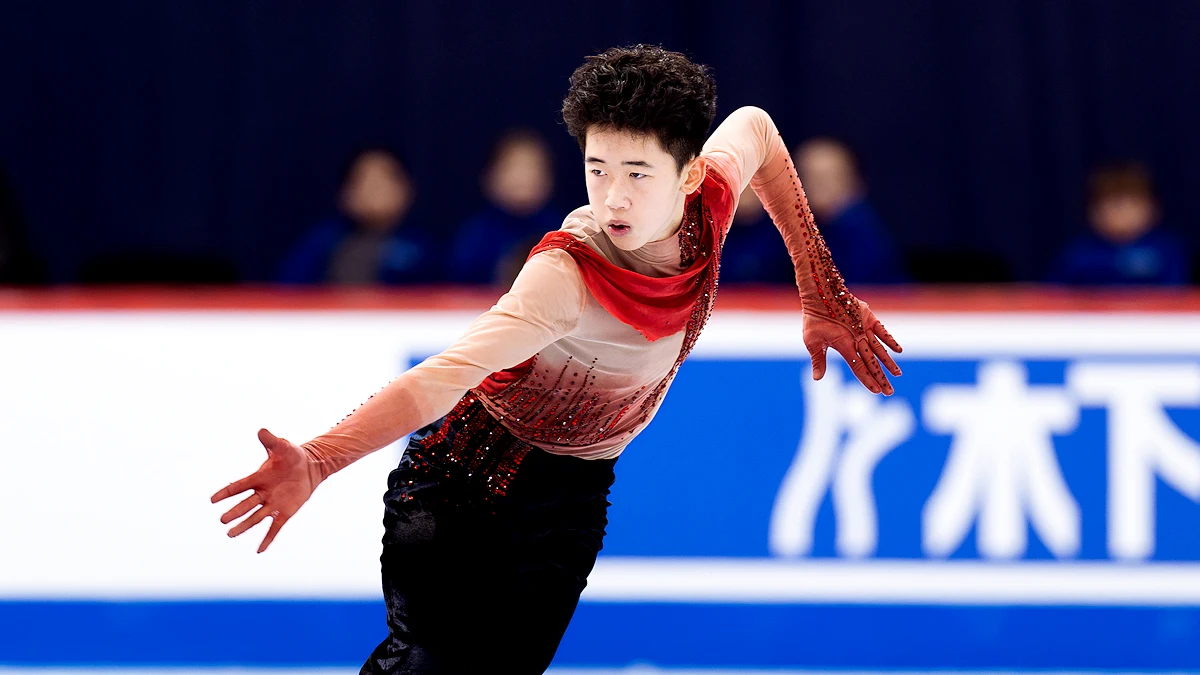
Yanhao Li performs his short program at the 2026 ISU World Junior Figure Skating Championships on March 4, 2026, in Tallinn, Estonia. © Golden Skate / Josephine Feng
Yanhao Li carves path for figure skating in New Zealand
Yanhao Li of New Zealand enters the 2026–27 figure skating season with clear goals on both the junior and senior circuits. His biggest challenge isn’t landing more difficult jumps—it’s developing the confidence to trust himself.
Li has already broken new ground for New Zealand. In 2023–24, he became the country’s first figure skater to qualify for the Winter Youth Olympic Games and won the bronze medal there. The following season, he became the first New Zealander to win an ISU Junior Grand Prix gold medal with his victory in Thailand.
Mental growth takes priority
After reflecting on last season, the New Zealand skater says the mental side of competition has become his primary focus.
“If I’m being honest, I still have a very long way to go. My biggest problem has always been inside my own head. I get stuck on one mistake, fixate on the numbers instead of the feeling, and let doubt creep in even when my body is fully ready. Physically I can do the elements, but mentally, I haven’t always trusted myself enough to deliver them when it counts. That gap between preparation and performance—that’s the wall I’m working hardest to break through.”
Li will compete in both the junior and senior ranks this season. He has Junior Grand Prix assignments in China and Thailand. His goals include winning at least one event and earning medals at the Junior Grand Prix Final and the World Junior Championships. On the senior side, his immediate objective is more measured.
“For seniors, I want to start with a clear and achievable target first: making the free skate at Worlds. I think setting that kind of stepping-stone goal is the right approach as I build my senior experience and a healthier mindset.”
This off-season, Li has focused on making his triple Axel and quad jumps more reliable after periods of inconsistency last year.
“Right now, the goal is to get comfortable with those jumps so they feel ‘easy.’ I want to find that flow state where I’m not constantly fighting with myself.”
He’s also paying closer attention to the quality of every element.
“I want to start holding myself to senior standards, not just technically, but in terms of how I approach every element in practice.”
Li believes one of the biggest adjustments in today’s technical men’s field is managing the mental demands of difficult content.
“As I add more quads, I notice my brain overthinking before jumps. It doesn’t feel ready even when my body might be. So, I’ve been working on learning to switch that off and focus on feel rather than thought.”
Learning through experience
Competing for New Zealand presents challenges beyond technical preparation. Li has far fewer domestic competitions than skaters from countries with larger competitive circuits. That means fewer opportunities to compete before reaching the international stage.
“Some skaters come from countries where they have sectionals, nationals, and a full domestic calendar. That repetition builds a kind of comfort with the competitive environment that’s hard to replicate any other way.”
He hopes more international experience will help close that gap.
Looking back, Li says his approach to competition has evolved. Early in his international career, he simply wanted to skate cleanly because he had little sense of where he ranked internationally. That changed after his first Junior Grand Prix, when competing against skaters from around the world introduced a level of pressure he hadn’t experienced at home. As expectations grew, he found himself paying more attention to results than the performance itself.
“So right now I’m trying to get back to something purer. I used to chase scores. Now I let the scores follow my performance. Jumps are my tools, but my mindset is the hand that holds them. Beating the voice in my head is far harder than beating any rival.”
He continues to work on staying present before competitions.
“I catch myself spiraling into ‘what if I don’t skate well’ or ‘what if something goes wrong.’ The moment I notice that, I try to pull myself back to the present.”
One competition that changed his confidence was the 2023 Junior Grand Prix in Thailand, where he exceeded his own expectations.
“I remember being so shocked when I broke 70 in the short program. It showed me that I really could reach scores I thought were out of reach.”
Returning to unfinished business
That collaboration extends to his music selection. Li prefers to bring ideas himself before working with his coach to refine them.
“I always try to find my own music ideas first. I like having that ownership over it. It’s a bit of a collaborative process from there.”
This season, he’ll keep last season’s short program to Extremely Loud & Incredibly Close. He’ll also revisit his 2024–25 free skate to Weeknd’s “Earned It,” replacing “Funny” by Nadim Naaman with “Blinding Lights.”
Li says adding “Blinding Lights” gives the free skate a different feel and helps him enjoy performing instead of focusing on the technical content.
“It completely changes the experience and turns the whole program into something genuinely fun. I’m bringing back familiar programs not out of comfort zone, but to rewrite their ending. I tweaked “Blinding Lights” not for difficulty, but to bring back the joy that started this all.”
“Even in practice, I still get tired,” he continued. “I still feel nervous about the elements, but there are moments within this program where I just feel completely hyped, and that’s a feeling I haven’t really experienced during run-throughs for a long time. When that happens, the entire atmosphere in the rink changes. The energy becomes different, and it starts to spread to everyone around me.”
Although he’s returning to familiar programs, Li says the unfinished business extends beyond the choreography itself. Looking back, he says nerves kept him from fully expressing either program.
“I know there are mixed feelings about it online, but in a way that’s its own kind of beauty. It’s a program that asks a lot emotionally. I felt like I didn’t fully do it justice last season so it’s unfinished business there.”
The unfinished business, he explains, is trusting himself enough to let his personality come through instead of simply getting through each element.
“I was so focused on the elements themselves that I couldn’t bring out the emotion of either program to my full potential. I was surviving through them rather than performing them. The unfinished business isn’t just about the music or the choreography, it’s about becoming the skater and performer I know I can be, and showing who I truly am rather than worrying about how others might perceive me. This season I really want to change that and let the feeling come through the way it was always meant to: impactful.”
His goals for each program are different. For the short program, he hopes audiences connect with the emotion.
“I hope people feel something real. Not necessarily that they remember every element, but that they remember how it felt to watch it.”
For the free skate, he hopes the excitement he feels while performing will be shared by the audience and judges.
“The last time I remember feeling that kind of excitement and connection was with my ‘Supreme’ short program. This season, I want to take that energy and project it outward. Not just feeling it for myself, but making the audience and judges feel it too. I want them to be pulled into the performance and experience the same excitement that I feel when I skate it.”
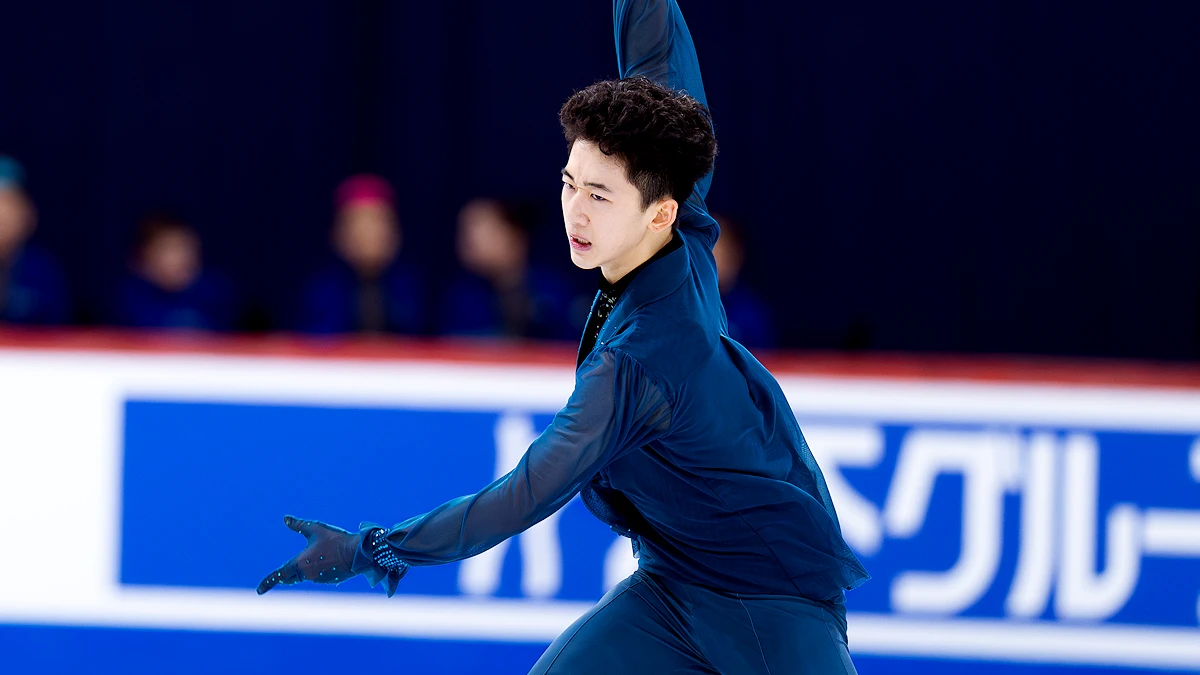
Yanhao Li performs his free skate at the 2026 ISU World Junior Figure Skating Championships on March 6, 2026, in Tallinn, Estonia. © Golden Skate / Josephine Feng
Eyes on 2030
Away from competition, Li’s schedule revolves around training. He is typically up at 5 a.m. for morning practice before heading to school, and often returns to the rink for another session in the afternoon. On weekends, he focuses on strength and conditioning before taking time to recharge.
That routine will change slightly this year after his acceptance into university. The added flexibility should allow him to better balance his studies with training.
Li plans to pursue a bachelor’s degree in Exercise Science. The choice reflects both his longtime interest in the human body and the demands of elite skating.
“Ever since I was little I’ve been interested in the human body. I originally planned to study medicine. But with training and competing and everything that comes with it, I knew I didn’t have the time or energy to commit to that path properly. So I shifted toward something that still connects to that interest, but also ties directly into what I do on the ice. Exercise Science feels like a good compromise. I get to study something I’m curious about, and hopefully it makes me a better athlete at the same time.”
Outside the rink, he enjoys spending time with friends and playing video games. After competitions, he rewards himself with his favorite foods.
“I have a serious sweet tooth. After every big competition I have this little ritual where I treat myself to junk food for the night: chips, ice cream, soda. All of it.”
Competing at the Olympic Winter Games was a childhood dream. Li says it became a realistic goal after he began representing New Zealand internationally.
“I remember telling my parents when I was little that I wanted to go to the Olympics. I don’t think they took it too seriously at the time, and I’m not sure I fully did either. But when I started competing internationally for New Zealand, Bess told me that making the 2026 Olympics was a matter of when, not if. I was skeptical at first like I usually am. But over the past few seasons it started to really sink in that this was actually reachable.”
The increase in the minimum age for Olympic eligibility shifted his focus from 2026 to 2030; something he now sees as a blessing rather than a setback.
“Looking back, I think the age eligibility increase really benefited me because, if I’m honest with myself, I don’t think I was mentally ready to be at the Olympics in 2026. Having one more full cycle to grow and develop a more mature mindset is something I’m really grateful for now.”
His focus is now on 2030.
“Short term, it’s skating two clean programs at an ISU Championships. Long term, the goal is definitely competing at the 2030 Olympics. That’s the thought that drives everything.”
When asked what still needs the most work, his answer comes back to the same theme that has shaped much of his off-season.
“Mental resilience and confidence are without a doubt the biggest gap right now.”
Li says a Junior Grand Prix victory, medals at the Junior Grand Prix Final and World Juniors, and a place in the World Championships free skate would make the season a success.
For now, though, his focus is on something simpler: trusting the work he’s already put in.
“When there’s no one beside you to race against, you learn to be your own toughest judge. I’m not just skating for myself, I’m carving a path for New Zealand figure skating.”
He is currently assigned to the Junior Grand Prix in Xi’an, China, which takes place August 20-22, 2026.