Why does starting order/grouping affect PCS? | Golden Skate

Why does starting order/grouping affect PCS?

yupeima

Spectator
Joined
Jan 21, 2019
This has puzzled me for a while: it is believed that skating earlier would hurt PCS in the competitions, and I always see comments like “XXX did not make the final group, this would put him/her in a disadvantaged position in PCS”. So what is the logic behind this judging bias?

There are two potential reasons that come to my mind: 1) because grouping is based on the reverse order of world standings or SP rankings, judges have this prior that skaters who skate in later groups are more skilled; 2) judges need to leave room for subsequent skaters. I wonder which reasoning makes more sense? Or are there other reasons that contribute to this bias?

Thank you guys!
 
My opinion :
Judges still evaluate by comparing to others instead of having a true sense of what an 8 or a 9 is.

So, indeed, they leave some room in the early stages of the competition and necessarily, PCS will keep growing and growing as the even unfolds. Of course, some late skaters may get some lower PCS scores within their own group... but even the worst skaters in the final flights are less penalized than the first skaters.

It is also true of GOE at times too... Saving the +3+4+5 for top skaters only. It's really unfortunate.
 
I think that both are factors.

In 6.0 times the judges’ job was clear. The person who gave the best performance should be declared the winner. All that mattered were ordinals: this skater is best, that skater is 5th best, the other skater is 29th best. The 5.7s and 5,8s were merely mnemonic signposts. Therefore the judges had to leave room at the top, as well as room between early competitors, so that later skaters could be slotted into their correct placement.

Judges were also probably influenced by the desire to put on an exciting show for the audience. What a great competition! Each performance better than the last! You’re on the edge of your seat until the final footfall!

Even in the IJS era TV commentators (in America, especially Terry Gannon) would sing out: “Only one skater remains. But that skater is __________! (Fill in the blank with Patrick Chan!! Yuzuru Hanyu!!!)
 
This has puzzled me for a while: it is believed that skating earlier would hurt PCS in the competitions, and I always see comments like “XXX did not make the final group, this would put him/her in a disadvantaged position in PCS”. So what is the logic behind this judging bias?

There are two potential reasons that come to my mind: 1) because grouping is based on the reverse order of world standings or SP rankings, judges have this prior that skaters who skate in later groups are more skilled; 2) judges need to leave room for subsequent skaters. I wonder which reasoning makes more sense? Or are there other reasons that contribute to this bias?

Thank you guys!
This only impacts really large end-of-the-season competitions. By then, the skaters already skated at least 5-6 high-profile competitions as compared to others, and the judges know the ranking by the PCSs they would give as skaters don't change dramatically during the season. In the early competitions of the season and in juniors, and the places in groups are purely random, the PCSs will push some of the starting group skaters higher. Watch competitions in JGP or summer-fall competitions and you will see some adjustments.

There is really no agreement which PCS each skater deserves anyway, because as an audience we normally only see skaters that made it into the top group of skaters, so their PCSs already start in the 6s. If you want to see the actual 1-5 in PCSs (not the spittle-spraying and mud-slinging on a champion skater, rage-saying they 'deserve' 1 or 2, lol), you need to start watching from far lower levels of selections, like at a school, city/region level to see skaters who didn't make it to national, let alone international level. There are skaters like that on JGP sometimes from places where skating starts to develop when skaters really barely make it across the rink or can do only simplest strokes etc
 
Last edited:
Let's go back to 2024 Worlds and read the commentary from Mark Hanretty and Tonia Kwiatkowski as they finished watching skater #6 in the the first group of the Men's FS.

Mark: I think I said in the warm-up I wasn't sure if he'd be able to get as big a score because it was so early in the event, but the components are in the 9's. The judges have totally gone with it.

Tonia: Well, they should have because that was a spectacular program and the performance overall deserved those numbers and deserved the marks. So, bravo to Adam.

The total score for the program was 206.90. Not something one will probably ever see again from a guy in group 1.


Here's a case of Tonia thinking like me which is basically, judge in the moment as the performance is meant to be judged and follow the established criteria. Do not compare to another skater and do not allow the time, or group, that a skater appears on the ice to influence the PCS.

Clearly, the judges went with Tonia's approach as they should have. But Mark has revealed his concern with what can still go on today but shouldn't be. Fortunately for Adam the judges did their job accurately, without regard to comparative factors.
 
The running order is not the cause of problem. The cause is that, after all these years of IJS, PCS is still not tied to any objective criteria at all.

This is a kind of a paradox: program components are absolutely material, physical factors that can be easily spotted by an eye and are easily compatible. Is a skate gliding smooth or is a skate scratching? This skater is faster than that skater. The edge here is deeper than the edge there. One skater is in sync with music during the whole program, another skater is only in sync during the step sequence. In this body position, it's harder to keep balance, etc. However, at the same time, there is no anchor that could serve as an objective reference point. We have neither the data, i.e., the skater needs to reach X speed during Y section to be 9+; nor we have i.e. an AI generated graphic skating routine that would show how much a skater needs do to be 9+ and to which all skaters could then be compared regardless of when they skate.
So, the judges still re-establish their nines every time comparing the skaters they see on the competition day. No wonder that these nines tend to find a place in the last free skate warm-up group. Although there are also "reputational PCS" (it's another discussion if the reputation is well-deserved or not in case of each individual skater) that skaters would receive regardless of when they skate.

In theory, it is of course possible to set objective, materially-tied references for PCS. In practice however, it would take lots of research, lots of discussion, and overall an enormous amount of incredibly complex work to get such complicated data gathered and sorted. Figure skating is complicated. Is the speed simple? Normally, it is; but the skaters have different speed during different sections of their programs. What should matter then, the medium overall speed or the speed during the fastest section of the program? Edges? Same. And how to measure them, with what technical means? This is before I even mention the interpretation of music. There is a wide variety of music that requires different interpretation. How could this be made compatible? Should it? I can imagine that it may cause more desire to give up the PCS altogether than to develop objective criteria.
In fact, the current development could be heading to PCS being abolished or replaced with updated GOE since the programs have a tendency to become more athletic and simpler. But it's just my impression. I may be mistaking.

 
Last edited:
The running order is not the cause of problem. The cause is that, after all these years of IJS, PCS is still not tied to any objective criteria at all.

This is a kind of a paradox: program components are absolutely material, physical factors that can be easily spotted by an eye and are easily compatible. Is a skate gliding smooth or is a skate scratching? This skater is faster than that skater. The edge here is deeper than the edge there. One skater is in sync with music during the whole program, another skater is only in sync during the step sequence. In this body position, it's harder to keep balance, etc. However, at the same time, there is no anchor that could serve as an objective reference point. We have neither the data, i.e., the skater needs to reach X speed during Y section to be 9+; nor we have i.e. an AI generated graphic skating routine that would show how much a skater needs do to be 9+ and to which all skaters could then be compared regardless of when they skate.
So, the judges still re-establish their nines every time comparing the skaters they see on the competition day. No wonder that these nines tend to find a place in the last free skate warm-up group. Although there are also "reputational PCS" (it's another discussion if the reputation is well-deserved or not in case of each individual skater) that skaters would receive regardless of when they skate.

In theory, it is of course possible to set objective, materially-tied references for PCS. In practice however, it would take lots of research, lots of discussion, and overall an enormous amount of incredibly complex work to get such complicated data gathered and sorted. Figure skating is complicated. Is the speed simple? Normally, it is; but the skaters have different speed during different sections of their programs. What should matter then, the medium overall speed or the speed during the fastest section of the program? Edges? Same. And how to measure them, with what technical means? This is before I even mention the interpretation of music. How could this be made compatible? Should it? I can imagine that it may cause more desire to give up the PCS altogether than to develop objective criteria for that.
In fact, the current development could be heading to PCS being abolished or replaced with updated GOE since the programs have a tendency to become more athletic and simpler. But it's just my impression. I may be mistaking.
Just to give an example of your speed question about overall vs sectional: I have often seen at Japanese Nationals in the past when they put up their speed and coverage map that it appears that Sakamoto has the most overall constant speed, but Higuchi would have the highest achieved speed. I think some of Kaori's constant speed comes from her jump trajectory being more flat do to emphasis on length, which doesn't kill momentum nearly as much as Wakaba's more vertical jump trajectory. How a judge is supposed to score such things is very subjective I suppose.
 
How could this be made compatible? Should it?
I for one do not see any problem with the judges comparing one skater to another. This is the essense of sport. Usain Bolt won 45 races in a row because he fcrossed the finish linei ahead of the other guys. His actual times are of interest mainly to sports statisticians.
 
I for one do not see any problem with the judges comparing one skater to another. This is the essense of sport. Usain Bolt won 45 races in a row because he fcrossed the finish linei ahead of the other guys. His actual times are of interest mainly to sports statisticians.
Yes, the scores in skating are not even that valuable to statisticians since they can vary so wildly depending on strictness of tech panels and judges. And the the rules and standards change virtually every year, so comparing competition scores in different years is meaningless.
 
I actually think that the scoring/judging system in figure skating is working out fairly well. The thing about this sport is that quality is more important than quantity. The IJS aspires to quantify those aspects of skating that are quantifiable, while providing guidelines as to how the difficult-to-quantify aspects of a performance should be judged.

Judging and measuring are two different things.
 
I for one do not see any problem with the judges comparing one skater to another. This is the essense of sport. Usain Bolt won 45 races in a row because he fcrossed the finish linei ahead of the other guys. His actual times are of interest mainly to sports statisticians.
I think it sort of depends. Usain Bolt crossed the finish line ahead of everyone else but he was also faster than everyone else. Believe it or not, the two are not mutually exclusive.

For example, I follow speed climbing. The route is standardized all over the world and the goal is to get to the top as fast as possible. Now in competitions, the first round is a seeding round where you race solely against the clock. Everyone gets two attempts and each person’s fastest time is ranked, which seeds a bracket.

For the bracket round, time doesn’t matter. The only thing that does matter is being faster than your opponent. Theoretically, it could take you 10 minutes to get to the top but you’d still win if your opponent didn’t get up the wall in that time.

It’s a single elimination bracket until you get to the semi-finals, which is where it gets interesting. You have two races. The winners of those races will race head to head in the Final (or big final) for gold and silver. The losers will race each other for bronze/4th.

However, time doesn’t matter, what can happen is the times of the big finalists are 6 seconds and 7 seconds, and they get gold and silver respectively. BUT, let’s say that the bronze medalist wins their race in 5 seconds. They still get bronze, even though their time was still faster than the person who won gold.

But it’s still interesting to think about, especially since you have the objectivity of the clock, and yet it’s still not perfect.

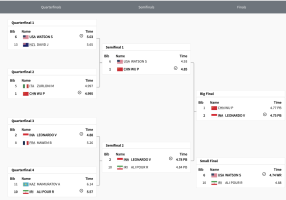
For example, here's the men's results from this year's Olympics.

Screenshot 2024-12-29 at 7.32.28 PM.png
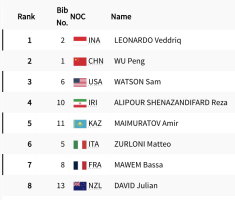
And here's the ranking for reference
.Screenshot 2024-12-29 at 7.32.37 PM.png
 
Plus, if you measure something which is measurable, judging it might not be necessary any more (unlike judging qualities which are not measurable), :)
For figure skating, there are a few things which are easily measurable, others that are theoretically measurable but too complicated to do accurately and cost effectively with current technology, and the majority is qualitative and therefore not really measurable.
 
For figure skating, there are a few things which are easily measurable, others that are theoretically measurable but too complicated to do accurately and cost effectively with current technology, and the majority is qualitative and therefore not really measurable.
But the problem is that even those which are perfectly measurable are not being properly measured but judged by the judge's eye instead... I second the opinion that confronting these "judged" measurements with any actual measurements could lead to very interesting conclusions...
 
Basically figure skating the way the rules are written is about as measurable as a beauty contest where the judges are related to the contestants. The rules and criteria are littered with words like creative, difficult, fast, high, long, good, original, etc. Completely subjective and arbitrarily decided by each judge. Its basically the 6.0 system camouflaged under a deluge of contrived numbers and run by the same corrupt people.
 
I honestly don't see it being a big issue at all, at least under the current system. We tend to believe this because in LP the better skaters usually go last so we naturally correlate to going last with having higher scores or higher PCS. If a top skater did not do well in SP and skates early in the LP i don't see the judges hold them back ..
 
The rules and criteria are littered with words like creative, difficult, fast, high, long, good, original, etc. Completely subjective.
An interesting list. I would say that of these,"creative" and perhaps "original" are difficult to measure. but"fast, high and long" are, at least in principle, fairly objective and straight-forward . "Difficult" and even "good" can be approached by lists of positive and negative features that are separately fairly precise.and not just up to judges' whimsy. A quad filp is more difficult than a double Salchow. A level 4 step sequence filled with intricate steps and turns is more difficult than a laid-back and boring one.

As for improving the objectivity of judging by relying more heavily on stop-watches and yardsticks, I am far from convinced. Post #8 is salient. Who is "faster," Sakamoto (with her long jumps or Higuchi with her vertical jumps? What about the skater who excels not so much in velocity but in acceleration, generating instant power by efficient stroking (Irina Slutskaya, for instance)?.
 
Back
Top