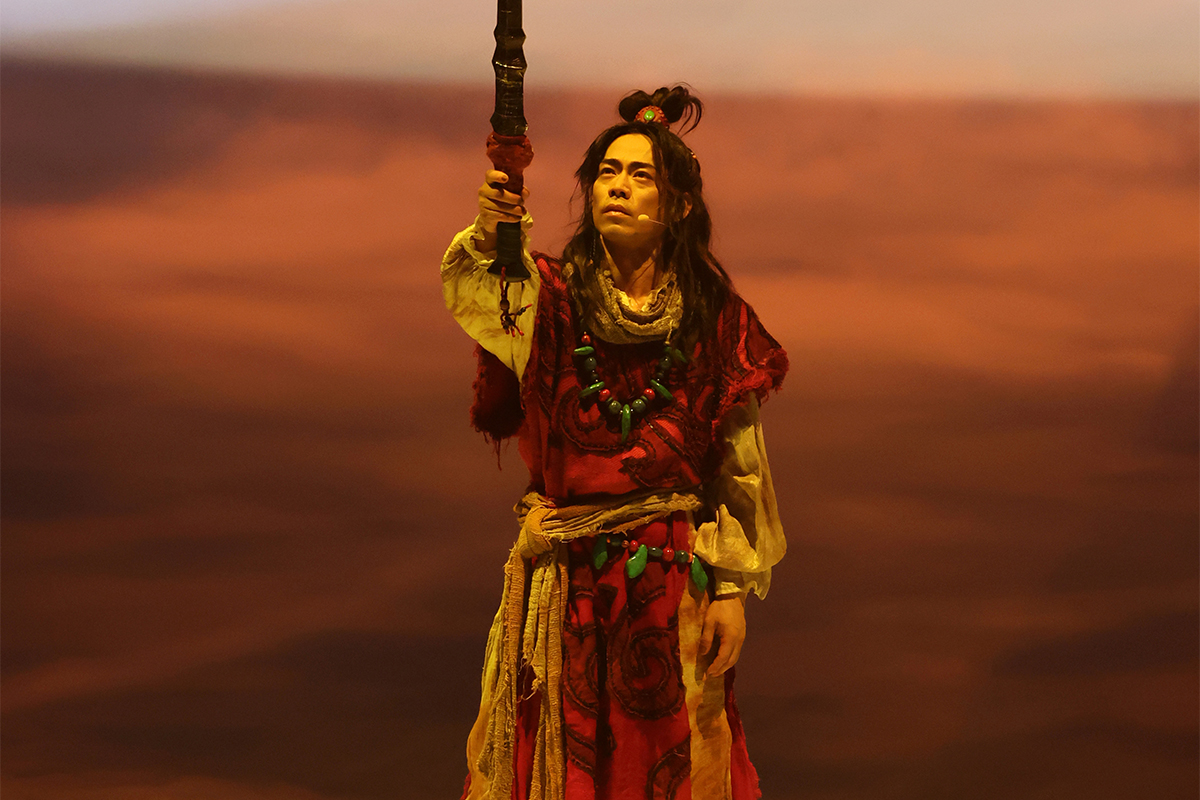
Gendai media published an in-depth two-part Hyoen report (caution: contains major spoilers as the entire play is retold):
Part 1:
https://gendai.media/articles/-/155209
Machine translation:
24 July 2025
Daisuke Takahashi and Takahisa Masuda: Athletes and idols take on a ‘high hurdle’ in ‘Hyoen’
'Hyoen 2025 - Mirror-Patterned Demon' Report 1
Akiko Tanaka
From 5th to 7th July, “Hyoen 2025 - Mirror-Patterned Demon" was held at the Yokohama Arena. Hyoen is an ice-based entertainment show that blends figure skating with Japanese culture, featuring performers from various fields. This time, it was directed by Yukihiko Tsutsumi, with Daisuke Takahashi and Takahisa Masuda as co-stars.
Additionally, SUGIZO was in charge of the music and also appeared as a special guest artist, among other star-studded cast members. The theme was the ‘Ura Legend,’ which inspired the Momotaro legend from Okayama, weaving together ancient Japanese tales.
Akiko Tanaka, a writer who has been following Hyoen since its fusion with Kabuki in “Hyoen 2017 - Basara -”, reports on the event.
This is the first time I've seen Hyoen delve so deeply into the roles. Even two weeks after the performance ended, I still haven't recovered from Hyoen withdrawal.
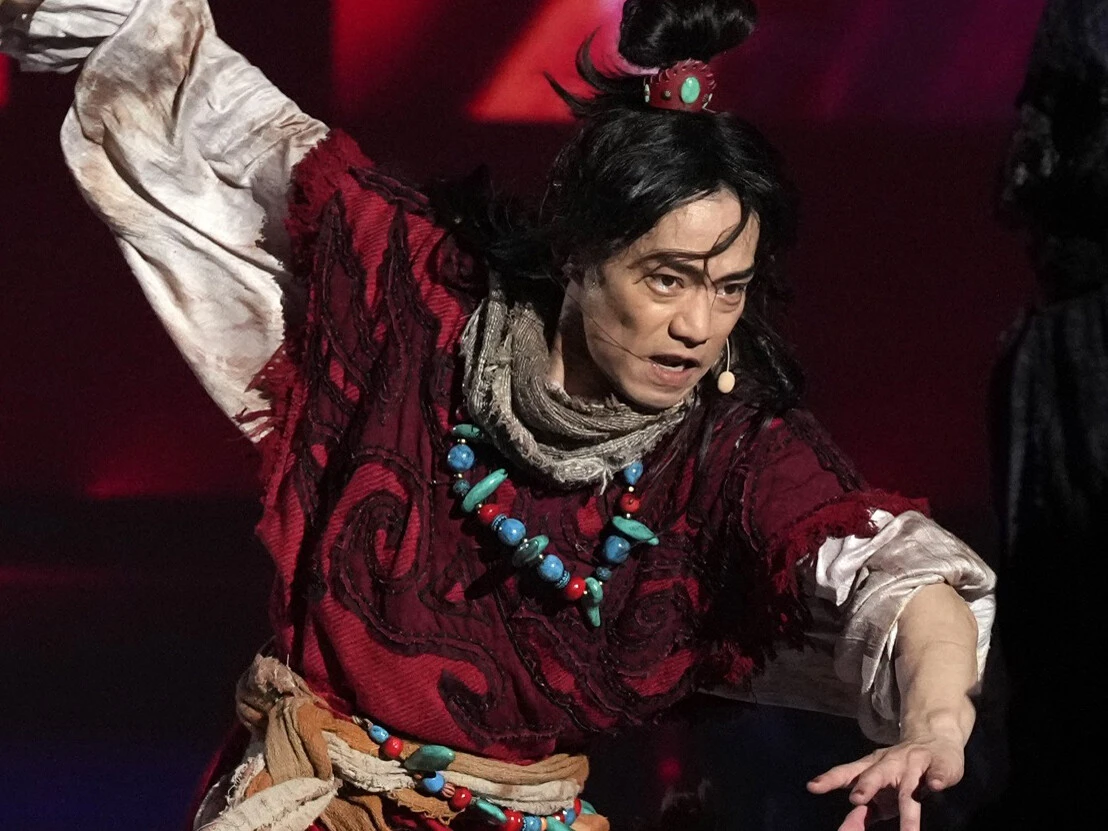
This time's "Hyoen 2025 - Mirror-Patterned Demon -" features a particularly strong theatrical element, where Daisuke Takahashi, alongside co-star Takahisa Masuda, vividly embodies the hero of an ancient Japanese story as depicted by Yukihiko Tsutsumi on the ice. His performance has surpassed the stage of a skater attempting acting; a fierce flame of intensity and energy has ignited, paving the way for him as an expressive artist.
‘This is the first time I've approached Hyoen with such depth in my role.’
Even before rehearsals for Hyoen began, Takahashi Daisuke spoke these words. In the previous Hyoen series, dialogue and songs were introduced, but until now, he had been acting passionately while being instructed by the director rather than creating his own character. "During that time, I had the opportunity to collaborate with many actors, and during the filming of the upcoming movie "The Tales of Kurashiki", I observed the character preparation of many actors. Some were so meticulous in their preparation, that I wondered “Do they really need to go this far?” After those experiences, this time I wanted to delve deeper into the role and my own inner self in my own way."
This production, "Hyoen 2025 - Mirror-Patterned Demon -" is based on the “Ura Legend,” which served as the foundation for the “Momotaro Legend” in Takahashi's home prefecture of Okayama. The script was written by Takuma Suehara, based on the legend of Ura, the king of Kibi, who was later portrayed as a demon, and whose legend still persists today. When stylish Momotaro commercials were being aired, Takahashi suggested to the production team that it would be cool to create a Momotaro world in ‘Hyoen.’ That idea has now come to fruition in this production.
In comments released after the performance, he said, "I feel both the joy and responsibility of being able to express myself while connecting with my roots." He is also a huge fan of director Yukihiko Tsutsumi, who directed this production. Furthermore, Takahisa Masuda of the top idol group NEWS was brought in as co-star, and the two played contrasting characters with fated destinies. This is not something that can be taken lightly! With such high expectations, during the rehearsals for ‘Hyoen’ broadcast on a TV program before the performance, Takahashi, who was reading the script with Masuda, already seemed to have the spirit of “Ura” within him. During 'Hyoen 2019 - Like Moonlight -', Takahashi-san was reading lines from a love scene during a television rehearsal for the first time in his life, blushing and embarrassed in front of everyone. That innocent figure is no longer anywhere to be found. Even at that time [of "Like the moonlight], his performance had transformed into a confident act during the actual show, so I wondered how it would turn out this time.
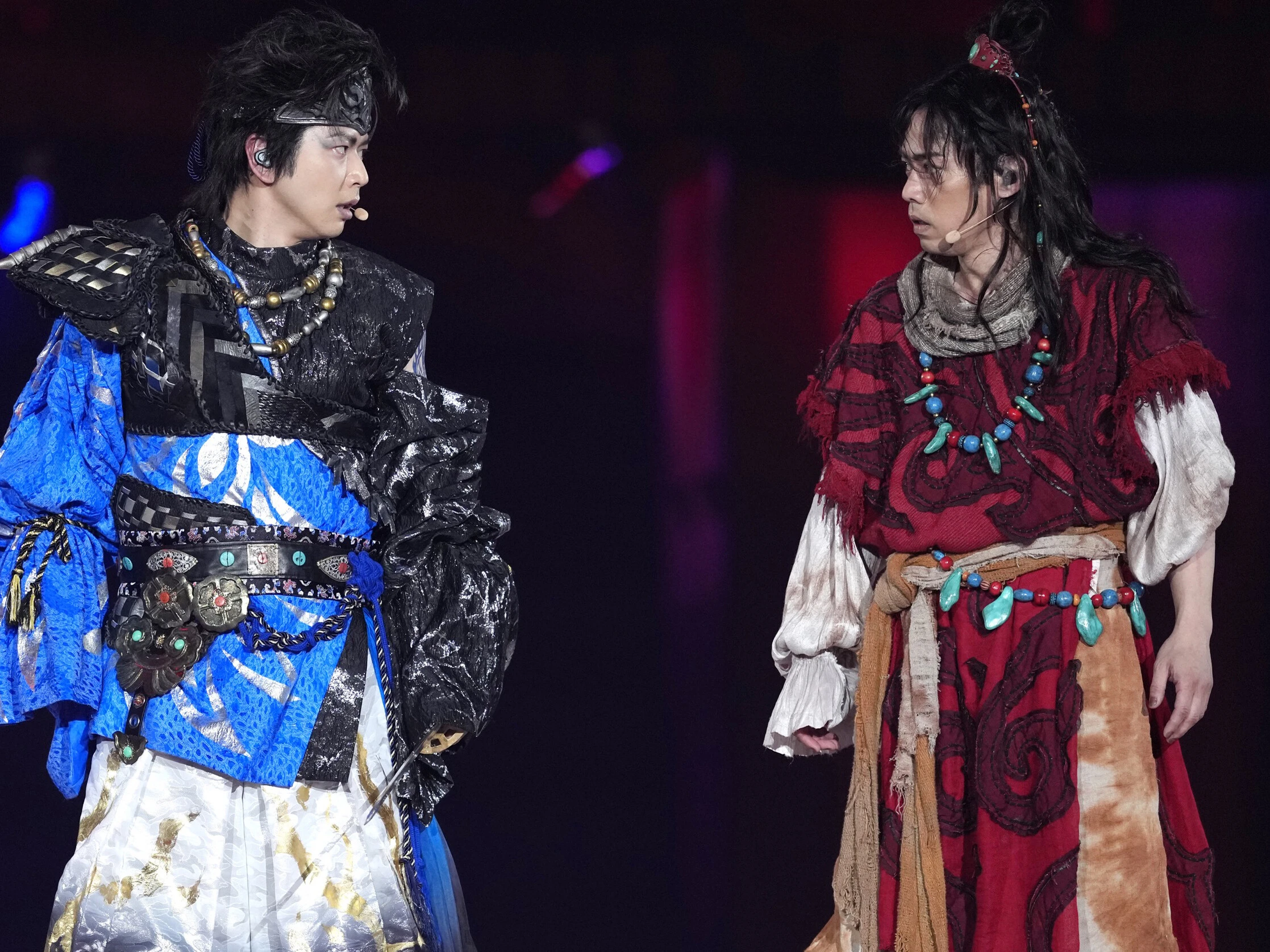
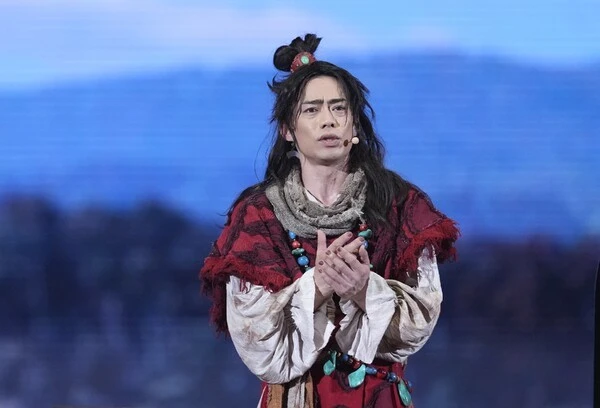
Let me briefly introduce the plot. In ancient Japan, in the village of Kibi, the villagers and the Shirakiri tribe, who lived in the highlands and possessed special iron-smelting techniques, had joined hands to live in prosperity. Ura (Daisuke Takahashi), a member of the Shirakiri tribe who would later be regarded as a demon, was a kind king beloved by all. However, one day, the Yamato Court invaded in pursuit of their iron-smelting technology. The Yamato Court raised Kibitsuhiko (Takahisa Masuda) as a weapon of mass destruction, who would later be known as ‘Momotaro.’ At first, Ura did not want to fight, but he fought to protect his country, lost his loved ones, and transformed into a demon warrior. On the other hand, Kibitsuhiko, through his encounter with Ura, awakened to his humanity and began to question the meaning of battle. The story follows the contrasting destinies of these two characters as they are tossed about by fate.
SUGIZO's guitar kicks off the rock opera
Now, the main event. The blue, icy world surrounded by three sides of the arena, filled with the heat of the packed audience, was suddenly sliced open by red beams of light and the sound of guitars. SUGIZO descended onto the stage set up at the back. His dramatic, urgent guitar riffs exploded from the start, marking the opening of the rock opera.
Guitar and the chaos of ancient Japan shown on the screen, along with the speed of the ensemble skaters, carried the consciousness beyond time and space. From the darkness, Eisaku Yoshida, playing the Shadow Emperor of the Yamato Court, made a flying entrance, which was surprising. I never thought Yoshida, with his fresh image, would suit such a dignified, dark role. Here, the Shadow Emperor speaks of his ambitions for the land of Kibi, which possesses iron-smelting technology. He then orders that the child, who has been raised in a warehouse without seeing anyone since being abducted, be imbued with the power of the dark god ‘Yami-nomi-kami’ and raised as a weapon of mass destruction. This child is Kibitsuhiko, portrayed by Masuda. All of this unfolds swiftly alongside the performance. SUGIZO seems like a wandering poet at the boundary of time and space, or the creator of the world depicted by his music.
Takahashi's Charming King
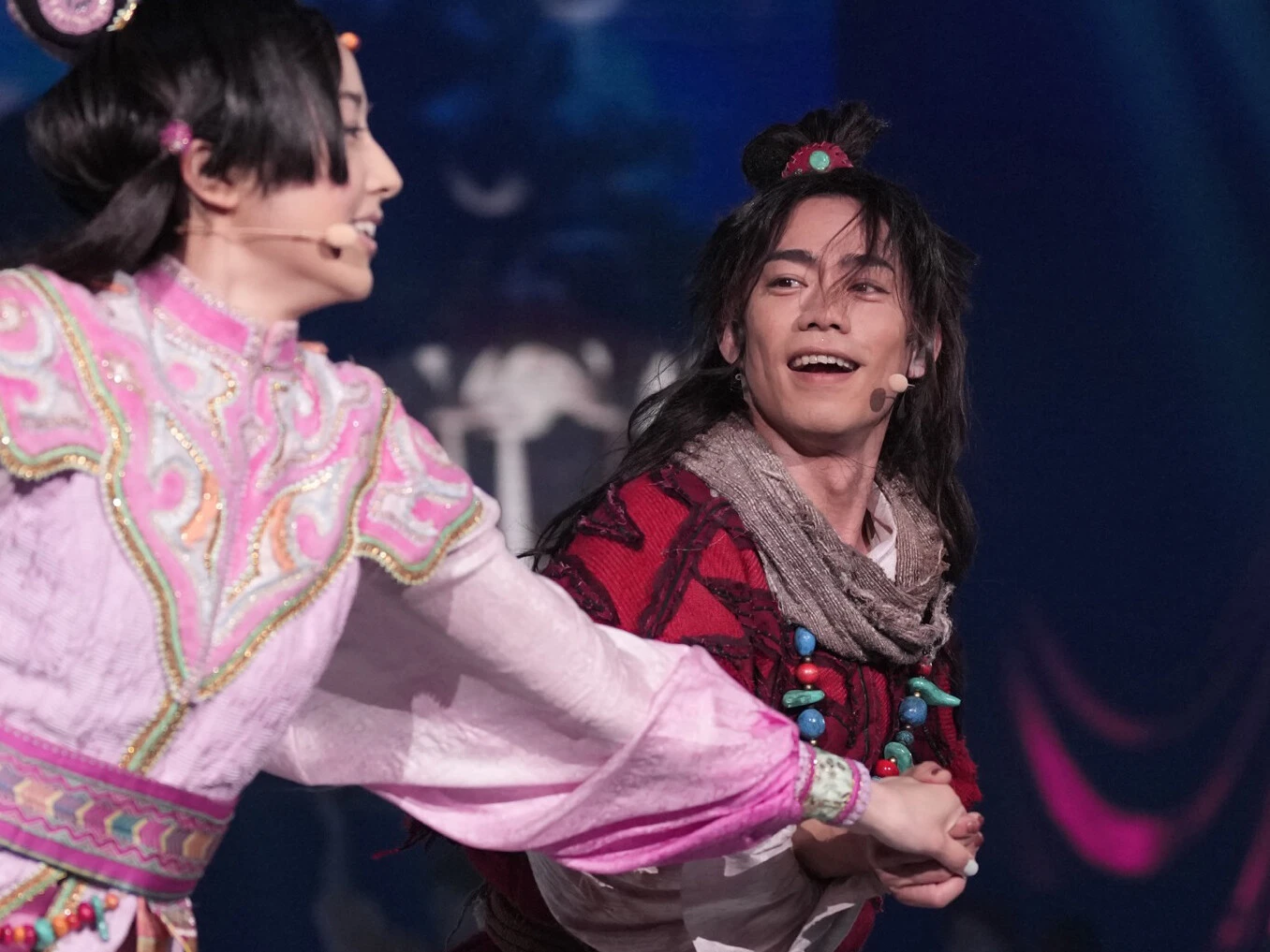
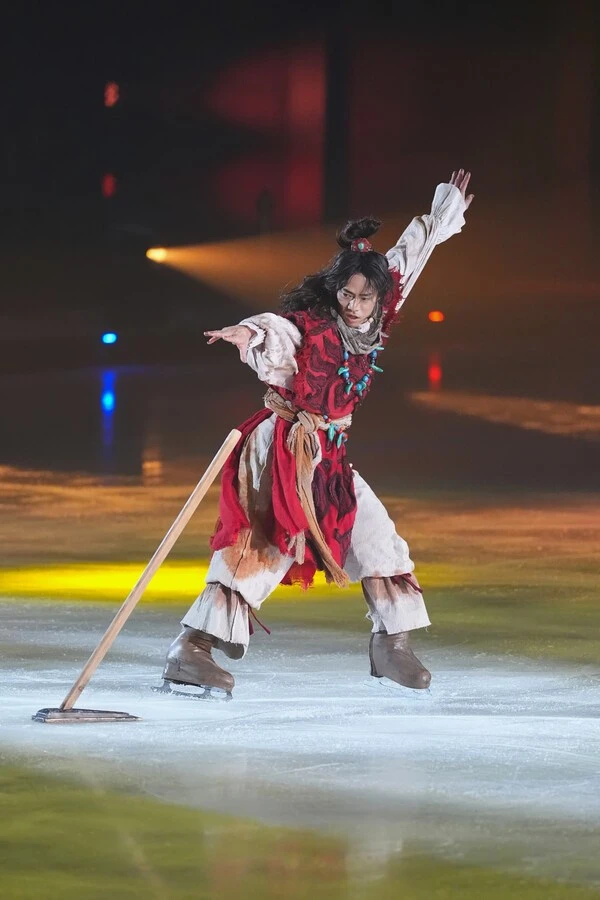
Thirteen years later, the scene shifts. Takahashi Daisuke, playing the role of Ura, appears and dances charmingly on skates using a hoe [no, this is not a translation error

]. The king holding a hoe symbolises a peaceful country that does not make weapons. Takahashi's expression at this moment is wonderful. He is calm, gentle, and radiates the aura of a healthy king. The crowd's dance also expresses the country's abundance. Inspired by the existing Kinojo Castle in Okayama, a platform resembling a moving tower appears, where Ura, alongside Fukushi Seiji, who portrays the elder ‘Yakumo’ of Kibi no Sato, addresses the people. Although Takahashi-san himself has a calm and gentle aura, the person here is undoubtedly someone entirely different.
Last year, when Takahashi, Director Tsutsumi, and screenwriter Suehara went on a location scouting trip to places associated with Ura, they also visited Kinojo Castle. Takahashi said, "It was very helpful to be able to imagine how the people lived and looked up at the castle from the sea." Watching Ura address the people and later give a speech, it seems that this experience has come to life.
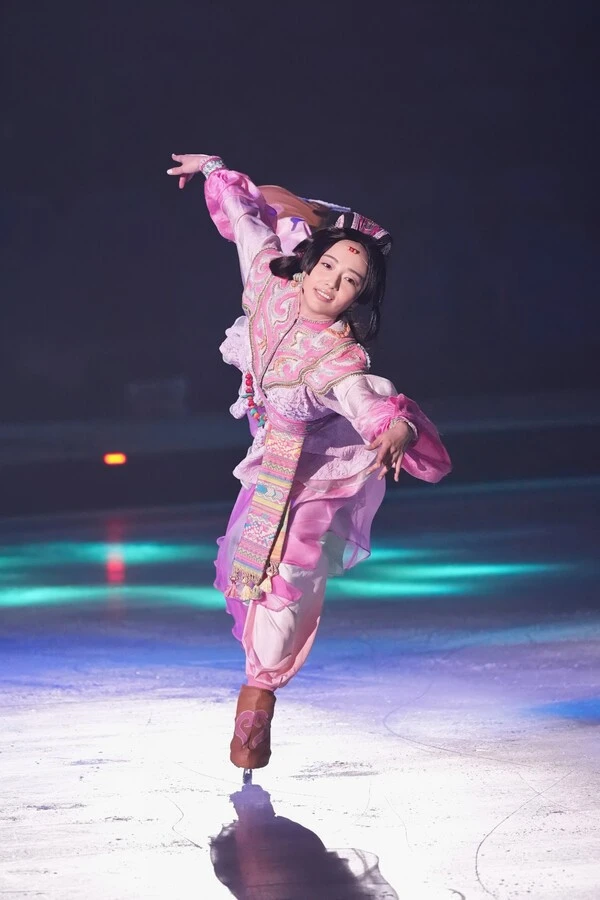
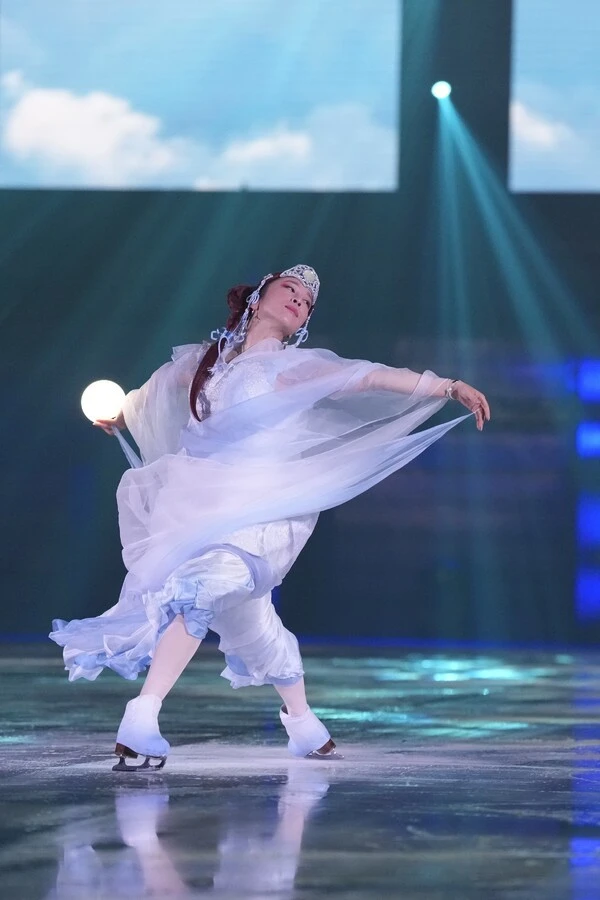
Soon, the engagement between Ura and Azohime, the younger sister of Yakumo, is announced. Azohime is portrayed by Morita Misato, who played Hanae in ‘Tiger with Wings.’ In addition to her emotionally rich acting skills, she seriously pursued figure skating as a child. Her spirals were beautiful, and her duet with Takahashi was refreshing. ‘We're getting married,’ Ura shyly announces to the people. At the peak of happiness for both the individuals and the nation, invaders from the Yamato Court arrive.
"Excuse us!" The three who arrived were Inu (Inukai Takeru), Sasa (Sasa Morihiko), and Tome (Tome Tamaomi). They demanded, "Hand over Ura, the rebel, rumoured to be planning a rebellion." Though these three are villains, there were many comedic scenes. The leader, Tome, is portrayed by actor Zaiki Takuma. Although it was his first time skating, he is skilled in sword fighting and must have practised extensively. As the leader, he moves gracefully on the ice, accompanied by Tanaka Keiji as the monkey and Shimada Koshiro as the dog, both of whom are skaters. Tanaka and Shimada are agile, wielding long spears and fyling across the ice, while Ura and Azohime mingle with the fleeing crowd, causing chaos. Then, Masuda Takahisa, playing Kibitsuhiko, makes his appearance.
Masuda's stability on the ice and Takahashi's expressive acting
Masuda was almost a beginner at skating. As a member of the top idol group ‘NEWS,’ he has been active for many years, so his core strength, honed through dance, is likely strong. He also showed rapid improvement in pre-performance practice videos, but given his extremely busy schedule, skating practice must have been quite challenging. Moreover, the ice stage was completely unfamiliar territory, and since Kibitsuhiko was initially portrayed as emotionless, it was a challenging role.
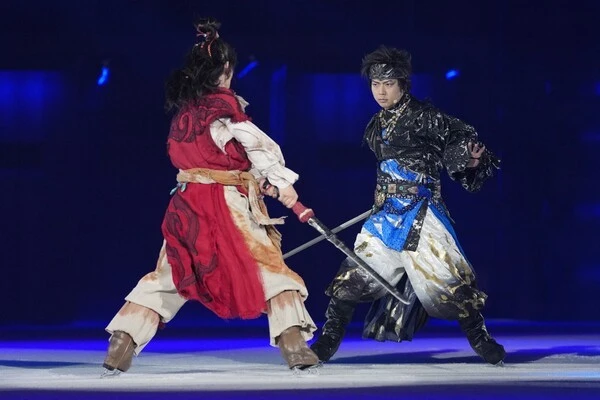
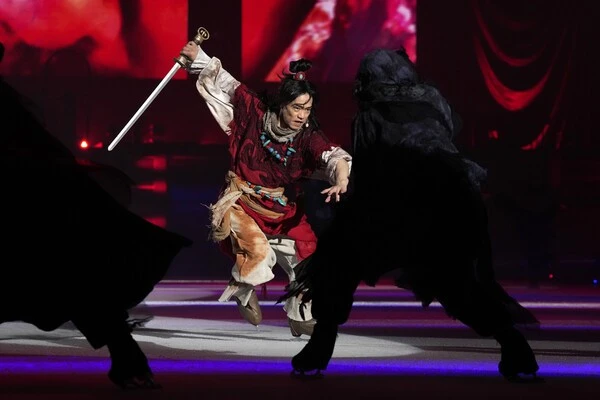
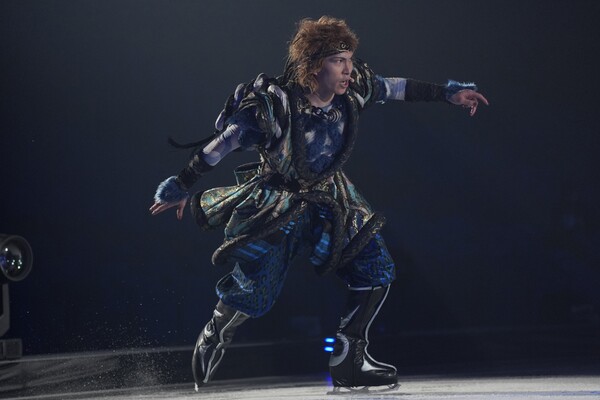
He is truly remarkable. But as expected, there he was, the cool and cruel Kibitsuhiko, who didn’t show even a hint of struggle, gliding smoothly with the edge tilted diagonally. His turn was natural, and as he coldly slaughtered the fleeing villagers, Ura, played by Takahashi, couldn't hold back any longer and rushed out, marking the beginning of their first battle. However, at first, Ura, who didn't even have a sword, was no match for him. But in the midst of the battle, he was given an ancestral sword and received a revelation from the Iron Goddess to ‘fight.’ Despite the chaos, Ura swung the sword and asked Kibitsuhiko, ‘Why are you fighting?’ Startled by the question, Kibitsuhiko was severely wounded, though Ura also sustained injuries.
Kibitsuhiko and his men retreat, but Ura is overwhelmed by confusion and fear at having wounded a person for the first time, and stares at the sword. Takahashi's performance eloquently conveyed Ura's various emotions from the attack to that point. The confusion, fear, anger, and anxiety when the Imperial Court arrived, the change from his hesitant stance in his first sword fight, and his regret over his actions. His expressions changed rapidly, and his lines, breathing, and unique timing conveyed his emotions very well.
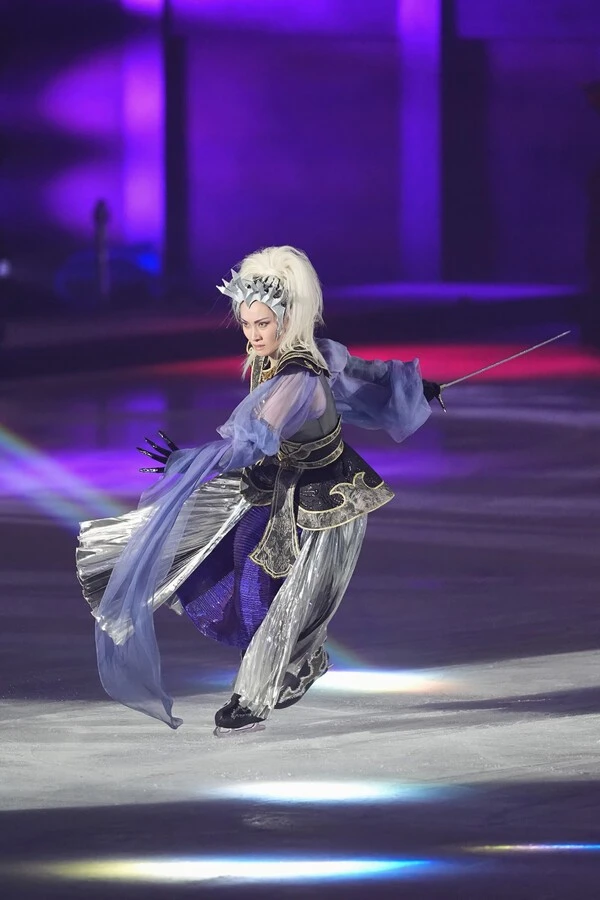
It is Arakawa Shizuka, playing the Iron Goddess, who tells Ura about the history of the ethnic war and declares, ‘You are the chosen vessel.’ This time, Toda Keiko provides a special voice performance, and her otherworldly lines are powerful. In ‘Hyoen,’ Arakawa always shone as a villain. This time, she plays a goddess who is the guardian of the village, neither evil nor righteous. However, Arakawa's presence in portraying such an otherworldly being is truly remarkable. When the goddess departs, a certain emblem is burned into Ura's arm.
Masuda's Kibitsuhiko gradually gains ‘emotions’...
Meanwhile, Kibitsuhiko and the trio who fled back are severely reprimanded by the Shadow Emperor. Kibitsuhiko is consumed by the question thrown at him by Ura: ‘Why do you fight?’ The ripples from the stone thrown at his innocent heart, which had lived as a killing machine without thought, spread widely. As Kibitsuhiko goes out into the town and watches parents and children, his human emotions continue to grow, and it feels as though this is melting out of Masuda's posture and expression.
Where Kibitsuhiko is, there are the dog, pheasant, and monkey, but what surprised me was the performance of Tanaka Keiji, who plays the monkey. Although it was his first time acting with lines, he was incredibly skilled. He was also wonderful in the ‘Narcissus’ number of the “Hyoen” spin-off ‘LUXE,’ where he portrayed the reflection of Narcissus, played by Takahashi Daisuke, on the water's surface. This time, he opened up a new side of himself. Shimada Koshiro, who is switching to ice dancing this season, appeared in ‘Hyoen’ for the second time. He played the role of a dog with cute twin tails with ease.
Takahashi's Ura, on the other hand, awakens to ‘battle’...
As Kibitsuhiko awakens to human emotions, Ura cannot escape change either. Still reeling from the shock of having wounded a person, Ura is told by Senshu, his childhood friend and confidant, that their ancestors were a strong, warlike people, and is pleaded with to become a strong king. Senshu's feelings eventually lead Ura to the dark side, but SUGIZO's violin accompanies his convincing performance, which shows that Senshu's actions are motivated by his desire for Ura to become a great king. Aoyama Ryōta, who played Senshu, is from Hokkaido and is skilled at skating, but this is his first on ice performance. The childhood visions evoke the history between the two, and when Ura and Senshu sing together, it becomes clear that this story is also their story. I would like to touch on Senshu again in the second part.
The ensemble skaters, representing the people engaged in sword manufacturing to prepare for an enemy attack from the court, perform a powerful and joyful dance. Leading the way to further uplift the spirit and prepare for battle was the heart of the warrior Ura, occupied by Kibitsuhiko. The first time he witnessed such brutal slaughter, the image of it ‘would not leave his mind,’ and the ripples caused by Kibitsuhiko's actions continued to spread through Ura's heart. Worried about Ura, his fiancée Azohime asks, "Isn't there a way besides fighting?" After hearing the legend that the fireflies are the guardian deities of the village, Ura remarks, "What a frail guardian deity." However, Azohime responds, "They are beautiful and kind guardian deities." Even after Ura leaves, her anxious performance hints at a fleeting fate. The imagery of these flying fireflies is effectively woven throughout the entire production, especially in quiet scenes or moments of purification where, although she cannot speak, Kanaka Muramoto, playing the role of a praying woman who can foresee the future, showcases a transparent skating performance that enhances the mystery of the play.
The ‘high hurdle’ for Takahashi and Masuda
Then came the scene where Takahashi and Masuda, the two lead actors, faced a challenge together. Ura and Kibitsuhiko gaze at the same moon in different places and sing about their feelings for each other. On the rink dyed red and blue, matching the colours of their costumes, Kibitsuhiko says, ‘I want to see him again soon,’ while Ura whispers seductively, ‘Kibitsuhiko is always on my mind, day and night.’ They take turns delivering monologues while skating, sing individually, and eventually turn to face each other back-to-back for a duet.
Upon reflection, this is an incredibly challenging endeavour for both of them. Watching Masuda, a novice skater, move naturally across the ice, skate backwards, and swiftly come to a stop in a back-to-back position with Takahashi while singing confidently, I witnessed the true prowess of an idol. Given his busy schedule, one can only imagine the amount of practice and talent required. Singing on ice is also said to be very difficult due to the instability of one's footing.
Even though Takahashi-san has sung many times in Hyoen, singing and duetting with a current top idol who has performed numerous concerts at Yokohama Arena must have been incredible pressure. Plus, it was a pretty tough song. However, his sweet voice and breathing conveyed Ura's emotions. Additionally, between Masuda-san's monologue and song, Ura emotionally skated like a phantom, but then quickly returned to singing, proving he's an athlete. The two evolved with each performance, and their harmony in the final performance was particularly wonderful.
The next scene was also unforgettable. In a non-verbal scene, Ura receives sword training from the Iron Goddess under the moonlight. Within the piano melody, the beauty and quiet power of speed in Takahashi and Arakawa's skating, which fully utilises the rink, is striking. Even without dialogue, the eloquence of skating conveys various emotions and situations. The two intertwine swords while showcasing skating techniques, creating a fantastical scene where Ura's growth under the goddess's training is evident.
Fully leveraging the compatibility of skating and swordfighting
And then, as the preparations for battle were completed and the wedding ceremony between Ura and Asohime was in full swing before the people, the imperial army attacked. Soldiers from the imperial side and acrobatic troops attacked one after another, but this time, the people of Kibi had grown stronger, and Ura, as if to say, ‘This is the ultimate battle on ice,’ sped across the rink at breakneck speed, defeating the enemy soldiers.
This work features a lot of ice-based swordfighting, but the compatibility between skating and swordfighting is very evident. Kibitsuhiko, who faces the second battle, has grown in heart and cannot fully become a killing machine, so Ura and his allies gain the upper hand. However, since Asohime is taken hostage, Ura is captured by the Imperial Court. In captivity, the Shadow Emperor, played by Yoshida Eisaku, offers to negotiate for him to join his army, but at this point, Yoshida appears in skating boots. On the ice, he sings about the justice and loneliness of a ruler, saying, ‘Someone must take the blame,’ and then naturally glides away. A passionate performance on unstable ice. Yoshida must have practised skating extensively for this new challenge.
Takahashi's series of performances while imprisoned are striking, showing a beast-like killing intent that seems ready to pounce if given the slightest opening. Kibitsuhiko intervenes and says, ‘I don't want to fight you,’ releasing Ura from prison. However, when Ura grabs him, Kibitsuhiko's sleeve tears, revealing that his arm also bears the same ‘mark’ of the Dark Devouring God as Ura.
Behind the Shadow Emperor and behind the Iron Goddess appears the Dark God. Masachika Ichimura plays this role on film/screen. Appearing in close-up on the screen, he tells the two, ‘You two are mirror images of the same fate. You are destined to kill each other, and there is no escape.’ Upon learning of their common enemy, Kibitsuhiko and Ura, who had been manipulated, shouted, ‘Enough of being controlled!’ and unexpectedly found common ground here. Amidst the turmoil, the curtain closed on the first part.
◇What kind of stage was the second part? We will delve into this in detail in ‘Takahashi Daisuke and Masuda Takahisa resonate... What lay beyond the hurdles of “Hyoen”.’



 :
: :
:

 ‘It was a hell of a composition work’, he says. Thank you
 :
:
 ameblo.jp

. (Edited to add: Why did I overlook Kazuki in the middle there?
So he came straight from the National training camp to watch his friends perform!



 :
:

 :
:


 #Hyoen 2025 merchandise will be sold online

 Will be available soon
 ):
):


 .
.


 :
:




 :
: