Getting shorter blades than recommended for 240 Edea boot? | Golden Skate

Getting shorter blades than recommended for 240 Edea boot?

Sterc

Rinkside
Joined
Jul 12, 2024
Hi Everyone!

So I've been thinking about my boot+blade combo being a little off lengthwise. I wear Edea Overture boots in the size 240 with a 9 inch MK Professional blade. I really like the boots, their size is perfect in my opinion, I've had them for more than a year now. I like my blades too, my new skates overall made a world of difference after having to start out in recreational skates. So I'm generally good with my equipment but I've been thinking about trying out different blade profiles recently.

Spinning came quite hard for me, even with the MK Pro blades, I find it really hard to kind of balance on the spin rocker, staying off the toepick but don't fall too back on the blade. I've read that the MK Pro has a relatively aggressive spin rocker, meaning that the spinning area is quite small, which helps with more dinamic spins but is also harder to control. Since I got them when my one foot spin was non existent, it was hard to get the hang of these moves. Last year I decided to try out a flatter blade with a more elongated spin rocker, more suitable for beginners. I bought the MK Galaxy blades in the same size as the Pro, 9 inch. I know that this blade is a stepback but I thought it would be a nice option to experiment with new profiles on a budget. Before getting them mounted, I started to get the hang of the one foot spin, so I didn't want to mess up my progress at that time. Now a few months have passed and I feel like I'd like to try new blades. The only thing that's stopping me from switching to my new Galaxy blades is a size dilemma.
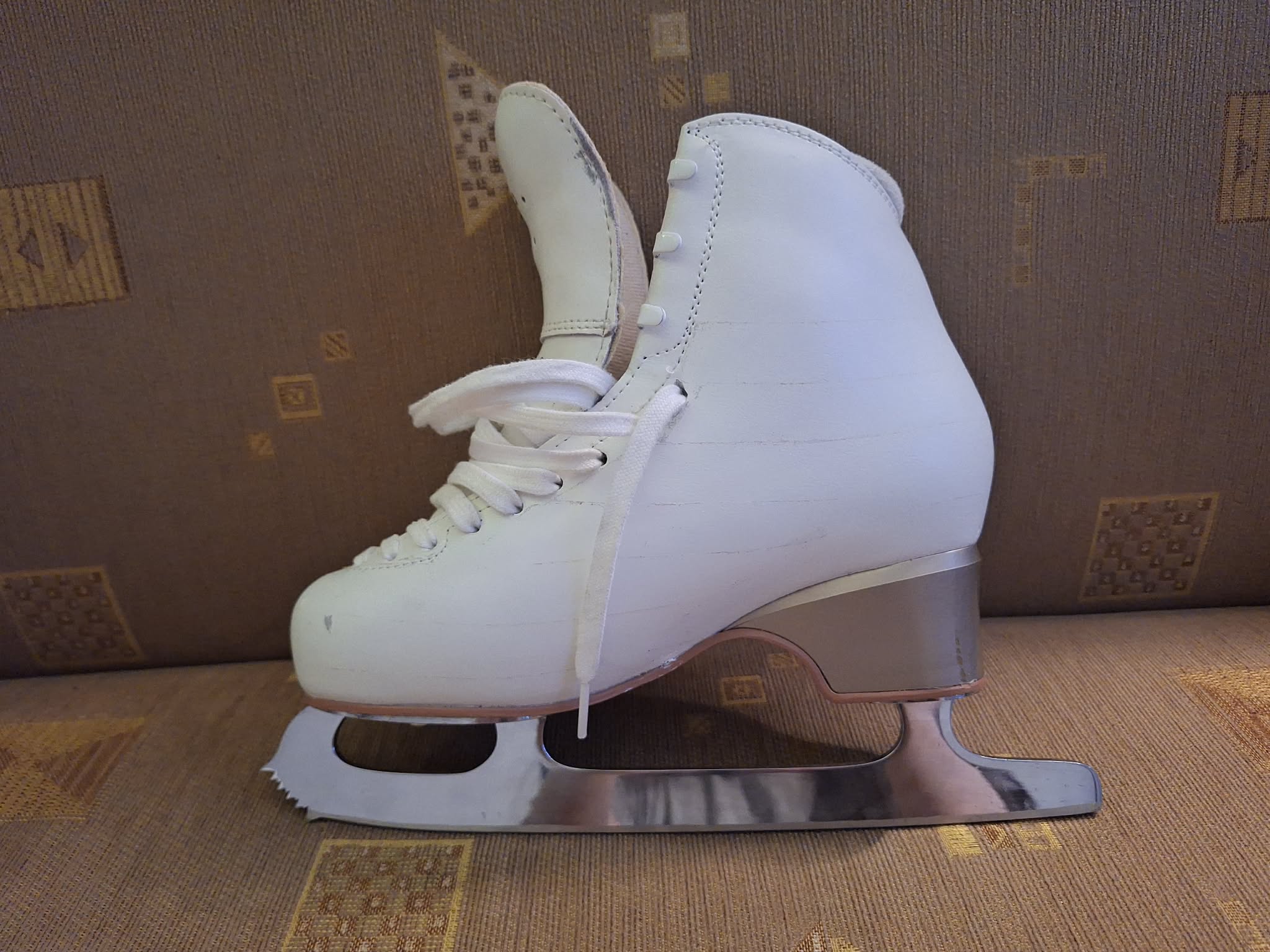
So I noticed that on my current skates, the plates are mounted from top to heel. There's no 1/4 inch gap at the back. I know that this could be normal but I just feel like that my Pro blades have a really long heel. Edea chart recommends a 9 inch blade for a 240 boot but that is just a guide as they say and often applies to children with growing feet. I've also read that ideally the heel plate should be on the center of the boot's heel for better response. On my skates the heel plate is really on the back part of the boot's heal. I'm trying to master back three turns and I find them quite challenging (especially back inside threes) because I just struggle with getting my weight so far back and the longer heel doesn't help with that either. If I was a pro skater that probably wouldn't be an issue but just learning these elements is harder I guess.
I thougth about going to a 8.75 inch blade but I already have the MK Galaxy in 9 inch. I could maybe order them in 8.75 but I actually noticed that the Galaxy is slightly shorter than the Pro. The difference mainly comes from the tail section and it is about 5 mm (around 1/4 inch). So switching to the Galaxy itself would mean a shorter blade, but it is also a flatter blade, with an 8 inch rocker compared to the Pro's 7 inch rocker. It's interesting because I just realized that the size only refers to the plate's length. And blades can have totally unique shapes and even runner lengths. I'll post some links to pics to show how my current skates look like and how the MK Pro compares to the Galaxy in length.

What do you think about switching to a shorter blade? Has anyone made similar changes or been to a similar situation?
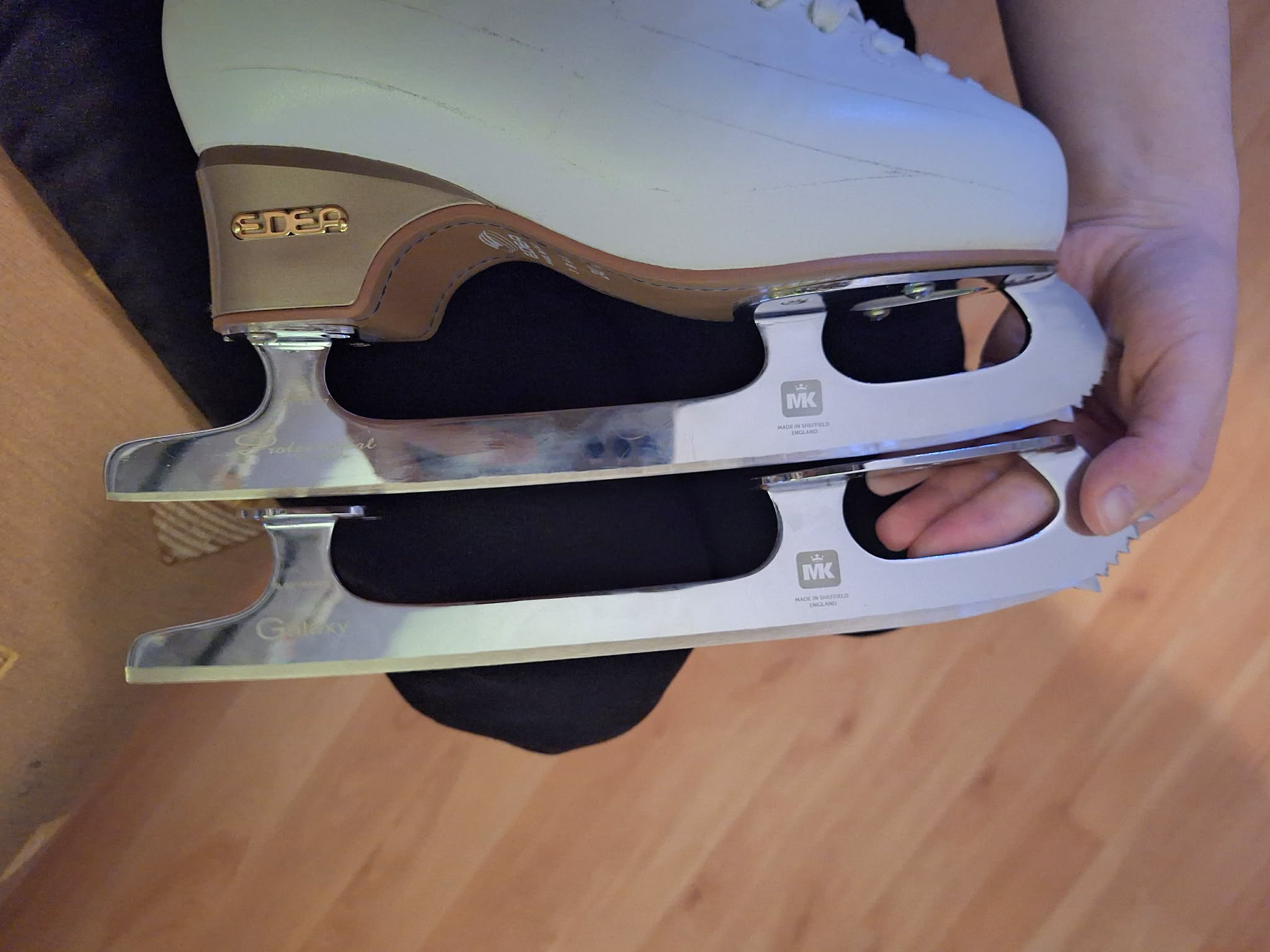
 
Edea recommends a heel-to-toe blade length whenever possible, because the sole length is really short already. However, you can still run them with a shorter blade (and many do so). Blades with shorter tails (many blades compared to MK Pro / Gold Seal) might get a little more iffy, but I think 8.75 on those with the Galaxy is still fine. MK Pro 8.50 would even be ok for some heel tricks, but it gets kind of dicey when you're going backwards, if you know what I mean (can get the worst kinds of falls when that tail bites).

A shorter blade will usually make spins and turns easier in terms of finding rocker sweet spot, but you're going from a rounder rocker to a flatter one, so it's kind of anybody's guess how it's going to be exactly. Also, many times it's not the blade but the placement that matters more (some shops/techs mount blades all wrong, and the sweet spot will be off no matter what...).

No harm in trying different things. Just keep in mind, that sometimes you just need practice, and the issue is not in the equipment (but sometimes it is!) ;)
 
Edea recommends a heel-to-toe blade length whenever possible, because the sole length is really short already. However, you can still run them with a shorter blade (and many do so). Blades with shorter tails (many blades compared to MK Pro / Gold Seal) might get a little more iffy, but I think 8.75 on those with the Galaxy is still fine. MK Pro 8.50 would even be ok for some heel tricks, but it gets kind of dicey when you're going backwards, if you know what I mean (can get the worst kinds of falls when that tail bites).

A shorter blade will usually make spins and turns easier in terms of finding rocker sweet spot, but you're going from a rounder rocker to a flatter one, so it's kind of anybody's guess how it's going to be exactly. Also, many times it's not the blade but the placement that matters more (some shops/techs mount blades all wrong, and the sweet spot will be off no matter what...).

No harm in trying different things. Just keep in mind, that sometimes you just need practice, and the issue is not in the equipment (but sometimes it is!) ;)
Thank you for sharing your thoughts!

Yes, I definitely need more practice on everything. I don't wanna blame things on equipment because I know that when you are doing things right, it is more or less managable on any proper skate. And I've been making great progress since I swtiched to these skates. It's just that I'm curious if a different profile would change the learning process for me. Edea's chart is a little weird to me because I understand that the sole is shorter because of the higher heel, but isn't that the point? Because that way you can have a shorter blade thus more maneuverability. If you mount from toe to heel than it is not really a shorter blade and the blade's heel is not aligned with your heel. Edea on their website even demonstrates the importance of getting the heel plate down the center of the boot's heel. But that is not really possible with their sizing guidance, so there's a little coincidence. https://edeaskates.com/en/ice/blade-mounting/

I feel like I will try the 9 Galaxys first and just watch the differencies compared to the Pro, maybe it will be a little less wobbly given the flatter design. I know that if I reach to Axel and doubles level (I'm currently learning flip jump, off ice lutz-axel), I'd need to upgrade my blades (and boots) from Galaxy. I think at that point it will be more interesting to decide which intermediate blade I wanna go with. I could go back to MK Pro, but this time definitely a 8.75 instead of 9, or try the Coronation Ace blades. Though I know that they have a significantly shorter tail than the MK Pro, soo going down to 8.75 with them would be a braver choice. It's interesting you mentioned a 8.50 size blade as a possibility. That's maybe something I would not try, even with Pro, it may be more like a dance blade profile. Also they might not even fit on a 240 boot.

Thank you once more for the conversation, it was nice to hear someone's perspective. :)
 
Maybe my experience is atypical, but when I once tried a short blade, I find the back corner of the blade often dragged on the ice, slowing me down. I also found that it was a bit easier to fall backwards. So maybe watch out for that?

A really good skate tech (meaning, in this case, a skate sharpening person) can sometimes customize the profile of your current blades to your personal needs, if the difference isn't too large. I don't know if that is practical in your case. That includes changing somewhat the position of the transition between the spin rocker and the main rocker. And they can also make that transition more abrupt, or more gradual, as desired. And sometimes they also trim the toepick, especially the back ("drag") pick, it if is interfering too much with your spins or other moves, though that is less common. (I'm not include accidental toepick grinds in that category - IMO only really bad skate techs make that mistake.)

"Sweet spot" doesn't mean the same thing to everyone. I was taught by one skate tech to use that name for that rocker curvature transition point, between the "spin rocker" and what I call the "main rocker" - but tstop4me pointed out a lot of people use "sweet spot" differently. Some people mean it to mean the entire portion of the spin rocker you can spin on without touching the toepick. Maybe more people use it that way. And there might be other definitions. I eventually realized he was right - I've mostly stopped using "sweet spot", and try to be more specific...

Most reasonably good skate techs modify blade shapes - especially for MK and JW, which have a reputation for creating inconsistent rocker profiles, even within a given model and size - to the shape they think the the blades should have. Especially at the beginning, before giving you new blades, but often even after that. That means that there is effectively no single rocker profile for a given model (e.g., for MK Professional blades). The shape any given blade model have depends substantially on the skate tech.

I think this is also a good reason to find a good tech, and stay with them. Because if you don't, each tech may re-modify your blades the way they think they should be. Each such modification removes a significant amount of steel, reducing the life of your blades.

Maybe a good tech could also help you find a blade you are more happy with.

Some of us eventually decide to do our own sharpening, because of bad experiences using professional techs. But some practice is involved doing so, and it takes a while to learn how to get what you want. So maybe don't do that if you have a tech your are happy with...
 
Maybe my experience is atypical, but when I once tried a short blade, I find the back corner of the blade often dragged on the ice, slowing me down. I also found that it was a bit easier to fall backwards. So maybe watch out for that?

A really good skate tech (meaning, in this case, a skate sharpening person) can sometimes customize the profile of your current blades to your personal needs, if the difference isn't too large. I don't know if that is practical in your case. That includes changing somewhat the position of the transition between the spin rocker and the main rocker. And they can also make that transition more abrupt, or more gradual, as desired. And sometimes they also trim the toepick, especially the back ("drag") pick, it if is interfering too much with your spins or other moves, though that is less common. (I'm not include accidental toepick grinds in that category - IMO only really bad skate techs make that mistake.)

"Sweet spot" doesn't mean the same thing to everyone. I was taught by one skate tech to use that name for that rocker curvature transition point, between the "spin rocker" and what I call the "main rocker" - but tstop4me pointed out a lot of people use "sweet spot" differently. Some people mean it to mean the entire portion of the spin rocker you can spin on without touching the toepick. Maybe more people use it that way. And there might be other definitions. I eventually realized he was right - I've mostly stopped using "sweet spot", and try to be more specific...

Most reasonably good skate techs modify blade shapes - especially for MK and JW, which have a reputation for creating inconsistent rocker profiles, even within a given model and size - to the shape they think the the blades should have. Especially at the beginning, before giving you new blades, but often even after that. That means that there is effectively no single rocker profile for a given model (e.g., for MK Professional blades). The shape any given blade model have depends substantially on the skate tech.

I think this is also a good reason to find a good tech, and stay with them. Because if you don't, each tech may re-modify your blades the way they think they should be. Each such modification removes a significant amount of steel, reducing the life of your blades.

Maybe a good tech could also help you find a blade you are more happy with.

Some of us eventually decide to do our own sharpening, because of bad experiences using professional techs. But some practice is involved doing so, and it takes a while to learn how to get what you want. So maybe don't do that if you have a tech your are happy with...
Thank you for sharing!

Wow, dragging the heel probably means that the tail part of the blade was heavily under your heel. I don't think that going down a size would cause me that given how back my current blades extend. Falling backwards more easily is definitely something to keep in mind. When I made my switch from recreational skates to my current equipment I actually had to go down a size in boots and in blades as well. First I was worried about falling backwards or tripping on the bigger picks but fortunately none of these caused problems. Sometimes dragging the toe picks going backwards is a bigger issue.

You and IceM both mentioned the importance of having a good skate tech. Now this is actually the biggest problem for me because in my country there are no "authorized dealers" or professional skate techs. At least for the recreational sport community, pro skaters sure have someone on their team. Getting a not so bad sharpening is kinda the maximum you can get here with the more reputable "skate techs". That involves not ruining entirely your blade, not shaving off toe picks. But all the little details, like proper rocker and non skateable zone maintenance, precise blade mounting is nowhere to be find. Let alone profiling or anything like that. So I have to settle for what we have.
 
Thank you for sharing!

Wow, dragging the heel probably means that the tail part of the blade was heavily under your heel. I don't think that going down a size would cause me that given how back my current blades extend. Falling backwards more easily is definitely something to keep in mind. When I made my switch from recreational skates to my current equipment I actually had to go down a size in boots and in blades as well. First I was worried about falling backwards or tripping on the bigger picks but fortunately none of these caused problems. Sometimes dragging the toe picks going backwards is a bigger issue.

You and IceM both mentioned the importance of having a good skate tech. Now this is actually the biggest problem for me because in my country there are no "authorized dealers" or professional skate techs. At least for the recreational sport community, pro skaters sure have someone on their team. Getting a not so bad sharpening is kinda the maximum you can get here with the more reputable "skate techs". That involves not ruining entirely your blade, not shaving off toe picks. But all the little details, like proper rocker and non skateable zone maintenance, precise blade mounting is nowhere to be find. Let alone profiling or anything like that. So I have to settle for what we have.
What country are you in?
 
WILLISPORT
Nefelejcs utca 16, 1161, Budapest, Hungary
+36209324252
https://willisport.hu/
[email protected]

Andrea Granicz
Istvànmezei út 3-5. Kisstadion. 1146. Budapest Hungary
+36 203806513
[email protected]
I know both stores, but thank you!
They distribute skate equipments, second one is only a shop, the first one does mounting and sharpening too. I take my skates there for sharpening. They use automatic sharpener machines, but they are not trained figure skate techs. I take my skates there because thanks to the automatic sharpening at least the blade profile doesn't get ruined for a while (the wheel follows the blade's curvature). But still, no non skateable zone maintenance or the detailed care that a trained skate tech could provide. And it is still the better options here. There is actually a newer skate tech which I've never been to, maybe I'll try it out, he does manual sharpening with Blademaster machines. But still, it's just the fact that there are no techs who really are trained for figure skates particular.
 
I know both stores, but thank you!
They distribute skate equipments, second one is only a shop, the first one does mounting and sharpening too. I take my skates there for sharpening. They use automatic sharpener machines, but they are not trained figure skate techs. I take my skates there because thanks to the automatic sharpening at least the blade profile doesn't get ruined for a while (the wheel follows the blade's curvature). But still, no non skateable zone maintenance or the detailed care that a trained skate tech could provide. And it is still the better options here. There is actually a newer skate tech which I've never been to, maybe I'll try it out, he does manual sharpening with Blademaster machines. But still, it's just the fact that there are no techs who really are trained for figure skates particular.
They are listed as official Edea techs. So that's scary lol!
 
They are listed as official Edea techs. So that's scary lol!
Well yeah, this is frustrating. I don't know what it takes officially to be claimed an "Edea skate tech". I can assure that they sell Edea skates and one of them do work on them, but whatever training they got it's still not the whole package. But that's just the way it is for now.
 
If your skate techs aren't all that great, and are using automated sharpening machines, I wonder if that could be a factor in your learning to spin better. Anyone else here - does that sound likely?

Hungary is in the European Union, yes? Does that make it easy to travel to other nearby EU countries, and use their techs?

Maybe IC3Rabbit can suggest someone good near Hungary? I know that sounds extreme for a recreational skater, but I've known a fair number of recreational skaters in the U.S.A. who travel a few hours each way to use a good skate tech. And maybe you can carpool with one or more other skaters who isn't ecstatic about the local techs. (Be sure to make an appointment first.)

It might be harder for you if gasoline is very expensive in your country. Alternately, once you have the name and location of a good tech, you could try to find public transportation systems (buses, trains, etc.) that could get you there cheaper.

But before you dismiss that because of cost, consider the cost / sharpening in terms of needing new blades more often. I'm wondering whether a machine set to sharpen by hockey standards might take off too much metal per sharpening. E.g., several "expert" skate techs have told me they normally take off about 0.003 inch / sharpening on figure skates (about 0.0762 mm) - but sometimes an order of magnitude or even more greater on hockey skates, because hockey skates take a beating. (Note: Like most in the U.S.A. I use "." to divide places values between 1 and 1/10. Are most Europeans familiar with that standard, or do they always use ","?) If, for example, you decide that blades become too difficult to use after removing 0.1 inch (especially if you don't have a good skate tech who can try to modify the toepick shape appropriately), a blade has a lifetime of about 30 sharpenings if the tech removes 0.003 inches each time. (Note: people vary a lot in how much they remove, and how much shape change they are willing to tolerate - so not everyone will agree with my estimates. Perhaps IC3Rabbit would give different estimates.) But only a few sharpenings if they remove about 10 times that. (Though perhaps your techs do know enough to remove less metal on figure skates...)

Also consider the cost of extra lessons and extra ice time and extra transportation costs to learn your skills if the blades are handled wrong.
 
If your skate techs aren't all that great, and are using automated sharpening machines, I wonder if that could be a factor in your learning to spin better. Anyone else here - does that sound likely?

Hungary is in the European Union, yes? Does that make it easy to travel to other nearby EU countries, and use their techs?

Maybe IC3Rabbit can suggest someone good near Hungary? I know that sounds extreme for a recreational skater, but I've known a fair number of recreational skaters in the U.S.A. who travel a few hours each way to use a good skate tech. And maybe you can carpool with one or more other skaters who isn't ecstatic about the local techs. (Be sure to make an appointment first.)

It might be harder for you if gasoline is very expensive in your country. Alternately, once you have the name and location of a good tech, you could try to find public transportation systems (buses, trains, etc.) that could get you there cheaper.

But before you dismiss that because of cost, consider the cost / sharpening in terms of needing new blades more often. I'm wondering whether a machine set to sharpen by hockey standards might take off too much metal per sharpening. E.g., several "expert" skate techs have told me they normally take off about 0.003 inch / sharpening on figure skates (about 0.0762 mm) - but sometimes an order of magnitude or even more greater on hockey skates, because hockey skates take a beating. (Note: Like most in the U.S.A. I use "." to divide places values between 1 and 1/10. Are most Europeans familiar with that standard, or do they always use ","?) If, for example, you decide that blades become too difficult to use after removing 0.1 inch (especially if you don't have a good skate tech who can try to modify the toepick shape appropriately), a blade has a lifetime of about 30 sharpenings if the tech removes 0.003 inches each time. (Note: people vary a lot in how much they remove, and how much shape change they are willing to tolerate - so not everyone will agree with my estimates. Perhaps IC3Rabbit would give different estimates.) But only a few sharpenings if they remove about 10 times that. (Though perhaps your techs do know enough to remove less metal on figure skates...)

Also consider the cost of extra lessons and extra ice time and extra transportation costs to learn your skills if the blades are handled wrong.
I'd be willing to suggest techs if you are willing to travel OP. But I am not about to say that it's a good thing or safe to have a tech modify a toepick as this other poster has suggested.
 
What is the issue with trimming the toepick?

Some of the best techs I've known have done that (e.g., Mike Cunningham, now retired, who was at various times the USFS/USFSA's official sharpener at major international events like Worlds and the Olympics). A figure skating blade isn't magic - it is just shaped metal + metallurgy. Of course, it has to be done right - which relatively few techs understand how to do, and might not have the right tools for.

Of course, most toepick trimming and other significant blade shape modification is instead done by accident or lack of understanding of what figure skaters need. And the damage is often great enough it isn't worth fixing. So I would understand if you think it isn't worth trying by the average skate tech.
 
Because the toepicks are there for a reason and doing anything to them compromises the integrity and safety of them and the rest of the blade.
It's incredibly dangerous. I have a really hard time believing that said tech (whom I know btw and have had my blades worked on by him) would do this. He may have flattened one out a bit but not shaving them alot or greatly modifying them.

Now, shaving off or trimming hockey blades a bit, yes.
 
Last edited:
If your skate techs aren't all that great, and are using automated sharpening machines, I wonder if that could be a factor in your learning to spin better. Anyone else here - does that sound likely?

Hungary is in the European Union, yes? Does that make it easy to travel to other nearby EU countries, and use their techs?

Maybe IC3Rabbit can suggest someone good near Hungary? I know that sounds extreme for a recreational skater, but I've known a fair number of recreational skaters in the U.S.A. who travel a few hours each way to use a good skate tech. And maybe you can carpool with one or more other skaters who isn't ecstatic about the local techs. (Be sure to make an appointment first.)

It might be harder for you if gasoline is very expensive in your country. Alternately, once you have the name and location of a good tech, you could try to find public transportation systems (buses, trains, etc.) that could get you there cheaper.

But before you dismiss that because of cost, consider the cost / sharpening in terms of needing new blades more often. I'm wondering whether a machine set to sharpen by hockey standards might take off too much metal per sharpening. E.g., several "expert" skate techs have told me they normally take off about 0.003 inch / sharpening on figure skates (about 0.0762 mm) - but sometimes an order of magnitude or even more greater on hockey skates, because hockey skates take a beating. (Note: Like most in the U.S.A. I use "." to divide places values between 1 and 1/10. Are most Europeans familiar with that standard, or do they always use ","?) If, for example, you decide that blades become too difficult to use after removing 0.1 inch (especially if you don't have a good skate tech who can try to modify the toepick shape appropriately), a blade has a lifetime of about 30 sharpenings if the tech removes 0.003 inches each time. (Note: people vary a lot in how much they remove, and how much shape change they are willing to tolerate - so not everyone will agree with my estimates. Perhaps IC3Rabbit would give different estimates.) But only a few sharpenings if they remove about 10 times that. (Though perhaps your techs do know enough to remove less metal on figure skates...)

Also consider the cost of extra lessons and extra ice time and extra transportation costs to learn your skills if the blades are handled wrong.
Well my blades are okay I think. I don't think that the difficulty of spinning is because of the way they are maintained. I only had them sharpened a few times and the profile of the blades doesn't seem messed up to me. Also, some other skaters in my group can spin fine and they don't have a better tech either.
Travelling abroad for sharpening alone feels a little too extreme for me, yeah. Even if I'm in the EU, it is just too much cost and I would have to make this trip every couple months. I thought about going to another country for fitting tho and blade mounting, because you need to have this done once and you're good after that (for a while at least). But even for that, I would do this under a vacation or something.
 
Well my blades are okay I think. I don't think that the difficulty of spinning is because of the way they are maintained. I only had them sharpened a few times and the profile of the blades doesn't seem messed up to me. Also, some other skaters in my group can spin fine and they don't have a better tech either.
Travelling abroad for sharpening alone feels a little too extreme for me, yeah. Even if I'm in the EU, it is just too much cost and I would have to make this trip every couple months. I thought about going to another country for fitting tho and blade mounting, because you need to have this done once and you're good after that (for a while at least). But even for that, I would do this under a vacation or something.
It's not just a one trip deal for boot fitting and blade mounting. Even if the boot was actually available in stock (and wouldn't have to be ordered in), then you'd still have a blade temporary mounted and then you'd come back after a bit for permanent mounting when you know the blade is correct for your individual skating needs.
 
It's not just a one trip deal for boot fitting and blade mounting. Even if the boot was actually available in stock (and wouldn't have to be ordered in), then you'd still have a blade temporary mounted and then you'd come back after a bit for permanent mounting when you know the blade is correct for your individual skating needs.
I already have my boots, I just want to change blades. So I need a temporary mounting, after that an alignment test, and a permanent mounting. I could do the alignment test at a local rink and then returning to the tech. Actually there are good techs in some countrys who work within the rink and attend the alignment test with you. That way they can make changes immediately.
 
I have received an email notification of your reply to this previous comment, Ic3Rabbit. I don't know if your reply got deleted or my page just not working correctly. But I'd like to briefly respond to it and also grabbing the opportunity to close this discussion.
I already have my boots, I just want to change blades. So I need a temporary mounting, after that an alignment test, and a permanent mounting. I could do the alignment test at a local rink and then returning to the tech. Actually there are good techs in some countrys who work within the rink and attend the alignment test with you. That way they can make changes immediately.
Ic3Rabbit: "Not being rude but this isn't news that I don't already know about 'some techs.' I have been doing this for over 30 years and am a pro. I suggested this to you b/c you answered the way you did in your previous posts and also said you don't have good techs there locally."
I'm sorry, but I think there may be some misunderstanding here. By "local" rink I meant the rink at the place I would travel to for the mounting. I meant that the mounting process could be handled during a single trip in this way. English is not my native language, so that may also have contributed to the confusion.

I appreciate that you take time to try helping everyone in the community. However, just because you've been involved in the sport for many years doesn't necessarily mean you know every small detail or every skate technician, and therefore can take responsibility for the suggestions you make. Because of that, I think it would be better to be a bit more careful when giving advice. I also don't want to be rude, I simply prefer a more humble approach.

I don't want to start a conflict, and in fact I have already received the perspective I needed regarding my original question. Thank you to everyone who has shared their thoughts and helped me make my decisions!
 
Ic3Rabbit - I'm going to guess that as a coach to elite skaters you probably advocate replacing blades earlier than many recreational skaters with more limited budgets choose to do. That makes sense - it seems like it would be better if serious competitive skaters don't have to waste time making major adjustments to their technique to deal with changes in their equipment. And typical elite level skaters probably have the money to do so (or their families and/or sponsors do) - because reaching & competing at that level usually requires a lot of resources.

But many recreational skaters on a lower budget try to keep using equipment - including blades - longer than the original toepick height makes practical, to save money. Eventually, after some number of sharpenings, the pick - particularly the back (drag) pick - significantly shortens and shifts backwards the usable portion of the spin rocker. A slight trim of the back pick moves the point at which the pick engages partially forwards again. Though of course not to the same position it had when the blade was when new, because toepicks generally project forwards, which means that while you can restore the ankle roll angle at the point the drag pick starts to engage to where it was before, the point of the pick will be further back, and the center of gravity will be a little different at that point, and so on.

I'm not sure why a slightly trimmed drag pick would be less strong (though it is possible the steel at the trimmed tip would be less hard), but recreational level skaters almost never break their blades, at least not if they have bought reasonably good quality blades.

Perhaps the same principle applies to boots - elite skaters with generous budgets are probably frequently advised to replace boots when they soften to the extent of providing significantly less support, or have stretched a bit so they no longer fit quite right. Whereas recreational skaters on a lower budget frequently try to make do with boots longer than that. And they sometimes modify the boots to remain somewhat usable at their level for a somewhat longer time.
 
Back
Top