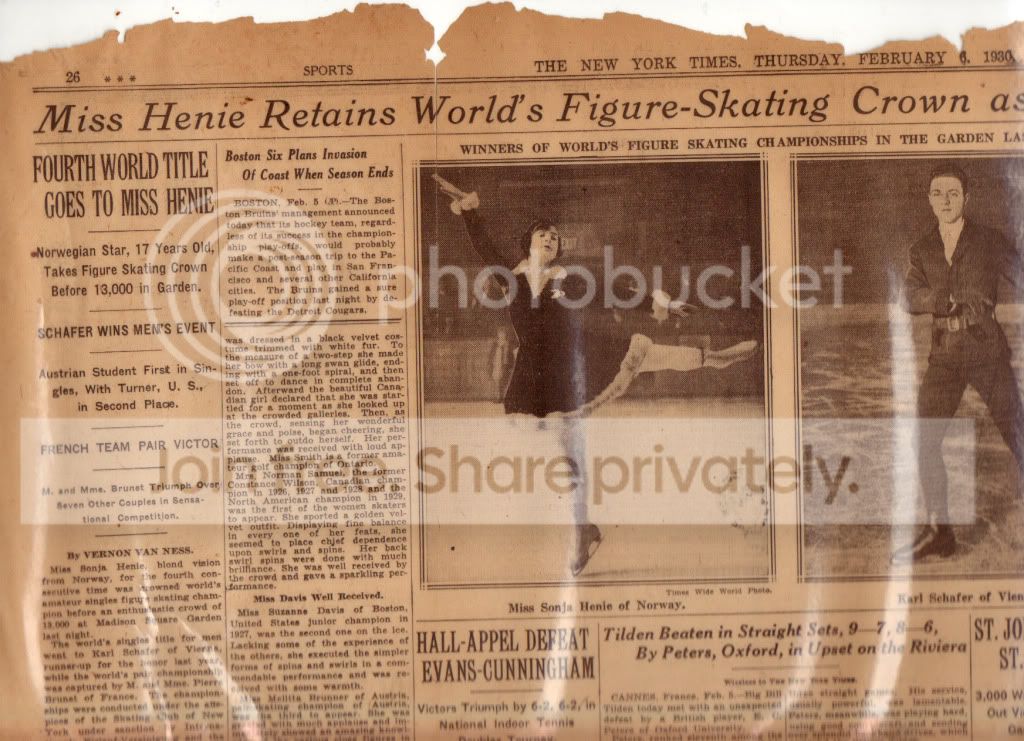
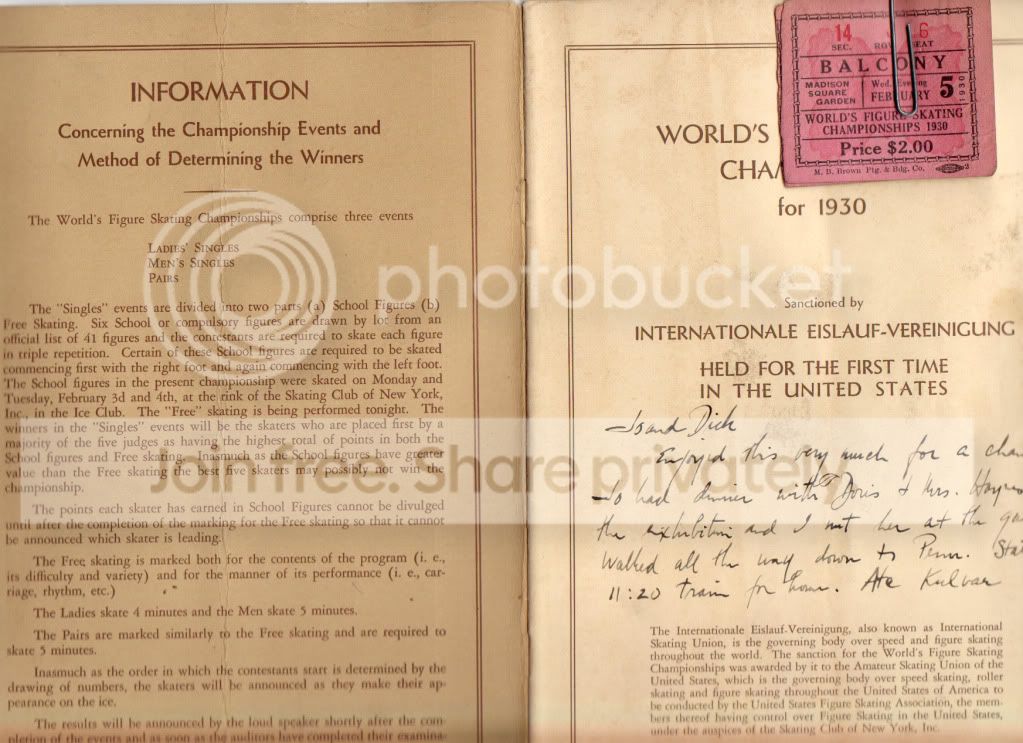
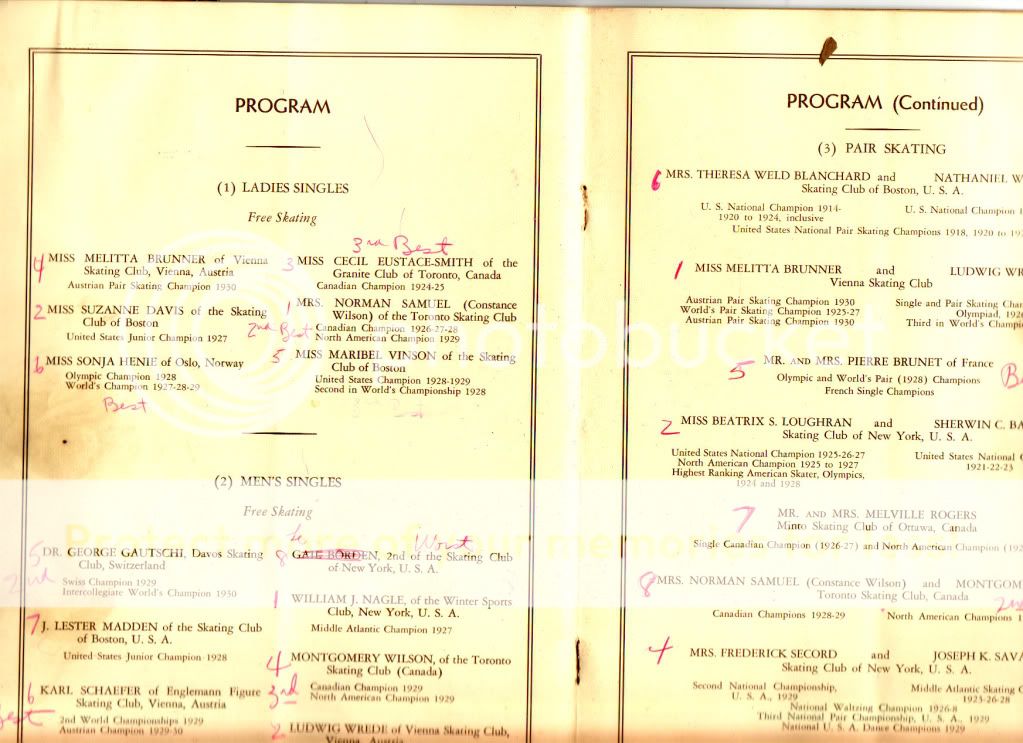
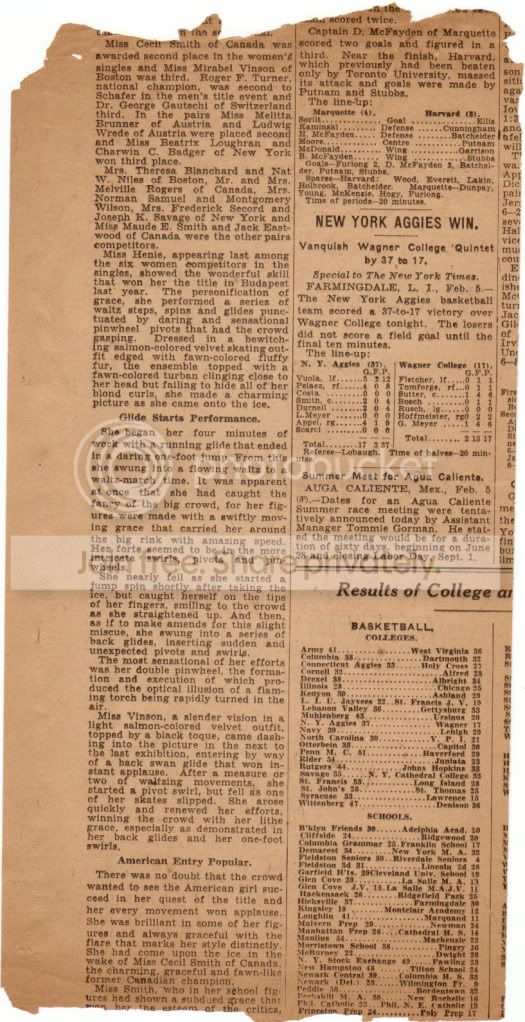
Catching up on some of my reading of Sonja in the old days, I concluded that not much has really changed from then to now, in fact not at all.

There still exist rivalries, and the higher up you go the more pressure, and with that comes jealousy & whatnot. For example, when Sonja first started out, she was known as the adorable wunderkid. And being so young & talented without the pressure of a seasoned performer, she won everything in sight with ease. But then her success translated into more & more competitors from different countries eager to overtake her #1 position at the very top. And with that came envy, talk about how impeccably groomed she was due to the inherited wealth of both her parents, thus Sonja was able to obtain the very best in not only fashion, but also when it came to instructors, tutors, coaches, and prima ballerinas. But there is an old saying ~
having the ability is one thing; having the means and opportunity to develop it, however, can make the difference between becoming a champion or just a good athlete. Sonja had it all.
She skated because she loved it, following her older brother Leif onto the ice at Frogner Stadium, wanting to do what he & his older friends did, as typical baby sisters are prone to do, lol.


Soon getting there before it opened & coming home late at night, after skating all day for the pure pleasure of it, only to see herself soon overtake Leif & his friends and everybody else, as she was a
natural. Winning her first competition at age 5, a little pearl-handled silver paper cutter, her most cherished possession, and which now sits in the Sonja Henie-Niels Onstad Museum in Oslo, Norway. All of this noted by a member of a private club at Frogner, whom took Sonja under her wing and taught her everything she knew, with Sonja soon doing school figures until she could etch the same figure 10 times and only leave 1 unblurred tracing behind her! She was already the perfectionist, and her own harshest critic, she would remain throughout her career. So advanced was she by age 8, she was allowed to skip Juniors (after defeating everybody by leaps & bounds) and go right on to Seniors, winning her first National Championship the next year, after a year's rigorous preparation (no more skipping meals nor skating all day, now she was on a strict dietary regimen, as well as skating regimen, as well as having all the best in coaching, tutoring, ballet, fashion, et al). Finally came the Olympics of 1924 in St. Moritz, at which she made her first non-Norweigan skating friend, Gillis Grafstrom, the internationally recognized Swedish skating champion (he holds the record at medalling in 4 Olympiads!). Sonja adored him, and listened avidly to everything he had to say, even generous suggestions & friendly criticisms (some say she had a mild puppy dog crush on him).
Of course he won his second gold medal at those Games, whereas Sonja, at only 11 yrs. old, came in last place, after falling on a spin.

Yet that first Olympics was more for exposure, a learning experience, to meet the great ones, to see how it is done, so by the time 1928 came round, she would be more than ready.
And boy was Sonja ready, after winning her first World Championships at the age of 14, despite some saying she was too young (the same criticism she received when she competed at the 1924 Olympics at age 11). Yet she soon calmed her detractors with her outstanding balletic free-skating! Her first Worlds victory seemingly to be her most cherished (just as her little pearl-handled silver paper cutter was her most cherished possession, which she won at age 5 in her very first skating competition). And from there came the 1928 Olympics in Lake Placid, which she prepared for harder than any other competition, as she said National & World Championships require intensive training, but they demand less than Olympic preparation. So with that in mind, Sonja had three things she focused on: (1) she would work diligently on each of the 80 school figures, polishing them to perfection, so that she would be prepared for any that might be selected for the Olympic test that year. (2) she would obtain extensive exhibition experience, having her father book her for as many as possible, so that she could retain her poise while facing all sorts of audiences & conditions (recall all skating was done outside under any conditions in those days, making it way more difficult than today). (3) this final one, in Sonja's mind, was thee most important one, she went to London to see her idol Anna Pavlova in action, considered the greatest ballerina of her time, as Sonja wanted more than anything else to make her free-skating program a blend of dancing & figure skating; she wanted a choreographed from of ballet solo on ice, incorporating jumps & spins to show the judges her stylized skills in a pattern and sequence that would reflect the mood of dancing, not just skating. So with all that in mind, Sonja went on to win her first Olympic Gold Medal in stunning fashion, no one else came close, she won it easily and with a flair & style all her own, recalling that her first Olympic victory meant so much to her that she broke down & wept in the locker room! The rest is history ~ she went on to to win 10 World Championships in a row, as well as two more consecutive Gold Medals at the Olympics in 1932 & 1936, respectively. Of course it wasn't easy, it just got more tough as the years went on, demanding more & more from Sonja, the beginning of that merry-go-round she often talked about, accompanied with more pressure as well, as now she was an international superstar, known throughout the world as "Pavlova of the Ice". She was
expected to win. The proverbial saying
it's more difficult to stay on top than to work up from the bottom was more than true in Sonja's case. She had gotten to know her competition better, even cutting out an article in which a reporter described them as such:
Cecil Smith of Canada, "studied & determined"; Maribel Vinson of the USA, "spirited"; Constance Samuel, "vigorous & determined"; Melitta Brunner of Austria, "careful & exact"; and Sonja Henie of Norway, "delicately graceful".
And during all of this Sonja managed to become the third-ranking woman tennis player in Norway, an excellent swimmer, a daring equestrienne, and a capable & lovely ballet dancer. She was a natural all-around athlete, which is why she never tired of the grueling 8-month pace of a figure skater, year after year, that was part of the competitions. Nor did she ever tire of *improving* herself, taking lessons from international renown figure skating master, Howard Nicholson, whom taught her how to use her arms to keep the attention of the public, what freshness means, and how to sustain verve throughout a program. The difference between her & everybody else was that her skating had dancing in it, as well as grace, able to execute difficult moves with the grace of a swan! Yet Sonja was aware of young upstarts hot on her heels, like 13 yr. old Hilda Holowsky from Vienna, whom almost managed to upstage her at the 1931 World Championships, with the Associated Press carrying the story that Sonja's greater international experience & smoothness on the ice gave her a narrow victory over little Miss Holowsky, whose flashing grace & skill almost wrested her the title over the Norwegian star. It was one of the few times that Sonja was seriously challenged. Shaken, Sonja realized the insecurity of crowns, both admiring Hilda's skating above all, therefore fearing it the most, anticipating Hilda as a very serious rival in the 1932 Olympics (unfortunately Hilda died unexpectedly that year, devastating Sonja, she cried for days over the loss of such a young, vibrant athlete; it taught Sonja that life, like fame, was precarious at best). And then there was the gossip about her retiring, adding more pressure, saying that such gossip could ruin her career. But she managed to buckle down for the 1932 Olympics, knowing that every year new skaters were arriving on the scene, eager to dethrone her. Sonja was growing up, no longer the cute little wunderkid, she had to have something new and different every year, the audience demanding more of her, otherwise someone else would replace her as #1. With this in mind, Sonja managed to win her second Olympic Gold Medal in Lake Placid despite snow & ice that was slushy and difficult to perform on, and amongst stiff competition from Fritzi Burger, Maribel Vinson, and Constance Samuel (including young newcomers like Megan Taylor and Cecilia Colledge). After that victory came the World Championships, which was marred by gossip & rumour & ill feelings, as several Canadian clubs expected her to do exhibitions, which she had never committed to do in the first place, but nevertheless the papers called her attitude "scandalous" and that she was merely "pretending to be an amateur". With the conflict swirling around her, Sonja managed to hold her head high and defend her 6th consecutive World Championship Title. All talk was immediately ceased and instead the papers focused on her incredible performance in the face of adversity. However, for the first time in her career she had serious reservations about continuing as an amateur because of all the stories & rumours swirling about her at the time. But after taking some time off that summer, she came back with a vengeance that September! Still, there were changes, her practices became more private, as she was working on her famous "Swan Number", determined to put ballet on ice for the first time in recognizeable form, something she had always dreamed about (dance being her first passion at 2 yrs. of age). And she debuted her signature piece in Milan in 1933 to great applause & cheer! Even her 7th World Title paled in comparison to her exquisite exhibition number, which she was known for throughout her life. But all was not roses, as when she debuted her Swan Number in Paris in December of 1933, there were tin-whistle blasts from the top gallery, soon to be drowned out by the other appreciative spectators. Yet it was later discovered that the French figure skating champion, a bitter rival of Sonja's at the time, had purchased and distributed balcony tickets, provided the tin whistles, and furnished instructions to the rabble, specifying precise times for the blasts to occur. Lol, and we thought the rivalries of today are intense!
^D
Sonja swept from success to success, luck being on her side as well, not just her flawless skating. She won her 8th World title in February of 1934 in perfect style & execution, a trademark of Sonja, whereas Maribel Vinson, the American champion, who was always close on her heels, unfortunately fell during a spin in the free-skating portion and consequently finished a disappointing 5th place, unlucky to say the least. Then, of course, came more jealousy from her rivals in the form of the ISF announcing that Sonja Henie would not be permitted to give any more "exhibitions" in the USA unless the Amateur Skating Union of America agreed to pay a percentage of her performance receipts to the ISU. It became an international affair, with Sonja finally being given permission to skate in America so long as she chose, as long as she limited her appearances to competitions and charities, thereby satisfying her rivals. Just another example of how amateur competitions can be vicious and destructive, which was in full bloom when she uncharacteristically fell during an exhibition in St. Moritz, where she was training for the 1935 European Championships. The Vienna press ran with it, saying she was washed up and a has-been, which was reported by somebody Sonja thought was her friend, but as it turns out wanted little Hedy Stenuf of Austria to win the World Championships that year. But as it turned out, Hedy fell at the end of her free-skating, despite the crowd cheering her on, wanting her to defeat Sonja. Whereas Sonja came out and skated like the veteran she was, sealing her 9th World Title, whereas Hedy came in 4th place. Later on, Sonja declared that competition to be her most satisfying, no other gave her such elation! Finally, came the year 1936, her very last one as an amateur, which she had told the press beforehand. Her most pressure-filled, some might say. The papers ran stories of a supposed engagement to another prominent skater of that era, Jackie Dunn, despite denials from Sonja, whom suspected they wanted to smear her name. In spite of all this, Sonja buckled down as never before, as she wanted to go out in a flash, on a high note! She began her preparations in late summer, training alongside youngsters Megan Taylor & Cecilia Colledge in London, the two 15 yr. olds anxious to dethrone her, making Sonja feel like a veteran beside them, and noting that they were now using training methods she had originated. This only fueled Sonja's desire to be the best, thereby overdoing it at one point, setting up too rigorous a practice schedule, which eventually had to be curtailed to allow Sonja to slow down a bit. Anxious to make a good showing at the European Championships that year, which would set her up for the Olympics & Worlds, she cared more in advance about winning then, than any other time in her life. It was a strange situation for her, as for years Sonja had been applauded in part for her youth, now she was the eldest competitor, with all her challengers being teenagers, the youngest 11 yrs. old from Japan. Cecilia Colledge came close to wresting the title from Sonja, scoring 417.2 points to Sonja's 434.6, the smallest 17.4 spread for Sonja ever. However, her perfect performance of the required turns enabled her to win her 6th European Title. Next came the Olympics, with Sonja being called one of the "old ladies", which put her under tremendous scrutiny by both the competitors and press alike. It was after all her fourth Olympics, with some saying her stamina must have diminished after 12 grueling years on the international scene. Nevertheless Sonja prevailed, just barely, with her lead in figures being a small one over Cecilia Colledge. The gauntlet had been thrown down, there was little or no room for error in the free-skating portion of the competition. Sonja didn't have her usual large margin of points from the school figures that she had managed in the past. It would be a head-on competition with Cecilia and Maribel Vinson in the free-skating finale. Sonja would be the last to perform. She followed her usual relaxing procedure that had served her well in the past. Finally it was Sonja's turn to take the ice, with only three things on her mind: (1) she led in points (2) the ice was not too good (3) I had to be careful. Later on, she called it the longest four minutes of her life, only recalling skating onto the ice that night and later the official annoucement, everything else a total blank. Not recalling the cheering & screaming from the crowd, her fellow Scandinavian competitors mobbing her & showing her with acclaim, nor the hush that preceded the announcement that she had made history, the winner for an unprecedented 3rd time!!!! Her victory was a narrow one, her most difficult ever, with Sonja scoring 424.5 points to Cecilia's 418.1. From there Worlds was anticlimatic, Sonja winning her 10th consecutive World Title, with few of the Olympic stars showing up. Her records still stand today...