ISU Grand Prix 2024-2025 Statistics (Women Singles) | Golden Skate

ISU Grand Prix 2024-2025 Statistics (Women Singles)

Alex Fedorov

Medalist
Joined
Nov 12, 2021
In the past, I have already created two threads about the statistics of skaters' execution of certain elements (mainly jumps) at the ISU Grand Prix stages in 2021, 2022 and 2023. This season, I have the opportunity to publish new information even before the final.

As before, if the GOE points received by a skater for a jump are greater than or equal to zero, the jump is considered successful, even in cases where the judges have made any additional marks in the protocol.

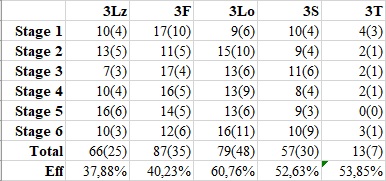
So, the first table, which displays the statistics of solo triple jumps in 2024:

Table J2024
J2024.jpg


The numbers in brackets are the number of successful attempts to perform the elements, and "efficiency" is a conditional value, the proportion of successfully completed jumps, expressed as a percentage.

A total of 42 athletes took part in the six Grand Prix tournaments of 2024, of which 12 competed in one stage, and the remaining 30 - in two stages. All these skaters performed 302 solo triple jumps. Of these, 148 attempts were successful. Thus, the average efficiency of performing these elements was 48.01%.

The changes from 2021 to 2024 look like this:

Table JD2021-24

JD2024.jpg


As you can easily see, the efficiency of 3F and 3Lz execution is decreasing again after some "recovery" in 2023. The sharp drop in this indicator in 2022 can be explained by the absence of Russian figure skaters, or the fatigue of athletes after the Olympics. But in 2024, such explanations are no longer relevant.

The efficiency of 3Lo execution increased slightly, but it was not possible to return to the level of 2022 and especially 2021. The trend towards a gradual decrease in the efficiency of 3S execution continued. In addition, the overall efficiency of triple jumps is steadily, albeit slowly, decreasing, the number of which, for reasons not entirely clear to me, has increased over the year.
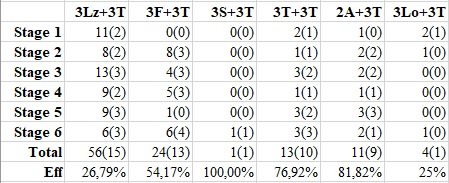
 
Statistics for the execution of 3+3 cascades

Table C3+3-2024


C3-3-2024.jpg


The table does not show 3 attempts to execute the 3Lz+3Lo cascade (one of them was successful) and one attempt to execute 3F+3Lo (not successful). In total, 103 3+3 cascades were executed (excluding 2A+3T cascades), 41 attempts were successful, and the average efficiency was 40.20%.

The changes from 2021 to 2024 look like this:

Table CD3+3-2021-24

CD3-3-2024.jpg


The sharp drop in the efficiency of 3Lz+3T execution looks like a random fluctuation. On the other hand, the increase in the efficiency of 3F+3T is a clear manifestation of the low base effect, because the real difference over the year is only two additional successful cascades.
 
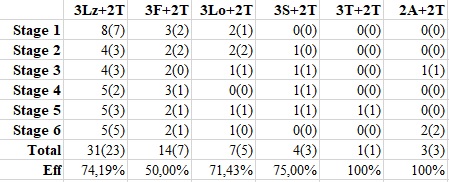
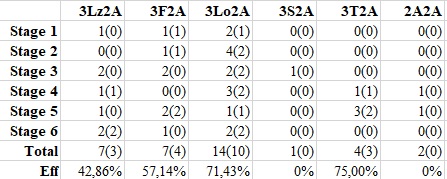
Statistics for 3+2 cascade execution

Table C3+2-2024


C3-2-2024.jpg


The table does not show one unsuccessful attempt to execute the 3S+2Lo cascade. Taking this attempt into account (but excluding 2A+2T), the total number of 3+2 cascades was 58, the number of successful attempts was 39, and the average efficiency was 67.24%.

The changes from 2021 to 2024 look like this:

Table CD3+2-2021-24

CD3-2-2024.jpg


It is impossible not to notice that this type of statistics turned out to be the most optimistic. The downward trend in efficiency observed in 2022 and 2023 has been decisively reversed. The efficiency of 3Lz+2T execution stands out in particular. At the same time, the total number of 3+2 cascades has significantly decreased. It was 79, now it is 58 - almost the same as in 2021. This is probably partly due to the increase in the number of sequences.

I will publish the rest of the statistics in the coming days. This will be information about cascades of three jumps and about sequences.
 
Statistics for three-jump cascades.


Cascades consisting of three jumps can be divided into two main types:

1) "Regular" cascades.

2) Cascades with an Euler.

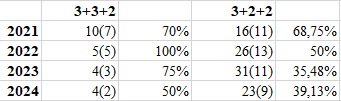
"Regular" cascades, in turn, can be divided into 3+3+2 and 3+2+2 cascades. Statistics for these types of cascades are as follows:

Table C3+2+2-2024

C3-2-2-2024.jpg


Here 2A is conditionally "equated" to triple jumps - this is done for simplicity. I did not provide data for each of the stages here - simply because there is no particular point in doing so.

There is no need to make a separate table for 3+3+2 cascades, because only 4 such elements were performed in all six stages of the Grand Prix: two 3Lz+3T+2T (both successfully, performed by Rino Matsuike) and two 2A+3T+2T (both unsuccessfully). Thus, the overall efficiency for these elements was 50%.

The dynamics of changes in the number of "regular cascades" from 2021 to 2024 looks like this:

Table CD-2021-24

CD2021-24.jpg


It is clearly visible that the number of 3+3+2 cascades after 2021 has dropped sharply, while the number of 3+2+2 cascades, on the contrary, has increased. Here it should be taken into account that such elements were not included in the programs of Russian figure skaters in 2021.
 
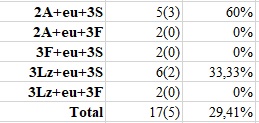
Now I will provide statistics on 3+eu+3 cascades

Table CE3+3-2024

CE3-3-2024.jpg


Only two 3+eu+2 cascades were performed: one 3S+eu+2F (successful) and one 3T+eu+2F (unsuccessful).

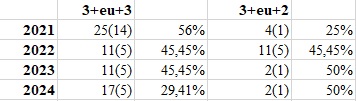
The dynamics of changes in the number of cascades with an Euler from 2021 to 2024 looks like this:

Table CED-2021-24

CED2021-24.jpg


It should be said that 3+eu+3 cascades were actively used by Russian figure skaters. Therefore, the number of such elements in 2022 has significantly decreased. In addition, such cascades can be replaced with sequences that are easier to perform. But in 2024, for some unknown reason, figure skaters again became interested in 3+eu+3 cascades - their number has noticeably increased, although the quality of execution still leaves much to be desired.
 
Sequence statistics

The total number of sequences in 2024 reached its maximum. At the same time, it cannot be said that there is any rapid growth here. For now, the number of these elements remains quite moderate.

First, statistics on "short" sequences, that is, on 3+2A combinations:

Table SEQ2-2024

SEQ2-2024.jpg


The number of "short" sequences and their execution efficiency from 2022 to 2024 changed as follows:

Table SEQD2-2022-24

SEQD2-2022-24.jpg


As you can easily see, the execution efficiency of "short" sequences is quite comparable to the execution efficiency of 3+2 cascades - despite the fact that the sequence has a higher base value.

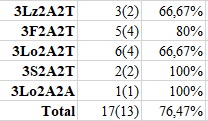
Now statistics on "long" sequences, that is, on 3+2A+2 combinations:

Table SEQ3-2024

SEQ3-2024.jpg


In 2022, three "long" sequences were performed (two of them were successful), in 2023 - already 10 such elements (7 were successful), and in 2024 the total number of sequences increased to 17 - with a consistently high performance efficiency. At the same time, however, it is noteworthy that the most advantageous sequence 3+2A+2A was performed only once. It was the combination 3Lo+2A+2A in Amber Glenn's program at the last stage of the Grand Prix.

Sequences 3+2A+2A are a real point generator (especially, of course, if the first jump is 3Lz or 3F). Why did no one except Amber Glenn try to take advantage of this? For comparison, I can say that many Russian figure skaters have developed this sequence at domestic competitions and successfully use it. Theoretically, sequences of 3+2A+3 or 3+3+2A are also possible, but this is still rather exotic, although at least one such element was performed by one of the skaters from Plushenko's "Academy".
 
In conclusion, a very short table with ultra-si elements.

UC2021-2024.jpg


Here, as you can easily see, little has changed after the dramatic fall in 2022. It may seem strange that Amber Glenn's efforts have hardly affected these statistics, but here we must take into account that in 2024, out of seven attempts to perform 3A, four were made by this skater.

The final is very soon, and I do not plan to make any predictions here. The results can be anything. However, it is worth noting that Kaori Sakamoto has scored more points than Amber Glenn in both the short and free programs at the Grand Prix stages, despite the fact that the Japanese skater does not have a triple axel, and the content of the free program has hardly changed in recent years. In particular, Kaori still does not use sequences and performs a not very advantageous 2A+eu+3S combination. This does not mean that she will definitely win - just remember how she failed at the 2022 Grand Prix Final. Rather, it indicates that the judges are more favorable to her than to anyone else.
 
The worst season I had watched
Everyone is entitled to their own opinion and judgement. To me the current season is by no means bad. Personal highlights for me are Lara Naki Gutman, Rino Matsuike and the re-emergence of Daniel Grassl and Matteo Rizzo. Also I am very excited about Sarah Everhart and in Juniors Kaoruko Wada and Yuseong Kim. And Demengeot/Mercier. Plus others that will surprise and dazzle us in future competitions...
 
Everyone is entitled to their own opinion and judgement. To me the current season is by no means bad. Personal highlights for me are Lara Naki Gutman, Rino Matsuike and the re-emergence of Daniel Grassl and Matteo Rizzo. Also I am very excited about Sarah Everhart and in Juniors Kaoruko Wada and Yuseong Kim. And Demengeot/Mercier. Plus others that will surprise and dazzle us in future competitions...
There were a few good moments. I did like Wada, Shaidorov making the final, and the sheer hilarity of Glenn being crowned the new Japanese National Champion... Ted waxing poetic how they didn't train sustainable technique on quads before in junior women, but now, now they are doing it right, because they have such a correct and superior technique, then Shimada hosing both 4T and 3A...pure joy. Overall, I'd say it was a D for the GP stages and a C- for the final, combined Jr's and seniors. Still better than an F, of course.
 
It's funny, because during one Grand Prix I thought how astounding it is that basically every woman is attempting a 3-3 combination these days. When I actively started watching women's figure skating (2007), I was excited there were 4 women jumping 3-3 combinations at Worlds!
 
Back
Top