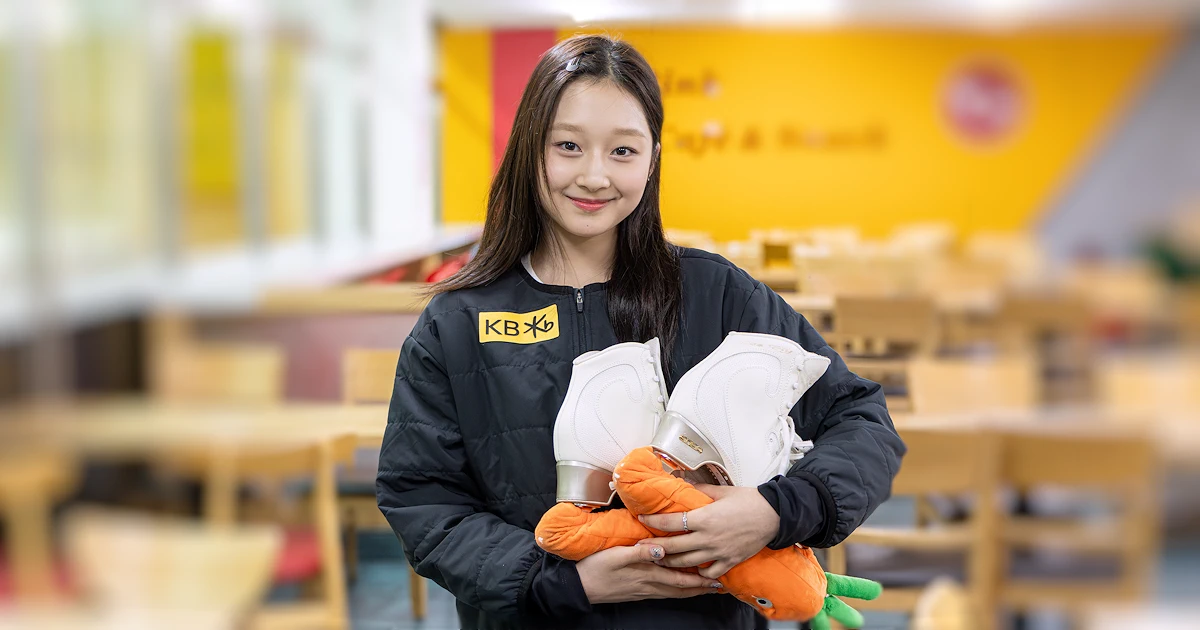
South Korea’s Jia Shin during Golden Skate’s interview at Zenith Ice Rink in Seoul. Photo © Warren Kim/Golden Skate.
Jia Shin embraces a more mature direction
Following the Milano Olympics, South Korea’s Jia Shin is preparing for the 2026–27 season with a desire to explore a more mature side of her skating. Working with longtime coach Hyun-jung Chi and choreographers Shae-Lynn Bourne and Jeffrey Buttle, the 18-year-old is moving beyond the lyrical style that defined much of her junior career.
Reflecting on the Milano Olympics
Shin’s free skate in Milano earned her a personal-best score of 141.02 and capped years of preparation for her Olympic debut. Asked what she remembered most after leaving the ice, her answer had little to do with the score.
“As soon as I came off the ice, my coach told me I had done a great job,” Shin recalled. “After finishing the free skate and striking my ending pose, the biggest thought I had was, ‘Ah, now it’s finally over.’ There was a little bit of lingering regret, but the feeling of relief was definitely the strongest.”
The Olympic Games represented the biggest stage of Shin’s career, but she approached them with the same mindset she brings to every competition.
“Before every competition, I always repeat the words, ‘I can do it,’ to myself,” she said. “I was really nervous at the Olympics, but I trusted the hours I had spent practicing. I approached the competition thinking these were all things I could do and that nothing was difficult. That mindset helped me a lot.”
Her confidence was also shaped by experiences long before she qualified for the Olympics.
“The Olympic selection trials were incredibly nerve-racking,” Shin said. “When I competed in the 2022 national and Olympic selection trials as a junior, I watched the senior skaters and wondered whether I would be able to handle that kind of pressure one day. But when I actually competed in the trials myself, I was so focused on performing each element one by one that those thoughts never even crossed my mind. By concentrating on my program, I was able to achieve a good result and qualify for the Olympics.”
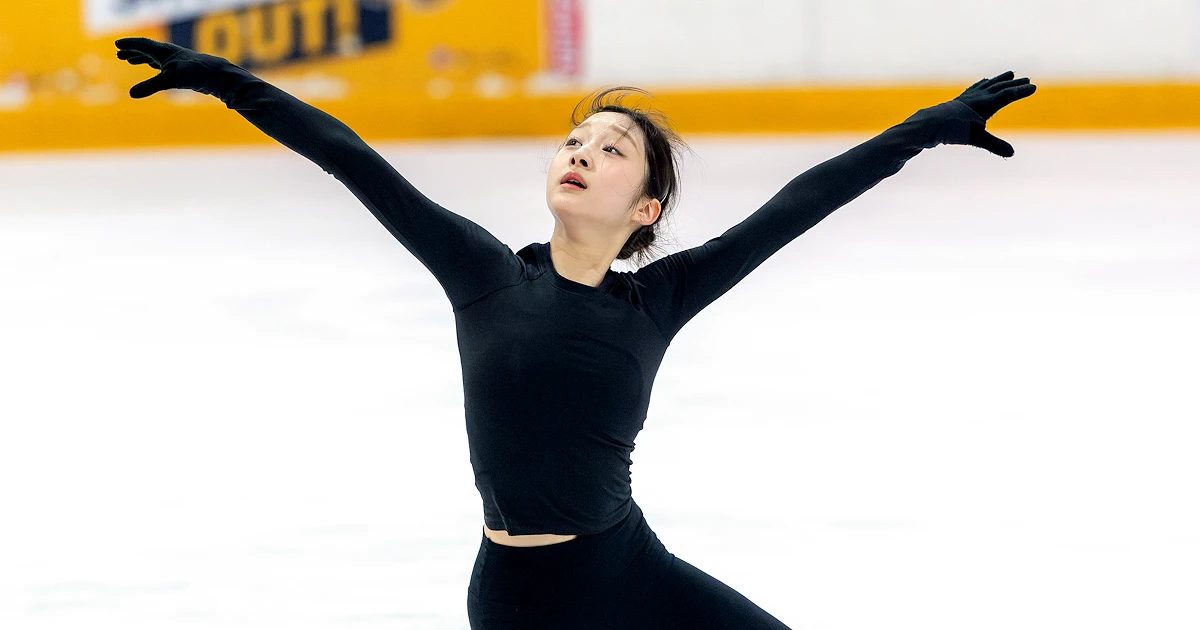
Jia Shin during a training session at Zenith Ice Rink in Seoul. Photo © Warren Kim/Golden Skate.
Training and Adapting to the New ISU Rules
Shin’s daily training routine has remained largely unchanged since her junior career, but competing at the senior level has shifted her focus toward injury prevention.
“I don’t think there’s a huge difference from when I was a junior,” said the three-time national champion. “I try to practice the same way and maintain my routine. But now that I’m competing as a senior, I’m much more aware of the risk of injury. I put more effort into off-ice work like foam rolling and stretching.”
The 2026–27 season has also brought significant changes to the ISU rulebook, including a reduction in free skating jump passes from seven to six and the introduction of the Choreo Spin.
“At first, when the jumps changed from seven to six, I thought it would be a little easier on my stamina because one jump had been removed. But after practicing with six jumps, it doesn’t really feel any easier. I thought it would be simpler, but that hasn’t been the case, so I think I need to practice with even more focus. The spin rules changed as well, which was confusing at first, but after training with them for a while, I got used to them.”
Among Shin’s most reliable elements is her triple Lutz–triple toe loop combination. The updated spin requirements also prompted her to add a triple Illusion variation to her short program.
“At first, I really couldn’t do three clean Illusions,” she admitted. “But after practicing it over and over, it gradually became natural, so it isn’t difficult for me anymore.”
New Programs and Creative Collaboration
Short Program
After several seasons built around lyrical programs, Shin was ready to explore a different artistic style.
Teaming up with Jeffrey Buttle for her short program, Shin chose Max Richter’s Dona Nobis Pacem 2, a piece she discovered on her own because it represented a style she had long wanted to explore.
“I happened to hear this song, and it felt like one of the genres I had really wanted to try, so I chose it.”
Asked what she hopes to express through the program, Shin pointed to the contrast within the music itself.
“It starts with thunder and lightning,” she explained. “Towards the end the music becomes much faster and more powerful. I’m focusing on expressing those sections.”
She also highlighted one choreographic moment that has become a personal favorite.
“There is a knee-slide in the middle of the step sequence, and the movements after that knee-slide feel the most captivating to me.”
Free Skate
Shin chose to work with Shae-Lynn Bourne for the first time as she looked to broaden her artistic range.
“I wanted to challenge myself with a new style, so I chose Shae-Lynn Bourne. It was based on Coach Chi’s recommendation.”
Bourne shared several musical suggestions before one caught her attention.
“Shae-Lynn recommended several pieces of music, including the In the Mood for Love soundtrack. It was music I was hearing for the first time, but I found it very charming, so I chose it.”
The film itself also became an important source of inspiration.
“The movie explores restrained love, longing and impossible love, and its mood is very captivating,” Shin said. “I’m working hard to reference those aspects and apply them to the program.”
The choreography also gives her the opportunity to explore movements she has never attempted before.
“It features many unique movements I have never used or attempted before, so I like that those kinds of movements are included throughout the program.”
Building the New Choreo Spin
Like all senior skaters this season, Shin has incorporated the new Choreo Spin into her free skate. She and Coach Chi built the element around one of her signature positions.
“I think the introduction of the Choreo Spin helps bring the program to life,” said Shin. “When we were told we had to create one, I wanted to include a spin that highlighted a personal moment. I thought my back-Biellmann variation was my most impactful spin, so I put it straight into the music. I created it after discussing it with my coach.”
The movement that follows the spin carries a specific meaning.
“I included that movement to convey the message of an unrequited, impossible love.”
Free Skating Outline
One change to Shin’s free skate layout is the placement of the Choreographic Sequence. Rather than placing it near the end of the program, Shin and her coaches chose a different approach.
“After the early jump passes, I placed the Choreographic Sequence in the middle to give the program a feeling of punctuation or a brief pause,” Shin explained. “We also wanted to place more emphasis on the Step Sequence, so moving the Choreographic Sequence to the middle happened naturally.”
- Triple Salchow (3S)
- Triple Lutz + triple toe loop combination (3Lz+3T)
- Triple loop (3Lo)
- Choreographic combination spin (CCoSp)
- Choreographic sequence (ChSq)
- Triple flip + double Axel + double Axel sequence (3F+2A+2A+SEQ)
- Triple Lutz (3Lz)
- Triple flip (3F)
- Flying camel spin (FCSp)
- Step sequence (StSq)
- Choreo spin
Exhibition Program
Alongside her competitive programs, Shin will also debut a new exhibition choreographed by fellow South Korean Olympian and training mate Cha Jun-hwan.
“It’s a pop song called Die on This Hill by Sienna Spiro.”
Looking beyond this season, Shin already has ideas about the kinds of music she’d like to skate to in the future.
“I haven’t decided on a specific piece yet, but I’d like to skate to music that really highlights a character. For example, music from Game of Thrones, Avatar or La La Land.”
Costumes and Creative Collaboration
As in previous seasons, Shin’s mother remains closely involved in the costume process.
“My mom takes care of almost everything regarding the costumes,” said Shin. “If something needs to be changed, she’s the one who asks for the modifications.”
Shin already has a clear vision for the overall color palette.
“For the short program, I think we’ll probably go with black, although nothing has been finalized yet. Lisa McKinnon will probably design the free program, while Edge will design the short. For the free skate, we’ll probably use a very dark plum or purple color.”
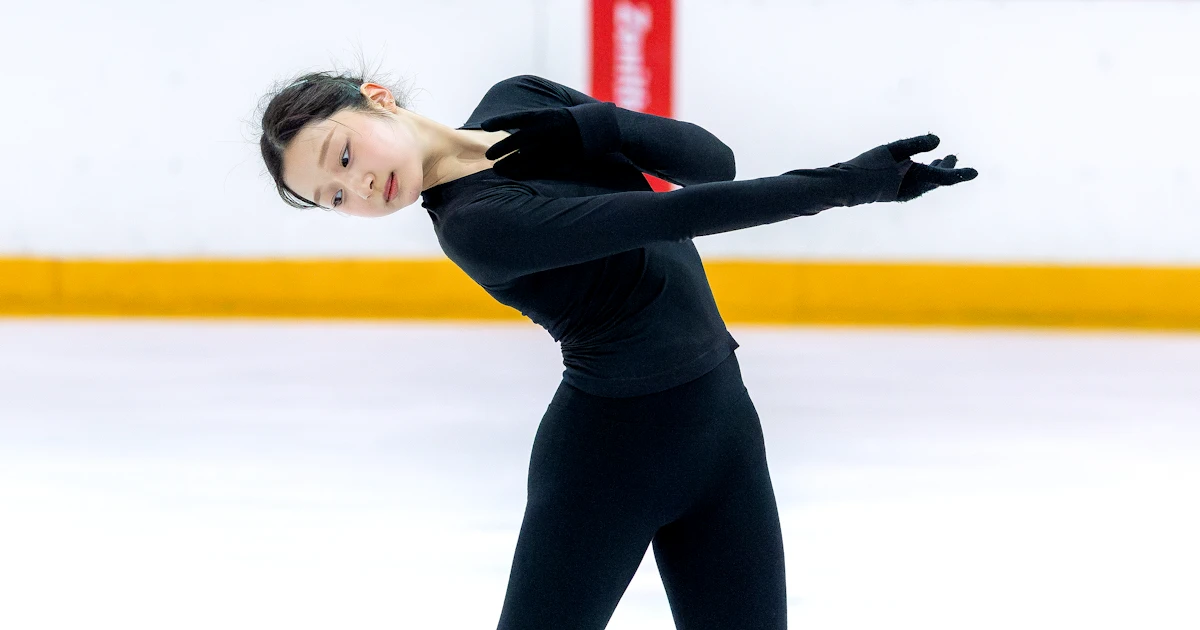
Jia Shin rehearses the opening pose of her new free skate. Photo © Warren Kim/Golden Skate.
Life Beyond the Ice
Away from competition, Shin enjoys a quieter pace of life. Among fans, she is affectionately known as “Jia-ging,” a nickname combining her name with the Korean word aegi (baby).
Outside the rink, Shin enjoys simple ways to relax after training.
“I do some baking from time to time, and when I walk into the house, my dog greets me, so it feels like my fatigue melts away instantly.”
Although many fans know about her knitting hobby, she admitted it has recently taken a back seat.
“Lately, I’ve been taking a break from it. I learned it all from YouTube.”
Most days continue to revolve around skating, conditioning and recovery.
“I do morning training from 10:30 a.m. to noon, and then from 2:00 p.m. to 3:00 p.m.,” said Shin. “Since I’m not doing national team training right now, I skate at Zenith or Mokdong. After 3:00 p.m., I do physical training and then conclude my day. I usually go to sleep around 10:00 or 11:00 p.m. and wake up at 7:00 a.m.”
When training becomes difficult, Shin keeps her perspective simple.
“I overcome it by thinking, ‘I’m not the only one having a hard time. Everyone else must be going through this, too.'”
After those difficult days, she’s often greeted by one of her biggest supporters, her dog Mimi.
“On days when things don’t go well and I come home feeling down, Mimi seems to notice. She comes over to lean on me and hug me. That gives me great strength and is deeply healing.”
Shin also spends time studying some of the sport’s most accomplished skaters.
“I frequently watch Yuna Kim’s performances, and I also often watch skaters like Yuzuru Hanyu and Yuma Kagiyama.”
Asked which of her own performances she revisits most often, the answer came without hesitation.
“I frequently watch my Junior World performance from Taipei, Taiwan.”
Eyes on the Grand Prix
Shin expects to open her season with Challenger events before competing at Skate Canada and NHK Trophy. Last season, she competed at Grand Prix de France and Cup of China where she placed seventh and fifth, respectively.
“It’s not finalized yet, but I’ll most likely skate at Lombardia and Denis Ten,” she shared.
She will then compete at Skate Canada and NHK Trophy, two events she will be competing at for the first time.
“Since both are competitions I’m visiting for the first time, I’m very excited! But I think I’m looking forward to the NHK Trophy a little bit more.”
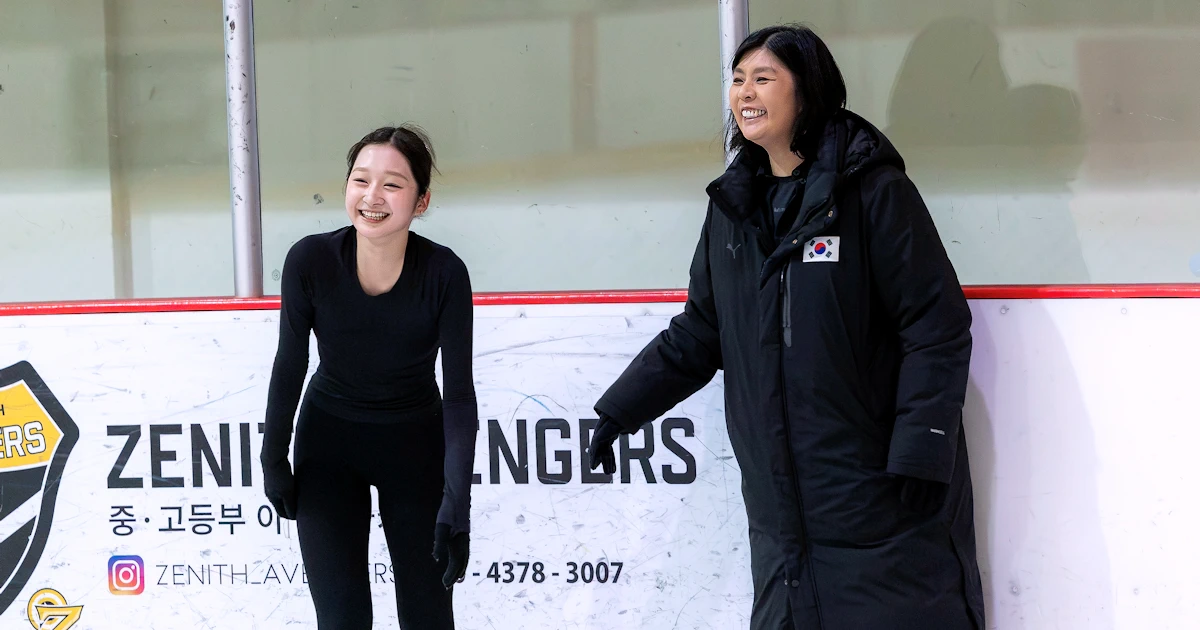
Coach Hyun-jung Chi works with Jia Shin during a training session at Zenith Ice Rink in Seoul. Photo © Warren Kim/Golden Skate.
Coach Chi on Jia Shin’s Growth
Coach Hyun-jung Chi has worked with Shin since childhood and has witnessed her growth from a promising young skater to an Olympian. She believes Shin’s greatest strengths extend well beyond her technical ability.
“I think Jia has a very clean and straightforward mindset,” said Chi. “She isn’t calculating, and she trains with the same steady attitude day after day. To me, Jia is like a human vitamin. Even when things are difficult, she has a bright smile that completely takes away my fatigue.”
As Shin prepares for her second senior season, Chi sees another opportunity for growth.
“She has successfully come through her first senior season. The 2026–27 season will be a time for her to establish herself as a mature senior skater. I think fans will see a different artistic expression from her this year—one that is more mature, more powerful and leaves a stronger impression.”
Related Info: