Relative difficulty of types of jumps: triples versus quads | Golden Skate

Relative difficulty of types of jumps: triples versus quads

Mathman

Zamboni Driver
Joined
Jun 21, 2003
The first triple jump was the 3-Loop. Presumably this was the easiest, at least for Dick Button in 1952. But for quads, the 4-Loop seems to be the hardest — it was the last done and almost no-one even attempts it currently.

In contrast the 3Lz is codified in the IJS as being the hardest (leaving the Axel out of account). But for quads the 4Lz has become relatively commonplace, while attempts at a 4Lo or 4Flip are exceedingly rare.

What do you think it is, technique-wise, about that extra revolution that accounts for this difference?
 
The first triple jump was the 3-Loop. Presumably this was the easiest, at least for Dick Button in 1952. But for quads, the 4-Loop seems to be the hardest — it was the last done and almost no-one even attempts it currently.

In contrast the 3Lz is codified in the IJS as being the hardest (leaving the Axel out of account). But for quads the 4Lz has become relatively commonplace, while attempts at a 4Lo or 4Flip are exceedingly rare.

What do you think it is, technique-wise, about that extra revolution that accounts for this difference?
Untechnical answer, but in my experience the loop takes more effort and strength, since it's a hop on the same foot with relatively no assistance from the free leg, unlike the Salchow where the free leg swings through and assists the rotation. Try hopping on one foot across a room, and then try it again only straddle-jumping (no revolutions) across the same distance from one foot to the other, left right left right left etc. Your leg will feel the difference. Perhaps the majority of skaters have enough leg strength to get the elevation (and thus the air time) needed for three revolutions but four is just too much.

About the flip I have no suggestions. I never completely mastered the triple flip but I thought that was just a personal quirk, getting on too deep an inside edge of the left foot and letting my weight drop onto the pick of the other foot.
 
(I)n my experience the loop takes more effort and strength, since it's a hop on the same foot with relatively no assistance from the free leg, unlike the Salchow where the free leg swings through and assists the rotation. Try hopping on one foot across a room, and then try it again only straddle-jumping (no revolutions) across the same distance from one foot to the other, left right left right left etc. Your leg will feel the difference.
It seems like edge jumps generally should require more leg strength, while toe jumps require more coordination among different parts of the body (picking in, together with upper body motion? Kristi Yamaguchi iwas an example of a skater who could do triple toes all day long, but the triple Salchow was her nemesis.

Tara reputedly destroyed her hip joints (forcing retirement at age 16) by endless repetitions of triple loops in practice. There is a story (I don't know if it is true or not) that she trained so obsessively that sometimes her coach had tp call in her mother to drag her pff the ice.
 
Last edited:
It seems like edge jumps generally should require more leg strength, while toe jumps require more coordination among different parts of the body (picking in, together with upper body motion)? Kristi Yamaguchi iwas an example of a skater who could do triple toes all day long, but the triple Salchow was her nemesis.
In general, I agree, but personal quirks or preferences play some part in which jumps an individual can or can't do easily. There seems to be no physical rule for that. I was a middle-of-the-pack national competitor and the Axel has always been my favourite and easiest jump. I just like to see where I'm going when I take off. But when most men were adding triple Axels in the 1980s, 1992 Olympic medallist and European champion Petr Barna, the first to do a quad (toe loop) in the Olympics, refused to attempt one. He said it made him feel as if he were taking a run and a jump off a cliff.
 
Two years ago 4Lo was very popular among Russian men.

Here this jump is considered comfortable for tall skaters. Many ended up switching to 4Lz and 4F because they are more expensive or could be done more consistent. I think Vladislav Dikidzhi said that it was too chaotic. Although 4Lo is still quite popular here.

I remember ISU was going to change the BV but that Communication was cancelled.

By the way, I can think of several top ladies who couldn't achieve a consistent 3Lo.
 
Last edited:
Maybe this is a bit off topic, but...

Lutz should be the more difficult as you jump against the outside edge. But since the mid-90s every skater have changed their skating into the Lutz, and goes back in a straight line and the change of edge happens just before the jump, which makes it easier.

Look at this 3Lutz from 1994 by Butyrskaya. (at ca 1:00)


She goes into the jump with a clear outside edge that makes a half circle across the ice, and then jumps in the opposite direction. It looks more awkward and it sure was more difficult.
But that was the way everybody did Lutzes back then and not everyone could master it.
Even Butyrskaya changed her Lutz later on and did the straight line thing...

That means, imo, that Lutz is an easier jump nowadays compared to Flip and Loop. And I think that reflects the fact that there is a lot of 4Lzs going around, but not that many 4Flips and 4Loops.

You can compare with Butyrskaya's straight line 3Lutz from 1999 (at 3:23). It looks so much easier.

 
Last edited:
The first triple jump was the 3-Loop. Presumably this was the easiest, at least for Dick Button in 1952. But for quads, the 4-Loop seems to be the hardest — it was the last done and almost no-one even attempts it currently.

In contrast the 3Lz is codified in the IJS as being the hardest (leaving the Axel out of account). But for quads the 4Lz has become relatively commonplace, while attempts at a 4Lo or 4Flip are exceedingly rare.

What do you think it is, technique-wise, about that extra revolution that accounts for this difference?
I would say the 4A is the hardest and last done. ;p

Of course depends on the competition too. For example at the GPF several quad flips (and only some quad loops) were attempted but at Europeans no quad flips and 3 quad loops were attempted.


Also depends on the skater too - for example, Daniel Grassl (who has some of the worst looking jump technique but still has the most number of successful quad loops ever, as in with +GOE) has done way more quad loop attempts than quad flip, Matteo Rizzo doesn't try a quad flip or lutz, Ilia Malinin has way more quad flip attempts than quad loop but can usually do quad loops when he opts to - even done them in practice at the tail end of combos.

4Z/4F is not only worth a bit more points but it's generally perceived as harder so that could explain why more skaters are doing it (and is seen as a benchmark for quads). If the loop was suddenly worth more than the quad lutz I'm sure you'd get more training attempts at it.

The quad loop is still quite difficult in terms of getting the timing right (not blowing out an edge) and generating sufficient height, whereas a vault pick from a flip or lutz can help generate that. However the jump mechanics of a loop jump make it easier than a flip or lutz because you can lift the free foot faster and snap into a backspin position quicker than a flip/lutz (which keeps the 'free/lead leg' on the ice), so extra height isn't as critical, nor do you have to worry about an edge call.

Also, personal preference, but the loop jump in general is not as exciting a jump as the others. I always viewed it as a bit of a 'weird' moment in a program when a skater was setting up a loop jump, as if it was a jump that a skater simply 'got out of the way'/"oh, and here comes the triple loop", whereas toe jumps are more exciting to watch because they usually get more height and flow (though some skaters like Hanyu and Kostner and currently Sakamoto, are quite good at making the loop an actual highlight).
 
Last edited:
It's interesting to look into Trusova's quad history.

4F seemed to be her most difficult, and she could never do it on an inside edge, it was always called !
Her 4S was inconsistent and she popped it a lot.
The most stable quads for her was the 4T and 4Lz.

She was never able to master the 4Lo, and interestingly, she could never really master the 3A either.

So if we take Trusova as an example, the 4Lo seems to be the hardest.
 
You can compare with Butyrskaya's straight line 3Lutz from 1999 (at 3:23). It looks so much easier.

Maria's greatest performance! :love:

Also, personal preference, but the loop jump in general is not as exciting a jump as the others.
Smooth as silk or shot-from-a-cannon! :rock:
 
It's interesting to look into Trusova's quad history.

4F seemed to be her most difficult, and she could never do it on an inside edge, it was always called !
Her 4S was inconsistent and she popped it a lot.
The most stable quads for her was the 4T and 4Lz.

She was never able to master the 4Lo, and interestingly, she could never really master the 3A either.

So if we take Trusova as an example, the 4Lo seems to be the hardest.

Trusova wasn't hit with an edge call ! or e for her 4F at 2022 EC and 2019 GPF.

While Trusova used to to +3Lo combos all the time before 2020, around that time she stopped doing loop combos internationally (and only did a solo 3L at 2021 Skate America). Not sure what happened but maybe she just became more comfortable/consistent with toe jumps (also her FS layout wasn't exactly amenable to +3L jumps once she incorporated more quads, but in her SP she opted for a +3T combo).
 
If the rules were changed to reflect what a textbook Lutz and Flip are supposed to be, aka less pre-rotation than a Loop/Salchow/Toeloop, then the amount of skaters who could get credit for a Quad Lutz or Quad Flip would significantly decrease. In that world, it's correct for the Quad Loop to be worth less.

Daniel Grassl (who has some of the worst looking jump technique but still has the most number of successful quad loops ever, as in with +GOE)

That mainly speaks to the ineptitude of the judges. Until this season his 4Lo's were all 1/4 short at best, and most of them were more than 1/4, given his 3/4 turn on the ice during the takeoff. I'm happy to see there's been some improvement this season, although he's still getting more points than he should: 2025 University Games - the 3Toe on the end of this 3Axel should be called < and his 3Lutz should get negative GOE, between the unclear edge entry and spindly takeoff and floppy air position.
 
In general, I agree, but personal quirks or preferences play some part in which jumps an individual can or can't do easily. There seems to be no physical rule for that. I was a middle-of-the-pack national competitor and the Axel has always been my favourite and easiest jump. I just like to see where I'm going when I take off. But when most men were adding triple Axels in the 1980s, 1992 Olympic medallist and European champion Petr Barna, the first to do a quad (toe loop) in the Olympics, refused to attempt one. He said it made him feel as if he were taking a run and a jump off a cliff.
This.
In addition to the direction preferences, there is the right leg and the left leg factor. Humans naturally tend to put more load on one leg than on the other; which means that both legs can't be equally fit as take-off legs. In track and field jumping disciplines, this can't cause a problem because only one leg is used as the take-off leg. In figure skating though, it can form a serious problem for skaters if they don't have appropriate loads in training or because of accrued injuries which may easily occur because of inappropriate loads in training.
Stephane Lambiel has a rather (in)famous experience here when mastering 3A with his "very slow" right leg. He fully accomplished this jump only in his thirties.
 
Last edited:
If the rules were changed to reflect what a textbook Lutz and Flip are supposed to be, aka less pre-rotation than a Loop/Salchow/Toeloop, then the amount of skaters who could get credit for a Quad Lutz or Quad Flip would significantly decrease. In that world, it's correct for the Quad Loop to be worth less.
I agree. Pre-rotation and full blade assist became standard - no negative GOE so today a loop is much harder to jump because cheating is not possible.
 
I agree. Pre-rotation and full blade assist became standard - no negative GOE so today a loop is much harder to jump because cheating is not possible.
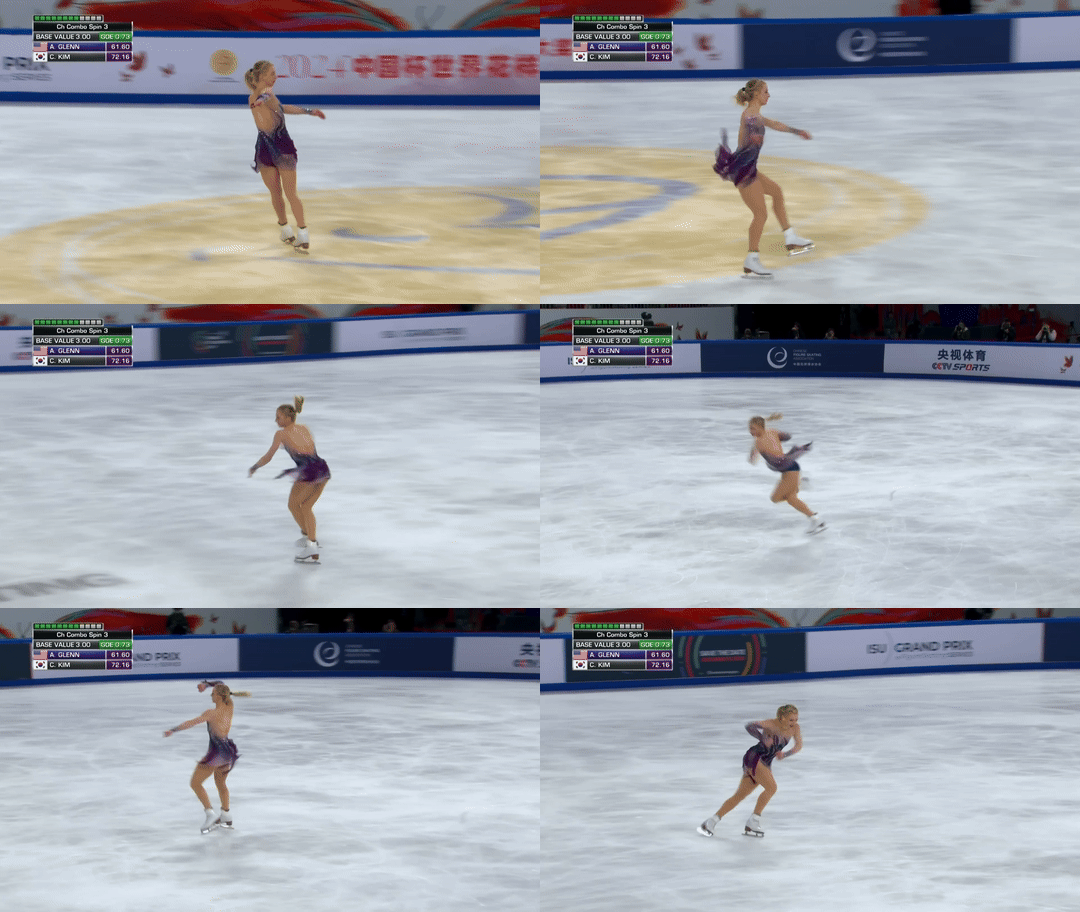
This is a Glenn 3Lo. Huge prerotation before she has left the ice. There's actually only two rotations there but they counted it as a triple.

Given she's travelling diagonally along the ice, it's nearly one full rotation before she's even left the ice.

Glenn3F.gif
 
Last edited:
Although officially Button's 3Lo was the first landed triple, it is possible that the 3S was landed by Lloyd Baxter already around 1939 - this is from Ryan Stevens and his book on jump history (Technical Merit). It would be interesting to know more about the attempt history, but that is not really possible for that period.

I did a bit of digging in the triples development based on YT videos and Stevens' book and the Skate Guard blog. After Button had cleared the first triple, other skaters who would attempt triples emerged. By late fifties David Jenkins and Ronnie Robertson had 3S and 3Lo. 3S was perhaps more common than 3Lo until early 60s when quite a few men cleared the 3Lo, 3T started to emerge in the late 60s. 3Lz was not attempted very much and neither was 3F.

By the early 1970s most top men seemed to have 3T, 3S and 3Lo, some had also 3Lz and 3F. 3A was attempted by a few skaters by 1978 when Vern Taylor hit it. Taylor was possible the first to get all six triples by 1980. And from then on having all six started to become the norm.

This is ofc anecdotal data, but 3S and 3Lo seemed to have been the easiest to get, then 3T, 3Lz and 3F and 3A maybe as the most difficult ones.

Quad history features 4T and 4S as the preferred jumps almost right from the start - slightly different from triples.

The third type to get attempted was 4Lz in 1997 and at least 4 skaters tried it before Brandon Mroz got the first clean one. It was also the third quad type that women tried and got clean. After 4T and 4S it is the third most attempted quad.

The next quad was actually 4Lo, Roman Serov around 2000-01. Again, at least 4 skaters tried it before Hanyu got it clean.

4F was tried the first time only in 2010 and Shoma was the second to try.

4A has now been attempted in competition by 3 skaters and 1 has it clean. Despite Dikidzhi's pretty good attempts, apparently he will not be going for it in competition (thanks for that tidbit @lariko!).

Only 1 skater has ever has ever gotten all quads clean in competition and no one else is getting near that because of 4A.

4Lz 1337 attempts, 823 fully rotated (62%), 541 with positive GOE (40%) - 81 skaters
4F 524 attempts, 360 fully rotated (69%), 252 with positive GOE (48%) - 44 skaters
4Lo 423 attempts, 207 fully rotated (48%), 146 with positive GOE (34%) - 54 skaters

Based on those figures, I'd say 4Lz does not deserve its high BV as the second most difficult quad. It is interesting that more skaters have tried 4Lo than 4F, but their success rates in getting even a fully rotated jump, let alone a really good one is much lower than 4Fs, so I would consider 4Lo as the second most difficult quad after 4A and before 4F.

ADD: I forgot to mention multiple jump types. Even if a skater would have all 6 triples/5 quads, they tend to have go-to jump types, in quads usually 4T and 4S. For example, Nathan had 5 but most frequently he jumped 4T, 4F and 4Lz, Ilia does 4T, 4Lz and 4S (also Trusova), Hanyu relied mostly on 4T and 4S with the occasional 4Lo, Zhou 4S and 4Lz with some 4T and 4F here and there.

E
 
Last edited:
Although officially Button's 3Lo was the first landed triple, it is possible that the 3S was landed by Lloyd Baxter already around 1939 - this is from Ryan Stevens and his book on jump history (Technical Merit). It would be interesting to know more about the attempt history, but that is not really possible for that period.

I did a bit of digging in the triples development based on YT videos and Stevens' book and the Skate Guard blog. After Button had cleared the first triple, other skaters who would attempt triples emerged. By late fifties David Jenkins and Ronnie Robertson had 3S and 3Lo. 3S was perhaps more common than 3Lo until early 60s when quite a few men cleared the 3Lo, 3T started to emerge in the late 60s. 3Lz was not attempted very much and neither was 3F.

By the early 1970s most top men seemed to have 3T, 3S and 3Lo, some had also 3Lz and 3F. 3A was attempted by a few skaters by 1978 when Vern Taylor hit it. Taylor was possible the first to get all six triples by 1980. And from then on having all six started to become the norm.

This is ofc anecdotal data, but 3S and 3Lo seemed to have been the easiest to get, then 3T, 3Lz and 3F and 3A maybe as the most difficult ones.

Quad history features 4T and 4S as the preferred jumps almost right from the start - slightly different from triples.

The third type to get attempted was 4Lz in 1997 and at least 4 skaters tried it before Brandon Mroz got the first clean one. It was also the third quad type that women tried and got clean. After 4T and 4S it is the third most attempted quad.

The next quad was actually 4Lo, Roman Serov around 2000-01. Again, at least 4 skaters tried it before Hanyu got it clean.

4F was tried the first time only in 2010 and Shoma was the second to try.

4A has now been attempted in competition by 3 skaters and 1 has it clean. Despite Dikidzhi's pretty good attempts, apparently he will not be going for it in competition (thanks for that tidbit @lariko!).

Only 1 skater has ever has ever gotten all quads clean in competition and no one else is getting near that because of 4A.

4Lz 1337 attempts, 823 fully rotated (62%), 541 with positive GOE (40%) - 81 skaters
4F 524 attempts, 360 fully rotated (69%), 252 with positive GOE (48%) - 44 skaters
4Lo 423 attempts, 207 fully rotated (48%), 146 with positive GOE (34%) - 54 skaters

Based on those figures, I'd say 4Lz does not deserve its high BV is has as the second most difficult quad. It is interesting that more skaters have tried 4Lo than 4F, but their success rates in getting even a fully rotated jump, let alone a really good one is much lower than 4Fs, so I would consider 4Lo as the second most difficult quad after 4A and before 4F.

E

Thank you for the stats. I am a bit conflicted with coming to such conclusions though I tend to agree to some extent.
1) the sample still remains low in my mind... not even a hundred skaters for each jump.
2) with the code of point giving the advantage to the lutz, if I were a skater with a relatively okay quad already, (toe or sal) I perhaps would be tempted to go for the lutz next because i may not have the goal of learning all of them and i may be aware that i may not land them very well but the higher base value is a better incentive. So yeah... I feel that this may be why we see this happening... it doesn't mean the jump is easier but a better investment.
3) Also, we talked about hips for the loop... maybe it is easier but skaters don't want to get injured so they do not bother with it.

The argument that makes me believe the loop may be harder is that it's not assisted with the toe pick so vaulting higher to get that extra revolution seems harder... So in some ways, I am conflicted between the mechanics of the jump versus the other 3 points i laid down higher
 
I have now 649 skaters who have attempted a quad in competition at least once since 1983. 511 have tried 4T and 297 4S. These two are the most popular combo if you go for two different types - 125 skaters our of 154 who have attempted two different quads.

Beyond 4T and 4S, the numbers drop quickly - everything beyond the 4T and 4S is obviously much more difficult and only a relatively small percentage of skaters go for them. 4Lz is the 3rd option if that is possible for the skater.

If the BV is the decisive matter, why the 4Lo and 4F are so rarely attempted? They are supposedly only "slightly" more difficult than 4T or 4S. If they are easier than the 4Lz, then learning them would already give more points. But most go for the 4Lz instead and also get it right.

Out of the 81 skaters who have attempted 4Lz, 45 (56%) have gotten it with positive GOE at least once. For 4Lo, 25/54 (46%) and for the 4F 28/44 (63%). With 4Lz, there are 18 skaters with 10 or more positive GOE jumps. Shoma and Nathan are the only skaters who have lots of good 4Fs (64 and 50 respectively), then its down to 10-15 with Grassl, Paniot and Ugozhaev (altogeter 5). With 4Lo, there are also 5 skaters with 10 or more good ones (Ignatov, Grassl, Uno, Hanyu, Lutfullin).

IMO, the interpretation of all these figures is that the 4Lz is somehow easier to master than the other two.

E
 
2005-06%2009-10%2015-16%2018-19%2022-23%
Quads1443,11522,95387,87439,877310,7
3T91319,7105420,2126918,5131217,3120816,8
3S58912,767312,976011,178910,473710,2
3Lo73515,85159,977611,383811,091112,6
3F79917,297318,7105615,4118715,6102914,3
3Lz91719,8111221,3141220,5147619,4146820,4
3A54611,873514,1106115,4125116,5108315,0
46435214687275967209

Got curious about triples and their significance in men's comps and used my trusted friend https://fses.sakuraweb.com/ to collect data. That database includes mostly senior internationals, major juniors and Japanese nationals. Obviously only IJS data and I decided to use 2005-06 as a starting point because before that the number of competitions using IJS was smaller. And then chose the season before the big change in jump scoring, one from the middle of the 2010s (before the first real quad explosion) and the last season the database contains. Shows the actual count and then also percentage which are easier to compare.

Increase in quads and 3As and decrease in all the other triples except 3Lz. Suprisingly little in most cases.

What this made me think was also the significance of the BV. Since most men's six different triples (at least the elite ones) are pretty consistent, it is possible for them to prefer the ones which bring most points, particularly 3A and 3Lz.

But with quads it is a little trickier since even most elite men usually only have 1 or 2 of them. You can't really pick and choose which ones to learn, maintain them in consistent form and use in competition, you take the ones you hopefully can do. (Except if you are Ilia Malinin.)

The BV for all jumps in the beginning of the IJS was quite low, for example 8,00 for 4T and 8,50 for 4S. By the end of the 2000s, they were raised to 9,80 and 10,30 but this did not encourage anyone to jump more quads or try the more difficult ones with the hopes of getting all those points. The major rearranging of jump scoring to encourage risk-taking was accompanied by even higher BVs and these put together did make quads more lucrative than before. However, increases in numbers happened very slowly and very few skaters tried the big jumps with even bigger BVs until mid-2010s. And even then the big favourite was 4Lz and not one of the easier difficult quads or the 4A which would have been the obvious choice if BV was considered.

The huge increase in attempting all kinds of quads and learning multiple types has happened only after the BVs for all quad types were lowered to current levels for the 2018-19 season. This happened maybe partly as a response to the repetition rules set at the same time and partly because it is perceived that more quads were needed to beat the elite skaters.

I would still argue that the types developed to competition consistency are not chosen simply by BV but rather by what the skater can do in the end.

E
 
The points system promotes good Lutz jumpers starting from an early age. I recall an interview with Vincent Zhou, who was more of an edge jumper himself, saying how the 3Lz was such an important jump in juniors. The result is that you're going to have a higher proportion of proficient Lutz jumpers among top seniors.
 
Back
Top