


- Joined
- Jun 21, 2003
I am sure that you will.Sakamoto also does something similar with her whole body when jumping the flip and lutz. I will investigate this later on.
Rebecca Moose said:Now all we need is for Koola King to weigh in on this debate.


Follow along with the video below to see how to install our site as a web app on your home screen.
Note: This feature may not be available in some browsers.
I am sure that you will.Sakamoto also does something similar with her whole body when jumping the flip and lutz. I will investigate this later on.
Rebecca Moose said:Now all we need is for Koola King to weigh in on this debate.

 . And like all of those women who continue skating after quitting with the quads, she still jumps triples.
27.08.2011Yana Yatsenko
26.12.2009Anastasia Bykova

Inspired by @Mathematician 's post earlier, I looked at my data on women's quads. 106 women since 1990 when Surya Bonaly attempted the first ones.
First jump types and success rates
4T: 66 skaters and 27 got good jumps (41%)
4S: 58 skaters and 25 got good jumps (43%)
4Lo: 6 skaters and 1 with good jumps (17%)
4F: 4 skaters and 3 got good jumps (75%)
4Lz: 12 skaters and 7 got good jumps (58%)
4T and 4S is the most popular combination with 22 of the 27 who have attempted two different ones, then 4T and 4Lz twice, 4Lo & 4Lz once and 4F & 4Lz once.
3 different quads by two: Lukashova 4S 4Lz 4T, Petrosyan 4T 4Lo 4F (order by number of jumps)
4 different quads by three: Prineva with 4Lz 4T 4F 4Lo. Samodelkina 4S 4T 4Lz 4Lo. Trusova 4T 4Lz 4S 4Lo (order by number of jumps)
Just based on these numbers, things look similar to men: most do 4T or 4S and then 4Lz is third. 4Lo and 4F are not popular, but 4F works better than 4Lo for those who try.
I thought the idea of different ages and different jumps was interesting and plotted the skaters according to their jumps and ages.
Then roughly by age group at start with bold those who have attempted quads in 2024 or 2025. In a range, the latter is the age at latest/last known attempt.
4T as only jump: 36 skaters (no date of birth for Yana Yatsenko - if you know, let me know!)
Start at 11 to 13 year olds: 20
(Sadaba 11, Lebedeva Daria 11, Chernobavskaya 11-12, Berestovskaya 11-13, Dokukina 12, Kachanova 12, Krivonosova 12, Kurlina 12, Lodoba 12, Parsegova 12, Sarycheva 12, Titova Ekaterina 12, Astashenkova 12-13, Glagolevskaya 12-14, Shimada 12-16, Nosova 13, Shcherbinina 13, Tarakanova 13, Tuguzbayeva 13, Vasilyeva 13)
Start as 13-14 to 15 years old: 10
(Kravchina 13-14, Ponteleenko 13-14, Zakharova 13-15, Zinina 13-15, Sadkova 13-16, Chereneva 14, Labutina 14, Levito 14, Trofimova 14, Khusnutdinova 15)
Start at 16 or later: 5
(Sinitsyna 16-17, Chiba 17, Sumiyoshi 18-21, Sakamoto 19, Tuktamysheva 23)
4S as the only jump: 33 skaters (no date of birth for Anastasia Bykova - if you know, let me know!)
Start at 9 to 13 year olds: 19
(Korchaznikova 9-11, Askarova 10, Stotskaya 10-12, Dmitrieva 11, Tsaregorodtseva 11, Anashkina 11-12, Lubkova 12, Martynenko 12, Orekhovskaya 12-13, Pogrebitskaya 12-13, Zigorenko 12-13, Lebedeva Milana 12-14, Milto 12-14, Titova Sofia 12-14, Gorbacheva 12-17, You Young 12-17, Monogarova 13, Nasybullina 13, Rebrova 13)
Start as 14 to 15 year old: 8
(Korobitsina 14, Tsipukhina 14-15, Ando 14-21, Agaeva 15, Denisova 15, Muravyova 15, Paramonova 15, von Felten 15)
Start at 16 or later: 5
(Hicks 16, Cohen 17, Yamashita 17, Kihira 17-18, Tursynbaeva 19)
No great differences here as far as I can see?
The other types as only quad:
4Lo: Safonova 20-21
4Lz: Sarafanova 12-13, Ezhova 13, Liu 14, Nelyubova 14-15
Then those who jump two quads, usually 4T and 4S, and their ages, 22 skaters.
8 are doing predominantly 4Ts
(Zaikina 10-11, Zhilina 11-14, Marasanova 12-14, Kalin 12-16, Akatyeva 12-17, Pleskacheva 13-14, Mazur 13-15, Valieva 13-15)
6 are doing predominantly 4Ss
(Gordeeva 10-15, Litvincheva 11-12, Streltsova 11-12, Kostyleva 11-13, Utkina 11-13, Andreeva 14)
8 are doing roughly the same number of both
(Sopova 10, Chistyakova 11, Bazylyuk 11-13, Kalugina 11-14, Khromykh 13-15, Kisel 14, Dzepka 14-15, Bonaly 16-22)
No clear preferences here either as far as I can see except maybe the 4T preferring skaters continuing later with quads? (Though so many of them are still active that it is not a very reliable conclusion.)
2 do 4T 4Lz, both with more 4Ts (Dvoeglazova 12-16, Lagutova 13-14)
1 4Lo 4Lz (Morozova 12-13)
1 4F 4Lz (Shcherbakova 14-17)
3 different quads
4S 4Lz 4T (Lukashova 11-13)
4T 4Lo 4F (Petrosyan 14-17)
4 different quads
4Lz 4T 4F 4Lo (Prineva 10-14)
4S 4T 4Lz 4Lo (Samodelkina 11-16)
4T 4Lz 4S 4F (Trusova 13-18)
So maybe this: those who jump more than one type of quad tend to keep on jumping maybe a little bit longer than the ones who try only one?
Only few try quads of any type after 15 years of age, let alone when they would qualify for senior with the current rules. (Later on jump quality also tends to be low.)
And Sinitsyna did try two 4Ts, she did not only talk about it
E
The rotation of a jump is measured by when the blade leaves and returns to the ice, not by the body position.
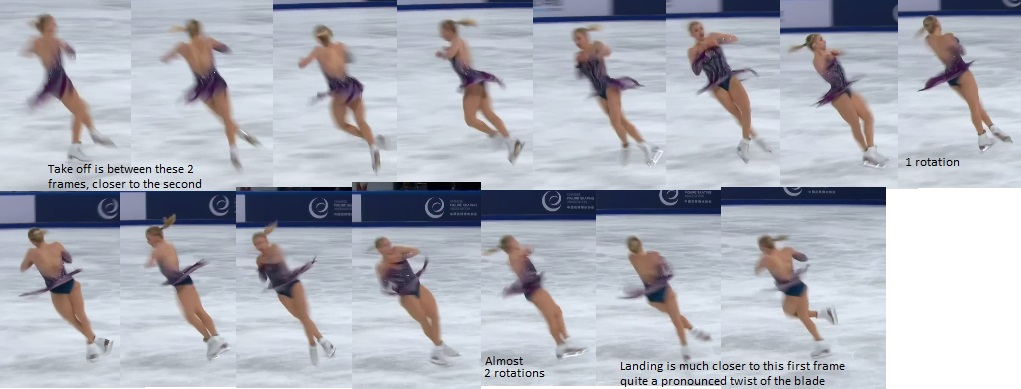

Illegal? By what rules?illegally prerotates
More than 180 degrees is illegal.Illegal? By what rules?
Keeping in mind that tech panels rules specifically do not permit reviewing suspected prerotation in slow motion, let alone frame by frame.
Good suggestion, thank you. An unfiltered numbering of total attempted quads partitioned by age group could be useful, if anyone provides that please mention me!The age grouping on attempted quads is useful info.
The rulebook is incomplete. There is no such thing as standardized jump technique.Illegal? By what rules?
The hivemind can do literally whatever it wants. This is not a skating-isolated phenomena. What can not be done however is your attempted reasoning with it while not simultaneously utterly wasting your time.I don't think you can dismiss the accomplishments of an entire nation 9,000km in diameter, 143 million people for one positive test from a common over the counter substance that experts aren't sure even enhances performance.

Maybe this needs to be addressed. This thread has been quite educational because we're all trying to decipher the rules and coming to completely different conclusions. Maybe there needs to be specific rules applying to the type of jump whether a lutz or a loop for instance. If a lutz is done correctly only a contortionist could prerotate, but it's quite easy to hide a prerotation with a loop with that arc of the body movement (and with a salchow). We don't really know where the jump starts.The rulebook is incomplete. There is no such thing as standardized jump technique.
Uwoa and I had an insane discourse about this on Discord. I ended up writing a 15 page treatise on font size 10 in google docs breaking it down: "Applying Occams'z Razor in Deriving Principles of Figure Skating Jump Rotation Analysis". @AxelLover was a part of this also. In summary the work argued my original (now revised) position that entry and exit should be defined based on when there is a loss or gain of distinct edge. She did manage to find some issues in my method. I still though think her perspective is also incomplete. We went back and forth for a few days after that. No consensus was reached. I have a lot of ideas brewing in my mind about standardizing rotation and I've nuanced my perspective on this a lot. For example, Uwoa convinced me that entry and rotation initiation can and should be defined before any part of the blade leaves the ice; before I would be against such a suggestion but now I am very sure its most accurate. Of course a standard pre-rotation allowance would be implemented in conjunction with that per jump variety (as you suggest). I'll say I was before and still am 100% sure defining rotation by the last or first partial contact (depending on take-off/landing) (this was Uwoa's position) is fallacious. Rotation standardization is a project I hope to begin within the next couple of months, though I have some other things at the forefront currently.Maybe this needs to be addressed. This thread has been quite educational because we're all trying to decipher the rules and coming to completely different conclusions. Maybe there needs to be specific rules applying to the type of jump whether a lutz or a loop for instance. If a lutz is done correctly only a contortionist could prerotate, but it's quite easy to hide a prerotation with a loop with that arc of the body movement (and with a salchow). We don't really know where the jump starts.
Alas, I won't be able to read it.font size 10
It would be an onerous read anyways. Some were unimpressed with the linguistic drudgery.Alas, I won't be able to read it.
Your thought experiment isnt totally analogous because the top doesn't have a defined orientation. There would be no such thing as an under or over rotation. The question concerning skating is at what point in the entry do we begin deducting degrees from what is intended to be a multiple of 360, plus 180 for an Axel, and at what point do we stop counting any further movement from the same expected value.I have to admit that it's a tricky business. The skater is turning on the ice, continues to turn in the air, and keeps on turning on the landing. I think of the following experiment. We set a top spinning on the floor. Then we snatch the floor out from under it. It continues spinning until it lands of the floor of the apartment below, where it continues to spin. Modern technology could make very precise measurements of all this.
Absolutely. Jumping in skating should be aesthetics first. I completely agree with you. I am careful not to mechanicalize art despite also enjoying numbers as you do. That being said, it seems like a different question of GOE or even PCS (as it contributes to the holistic impression of the program, even if we don't consider jumps directly for PCS) rather than the parameters by which rotation is actually defined (which I think is a question approachable in a completely technical manner).But it would be a boring endeavor, neither sport nor art, I lean more toward the direction of "how does it look to the eyes of expert and experienced judges" as the lesser of two evils, even while recognizing that the battle against bias and dishonesty will never be won.
As much as I like numbers, the best thing about post #21 above is the videos of Valieva's quad. Intensely satisfying, surpassingly beautiful.
Not to nitpick, but I think that it would be a trivial matter technologically to determine whether the top under-rotated or over-rotated a quad. Between the instant that the first floor is snatched away and the instant when she lands on the next floor below, how many degrees of rotation did she achieve? Was it 1440?It would be an onerous read anyways. Some were unimpressed with the linguistic drudgery.
Your thought experiment isnt totally analogous because the top doesn't have a defined orientation. There would be no such thing as an under or over rotation. The question concerning skating is at what point in the entry do we begin deducting degrees from what is intended to be a multiple of 360, plus 180 for an Axel, and at what point do we stop counting any further movement from the same expected value.


You're mistaken about both her takeoff and landing points, and don't show good knowledge about mechanics and counting rotation with these comments. Someone gliding into a jump is not necessarily the direction the jump rotation has to start, and a "twist" on the landing (which in this case wasn't even caused by a big turn on the ice, rather her landing going slightly to the inside edge) is not indicative of the total rotation.half a rotation is allowed before take off and is effectively included, but take off is another 90 degrees after this threshold
There is far more "thorough" footage of this jump out there, which you continue to not look at. She landed at least 1/4 past the point where she left the ice, it was a sufficiently completed jump, and not hard to see on the Eurosport coverage that has a better, closer camera view.No-one on the internet probably posts as thorough footage as I do.
True. The orientation would be defined by its take-off. Also, the top is a rigid body, so all points have the same period, but a skater is not so. I guess you would just be looking at the blade though (some people suggest the whole body's position is relevant).Not to nitpick, but I think that it would be a trivial matter technologically to determine whether the top under-rotated or over-rotated a quad. Between the instant that the first floor is snatched away and the instant when she lands on the next floor below, how many degrees of rotation did she achieve? Was it 1440?
Interesting. I was not thinking of this issue dynamically. I've thought of a gyro but not a pressure sensor (so I was still thinking geometrically). How would the device measure the pressure specifically for jumps? I imagine there is a lot of variance with the skater's weight distribution anywhere throughout the program. What reading would it be giving when a take-off occurs? I suppose the jump reading would have a specifically drastic spike, and a long period, but the skater is also turning very quickly so I think you would have to define it as being right at the start of the spike in reading or else it would be too easy to get away with over-rotations (or under-rotations) especially if you train your technique specifically for that device. Hm, I really do think the dynamic approach allows for a lot of potential sneaky techniques and maneuvers... which would affect aesthetics severely. It will take a lot of practical testing and trouble-shooting. My skepticism increases the more I ponder this, but I am still very open to it. I do like the idea of your definition's contingency on weight distribution, it just sounds really difficult to implement strictly and accurately (not taking the measurement itself, but making sure it actually reflects what we intuitively expect from a good jump).In figure skating, the take-off point is when the skater's weight is no longer supported by contact with the ice and the landing point occurs when it is again. The air time is what's in between. In principle this would be easy to determine by unobtrusive and inexpensive pressure sensors attached to the boot. (Yuzuru Hanyu write his maters thesis on this topic.)

When I first took an interest in figure skating as a newby spectator, naturally I couldn't tell one jump from another. My friends told me that you can always tell an Axel because the skater is facing the wrong way. This was only moderately helpful because of pre-rotation on toe-loops.When discussing the difficulty of the lutz versus the flip one more thing that also can come into play is that men seem to have edge problems on the flip more often than on the lutz.


