1985
USSR CHAMPIONSHIPS
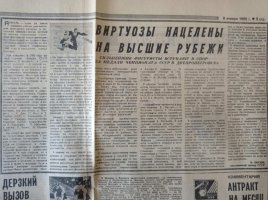
VIRTUOSOS ARE AIMED AT NEW FRONTIERS
(the article published in russian 'Sovetskiy Sport' on January 8, 1985)
THE STRONGEST FIGURE SKATERS ENTER THE STRUGGLE FOR MEDALS OF THE USSR CHAMPIONSHIPS IN DNIPROPETROVSK
January is one of the peak months of the winter season for figure skating masters. And the current January is special in many respects. Soviet figure skaters are conducting intensive preparation not only for the upcoming European and World Championships, but also for the future Winter Olympics of 1988 in the Canadian city of Calgary.
As is known, in 1984 at the Sarajevo Olympics, the USSR team won 5 medals, including a gold one — in pair skating. Our juniors also performed successfully: following the World Championships in Colorado Springs, they had three gold medals in their collection (in pairs, in women's singles, and in ice dancing).
Today, it is important to clarify the modern trends in the development of world figure skating. The first of these is a broad change of generations in national teams. Such famous masters of figure skating as the English pair J. Torvill and C. Dean, Americans S. Hamilton, E. Zayak, R. Sumners, brother and sister Carruthers (USA), Canadians B. Underhill – P. Martini as well as R. Cerne, N. Schramm (FRG) have left competitive sports and turned professional. In their place come new waves of talented masters. Their new leaders, without doubt, will have even more complex programs. If at the Lake Placid Olympics the leaders in single skating performed several triple jumps, then in Sarajevo we saw both quadruple jumps and 3.5-turn jumps in combinations for men, and the triple lutz and flip for women. If earlier in pair skating it was sufficient for the strongest pairs to perform a parallel jump in 2.5 rotations, then now it is necessary to include in the program one or two triple jumps, complex twists, and lifts.
However, to achieve success in Calgary, it is necessary to surpass previous levels of mastery. All-around at the highest level — this is the key to success in modern single skating. Current leaders of our national team should perfectly do compulsory exercises, have in their arsenal the most complex combinations of jumps and virtuoso spins in the short program, include four-rotation jumps and combinations with triple axels.
The judges and spectators expect from the skaters new programs that would meet high artistic criteria. Music, choreography must be organically combined with technical skill. It is precisely on the basis of elements of the highest complexity that the best figure skaters create a kind of micro-performance with an original concept, reflecting the individuality of the athletes.
In ice dance, there is a clear trend toward narrative-driven compositions using cohesive musical works. Coaches are focusing heavily on personalizing performance styles and offering original interpretations of musical themes.
Olympic, World, and European silver medalists Natalia Bestemyanova and Andrei Bukin, under the guidance of coach Tatiana Tarasova, created a new free dance set to Georges Bizet’s "Carmen" (specifically the Rodion Shchedrin transcription for ballet). This dance highlights the duo's emotional, dynamic style and showcases their high level of choreographic movement.
Olympic and European bronze medalists Marina Klimova and Sergei Ponomarenko (coached by Natalya Dubova) prepared a compelling free program as well. Their dance, unified by Latin American rhythms, is elegant and distinguished by a unique directorial vision and impressive skating technique.
The 1985 season also features vibrant new dances from Olympians Olga Volozhinskaya and Alexander Svinin (coach Elena Tchaikovskaya), medalists of international competition in England Natalia Annenko and Genrikh Sretenski (coach Lyudmila Pakhomova), and the young pair Maya Usova and Alexander Zhulin (coach Natalya Dubova).
In pair skating, the top duos continue to push technical boundaries, incorporating side-by-side double Axel and triple jumps, double and triple twist lifts, and triple throw jumps into their programs.
Olympic pair skating champions Elena Valova and Oleg Vasiliev (coached by Tamara Moskvina) have prepared a new free program set to Fiyar Yarullin's music for the ballet "Shurale" (choreographed by Alexander Matveev). This program is a bold attempt to create a unique athletic-choreographic miniature. Its segments are tightly woven into a cohesive narrative while strictly maintaining a balance between technical elements and aesthetic quality.
Sarajevo Olympic medalists Larisa Selezneva and Oleg Makarov (coached by Igor Moskvin) are also successfully preparing for the upcoming season. Their short program features an original concept with engaging rhythm changes, impulsive execution, and unique plasticity. Their free program, set to music from the ballet "The Marriage of Figaro," is packed with side-by-side 2.5 and 3-rotation jumps, triple twists, and highly complex combinations of lifts and spins.
Contenders for the USSR national team in this discipline include students of Irina Rodnina: Veronika Pershina and Marat Akbarov, and Irina Bekker and Sergei Likhansky. They are joined by coach Tamara Moskvina’s students, Elena Bechke and Valery Kornienko, winners of the international "Coupe des Alpes" competition.
In men's singles, European champion Alexander Fadeev is showcasing a new short program set to Russian melodies, featuring a unique triple Axel combination. In his free skate, performed to modern pop tunes, he reveals his vast technical range, fully demonstrating his performance artistry and expressive plasticity.
Experienced skater Vladimir Kotin, who made a strong impression with his free program at the last World Championships, along with Junior World Champion Viktor Petrenko, are determined to fight for top spots at the European and World Championships. Their plans for the new season include mastering 3.5 and 4-rotation jumps.
In women’s singles, Soviet skaters Kira Ivanova (coach Vladimir Kovalev) and Anna Kondrashova (now training under Stanislav Zhuk) made history in 1984 by winning their first podium spots at the most prestigious international events—the Olympics and the World Championships. Now, their task is to solidify those positions and mount a serious challenge for leadership against world-renowned skaters like Olympic champion Katarina Witt (GDR), Tiffany Chin (USA), and Midori Ito (Japan).
Sverdlovsk native and USSR champion Natalia Lebedeva (coach Igor Ksenofontov) has also closed in on the lead group. By taking second place at the international "Moscow News" tournament, she proved she possesses undeniable strengths in the all-around competition.
Today, the USSR Figure Skating Championships open in Dnipropetrovsk, featuring all candidates for the national team. This tournament will allow us to fully assess not only the caliber of our leaders but also the strength of our reserves, as the best juniors—including winners and participants from the recent World Junior Championships in Colorado Springs—have been cleared to compete in every discipline. As a result, these competitions promise to be incredibly exciting across the board.
V. Piseev,
Honored Coach of the USSR.







 !
!
