Archive of newspaper articles | Golden Skate

Archive of newspaper articles

1979

European Figure Skating Championships in Zagreb

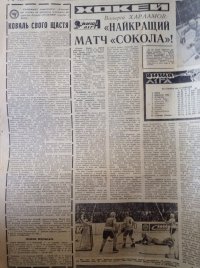
"School" of Volodymyr Kovalyov

Translated from a Ukrainian newspaper "Sportyvna Hazeta" article (dated February 1, 1979)

Zagreb (TASS) — Athletes from 20 countries are participating in the European Figure Skating Championships, which began on January 30 in this Yugoslav city.

The competition opened with the men's compulsory figures.

Top performers:
1. ex-world champion Volodymyr Kovalyov
(USSR) — 40.56 points (sum of places: 13). Skated with a bandaged leg.
2. title holder Jan Hoffmann (GDR) — 40.92 (15)
3. Igor Bobrin (USSR) — 37.92 (38)
6. Robin Cousins (UK) — 37.24 (53)
12. Kostyantyn Kokora (USSR) — 35.24 (90) after multiple mistakes

The Soviet team has received wide media attention, with local newspapers publishing numerous articles.

The main gold medal contenders according to "Viesnik" are Volodymyr Kovalyov, Natalia Linichuk/Gennadiy Karponosov, Irina Moiseyeva/Andriy Minenkov, Marina Cherkasova and Serhiy Shakhrai.

Notable absence: Olena Vodorezova (USSR) — withdrew due to illness, potentially opening the way for the title holder GDR skater Anett Poetszch.

Atmosphere in Zagreb: The city is fully immersed in the championship. During the event, the newspaper Večernji list held a figure skating art contest with great participation, because in Zagreb for 105 years the club of "Picturesque skating", as it used to be called, has existed. On the improvised ice rink of the river Sava the first competition took place in 1874. Instead of medals male winners received ... a bottle of champagne, female winners - flowers, and children - chocolates!

Nowadays Zagreb has become the training centre for figure skaters of Yugoslavia. Here a 14-year-old Sanda Dubravčić lives. She is considered a major hope for Yugoslav figure skating.

Media presence: Over 180 journalists arrived in Zagreb to cover the championship. Notable guests included:
  • Peggy Fleming
  • John Curry
  • Emmerich Danzer
  • Zsuzsa Almássy
23 European countries, along with the USA, Canada, Japan and ... Jordan, are covering the events of the championships on TV.

The event like this is held in Zagreb for the second time. The first was in 1974. Then the audience applauded to the brilliant skillfulness of Irina Rodnina and Oleksandr Zaitsev, Liudmila Pakhomova and Oleksandr Gorshkov.

Pairs Short Program: Best result shown by Marina Cherkasova and Serhiy Shakhrai (USSR), who earned top marks and are in front of their closest competitors by 2 points.

1751127625488.jpeg
 
Last edited:
1979

European Figure Skating Championships

GROWN UP TO THE PEDESTAL
(the article published in Ukrainian 'Sportyvna Hazeta' on February 3, 1979)

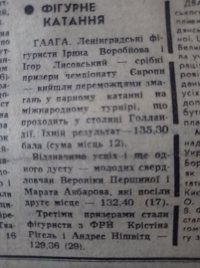
ZAGREB, (TASS), Brilliant victory of Marina Cherkasova and Sergey Shakhray ended the competition of pairs. Leningrad residents Irina Vorobyova and Igor Lysovsky became vice-champions of Europe, another our couple – Sverdlovsk residents Marina Pestova and Stanislav Leonovich - fourth. The result, of course, cannot but satisfy all figure skating enthusiasts in our country.

The main birthday-makers were, of course, Cherkasova and Shakhray. A 14-year-old schoolgirl and a 20-year-old student at the institute of physical education continued an uninterrupted series of victories of Soviet couples at the European championships, which began in 1965 by Liudmila Belousova and Oleg Protopopov. Here, in Zagreb, Marina and Sergey took over from Irina Rodnina and Alexandr Zaitsev.

And here they are standing on the top step of the podium and the president of the International Skating Union Jacques Favard presents them with gold medals. In their honor the Anthem of our Fatherland is played.

“Marina and Sergey have earned the championship honor. They are clearly stronger than everyone’, said Alexandr Zaitsev, who was among the Soviet tourists on the on the tribune of the sports palace. “From myself and Irina, who probably saw everything in Moscow on television, I congratulate you and wish you success at the world championship in Vienna”.

Yugoslav newspapers highly praised the performance of Cherkasova and Shakhrai. They noted that the athletes had a big advantage already after the short program, and then confidently performed all the elements of their free skate and among them the "branded" parallel triple jump. The result of the new champions is also impressive - 145.26 points (total places - 9). Vorobyova and Lysovsky - 138.98 (23). Bronze awards went to the skaters from the GDR Sabine Baess-Tassilo Thierbach - 138, 26 (23). Here, as you can see, there was a struggle of equals.

When it was night in Moscow, the winners had still one more exam in the press room conference.

Marina and Sergey worthily repelled the one and a half hour ‘attack’ of journalists.

- How did you manage to grow more than 10 cm so fast? - Cherkasova was asked.

- Some referees were not happy with the height difference between Sergey and me. So, I tried not to upset them anymore, - replied Marina, - But in general, I am engaged in figure skating, not basketball.

We are not going to stop at what we have achieved, we know that we still have many shortcomings, - said Sergey Shakhrai. - We will try to reduce them by the world championship, where we are preparing to fight for the highest title.

A fierce battle was fought in the men's singles. After the short program, which was best performed by Robbie Cousins, last year's European champion Jan Hoffman from the GDR came out on top - 81, 84 (12). Muscovite Vladimir Kovalev had the second sum - 81, 48, Cousins was third, Igor Bobrin - fifth, (16), Konstantin Kokora - eighth.

The free program did not change the situation. Hoffmann won again. Kovalev is the silver medalist. We remind you that he performed after an injury that was successfully treated just before the championship.

The compulsory figures were performed by women. The leader is the world champion Anett Poetszch (GDR). Our participants Kira Ivanova and Natalia Strelkova took, respectively, thirteenth and seventeenth places. But the dancers, as always, are a delight. Here, Natalia Linichuk and Gennadiy Karponosov are confidently leading the way.
1751126764955.jpeg
 
Last edited:
1979

European Figure Skating Championships


WINGED DANCE

(the article published in Ukrainian 'Sportyvna Hazeta' on February 6, 1979)
ZAGREB. TARS. The victory at the current continental championship of the Soviet dancers Natalya Linichuk and Gennady Karponosov was convincing. Last year's world champions made the lap of honor for the first time as European championship winners. They were accompanied on this pleasant ice journey by the silver medalists of the competition, Muscovites Irina Moiseeva and Andrey Minenkov, and the bronze medalists, the Hungarian duo Kristina Regoesczy/Andras Sallay.
- We went to Zagreb with a special feeling, - said Linichuk. - After all, it was here that we made our debut at the European Championship-74 and became bronze medalists. However, we have not yet managed to win at these competitions.
- We tried not just to win, but to defend our positions in the interpretation of ice dancing, - added Karponosov. - I mean the combination of high technique with great emotional intensity. We also pay great attention, so to speak, to the sportsmanship of our type, which allowed it to get into the Olympic program. On the evening of the dances, numerous spectators were not mistaken in their hopes of seeing a bright spectacle on ice. If the success of Linichuk and Karponosov, who were leading by a large margin after the compulsory program, did not cause any doubts in anyone, then the fight for the second place this time was quite stubborn.
Linichuk and Karponosov, in their free composition "Evolution of Dance" - a kind of fantasy to the rhythm of tango, modern Spanish dance, blues and rock and roll - collected the most magnificent bouquet of applause and champion scores from the judges from 5.8 to 5.9 for both technique and artistry.
The judges liked Moiseeva and Minenkov a little less than usual. However, the audience and experts had a different opinion. However, it should be noted that the partner made a mistake. Only the computer at the University of Zagreb determined that Moiseeva and Minenkov became the vice-champions of Europe, and the bronze medalists were the Hungarian dancers.
The Zagreb newspaper "Sportske Novosti" writes that Tatyana Tarasova's students demonstrated a very expressive free composition. And Linichuk and Karponosov, as the entire press notes, brought real pleasure to sports fans.
Karponosov first “invited” Linichuk to a dance in 1972. According to their coach, Elena Chaykovskaya, the athletes have achieved complete mutual understanding over the years of stubborn training and are now in the prime of their creative powers. Natalia turns 23 on February 6. Last year, along with the world champion medal, she received a diploma from the Institute of Physical Education, where she is currently studying for a postgraduate degree. Gennady is six years older than his partner. He is a postgraduate student at the Faculty of Economics of Moscow State University, from where one of the many congratulations to the winners came. "Now our collection is only missing an Olympic medal, but for now we are thinking about the nearest starts - at the World Championships in Vienna," say the athletes.
According to experts, the fifth place of the debutants of the European Championship - Sverdlovsk athletes Natalia Karamysheva and Rostislav Sinitsyn - can be considered a significant achievement.
Unfortunately, in the absence of Elena Vodorezova, our single skaters failed to perform adequately. If the 10th place of debutant Kira Ivanova is a fairly decent result, given the conservatism of the referees and some stiffness of the athlete when performing extremely complex elements, then the 17th place of Natalia Strelkova is a serious failure. After all, she was ninth in similar competitions last year.
Annette Poetszch from the GDR became the European champion for the third time in a row. Dagmar Lurz from West Germany won silver, and Swiss figure skater Denise Biellmann won bronze.
The tournament in Zagreb brought the Soviet athletes two gold and three silver medals. The GDR team has 2 gold and one bronze medal. We retain our advantage in the pair events, and our GDR rivals once again confirmed the seriousness of their Olympic intentions in single skating.
 

Attachments

  • 1751297519803.jpg
    1751297519803.jpg
    233.9 KB · Views: 3
Last edited:
1979

Japanese Figure Skating Championships

HOPES OF JAPANESE FIGURE SKATERS

(the article published in Ukrainian 'Sportyvna Hazeta' on February 22, 1979)

TOKYO. The 47th Japanese Figure Skating Championships concluded at the Shinagawa Indoor Skating Rink in Tokyo. Emi Watanabe took first place in the women's singles for the seventh time in a row. Mitsuru Matsumura beat last year's Japanese champion Fumio Igarashi. The following pairs also climbed to the top of the podium: the sports pair Kyoko Hagiwara - Hisao Ozaki and the dance pair Yumiko Kage - Tadayuki Takahashi. These skaters will perform at the World Championships in Vienna in March.
A TASS correspondent met with Emi Watanabe and asked her to answer questions about preparing for the World Championships and share her thoughts on the world's strongest skaters.
- Since 1977, I have been training under the guidance of the famous Carlo Fassi, - the athlete said, - so most of the year I am in the USA, in Denver (Colorado), where he works. Training is held every day, except Saturday, for six hours: four "school" workouts and two - a free program. In April, I return to Tokyo. My mentor, Fumie Fujimoto, is a gymnastics coach (her husband is the Montreal Olympic gymnastics champion, Xiong Fujimoto), but in addition to gymnastic elements, we practice ice jumping with Fumie and pay a lot of attention to athletics, primarily running.
- What are your hopes for the Vienna World Championships?
- I'm fighting to get into the top five strongest figure skaters (I was eighth in Ottawa). And another small dream is to clearly perform the triple jump at these competitions, which I pulled off at the Japanese championship.
- Who do you consider the main contenders for the title of "number one figure skater" of 1979?
- I think that at the next world championship the favorite will be the Swiss figure skater Denise Biellmann.
- Your ideal figure skater?
- Janet Lynn. I am very impressed by the manner of performance on the ice of this American athlete.
- What are you passionate about besides figure skating? - I ask a 19-year-old second-year student at the Faculty of International Relations at Jioji University in Tokyo.
- Of the other sports, I like tennis and water skiing the most. I like reading books and listening to modern music.
Since Minoru Sano, who came third at the 1977 Tokyo World Championships, left amateur ice skating for ballet, Fumio Igarashi has been the leader of the Japanese men's team (although he is being successfully challenged by 21-year-old Senshu University student Mitsuru Matsumura). Igarashi came seventh at the 1978 World Championships.
- Is your preparation for the next world championship different from training in previous seasons? - I ask Fumio Igarashi, a 20-year-old student of the Faculty of Economics at Keio University.
- No, it's not different. As usual, I train six days a week ... Figure skating is becoming more and more difficult and interesting every year, so you have to constantly strive for new goals. Each new world champion surpasses his predecessor ... As for my personal plans - I would like to perform more successfully in Vienna than at the previous world championship.
- Who do you think figure skating fans will see on the podium in Vienna?
- In ice dancing, the Soviet pair will certainly lead. In the other disciplines, the competition will be fierce, and it is difficult to predict the results. The last time I had the opportunity to watch Soviet skaters in Japan was in the fall of 1978, but those were demonstration performances, which, of course, do not give a complete idea of the level of training of the athletes.
- Who do you look up to in figure skating?
- I really like Canadians Ron Shaver and Toller Cranston.
- What are your hobbies, besides figure skating?
- Painting. I paint portraits and landscapes in oil.
- What can you say about your plans for the future?
- My goal is to get to the 1980 White Olympics in Lake Placid and perform there at full strength. In addition to studying at the university, I will continue to engage in figure skating and other sports: swimming, tennis. As you can see, my sports hobbies are not limited to winter sports. Therefore, I am also looking forward to the Olympic Games in Moscow.
GERONIN, TASS correspondent.
1751453644420.jpeg
 
Last edited:
1979

World Figure Skating Championships

Special correspondent of "Sportyvna Hazeta" Georgy KUZMIN reports from the world figure skating championship:

EVERY BIRD HAS ITS OWN SONG

(the article published in Ukrainian 'Sportyvna Hazeta' on March 15, 1979)

Where did the composure of the Viennese people go when, after a huge break, they saw their famous compatriots on the ice again? To Strauss's "Blue Danube", Regina Heitzer, as fragile as she was 15 years ago, circled in the arms of Emmerich Danzer, and Sapporo's triumphant Beatrice Schuba accepted roses from Wolfgang Schwarz...
This happened during the opening ceremony and caused a storm of emotions in the stands. The head of the organizing committee, Dr. Oskar Mandl, jokingly suggested that only four of them be included in the participants, although the 69th World Championships already brought together a record number of skaters in history - 128 from 22 countries. The joke, however, hid a bitter irony. The hosts are passionately dreaming of a revival of their former glory, but for now they are forced to limit themselves to the memories... We will follow in the hot footsteps of the first day, the program of which stretched for almost 14 hours.
In the morning the men took the exam at the "school". Those observers who have long complained about the neglect of the compulsory program even by the best masters were triumphant. None of the favorites was without mistakes, Hoffman from the GDR missed the first figure, our Kovalev - the second, the American Santee spoiled both, although he performed the last one cleanly: In the morning the men took the exam at the "school". Those observers who have long complained about the neglect of the compulsory program even by the best masters were triumphant. None of the favorites was without mistakes, Hoffman from the GDR missed the first figure, our Kovalev - the second, the American Santee spoiled both, although he performed the last one cleanly: figure eight with loops back - the same one on which his compatriot, world champion-78 Tickner, fell. However, he instantly found a tiny speck on the ice and persuaded the judges to allow a second attempt. They allowed it, although they had no right. Tickner fell again - 16th place. In total, he came fourth - he saved a reserve of points ...
The loops back became a real noose for the Englishman Robbie Cousins. He started normally, but then he started bouncing, as if he was moving on potholes, and not on an ice mirror. A great lover of self-promotion, Robbie then also tried to put forward some otherworldly reasons for the failure, but it didn't work - the 13th result. The referees simply pardoned him, calling him the fifth in the end.
And the three prize-winners after the compulsory exercises looked like this: Hoffman - 42.64 points (sum of places - 18), Kovalev - 42.40 (17), Santee - 40.56 (31). The gap between Jan and Vladimir, as you can see, is minimal. However, Tchaikovskaya did not promise anything in the press box in the evening, asked to wait until tomorrow ... Bobrin after the "school" - seventh, and Kokora, as at the European Championship, - 12th.
Both can still correct the situation, which is the charm of triathlon. But for sports pairs, inaccuracy in the short program practically deprives them of the chance of a decent finish. So the two minutes during which six mandatory elements are performed take away from the athletes, probably, a week's supply of nervous energy. And some do not have such reserves ...
The first to withdraw were Špiglova and Špigl from Czechoslovakia. Already during the warm-up, they were afraid that one element would not work out, and withdrew, citing a slight injury to their partner. Then the best pair from the GDR, Stolfig and Kempe, suffered a complete failure. The partner messed up her death spiral, fell while performing a jump, and, getting excited, completely forgot about the step sequence - 11th place. Only couples from Japan, FRG, and Australia were lower.
The Australians are a minimum requirement, they are debutants. But the representatives of Japan and Germany "distinguished themselves" in the field of refereeing. Frank bias can be explained by the assessments of the referee from Germany Willy Wörns, who, with an average score of 4.1-4.2, gave his compatriots 4.7, and with 4.7-4.9, even more - 5.4. Well, the Japanese Junko Hirometsu showed complete incompetence, making a good half-point mistake in both directions after almost every performance. Nothing surprising: Japan has never had a decent sports couple, where to get a referee ... Where is the ISU looking, which likes to boast about its fair personnel policy?
... When the pairs from among the main contenders for victory flew onto the ice, it was painful to watch Alexander Zaitsev. After all, a person "without a fight" gave up such a hard-earned championship title, gave it away, powerless to intervene in the course of events. Zaitsev's comments were concise:
"Franks - Botticelli (USA): an awkward partner nullifies the efforts of his girlfriend. The ideal option is eighth place (Zaitsev seemed to be looking into the water).
Babylonia - Gardner (USA): trumps of the pair - in the original step sequence and charm of the partner. Everything is done cleanly, but without inspiration.
Vorobyova – Lisovsky (USSR): classic execution of all elements. It is a pity that after the salchow Igor froze on both legs.
Cherkasova – Shakhrai (USSR): "mobility, strength, confidence - their motto".
Meanwhile, the judges put Babilonia and Gardner ahead - 40.84 (15). Marina and Sergey - 40.72 (16),
Vorobyova and Lysovsky - 40.12 (26).
Happy Tai Babylonia hurried to give an interview to reporters:
- You haven't seen our free program yet, which is significantly more complicated compared to last year. Moreover, the performances of the famous Soviet couple Rodnina - Zaitsev served as a model for us to follow. We worked a lot on strength, tried to increase endurance. I am 17, and Randy is 19. Before we started skating together, we barely knew each other. But long-term training together contributed to friendship. Without this, I believe, it is impossible to achieve success in figure skating, to work productively together. Of course, sometimes we disagree with each other, sometimes we quarrel, but not for long. Randy sometimes does not ignore a successfully performed element. Sometimes he tells me about it, sometimes he just smiles, but I immediately feel that everything is going well, as it was, for example, today… While Tai Babylonia was giving an interview, our journalists were reassured by the honored coach of the USSR lgor Moskvin.
- In any work of art, friends, it all comes down to the concept. Most couples here demonstrate themselves in figure skating, some even perform the program facing the cameras, with their backs to the judges. Ours, as we noticed, have a different goal, a different song - to show by their own example the limitless possibilities of the discipline. Does this find followers? Cheers! It's just more interesting to move on.
The venerable specialist diplomatically kept quiet that Sergey and Marina were only a tiny bit behind, and Babylonia might have rushed the first interview.
Vienna (by phone).
1751487446877.jpeg
 
1979

World Figure Skating Championships
Special correspondent of "Sportyvna Hazeta" at the world figure skating championship Georgy KUZMIN reports from Vienna:


THE BLACKSMITH OF HIS HAPPINESS

(the article published in Ukrainian 'Sportyvna Hazeta' on March 17, 1979)

"WHEN Hoffman is on the ice, you get pleasure from a job well done, Cousins performs - and it's like you're at a concert, and Kovalev comes out - the blood rushes to your veins. We see the skating of a real man: an ironic fighter with a character as hard as a blade of a skate. The Soviet skater, unlike Cousins, never plays for the public. But when he smiles, every woman hopes that it is for her, - wrote about the three prize-winners of the world championship in Vienna "Kronen Zeitung" and added:
"The singles competition was the highlight of the tournament. He didn't know anything until the last performance. But as soon as Kovalev performed the first of a series of difficult numbers: a triple salchow and a double toeloop combination, it became clear: he was the champion again."
Yes, dear friends, our athlete, after a two-year break, regained the title of the best skater on the planet. He defeated last year's world champion Tickner (USA), the current European champion Hoffman (GDR), and the Englishman Cousins, whom the entire press was courting as gold medalists.
After the "school", remember, Vladimir was only slightly inferior to Hoffman. He demonstrated the short program earlier than the main competitors and tried to use it for a psychological attack. It turned out brilliantly! The Muscovite mastered all six mandatory figures flawlessly, at breakneck speed. The effect was striking.
One after another, world-famous masters took to the ice and one after another ... fell on it. Of course, it was not only Kovalev's impeccable performance that was the reason. Some of the venerable ones are afraid to do a cascade of double and triple jumps in the free program. But if this simplification during the action is punished quite conditionally, in the short program - the picture is different. Whether you want to or not, do it!
For the faint-hearted, there is a place to retreat: replace the triple jump with another one in two turns. The decrease in this case is small. But often skaters change their decision in flight, and this leads to misunderstandings. Hoffman, for example, having twisted the triple, for some reason decided to replace the cascade with a single jump - a clear flaw.
Even worse memories remained about the cascade of Cousins, Tickner and his compatriot Santee. Our Bobrin also missed - 11th place. But Kokora became sixth and got into the group of the strongest in the free skating.
Uniqueness is the most characteristic feature of each of the leading skaters of the current generation. Viewers probably paid attention to which of the rivals took what. The Japanese Igarashi impressed with original spins. His compatriot Matsumura subtly conveyed the nuances of his musical accompaniment. Kokora made the most triples - five. Others were not left in the shadows. Hoffman impressed with his athleticism, Cousins with his artistry, Tickner with his variety of jumping elements, another American, Kramer, with his particularly easy, clean skating technique. And Kovalev prevailed, first of all, thanks to his ability to do everything well. He is a triathlete. And this is the highest praise for a figure skater.
After five minutes of freeskate, the athlete's pulse reaches 200 beats. Nothing surprising. The number of jumps he makes during this period is 12-17. But it is significant that the coach, who stands motionless by the side, has almost the same pulse. So each student's performance costs the teacher a thousand beats in the heart.
Elena Anatoliyevna Tchaikovskaya didn't seem to be worried the day before. Vladimir was leading quite confidently after the short program, and Natalia Lynichuk and Gennady Karponosov pleased everyone in the afternoon: they won all the compulsory and original dances. And yet, she watched the warm-up of the best performers warily, without a smile. She must have felt Tickner's confidence, Hoffman's desperate mood, and Cousins' cold calculation, who believed in the sympathy of the audience, and most importantly - in the judges. And off we went!
Tickner's scores: 5.7-5.8 (one - 5.9) and the same for Hoffman - did not pose any major problems. But Cousins' result: 15 scores of 5.9 forced Kovalev to take a risk and keep all the ultra-c in his performance.
Vladimir characteristically pushed his stubborn bangs away from his forehead and, in a youthful manner, dashed into battle for all the gold in the world. He soared into the air, spiraled into the ice, stretched out his arms towards the music as if it were his beloved, and we counted: one triple, the second, the third ... finally the fourth. This is victory. A victory despite fate, which did not pamper Kovalev for two winters, despite the illness that almost left him behind in the national team, and finally, despite the judge from Canada, who managed to give him - 5.4-5.5. In a word, all failures - to the detriment of the enemy.
Immediately after the award ceremony, former world champion Emmerich Danzer told a TASS correspondent: - The Soviet skater won honestly. Today, there were more elegant and relaxed people than him, but there was no more inspiring, more purposeful person around than your Vladimir.
It's nice to write about the triumph of a compatriot. Less nice - about the relative failure. Marina Cherkasova and Sergey Shakhrai became vice-champions of the world in pair skating. And the Americans Tai Babilonia and Randy Gardner rose to the top step. The next day, Irina Rodnina called from Moscow. They ran after Zaitsev:
- Get ready, Alexander, - his wife said decisively. - In April we return to the ice ...
Vienna (by phone).
TECHNICAL RESULTS
Pair skating:
1. T. Babylonia - R. Gardner (USA) - 144.64 points (total places - 12). 2. M. Cherkasova - S. Shakhrai (USSR) - 142.22 (16). 3 S. Baess - T. Thierbach (GDR) - 137.74 (32). 4. I. Vorobyova - I. Lisovsky - 138.22 (33), 5. M. Pestova - S. Leonovich (all - USSR) - 133.98 (46). 6. V. Heasly - R. Wagenhoffer (USA) - 132.50 (54).
Men: 1. V. Kovalev (USSR) - 185.80 (17). 2. R. Cousins (England) - 185.18 (22). 3. J. Hoffman (GDR) - 185.10 (23). 4. C. Tickner - 184.25 (26). 5. S. Kramer (both - USA) - 178.04 (52). 6. F. Igarashi (Japan) - 177.06 (57)… 10. I. Bobrin - 170.04 (87). 11. K. Kokora (both - USSR) - 169.00 (104).
1751550260609.jpeg
 
Last edited:
1979

World Figure Skating Championships
Special correspondent of "Sportyvna Hazeta" at the world figure skating championship Georgy KUZMIN reports from Vienna:


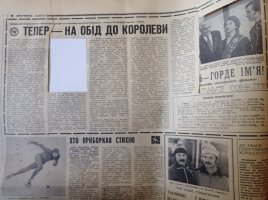
NOW FOR DINNER WITH THE QUEEN

(the article published in Ukrainian 'Sportyvna Hazeta' on March 20, 1979)
ON Friday evening, a line of cars stretched from Vienna to the mountains. Ski enthusiasts were seizing almost the last opportunity for a winter vacation. And yet this was the case when the highway to the Alps did not know record traffic. Another thing is the Wienerstadthalle. This hall will not surprise with competitions of any rank. But it gathered a five-figure number of spectators for the demonstration performances of the best skaters in the world. When asked why he gave his day off to figure skating, Viennese lawyer Ludwig Badura replied: it is one of the few sports that clearly combines art and physical competition, and therefore inspires everyone involved in it.
Indeed, on the closing day of the 69th World Championships, all tickets, the cheapest of which cost 200 shillings ($15), were sold out at least twice: first by the organizers, then by speculators. And at the moment when our dancers Bestemyanova and Bukin took to the ice, the stands resembled cars of the Vienna subway at rush hour. By the way, it was not by chance that Bestemyanova and Bukin opened the exhibition performances. Although they placed tenth overall, their free program so impressed the members of the International Skating Union (ISU) that they invited Soviet athletes to participate in the closing ceremony.
In farewell, the press center distributed a release, which reported that the championship was covered by 237 journalists, 94 TV commentators and 59 photo correspondents from 31 countries in Europe, America, Asia and Australia. They used about 250 thousand sheets of paper, answered 1059 telephone calls, transmitted over 200 photographs and 650 reports by teletype. They failed to do one thing: to determine all the champions in advance. Only in dancing did the majority of accredited reporters make no mistake, preferring our Linichuk and Karponosov. In the other disciplines, there was no such unanimity, and at a reception at the Park Hotel, hosted by the Dortmund (Germany) organizers of the 1980 World Championships, the future hosts, not by chance, made a toast to the exact criteria. It was not so much about paying tribute to the same masters, but about the fact that on the eve of the Olympic Games there is no consensus in the world on the ways of further
development of figure skating, and the struggle between supporters of refined technique and artistry has flared up with new force. The famous Hungarian singles skater Zsuzsa Almasi stated without sentimentality:
- Women in pursuit of triple jumps have forgotten who they are, and men in search of additional chances abuse ballet steps. Only a few are able to combine both. Kovalev won because he did not resort to artificial techniques. He danced with a manly power and a champion's freedom. I think this style is the future.style='font-size:11.0pt;font-family:"Calibri",sans-serif;mso-ascii-theme-font:
minor-latin;mso-hansi-theme-font:minor-latin;mso-bidi-theme-font:minor-latin;
color:#1F1F1F'>
But the women have no one to emulate. The gold medalist - American Linda Fratiani, like the previous Anett Pötzsch from the GDR, personifies the old school. Both have a polished skating, but neither the choreography of the programs, nor their saturation with complex elements can satisfy. Excuse me, but at the women's competitions the impression was that you were in the Vienna Museum of Technology: everything is grandiose, but old-fashioned. Stagnation is observed primarily due to the attempts of figure skaters to copy each other. When there is no own handwriting, fiasco is guaranteed, if not today, then tomorrow. I believe that ice dancing flourished precisely because a kind of Soviet school appeared alongside classical English, and my fellow countrymen Regöczy and Sallayfound their own path - they managed to breathe new life into the tradition of Kalman's cheerful operettas ... The evening of dances became the brightest fragment of the competitive program. Art is the translator of what cannot be translated. So attempts to convey what is seen in words seem naive. And yet we are trying to do it. Because our mind receives so much profit that it restores the expenses of the spiritual state with interest. Therefore, forward.
The lyricism of Moiseeva and Minenkov was in the free program a weighty admixture of the emotionality of Regöczy and Sallay, but the judges were subdued by the reaction of the audience, which seemed to be dancing with a cute Hungarian couple. Only the skill of Lincihuk and Karponosov is beyond comparison. When you ask them about the distinctive feature of the champions, you risk being mistaken in the expected answer. Experts, noting the filigree technique of Natalia and Gennady, their brilliant physical training, high musical culture, still more often put the charm of the couple in first place and the fact that the dancers themselves do not abuse this beauty, they are simply not able to appreciate themselves.
The Vienna Championship turned out to be a benefit for Elena Tchaikovskaya. Half of the main titles went to her students. At the night press conferences (after the doping control), journalists were very interested in how Tchaikovskaya manages to combine training for dance masters and single skating. Reiterating her long-standing opinion that such a combination only enriches, Elena Anatolyevna stated:
- The art of a coach lies not only in high qualifications, but also in the ability to apply them to the fullest extent. Our system of training newcomers allows me, like other specialists working in the USSR national team, to select the most gifted for improvement. And also, - joked Tchaikovskaya, - to become a world champion, you need to regularly report to Kyiv journalists. It helps a lot.
The joke could only be appreciated by those who knew that every fall, Elena Anatolyevna's students train at the skating rinks of our republic and, as is customary, speak at press conferences at the publishing house "Soviet Ukraine". On the eve of the last season, Linichuk and Karponosov shared their plans in Kyiv, and then surpassed them - they became champions. Kovalev did not come - fourth place. This season, he also came to meet with correspondents. The result is a double victory. So, the secret is known …
You can imagine what a crowd there will be in the small hall of the publishing house on April 7, when the strongest skaters of the globe will come to Kyiv for demonstration performances. (Who doesn't want to become an Olympic winner!) And for now, the laureates will have a big tour of European countries and a dinner with the Queen of England, which will take place at the end of March in honor of the 100th anniversary of the emergence of figure skating in the UK.
Like the hosts, the English today have only to rejoice in their past successes. According to the Olympic scoring system, they scored four times fewer points in Vienna than the Soviet skaters, three times fewer than the Americans, and two times fewer than the representatives of the GDR. It is the athletes of these three countries who will lead the dispute for Olympic awards in Lake Placid.
Vienna (by phone).
TECHNICAL RESULTS
Dance.
1. N. Linichuk-G. Karponosov (USSR) - 207.86 (9), 2. K. Regöczy - A. Sallay (Hungary) - 204.10 (22), 3. I. Moiseeva - A. Minenkov (USSR) - 203.74 (23), 4. L. Rehakova - S. Drastiсh (Czechoslovakia) - 199.94 (36), 5. D. Thompson - W. Maxwell (England) - 194.00 (51), 6. L. Wighton - D. Dowding (Canada) - 192.70 (52) ... 10. N. Bestemyanova - A. Bukin (USSR) - 184.06 (87).
Ladies. 1. L. Fratianne (USA) - 186.62 (11), 2. A. Pötzsch (GDR) - 184.36 (18), 3. E. Watanabe (Japan) - 180.52 (31), 4. D. Lurz (Germany) - 179.96 (33), 5. D. Biellmann (Switzerland) - 177.28 (49), 6. L.- M. Allen (USA) - 179.68 (54) ... 13. N. Strelkova - 169.94 (134). 18. K. Ivanova (both - USSR) - 164.02 (147).
1751627385776.jpeg
 
1979

World Junior Figure Skating Championships
EVENT AND COMMENT


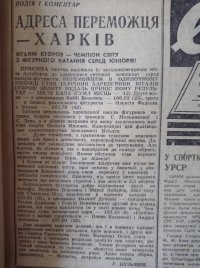
WINNER'S ADDRESS - KHARKIV

(the article published in Ukrainian 'Sportyvna Hazeta' on April 3, 1979)

VITALІY EGOROV - JUNIOR WORLD FIGURE SKATING CHAMPION!
GOOD news came from the West German city of Augsburg, where the Junior World Figure Skating Championship ended. 15-YEAR-OLD KHARKIV RESIDENT VITALY EGOROV BECAME THE SINGLE WINNER! THE GOLD MEDAL BROUGHT HIM A RESULT OF 168.78 POINTS (TOTAL PLACES - 12). Second place went to American Bobby Beauchamp - 166.82 (25), third place to another Soviet skater - Alexаndr Fadeev from Kazan - 163.70 (42).
A talented student of the Kharkiv figure skating school, Egorov trained with coaches G. Melnikova, S. Lev, and in the national team he came under the tutelage of Honored Master of Sports Oleksiy Myshin. The day before, this specialist described Vitaliy's abilities as follows:
- A very jumpy young man with a competent skating technique, but he lacks artistry and choreographic training. Until recently, he could have been dismissive of training. But since he found out that he was a candidate for the national team, he has changed his behavior drastically. By the will of circumstances, he became the first number of the team. I believe he will not let you down!
The Kharkiv skater was well supported by his teammates. Veronika Pershina and Marat Akbarov, trained by Stanislav Zhuk, won in pair skating - 133.82 (10), and Natalia Dubova's students, dancers Tetyana Durasova and Sergey Ponomarenko, proved for the second year in a row that they have no equal among their peers in the world. The championship total of the Moscow pair is 193.40 (9). Our athletes - Elena Batanova and Andrey Antonov - also won silver - 187.00 (20).
For the sake of completeness, we will add that in pair skating, the Soviet juniors also took, in addition to the first, second place (Larisa Selezneva - Oleg Makarov).So, the success is remarkable: three gold, two silver and one bronze awards were won in four categories. One can only be proud of such a reserve, but the main thing is to preserve the young champions for achievements at the highest level. After all, the first team, primarily the men's team, needs to be replenished.
G. KUZMIN.
1751705277955.jpeg
 
Last edited:
1979

World Figure Skating Championships

WHERE IS THE “WINGED SKATE” FLYING?

(the article published in Ukrainian 'Sportyvna Hazeta' on April 7, 1979)

TO THE SUMMARY OF THE PRE-OLYMPIC SEASON OF FIGURE SKATING
WHEN the world championship program was exhausted and only demonstration performances awaited the participants, spring came to Vienna. It lured coaches and journalists from the smoky, hangar-like press center to the street, led them through the evergreen, neatly trimmed alleys of the Tiergarten, opened the beech embrace of the Vienna Woods.
But even here, in the suburbs of the Austrian capital, amidst the hubbub of young football players, which drowned out the wedding songs of birds and the rumble of cars with new groups of vacationers, amidst this festival of nature - discussions about the future of figure skating did not stop. On our way back to the Stadthalle, we climbed the observation tower and over the centuries-old trees saw the city, washed by spring. The fog that had enveloped it for a whole week had finally lifted. Unfortunately, the same cannot be said about the Olympic pedestal-80 after the Vienna general reviews. It seems that the World Championships-79, on the contrary, only confused the situation on the eve of the Games.
THE change of winners in three out of four categories is an atypical phenomenon in figure skating. And here in two more cases the new champion defeated the old one in a head-to-head duel, while both are in their prime and are not going to put their skates away. The experts had something to think about. And the victory in pair skating of the Americans Tai Babilonia and Randy Gardner also did not mislead anyone. "If Rodnina and Zaitsev had come to Vienna," wrote "Czechoslovenski sport," "they would certainly have brought home another gold. The Americans, although they made progress, mainly took advantage of the position that had become vacant and a certain inclination of the judges. As for the Olympic chances, there are no guarantees for Babilonia and Gardner, despite the support of their native walls. Almost everything depends on Rodnina's current capabilities. And we shouldn't forget about Cherkasova and Shakhrai.
Of course, the vice-championship title of Marina and Sergey was met with some coolness here. Meanwhile, the young skaters not only managed to become the first in Europe, but also rose two places in the world rankings compared to last season. And this, acting as leaders of the USSR national team, and even without a coach who was ill.
One might ask: why do high-class athletes need a coach when it comes to a routine that is polished to the last detail, and the opponents are, in principle, well-known? The answer of the Honored Coach of the USSR Viktor Kudryavtsev: "It's so that all these little things "play" in your favor, and not the other way around. After all, the weight of gold in equal forces is increasingly measured by one judge's vote...
Now specifically about Cherkasova and Shakhrai. They were given a phonogram that was too quiet. Young army men like much louder sound, which allows them to more accurately convey to the judges rich technical and not so rich (and therefore very valuable) artistic findings. Zhuk would have noticed this nuance in an instant, and the error was corrected only after the short program.
To finish with pair skating, we would like to note that the average age of the participants here was the lowest - 17.2 years, and the dispute between the "techies" and the "actors" unfolded in a completely unconventional way. It has become so that the former are usually represented by Americans, and the latter by Europeans. Babilonia and Gardner are very far from the skating and jumping techniques of Cherkasova and Shakhrai, but they found their own style that emphasizes the charm of the lady and the masculinity of the man, and with this they bribed the judges and the audience.
STANISLAV Zhuk was recently criticized for forgetting about external effects in the pursuit of ultra-c. Stanislav Alekseevich retorted: "A duckling in the role of a swan is a laughing stock. Let him grow up, and a wonderful transformation, prepared by work in training, will happen for the viewer in one moment. But it is already impossible to teach the same beautiful Babilonia a triple jump - it is too late. What do you order to start with? "
The question is not at all rhetorical. And the answer to it is known. It is necessary to find universals in children's sections: born actors with Ovchinnikov's jumping abilities and fighting qualities of Kovalev. But in practice this is unrealistic. Universalists should be educated. The work is long-term, painstaking. No wonder some are looking for other ways to fame.
In particular, in Vienna, voices were insistently heard about the archaic nature of the mandatory program, that the "school" should be abolished. One of the most energetic critics, the Englishman Robbie Cousins, realizing the precariousness of his position (how can one perform symphonic works without knowing scales?), suggested holding a separate championship for the compulsory program. The newspaper "Courier" ironically commented on this: "Then Robbie will definitely become the champion in the free program. Unless the organizers think of allowing the 10-12 best "schoolchildren" to participate. In such a case, there will be no place for Cousins there at all."
The idea to limit the number of participants in freeskate does not belong to an Austrian newspaper, but to the famous Hungarian figure skater Zsuzsa Almasi. Indeed, thirty singles, as was the case in the Austrian capital, is clearly too many. The "School" could have eliminated two-thirds of them. Zsuzsa's other suggestion also concerns entertainment: to introduce music when performing school exercises and parallel performance of several athletes at once. There were other projects, the most interesting of which the ISU will consider after the Games-80. But no innovations, I think, will replace the masters of the universal style. They are the catalysts of progress, although the public prefers others - "actors".
It is interesting that both men and women currently do not have clear favorites, as Peggy Fleming or Ondrej Nepela once established themselves. But the reasons for this are different. In the women's singles category - there is a frank stagnation. Neither Annette Pötzsch (GDR) nor Linda Fratianne (USA) have modern jumping combinations and rotations. They take turns winning due to their great advantage in "school". Only two skaters are able to challenge them at the Lake Placid Olympics - the brightest representatives of the new wave: Denise Biellmann (Switzerland) and Elena Vodorezova (USSR). Both are still far from universal (school exercises are lagging behind), but they are much more promising than the current leaders. We just need to wish Denise more endurance, and our Elena - recovery, and then among the singles there will also be masters worthy of the modern level of figure skating.
For now, let's state: there are no universals among women. The picture is exactly the opposite for men. Half a dozen athletes have reached the level of experienced Jan Hoffman (GDR) and Vladimir Kovalev (USSR). And here the constant change of prize-winners is due to a completely different level of rivalry. For example, all the Americans - Tickner, Santee, Cramer - are well-prepared. You can't take them with your bare hands in any kind of triathlon. And Kovalev's strength lies in the fact that in a competition of skaters who are approximately equal in technical and artistic abilities, he far surpassed his competitors in psychological preparation. It seemed that the more difficult the situation, the more confident Vladimir feels, the more relaxed he is in his actions.
Already in the rank of champion, Kovalev held his own at the press conference. He was bombarded with provocative questions, to which the Muscovite answered instantly, in Russian and English.
- Eight of the nine judges were female. Did you notice that you were strongly influencing them and thereby making your path to victory easier?
- I competed exclusively with men.
- How would it have ended if Cousins had not fallen during the short program?
- You are mistaken. I am a skater, not a fortune teller.
- What are you counting on in Lake Placid?
- The goal is one - victory.
After the press conference, the correspondent of the Deutsche Welle radio station, Werner, pulled him aside and whispered trustingly: - What do you think, Volodya, about such problems of figure skating as ...
- I talked about everything related to figure skating at the press conference, Kovalev interrupted him, "And now I can only say what I think about you," and went to his team.
THE NEXT evening, Elena Tchaikovskaya shone again. Her students Natalia Linichuk and Gennady Karponosov brilliantly confirmed their fame as the best dancers in the world. Irina Moiseeva - Andrey Minenkov performed well, especially in the free composition. But the judges were probably influenced by the reaction of the audience after the performance of the Hungarian couple Regöczy - Sallay. Because, to be precise, the Hungarian duo is noticeably inferior in technique not only to our two, but also to the best English duo: Thompson - Maxwell. The secret of the high place is that Regöczy and Sallay have created and have been defending the image of young grooms at a wedding for many years, an image that many experts like, who are inclined to turn a blind eye to technical flaws.
And sometimes the judges simply do not have time to notice technical errors. After all, nowhere has the pace increased so much as in dancing. It is good that the key moments of each performance were repeated again and again on the official monitors in the press center, and the experts could give a much more accurate assessment. The judges behind the bar are deprived of such teleprompters. And yet this does not justify mass "hypnosis", as in the case of our Natalia Bestemyanova and Andrey Bukin. For the free dance, a Frenchwoman, an American, a Canadian and an Austrian - gave the debutants only 4.9 - 5.1, while the rest of the judges - 5.4-5.6... Then, in an unofficial explanation to journalists, the ice master, referee Rudolf Zorn, admitted, that he simply did not expect such an incendiary, compositionally balanced, ultra-satisfied program from Bestemyanova and Bukin. An eloquent statement. It not only testifies to the enormous wealth of the Soviet ice dancing school, but also suggests that it is necessary to acquaint foreign specialists with our reserve in advance at auxiliary tournaments.
THE VIENNA championship, as, incidentally, the recent World Junior Championships in Augsburg (Germany), once again demonstrated the strength of domestic figure skating. At least in three out of four categories, Soviet athletes are real contenders for Olympic medals, and in all categories they are in the forefront of innovators, which, by the way, is no less important.
In the current, unsuccessful for our representatives of winter sports season, figure skaters are the only ones who have won the highest world titles. It is significant that among the heroes here appeared our fellow countryman - Kharkiv schoolboy Vitaliy Egorov. It is clear that today both hockey players and everyone who hopes to perform at the games in Lake Placid are equal to the masters of winged skates. And this places a special responsibility on the skaters themselves. To confirm their Vienna result, they will have to rush far ahead in a year to where no fog will cover the contours of the Olympic pedestal.
G. KUZMIN, special correspondent of "Sportyvna Hazeta"
Vienna - Kyiv
1751800912750.jpeg
 
Last edited:
1979
ALL-UNION FIGURE SKATING COMPETITIONS "KYIV KASHTAN"

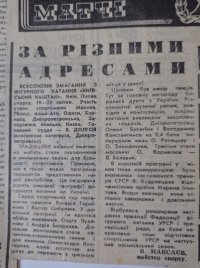
AT VARIOUS ADDRESSES

(the article published in Ukrainian 'Sportyvna Hazeta' on April 24, 1979)


ALL-UNION FIGURE SKATING COMPETITIONS "KYIV KASHTAN". Kyiv, Palace of Sports. April 19-23. Athletes from Moscow, Tbilisi, Alma-Ata, Odessa, Kharkіv, Dnipropetrovsk, Zaporіzhzhia, Minsk, Kyiv took part. The chief judge was V. Dolgov (all-Union category, Dnipropetrovsk).
TRADITIONAL Kyiv competitions, perhaps, became the final one in this season for most athletes. It is nice that representatives of our republic won in three categories of the program. This is evidence of the rather wide geography of figure skating in Ukraine.
Among the pairs, Odessa's Valeria Goryainova and Viktor Tsibulaev won. In the free program, they managed to beat Muscovites Olga Chudakova and Andriy Boldenko. The free program also became a turning point for Kyiv's Oleksandr Kosterov, as he began his path to victory from third place in school.
The evening of dances was interesting. Duets from Ukraine competed for the main award here. A variety of musical rhythms, discoveries in compositions, and bright costumes delighted the audience. Dnipropetrovsk Olena Busygina and Volodymyr Konstantinov were 0.4 points ahead of Kyiv O. Rusetska and O. Zykhmanchuk. Muscovites O. Kornelyuk - V. Belevich came in third.
In the women's short program, the pupil of the Honored Coach of the USSR V. Kudryavtsev, the vice-champion of the country, Marina Ignatova, was out of competition. Yesterday evening, she successfully completed the free skate.
An extended meeting of the Presidium of the Figure Skating Federation of the Ukrainian SSR and the Coaches' Council was held, where a plan was drawn up for the training of athletes of the Ukrainian SSR for the next Olympic season.
V. MAKSAYEV,
Master of Sports.
1751803997761.jpeg
 
1979
ALL-UNION FIGURE SKATING COMPETITIONS "KYIV KASHTAN (CHESTNUT)"

A PROMISE OF LOVE

(the article published in Ukrainian 'Sportyvna Hazeta' on April 24, 1979)

UNDER THE "KYIV CHESTNUT" THAT BLOSSOMED IN THE PALACE OF SPORTS
IN THE VIENNA NATIONAL MUSEUM at number 50, Pieter Bruegel's painting "Winter Games" is exhibited. In it, the Dutch painter, who lived 400 years ago, was the first in the history of world art to depict people on skates. In some of them, you can see something like modern hockey sticks in their hands - hockey? And several couples are circling in a waltz on the lake ice - figure skating!
Where did it come from in the 16th century? That is already a mystery to historians. Or maybe we will try it?
“Why do you like figure skating?” - with this question “SН” addressed the spectators and participants of the tournament “Kyiv Chestnut”, as well as the outstanding skating masters who recently performed in the capital of Ukraine.
The first review is from a young spectator, Natalya Krychevskaya (7 years old, "figure skating experience" - two winters)
- I love skating for the jumps, for the fact that I will never be fat and weak.
18-year-old Marina IGNATOVA from the Moscow region won among women.
- I am attracted primarily by the spectacular nature of our sport, - said Marina.
Blue-eyed Natalia LINICHUK confessed her love like this:
- The opportunity to assert myself, to become necessary for people (and beautiful – let's add from myself) - that's what figure skating gave me.
American Tai BABILONIA speaks:
- Figure skating makes you believe that everything sublime, high, majestic belongs to us.
Monologue of the English ice actor Robbie COUSINS:
- The quintessence of our sport is in music. It is both form and content. Music ennobles everything that is attempted to be expressed. It gives a person a feeling of happiness.
Ex-world champion Jan HOFFMANN (GDR):
- Skates for me are a natural gift of nature. Thanks to them, a person knows himself.
World Champion Vladimir Kovalev:
- Even in motorcycle racing, I don't go crazy with speed as much as in figure skating. And nowhere is the fight fought on such a slippery arena and with such a sharp weapon as the blade of a skate.
Enough, the reader will say. And what does Bruegel's painting have to do with it? After all, figure skating is loved by millions and is only comparable in popularity to hockey, football, chess...
Yes, maybe that's the answer. And our natural attraction to speed, wingedness, and beauty of movement resulted in humanity putting on skates, and then transferring one of the oldest and richest manifestations of folk art - dancing - to the ice? And did Bruegel brilliantly spy on the widespread enthusiasm of distant descendants from the twentieth century in the winter entertainments of his contemporaries? It is not for nothing that it is said about the famous Dutch master: “He was inclined to fantasy and synthetic pictures of the world.” Thanks to him for this.
G. KUZMIN.
1751814615510.jpeg
 
1979
Skate America (Norton Skate)

FIGURE SKATING

(the article published in Ukrainian 'Sportyvna Hazeta' on September 25, 1979)

NEW YORK. The Olympic Ice Center in Lake Placid, where figure skating and hockey champions will compete for medals at the 1980 Winter Olympics next February, is undergoing a test of the ice. About 70 skaters from 20 countries have gathered for the international tournament.
The local ice turned out to be lucky for the GDR champions in pair skating Sabina Baess and Tassilo Thierbach. They confidently won first place with a total of 139.08 points (total places - 11). Leningraders Zhanna Ilyina and Alexandr Vlasov were fourth - 129.28 (37), letting two duets from the USA - Caitlin and Peter Carruthers, as well as Vicki Heasly and Robert Wagenhoffer - go ahead.
Silver medals in ice dance were won by young Muscovites Natalia Bestemyanova and Andrey Bukin (total points - 189, total places - 25). The winners were the silver medalists of the World Championship-79, athletes from Hungary Kristina Regöczy and András Sálláy (198.24; 9).
The men's gold medal was won by Scott Hamilton from the United States (183.54; 14), ahead of compatriot Scott Kramer (181.74; 20) and world championship bronze medalist Jan Hoffman from the GDR (180.16; 21).
The women's gold medal was also won by American figure skater Lisa-Maria Allen (178.16; 10), with Italian athlete Susanna Driano (172.66; 28) in second place.
1751898037965.jpeg
 
1979
ON THE BORDER - WINTER OLYMPICS

(the article published in Ukrainian 'Sportyvna Hazeta' on October 13, 1979)

A TOURNAMENT for the prize of the newspaper "Nouvelle de Moscou" (November 27 - December 2), a match of the strongest skaters in Leningrad (December 25-29), the European Championship in the Swedish city of Gothenburg (January 22-27) - these are the main stages of the path of our best skaters to the Olympic Lake Placid.
At the NEXT Olympics, athletes will compete for medals in all four disciplines of figure skating for the second time. In three of them - men's and women's single skating and ice dancing - a change of champions is inevitable. The Englishman John Curry and Dorothy Hamill (USA) left the big sport, as well as the first owners of Olympic gold medals in dancing Lyudmila Pakhomova and Alexandr Gorshkov. And in pair skating alone, two-time Olympic champion Irina Rodnina and Olympic champion Alexandr Zaitsev will defend the championship at the Olympic Ice Center arena in Lake Placid.
Irina Rodnina and Alexandr Zaitsev are training with amazing enthusiasm, so intensely, as if they had not had a long break. Together with coach Tatyana Tarasova, they have prepared bright compositions for the Olympic season. Now, the details are being polished, which must be said to be complex and interesting. Iryna and Alexandr, as is known, have already met with the audience during exhibition performances in some cities of the country and abroad and were enthusiastically received by sports fans. I would like to note that the one-year break did not diminish their skill and we saw the famous skaters in all the splendor of their talent, as their numerous fans know them.
European champions Marina Cherkasova and Sergey Shakhrai are diligently preparing for important starts, as well as the fifth pair of the world championship Marina Pestova and Stanislav Leonovich, world junior champions Veronika Pershina and Marat Akbarov.
Determined to fight for a place in the main team, the now-family duo of Irina Vorobyova and Igor Lisovsky, as well as their fellow Leningraders Zhanna Ilyina and Alexander Vlasov, are believed to have undoubted potential for Olympic success in pair skating. The main rivals of our skaters in this sport, in addition to last year's world champions Tai Babilonia and Randy Gardner (USA), who will perform in their native walls (and they, as is known, help), will be sports couples from the GDR - Manuela Mager - Uwe Bewersdorf and others.
Three duets from our country will perform in ice dancing in Lake Placid. First of all, these are Natalia Linichuk and Gennady Karponosov. The world champions and their coach Tchaikovskaya are preparing a free dance using American melodies and country-style movements.
Considering that Linichuk and Karponosov are strong in compulsory dances, and the original one – the foxtrot – has always impressed them, these athletes' chances of winning the highest Olympic awards are very good.
Irina Moiseeva and Andrey Minenkov worked very hard to perfect the compulsory dances, and their free composition is distinguished by its technical complexity and originality of construction.
There will be a tight fight for the third ticket to the Winter Olympics. Among those who will take part in it are the medalists of the recent competitions in Lake Placid, Natalia Bestemyanova and Andrey Bukin, whose youth free dance made a bright impression, Natalia Karamysheva and Rostislav Sinitsyn, Marina Zueva - Andrey Vitman, Elena Garanina - Iro Zavozin.
Although the authority of our dancers on the world stage is very high, this does not mean that their path to the Olympic podium will be strewn with roses. The fight is expected to be stubborn. Our masters will be opposed by the duo from Hungary, Kristina Regöczy - András Sálláy, and dance couples from other countries.
In men's single skating, it is perhaps the most difficult to make any predictions. This sport is experiencing a period of its highest flowering and technical and artistic harmony. It is difficult to even list all the athletes who are able to demonstrate their skills on the Lake Placid arena.
In addition to the recognized leaders of world ice: Vladimir Kovalev, Jan Hoffman (GDR), Charles Tickner (USA), Robin Cousins (Great Britain), there are Olympic hopefuls Fumio Igarashi and Mitsuru Matsumura (Japan), Frenchman Jean-Christophe Simon, and Americans David Santee, Scott Hamilton, and Scott Cramer.
In the men's competition, in my opinion, the decisive factor for achieving victory will be moral and strong-willed attitude, the ability to mobilize all forces for the fight at the right moment. Our leader Kovalev has shown himself at his best in such situations more than once.
I would like to hope that Igor Bobrin, who is now being helped by Yuriy Ovchinnikov, and Konstantin Kokora will pose serious competition to the favorites.
Unfortunately, apart from Elena Vodorezova, we do not yet have a strong athlete to achieve success in women's single skating. The illness prevented the girl from participating in the 1979 championships, where experts predicted high places for her. We hope that now Elena will reach the necessary sports form. The composition of the USSR Olympic figure skating team will be finally determined after the European Championships. The skaters' season will end with the World Championships in Dortmund (Germany) - March 11-15 - and the USSR championship, which is planned to be held in Kharkiv from April 8 to 13.
V. PISEEV,
Deputy Head of the Winter Sports Department of the USSR Sports Committee.

Moscow.
1751976699571.jpeg
 
Last edited:
1979
FAVORITES RETURN TO THE ICE

(the article published in Ukrainian 'Sportyvna Hazeta' on October 13, 1979)

Couple Irina Rodnina and Alexandr Zaitsev will compete at the 1980 Winter Olympics in Lake Placid. Irina, who gave birth to a son in February of this year, put on skates again in May.
BECOMING a mother, Rodnina has remained as slim. And she skates on the ice with the same boyish enthusiasm, swing and excitement. But when you see her eyes, you feel the changes. They are now the wise, strict, calm eyes of a woman. The mother of little Alexandr - as the couple named their son - has 12 years of sports life behind her, wrestling at the highest level. At the last ten world championships, ten European championships, and two winter Olympics (in Sapporo and Innsbruck), Irina Rodnina was first.
- How is your life, Irina, after the birth of your son?
- Life has become more beautiful, - Rodnina answers without the slightest irony. - The thought of my son does not leave me, it gives me strength and energy.
- Of course, we have more troubles, - Alexandr Zaitsev joins the conversation. - But life has become more interesting, all our efforts in sports have acquired a new meaning - we want not only to fight for a medal, but also to bring new colors to our favorite sport. When I began my sports career in figure skating - it was 16 years ago in Leningrad - coach Oleksandr Davydenko told me: you need to achieve not only sporting success and recognition, but first of all, strive to become a person, an athlete with your own individuality, with your own understanding of skating and music.
- What was your goal now, when creating the 1980 Olympic program?
- We wanted to immediately recognize two performers in our new program - Rodnina and Zaitsev, - Irina answers.
- And what does the coach of Olympic champions Tatyana Tarasova think about this?
- I never wanted to follow only the beaten path, - says the coach. - And at one time, when I performed myself, and later, when I became a coach, I was always willing to go for an experiment if it promised to develop an original style. Since 1974 - for five years now - I have been working with Rodnina and Zaitsev. During this time we have become not only friends, but also like-minded people in creativity, creating several sports programs with a skating style inherent only to these athletes.
If we talk about Rodnina and Zaitsev's preparation for the 1980 season, I will emphasize one aspect - the skaters not only made a bold attempt to restore their prestige, but also set themselves the task of reaching new heights of skill in their program.
- Has the interpretation of skill in pair skating changed recently?
- I think so. - says Irina Rodnina. - For many years, creative search has been going on on the ice arena, which, of course, contributes to the progress of world figure skating. Our debut with Alexei Ulanov at the 1969 World Championships (combinations of jumps, daring step sequences, a frantic pace) found its followers. The programs that Alexander Zaitsev and I created in collaboration with Tatyana Tarasova were also qualitatively new in terms of creativity. And here is another direction: the extraordinary complexity of the elements in the performances of the 1979 European champions Marina Cherkasova and Sergey Shakhrai. Today, pair skating stands, it seems to me, on the threshold of a new period, in which skaters will achieve a true harmony of the beauty of movements, the complexity of the elements, and the originality of the music.
- When preparing new programs, you probably focus not only on the judges' scores, but also on the audience's assessment?
- We are not devoid of sporting ambition, but another task is no less important for us - to attract people's attention to pair skating, to raise interest in this sport even higher in many countries. Leaders can do it. Remember, for example, the recent past, when ice dancing took a huge leap forward, gaining unprecedented popularity thanks to the performances of Lyudmila Pakhomova and Alexander Gorshkov.
- You were absent from the ice arena for a year. Experts say that you have already managed to return to your former form. How?
- I can't give a recipe. We have our own, special case. Alexandr continued to train throughout the year. And his care and help with household chores allowed me to run small cross-country races, do track and field athletics, and gymnastics at first. Thanks to this, I went out on the ice quite early, and in the last two months I have been actively working on a new program.
A. SHELUKHIN.
(APN).
1752075370598.jpeg
 
Last edited:
1979
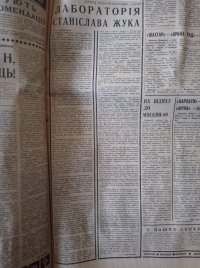
STANISLAV ZHUK'S LABORATORY

(the article published in Ukrainian 'Sportyvna Hazeta' on October 23, 1979)

HE is restless.
As a student at the Kyiv Institute of Physical Education, he and his wife Nina went to the USSR Championship in 1957. The day before, for the first time in his life, he saw his training performance on film and was amazed by the number of mistakes. Then, on the train to Moscow, right in the corridor of the carriage, the couple memorized a new program pattern. At the championship - "silver"!
He is a daredevil and a dreamer. Once he was the first in the country to perform a jump of 2.5 turns, performing among singles. At first, the judges did not even count the element - they did not know how to classify it. Then his students conquered the "outer space" of figure skating. Iryna Rodnina, Tetyana Zhuk, Nadiya Gorshkova, and Marina Cherkasova, with the help of their partners, mastered the teacher's discoveries one after another, and today Cherkasova, together with Sergey Shakhrai, Marina Pestova with Stanislav Leonovich, and the newcomers of the group Veronika Pershina with Marat Akbarov, are performing "ultra-c", subservient to them in the whole world, the students of Stanislav Zhuk: a three and a half turn twist, cascades of 4-5 jumps, a parallel axel of 2.5 turns and, finally, a parallel triple salchow.
Zhuk is a jack of all trades.
No one in the USSR national team knows how to show any element on the ice better than him, to debug and sharpen skates, and most importantly - to see in a beginner a future master, and then with all his inherent passion to force the student to realize his capabilities in the shortest possible time.
He knows how to achieve his goal.
For example, the path of Elena Vodorezova from the first training with Zhuk to victory in the international tournament is two and a half years. He saw that Vodorezova is a swallow of those who will make a spring in women's skating, and he decided to part with Rodnina and Zaitsev, sacrificing certain success. He did not have enough time for all his students, and he does not know how to work at half strength. Whether you are a debutant or a world champion, or you are not in a good mood or feel bad, - complete dedication!
Stanislav Zhuk lives in a dynamic rhythm.
He wakes up every morning at six. At seven - he is already at the CSKA rink, where in the silence of the ice hall he polishes the compulsory figures with his charges. Then he works in the skating workshop, studies the video recordings of the morning classes and goes out on the ice again. In the evenings he can be seen a hundred kilometers from Moscow, watching the participants of the youth competitions in Voskresensk or Elektrostal, visiting the choreographers of the Bolshoi Theater, the costume designers.
These days, S. Zhuk's group was preparing in Kyiv. And here the daily schedule almost did not change. It happened that after a morning training at the Palace of Sports, Zhuk flew to Moscow to give a report at a meeting of the Olympic Committee, and the next dawn he was already doing exercises with his students in the forest alleys of Koncha-Zaspa.
His exactingness became legendary.
But it's better to see once than hear a hundred times. And so, day, day two, day three, we, photojournalist I. Gorelyk, and I "practise" with this group. Its pre-Olympic composition is as follows: Stanislav Alekseevich Zhuk, choreographer Nina Domanovskaya, sports couples Cherkasova - Shakhrai, Pestova - Leonovich, Pershina - Akbarov and a video recorder operator.
And where is Vodorezova? After all, there are so many questions about her in readers' letters! And with this question, which is not very pleasant for a coach, our conversation begins.
Colds are a scourge of figure skaters, - says Stanislav Alekseevich. - But with Elena the case is special. Since 1976 - just when her most intensive classes at the "school" were underway, it was decided not to heat the sports palaces in the summer. And Elena turned out to be prone to colds... I went to various authorities, insisted, asked if, for example, swimmers would be able to train even in the summer if the water was not heated... But the sports administrators came to their senses only when Vodorezova left the ice. I think I was to blame - I didn't insist enough, I didn't slam the door enough... Now Elena has fully recovered, but she should still beware of encounters with ice...
… The music of the “Boney M” group invaded the vaults of the Kyiv Palace, and Zhuk’s subordinates went out for a warm-up. They know the training program in detail. The coach knows it perfectly well. And although Zhuk cannot keep three duets in sight at once, a control check is enough to make a complete diagnosis. But first, Stanislav Alekseyevich simply looks at the athletes: who started the classes with what mood. Cherkasova and Shakhrai immediately developed a crazy pace. Marina has stretched even more over the summer, her height is already 156 cm, Serhiy - 177 cm, so the argument about "dissonance in height" will finally disappear from the unfriendly critics. Meanwhile, the partners are doing their record elements with the same ease as three years ago.
Here Marina and Sergey repeat a fragment of the new free program several times with brilliance, as it seemed to us, but Stanislav Alekseyevich is dissatisfied:
- You are saving the area of the rink! Why? You have to stretch the figures, to visit all corners of the rink in the same seconds. Faster, even faster, forward!
And his attention is already focused on Pershina and Akbarov. The pupils of the Sverdlovsk figure skating school are obviously not yet accustomed to the loads in Zhuk's "dance class". In any case, the miniature Veronika often drives up to the side to catch her breath and glance at her watch: how long until the break?
- Little one, you are doing the element as you feel most comfortable, not as it should be done. Maybe you forgot your promise yesterday?
And Pestova can't do the lasso jump today. Every attempt ends in a fall. Zhuk's patience is running out:
Pestova listens to the "sentence" in the zone where hockey referees hide from the arguments of temperamental players. She rolls up the sleeves of her green dress and again takes up the "lasso". Attention! Zhuk froze in the center of the field ... She ran - and ... another fall ...
Zhuk falls silent. Maybe he saw a completely different reason in the falls, or maybe he remembered how the benevolent Petro Petrovich Orlov once taught him to overcome such barriers. Stanislav could not do the element, which is now even funny to mention. Already recognized then in everything related to technique, Zhuk fought in vain over the unfortunate element before the opening of the national championship and finally decided to throw it out of the program.
And then Orlov removed the student from the competition, put on skates himself and performed in a pair with Nina Bakusheva-Zhuk in a full program. And he presented the bronze medal to Stanislav with the words: "It, you fool, is yours..." Never in his life, where there were both ups and downs, did Zhuk retreat more from difficulties, even when his loved ones did not understand him...
And Pestova's "lasso" knocked her off her feet for two more days. That's about a hundred times, you might say. The number of special exercises on the floor could be increased, but Zhuk is a fan of ice classes. The coach considers excessive enthusiasm for choreography harmful. In his opinion, the beauty of figure skating is, first of all, complexity and risk, and only then grace.
Insecurity is one of the most dangerous enemies of an athlete... As a rule, Zhuk demonstrates the insidious elements himself, but he cannot do the "lasso" himself... An old film came to the rescue, where a very young Pestova performed this jump flawlessly. One viewing, another, and Marina again "saddled" the cowboy element, correctly repeating it as many times as she had previously made mistakes.
In parting, Stanislav Alekseyevich assessed the activities of his colleagues in Ukraine without diplomacy:
- How many times have I noticed promising skaters among you, but they never made it to the national teams. I believe that the first successes of Kharkiv native Egorov will be stable. However, his example only confirms the rule: the opportunities in the republic are huge, but there is practically no one to realize them. I got acquainted with the activities of some Kyiv coaches. Excuse me, but for the most part it is naive amateurism. Everyone works on their own, the limit of dreams is the training of a master of sports, I saw only a few enthusiasts (and nothing will work without them). Authorities are not recognized… Well, okay, my local colleagues took a look at my classes several times.
I got acquainted with the activities of some Kyiv coaches. Excuse me, but for the most part it is naive amateurism. Everyone works on their own, the limit of dreams is the training of a master of sports, I saw only a few enthusiasts (and nothing will work without them). Authorities are not recognized… Well, okay, my local colleagues dropped by my classes several times.
But the founder of figure skating in Ukraine lives in Kyiv - the only honored coach in the republic, Petro Petrovich Orlov! Why was he completely removed from work, by the way, as well as another talented specialist - the man who discovered hockey player Helmut Balderis (first category in figure skating) - Volodymyr Perepelitsyn?
- Many more questions could be asked of the hosts, - Zhuk concludes, - but I will be polite and limit myself to those that directly relate to the coaching profession. The organization of our classes, as well as the successful many years of training in Ukraine of Elena Tchaikovskaya's group, indicate that you are capable of creating a figure skating center like the swimming center "Echo" in Kharkiv. It's time for you to grow out of your shorts!
G. KUZMIN.
1752143532931.jpeg
 
1979
NHK Trophy

FIGURE SKATING

(the article published in Ukrainian 'Sportyvna Hazeta' on October 30, 1979)

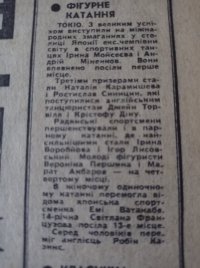
TOKYO. Former world champions in ice dances Irina Moiseeva and Andrey Minenkov performed with great success at international competitions in the Japanese capital. They confidently took first place.

The third prize winners were Natalia Karamysheva and Rostislav Sinitsyn, who lost to English dancers Jayne Torvill and Christopher Dean.
Soviet athletes also excelled in pair skating, where Irina Vorobyova and Igor Lisovsky were the strongest. Young skaters Veronika Pershina and Marat Akbarov were in fourth place.
In women's single skating, the famous Japanese athlete Emi Batanabe won. 14-year-old Svitlana Frantsuzova took 13th place.
Among the men, the winner was Englishman Robin Cousins.
1752163970448.jpeg
 
1979
Ukrainian SSR Junior Cup


DANCE ... WITHOUT A PARTNER

(the article published in Ukrainian 'Sportyvna Hazeta' on November 13, 1979)

THE CUP OF THE UKRAINIAN SSR IN FIGURE SKATING AMONG JUNIORS. Severodonetsk. 62 participants from Kyiv, Donetsk, Dnipropetrovsk, Odesa, Kharkiv. Referee – L. MYKHAYLOVSKA (all-union category, Kyiv).
SO, FINALLY, the first meeting of the best young skaters of the republic took place this season. And it would be inaccurate to call it a meeting of old acquaintances. Over the summer, the boys and girls grew up in the literal and figurative sense of the word, newcomers appeared, who in some disciplines immediately pushed aside the "old-timers."
Odesa coach A. Morozov managed to prepare four pairs in a year, each of which could claim victory, and one - E. Vasilyeva - V. Yaroslavsky - did finish as the winner. But are all capable skaters guided by the same firm mentoring hand?
In the singles, Dynamo Kyiv skaters V. Tyshchenko and O. Lunin stood out. The dispute ended in favor of Lunin, who did better with free jumps. It was more difficult to determine the future laureate among the girls. If after the "school" the already quite experienced skaters were in the lead, then in the short and free parts 9-10-year-old L. Shkurko ("Dynamo", Kyiv), E. Koltsova and E. Lomakina (both - "Avangard" Odesa) felt more confident. However, only I. Shostak from the Kyiv school "Dynamo" managed a jump of 2.5 turns. The most stable all-rounder was S. Pyrlya from Odesa.
Among the ten duets of dancers, the Kyiv duo I. Khvostyk - Y. Karykh won. Interestingly, for the first time, the partners performed one of the compulsory dances separately. The new rules force athletes to pay even more attention to the technique of performing school exercises. After all, now every flaw, every mistake is visible. In the team competition, the Odessa team came first.
V. MAKSAYEV,
master of sports.
1752237057169.jpeg
 
1979
Ennia Challenge Cup

FIGURE SKATING

(the article published in Ukrainian 'Sportyvna Hazeta' on November 17, 1979)

THE HAGUE. Leningrad figure skaters Irina Vorobyova and Igor Lisovsky - silver medalists at the European Championship - emerged as winners of the pair skating competition at the international tournament taking place in the capital of Holland. Their result was -135.30 points (total places 12).
We would like to note the success of another duo - young Sverdlovsk residents Veronika Pershina and Marat Akbarov, who took second place - 132.40 (17).
The third prize winners were figure skaters from West Germany Christina Riegel and Andreas Nischwitz - 129.36 (29).
1752313611338.jpeg
 
1979
Prize of Moscow News


ON ICE - RODNINA!

(the article published in Ukrainian 'Sportyvna Hazeta' on December 1, 1979)

XIV INTERNATIONAL FIGURE SKATING TOURNAMENT FOR THE PRIZE OF THE NEWSPAPER "NOUVELLE DE MOSCOU". November 28 - December 2. Moscow. Palace of Sports. Representatives of 13 countries take part.
AFTER the Innsbruck-76 Olympics, domestic pair skating was going through a worrying time. Rodnina and Zaitsev seemed to be about to put their skates away, and the change was delayed. Irina and Alexandr increasingly had to climb the podium surrounded by foreign rivals ...
The appearance of Marina Cherkasova and Sergey Shakhrai in the elite marked the birth of a new, extremely complex direction - the "godfather" of which is rightfully considered Stanislav Zhuk. Following Marina and Sergey, he prepared Marina Pestova and Stanislav Leonovich, and now Veronika Pershina and Marat Akbarov. Our other specialists did not blindly follow Zhuk, but in particular, looked for something new in single skating. Thus, the experienced pair of Vorobyova - Vlasov, which lacked psychological unity, was disbanded, and the duets of Vorobyova - Lisovsky, Ilyina - Vlasov were created. In the new combinations, the coaches maintained the principle of mutual sympathy between partners, which is considered very important in such a spectacle as figure skating.
And yet, in the absence of Irina and Alexandr, the “gold” in pair skating sailed overseas in March of this year. Although the backs noticeably tightened, the place of the leader in our team turned out to be vacant. Now the vacancy is filled. The faces are familiar: Rodnina and Zaitsev!
Having become a mother in February, the courageous woman already took to the ice in May. Her partner and husband did not part with the skates at all, continuing to practice on his own. The case is unique! No wonder, when she saw Irina three weeks ago in Tokyo, the current world champion American Tai Babilonia got so excited that she completely ruined a short exhibition dance ...
And here is the first appearance of the famous athletes in front of the judges. For the judges, they are ordinary participants under the seventh starting number, but for the spectators? They thundered with applause and fell silent, looking at their favorites. Irina, thin and ringing, like an arrow in flight, was barely worried and hid her anxiety under a mask of severity. Alexandr was a model of imperturbability. It seemed that he could have carved out six compulsory figures with his eyes closed. The introduction was the signal for the attack. Almost immediately, Irina Rodnina and Alexandr Zaitsev are ahead of the music - so rapid is their run. We are well familiar with this winged style of the couple, and at the same time eternally new - the personification of the storm and onslaught. Six elements, like six barriers, were conquered in one breath: simply, beautifully and flawlessly. The judges gave nine scores of 5.9 points and another five - 5.8. And all the emotions of the partners poured into Irina's slight smile at the moment of performing the parallel jump and into Alexandr's haste when he picked flowers on the ice. The feeling from their performance was as if you had been to an exhibition and seen a standard. Two minutes of the demonstration, and you have an idea of everything that figure skating is rich in today, in which direction it is moving. And it keeps the path, according to Rodnina, to the combination of the beauty of the movements with the complexity of the elements and the originality of the music.
Obviously, the rivals in the most daring calculations did not expect such fireworks. And next to the skill of Rodnina and Zaitsev, the comparison did not stand up. Even Marina Cherkasova and Sergiy Shakhrai performed worse than usual. They messed up their joint spin in the swallow and then didn't know where to hide from the indignant S. Zhuk.
Both pairs moved to the stands the next day, but the excitement on the ice did not subside. Even the winners of the tournament - the Leningrad couple Irina Vorobyova - Igor Lisovsky - made two noticeable mistakes in their free program, then Vorobyova admitted that the desire to please the most meticulous expert - Rodnina - spilled over the edge ...
G. KUZMIN,
special correspondent of "Sportyvna Hazeta".

Moscow (by phone).
1752321805952.jpeg
 
Last edited:
Back
Top