Archive of newspaper articles | Page 22 | Golden Skate

Archive of newspaper articles

1984
USSR JUNIOR CHAMPIONSHIPS

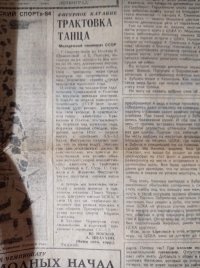
INTERPRETATION OF THE DANCE

(the article published in russian 'Sovetskiy Sport' on November 18, 1984)

USSR Youth Championship

For the Spartak athletes from Moscow, E. Krykanova and E. Platov, despite their youth (they are only 16 years old), their list of sporting victories is quite impressive. They are world junior champions in ice dance and were the national youth champions last year.
Even now on the Tallinn ice, the positions of Krykanova and Platov caused no concern. In the battle for the medals of the USSR Junior Championship, this plastic duo decided to reveal all their trump cards. In their original dance—the quickstep—Krykanova and Platov practically soared over the mirror of the ice, amazing everyone with series of edges, spins, and steps. The result: first place with scores of 5.3–5.5. The skaters knew perfectly well that two other Moscow duos were in hot pursuit. Indeed, the entire audience felt the great charm of the cheerful, sometimes humorous quickstep as interpreted by S. Lyapina and G. Sur, and S. Serzheli and A. Zharkov. These skaters also received scores above 5.0.
And now we introduce readers to a new name in singles skating: Pavel Chernousov, a skater from the CSKA school. At 14 years old, he consistently performs three different triple jumps. Chernousov is coached by Master of Sports Marina Sokolova.
In Tallinn, Chernousov became the strongest in the short program with scores of 5.3–5.5.​
YU. NOSKOV,
A. SHELUKHIN.
(Our special correspondents).
TALLINN.
1772284873607.jpeg
 
1984
Figure Skating

(the articles published in Ukrainian 'Sportyvna Hazeta' on November 20, 1984)
ENNIA CUP
THE HAGUE. Two gold and two silver medals were won by Soviet figure skaters at the "Ennia Cup" international competitions that concluded in The Hague. Two Moscow duos, students of coach Natalya Dubova, took first and second place in ice dancing. The winners were Sarajevo Olympic bronze medalists Marina Klimova and Sergei Ponomarenko. National championship silver medalists Maya Usova and Alexander Zhulin were second. Third place went to Austrian athletes Katrin and Christoff Beck.
Leningraders Larisa Selezneva and Oleg Makarov became the winners in pair skating. In second and third place were Americans Melinda Kunhegyi – Lyndon Johnston and Natalie and Wayne Seybold.
In the men's singles skating, world junior champion Viktor Petrenko from Odesa was second. First place was taken by Petr Barna from Czechoslovakia, and the bronze medal went to Christopher Bowman (USA).
Among women, Constanze Gensel (GDR) won, followed by Yukari Yoshimori (Japan) and Ivana Gomes (USA). Soviet female athletes did not participate in the competitions.
BLUE SWORDS CUP
KARL-MARX-STADT. 14-year-old Irina Mironenko and 16-year-old Dmitry Shkidchenko from Dnipropetrovsk were the best in pair skating at the traditional international "Blue Swords" Cup competitions held in this GDR city. The hosts of the competition, Antje Schramm – Jens Müller and Katrin Kanitz – Alexander König, took second and third place respectively.
1772287999721.jpeg
P.S. A mistake in this article. Melinda Kunhegyi – Lyndon Johnston are Canadians not Americans.​
 
Last edited:
1984
Figure Skating

(the articles published in russian 'Sovetskiy Sport' on November 20, 1984)
ENNIA CUP
THE HAGUE. Soviet figure skaters were awarded two gold and two silver medals at the "Ennia Cup" international competition that concluded in The Hague.
Two Moscow duos, students of coach Natalya Dubova, took first and second place in ice dancing. The Sarajevo Olympics bronze medalists Marina Klimova and Sergei Ponomarenko took first place, while national championship silver medalists Maya Usova and Alexander Zhulin were second.
Leningraders Larisa Selezneva and Oleg Makarov emerged victorious in pairs skating. American pairs took second and third place.
In men's singles, world junior champion Viktor Petrenko from Odesa was second.​

BLUE SWORDS CUP
KARL-MARX-STADT. 14-year-old Irina Mironenko and 16-year-old Dmitry Shkidchenko from Dnipropetrovsk were the best in pairs skating at the traditional international "Blue Swords" Cup competition in this GDR city.
(TASS Corresp.).


USSR JUNIOR CHAMPIONSHIPS
The USSR Youth Figure Skating Championship has concluded in Tallinn.

Y. Tsimbalyuk (Odesa), S. Dudakov (Moscow Region), and P. Chernousov (Moscow) were rightly called contenders for the gold medal among boys. None of them lacked persistence. However, 14-year-old M. Shmerkin from Kharkiv also joined their contest. The overall victory was won by 14-year-old S. Dudakov, a student of Honored Coach of the USSR V. Kudryavtsev. He completed all sections of the competition steadily, placing second everywhere.
Among the girls, the dispute for the "gold" was between N. Gorbenko from Kyiv (coach L. Maslyukova) and T. Andreeva from Leningrad (coach T. Mishina). Only more powerful jumps gave a slight advantage to the Kyiv girl, who became the national champion.
In ice dancing, the winners of the championship E. Krykanova and E. Platov (coach N. Dubova) received scores of 5.8 for their Moldovan dance. Congratulations on the creative success of the mentors of other prize-winners, T. Tarasova and S. Alekseeva (who prepared S. Lyapina and G. Sur), as well as coach I. Akkerman, who trained S. Serkeli and A. Zharkov, who took third place.
In pairs skating, the technically skilled Muscovites E. Gordeeva and S. Grinkov (coach S. Leonovich) became champions.​
YU. NOSKOV, A. SHELUKHIN. (Our special corrs.).
TALLINN.
1772288626834.jpeg
 
1984
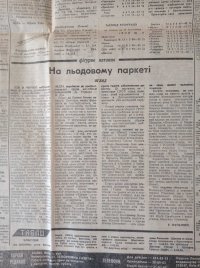
On the Ice Parquet

(the article published in Ukrainian 'Sportyvna Hazeta' on November 24, 1984)

Review

AS FAR BACK AS JUNE, our best figure skaters, seeing off the Olympic season, participated in a major exhibition tour of Australia. In August-September, they already demonstrated new programs at the international "Elbe-Alps Cup" tournament, which takes place in two stages in France and West Germany, and in a series of all-Union tournaments.
The calendar for the masters of the winged skate is very dense. In October, competitions were held in Austria, England, and Canada; in November, the open championship of Moscow and traditional international tournaments in Czechoslovakia, the GDR, Yugoslavia, Japan, and Holland. A similar picture has been observed for more than a year. But previously, the strongest often avoided autumn starts, polishing innovations in the silence of training halls, appearing before the eyes of judges and spectators only in December. Now the situation has changed. Practically all contenders for medals in the European and world championships (among seniors and juniors) already have 2-3 performances with a full program under their belts, although they avoided head-to-head duels with main competitors.
There are several reasons for such a reorientation toward autumn. After the completion of the last Olympic cycle, a large group of recognized leaders left the ice. In the men's category, it's the American S. Hamilton and N. Schramm from West Germany; in the women's, Elena Vodorezova (who, by the way, got married), Americans E. Zayak and R. Sumners. Former world champions in pair skating S. Baess and T. Thierbach (GDR) hung up their skates, and English ice dancers J. Torvill and C. Dean moved to a professional troupe.
Thus, there are many vacancies on Olympus. Since no clear favorites are observed, numerous contenders are in a hurry to declare themselves as early as possible with a victory in a prestigious international competition, and most importantly—to please the judges. In figure skating, where scores are quite subjective, this is very important.
There are grounds for "autumn fever" for those who are only taking their first steps on the international arena. It is still difficult for them to break into their national teams. Therefore, after the New Year, when the main events begin, they will have no opportunities to perform at the highest level and gain authority for the future. That is why autumn tournaments of various kinds have become so popular. They are not of a qualifying nature, but they allow skaters to "feel" the ice, compare their own programs with the compositions of opponents, and, if necessary, make adjustments to one element or another.
As is known, members of the USSR national team are prepared in specialized groups of "Trud" (senior coach—Tatyana Tarasova), "Spartak" (Natalia Dubova), "Dynamo" (Elena Tchaikovskaia), CSKA (Stanislav Zhuk and Lyudmila Pakhomova), and in the Leningrad trade union center (Tatyana and Igor Moskvin). We will see them all together for the first time in December, when the prizes of the "Moscow News" newspaper will be contested. These competitions, as well as the USSR senior championship opening on January 7 in Dnipropetrovsk, will already have a qualifying character.
Autumn starts showed that the selectors of the USSR national team will face problems of a somewhat unusual nature: how to choose the three most stable and promising from five or six approximately equal pairs or soloists.
In pair skating, for trips to Sweden (European Championship) and Japan (World Championship), the Leningrad spouses Elena Valova and Oleg Vasiliev, their compatriots Larisa Selezneva and Oleg Makarov, Moscow Spartak members Elena Bechke and Valery Kornienko, experienced Veronika Pershina and Marat Akbarov (who now train in "Dynamo" with Irina Rodnina), as well as other students of Rodnina—Dnipropetrovsk's Inna Bekker and Sergei Likhansky, who just won the all-Union "Dynamo" championship in Kyiv—are competing.
Among women, leadership is maintained by Moscow's Kira Ivanova and Anna Kondrashova. Both hold places in the world's top five. But the programs of Anna Antonova from Kharkiv and Natalia Lebedeva from Sverdlovsk are no less complex; they only lack stability in performing "ultra-c" elements.
Muscovites Vladimir Kotin and Alexander Fadeev, Kharkiv's Vitaly Egorov, and Odesa's Viktor Petrenko are the shock force of the men's team.
There are many bright, distinct duets with solid international authority among the ice dancers. Let's name at least Natalia Bestemianova and Andrei Bukin, Marina Klimova and Sergei Ponomarenko, medalists of the Sarajevo Olympics. The former prepared a free dance to the music of Bizet-Shchedrin's "Carmen" for the new season. And Marina and Sergei, who got married in the summer, will show a composition based on the themes of the most popular ice dancers of the past. Original, sometimes with risky elements, programs will be demonstrated by Elena Batanova and Alexei Soloviev, Natalia Annenko and Genrikh Sretenski, Maya Usova and Alexander Zhulin, Elena Krykanova and Evgeni Platov. It is characteristic that N. Dubova's students from Odesa, Krykanova and Platov, by age will still compete at the World Junior Championship in Colorado Springs (USA). Moreover, they are going there not as newcomers, but to defend the champion title won last year in Japan.
Young talents will gather in Colorado Springs in mid-December. It is pleasant that the Soviet national team will include many of our compatriots. This became clear after the qualifying starts in Tallinn, where, in addition to the already mentioned Krykanova and Platov, Kyiv's Natalia Gorbenko, Odesa's Yuri Tsimbalyuk, and Kharkiv's Mikhail Shmerkin performed excellently.​

G. KUZMIN.
1772290098816.jpeg
 
1984
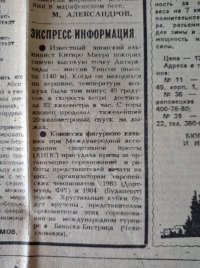
EXPRESS INFORMATION

(the article published in russian 'Sovetskiy Sport' on November 24, 1984)

The Figure Skating Commission of the International Sports Press Association (AIPS) has awarded prizes for the organization of competitions and the work of press representatives to the organizers of the 1983 (Dortmund, FRG) and 1984 (Budapest) European Championships. Crystal cups will be presented to representatives of the organizing committees of these competitions at an international tournament in Banská Bystrica (Czechoslovakia).
1772290699109.jpeg
 
1984
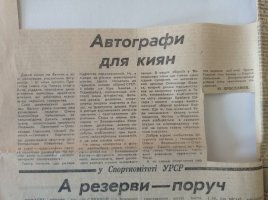
ALL-UNION DYNAMO SOCIETY CHAMPIONSHIPS

Autographs for Kyivans

(the article published in Ukrainian 'Sportyvna Hazeta' on November 27, 1984)

For a long time, Kyivans have not seen the best Soviet figure skaters in action. And now, a new meeting. For a week, the ice of the Palace of Sports was given to the leading Dynamo masters of the "winged skate," who competed for the All-Union championship of the society.
The strength of the Dynamo school, which has been headed for many years by our renowned teacher Elena Anatolyevna Tchaikovskaya, is well known. It is enough to recall the names of Olympic champions Lyudmila Pakhomova — Alexander Gorshkov, Natalya Linichuk — Gennadiy Karponosov, and two-time world champion Vladimir Kovalev. Now on stage are representatives of a new generation of Dynamo members. Are they ready to uphold the high authority of their predecessors?
The tournament showed that a promising reserve is growing. Well, the leaders, in terms of their skill level, are quite capable of making it into the first squad of the USSR national team. Among the women, this is Kira Ivanova from the Moscow region, our strongest figure skater today. Great experience allowed the athlete to win the competition in Kyiv without forcing her form. Kira was previously noted for her lightness of skating and original footwork. The union with her new coach, Vladimir Kovalev, allowed her to significantly improve her jumping preparation and gain stability when performing the most difficult elements. And this is already a sign of class.
No less colorful is the figure of the winner among the men, Muscovite Vladimir Kotin — an expressive, sophisticated figure skater who perfectly commands the language of ice dance. In our national team, Vladimir currently has only one worthy opponent — Moscow army man Alexander Fadeev, who recently took first place at a major tournament in Tokyo, ahead of world vice-champion Canadian Brian Orser and the new leader of the American national team, Brian Boitano. Well, the head-to-head duel between Kotin and Fadeev this season will be all the more interesting, which will take place in mid-December at the international tournament for the prizes of the newspaper "Moscow News."
Also well-known to figure skating fans are the ice dancers Olga Volozhinskaya — Alexander Svinin, who, like Kotin, are trained by Tchaikovskaya. The Muscovites confidently won in Kyiv.
But among the pairs, the tone was set by the young students of Irina Rodnina — Inna Bekker and Sergei Likhansky. The Dnipropetrovsk pair became champions of the society for the first time.​
Yu. YAROSLAVOV.
1772291887032.jpeg
 
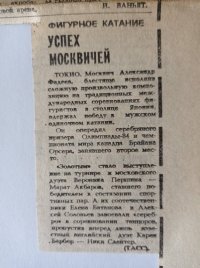
1984
NHK TROPHY

SUCCESS FOR MUSCOVITES

(the article published in russian 'Sovetskiy Sport' on November 27, 1984)

TOKYO. Muscovite Alexander Fadeev, having brilliantly performed a complex free program at the traditional international figure skating competition in the capital of Japan, won the men's singles.
He finished ahead of the 1984 Olympic silver medalist and world champion, Canadian Brian Orser, who took second place.
The performance of the Moscow duo Veronika Pershina and Marat Akbarov, who won the pairs competition, also became "golden." Their compatriots Elena Batanova and Alexei Soloviev won "silver" in the ice dance competition, trailing only the famous English duo Karen Barber and Nicky Slater.​
(TASS)
1772292851930.jpeg
 
1984
INTERNATIONAL JUNIOR TOURNAMENT

Figure Skating

(the article published in russian 'Sovetskiy Sport' on December 1, 1984)

BANSKÁ BYSTRICA. A traditional international figure skating tournament for juniors was held in this Czechoslovak city. Athletes from the GDR, USA, and USSR set the tone for the competition.
Soviet skaters took second place in three disciplines: E. Gud and E. Koltun (pair skating), I. Stavrovskaya and A. Antonov (ice dance), and E. Taranenko (single skating). Young Muscovite Elena Taranenko attracted special attention from specialists, as she was the strongest in both the short and free programs. She successfully performed four triple jumps. However, an 8th-place finish in the "school" [compulsory figures] prevented her from winning the overall combined event.
GDR athletes A. Schramm and G. Müller were the strongest in pair skating. In the girls' tournament, I. Gauter (GDR) demonstrated consistent skill. Skater R. Galindo from the USA showed the best result in the free program with four triple jumps and took first place in the boys' competition. The ice dance tournament was won by D. Balloch and D. Swallow (USA).​
V. SOLOVYOV,
International Category Judge.
1772294722059.jpeg
 
1984
MOSCOW NEWS PRIZE

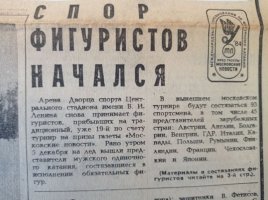
THE FIGURE SKATERS' RIVALRY HAS BEGUN

(the article published in russian 'Sovetskiy Sport' on December 6, 1984)

The arena of the Palace of Sports of the V. I. Lenin Central Stadium is once again hosting figure skaters who have arrived for the traditional, now 19th, tournament for the prizes of the newspaper "Moscow News." Early in the morning on December 5, representatives of men's singles took to the ice, competing in the execution of compulsory figures.
In this year's Moscow tournament, 93 athletes will compete, including 45 foreign representatives from 13 countries: Austria, England, Bulgaria, Hungary, GDR, Italy, Canada, Poland, Romania, Finland, France, Czechoslovakia, and Japan.
1772366577762.jpeg
 
1984
MOSCOW NEWS PRIZE
PARTICIPANTS


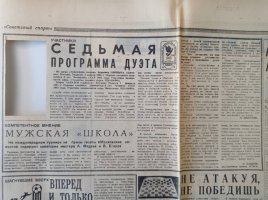
THE DUO'S SEVENTH PROGRAM

(the article published in russian 'Sovetskiy Sport' on December 6, 1984)

From the "Soviet Sport" dossier. Veronika PERSHINA ("Dynamo", Moscow). Born April 3, 1966. Has been pair skating for 6 years. 1981 USSR Champion. World Championships participant. First-year student at GTSOLIFK.
Marat AKBAROV ("Dynamo", Moscow). Born February 3, 1961. Has been pair skating for 6 years. 1981 USSR Champion. World Championships participant. Graduate of GTSOLIFK.

The fate of this sporting duo is remarkable in many respects. Fame came to them early: the female partner was only 14 and her male partner 18 when they became candidates for the USSR national team. Their skating was called dashing and bold. As Marat Akbarov notes: "We did everything so that complex elements stood out in our programs." Three years ago in Odesa, they won the national championship, but at the World Championships, another Leningrad pair, Irina Vorobieva and Igor Lisovsky, were named the number one pair. They, by the way, also said: "We did everything to make our programs spectacular."
It was then that a new concept, "balanced program," appeared in the parlance of specialists and figure skaters. Pershina and Akbarov realized they needed to find a new style for their sporting duo. New mentors helped them find it: three-time Olympic champion Irina Rodnina and choreographer Elena Cherkasskaya.
But it took two years for the athletes to not only gain maturity but also to feel their own style, their own music. The debut of their new free program to Khachaturian's music for the ballet "Spartacus" brought them victory at the 1984 tournament in Tokyo.
What, in your opinion, constitutes the main merit of a partner in a sporting duo?
Pershina: "Calmness and kindness both on the ice and in life".
Akbarov: " Reliability and a sense of partnership. Even if my partner falls, I continue to believe in her. How could it be any other way? After all, I'm not immune to making mistakes either...".
"You have been performing together on the ice for six years now and have seen many duos with different styles. Can you name the figure skaters who appeal to you?"
Pershina: "I really like Larisa Selezneva. No matter how difficult it is for her, she fights with total commitment. And she smiles!"
Akbarov: "I feel respect for two of my friends on the national team. Sergei Shakhrai always amazed me with his hard work, and Stanislav Leonovich with his ability to carry himself as a true gentleman in every performance and training session."
Pershina and Akbarov call their new free program their most successful yet, even though they have performed six different compositions in the past. Khachaturian's music for the ballet Spartacus proved to be the closest and most understandable for the athletes; it offers opportunities to reveal both lyrical and dramatic themes.
Olympic champion Irina Rodnina, speaking about her students, remarked:
"They have undergone difficult psychological tempering. In their failures, they blamed only themselves. Both were born in the Urals, in Sverdlovsk. And there is a certain special trait in these Ural kids. It isn't stubbornness, but the ability to hold on until the very end."​
A. SHELUKHIN

EXPERT OPINION
MEN'S "SCHOOL"

(the article published in russian 'Sovetskiy Sport' on December 6, 1984)

Soviet masters A. Fadeev and V. Egorov lead the international tournament for the prizes of the "Moscow News" newspaper.
The figure skaters' tournaments on the Luzhniki ice traditionally open with representatives of men's singles. They open early in the morning, tracing mandatory exercises. But in this outwardly calm competition, there is its own internal subtext. I would call it a trial of characters for reliability, because in school it is impossible to achieve success with a desperate sprint or bravado by relying on outward effects.
And the current test has fully confirmed the old truth. The tone in the struggle was set by masters who had passed the "forge" of dozens of previous tournaments, including the Winter Olympics in Sarajevo and the World Championships of recent years.
In the center of attention is European champion Muscovite A. Fadeev, his teammate, last year's winner of the "Moscow News" tournament V. Kotin, and also European championship participant V. Egorov from Kharkiv. All three showed real masculine character and stability in performing the "school." For the first figure, "circle," Fadeev received 27.3 points, Kotin 27.1, and Egorov 27.0 and for the 'eight' with brackets, Fadeev received 28.4. Kotin had 26.2, and Egorov had 26.2. Fadeev and Egorov performed the third figure most successfully, and they became the leaders. I should note that, even compared to the Olympic tournament in Sarajevo, the class of our leaders in the 'school' has grown significantly. In this situation, one of Canada's leading figure skaters, G. Forbes, found himself outside the top six.
I consider the performance of 15-year-old Odesa’s Viktor Petrenko a great surprise A year ago he became the world junior champion, and now he is holding his own in competition against senior masters (currently holding fourth place). An interesting detail: Petrenko's younger brother, Vladimir, has also joined the national team and will compete in the World Junior Championships in the USA next week. And, as all specialists say, the younger Petrenko is not inferior to his brother in 'geometry' [compulsory figures].​
E. PLINER, Honored Trainer of the RSFSR.
1772371386435.jpeg
 
1984
MOSCOW NEWS PRIZE

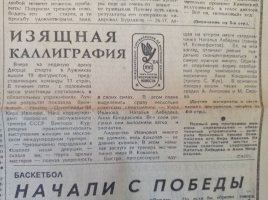
Elegant Calligraphy

(the article published in russian 'Sovetskiy Sport' on December 7, 1984)

Yesterday, 19 female figure skaters representing teams from 11 countries stepped onto the ice at the Luzhniki Palace of Sports. For five and a half hours, the participants competed in compulsory exercises. The best result was shown by 1984 Olympic bronze medalist Kira Ivanova. Our correspondent asked Honoured Coach of the USSR Viktor Kudryavtsev to comment on the women’s performances at this Moscow international tournament.
"Our girls were extremely pleasing in the 'school' [compulsory figures]," he said. "The hallmark of mature masters—complete confidence in their own strength—was immediately evident. Several Soviet athletes stood out in this regard: Kira Ivanova, Natalya Lebedeva, and Anna Kondrashova. They executed all their patterns easily and elegantly."
Ivanova's leadership surprised no one, as the "school" has long been her "forte." Much of this credit goes to her coach, former world champion V. Kovalev.
Natalya Lebedeva (coached by I. Ksenofontov), currently in second place, is progressing rapidly. In my view, she is distinguished by an ability to concentrate intensely at the most critical moment. World Championship silver medalist Anna Kondrashova (coached by S. Zhuk) is also regaining her competitive form. The top five also included A. Antonova and M. Serova from Leningrad.​

The first event of the women's program—compulsory exercises—was won by Olympic bronze medalist Kira Ivanova. Second and third places were also taken by Soviet athletes Natalya Lebedeva and Anna Kondrashova. (TASS).
1772373693969.jpeg
 
1984
MOSCOW NEWS PRIZE
CROSSROADS OF OPINIONS


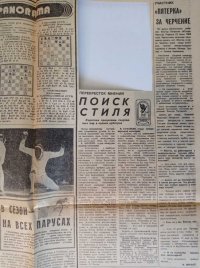
In Search of Style

(the article published in russian 'Sovetskiy Sport' on December 7, 1984)

A short program of pairs in the eyes of referees

After the conclusion of the pairs' short program, we asked two international-category judges to share their views. Here is what they had to say.

B. ANOKHIN, International Category Judge:

"Naturally, I watched the Winter Olympic bronze medalists Larisa Selezneva and Oleg Makarov with the greatest interest. Their mentor, Igor Borisovich Moskvin, chose their music with exceptional care last season as well. Now, he has strived to achieve complete unity among three vital components: skating style, music, and costumes. The result was a 'micro-performance' reminiscent of modern ballet (the athletes' unique movements were perfectly matched by the music of French composer Jean-Michel Jarre). The duo deservedly took first place.
A special emphasis on music was also made by Muscovites Veronika Pershina and Marat Akbarov (coached by Irina Rodnina). Performing to Chopin’s romantic music, the skaters aimed for maximum effect in their glide and the purity of their gestures. This made a strong aesthetic impression.
The third duo—Leningraders Elena Bechke and Valery Kornienko—also impressed with their technical execution. All elements were performed with great amplitude. I should also note the brilliant double lutz by Selezneva and Makarov, and the sit spin by Pershina and Akbarov. Finally, I want to congratulate Igor Moskvin, who introduced a new duo to the ice: Elena Kvitchenko and Rashid Kadyrkaev. In my opinion, they are a promising pair; it’s no wonder they received a 5.3 for artistry."​

V. Solovyov, International Category Judge:

"I believe that compared to the Olympic season, the overall standard of our pairs has grown significantly. Here, the Leningraders Selezneva and Makarov stood out favorably, skating not only with confidence but with great soul. It is a pity that Olympic champions Elena Valova and Oleg Vasiliev were unable to compete due to a minor injury. Had they been here, the tournament would have been characterized by even greater intensity and dynamics.
Nonetheless, I feel the competitive edge was felt until the very last minute, and two duos played the leading roles in this: Pershina and Akbarov, and Bechke and Kornienko. We know that both pairs recently secured convincing victories abroad—one in Japan, the other in Canada. Their performance in Moscow reaffirmed that these skaters possess significant technical potential and a great desire to fight to the end.
In my view, the search for individual style has become more active. Selezneva and Makarov demonstrate expression, a burst of energy, power, and plasticity from the most unexpected angles; Pershina and Akbarov offer lyricism; and Bechke and Kornienko bring a cheerful and spirited signature to the ice.
The battle in the free program promises to be a most interesting spectacle."​

Technical Results

International Figure Skating Tournament for the "Moscow News" Prize. Moscow, Sports Palace. December 5. Pairs Skating. Short Program. 1. L. Selezneva and O. Makarov — 0.4 points; 2. V. Pershina and M. Akbarov — 0.8 points; 3. E. Bechke and V. Kornienko — 1.2 points; 4. I. Bekker and S. Likhansky — 1.6 points; 5. Y. Bystrova and A. Tarasov — 2.0 points; 6. E. Kvitchenko and R. Kadyrkaev — 2.4 points (All represent the USSR)​

PARTICIPANT

"Five" for Drawing

From the "Soviet Sport" Files: Viktor Petrenko ("Trud," Odessa). Born June 27, 1969. Has been figure skating for ten years. Master of Sports. World Junior Champion, medalist at international tournaments in England and Canada. Coach: Galina Zmievskaya.
Alfred Korytek, mentor of the Ukrainian national figure skating team, speaking about the origins of the rapid progress of Odessa's young skaters, emphasizes that high results are ensured only by a firm, multi-year system for identifying talent. It is no coincidence that several capable athletes, candidates for the country's youth national team, train in Galina Zmievskaya’s group.
"Strict discipline reigns at the training sessions of this group. At times, it seems as though Zmievskaya is pouring an extra charge of energy into her students. And the kids skate with unprecedented enthusiasm..."
This enthusiasm is palpable in every program performed by Viktor Petrenko.
Ten years ago, Vasily Ivanovich Petrenko brought his five-year-old son to coach Tatyana Shalaeva at the skating school. For the first four years, the boy hardly stood out among his peers; he fell and made mistakes, but persistently tried to complete every task from the coach. He was equally interested in "ice geometry" (compulsory figures) and jump combinations.
"Viktor, you are debuting at the 'Moscow News' international tournament. How do you rate your fourth-place finish in the 'school' (compulsory figures)?"
"For me, it’s like getting an 'A' in technical drawing. My goal was to make it into the top group of men. So far, I’ve fulfilled my coach's assignment..."
"You’ve been training at the skating school for ten years. What brings you the most joy in this sport?"
"Most of all, I love full stands in the arena. When I see that many spectators have come, I feel proud of my sport. I love to compete. My second passion is science fiction. I don't miss a single book dedicated to incredible journeys and adventures."
"Do you have a dream, Viktor?"
"I have two. First of all, I dream of not being an 'accidental' person on the national team. And also of the time when 'Chernomorets' [Odessa's football club] moves from fourth to first place in the football championship..."
"Is there a 'super-task' for this current tournament?"
"I want to land a triple аxel..."​
I. VANYAT.
1773487504878.jpeg
 
Last edited:
1984
MOSCOW NEWS PRIZE

From Champions — to Debutants

(the article published in Ukrainian 'Sportyvna Hazeta' on December 8, 1984)

The arena of the Sports Palace of the Central Stadium named after V.I. Lenin again hosts figure skaters who arrived for the traditional, 19th tournament for the prize of the newspaper "Moscow News."
This time, 93 athletes are competing, including 45 representatives from foreign countries: Austria, England, Bulgaria, Hungary, GDR (East Germany), Italy, Canada, Poland, Romania, USA, Finland, France, Czechoslovakia, and Japan.
The opening day did not bring any special surprises—the leadership was taken by titled ones, who have more than once proven themselves in competitions of the highest level: in men's singles—European champion Alexander Fadeev, in ice dancing—Olympic silver medalists Natalia Bestemianova and Andrei Bukin, in pairs—Olympic bronze medalists Larisa Selezneva and Oleg Makarov.
Debutants in figure skating don’t achieve a “place under the sun” quite quickly. Therefore, it is pleasant to see in the leading group 15-year-old Odesan Viktor Petrenko, who is performing for the first time in the "Moscow News" tournament. After the compulsory figures, he has the fourth place, ahead of many experienced rivals.
By the way, the surname Petrenko is already quite well known to fans and lovers of figure skating. A student of the trainer Halyna Zmievska—last year's world junior champion, an athlete on whom the coaches of the national team of the country are counting.
In this year's season, Petrenko took second place in the tournament in Holland, where he received a special prize "To the most promising participant."
And the younger brother of Viktor—13-year-old Volodymyr—is a participant in the World Junior Championship, which begins on December 9 in Colorado Springs (USA). Last year at similar competitions, he took fifth place.
Already from the beginning of the tournament, a struggle unfolded between Bestemianova—Bukin and bronze medalists of the Sarajevo Olympics Marina Klimova and Sergei Ponomarenko. With a precise performance of each compulsory dance, the rivals set difficult tasks for the judges, said the Olympic champion Oleksandr Horshkov to the TASS correspondents. However, our other leading masters also demonstrated a grown level of dance technique.
Due to the absence of Olympic champions Elena Valova and Oleg Vasiliev (on the eve, the male partner suffered a small injury), the best in the short program among pairs were Selezneva and Makarov, who performed all elements at high speed—from jumps to spins—confidently and cleanly.
Second place went to Veronika Pershina and Marat Akbarov, third—to Elena Bechke and Valery Kornienko.
The first event of ladies’ competitions—compulsory exercises—was won by Olympic bronze medalist Kira Ivanova. In second and third places are also Soviet athletes Natalia Lebedeva and Hanna Kondrashova.​
(TASS)
1773568638116.jpeg
 
1984
MOSCOW NEWS PRIZE

Brilliance of "Carnival Night"

(the article published in russian 'Sovetskiy Sport' on December 8, 1984)

The compositions of Soviet ice dancers became the culmination of the international tournament for the prize of the newspaper "Moscow News."
"Original dance in the rhythm of the quickstep"—this is the name of one of the most interesting sections in the ice dancers' competitions in the 1984-1985 season. At the international tournament for the prize of the newspaper "Moscow News" at Luzhniki, the strongest masters of ice dance created a magical spectacle, demonstrating their interpretation of the quickstep. The striving for a synthesis of dynamic gliding, virtuoso step sequences, acting, and original choreographic solutions allowed the leaders of the USSR national team—Natalia Bestemianova and Andrei Bukin, Marina Klimova and Sergei Ponomarenko, Olga Volozhinskaya and Alexander Svinin, Elena Batanova and Alexei Soloviev—to achieve an unusually bright aesthetic effect.
The melody from the movie "Carnival Night" in a unique arrangement became the "soul" of the new quickstep created by Bestemianova and Bukin, as before, in their unique style, with generous emotionality and energy. Three scores of 5.9 were awarded to this truly carnival-like dance (by the way, sketches of the skaters' costumes were developed by the famous fashion designer Vyacheslav Zaitsev in accordance with the style of the duo).
An average score of 5.9 was also received in the second day of the tournament by Klimova and Ponomarenko after their life-affirming, air-filled quickstep. 5.5—5.7—these are the results of Volozhinskaya and Svinin. 5.4—5.6 were received by Batanova and Soloviev, Natalya Annenko and Genrikh Sretenski.
Yesterday, women performed the short program. First place was confidently taken by Olympic prize-winner Kira Ivanova. In second place is Natalia Lebedeva, third—Anna Antonova.​
A. SHELUKHIN.
1773569244056.jpeg
 
1984
MOSCOW NEWS PRIZE

Bernard Ford — Ice Dancer and Coach

(the article published in russian 'Sovetskiy Sport' on December 8, 1984)


FROM THE DOSSIER OF "SOVIET SPORT"
BERNARD FORD (Great Britain). Born in 1947. Involved in ice dancing for 24 years. Four-time world and European champion in ice dance. At the international tournament for the prize of the newspaper "Moscow News," he appears in the role of coach for the Canadian national team.


Question: 19 years ago you, together with partner Diane Towler, performed on the ice of Luzhniki, when the European Championship was held. In recent years you have been raising young duos. What can you say about the progress of ice dancers?
Ford: Beyond any doubt, today the strongest duos dance many times brighter, more interesting than in the sixties, when we performed and won. I remember there were times when the attitude toward ice dance was somewhat condescending, it was considered a game, a pastime, simply a beautiful spectacle. Now, the performances of ice dancers are a great art.
Question: What can you say about your coaching work in recent years?
Ford: Already in the first years of working with young duos I realized: to become a high-class coach, I lacked knowledge, special experience, and original fresh ideas. Besides, I did not want to repeat the mistakes of many figure skating specialists—for it is hard to expect any success if you release a new duo that copies previous samples. Only innovators win, shaping fashion and educating the taste of judges and the public.
Therefore, it was necessary to look for a new path. And I went to work in Canada, where athletes are more patient and do not demand exclusively first places.
Of course, this does not mean that I am not demanding enough toward myself; rather the opposite, I do not know a stricter judge for coach Ford than figure skater Ford.
Question: What has coach Ford managed to achieve?
Ford: I am working now with four couples who took first, third, fifth, and sixth places in Canada. They live in Toronto, Vancouver, and Halifax, and I have to not only invite them to my place in Toronto but also travel quite a bit around the country. This year's Canadian champions—students from Halifax Tracy Wilson and Robert McCall—personally fill me with optimism. However, I am not a supporter of "cramming" for a high result for just one couple—at best, this promises fleeting success. I try to make as many dance duos as possible reach a high class.
Question: Do you have children ready to continue their father's work on ice?
Ford: My seven-year-old son with the Russian name Sergei has been doing judo for two years, and skating for him so far is associated only with hockey. After all, he doesn't know that I am a world champion in ice dance, and therefore he doesn't possess great ambitions. I somehow find it uncomfortable to boast to the boy about past merits. If my parents tell Sergei about my sporting path and he wants to follow in my dancing footsteps, it is not too late to become a figure skater.
Question: Many figure skating fans remember your partner Diane Towler. What is she doing now?
Ford: Last summer in London, two charming twin girls were born to her. Diana herself is now more of a housewife than a coach, but she does not lose interest in figure skating. In any case, I meet her at all major competitions in England.​
Interview taken by Yu. DARAKHVELIDZE.
1773570454067.jpeg
 
1984
MOSCOW NEWS PRIZE
Figure Skating: Virtuoso Technique of Alexander Fadeev
CROSSROADS OF OPINIONS


FOR THE FIRST TIME ON THE SCOREBOARD — 6.0!

(the article published in russian 'Sovetskiy Sport' on December 8, 1984)

Sports fans will remember for a long time the second day of the international tournament for the prize of the newspaper "Moscow News" in Luzhniki. A very rare case in the practice of major tournaments occurred at the men's short program competition: European champion Alexander Fadeev received the highest score — 6.0 — both for execution technique of elements and for artistry.
Here is how specialists of various profiles assessed the course of the struggle on the Moscow ice:
Honored Master of Sports, 1975 World Champion Sergey Volkov:
"I liked the compositions performed by Alexander Fadeev, Vladimir Kotin, Viktor Petrenko, and Vitaly Egorov. One could say that in our men's singles skating, a new interesting 'four' has formed, and their rivalry immediately comes to the fore, keeping everyone in suspense. Fadeev brilliantly coped with the combination where he performed an axel of 3.5 revolutions. I am impressed by the skater's courage."
Moscow stage artist Yuri Zamiatnin:
"For the third season already, I have been working as the choreographer of Alexander Fadeev's sports programs. Every year his mastery unfolds more fully and diversely. He was very good in the Charleston last year, and is just as impressive in the current composition 'Russian Dance.' Fadeev is always outwardly calm, but in training, he shows exceptional energy and drive, solving the most difficult tasks. Even until now, he is to some extent a mystery to me."
Coach of the country's youth national team Vladimir Kaprov:
"Seven figure skaters started in the strongest group, and yet there was not a single mistake among any of them. Seven bright individuals, and each is original with their own 'handwriting.' It is gratifying that the atmosphere of a tournament with a very high sporting level is arising. Fadeev, of course, amazed with his unique technique. An undisputed leader — ten scores of 5.9 and two sixes speak of this.
For all the others, the 'calling card' was the combination with a triple lutz. And our athletes — Kotin, Petrenko, Egorov, Vardanyan, Kaznakov — were at their best. I will especially highlight Kotin and the 15-year-old Odesa skater Petrenko; their compositions in aesthetic terms gave true pleasure. I will note the unique plasticity of the Canadian skaters — G. Forbes and A. Bourgeois, but they still have to solve the problem of complex jumps.
One cannot but be happy for our masters — Kotin and Petrenko, who received a high score of 5.8 points for the technique of difficult elements."
And, finally, in conclusion, a concise comment from the tournament leader Alexander Fadeev:
"I am glad that for three starts in a row already, I have been performing the combination with a triple axel. Is there risk in this? Of course. But in top-level sport, risk is a mandatory thing..."
TECHNICAL RESULTS
International figure skating tournament for the prize of the newspaper "Moscow News." Moscow. Sports Palace. December 6.
Men's Singles. Short Program:
1. A. Fadeev — 0.4 points; 2. V. Kotin — 0.8; 3. V. Petrenko — 1.2; 4. V. Egorov — 1.6; 5. L. Kaznakov — 2.0; 6. G. Vardanyan (all — USSR) — 2.4.
1773571955209.jpeg
 
1984
MOSCOW NEWS PRIZE

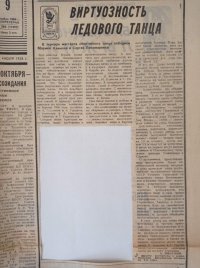
VIRTUOSITY OF THE ICE DANCE

(the article published in russian 'Sovetskiy Sport' on December 9, 1984)

In the tournament of masters of ice dance, Marina Klimova and Sergei Ponomarenko won

Never before has the struggle among our best ice dance duos reached such a fever pitch as now at the international tournament for the prize of the newspaper "Moscow News." This was not an ordinary dispute over a more complex sequence of steps or a fast series of rotations. It was a clash of creative ideas, directions, and styles. Something similar was observed in previous years, when the country's national team was represented by duos of three different styles. For example, the trio of prize-winners according to the results of the 1976 European Championship consisted of L. Pakhomova and A. Gorshkov, I. Moiseeva and A. Minenkov, N. Linichuk and G. Karponosov.
"Today, other criteria of mastery, different requirements for the free dance exist. And yet the spirit of discussion around the styles of favorite duos literally hovered in the stands and in the lobbies of the Sports Palace. In the struggle for first place, the leaders of our national team participated — N. Bestemianova and A. Bukin, M. Klimova and S. Ponomarenko. In the preceding days, the judges' votes were divided almost equally. With a minimal advantage, Bestemianova and Bukin won the compulsory dances.
They were close to victory yesterday in the free program as well. "I watched their composition to the music of 'Carmen' with great excitement, I lived these minutes together with the skaters," said later the multiple world and European champion, Englishman Bernard Ford. "Yes, this dance captivated the entire hall with its passion, internal drama. The duo received three scores of 5.9 for technique, and all seven scores for artistry were 5.9."
And yet... Even almost maximum points turned out to be too few for the victory of Bestemianova and Bukin. Following them, Klimova and Ponomarenko started. Regarding the intent of their dance, the Honored Trainer of the RSFSR Natalia Dubova said:
"In the composition, we combined several Latin American rhythms. At the same time, we strove to reflect the bright events in the development of sports dance on ice. In one part of the tango 'Cumparsita' — a tribute to the mastery of Pakhomova and Gorshkov, in another — the rumba — the English pair Torvill and Dean. The final — the samba — is a bet on the style of the future."
Indeed, the polished technique of the partners, the refined and juicy rhythms of the composition deserved a high mark from the judges — four scores of 5.9 for technique, six scores of 5.9 and one 6.0 for artistry. As a result, Klimova and Ponomarenko, the bronze medalists of the Sarajevo Olympics, took first place.
A more detailed discussion about the programs presented by the figure skaters is ahead. In the meantime, we will only cite the statement of the Honored Coach of the USSR Tatiana Tarasova: "In the narrative dance of Bestemianova and Bukin, 'Carmen' embodies a new direction, in which huge possibilities are hidden. We developed ideas once developed by our predecessors — Pakhomova and Gorshkov, Linichuk and Karponosov. The course toward an original dance, based on high technique, is universally recognized. We should continue to enrich the domestic school."
On this evening, the hall also warmly welcomed the third prize-winners — O. Volozhinskaya and A. Svinin, who subtly and gracefully revealed the intent of the dance to the music of Tchaikovsky's "Capriccio Italien," as well as the occupiers of the fourth place, Muscovites N. Annenko and G. Sretenski, who performed a lyrical dance to the music of Gershwin.​
A. SHELUKHIN.
1773573649895.jpeg
 
1984
MOSCOW NEWS PRIZE
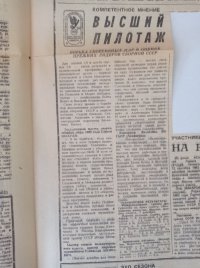
COMPETENT OPINION


HIGHEST AEROBATICS

(the article published in russian 'Sovetskiy Sport' on December 9, 1984)

The struggle of pairs in the assessment of former leaders of the USSR national team

Two scores of 5.9 and six scores of 5.8—such is the result in the free program of the Leningrad duo—Larisa Selezneva and Oleg Makarov, who for the third time in a row won the Moscow international tournament. Second place was won by Muscovites Veronika Pershina and Marat Akbarov, third—by Leningraders Elena Bechke and Valery Kornienko.
Their point of view on the struggle of the pairs is expressed by former leaders of the USSR national team in pairs skating: Sergei Shakhrai, Stanislav Leonovich, as well as Leningrad choreographer Valentina Vigant.
Honored Master of Sports, 1980 World Champion SERGEI SHAKHRAI:
"I won't be mistaken if I say that in this tournament the prize-winners of the Sarajevo Olympics Selezneva and Makarov won with a convincing advantage. And although from the Olympic tournament in Sarajevo we are separated by only nine months, in pairs skating quite a few significant changes have occurred: the 'handwriting' of a whole series of duos has become more multifaceted and vivid in execution. I will note, for example, for Selezneva and Makarov a magnificent combination of elements—a triple throw and a parallel double axel, an original lift in the finale of the program.
The class growth of Pershina and Akbarov is noticeably higher, primarily in the aesthetic sense, in the revelation of a complex musical theme.
A pleasant surprise was the effective composition of the tournament debutants Elena Kvitchenko and Rashid Kadyrkaev, who were prepared by Honored Trainer of the USSR Igor Moskvin."
Master of Sports of International Class, prize-winner of World Championships STANISLAV LEONOVICH:
"Usually, December is for pairs a month of unique reconnaissance before decisive duels. But right now on the ice of Luzhniki we saw a very high level of program execution for this period. And, of course, the tone was set by Selezneva and Makarov, showing that they are ready to demonstrate 'highest aerobatics' this winter.
I was happy for Sverdlovsk coach Ardo Rennik. He brought to the start a very dynamic pair—Yulia Bystrova and Alexander Tarasov. And although they have only sixth place, the free composition of the Ural athletes stood out for its purity of skating, with quite substantial content."
Choreographer VALENTINA VIGANT (Leningrad):
"Interesting, balanced compositions—that is the main feature of this tournament. It is visible that a lot of work was done by trainers and choreographers. Of course, a step forward was made by my fellow citizens Elena Bechke and Valery Kornienko, who took a prize-winning place. I would like to wish all the figure skaters, competing in Moscow, more emotionality and liveliness in embodying the choreographic intent. Not only a smile, but also nuances in conveying dramatic, lyrical moments are very important in the creation of spectacular programs."​

TECHNICAL RESULTS
International figure skating tournament for the prize of the newspaper "Moscow News." Moscow. Sports Palace. December 7.
Pairs Skating. Final sum: 1. L. Selezneva and O. Makarov — 1.4; 2. V. Pershina and M. Akbarov — 2.8; 3. E. Bechke and V. Kornienko — 4.2; 4. I. Bekker and S. Likhansky — 5.64 5. E. Kvitchenko and R. Kadyrkaev — 7.4; 6. Y. Bystrova and A. Tarasov (all — USSR) — 8.0.
Women's Singles. Short program: 1. K. Ivanova — 0.4; 2. N. Lebedeva — 0.8; 3. A. Antonova - 1.2; 4. M. Tveretinova — 1.6; 5. M. Serova — 2.0; 6. A. Kondrashova (all — USSR) — 2.4.
1773575265472.jpeg
 
1984
MOSCOW NEWS PRIZE
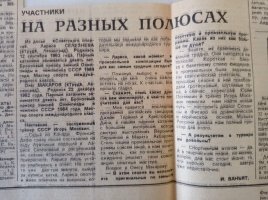
PARTICIPANTS


ON DIFFERENT POLES

(the article published in russian 'Sovetskiy Sport' on December 9, 1984)

From the dossier of "Soviet Sport":
Larisa SELEZNEVA ("Trud", Leningrad). Born September 12, 1963. Has been doing pair skating for nine years. Bronze medalist of the Winter Olympics and USSR champion of 1984. Master of Sports of International Class.
Oleg MAKAROV ("Trud", Leningrad). Born December 22, 1962. Has been doing pair skating for nine years. Bronze medalist of the Winter Olympics and USSR champion of 1984. Master of Sports of International Class.
Mentor — Honored Trainer of the USSR Igor Moskvin
.
…Judge from Canada Francis Dafoe immediately after the competitions on the ice of Luzhniki approached Larisa Selezneva and kissed her, saying: "Wonderful, girl, wonderful!". Larisa only tiredly smiled in response. But after already two-three minutes, having gone backstage of the rink, Larisa willingly and lively answered questions that we asked her as the winner of the international tournament.
— Larisa, which moment in the free composition was for you the most difficult today?
— Perhaps, the triple throw, where for me it is very important to stay on my feet. Fortunately, everything went smoothly.
— Tell me, the style of which duos appeals to you, is in some way instructive for you?
— I like the latest program of the English ice dancers Jayne Torvill and Christopher Dean; in our pair skating, with great interest I always watch the performances of Veronika Pershina and Marat Akbarov. The style of our free program is completely different, but we want to see how in a new way, unexpectedly, experienced masters solve their compositions.
Question to Oleg Makarov:
— In this season you perform original-in-intent short and free programs. Which of them is for you more to your heart?
— You know, comparing them is quite difficult. They are located on different poles. The short one is close to the ballet style "modern," while the free one was conceived as a classical performance. In the last season, grotesque, playful tones prevailed in it, but now choreographer Yuri Potemkin and trainer Igor Moskvin helped us find a new path — to build a dialogue between Susanna and Figaro on a dramatic and lyrical basis. Rossini's music gave us full scope for this.
— And with the result in the tournament, are you satisfied?
— With the sporting outcome — yes. But in a creative sense, in my opinion, the question for us stands differently: that which is good today, tomorrow is already not enough.​
I. VANYAT.
1773576249752.jpeg
 
1984
MOSCOW NEWS PRIZE

Holders of the "Crystal Skates"

(the article published in Ukrainian 'Sportyvna Hazeta' on December 11, 1984)

The traditional international figure skating tournament for the prize of the newspaper "Moscow News" has concluded. It brought many bright impressions and surprises.
THE MAIN SENSATION — the victory of Marina Klimova and Sergei Ponomarenko in the competition of masters of ice dance. Few of the specialists doubted that the prize would again be taken by the experienced Natalia Bestemianova and Andrei Bukin. They were leading before the free dance. Klimova — Ponomarenko stayed close. Only one judge's vote determined the minimal advantage of the USSR champions.
But in the free composition, the students of the Honored Trainer of the RSFSR Natalia Dubova surpassed even themselves. If Bestemianova and Bukin earned ten scores of 5.9, then Klimova and Ponomarenko, repeating this result, had for artistry even a 6.0. Third place went to Olga Volozhinskaya and Alexander Svinin.
In pairs skating, for the third time in a row, the Leningraders Larisa Selezneva and Oleg Makarov came out on top. Their new free program is not only choreographically original, but also saturated with extra-difficult elements.
Second here were Veronika Pershina and Marat Akbarov, third — Elena Bechke and Valery Kornienko. Dnipropetrovsk’s Inna Beker — Serhii Likhanskyi finished fourth.
A pleasant discovery of the tournament was 15-year-old Odesan Viktor Petrenko. A debutant from the first attempt climbed the pedestal of honor, surpassing Leningrad’s Leonid Kaznakov and the two-time champion of the USSR Kharkiv’s Vitaliy Egorov.
The free composition in men with scores of 5.7–5.9 was won by Vladimir Kotin. But due to significant mistakes in the short program, he took overall second place. And the winner was Muscovite Alexander Fadeev.
A unique record-holder of the tournament became Kira Ivanova from the Moscow region. She won the women's competition for the fourth time. In second place — Natalia Lebedeva from Sverdlovsk, and in third — Muscovite Hanna Kondrashova.
1773577687748.jpeg
 
Back
Top