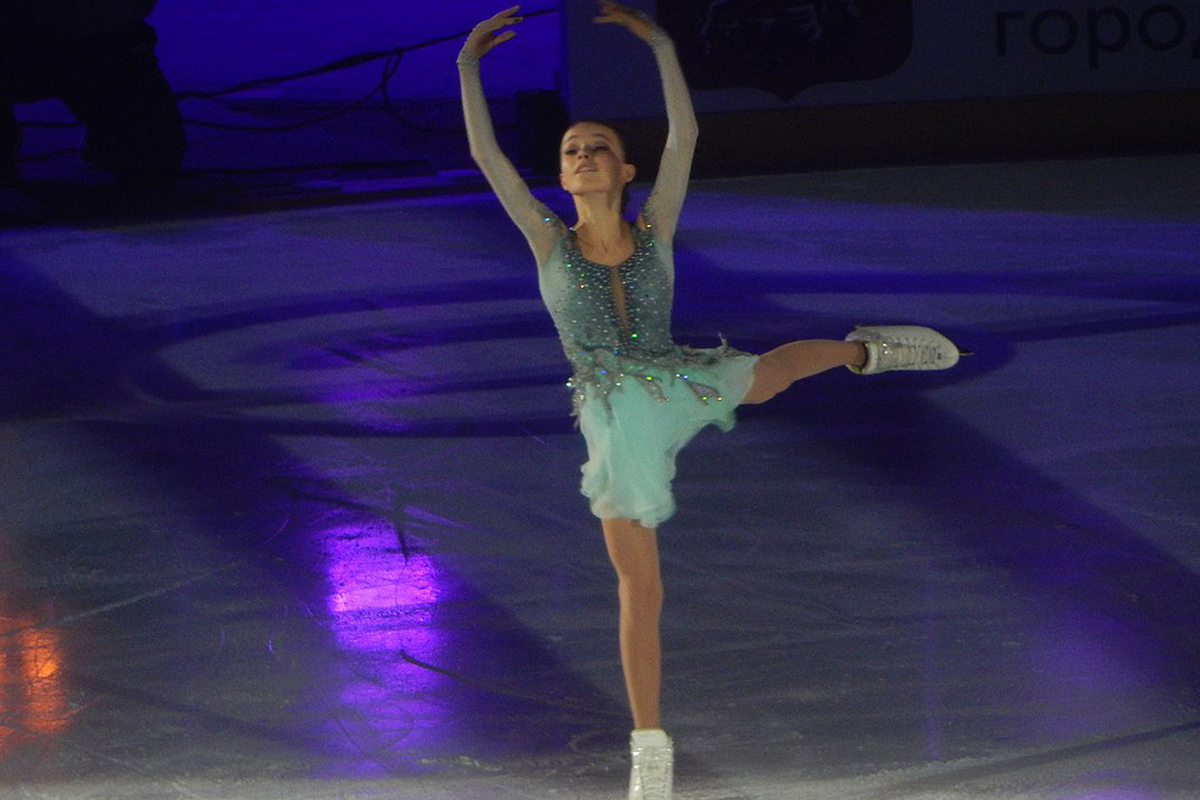
Anna Shcherbakova | Page 239 | Golden Skate

Anna Shcherbakova

It's her whole approach, so systematic and problem-solving, one little step at a time.
Yeah, she is really amazing that way. I remember seeing one video where she explains how to achieve things, and it's basically this: dividing one big task into several smaller ones. It may seem obvious, but I know many adults who haven't fully grasped this yet..
 
New boots are so stiff and they always hurt the feet and ankles so it is a miracle that she won Olympic gold with new boots.

Anna has the personality and calm demeanor where she can just handle anything and skate well.

I used to attribute it to her personality and calm, but what I felt was interesting was that here, she shared her method, which is to take small actions systematically, and only focus on that one small thing at a time. It's not the first time she's said it. At the Olympics, it's a lesson to anyone, on how not to get overwhelmed.

I thought it was really cute how she responded to the talk about new boots. She didn't understand, even, how it got into the press, because it didn't stop her ... so there was "no point in discussing it." It's like she broke down into steps, (for anyone interested), how to achieve that calm. She relied on her experience of having to change boots 6 times a year, no matter what stage of training or competition. So it wasn't a miracle, to her.
 
I used to attribute it to her personality and calm, but what I felt was interesting was that here, she shared her method, which is to take small actions systematically, and only focus on that one small thing at a time. It's not the first time she's said it. At the Olympics, it's a lesson to anyone, on how not to get overwhelmed.

I thought it was really cute how she responded to the talk about new boots. She didn't understand, even, how it got into the press, because it didn't stop her ... so there was "no point in discussing it." It's like she broke down into steps, (for anyone interested), how to achieve that calm. She relied on her experience of having to change boots 6 times a year, no matter what stage of training or competition. So it wasn't a miracle, to her.
Interesting how you break down why it wasn't a miracle for Anna. She takes things step-by-step analyzes it gets something done and moves onto the next step. That's a good way not to get overwhelmed by things. I wish I could do that like Anna. The world has been a confusing place on many levels the last 2 years in large part because of the furor around coronavirus. A lot of people have gotten confused and taken out of their game mentally. But not Anna.
 
I'm still angry on her behalf that nobody came to celebrate with her in the moment that she knew she won the Olympics.
Daniil came to her:


But again, seeing Anna handling the whole situation with so much maturity, kindness and dignity is overwhelming.

(Tara may talk about how she was happy after winning gold and Anna was not, but it's just about how different people handle different situations. And Anna is just a great character.)
 
I've found a new instagram profile with magnificent fanart of Anna, one for all:

[...]

But surely check the whole profile, whicvh one do you like the most?

Oh my!! what an incredible artist! They're all amazing, but for me, the first one is probably my favorite. There is something about this that truly captures the feelings I have always gotten from Anna.

 
big interview for MK.RU (February 28):


- Anya, in Beijing you said that a mountain fell off your shoulders. Because you showed your maximum in the right place and at the right time. And then there was a solemn meeting in Moscow ...

— And how this meeting was needed! When I found out that they would meet us, thoughts flashed: after the plane, a long road, hard. But when we went on stage ... it was such an indescribable emotion, such a feeling of incredible pride! And exactly what I really missed in Beijing. A huge hall, such energy of the audience, which nothing can replace. I just love this feeling.

- Did you meet Alexander Bolshunov before the joint raising of the Russian flag in Moscow?

- I saw him at the airport, I say to Daniil Markovich (Gleikhengauz): “Hold the phone, take a picture of me, please!” Yes, I came to him myself. I just admire him! And Bolshunov, when he saw me, said: “What a miniature you are” ...

- Anya, you are often called a figure skater with nerves of steel, to put it simply, a steel girl. You dont mind?

- I think that this is still a pleasant compliment for an athlete, because one of the most important components for performing in any sport is to cope with excitement and nerves. So, I'm pleased.

- In Beijing, you admitted that you want silence after the victory. But a day after arrival, you resumed training.

- Yes, I started training on the 23rd. And a few days after the competition there was an absolute emptiness inside. No thoughts, no emotions. I realized that, probably for the first time in my life, I could spend a whole day without thinking about anything at all. I'm having some kind of internal dialogue. And for the first time, absolutely nothing. Complete emptiness.

- Did it scare you?

No, I didn't try to fix it. And I didn’t even try to convince myself that I should feel something. I didn't force myself to be happy or sad. I decided that it was better to just give myself time: there are no thoughts in my head, which means that this is how it should be now. And I think it was right. I needed this time. Thoughts are coming back. And now I can think about everything with peace of mind. I'm completely back to my normal self, so to speak.

- Like any athlete, in your career you had to overcome different things. At the age of 13, for example, there was a broken leg. When an athlete has already reached some heights and returns after an injury, this is understandable, but how can you return yourself through overcoming when there are no such victories yet?

— I do not agree. Like most people, I started figure skating at the age of three and a half. Therefore, by the age of thirteen you have just spent almost your entire life on the rink, you do not know another life. Perhaps, when you are an adult and have titles behind you, you just have an understanding that there is something else in life besides figure skating. And at 13 you know that you have been skating all your life, waiting and dreaming about senior competitions. Therefore, even the thought did not arise then that everything should be abandoned. Everything important has not yet begun, you have been striving for so long for everything to start now ... and you stop it all? I did not convince myself that I would skate, I just never once thought that my skating would remain in the past.

But was it scary to look at the leg?

- Well, leg was in a cast, what's the big deal?

- No, after the plaster ...

- Yes, leg was ... All the muscles were completely asleep, the leg did not look the best. So I will say.

- Delicate. Big sport is a completely different way of life. Starting from getting up at 4:30 am…

- Yes, I remember how for several years we started training on ice at six in the morning. And before that, it was necessary to arrive and still warm up, so the rise at 4.30. If now I had training at six in the morning, then I would get up, of course, much earlier. Because now the warm-up is longer, you approach everything more responsibly.

But, you know, in fact, for a child, this is not a test at all, because his regimen is simply rearranged. He goes to bed at seven in the evening, gets up early, it seems to him that this is an ordinary morning. But mothers ... My mother, of course, a hero, adjusted her life to figure skating, fiddled with me and my sister, nothing bothered her.


Many athletes keep diaries. Not only sports. Is the diary your story?

- I tried, but, probably, still not mine. I can't sincerely put everything I feel on paper. It’s easier for me to think about everything inside, I don’t even share my feelings with anyone, it’s easier for me to regulate everything with myself ...

- You appeared in the group of Eteri Tutberidze in the Olympic season of Sochi-2014, then Yulia Lipnitskaya was preparing on the ice, you are nine years old. Do you remember your feelings?

- I remember not my training, but how I watched others, including Yulia. At that moment, I didn’t have any success at all, the days were routine and monotonous, I was studying triple jumps. And without much progress. Of course, I admired the elders. For the first time I got on the ice with athletes of this level. And I didn’t even know how to behave properly on the ice. It comes with experience.

- How not to interfere with other skaters?

- Before that, I skated on the ice, where there were 30 small children, this is a completely different speed. And here there are about 10 athletes, everything happens at great speed, and I didn’t know at what moment I would interfere with them, at what not. As a result, of course, I constantly interfered with everyone, I could not understand what to do, how and where to hide on the ice.

Now all this is happening automatically: someone comes to the jump, you track, you know where you need to go. And then I didn't understand. But even today, with foreign athletes, of course, you need to be a little more attentive in joint training. This is when our people ride, then we know: the approach to the jump, the trajectory, the program, who and where will go.
 
part 2:

- Journalists on long business trips take a second computer. Is it normal for you to take a second set of boots with you?

— No, I took it for the first time. Typically trips are three to five days long. And for such a period, with all the desire, no matter what happens, it will not work to replace the skates. And here - we were leaving for a training camp in Krasnoyarsk, then two weeks of training in Beijing, so a spare pair was needed. It was clear that something could happen in two or three weeks, and there would be time to somehow fix it. And you need to be ready for this.

- And the skates, which at the time of the short program were three days old, were not rolled out at all?

No, absolutely new.

Is that also normal? Are you dressing up and taking it easy?

- Well, not so calmly. I think it was clear from the training that some kind of process was underway. It was another surprise: in the new skates to go straight to the official training. At Khrustalny, I'm used to going out and starting to work - all the coaches are aware that I'm in new skates, but I try to do the full amount of work. And I have the opportunity to go on additional ice, that is, to skate for many hours in one day. And in Beijing, it turned out that I had literally thirty or forty minutes in training to roll them out. And at the same time, there was an official training, the inclusion of music, which, of course, was a bit stressful. Although I was ready for this and just calculated the time before the free program in order to get used to the skates. The first days everything was not going in the best way, but I knew that it would be so, it was important to bring everything back to normal for the free skate.

— Was it the first change of skates of the season?

- No, I change skates more often than I would like, so at the end of the season I will try another model. This is the problem of recent seasons: as soon as I started jumping more quadruple jumps, the shoes began to break more often, now I have to change them five or six times a season. This interferes, of course, with the training process, but during the Olympic season I did not experiment with the model.

- You came to Beijing at the peak of your form, did you realize this?

— I am always very attentive to my feelings. And I roughly imagined how I would get in shape, after each workout I noted to myself: how correctly I was moving towards the goal in order to show the maximum exactly.

- Anya, what if in the free program at the Olympic Games you had to perform three quadruple jumps?

I have no idea if it's necessary or not. I just considered my options.

- Not only steel, but also the right girl, this is the image. Is that a compliment too?

I don't like it when people exaggerate or idealize a person. I don't pretend to be anyone. And I do not try to seem like an angel or an absolutely perfect person. I don't try to make anyone out of myself. But at the same time, only from an interview, people cannot fully understand what kind of person I am. Moreover, at first I was generally embarrassed to give interviews.

- School ends this year, will you go somewhere?

- I plan to study as a coach and continue to skate, it is not so easy to combine studies and a sports career. I haven't decided on the future yet, but maybe it will come in handy for me. And then I'll try to find myself. Unfortunately, there are no clear preferences yet. I guess figure skating have so big place in my life that nothing else interests me so much.

- In Beijing, you unexpectedly told many people that you never set a goal to become an Olympic champion as a child. And emphasized that you speak honestly. I will ask a popular question: what - it was possible?

I've been thinking about this for a long time. And I don’t support it at all when children from an early age say that their goal is to win the Olympics. Sometimes this sincerely comes from a child, but more often from adults who inspire that the Olympic Games are the main goal of any athlete. A child listens, listens, and, say, at the age of three or four, sets a goal for himself, without even understanding what needs to be done to achieve it. What will it cost him? What will be his path? In my opinion, this is wrong.

Yes, there should always be goals. A child at this age may dream of winning the championship among his age. May dream of mastering a new jump - double. But he still cannot understand what is hidden behind the dream of becoming an Olympic champion. Goals must be realistic. What will happen to this child, no one knows. And how much pain and disappointment there will be from the fact that a childhood dream did not come true.


What is sport for you in general?

- If you do not say that this is my life ... Then this is my opportunity to realize myself. Because at the age of 17, not every person has the opportunity to realize their ambitions, potential, find a business in which he feels at ease. And not just to realize myself, but also to get the opportunity to show it to a huge audience that can follow performances, successes or defeats, my sports path.

- You say that you don’t come to the competitions feeling like a favorite, but you leave as a champion ...

So I'm doing everything right.

You're laughing, but you're right. And what many call the “skating of life”, you have managed more than once. And can you compare in emotions, for example, a phenomenal performance in Chelyabinsk at the Russian Championship and in Beijing at the Olympic Games?

No, I wouldn't compare. At the Russian Championship it turned out, I would say, such a cinematic dramatic story. And in the end, I could not believe that after those difficulties there could be a happy ending. After the end of the performance, there were incredible emotions that I did the impossible, there was some kind of unreality of everything that was happening.

And in Beijing, probably, everything just happened happily. There was no drama, I'm talking about myself personally, just a celebratory moment: day after day I worked in training, tried not to pay attention to the difficulties. I went on the rise, got in shape, and at the right time everything worked out. Rather, it is a happy story without drama. And after the performance, there were still other emotions - absolute happiness, joy.


- In "Crystal", as I heard, Dwen Dwens settled en masse?

— I tried to bring it to everyone who asked me. Yes, they gave, as they say, only one to each athlete, but there was a little secret. Figure skating is very popular in China, when we came, all the sellers asked for an autograph, a photo, and this was the right moment to beg for more mascots. Therefore, I scored the maximum number of Dwen Dwens that fit into the suitcase.

- The brightest impression is the outbreak of Beijing?

- Free skate and ... a few seconds after. The most unforgettable. Before leaving the ice.

 
I plan to post two more interviews with Anna here. One of them is quite old, but it has interesting moments. For example, Anna is teaching a journalist how to jump with his arms above his head. Another interview was given shortly after the dramatic and cinematic story at the 2021 Russian Championship.

Both videos are still on YouTube, but it is likely that soon someone at Google will come up with the idea of destroying them (of course, as part of a merciless struggle for all that is good). So I copied them just in case.
 
Back
Top