
Navigation
Install the app
How to install the app on iOS
Follow along with the video below to see how to install our site as a web app on your home screen.
Note: This feature may not be available in some browsers.
More options
You are using an out of date browser. It may not display this or other websites correctly.
You should upgrade or use an alternative browser.
You should upgrade or use an alternative browser.
Anna Shcherbakova
- Thread starter Roman09
- Start date
More options
Who Replied?


- Joined
- Feb 10, 2018
Officially it should be (that's why there was that massive boom of telegram profile creations) but so far it seems that it is still working. Alina made a quick survey:I just heard on the news that Insta is blocked in Russia.

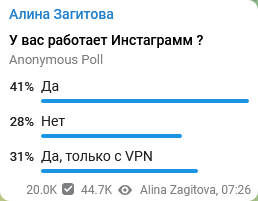
Last edited:
- Joined
- Feb 10, 2018
Anna is preparing for university admission:

 t.me
t.me
Anna's new video
Anya is preparing to enter the sports university
For admission, she must pass: Russian language, mathematics and biology.
Tell me, what exams did you take?
TeamShcherbakova
t.me
Anna's new video
Anya is preparing to enter the sports university
For admission, she must pass: Russian language, mathematics and biology.
Tell me, what exams did you take?

- Joined
- Nov 12, 2021
Today I heard in some news that the blocking will be "partial". What that means, I can only guess. However, most likely access to Instagram is retained simply for the reason that providers are not in a hurry to follow instructions. We do not yet have such a total merciless discipline as in YouTube.Officially it should be (that's why there was that massive boom of telegram profile creations) but so far it seems that it is still working. Alina made a quick survey:
- Joined
- Feb 10, 2018
That's what I read somewhere too, but I also did not follow what exactly is meant by "partial".Today I heard in some news that the blocking will be "partial". What that means, I can only guess. However, most likely access to Instagram is retained simply for the reason that providers are not in a hurry to follow instructions. We do not yet have such a total merciless discipline as in YouTube.
- Joined
- Nov 12, 2021
If you only knew how hard it is for me to resist not entering the Ukrainian thread. I only have to take part in the discussion there - and you will be left without translations for a long time, if not forever. Here I look at Anya and learn to be a person with a strong will. In the end, it is useless to convince people, I have understood this for sure over the years.

- Joined
- Nov 12, 2021
It seemed to me that there was already a partial block - access to Instagram without VPN slowed down dramatically, photos were not loaded, videos were not shown. But what our government means by partial blocking is a mystery. Such are the Russian traditions - to arrange a ridicolous circus out of the blueThat's what I read somewhere too, but I also did not follow what exactly is meant by "partial".
- Joined
- Nov 12, 2021
Translation of the conversation between Channel One journalist Pavel Zanozin (Z) with Anna Shcherbakova (A) and Daniil Gleikhengauz (D). The conversation took place back in Beijing, the day after the awards ceremony. The video has been blocked, unfortunately. Part of this conversation was published by someone with English subtitles, but only part of it:
Z: And now - the newly-minted Olympic champion, Anna Shcherbakova, is on our live broadcast! We have a unique opportunity to communicate with her. And Daniil Gleikhengauz, who also does not leave his beloved student at the most pleasant moments, and this is very cool. Friends, hello!
A: Hello!
D: Hello.
Z: I understand that there are not very many emotions now. Probably even less than you had yesterday, Anya, when you went out to reporters. You know, as if nothing special had happened - well, she became an Olympic champion, so what, the usual thing, right?
A: If I really realized this, then, probably, the emotions would be different. So far, it’s just that even the understanding has not come to me that everything has already happened ...
Z: Although at the end of the skating you still had this gesture (shows). Daniil also gave you to understand with a gesture that everything is fine. (to Daniil) Tell me, what did you feel at that moment, what did you think? I can hardly imagine how much nervous energy was expended.
D: The best feeling I want to have is when an athlete comes out and cleanly performs his program, and I understand that at the moment it would be impossible to perform even better. Therefore, when Anya finished her FS, I was proud that today, now, just like in the short program, it was perfect skating. And it happened at the Olympics, there were no mistakes, and I could not experience anything but pride, because all this is happening here and now - an unforgettable feeling.
Z: Before that, there was Sasha, and after that it was necessary to take care of Kamila ...
D: We have to change very quickly because that's our job. Emotionally it is very difficult, and I do not even want to delve into the question of how difficult it is to experience these emotions. As soon as our time in Kiss and Cry ends, after we hear the scores, I have to quickly switch, move on to another athlete and fully focus on the next performance. All other emotions will come later.
Z: Anya, after the announcement of the marks, you went to this green room and sat in the first place, watched Camila perform. We all watched [her performance] and wept. How did you feel at that moment? Your fate was decided - you could become an Olympic champion or just a silver medalist. Just a silver! Ha!
A: To be honest, at that moment I was completely immersed in my thoughts and, probably, I tried to convince myself, to understand ... I asked myself the question: “Do you even understand that your FS has just ended? This is what you have been preparing for so long.” And so I asked myself this question, do I understand what actually just happened. But at the same time, of course, I watched Kamila's performance and was very worried, because as an athlete I perfectly understand her feelings. After the first jump, it became clear that her skating was hard. I, as an athlete, feel the same, worry, and, of course, I was also very worried about Kamila.
But at the same time, there was such a strong devastation in me that I almost didn’t feel anything for myself. Probably, after the announcement of all the results, there was such a emptyness that the emotions seemed to have completely disappeared.
Z: All these days before the start of single skating, there was a lot of talk about Kamila. Everyone was talking about it, and the very fact that such a situation arose came as a shock to everyone. How did it affect you? Maybe the pressure on you has eased a little - on you and on Sasha?
A: To be honest, before the start of the competition, I was so focused on my skates and on some of my feelings and problems that I completely pulled away [from the situation with Kamila] and thought only about myself, because I also stroved to this moment for a very long time , I had a lot of my goals and ambitions, different experiences. Therefore, probably, before the competition, before my performances, all thoughts were only about my programs, about how I could show the best skating. Thus, before the tournament, this situation did not affect me.
Z: Even in a positive way, because…
A: No, I don't think it affected me at all. In general, I just prepared and continued to do it.
Z: Daniil, let's remember...
D: Same question for me?
Z: No, not the same question. Let's remember how you first saw Anya Shcherbakova.
A: Unexpectedly topic change ...
Z: I'm just wondering how it was. How old were you then? Nine, right?
D: No, a little more than 9...
A: Ten, probably.
Z: Ten.
D: Yes, just then I came to the group to Eteri Georgievna. I was still very young, green, ambitious guy. And besides those trainings that we had at Khrustalny, Anya and I went to additional classes at the skating rink, which was located nearby. We went there before morning training, and Anya was one of the children who was entrusted to me to try to prove themselves and improve their skills. They needed extra classes, and that's how we started to work harder than during normal training days. That's how I got to know her parents better. Three times a week we went [to these extra classes] and worked on gliding and jumping. Just at that moment there was a “breakthrough” - as I was told, before that, for almost a whole year, Anya could not perform a triple jump, although all the coaches, including Eteri Georgievna, understood that this element should already appear. The only question was when Anna will make the first landing, and from that moment she will go further. That is exactly what happened. She landed a triple toe loop, and then in about a month she mastered all the other triple jumps, which actually happens very rarely in our sport.
A: The last one was the double axel…
D: Yes! The most recent was a double axel, oddly enough. Right after that, we broke into a very important season (laughs).
A: At that time it seemed that this was the most important season ...
D: I just remember now all my emotions when we went to the children's preliminaries. This is the Moscow Championship, a special children's program of the Russian Championship. And I called Eteri Georgievna and told me about every training session, about every skate - what we did or didn’t do there, why we took this or that place, something else. Now I just imagine how tolerant she was to my emotional calls at that moment, during the preparation of older athletes for the Grand Prix final, for the World Championship - and we are there in Moscow with our children's competitions. "We jumped a triple toe loop!" (everyone laughs) "We were selected for the children's championship of Russia!".
Z(to Anna): Do you remember the moment of your first triple jump? What happened then that didn't work before?
A: Yes, I remember training when I got my first triple jump. But, perhaps, then all this was somehow less conscious. Therefore, I cannot say now what exactly I could not do for a whole year before. But really, something changed very dramatically in me, I got the feeling of a triple jump, and then, yes, the learning process began very quickly, and from that moment on, training became much more interesting for me. Before that - a year of monotonous work without any special results.
Z: And the next jump - already on quads? Actually, we are already used to the fact that quads are normal, but you [with Sasha] were the first to start doing them. Have you ever imagined what kind of revolution you are making?
A: It seems to me that at that time we did not imagine this. Well, maybe the coaches in their imagination have already seen how we will perform all this at the competitions, but at that moment it seemed that we were really trying something new and it was interesting - would it work? For example, I was not sure that in a few years quadruple jumps would become a regular part of our free program. Personally, I then tried a quadruple sheepskin coat out of interest, I wanted to succeed. I wanted to prove to myself that it was possible. But of course, I had no idea that...
D: That then you will have to do this all your life ...
A (laughs): Yes!
Z: And who came up with this, and how did it happen at all, that [the coaches] decided that the girls would do quadruple jumps, although nothing like this had happened before.
D: No, well, in fact, there were cases in history when girls performed quadruple jumps ...
Z: Well, there were attempts...
D: There were attempts, and they did a triple axel, and jumped a quadruple salchow ... But there really was no feeling that this should become some kind of routine. There really are no reasons why girls could not perform quads. These reasons were only in our heads, because at some point everyone decided that boys should do quadruple jumps, and girls should only do triple jumps. Well, everyone is used to it. But we have a new, very talented generation of girls, and with the right technique, their capabilities were already visible when performing triple jumps. When we saw that this reserve appeared and that triple jumps were performed easily by girls, we began to think that we need to move somewhere further. Of course, all this was gradual, because at that time Alina and Zhenya were training. Then we moved all the jumps in their programs to the second half in order to get extra points for this. We were looking for options for programs with cascades, for example, the Lutz Rittberger that Alina had - so that there would be even more points. And it was clear that in general we had reached the peak here.
What Alina did in 2018 in terms of technical evaluation was the maximum in both programs. And if you do not add a triple axel or quadruple jumps, further movement would become impossible. Therefore, we understood that it was necessary to develop figure skating further. Having such talented girls and seeing that their progress in the performance of triple jumps has reached the required level, we realized that it is time for Sergey Viktorovich [Dudakov] to take up the lounge and with the help of this support and a very large volume of foam rubber, learn new elements.
Z: (to Anna) Do you still skate in pants with a lot of foam rubber in training?
A: Yes, but now these pants at least look better, because when I studied the very first quadruple jumps, in these pants I looked like SpongeBob - there were such huge pillows there (laughs).
D: Yes, I recently watched a video on my own Instagram with one of Anya's first quadruple toe loop. At that moment it didn’t seem so to me, but now, when she has already grown up, it is very noticeable that there really is some kind of SpongeBob.
A: (laughs) Yes!
Z: Well, there are far fewer bruises, no matter what it looks like. Now you have already come to something serious, there are already quadruple jumps - and then that terrible story happens. Daniil, if you can, remember how it was. It seems that this happened in the summer of 2017?
A: Yes...
D: Oh yes... It was in Novogorsk, and that day I had the first day off when I did not come to training. I remember that I was driving a car when Eteri Georgievna or Sergey Viktorovich called me (I don’t even remember who exactly) and I found out about it. I immediately went to the hospital, where Anya was taken. Well, what can I say... Maybe it's even a good thing that I didn't see it myself, because I don't know how I would have survived it. But it was a very difficult moment and a difficult period. I think Anya can tell more about it, because she was the one who went through it. For our part, we did everything we could to help her cope with this. Then there was a very difficult period of recovery. But we see that everything was overcome, and everything was not in vain.
Z: That's right! (to Anna) If possible, show again so that everyone understands that everything was not in vain.
(Anna raises and shows the gold medal)
Z: (to Daniil) Anya and I already discussed this - once again I want to go back to last summer, when some strange nonsense also happened with a broken little finger. That's what you thought at that moment - you wanted to give her a cuff or say: “Gods, how?! What a little finger, we have the Olympics soon! ?
D: Well, I was angry, I can’t say anything (laughs). Even though I saw her alive and well as I walked past her into the dining room, and 15 minutes after I had eaten, she was already sitting on the couch with her finger pointing the other way.
Z: Anya, tell me how you broke ...
A (laughs): Well, stupid story, I don't even want to go into details. It happened on my day off. Injuries received in training are still a little different, this is work, but here I reproached myself, because I understood that I was losing training time due to some stupidity. Therefore, I wanted to quickly forget this moment and never remember it again, and, I don’t know ...
D: Don't break your little finger anymore.
A (laughs): Yes!
Z: Could any of you at that moment imagine that you would become an Olympic champion?
A: At that moment, there was no time for such thoughts at all.
Z: But it’s the Olympic season and you still went to this all the years while you were engaged in figure skating?
D: That's why this is the last thing I would like to see at the beginning of a sports camp, when ...
A: There was just another story: I arrived from vacation a few days before the start of the sports camp and even then I started training. It seemed to me that if I started three days earlier, it would be very important for me. These three days, each of which counts ... That's when the thoughts really were about the Olympic season. It seemed to me that I needed to get in shape without wasting a second. Every day seemed very valuable, I wanted to be ahead of time and prepare for the season in such a way as to approach it fully armed at the beginning. And at that moment, when I so appreciated every workout and every day - because of one stupidity, I lost two or three months of full-fledged training. With such thoughts, it was hard to sit and think about what I had done. But, probably, nothing could be done about it, it was necessary just to get out of this situation in all possible ways.
Z(to Daniil): We know that Anya has a unique feature - to get ready at the right time and show the maximum. So it was at all the most important tournaments in her career. Do you understand why this is happening? When it seems that everything is bad, everything is not right - and suddenly bam - she goes out and does something brilliant.
D: Well, everyone has their own talent. And I think that this is just her talent, her feature. To do this, you need to be a very strong internally and self-confident person. But in any case, this should be backed up by training. Because if you can go out and show more, that's great and it's very important, but you have to have a base that you build on. Therefore, when it is 100% ready, it means that it is able to show 120-130%. And if the form is only 50%, then you get 70-80%, and this is not enough for clean skating and a good result. Therefore, during the training process, you still can’t think that you will just go out and do that today’s result is not important. We still want to see [a high level of performance] in training. It is clear that it is difficult to show such a maximum every day and remain perfect, but you cannot lower the bar below a certain level.
Z (to Anna): For me, your image looks like such an excellent student who always wants to do everything perfectly and well. Do you really do this every training session, or do you also have moments when you are lazy?
(Anna laughs embarrassedly)
Z: Well, just now let's try to show not ideal Anna Shcherbakova.
(Anna thinks for a long time, then starts laughing again)
A: It’s so embarrassing to talk about it, and there’s also a coach behind my back ... No, well, of course, I’m not an ideal person and I certainly don’t stay in the image of an excellent student every day. I often have difficulties in training. I think this was evident from the broadcasts of training before performances at competitions. If only everything was so perfect...
Z: But it's obviously not laziness, because you have problems with jumping, but judging by what I've seen, you always try. We see little, for us, unfortunately, this is a closed process.
D: You yourself answered for her, and she does not mind, as I understand it ...
Z: Well, a modest, modest girl, of course ...
A: Let it stay inside the training process.
Z: Yes, especially since it all ends like this: three-time Russian champion, world champion, Olympic champion.
A: In training, we work in order to show results in competitions. Therefore, let everything that happens in training stay in training. (laughs) I just thought and came up with the answer. That's what happens at the competition - it's for the audience.
Z: And now - the newly-minted Olympic champion, Anna Shcherbakova, is on our live broadcast! We have a unique opportunity to communicate with her. And Daniil Gleikhengauz, who also does not leave his beloved student at the most pleasant moments, and this is very cool. Friends, hello!
A: Hello!
D: Hello.
Z: I understand that there are not very many emotions now. Probably even less than you had yesterday, Anya, when you went out to reporters. You know, as if nothing special had happened - well, she became an Olympic champion, so what, the usual thing, right?
A: If I really realized this, then, probably, the emotions would be different. So far, it’s just that even the understanding has not come to me that everything has already happened ...
Z: Although at the end of the skating you still had this gesture (shows). Daniil also gave you to understand with a gesture that everything is fine. (to Daniil) Tell me, what did you feel at that moment, what did you think? I can hardly imagine how much nervous energy was expended.
D: The best feeling I want to have is when an athlete comes out and cleanly performs his program, and I understand that at the moment it would be impossible to perform even better. Therefore, when Anya finished her FS, I was proud that today, now, just like in the short program, it was perfect skating. And it happened at the Olympics, there were no mistakes, and I could not experience anything but pride, because all this is happening here and now - an unforgettable feeling.
Z: Before that, there was Sasha, and after that it was necessary to take care of Kamila ...
D: We have to change very quickly because that's our job. Emotionally it is very difficult, and I do not even want to delve into the question of how difficult it is to experience these emotions. As soon as our time in Kiss and Cry ends, after we hear the scores, I have to quickly switch, move on to another athlete and fully focus on the next performance. All other emotions will come later.
Z: Anya, after the announcement of the marks, you went to this green room and sat in the first place, watched Camila perform. We all watched [her performance] and wept. How did you feel at that moment? Your fate was decided - you could become an Olympic champion or just a silver medalist. Just a silver! Ha!
A: To be honest, at that moment I was completely immersed in my thoughts and, probably, I tried to convince myself, to understand ... I asked myself the question: “Do you even understand that your FS has just ended? This is what you have been preparing for so long.” And so I asked myself this question, do I understand what actually just happened. But at the same time, of course, I watched Kamila's performance and was very worried, because as an athlete I perfectly understand her feelings. After the first jump, it became clear that her skating was hard. I, as an athlete, feel the same, worry, and, of course, I was also very worried about Kamila.
But at the same time, there was such a strong devastation in me that I almost didn’t feel anything for myself. Probably, after the announcement of all the results, there was such a emptyness that the emotions seemed to have completely disappeared.
Z: All these days before the start of single skating, there was a lot of talk about Kamila. Everyone was talking about it, and the very fact that such a situation arose came as a shock to everyone. How did it affect you? Maybe the pressure on you has eased a little - on you and on Sasha?
A: To be honest, before the start of the competition, I was so focused on my skates and on some of my feelings and problems that I completely pulled away [from the situation with Kamila] and thought only about myself, because I also stroved to this moment for a very long time , I had a lot of my goals and ambitions, different experiences. Therefore, probably, before the competition, before my performances, all thoughts were only about my programs, about how I could show the best skating. Thus, before the tournament, this situation did not affect me.
Z: Even in a positive way, because…
A: No, I don't think it affected me at all. In general, I just prepared and continued to do it.
Z: Daniil, let's remember...
D: Same question for me?
Z: No, not the same question. Let's remember how you first saw Anya Shcherbakova.
A: Unexpectedly topic change ...
Z: I'm just wondering how it was. How old were you then? Nine, right?
D: No, a little more than 9...
A: Ten, probably.
Z: Ten.
D: Yes, just then I came to the group to Eteri Georgievna. I was still very young, green, ambitious guy. And besides those trainings that we had at Khrustalny, Anya and I went to additional classes at the skating rink, which was located nearby. We went there before morning training, and Anya was one of the children who was entrusted to me to try to prove themselves and improve their skills. They needed extra classes, and that's how we started to work harder than during normal training days. That's how I got to know her parents better. Three times a week we went [to these extra classes] and worked on gliding and jumping. Just at that moment there was a “breakthrough” - as I was told, before that, for almost a whole year, Anya could not perform a triple jump, although all the coaches, including Eteri Georgievna, understood that this element should already appear. The only question was when Anna will make the first landing, and from that moment she will go further. That is exactly what happened. She landed a triple toe loop, and then in about a month she mastered all the other triple jumps, which actually happens very rarely in our sport.
A: The last one was the double axel…
D: Yes! The most recent was a double axel, oddly enough. Right after that, we broke into a very important season (laughs).
A: At that time it seemed that this was the most important season ...
D: I just remember now all my emotions when we went to the children's preliminaries. This is the Moscow Championship, a special children's program of the Russian Championship. And I called Eteri Georgievna and told me about every training session, about every skate - what we did or didn’t do there, why we took this or that place, something else. Now I just imagine how tolerant she was to my emotional calls at that moment, during the preparation of older athletes for the Grand Prix final, for the World Championship - and we are there in Moscow with our children's competitions. "We jumped a triple toe loop!" (everyone laughs) "We were selected for the children's championship of Russia!".
Z(to Anna): Do you remember the moment of your first triple jump? What happened then that didn't work before?
A: Yes, I remember training when I got my first triple jump. But, perhaps, then all this was somehow less conscious. Therefore, I cannot say now what exactly I could not do for a whole year before. But really, something changed very dramatically in me, I got the feeling of a triple jump, and then, yes, the learning process began very quickly, and from that moment on, training became much more interesting for me. Before that - a year of monotonous work without any special results.
Z: And the next jump - already on quads? Actually, we are already used to the fact that quads are normal, but you [with Sasha] were the first to start doing them. Have you ever imagined what kind of revolution you are making?
A: It seems to me that at that time we did not imagine this. Well, maybe the coaches in their imagination have already seen how we will perform all this at the competitions, but at that moment it seemed that we were really trying something new and it was interesting - would it work? For example, I was not sure that in a few years quadruple jumps would become a regular part of our free program. Personally, I then tried a quadruple sheepskin coat out of interest, I wanted to succeed. I wanted to prove to myself that it was possible. But of course, I had no idea that...
D: That then you will have to do this all your life ...
A (laughs): Yes!
Z: And who came up with this, and how did it happen at all, that [the coaches] decided that the girls would do quadruple jumps, although nothing like this had happened before.
D: No, well, in fact, there were cases in history when girls performed quadruple jumps ...
Z: Well, there were attempts...
D: There were attempts, and they did a triple axel, and jumped a quadruple salchow ... But there really was no feeling that this should become some kind of routine. There really are no reasons why girls could not perform quads. These reasons were only in our heads, because at some point everyone decided that boys should do quadruple jumps, and girls should only do triple jumps. Well, everyone is used to it. But we have a new, very talented generation of girls, and with the right technique, their capabilities were already visible when performing triple jumps. When we saw that this reserve appeared and that triple jumps were performed easily by girls, we began to think that we need to move somewhere further. Of course, all this was gradual, because at that time Alina and Zhenya were training. Then we moved all the jumps in their programs to the second half in order to get extra points for this. We were looking for options for programs with cascades, for example, the Lutz Rittberger that Alina had - so that there would be even more points. And it was clear that in general we had reached the peak here.
What Alina did in 2018 in terms of technical evaluation was the maximum in both programs. And if you do not add a triple axel or quadruple jumps, further movement would become impossible. Therefore, we understood that it was necessary to develop figure skating further. Having such talented girls and seeing that their progress in the performance of triple jumps has reached the required level, we realized that it is time for Sergey Viktorovich [Dudakov] to take up the lounge and with the help of this support and a very large volume of foam rubber, learn new elements.
Z: (to Anna) Do you still skate in pants with a lot of foam rubber in training?
A: Yes, but now these pants at least look better, because when I studied the very first quadruple jumps, in these pants I looked like SpongeBob - there were such huge pillows there (laughs).
D: Yes, I recently watched a video on my own Instagram with one of Anya's first quadruple toe loop. At that moment it didn’t seem so to me, but now, when she has already grown up, it is very noticeable that there really is some kind of SpongeBob.
A: (laughs) Yes!
Z: Well, there are far fewer bruises, no matter what it looks like. Now you have already come to something serious, there are already quadruple jumps - and then that terrible story happens. Daniil, if you can, remember how it was. It seems that this happened in the summer of 2017?
A: Yes...
D: Oh yes... It was in Novogorsk, and that day I had the first day off when I did not come to training. I remember that I was driving a car when Eteri Georgievna or Sergey Viktorovich called me (I don’t even remember who exactly) and I found out about it. I immediately went to the hospital, where Anya was taken. Well, what can I say... Maybe it's even a good thing that I didn't see it myself, because I don't know how I would have survived it. But it was a very difficult moment and a difficult period. I think Anya can tell more about it, because she was the one who went through it. For our part, we did everything we could to help her cope with this. Then there was a very difficult period of recovery. But we see that everything was overcome, and everything was not in vain.
Z: That's right! (to Anna) If possible, show again so that everyone understands that everything was not in vain.
(Anna raises and shows the gold medal)
Z: (to Daniil) Anya and I already discussed this - once again I want to go back to last summer, when some strange nonsense also happened with a broken little finger. That's what you thought at that moment - you wanted to give her a cuff or say: “Gods, how?! What a little finger, we have the Olympics soon! ?
D: Well, I was angry, I can’t say anything (laughs). Even though I saw her alive and well as I walked past her into the dining room, and 15 minutes after I had eaten, she was already sitting on the couch with her finger pointing the other way.
Z: Anya, tell me how you broke ...
A (laughs): Well, stupid story, I don't even want to go into details. It happened on my day off. Injuries received in training are still a little different, this is work, but here I reproached myself, because I understood that I was losing training time due to some stupidity. Therefore, I wanted to quickly forget this moment and never remember it again, and, I don’t know ...
D: Don't break your little finger anymore.
A (laughs): Yes!
Z: Could any of you at that moment imagine that you would become an Olympic champion?
A: At that moment, there was no time for such thoughts at all.
Z: But it’s the Olympic season and you still went to this all the years while you were engaged in figure skating?
D: That's why this is the last thing I would like to see at the beginning of a sports camp, when ...
A: There was just another story: I arrived from vacation a few days before the start of the sports camp and even then I started training. It seemed to me that if I started three days earlier, it would be very important for me. These three days, each of which counts ... That's when the thoughts really were about the Olympic season. It seemed to me that I needed to get in shape without wasting a second. Every day seemed very valuable, I wanted to be ahead of time and prepare for the season in such a way as to approach it fully armed at the beginning. And at that moment, when I so appreciated every workout and every day - because of one stupidity, I lost two or three months of full-fledged training. With such thoughts, it was hard to sit and think about what I had done. But, probably, nothing could be done about it, it was necessary just to get out of this situation in all possible ways.
Z(to Daniil): We know that Anya has a unique feature - to get ready at the right time and show the maximum. So it was at all the most important tournaments in her career. Do you understand why this is happening? When it seems that everything is bad, everything is not right - and suddenly bam - she goes out and does something brilliant.
D: Well, everyone has their own talent. And I think that this is just her talent, her feature. To do this, you need to be a very strong internally and self-confident person. But in any case, this should be backed up by training. Because if you can go out and show more, that's great and it's very important, but you have to have a base that you build on. Therefore, when it is 100% ready, it means that it is able to show 120-130%. And if the form is only 50%, then you get 70-80%, and this is not enough for clean skating and a good result. Therefore, during the training process, you still can’t think that you will just go out and do that today’s result is not important. We still want to see [a high level of performance] in training. It is clear that it is difficult to show such a maximum every day and remain perfect, but you cannot lower the bar below a certain level.
Z (to Anna): For me, your image looks like such an excellent student who always wants to do everything perfectly and well. Do you really do this every training session, or do you also have moments when you are lazy?
(Anna laughs embarrassedly)
Z: Well, just now let's try to show not ideal Anna Shcherbakova.
(Anna thinks for a long time, then starts laughing again)
A: It’s so embarrassing to talk about it, and there’s also a coach behind my back ... No, well, of course, I’m not an ideal person and I certainly don’t stay in the image of an excellent student every day. I often have difficulties in training. I think this was evident from the broadcasts of training before performances at competitions. If only everything was so perfect...
Z: But it's obviously not laziness, because you have problems with jumping, but judging by what I've seen, you always try. We see little, for us, unfortunately, this is a closed process.
D: You yourself answered for her, and she does not mind, as I understand it ...
Z: Well, a modest, modest girl, of course ...
A: Let it stay inside the training process.
Z: Yes, especially since it all ends like this: three-time Russian champion, world champion, Olympic champion.
A: In training, we work in order to show results in competitions. Therefore, let everything that happens in training stay in training. (laughs) I just thought and came up with the answer. That's what happens at the competition - it's for the audience.
- Joined
- Nov 12, 2021
and part 2:
Z: Great! You have other competitions that you have not won. European Championship (probably a very big goal for you), Grand Prix final, canceled this season. Can this be an incentive when you now have such a victory - the most important one?
A: To be honest, I would not say that the medals that I do not have yet are an incentive for me. Probably, I have not competed for any particular medal before. It seems to me that I skate because, first of all, I like the process itself, the performances themselves, the support of the audience, emotions. And I think that the most valuable moment for an athlete is what I experienced in the first seconds after the free program. This is not some moment in Kiss & Cry and not the moment of announcing the marks, but the moment when I finish my free program and feel that now on the ice I have reached the maximum of my abilities. It seems to me that I am working for this moment, and as long as I feel the strength in myself to perform and show programs, feel support from the audience, adrenaline ... I think that's why I skate.
Z (to Daniel): What are you training for?
D: Well, actually Anya answered very correctly. It seems to me that if you are looking for motivation for yourself only in winning something that has not yet been won, this is not quite the right approach. It seems to me that a long career means loving the work you do. Of course, to keep this love, if this work does not bring results, medals, success, but I still can’t imagine my life without figure skating either. That's why I do it, and we all our team spend all our time on the ice. And returning home from the skating rink, we continue to discuss training and plans for the future, not because our athletes and I have not yet won some medals, but simply because we love it, this is our life.
Z: Great words! I just always at such moments when we discuss this with athletes, I remember Andre Agassi's book "Open", at the very beginning of which he says that he hates tennis. And all his life and career he went through this hatred, which helped him to succeed. From love to hate, as you know, one step. You had a moment when you, just like Sasha Trusova, shouted “I hate sports! Never again!" etc.? I just can't imagine you in this state.
A: No, of course, I'm actually a very emotional person and even during training sometimes my mood changes a lot. I can get frustrated after every failed attempt. And if I get upset after a failed attempt, then after a failed training session, when I come home, I also have bursts of emotions. Especially if, as sometimes happens, there are several unsuccessful trainings in a row. All the time I keep it all in myself, but at some point, emotions still break out. But, as it seems to me, I never seriously thought about leaving figure skating. Maybe some fleeting thoughts, but I never seriously considered the real end of a career. Seriously - never, but, of course, some difficult emotional moments happen. At such moments, my parents often support me. Perhaps they can listen to my emotional outbursts ...
Z: Are you in contact with your parents all the time? Because I understand that they have a strong influence, but your influence is also strong, and it is probably difficult to find a balance here. (to Daniil) Did you say that you had a good relationship with Anna's parents from the very beginning?
D: Yes, it so happened that we found a common language from the very beginning. And we feel comfortable talking together, spending time together ...
Z: I support, by the way. (to Anna) You have great parents!
D: They devoted a lot of their time and nerves to Anna's sports activities and, of course, I congratulated them, and once again I will congratulate them with pleasure on the fact that their daughter became an Olympic champion. I can't imagine how proud it is for parents.
A: Here I would like to say that parents, of course, also devote themselves to figure skating. They do an incredible amount for me. And at the same time they do not interfere in the training process. That is, for example, my parents never taught me how to train properly. That's why there are always coaches. And here, it seems to me, it is important that there is never a conflict. Coaches do their job on the ice, and parents are at home. They support me, but this is purely emotional support, not related to trying to teach me how to train - probably like this.
Z: At the same time, it seems to me that you are a unique example, because usually ... Of course, you are almost an adult, but until the age of 15-16, parents usually force: “Come on, get it, you can”, etc., because children may not want to go through pain, hardship and trauma. Why are you different, what is special about you?
A: No, I wouldn't say that. It seems to me that those who end up in professional sports love what they do. Otherwise, it would be difficult to go through difficulties. So I would say that...
Z: Of those athletes whom I personally know, there are very few people like you who really love it themselves. You said that from the very beginning you wanted to do figure skating, then you wanted to continue, and after the fracture you returned. No one forced you, no one pushed you in this direction - is that how it turns out?
A (shrugs, laughs): I don't even know what to say. I really love it, but I don't see anything supernatural in that regard. It seems to me that many people in life do what they like. And, maybe, if they forced me, then, on the contrary, I would not have the desire, I would not have such zeal - most likely, so.
Z: It’s just that now one of the most discussed topics related to this Olympics and figure skating looks like this: “You can’t mock children like that!” This is mainly said in connection with Camila, but you and Sasha too ... Soon you will be 18, but you are still young too - I don’t know if you consider yourself a child. Anyway, you are small and it seems to people who look from the side that ...
D: It's just you yourself being old!
Z: (something suspiciously like a friendly curse) That this is some kind of mockery of you - pain, trauma, some kind of violence against the person. Have you ever experienced it that way? Or do you realize that you are doing a job that you like - and that's it?
A: Well, I don’t know, it seems to me that figure skating has given me so much that I can’t find any disadvantages in my doing it. In my opinion, there are only pluses around - the fact that I travel, I go to international competitions, that the whole world is watching me at competitions, that we have the opportunity to prove ourselves. And at such a young age, we have already found a business that we have a soul for, a business that we like to do, and in which we have already achieved something. In my opinion, this, on the contrary, is a great advantage - we are not in search of ourselves, but we already know quite definitely: figure skating is what we have chosen in life.
Z: Have you ever thought how long you are ready to do this with the same enthusiasm, completely, to the maximum? Because there are plans anyway, I guess?
A: It's hard to say specifically about professional sports. Of course, if you look at a long career, it's ups and downs and sometimes it will be hard to go through some kind of difficulties. But for now, I'm probably ready to continue my professional career and I'm sure that my future life will be connected with figure skating anyway. Probably, if it was torment and mockery for me, then I would dream of running away from here as soon as possible, but, on the contrary, I cannot imagine myself without figure skating. And if I finish my sports career, I want to be somehow connected with figure skating.
Z: That's great! I would also suggest that you consider television, because I don’t say in vain that you look amazing and speak amazingly. That's when you just came - said, "I don't have a single thought" - but these thoughts are born in the process, and it's very interesting to watch, it's very cool.
Daniil, this is your third Olympics, where your athletes become champions. You know, there's such a thing as season two syndrome. You also love football and you know what I'm talking about. And it's not just the syndrome of the second season. Here you are obliged. However, you have the second Olympics, and Eteri Georgievna has the third. How to live with it? Maybe someone is standing over you with a gun and says something like “If you don’t win, then your price is zero”, or what?
D: Well, of course, I can't say that someone is standing over us with a gun. Everyone just wants to win.
Z: Public opinion, it seems to me, is just that [with a gun]
D: It doesn't get any easier for us - it's true. In fact, it seems to me that we are already used to the fact that we cannot be completely happy. In any case, we feel great happiness for one athlete, and at the same time, our hearts are broken because of another athlete. I see their emotions, experiences, and it is impossible to take it calmly. In principle, I don’t understand how a person who has a soul and a heart could calmly relate to what happened here. Because although I am an adult compared to the girls, it was very difficult. I didn't sleep and even lost weight during these days, and therefore I can't even imagine how they coped with this pressure.
But we go to work not because we have to, but because we ourselves want it. And when we create new programs, we see the results of our work at the competitions, the applause of the audience, the joy of the athletes - we understand that we live for this, that everything is not in vain. Of course, it does not happen that emotions are only positive. But it seems to me that it is precisely for this that people love figure skating and everything that we show to the audience. Because it creates a variety of emotions and leaves no one indifferent.
Z: Anya, tell me honestly - were you at least a little worried about the girls? I remember that you said that you thought a lot about yourself, and rightly so - this is a sport, and you are here for yourself. But now you've been thinking about how they feel?
A: Well, as I said before: before the start, I thought only about myself, and after the end of my program, for example, when I watched Kamila’s performance, then, of course, I, as a person who sees all her trainings and experiences a lot herself, could not remain indifferent. And if I watch the performances of the girls when they pass after my skating, I also experience emotions.
Z: Did you manage to talk with Kamila at least a little after what happened in the free program?
A: Yes, we had a heart-to-heart talk with Kamila in the evening, discussed everything.
Z: Did you support her?
A: Yes. But still, I want to leave it all between me and Kamila.
Z: What matters to me is that you supported her. Because… I don’t know, but Daniil says that for someone who has a soul, it’s impossible to endure all this… I think everyone who watched was literally dying from conflicting feelings. On the one hand - joy for you, on the other - terrible pain for what was there.
What will you do now when you come to Moscow? I just can’t imagine – well, I’m an Olympic champion, so what, let’s train the same way again. Channel One Cup, by the way, yes.
A: The most important start of the season, by the way (laughs)
Z: From March 4 to March 7 in Sochi - in case someone forgot.
A: Well, it's probably important that we haven't reached the end of the season yet. Despite the fact that it was the main tournament of four years, we are going back and we won't even have much time to rest. I even know that we will have some shows with my participation, but I will have to return to training - and it's probably for the best that I won't have time to rest and think about a carefree life. The fact that I have to get back to training as soon as possible will help me gather myself. And the fact that the season continues is also very important.
Z: So you don’t want to rest?
A: I don't have an understanding yet that the Olympic competitions are over. I'm still tense, not relaxed, not exhaled
D: More Gala ahead! (everyone laughs)
A: In general, even after these competitions, I still haven’t relaxed. But I think it's for the best that there won't be a long break, because it will be easier to get back to work and not turn off your head.
Z: You, as an Olympic champion, have the opportunity to express your wishes for the First Channel Cup. Maybe you want some special jumping contest format? Maybe you want to call someone?
A: To cut out unsuccessful attempts? (laughs) It would be nice!
Z: Ice cream after every jump? Seriously, would you like some changes compared to last year? Everyone was in awe of these team formats, of the jumps – is there anything else you could add?
A (shakes head): I don't even know...
Z: Okay, then you choose one skater who could be invited.
A: Well, I already know that Nathan Chen will be participating.
Z: I thought you didn't know! You just say: “can I call Nathan Chen”, and we immediately: “Yes! Here it is for you!”
D: It would be funny if she chose someone else - then I would look at you.
Z: Would you like to be on the same team with him?
A: Of course! Undoubtedly.
Z: Okay, then let's try this. Could you beat him in jumping? Remember, our guys were so upset last year that they lost to you girls ...
D: And so you were forced to call ...
Z: Yes! Strengthen the team this way.
A: Yes, this time it will definitely be more difficult, what can I say. Well, I think it will be interesting to compete. Nathan Chen has been looking like the best and most unattainable figure skater on the planet for many years now. Therefore, the idea that we will compete with him in jumping is already something incredible. So I think that will be interesting to watch.
Z: Sasha would now say: “Yes, I'm ready! I'll beat him easily!" Do you have any plans to make things more difficult for yourself? I think about the triple axel all the time. Did you say that you learned the double last, and it’s really possible for you to complete the triple?
A: According to my physical data, I think I can actually perform this jump. And this is not just a hypothetical assumption. At the moment when I was actively working on the triple axel, it was already clear to me that this was quite real. I think I had a little time left, but then everything started to spin, and I didn’t work on this element for quite a long time. Of course, if I return to the triple Axel, it will take a lot of time to train and learn. Therefore, if I am in optimal shape, this could be an interesting goal for me, although not an easy one.
Z: Daniel, what do you think – is it possible?
D: Well, I was very upset when we stopped working on the triple Axel. I understood very well how necessary that element was in the short program. Without it, it is difficult to score the maximum number of points. In fact, there were very good attempts. The goal was close. But, as Anya said, “everything is spinning” (everyone laughs) This, of course, is a very good explanation for why we did not get the triple Axel and do not train it. I hope that everything that started spinning will unwind in the opposite direction. Here the question is the desire of the athlete himself. In order for the jump to work, it must be constantly trained. And if we constantly train the triple axel, I can believe that it will start to work out.
Z: Well, then we are waiting for new achievements - and it's great that they are still possible, even after the Olympic gold medal has been received. Anna Shcherbakova, Olympic champion, Daniil Gleikhengauz, coach of the Olympic champion. Guys, thank you very much, I wish you a great Gala, and then we'll light it up on the Channel One Cup
A: Thank you!
D: Thank you!
Z: Great! You have other competitions that you have not won. European Championship (probably a very big goal for you), Grand Prix final, canceled this season. Can this be an incentive when you now have such a victory - the most important one?
A: To be honest, I would not say that the medals that I do not have yet are an incentive for me. Probably, I have not competed for any particular medal before. It seems to me that I skate because, first of all, I like the process itself, the performances themselves, the support of the audience, emotions. And I think that the most valuable moment for an athlete is what I experienced in the first seconds after the free program. This is not some moment in Kiss & Cry and not the moment of announcing the marks, but the moment when I finish my free program and feel that now on the ice I have reached the maximum of my abilities. It seems to me that I am working for this moment, and as long as I feel the strength in myself to perform and show programs, feel support from the audience, adrenaline ... I think that's why I skate.
Z (to Daniel): What are you training for?
D: Well, actually Anya answered very correctly. It seems to me that if you are looking for motivation for yourself only in winning something that has not yet been won, this is not quite the right approach. It seems to me that a long career means loving the work you do. Of course, to keep this love, if this work does not bring results, medals, success, but I still can’t imagine my life without figure skating either. That's why I do it, and we all our team spend all our time on the ice. And returning home from the skating rink, we continue to discuss training and plans for the future, not because our athletes and I have not yet won some medals, but simply because we love it, this is our life.
Z: Great words! I just always at such moments when we discuss this with athletes, I remember Andre Agassi's book "Open", at the very beginning of which he says that he hates tennis. And all his life and career he went through this hatred, which helped him to succeed. From love to hate, as you know, one step. You had a moment when you, just like Sasha Trusova, shouted “I hate sports! Never again!" etc.? I just can't imagine you in this state.
A: No, of course, I'm actually a very emotional person and even during training sometimes my mood changes a lot. I can get frustrated after every failed attempt. And if I get upset after a failed attempt, then after a failed training session, when I come home, I also have bursts of emotions. Especially if, as sometimes happens, there are several unsuccessful trainings in a row. All the time I keep it all in myself, but at some point, emotions still break out. But, as it seems to me, I never seriously thought about leaving figure skating. Maybe some fleeting thoughts, but I never seriously considered the real end of a career. Seriously - never, but, of course, some difficult emotional moments happen. At such moments, my parents often support me. Perhaps they can listen to my emotional outbursts ...
Z: Are you in contact with your parents all the time? Because I understand that they have a strong influence, but your influence is also strong, and it is probably difficult to find a balance here. (to Daniil) Did you say that you had a good relationship with Anna's parents from the very beginning?
D: Yes, it so happened that we found a common language from the very beginning. And we feel comfortable talking together, spending time together ...
Z: I support, by the way. (to Anna) You have great parents!
D: They devoted a lot of their time and nerves to Anna's sports activities and, of course, I congratulated them, and once again I will congratulate them with pleasure on the fact that their daughter became an Olympic champion. I can't imagine how proud it is for parents.
A: Here I would like to say that parents, of course, also devote themselves to figure skating. They do an incredible amount for me. And at the same time they do not interfere in the training process. That is, for example, my parents never taught me how to train properly. That's why there are always coaches. And here, it seems to me, it is important that there is never a conflict. Coaches do their job on the ice, and parents are at home. They support me, but this is purely emotional support, not related to trying to teach me how to train - probably like this.
Z: At the same time, it seems to me that you are a unique example, because usually ... Of course, you are almost an adult, but until the age of 15-16, parents usually force: “Come on, get it, you can”, etc., because children may not want to go through pain, hardship and trauma. Why are you different, what is special about you?
A: No, I wouldn't say that. It seems to me that those who end up in professional sports love what they do. Otherwise, it would be difficult to go through difficulties. So I would say that...
Z: Of those athletes whom I personally know, there are very few people like you who really love it themselves. You said that from the very beginning you wanted to do figure skating, then you wanted to continue, and after the fracture you returned. No one forced you, no one pushed you in this direction - is that how it turns out?
A (shrugs, laughs): I don't even know what to say. I really love it, but I don't see anything supernatural in that regard. It seems to me that many people in life do what they like. And, maybe, if they forced me, then, on the contrary, I would not have the desire, I would not have such zeal - most likely, so.
Z: It’s just that now one of the most discussed topics related to this Olympics and figure skating looks like this: “You can’t mock children like that!” This is mainly said in connection with Camila, but you and Sasha too ... Soon you will be 18, but you are still young too - I don’t know if you consider yourself a child. Anyway, you are small and it seems to people who look from the side that ...
D: It's just you yourself being old!
Z: (something suspiciously like a friendly curse) That this is some kind of mockery of you - pain, trauma, some kind of violence against the person. Have you ever experienced it that way? Or do you realize that you are doing a job that you like - and that's it?
A: Well, I don’t know, it seems to me that figure skating has given me so much that I can’t find any disadvantages in my doing it. In my opinion, there are only pluses around - the fact that I travel, I go to international competitions, that the whole world is watching me at competitions, that we have the opportunity to prove ourselves. And at such a young age, we have already found a business that we have a soul for, a business that we like to do, and in which we have already achieved something. In my opinion, this, on the contrary, is a great advantage - we are not in search of ourselves, but we already know quite definitely: figure skating is what we have chosen in life.
Z: Have you ever thought how long you are ready to do this with the same enthusiasm, completely, to the maximum? Because there are plans anyway, I guess?
A: It's hard to say specifically about professional sports. Of course, if you look at a long career, it's ups and downs and sometimes it will be hard to go through some kind of difficulties. But for now, I'm probably ready to continue my professional career and I'm sure that my future life will be connected with figure skating anyway. Probably, if it was torment and mockery for me, then I would dream of running away from here as soon as possible, but, on the contrary, I cannot imagine myself without figure skating. And if I finish my sports career, I want to be somehow connected with figure skating.
Z: That's great! I would also suggest that you consider television, because I don’t say in vain that you look amazing and speak amazingly. That's when you just came - said, "I don't have a single thought" - but these thoughts are born in the process, and it's very interesting to watch, it's very cool.
Daniil, this is your third Olympics, where your athletes become champions. You know, there's such a thing as season two syndrome. You also love football and you know what I'm talking about. And it's not just the syndrome of the second season. Here you are obliged. However, you have the second Olympics, and Eteri Georgievna has the third. How to live with it? Maybe someone is standing over you with a gun and says something like “If you don’t win, then your price is zero”, or what?
D: Well, of course, I can't say that someone is standing over us with a gun. Everyone just wants to win.
Z: Public opinion, it seems to me, is just that [with a gun]
D: It doesn't get any easier for us - it's true. In fact, it seems to me that we are already used to the fact that we cannot be completely happy. In any case, we feel great happiness for one athlete, and at the same time, our hearts are broken because of another athlete. I see their emotions, experiences, and it is impossible to take it calmly. In principle, I don’t understand how a person who has a soul and a heart could calmly relate to what happened here. Because although I am an adult compared to the girls, it was very difficult. I didn't sleep and even lost weight during these days, and therefore I can't even imagine how they coped with this pressure.
But we go to work not because we have to, but because we ourselves want it. And when we create new programs, we see the results of our work at the competitions, the applause of the audience, the joy of the athletes - we understand that we live for this, that everything is not in vain. Of course, it does not happen that emotions are only positive. But it seems to me that it is precisely for this that people love figure skating and everything that we show to the audience. Because it creates a variety of emotions and leaves no one indifferent.
Z: Anya, tell me honestly - were you at least a little worried about the girls? I remember that you said that you thought a lot about yourself, and rightly so - this is a sport, and you are here for yourself. But now you've been thinking about how they feel?
A: Well, as I said before: before the start, I thought only about myself, and after the end of my program, for example, when I watched Kamila’s performance, then, of course, I, as a person who sees all her trainings and experiences a lot herself, could not remain indifferent. And if I watch the performances of the girls when they pass after my skating, I also experience emotions.
Z: Did you manage to talk with Kamila at least a little after what happened in the free program?
A: Yes, we had a heart-to-heart talk with Kamila in the evening, discussed everything.
Z: Did you support her?
A: Yes. But still, I want to leave it all between me and Kamila.
Z: What matters to me is that you supported her. Because… I don’t know, but Daniil says that for someone who has a soul, it’s impossible to endure all this… I think everyone who watched was literally dying from conflicting feelings. On the one hand - joy for you, on the other - terrible pain for what was there.
What will you do now when you come to Moscow? I just can’t imagine – well, I’m an Olympic champion, so what, let’s train the same way again. Channel One Cup, by the way, yes.
A: The most important start of the season, by the way (laughs)
Z: From March 4 to March 7 in Sochi - in case someone forgot.
A: Well, it's probably important that we haven't reached the end of the season yet. Despite the fact that it was the main tournament of four years, we are going back and we won't even have much time to rest. I even know that we will have some shows with my participation, but I will have to return to training - and it's probably for the best that I won't have time to rest and think about a carefree life. The fact that I have to get back to training as soon as possible will help me gather myself. And the fact that the season continues is also very important.
Z: So you don’t want to rest?
A: I don't have an understanding yet that the Olympic competitions are over. I'm still tense, not relaxed, not exhaled
D: More Gala ahead! (everyone laughs)
A: In general, even after these competitions, I still haven’t relaxed. But I think it's for the best that there won't be a long break, because it will be easier to get back to work and not turn off your head.
Z: You, as an Olympic champion, have the opportunity to express your wishes for the First Channel Cup. Maybe you want some special jumping contest format? Maybe you want to call someone?
A: To cut out unsuccessful attempts? (laughs) It would be nice!
Z: Ice cream after every jump? Seriously, would you like some changes compared to last year? Everyone was in awe of these team formats, of the jumps – is there anything else you could add?
A (shakes head): I don't even know...
Z: Okay, then you choose one skater who could be invited.
A: Well, I already know that Nathan Chen will be participating.
Z: I thought you didn't know! You just say: “can I call Nathan Chen”, and we immediately: “Yes! Here it is for you!”
D: It would be funny if she chose someone else - then I would look at you.
Z: Would you like to be on the same team with him?
A: Of course! Undoubtedly.
Z: Okay, then let's try this. Could you beat him in jumping? Remember, our guys were so upset last year that they lost to you girls ...
D: And so you were forced to call ...
Z: Yes! Strengthen the team this way.
A: Yes, this time it will definitely be more difficult, what can I say. Well, I think it will be interesting to compete. Nathan Chen has been looking like the best and most unattainable figure skater on the planet for many years now. Therefore, the idea that we will compete with him in jumping is already something incredible. So I think that will be interesting to watch.
Z: Sasha would now say: “Yes, I'm ready! I'll beat him easily!" Do you have any plans to make things more difficult for yourself? I think about the triple axel all the time. Did you say that you learned the double last, and it’s really possible for you to complete the triple?
A: According to my physical data, I think I can actually perform this jump. And this is not just a hypothetical assumption. At the moment when I was actively working on the triple axel, it was already clear to me that this was quite real. I think I had a little time left, but then everything started to spin, and I didn’t work on this element for quite a long time. Of course, if I return to the triple Axel, it will take a lot of time to train and learn. Therefore, if I am in optimal shape, this could be an interesting goal for me, although not an easy one.
Z: Daniel, what do you think – is it possible?
D: Well, I was very upset when we stopped working on the triple Axel. I understood very well how necessary that element was in the short program. Without it, it is difficult to score the maximum number of points. In fact, there were very good attempts. The goal was close. But, as Anya said, “everything is spinning” (everyone laughs) This, of course, is a very good explanation for why we did not get the triple Axel and do not train it. I hope that everything that started spinning will unwind in the opposite direction. Here the question is the desire of the athlete himself. In order for the jump to work, it must be constantly trained. And if we constantly train the triple axel, I can believe that it will start to work out.
Z: Well, then we are waiting for new achievements - and it's great that they are still possible, even after the Olympic gold medal has been received. Anna Shcherbakova, Olympic champion, Daniil Gleikhengauz, coach of the Olympic champion. Guys, thank you very much, I wish you a great Gala, and then we'll light it up on the Channel One Cup
A: Thank you!
D: Thank you!


- Joined
- Feb 11, 2018
 @ spongebob Anna with foam pants


- Joined
- Nov 12, 2021
He planned, but it was in February. Now, of course, he will no longer participate.Nathan Chen is competing in the channel 1 cup? or did i misinterpret that?
Last edited:
- Joined
- Feb 10, 2018


- Joined
- Jul 30, 2021

Anna answered some fan questions from social media: (That part about diet is...interesting  )
)
https://www.sports.ru/figure-skatin...hhaemsya-k-trenirovkam-posle-dolgogo-otd.html
)https://www.sports.ru/figure-skatin...hhaemsya-k-trenirovkam-posle-dolgogo-otd.html


- Joined
- Feb 27, 2014
4F+3T:
So many girls struggle to do a 3 - 3. It's a super tough jump to pull off back-to-back. Then Anna goes out in the Olympics and does a 4 freaking 3 as easy as a hot knife through butter.
I don't know if we've ever seen a lady skater with the highest level of artistry and technical difficulty as Anna.. It's easier to excel with one rather than both but Anna pulls off both it's quite remarkable.
Similar threads

- Replies
- 44
- Views
- 3K

- Replies
- 0
- Views
- 730
- Replies
- 45
- Views
- 5K
