- Joined
- Nov 30, 2016
1986
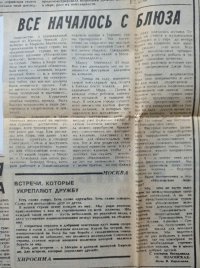
MOSCOW NEWS PRIZE
CROSSROAD OF OPINIONS
The culmination of the international tournament of figure skaters—compositions by the leaders of the USSR men's singles team
Yu. ZIMMERMAN, international referee:
S. CHETVERUKHIN, Honored Master of Sports, Olympic medalist:
Yu. OVCHINNIKOV, Master of Sports of International Class, European Championships medalist:
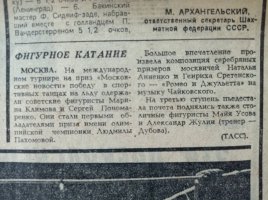
The Moscow tournament is approaching its end, and another exciting premiere awaits us — the original dance routines of the ice dance duos. After the compulsory and original dances — the Viennese Waltz — the tournament is confidently led by three Soviet duos — Marina Klimova and Sergei Ponomarenko, Natalia Annenko and Genrikh Sretenski, and Maya Usova and Aleksandr Zhulin.
International Figure Skating Tournament for the Prize of the "Moscow News" Newspaper. Moscow, Sports Palace, December 4.
Men's Singles. Combined Short and Compulsory Program Positions. 1. V. Kotin — 1.0; 2. V. Egorov — 2.0; 3. V. Petrenko — 3.0; 4. A. Torosian (all — USSR) — 4.6; 5. N. Köpp (GDR) — 5.2; 6. R. Burghart (Austria) — 6.0.
MOSCOW NEWS PRIZE
CROSSROAD OF OPINIONS
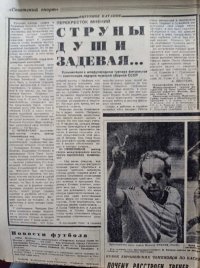
TOUCHING THE STRINGS OF THE SOUL...
(the article published in russian 'Sovetskiy Sport' on December 6, 1986)
(the article published in russian 'Sovetskiy Sport' on December 6, 1986)
The culmination of the international tournament of figure skaters—compositions by the leaders of the USSR men's singles team
The backstage areas of the Luzhniki Sports Palace erupted into a buzz as arguments flared and experts hunched over their clipboards, calculating dozens of judges' marks. Such a sporting excitement (passion in the best sense of the word) was triggered by the performances of the strongest men in the short program. Out of 18 figure skaters, at least six earned complimentary reviews that evening.
Yu. ZIMMERMAN, international referee:
"Without exaggeration, I can say that the discovery of the Moscow ice ball is the 15-year-old Odesa athlete Vladidmir Petrenko, a student of coach Galina Zmievskaya. I happened to be at the very origins of the creation of the figure skating school in Odesa and participated in the admission of novices to this school. Yes, we noticed the Petrenko brothers, Viktor and Vladimir, when they were only 8–9 years old. But hardly any specialist could have predicted such a rapid growth. Both brothers are already on the USSR national team. As for the execution quality of the short program by Volodya Petrenko, the current World Junior Champion, it is a statement for a great future. After all, for the first time, he was awarded two scores of 5.7 and two scores of 5.9..."
S. CHETVERUKHIN, Honored Master of Sports, Olympic medalist:
"It gave me great aesthetic pleasure to watch the performances of four athletes: Vladimir Kotin, Vitali Egorov, Vladimir Petrenko, and the American Paul Wylie. The artistry of Kotin, silver medalist of the European Championships is a unique phenomenon. His composition 'Spain' rightfully became the culmination of the entire evening. The figure skater was so emotionally charged that he gave in to his feelings, somewhat to the detriment of his excellent technique. Perhaps he was right: where else, if not at home, can one show complete freedom, a flight of the soul! However, a mistake on his double Axel prevented him from receiving the highest marks for technique. Yet, for his artistry, he received four scores of 5.9."
The stable Vitali Egorov has developed new features: absolute purity of lines and deeply meaningful gestures. This is exactly where his high second-place result stems from. I even got the impression that he can execute a powerful jump combination with a triple Lutz even more powerfully. His victory at the international tournament 'Skate Canada' was not accidental. Egorov's destiny makes one ponder over many things — after all, there are athletes who mature slowly. They need to be given time to, as they say, ripen."
I share the many compliments directed at the young Petrenko. The youth is talented, goal-oriented, and can achieve a great deal in sports. But he still needs to learn. In particular, it is worth looking more closely at the American school of singles skating, at the gliding style of the best representatives of this school. In Moscow, Paul Wylie shone with his footwork and rotation speed, and completely deserved his place among the top five..."
The stable Vitali Egorov has developed new features: absolute purity of lines and deeply meaningful gestures. This is exactly where his high second-place result stems from. I even got the impression that he can execute a powerful jump combination with a triple Lutz even more powerfully. His victory at the international tournament 'Skate Canada' was not accidental. Egorov's destiny makes one ponder over many things — after all, there are athletes who mature slowly. They need to be given time to, as they say, ripen."
I share the many compliments directed at the young Petrenko. The youth is talented, goal-oriented, and can achieve a great deal in sports. But he still needs to learn. In particular, it is worth looking more closely at the American school of singles skating, at the gliding style of the best representatives of this school. In Moscow, Paul Wylie shone with his footwork and rotation speed, and completely deserved his place among the top five..."
Yu. OVCHINNIKOV, Master of Sports of International Class, European Championships medalist:
“We have witnessed once again that the modern masters of figure skating know how to speak directly to the hearts of the spectators, touching the strings of their souls while creating unique compositions within the strict technical constraints of the short program. The Spanish theme in Vladimir Kotin’s program completely captivated the entire arena. This premiere proves yet again that our singles skating leaders have taken another quality step upward on the ladder of mastery. I want to emphasize that the coaches of our singles skaters — Elena Tchaikovskaya, Aleksei Mishin, and Galina Zmievskaya — very keenly sense the general trend of modern sports."
In recent years, I have heard complaints of this kind: sometimes spectators seem to be disappearing from the stands. This is a troubling symptom. Spectators must be brought back to sports arenas. And how can this be accomplished? We need to boldly and resolutely restructure the choreography and creative training systems across our figure skating schools."
Currently, I am working with the 'All Stars' ice ensemble. This work is very interesting from a creative perspective. Recently at Luzhniki, we performed our new dance piece 'Bolero', and it was a joy to see that the spectators yearn for a world of beauty and deep emotions. There was a full house. I hope that full houses will become a regular occurrence for competitive sports tournaments as well..."
In recent years, I have heard complaints of this kind: sometimes spectators seem to be disappearing from the stands. This is a troubling symptom. Spectators must be brought back to sports arenas. And how can this be accomplished? We need to boldly and resolutely restructure the choreography and creative training systems across our figure skating schools."
Currently, I am working with the 'All Stars' ice ensemble. This work is very interesting from a creative perspective. Recently at Luzhniki, we performed our new dance piece 'Bolero', and it was a joy to see that the spectators yearn for a world of beauty and deep emotions. There was a full house. I hope that full houses will become a regular occurrence for competitive sports tournaments as well..."
The Moscow tournament is approaching its end, and another exciting premiere awaits us — the original dance routines of the ice dance duos. After the compulsory and original dances — the Viennese Waltz — the tournament is confidently led by three Soviet duos — Marina Klimova and Sergei Ponomarenko, Natalia Annenko and Genrikh Sretenski, and Maya Usova and Aleksandr Zhulin.
A. SHELUKHIN.
TECHNICAL RESULTS
International Figure Skating Tournament for the Prize of the "Moscow News" Newspaper. Moscow, Sports Palace, December 4.
Men's Singles. Combined Short and Compulsory Program Positions. 1. V. Kotin — 1.0; 2. V. Egorov — 2.0; 3. V. Petrenko — 3.0; 4. A. Torosian (all — USSR) — 4.6; 5. N. Köpp (GDR) — 5.2; 6. R. Burghart (Austria) — 6.0.