Archive of newspaper articles | Page 16 | Golden Skate

Archive of newspaper articles

1984
EUROPEAN CHAMPIONSHIPS
Our special correspondent reports from Hungary

OVERTURE TO AN ICE SPECTACLE

(the article published in russian 'Sovetskiy Sport' on January 10, 1984)

The European Figure Skating Championships have started in Budapest. Yelena Vodorezova is leading the women's event.
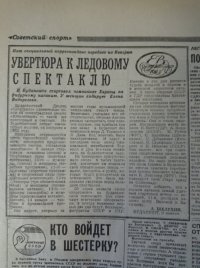
The Budapest "Sportshall" Palace is surprisingly similar to the Leningrad "Yubileyny" Palace – just as spacious and bright. But the Budapest counterpart is significantly younger; it was built in 1982.
The program for the European Championships that opened here, the last pre-Olympic review, is structured uniquely: on January 9, women (compulsory figures) and pairs (short program) started; on the 10th – men (compulsory figures) and women (short program); on the 11th – men (short program) and pairs (free skate); on the 12th – ice dancers (three compulsory dances) and women (free skate); on the 13th – ice dancers (pasodoble) and men (free skate); finally, on January 14 – ice dancers in the free dance.
As you can see, for the first time in many years, the culmination of the championship will be the ice dancing events. Perhaps taking this circumstance into account, the England team decided to keep their main weapon a secret: they arrived in Budapest three days ago without the world champions J. Torvill and C. Dean. Everyone, of course, was intrigued. And suddenly, in the last hours before the official draw, Torvill and Dean finally appeared on the Budapest ice.
About 6 thousand spectators were present at the practice session; the Britons showed them their compulsory dances – the waltz, pasodoble, and rumba – which will be performed at the championship. This was a small overture before a grand spectacle.
20 countries have entered their athletes for the Budapest championship. As Hungarian observers note, the focus for the first two days will unquestionably be on the figure skaters from the USSR and the GDR. It is during these days that the fate of the medals in pair and ladies' singles skating will be decided. And here, the USSR and GDR teams are represented by brilliant masters.
Today the women performed three compulsory figures. The medalist of world and European championships, Yelena Vodorezova, demonstrated excellent technique. She became the leader. The subsequent places were taken by: K. Witt (GDR), A. Kondrashova (USSR), M. Ruben (FRG), S. Cariboni (Switzerland), S. Dubravcic (Yugoslavia), P. Sarafidis (Austria), and K. Ivanova (USSR).
As you can see, all three Soviet athletes started the long ice marathon quite well. It should be noted, however, that due to an injury, the world championship silver medalist С. Leistner (FRG) was unable to come to Budapest. She is planning to start her next competition directly at the Olympics.
It remains to be added that in pairs skating, the most fortunate starting number – the last one, number 11 – went to our duo Valova and Vasiliev.​

А. SHELUKHIN.
BUDAPEST, January 9.
1768838713344.jpeg
 
Last edited:
1984
EUROPEAN CHAMPIONSHIPS
Our special correspondent reports from Hungary

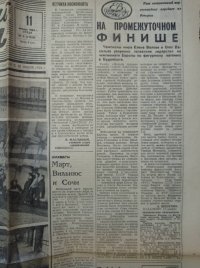
AT THE INTERMEDIATE FINISH

(the article published in russian 'Sovetskiy Sport' on January 11, 1984)

World champions Yelena Valova and Oleg Vasiliev confidently took the lead at the European Figure Skating Championships in Budapest.

On the eve of the starts, the newspaper "Magyar Hírlap" published a modest note announcing the appearance in the FRG national team of 19-year-old Manuela Ruben, a tall, slender, blonde girl capable of causing the most unexpected twists in the fight for medals. Indeed, Ruben exceeded all expectations: she won the FRG championship, going through the stages of the competition without a single error. This was so unexpected that the team leader, Claudia Leistner, was forced to withdraw from the competition. In Budapest, Ruben again proved herself a worthy master and took fourth place after the compulsory figures, gaining an advantageous position before the free skate.

There are many debutants at the European Championship. First and foremost are the Leningrad pair Larisa Selezneva and Oleg Makarov, students of coach Igor Moskvin. After the competition, one of the coaches of our national team told a curious detail. Seeing Selezneva and Makarov off to their start, Moskvin encouraged them with the words: "Don't think about the result; first and foremost, show excellent quality skating." The Honored Coach of the USSR, Tamara Moskvina, held the same opinion before the start when she led her proteges – world champions Yelena Valova and Oleg Vasiliev – onto the ice. Our mentors precisely tuned their students for the fight.

It was specifically Selezneva and Makarov’s style, combined with the music of a spirited black blues, that sparked enthusiasm from the crowd. All seven elements were performed without a single hitch. Seven scores of 5.5 and three scores of 5.7 are indicators of international class. The debutants moved into fourth place.

Young Muscovites Marina Avstriyskaya and Yuri Kvashnin also placed their emphasis on skating quality. A powerful, athletic program secured them a spot in the top five (with scores ranging from 5.3 to 5.6).

But, of course, the most fundamental clash proved to be the duel between the most decorated duos: Valova and Vasiliev on one side, and Sabine Baeß and Tassilo Thierbach (GDR) on the other. The GDR athletes enlisted a melody from a Kálmán operetta as their ally, while our skaters chose the tunes of the no less famous "Kalinka." Both pairs succeeded in winning the public's sympathy. However, the decisive factors for our duo's success were the sophistication of their compositional techniques, the connection between the partners, and movements in the style of modern ballet. The aesthetics and nobility of Valova and Vasiliev’s lines were more apparent than ever. Seven scores of 5.8 and two of 5.9 became the main event of the evening, and it was no coincidence that more than 50 photojournalists surrounded our pair after their performance. Yes, for the first time, Valova and Vasiliev won the short program against their most formidable rivals. Incidentally, the GDR skaters again received excellent marks at the 5.8 level.

So, a solid foothold for our duos' ascent is the main result of the first evening. Holding first, fourth, and fifth places, it is possible to fight for any step on the podium. Tamara Moskvina, commenting on the results of the short program, emphasized that Valova and Vasiliev have not yet fully exhausted their reserves.

Earlier in the day, the men's compulsory figures competition was won by French skater Jean-Christophe Simond. In second place is Jozef Sabovčík of Czechoslovakia, and in third is Rudi Cerne (FRG). USSR champion Alexander Fadeev is in fourth, ahead of two-time European champion Norbert Schramm of the FRG, who is in sixth place. Vladimir Kotin and Vitaly Egorov occupy seventh and ninth places, respectively.​

A. SHELUKHIN.
BUDAPEST, January 10
TECHNICAL RESULTS

European Figure Skating Championships. Budapest. "Sportshall" Sports Palace, January 9.
Pairs Skating. Short Program.
1. E. Valova – O. Vasiliev (USSR) – 0.4; 2. S. Baeß and T. Thierbach (GDR) – 0.8; 3. B. Lorenz and K. Schubert (GDR) – 1.2; 4. L. Selezneva and O. Makarov – 1.6. 5. M. Avstriyskaya and Yu. Kvashnin (all – USSR) – 2.0; 6. B. Preußler and T. Schröter (GDR) – 2.4.
Women. Compulsory Figures. 1. E. Vodorezova (USSR) – 0.6; 2. K. Witt (GDR) – 1.2; 3. S. Cariboni (Switzerland) – 1.8; 4. M. Ruben (FRG) – 2.4; 5. A. Kondrashova (USSR) – 3.0; 6. S. Dubravčić (Yugoslavia) – 3.6; 7. P. Sarafidis (Austria) – 4.2; 8. K. Ivanova (USSR) – 4.8.
1768839872169.jpeg
 
Last edited:
1984
EUROPEAN CHAMPIONSHIPS

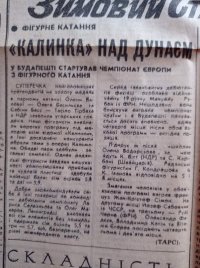
"KALINKA" OVER THE DANUBE

(the article published in Ukrainian 'Sportyvna Hazeta' on January 12, 1984)

EUROPEAN FIGURE SKATING CHAMPIONSHIPS START IN BUDAPEST
The RIVALRY between the top contenders for the gold medal in pairs skating—Yelena Valova / Oleg Vasiliev and Sabine Baeß / Tassilo Thierbach from the GDR—captivated the Hungarian audience. Our skaters performed their short program to the melody of the well-known "Kalinka," while their experienced competitors chose themes from Kálmán's operettas. Both pairs won general sympathy. However, the Soviet skaters, thanks to the sophistication of their compositional techniques and excellent artistry, received the highest scores: seven marks of 5.8 and two of 5.9.
Their teammates, championship debutants Larisa Selezneva and Oleg Makarov, also performed well. The Leningraders completed all seven elements without errors and received seven marks of 5.5 and three of 5.7, which is undoubtedly at an international class level.
Among the talented debutants, specialists particularly note 19-year-old Manuela Ruben from the FRG. She recently had a brilliant win at her national championship and feels quite confident in Budapest, as fourth place after the compulsory program is an advantageous position.
Yelena Vodorezova is leading after the "school" (compulsory figures), followed by K. Witt (GDR) and S. Cariboni (Switzerland). Soviet skaters A. Kondrashova and K. Ivanova are in 5th and 8th places, respectively.
The men's compulsory program was won by Frenchman Jean-Christophe Simond. In second place is Jozef Sabovčík from the CSSR, and in third is Rudi Cerne (FRG). Alexander Fadeev, Vladimir Kotin, and Vitaly Egorov occupy fourth, seventh, and ninth places.​

(TASS).
1768840521600.jpeg
 
1984
EUROPEAN CHAMPIONSHIPS

The Ice Ball

(the article published in Ukrainian 'Sportyvna Hazeta' on January 10, 1984)

The ancient city on the Danube is hosting the European Figure Skating Championships, which opened yesterday.
All tickets for the free programs and exhibition performances have long been sold out. The stadium, meanwhile, accommodates over 8,000 spectators. Interest in the championship is enormous. This is not surprising, as the strongest athletes from 20 countries are taking part. Hungarian figure skating fans are especially looking forward to the performances of our country's representatives; the chances of the Soviet singles skaters A. Fadeev and O. Vodorezova are highly rated.
More than 400 journalists have been accredited for the competition. Live broadcasts will be carried by 33 television companies from 40 countries. The well-known former Canadian figure skater Toller Cranston is popular among TV commentators.
For the strongest European athletes, this tournament is an important pre-Olympic test of strength.
View attachment 10741
Interesting to see Toller Cranston as the only named commentator in both articles (and to pick out his name in Cyrillic script) 🧐
 
1984
All-Union youth competitions

FIGURE SKATING

(the article published in russian 'Sovetskiy Sport' on January 11, 1984)

DNІPROPETROVSK. The All-Union youth competitions concluded with a confident victory for the Ukrainian team.
Ukrainian athletes took the lead in almost all events of the program. The second Ukrainian national team finished right behind the first. Third place went to the skaters of the RSFSR national team.
In the ladies' singles, the best was 13-year-old Kyiv native N. Gorbenko, a participant in the World Championships. The athlete's repertoire includes difficult jumps and original spins.
First place among the boys was won by Odessa native Yu. Tsymbalyuk. Pairs skaters demonstrated an increased level of skill. Victory was claimed by World Junior Championship participants I. Shishova and A. Suleimanov (Tashkent). The program performed by V. Tyukov’s students is dynamic and saturated with complex elements. In the ice dance competition, the top performers were E. Tonkonog and K. Kaplan, students of the Dnepropetrovsk School of Higher Sports Mastery.​
V. KRIVOPALTSEV.
1768844191470.jpeg
 
Last edited:
1984
EUROPEAN CHAMPIONSHIPS
Our special correspondent reports from Hungary

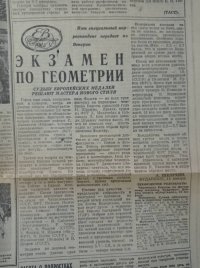
EXAM IN GEOMETRY
(the article published in russian 'Sovetskiy Sport' on January 12, 1984)
THE FATE OF EUROPEAN MEDALS IS DECIDED BY MASTERS OF THE NEW STYLE

The city was still asleep, immersed in twilight, when the competitions for the 22 men's single skaters in the compulsory program began at the "Sporthall" Palace of Sports. The panel of judges is led by referee S. Bianchetti (Italy), who also heads the ISU technical committee. Bianchetti is very strict and punctual in observing the rules, and it is clear how carefully the judges studied each figure drawn on the ice.
For the third year in a row at the European Championships, Frenchman Jean-Christophe Simond has shown the best result in the performance of the "school figures". But each time, three, four, or even five skaters beat him in the free skating program. Currently, men's single skating in Europe is on the rise. This progress is owed to the virtuosos of the new style from Czechoslovakia, the USSR, West Germany (FRG), and Poland. Nowadays, they are literally "treading on Simond's heels". Following the Frenchman is a group of skaters equal in skill: Jozef Sabovčík (Czechoslovakia), Rudi Cerne (FRG), Alexander Fadeev (USSR), Heiko Fischer, Norbert Schramm (both FRG), Vladimir Kotin (USSR), Grzegorz Filipowski (Poland), and Vitali Egorov (USSR).
Our Fadeev successfully passed the exam in "ice geometry" — in all three figures, he outplayed last year’s European champion, N. Schramm. Although judge H. Mollenbach from West Germany and E. Bon from the Netherlands persistently gave Schramm higher marks, it did not help him. Six out of the nine judges gave their preference to Fadeev.
Our two other skaters, Kotin and Egorov, also achieved decent results. Now, the short program — a kind of "key" to the overall standings — takes on decisive importance. Our arbiter, multiple national champion T. Danilenko (Likhareva), noted that all eight of the top athletes are prepared to perform a highly complex combination with a triple lutz. This means a maximum mobilization of strength is required.
It was exactly these qualities — ultimate focus and endurance — that our Elena Vodorezova displayed on the second evening of the competition, as she continues her duel with European champion Katarina Witt (GDR). By choosing czardas music for her short program, Witt made an exceptionally clever tactical move. Her precise combination with a triple jump delighted the audience and predetermined a very high level of scores: 5.7–5.8 for technique, and four marks of 5.9 for artistry.
Vodorezova took to the ice immediately after Witt, knew her scores, but was not the least bit flustered; she skated with inspiration. Her spins and footwork sequence were especially good. The result was 5.5 - 5.7 points, which earned Vodorezova an overall second place after the two programs.
An equally polished technique in all elements was demonstrated by two other athletes: 18-year-old Anna Kondrashova (USSR) and 19-year-old M. Ruben (FRG). Just three weeks ago, our skater, on the advice of coach Eduard Pliner and choreographer Elena Matveeva, completely changed her short program. It took a lot of effort to quickly master the new composition. And yet, the risk paid off. Plasticity, soft gliding, and a beautiful cascade brought Kondrashova scores of 5.5–5.7 points for artistry.
Kondrashova holds the overall third place and is full of desire to consolidate her success in the all-around competition. But she faces a difficult duel with the champion from West Germany, Ruben, who is in fourth place. Alas, our third athlete, K. Ivanova, did not cope with the jump combination and ended up in seventh place.​
A. SHELUKHIN.
BUDAPEST, January 11.

TECHNICAL RESULTS

European Figure Skating Championships. Budapest. "Sporthall" Palace of Sports, January 10.
Women. Sum of Compulsory and Short Programs.

1. K. Witt (GDR) - 1.6; 2. E. Vodorezova - 1.8; 3. A. Kondrashova (both USSR) - 2.6; 4. M. Ruben (FRG) - 4.0; 5. S. Cariboni (Switzerland) - 5.0; 6. S. Dubravcic (Yugoslavia) - 6.6; 7. K. Ivanova (USSR) - 7.2.
Men. Compulsory Program.
1. J.-C. Simond (France) - 0.6; 2. J. Sabovčík (Czechoslovakia) - 1.2; 3. R. Cerne (FRG) - 1.8; 4. A. Fadeev (USSR) - 2.4; 5. H. Fischer - 3.0; 6. N. Schramm (both FRG) - 3.6; 7. V. Kotin (USSR) - 4.2; 8. G. Filipowski (Poland) - 4.8; 9. V. Egorov (USSR) - 5.4.
1768919830250.jpeg
 
1984
EUROPEAN CHAMPIONSHIPS
Our special correspondent reports from Hungary

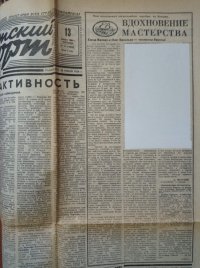
INSPIRATION OF MASTERY
(the article published in russian 'Sovetskiy Sport' on January 13, 1984)
Elena Valova and Oleg Vasiliev are the European champions!

"The last few seconds of the program decided everything," said Oleg Vasiliev, the new European champion, happy and serious at the same time. "Although we had already been performing for four minutes and twenty seconds, Elena and I still had a difficult series of jumps to complete in the remaining moments. And we had no right to make a mistake..."
That was the crucial point of the situation – the world champions were put in a position by their rivals where they had to skate flawlessly. The two best duos from the GDR started their free program with such energy and expression that it seemed everything was within their power that evening. And no matter how high Valova and Vasiliev's authority was, we must also consider something else: for two years running, the European crown had been held by Sabine Baeß and Tassilo Thierbach. In Budapest, the duo from Berlin captivated everyone with hussar daring and inexhaustible energy. Ten scores of 5.8 lit up the scoreboard after Sabine and Tassilo's performance.
What, then, tipped the scales in favor of the Soviet athletes? Their coach, Tamara Moskvina, believes that her pupils worked more purposefully on the artistry and musicality of their programs, bringing each composition closer to a theatrical performance. But, at the risk of sounding trivial, I should note that in this case much, if not everything, was decided by their will to win. After the performance, Elena Valova recounted:
"I go into the final Salchow twist and think: this is my last frontier. If I hold on, we win. And then I move to the next element, and the same thought occurs again..."
Valova and Vasiliev won against rivals who were perfectly prepared to fight for the top step of the podium. That is why their victory is so impressive. Each of the five sections of the free program performed by the World and now European champions had its own "zest": for example, a triple toe loop in one part, or a spectacular lift in another. And all of it was done broadly and freely. Their supreme technique earned them two maximum scores of 6.0 and five scores of 5.9. Indeed, they continue to amaze the world of figure skating with a synthesis of athletic and artistic qualities. It was especially pleasant to hear the words of gratitude expressed by Valova and Vasiliev to their mentors—Tamara Moskvina and choreographer Valentina Vigant.
Birgit Lorenz and Knut Schubert became the bronze medalists. The coaches of the GDR national team see the future in the person of the coquettish, black-eyed Lorenz and her cool-headed, steel-nerved partner. The well-known coach H. Steiner-Walter brought not only this highly technical duo to Budapest, but also... a multitude of surprises in their performance. Here is just one of them: she offered Lorenz and Schubert a risky option: half of the composition consisted of a two-minute section—the cancan, performed at maximum tempo. The skaters handled it, hence the six scores of 5.7.
Given such high competition, only a hundred percent flawless performance could bring two young Soviet duos closer to medals—Larisa Selezneva and Oleg Makarov, and Marina Avstriyskaya and Yury Kvashnin.
They fell just short of the medals. Nine scores of 5.5 and three scores of 5.6 clearly speak to the style of the USSR national team debutants, Selezneva and Makarov. The witty, bold interpretation of the music from the ballet "The Marriage of Figaro" appealed to both judges and spectators, but two obvious technical errors nullified our athletes' claims to a medal. Avstriyskaya and Kvashnin arrived at the European Championships in excellent form, though they too did not escape unfortunate slips. In the end—fifth place.
Meanwhile, in the men's short program, the hero of the day was 20-year-old Alexander Fadeev, who demonstrated literal technical miracles in his composition set to the charleston. His combination with a triple lutz, his spins, and the final step sequence were brilliant. The result—nine scores of 5.8 and first place in the short program. Based on the total of the two events, Fadeev became the overall leader of the championship.
None of Alexander's rivals escaped errors. This included Vladimir Kotin, who botched an axel jump—he is currently in seventh place. Vitaly Egorov was only 12th in the short program.
Immediately after the end of the men’s short program, the press center released a statement that came as a complete surprise to everyone. The French champion J.-C. Simond withdrew from the competition, even though he was in 2nd place. He had been feeling unwell before the start, and now illness has forced him to withdraw from the championship.
Our national team suffered a loss as well. Elena Vodorezova received a telegram from Moscow regarding her mother’s illness and hurriedly flew home. Thus, in the women's competition, the leadership of our team has passed to Anna Kondrashova, who currently holds third place.​

A. SHELUKHIN.
BUDAPEST, January 12.

TECHNICAL RESULTS

European Figure Skating Championships. Budapest. "Sportshall" Sports Palace, January 11.
Pair Skating. Total Score.

1. E. Valova – O. Vasiliev (USSR) – 1.4; 2. S. Baeß and T. Thierbach (GDR) – 2.8; 3. B. Lorenz and K. Schubert (GDR) – 4.2; 4. L. Selezneva and O. Makarov (USSR) – 5.6; 5. M. Avstriyskaya and Y. Kvashnin (USSR) – 7.0; 6. B. Preußler and T. Schröter (GDR) – 8.4.​
Men. Total Compulsory and Short Program Scores.
1. A. Fadeev (USSR) – 2.8; 2.-3. R. Cerne (FRG), J.-C. Simond (France) – 3.0; 4. J. Sabovčík (Czechoslovakia) – 3.2; 5. N. Schramm – 4.4; 6. H. Fischer (both FRG) – 4.6; 7. V. Kotin (USSR) – 7.0; 8. G. Filipowski (Poland) – 8.4; 9. V. Egorov (USSR) – 10.2.​
*​
Three-time world champions Jayne Torvill and Christopher Dean from Great Britain lead the ice dance competition after performing three compulsory dances (the rumba, paso doble, and Westminster waltz). Muscovites Natalia Bestemianova and Andrey Bukin are in second place, Marina Klimova and Sergey Ponomarenko are in third, Olga Volozhinskaya and Alexander Svinin are in fifth place.
(TASS).​
1768944231020.jpeg
 
1984
EUROPEAN CHAMPIONSHIPS

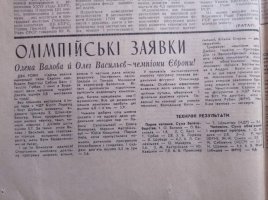
OLYMPIC BIDS

(the article published in Ukrainian 'Sportyvna Hazeta' on January 14, 1984)

Elena Valova and Oleg Vasiliev are European champions!

For two years in a row, the title of best European pair was won by the Berliners Sabine Baeß and Tassilo Thierbach. And in Budapest today, they skated wonderfully! The judges gave them ten scores of 5.8.
Another pair from the GDR, Birgit Lorenz and Knut Schubert, pupils of the famous coach H. Steiner-Walther, also performed without mistakes. They demonstrated high technique, tempo, many innovations, and received six scores of 5.7. Under these conditions, Valova and Vasiliev, who started later than their main competitors, had to be impeccable on the ice.
And they succeeded brilliantly! The athletes performed their free program broadly, freely; each part had its own highlight. The mentors of the Leningrad residents – Tamara Moskvina and choreographer Valentina Vigant – helped their proteges execute a spectacular composition, working hard on its musicality. All this allowed our compatriots to get two scores of 6.0 and five 5.9s.
Many kind words can also be said about two young Soviet pairs – Larisa Selezneva and Oleg Makarov, and Marina Avstriyskaya and Yuri Kvashnin. The first pair, although they made some mistakes, pleased both the audience and the judges with their clever program: nine scores of 5.5 and three 5.6s.
In the men's event, Soviet figure skater Alexander Fadeev showed a highly technical short program. His combination with a triple lutz, his spins, and the final step sequence were particularly impressive. His teammates did not avoid mistakes: Vladimir Kotin is in seventh place, and Vitaly Egorov is in twelfth.
Three-time champions Jayne Torvill and Christopher Dean from Great Britain are leading the ice dancers after three compulsory dances. Muscovites Natalia Bestemianova and Andrei Bukin are in second place.
And here is some more pleasant news. Anna Kondrashova from Moscow won a bronze medal in the women's competition for the first time. Katarina Witt, a figure skater from the GDR, became the European champion. Manuela Ruben (FRG) is in second place. Our Kira Ivanova finished fourth.​
TECHNICAL RESULTS
Pair Skating. All-around total. 1. E. Valova - O. Vasiliev - 1.4. 2. S. Baeß - T. Thierbach - 2.8. 3. B. Lorenz - K. Schubert - 4.2. 4. L. Selezneva - O. Makarov - 5.6. 5. M. Avstriyskaya - Y. Kvashnin - 7.0. 6. B. Preußler - T. Schröter (GDR) - 8.4.
Men. Total of compulsory and short programs. 1. A. Fadeev - 2.8. 2-3. R. Cerne (FRG), J.-C. Simond - 3.0. 4. J. Sabovčík (CSSR) - 3.2. 5. N. Schramm - 4.4. 6. H. Fischer (both FRG) - 4.6.
1768979286429.jpeg
 
1984
EUROPEAN CHAMPIONSHIPS
Our special correspondent reports from Hungary


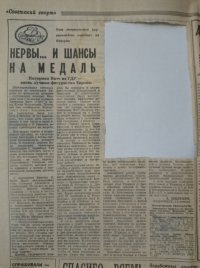
NERVES... AND CHANCES FOR A MEDAL
(the article published in russian 'Sovetskiy Sport' on January 14, 1984)
Katarina Witt from the GDR is once again the best female figure skater in Europe

A most interesting situation arose at the European Figure Skating Championships in the women's competition. Katarina Witt (GDR) and our Elena Vodorezova were leading by a large margin. Then, as already reported, Vodorezova was forced to fly to Moscow due to her mother's illness. It was then revealed that as many as five athletes, including our A. Kondrashova and K. Ivanova, were real contenders for medals.
Everyone expected a bright and exciting spectacle, but pre-start fever and nerves played an unexpected, fatal role. For example, the program of the Swiss champion S. Cariboni was good. For three minutes she skated cleanly and even performed a triple toe loop. But the last 60 seconds deprived her of all hope. The athlete lost speed, clarity on her landings after jumps, and took tenth place in the free program.
The European champion K. Witt had seven complex elements and combinations planned. But not all of them were successful. Instead of triple jumps – the toe loop and axel – Witt performed doubles. This was reflected in the judges' scores for technique – 5.5-5.7. However, the athlete's musicality and temperament compensated for a lot. She received two scores of 5.9 for artistry. Her mentor, coach Jutta Müller, expressed the following opinion:
- Pre-Olympic preparation took a lot of nervous energy. Many athletes failed to reach their peak form. My student has made an obvious step forward in artistry, but even here I see many opportunities for growth in mastery. I believe we will see the athletes in a completely different light on the ice in Sarajevo...
We would also like to wish our figure skaters Kondrashova and Ivanova more sparkle and confidence. The athletes' compositions had interesting finds and spectacular step sequences. However, due to mistakes in complex jumps, they could not outplay the FRG champion Manuela Ruben and lost to her in the battle for second place. Kondrashova was fourth in the free program, and Ivanova was third. However, Kondrashova's chances in the all-around were better (she was second in the short program). As a result, she became the bronze medalist.
And now about the ice dance competition. Watching them, you inadvertently notice that the best duets strive for complex simplicity, where everything seems light and accessible. In reality, this hides meticulous and fine work.
The Westminster Waltz, Paso Doble, and Rumba, performed on the ice in Budapest, brought success to representatives of two ice dance schools – the English and the Soviet. Leading the way are three-time world champions J. Torvill and C. Dean (England), European champions N. Bestemianova and A. Bukin, the rapidly progressing duo M. Klimova and S. Ponomarenko, the English pair K. Barber and N. Slater, as well as Soviet skaters O. Volozhinskaya and A. Svinin. Let me remind you that these five duos contested the main awards at the last championship. They are setting the tone now, too.
And once again, discussions among coaches and judges flared up after the compulsory dances. The fact is that Torvill and Dean are demonstrating an unusual style, wanting to establish new canons, new criteria for mastery. In the compulsory program, they risked changing the classic pattern and positions so as not to be like others. The judges notice this but tacitly agree, believing that champions can and should experiment.
The English school of ice dance was characterized by conservatism for many decades. But that was in the past; over the last four years, Torvill and Dean, with the help of coach B. Callaway and London choreographer M. Stylianos, have created a series of original compositions. Interestingly, in the past, Stylianos and his wife constantly participated in world championships for ballroom dancing, with their program consisting mainly of Latin American melodies. It is quite natural that Stylianos suggested many techniques and discoveries from the arsenal of ballroom dance. This also affects the performance style of Torvill and Dean in all segments of the program. Torvill and Dean emphasize deep edges and maintain a unified position even during complex transitions: two moving as one.
A similar aesthetic line is generally close to the style of our leaders, Bestemianova and Bukin. Incidentally, the two best duos in the world are characterized by an unusually wide range in their use of various musical themes and works of different styles.
For now, the situation is as follows: Torvill and Dean’s scores range from 5.7 to 5.9. Bestemianova and Bukin have 5.6–5.7, while the other couples range from 5.2 to 5.5.​
A. SHELUKHIN.
BUDAPEST, January 13.
TECHNICAL RESULTS
European Figure Skating Championships. Budapest. "Sportshall" Sports Palace. January 12.
Women. All-around total. 1. K. Witt (GDR) – 2.6; 2 M. Ruben (FRG) – 6.0; 3. A. Kondrashova – 7.8; 4. K. Ivanova (both USSR) – 10.2; 5. S. Dubravčić (Yugoslavia) – 13.8; 6. S. Cariboni (Switzerland) – 16.2.
Ice Dance. Compulsory program. 1. J. Torvill – C. Dean (England) - 0.6; 2. N. Bestemianova - A. Bukin - 1.2; 3. M. Klimova – S. Ponomarenko (both USSR) – 1.8; 4. K. Barber - N. Slater (England) – 2.4; 5. O. Volozhinskaya - A. Svinin (USSR) – 3.0; 6. P. Born - R. Schönborn (FRG) – 3.6.
1768983780358.jpeg
 
1984
EUROPEAN CHAMPIONSHIPS
Our special correspondent reports from Hungary

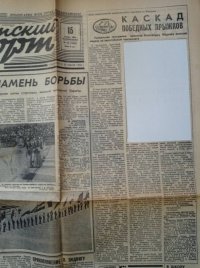
CASCADE OF VICTORIOUS JUMPS

(the article published in russian 'Sovetskiy Sport' on January 15, 1984)

A unique program brought Alexander Fadeev the gold medal at the European Championship

In Budapest, the famous figure skater Toller Cranston debuted as a commentator for Canadian television, leading a three-hour broadcast of the men’s finals at the European Championship. Here is what Cranston said after the competition:
"I am pleased to note two circumstances. First, Europe's best skaters gave us a superb evening. It could be compared to a high-level professional ice show. Second, the programs of the leaders are aimed at the future. I am talking about the programs of Fadeev, Schramm, and Cerne..."
That evening, the fate of the top six places remained unclear until the very last second—except for first place. The top step of the podium was reserved by the 20-year-old USSR champion Alexander Fadeev, coached by Stanislav Zhuk. A specific detail illustrates his competitive mindset: after the "school" (compulsory figures) competition, Alexander returned to the team hotel feeling somber. On the way, one of our coaches tried to comfort him: "Sasha, understand, fourth place still gives you an excellent chance." To which Fadeev reasonably remarked: "But I was obligated to be third."
Fadeev knew perfectly well that the competition was greater than ever and that the slightest oversight could be costly. To his credit, he did everything possible to worthily withstand the challenges of two-time European champion Norbert Schramm, Rudi Cerne (both from West Germany), and Jozef Sabovčík from Czechoslovakia.
Later, many specialists noted a similarity between Schramm’s program and the compositions of Canada’s Cranston, as well as the closeness of Cerne’s romantic style to the dancing of British Olympic champion John Curry. The West German athletes followed a path of borrowing from the experiences of the past. Fadeev’s strength, however, lay in the fact that he is unlike anyone else—he seriously set his sights on elements of unique complexity. For example, a sequence with a 3.5-turn axel (triple axel), a combination with a triple lutz and a triple toe loop... At the press conference, Fadeev stated outright: "In the future, I want to include mainly quadruple jumps in my free program."
By draw, Alexander opened the performances for the group of strongest skaters. It was then that it became clear that his free program was unique in the complexity of its combinations and step sequences. The 270 seconds of this miniature performance were densely packed with the most difficult jumps performed at a rapid pace. True, Fadeev had one fleeting fall, but even in that instance, he was attempting a quadruple jump. Twelve scores of 5.8 and two scores of 5.9—such was the result of the new European champion’s performance. Fadeev received the large gold medal for the overall title, as well as the small gold medal for the free skate.
Many attempts were made to catch up with Fadeev. The figure skaters from West Germany were the most successful in this regard: 25-year-old Rudi Cerne with his subtle interpretation of Verdi's music and 24-year-old Norbert Schramm with his semi-pop performance style. However, they lost to Fadeev in the technique of element execution, including the quality of their gliding itself.
A fierce battle for fourth place in the free program ensued. Jozef Sabovčík was close to success, but he put so much effort into the 3.5-turn axel (triple axel) that he barely managed to finish the program. Vladimir Kotin overtook him, performing all five triple jumps flawlessly. Unfortunately, in the overall competition, Kotin could not catch up with his rivals, as he had only placed seventh in the short program. Our third skater, 20-year-old Vitaly Egorov, was highly mobilized in the final and managed to move from ninth place to seventh—a success for a debutant.
The ice dancers performed their temperamental "corrida" (bullfight), executing the original dance in the rhythm of a pasodoble. Most duos had many innovative elements, but among the participants, as before, two pairs stood out for their mastery: Jayne Torvill and Christopher Dean, and Natalia Bestemyanova and Andrei Bukin. The world champions received six scores of 6.0 and nine scores of 5.9 for their exquisite dance, which was treated in a purely balletic manner as a battle between day and night. The partner's cloak provided a contrast of two colors—white and black. At times it seemed that her partner almost disappeared, hidden by the cape, and then suddenly broke free again to continue the duel with the night. The concept, interpreted very boldly, essentially went beyond the scope of the rules, but the performers rose to the occasion in terms of artistry.
Our duo received three scores of 5.9—testament to their excellent acting skills and their passionate drive, which was emphasized by every beat of the music. Our ice dancers hit the rhythm of the melody with remarkable precision.
Overall, there were no changes among the leaders. However, it is worth noting that in the battle for fourth place, O. Volozhinskaya and A. Svinin lost to the British pair K. Barber and N. Slater by just a single judicial vote (the count was 4:5 among the nine judges).
The Hungarian press continues to comment on the victory of E. Valova and O. Vasiliev in pair skating. For example, the newspaper Esti Hírlap writes: "In the pair skating finals, Soviet skaters Valova and Vasiliev captivated everyone. The elegant duo rose to a level of performance comparable to a grand concert piece. They drew attention with a true sporting spirit, embodied in dynamic jumps."​

A. SHELUKHIN.
BUDAPEST, January 14.
TECHNICAL RESULTS

European Figure Skating Championships. Budapest. Sportcsarnok Arena. January 13.
Men. Overall Total. 1. A. Fadeev (USSR) - 3.8; 2. R. Cerne (FRG) - 5.0; 3. N. Schramm (FRG) - 7.4; 4. J. Sabovčík (Czechoslovakia) - 8.2; 5. H. Fischer (FRG) - 10.6; 6. V. Kotin (USSR) - 11.0; 7. V. Egorov (USSR) - 17.2; 8. G. Filipowski (Poland) - 17.4; 9. F. Kirsten (GDR) - 19.0; 10. P. Barna (Czechoslovakia) - 21.2.
Ice Dance. Sum of Compulsory and Original Dances. 1. J. Torvill and C. Dean (Great Britain) - 1.0; 2. N. Bestemyanova and A. Bukin - 2.0; 3. M. Klimova and S. Ponomarenko (both pairs - USSR) - 3.0; 4. K. Barber and N. Slater (Great Britain) - 4.0; 5. O. Volozhinskaya and A. Svinin (USSR) - 5.0; 6. P. Born and R. Schönborn (FRG) - 6.0; 7. W. Sessions and S. Williams (Great Britain) - 7.0; 8. N. Hervé and P. Béchu (France) - 8.0; 9. J. Holá and K. Foltán (Czechoslovakia) - 9.0; 10. M. van Bommel and W. Deweijer (Netherlands) - 10.6.
1769009289401.jpeg
 
1984
EUROPEAN CHAMPIONSHIPS

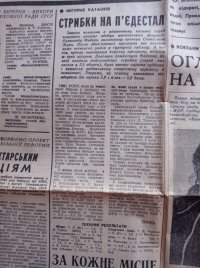
JUMPS TO THE PEDESTAL

(the article published in Ukrainian 'Sportyvna Hazeta' on January 17, 1984)

The title of champion in men's single skating was won for the first time by the Moscow figure skater Alexander Fadeev, a student of coach Stanislav Zhuk. After the compulsory program, he occupied only the fourth line in the tournament table. Then, having perfectly performed the short program, he immediately took the lead. Fadeev’s free program, which included the most difficult jumps (among them a 3.5-turn axel), was highly praised by the judges and brought the Soviet athlete victory in the championship. Specifically, for technique of execution, he received two scores of 5.9 and five scores of 5.8 points.

IN 1981, when Igor Bobrin took the upper hand at the European Championship in Innsbruck, Fadeev, making his debut, placed ninth. In the following season, the young skater took fifth place at the continent's championship. In the pre-Olympic year of 1983, he won a bronze medal at such competitions.
Now, the 20-year-old physical education institute student has managed to defeat the two-time European champion Norbert Schramm from West Germany. The ex-champion received only a bronze medal, also losing to his talented compatriot Rudi Cerne. The latter, according to specialists, resembles British Olympic champion John Curry in his skating style. For artistry in the free program, Cerne received three scores of 5.9.
After Elena Vodorezova's departure from Budapest, five female athletes immediately laid realistic claims to medals, including our skaters A. Kondrashova and K. Ivanova. Everything was to be decided by the free program.
The European Champion, Katarina Witt from the GDR, had seven complex elements planned. However, she simplified some of them, which affected her technical scores—5.5 to 5.7. Kondrashova and Ivanova also made mistakes; they placed fourth and third in this segment of the competition, respectively. Nevertheless, based on the overall results, Kondrashova won the bronze medal.
Europe's dance duos demonstrated many innovative approaches. Above all, the three-time world champions J. Torvill and C. Dean from Great Britain stood out in this discipline. In both the compulsory and original dances, they displayed an unusual style, striving to establish new criteria for mastery. And although their concepts do not always meet strict rules, the judges silently agree with this, apparently justifying the experiments of the outstanding skaters.
Excellent technical and acting skills were demonstrated by Natalia Bestemyanova and Andrei Bukin, who secured the "silver" medal with a small point difference.
In the unofficial team standings, Soviet figure skaters were far ahead of their closest rivals. According to the Olympic scoring system, they earned 38 points, winning as a team in all disciplines except men's single skating. The GDR and FRG national teams followed, each with 17 points.​

(TASS).
TECHNICAL RESULTS

Women. 1. K. Witt - 2.6. 2. M. Rubin (FRG) - 6.0. 3. G. Kondrashova - 7.8, 4. K. Ivanova - 10.2. Men. 1. A. Fadeev - 3.8. 2. R. Cerne - 5.0. 3. N. Schramm - 7.4 ... 6. V. Kotin - 11.0. 7. V. Egorov (both from USSR) - 17.2. Ice Dance. 1. J. Torvill - C. Dean - 2.0. 2. N. Bestemyanova - A. Bukin - 4.0. 3. M. Klimova - S. Ponomarenko - 6.0 ... 5. O. Volozhinskaya - A. Svinin (all from USSR) - 10.0.
1769011713990.jpeg
 
1984
EUROPEAN CHAMPIONSHIPS

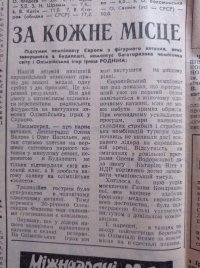
FOR EVERY PLACE

(the article published in Ukrainian 'Sportyvna Hazeta' on January 17, 1984)

The results of the European Figure Skating Championships, which ended in Budapest, are commented on by multiple world and Olympic champion Irina Rodnina:

Our national team brought home two gold medals, one silver, and two bronze medals from the current European Championship. This is a good result. It allows us to optimistically assess the prospects of Soviet figure skaters at the upcoming Winter Olympic Games in Sarajevo.
First and foremost, regarding pair skating: the Leningrad pair Elena Valova and Oleg Vasiliev, who soared so rapidly to the top of world pair skating last season, have not only confirmed their high class with their victory in Budapest, but have also made a strong claim for Olympic gold.
The rivalry in men's single skating was traditionally intense. Therefore, the victory of the 20-year-old Alexander Fadeev over strong opponents is important. I will note that the leader of our men's skating has great reserves. He must perform at a higher level at the Olympic Games.
The European Championship has once again shown that the progress anticipated in women's single skating for several seasons now cannot seem to take a tangible shape. Despite the obvious complication of programs, and the presence of complex jumps and jump combinations, the ladies' tournaments have yet to reveal a bright leader on the European stage. Elena Vodorezova's absence from the free skate competition allowed Katarina Witt from the GDR to win the championship title with comparative ease.
I would like to see the success of Muscovite Anna Kondrashova, who won a bronze medal of European standard for the first time, confirmed by a more confident performance in the free program.
And finally, in ice dance, the most intense battle at the Olympics will be for every place on the podium.
1769012953301.jpeg
 
1984
EUROPEAN CHAMPIONSHIPS
Our special correspondent reports from Hungary


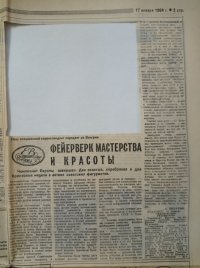
FIREWORKS OF SKILL AND BEAUTY

(the article published in russian 'Sovetskiy Sport' on January 17, 1984)

The European Championship has concluded. Soviet figure skaters have secured two gold, one silver, and two bronze medals.

The organizers of the Budapest championship did well to schedule the final ice dance competitions for the last day of the program. The European tournament ended with a spectacular carnival, featuring a succession of duos in a wide variety of styles.
Marina Klimova and Sergei Ponomarenko captivated the audience with a polished czardas; the British pair Karen Barber and Nicky Slater concluded their dance with a spirited charleston; Jayne Torvill and Christopher Dean glided mysteriously across the ice in a sultry bolero; and the fierce sound of tambourines and guitars could be heard in the dance of Natalia Bestemyanova and Andrei Bukin. And what imagination there was in the costumes! Bestemyanova’s dress, shimmering with the colors of the rainbow, and the delicate lilac outfits of Torvill and Dean were truly remarkable. The male partners masterfully guided their ladies through the most intricate combinations.
The breath of the Winter Olympics was most palpable in witty and profound in concept dances. The tournament was generous with creative surprises. There were no changes in the standings themselves. Instead, we saw a full spectrum of dance elements and technical maneuvers in the free programs.
The top six duos showed a whole series of previously unfamiliar elements. For example, the British performed an interesting lift where Dean raises his partner by the skate. And Bestemyanova and Bukin demonstrated a spin in literally ten variations.
Our young duo—Klimova and Ponomarenko, who opened the leaders' performance, was especially good in the finale when the partners managed to build a whole series of sequences: along the circle, along the diagonal, along the straight line. The students of coach Natalia Dubova won bronze medals for the first time.
The dances of the two best duos were beautiful. "A real celebration for the soul and heart," was how the TV commentator from Austria, former European champion Ingrid Wendl, assessed these compositions. Torvill and Dean received eleven top scores of 6.0 and became European champions for the third time. Bestemyanova and Bukin captivated the audience with their sparkling "Fairground" (Yarmarka).
On the eve of the top duos' start, we spoke with Honored Coach of the USSR Tatyana Tarasova.
"Tatyana Anatolyevna, is there a main quality that ice dancers need?"
"The main quality for ice dancers is talent, unmistakable individuality. By the way, dance talent can be spotted very early... For instance, at just 15 years old, Natasha Bestemyanova was noticed by me primarily because she possessed a combination of natural qualities—generosity of spirit, kindness, and great courage. All of our seven years of work with the duo Bestemyanova and Bukin pursued one goal: to maximize the unveiling of the performers' talent. That is why the connection between their competitive programs and the series of exhibition numbers is so strong in their work. As for their Olympic program set to Russian melodies, like many connoisseurs, I consider it the pinnacle of Natasha and Andrei's creativity..."
"In the pursuit of new challenges, should we perhaps also see the manifestation of our pair's internal artistic growth?"
"The '84 season, in my opinion, brought a qualitative breakthrough in Natasha and Andrei's mastery. Working on exhibition numbers featuring the melodies of Beethoven, Albinoni, and Khachaturian led our duo to a new understanding of dance. Mature artistry, a wealth of gestures — all of this is subordinated to a single goal: to convey an artistic image to the audience..."
In Tarasova’s words lies the key to understanding the progress of Bestemyanova and Bukin this season. Succinctly, with just two or three gestures or a cascade of spins, the dancers create a living picture.
Our third duo — O. Volozhinskaya and A. Svinin — fought a persistent battle with the second British pair but ultimately remained in fifth place.
A very important review has concluded. Its results will still be discussed and analyzed, but for now, we will cite just two statements from specialists. Here is what Benjamin Wright (USA), the referee of the pair skating judging panel, said:
"I believe that the world and European champions Elena Valova and Oleg Vasiliev have found the most correct direction. They represent a model of a harmonious combination of sport, spectacle, and vivid theatricality. I think they will find many more followers."
International category judge Mikhail Drey (USSR):
"The European Championship has shown that the peak of athletic form has not yet been reached. In the time remaining until the Olympic start, many duos will be able to significantly improve their mastery, including the leaders."​

A. SHELUKHIN.

BUDAPEST, January 16.
TECHNICAL RESULTS

European Figure Skating Championships. Budapest. Sportcsarnok Arena. January 14.
Ice Dance. Overall Total. 1. J. Torvill and C. Dean (Great Britain) - 2.0; 2. N. Bestemyanova and A. Bukin (USSR) - 4.0; 3. M. Klimova and S. Ponomarenko (both pairs - USSR) - 6.0; 4. K. Barber and N. Slater (Great Britain) - 8.0; 5. O. Volozhinskaya and A. Svinin (USSR) - 10.0; 6. P. Born and R. Schönborn (FRG) - 12.0; 7. W. Sessions and S. Williams (Great Britain) - 14.0; 8. N. Hervé and P. Béchu (France) - 16.0; 9. J. Holá and K. Foltán (Czechoslovakia) - 18.0; 10. I. Micheli and R. Pelizzola (Italy) - 20.8.
1769017828242.jpeg
 
1984
EUROPEAN CHAMPIONSHIPS
Our special correspondent reports from Hungary

CASCADE OF VICTORIOUS JUMPS

(the article published in russian 'Sovetskiy Sport' on January 15, 1984)

A unique program brought Alexander Fadeev the gold medal at the European Championship

In Budapest, the famous figure skater Toller Cranston debuted as a commentator for Canadian television, leading a three-hour broadcast of the men’s finals at the European Championship. Here is what Cranston said after the competition:
"I am pleased to note two circumstances. First, Europe's best skaters gave us a superb evening. It could be compared to a high-level professional ice show. Second, the programs of the leaders are aimed at the future. I am talking about the programs of Fadeev, Schramm, and Cerne..."
That evening, the fate of the top six places remained unclear until the very last second—except for first place. The top step of the podium was reserved by the 20-year-old USSR champion Alexander Fadeev, coached by Stanislav Zhuk. A specific detail illustrates his competitive mindset: after the "school" (compulsory figures) competition, Alexander returned to the team hotel feeling somber. On the way, one of our coaches tried to comfort him: "Sasha, understand, fourth place still gives you an excellent chance." To which Fadeev reasonably remarked: "But I was obligated to be third."
Fadeev knew perfectly well that the competition was greater than ever and that the slightest oversight could be costly. To his credit, he did everything possible to worthily withstand the challenges of two-time European champion Norbert Schramm, Rudi Cerne (both from West Germany), and Jozef Sabovčík from Czechoslovakia.
Later, many specialists noted a similarity between Schramm’s program and the compositions of Canada’s Cranston, as well as the closeness of Cerne’s romantic style to the dancing of British Olympic champion John Curry. The West German athletes followed a path of borrowing from the experiences of the past. Fadeev’s strength, however, lay in the fact that he is unlike anyone else—he seriously set his sights on elements of unique complexity. For example, a sequence with a 3.5-turn axel (triple axel), a combination with a triple lutz and a triple toe loop... At the press conference, Fadeev stated outright: "In the future, I want to include mainly quadruple jumps in my free program."
By draw, Alexander opened the performances for the group of strongest skaters. It was then that it became clear that his free program was unique in the complexity of its combinations and step sequences. The 270 seconds of this miniature performance were densely packed with the most difficult jumps performed at a rapid pace. True, Fadeev had one fleeting fall, but even in that instance, he was attempting a quadruple jump. Twelve scores of 5.8 and two scores of 5.9—such was the result of the new European champion’s performance. Fadeev received the large gold medal for the overall title, as well as the small gold medal for the free skate.
Many attempts were made to catch up with Fadeev. The figure skaters from West Germany were the most successful in this regard: 25-year-old Rudi Cerne with his subtle interpretation of Verdi's music and 24-year-old Norbert Schramm with his semi-pop performance style. However, they lost to Fadeev in the technique of element execution, including the quality of their gliding itself.
A fierce battle for fourth place in the free program ensued. Jozef Sabovčík was close to success, but he put so much effort into the 3.5-turn axel (triple axel) that he barely managed to finish the program. Vladimir Kotin overtook him, performing all five triple jumps flawlessly. Unfortunately, in the overall competition, Kotin could not catch up with his rivals, as he had only placed seventh in the short program. Our third skater, 20-year-old Vitaly Egorov, was highly mobilized in the final and managed to move from ninth place to seventh—a success for a debutant.
The ice dancers performed their temperamental "corrida" (bullfight), executing the original dance in the rhythm of a pasodoble. Most duos had many innovative elements, but among the participants, as before, two pairs stood out for their mastery: Jayne Torvill and Christopher Dean, and Natalia Bestemyanova and Andrei Bukin. The world champions received six scores of 6.0 and nine scores of 5.9 for their exquisite dance, which was treated in a purely balletic manner as a battle between day and night. The partner's cloak provided a contrast of two colors—white and black. At times it seemed that her partner almost disappeared, hidden by the cape, and then suddenly broke free again to continue the duel with the night. The concept, interpreted very boldly, essentially went beyond the scope of the rules, but the performers rose to the occasion in terms of artistry.
Our duo received three scores of 5.9—testament to their excellent acting skills and their passionate drive, which was emphasized by every beat of the music. Our ice dancers hit the rhythm of the melody with remarkable precision.
Overall, there were no changes among the leaders. However, it is worth noting that in the battle for fourth place, O. Volozhinskaya and A. Svinin lost to the British pair K. Barber and N. Slater by just a single judicial vote (the count was 4:5 among the nine judges).
The Hungarian press continues to comment on the victory of E. Valova and O. Vasiliev in pair skating. For example, the newspaper Esti Hírlap writes: "In the pair skating finals, Soviet skaters Valova and Vasiliev captivated everyone. The elegant duo rose to a level of performance comparable to a grand concert piece. They drew attention with a true sporting spirit, embodied in dynamic jumps."​

A. SHELUKHIN.
BUDAPEST, January 14.
TECHNICAL RESULTS

European Figure Skating Championships. Budapest. Sportcsarnok Arena. January 13.
Men. Overall Total. 1. A. Fadeev (USSR) - 3.8; 2. R. Cerne (FRG) - 5.0; 3. N. Schramm (FRG) - 7.4; 4. J. Sabovčík (Czechoslovakia) - 8.2; 5. H. Fischer (FRG) - 10.6; 6. V. Kotin (USSR) - 11.0; 7. V. Egorov (USSR) - 17.2; 8. G. Filipowski (Poland) - 17.4; 9. F. Kirsten (GDR) - 19.0; 10. P. Barna (Czechoslovakia) - 21.2.
Ice Dance. Sum of Compulsory and Original Dances. 1. J. Torvill and C. Dean (Great Britain) - 1.0; 2. N. Bestemyanova and A. Bukin - 2.0; 3. M. Klimova and S. Ponomarenko (both pairs - USSR) - 3.0; 4. K. Barber and N. Slater (Great Britain) - 4.0; 5. O. Volozhinskaya and A. Svinin (USSR) - 5.0; 6. P. Born and R. Schönborn (FRG) - 6.0; 7. W. Sessions and S. Williams (Great Britain) - 7.0; 8. N. Hervé and P. Béchu (France) - 8.0; 9. J. Holá and K. Foltán (Czechoslovakia) - 9.0; 10. M. van Bommel and W. Deweijer (Netherlands) - 10.6.
View attachment 10760
And I remember watching it and Toller's commentary. Now I'm feeling rather old! 👵
 
1984
CANADIAN CHAMPIONSHIPS

OPPONENT PROFILE
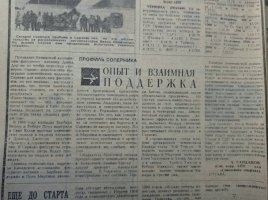
EXPERIENCE AND MUTUAL SUPPORT

(the article published in russian 'Sovetskiy Sport' on January 18, 1984)

David Dore, President of the Canadian Figure Skating Association, isn't exactly overly superstitious. However, in his view, the prospect of Canadian skaters winning Olympic medals in Sarajevo is so realistic that, fearing a jinx almost to the point of panic, he avoids going into deep predictions. "The only thing I can say," he hints, "is that for the first time since the Squaw Valley Olympics, Canada is sending such strong figure skaters to the Olympic Games."
In 1960 in Squaw Valley, Canadians Barbara Wagner and Robert Paul won Olympic gold medals in pair skating, and Donald Jackson took the bronze in the men's competition. In Sarajevo, the skaters from the Land of the Maple Leaf will be contenders for medals in these same disciplines.
The main Olympic hope for the Canadian Figure Skating Association is Barbara Underhill and Paul Martini, who are bronze medalists from last year's World Championship in pair skating. Due to a minor injury to Underhill, the pair did not compete in the national championship that concluded on Saturday in Regina. However, local specialists assert that this will hardly prevent them from competing for the top award in Sarajevo. According to Dore himself, Underhill and Martini have significantly improved the artistry of their program execution this season, which was previously considered their weak point.
Brian Orser, the bronze medalist from last year's World Championship in Helsinki, is another favorite on the Canadian team. In Regina, he faced stiff competition from Gary Beacom, who was leading after the compulsory program. But Orser managed to catch up through his free skating and become the Canadian champion for the fourth time. Beacom, who skates quite effectively visually and generally elicits more sympathy from the audience than from the judges, still hopes to beat Orser in Sarajevo.
In the women's competition, Kay Thomson became a three-time Canadian champion. In pair skating, in the absence of Underhill and Martini, Kathy Matousek and Lloyd Eisler won, and in ice dance, Tracy Wilson and Robert McCall, who also won the title of Canadian champions for the third time.
Paul Martini, captain of the Canadian Olympic figure skating team, believes that their successful performance in Sarajevo will be greatly facilitated by the relationships of camaraderie and mutual support established between the athletes, which was clearly lacking in Lake Placid. Moreover, the Canadians also have experience to their credit. Many of the skaters began preparing for the Sarajevo '84 Olympics six years ago, participating in numerous international competitions.
Dore believes that the main rivals for Underhill and Martini in the fight for Olympic medals will be pairs from the Soviet Union and the GDR. In men's skating, in his opinion, the Canadians will compete for prizes with Soviet, American, and West German skaters.​

A. SANDAKOV.
(APN Own Correspondent – for Sovetsky Sport).
OTTAWA.
1769022799193.jpeg
 
1984
USSR CUP

FIGURE SKATING

(the article published in russian 'Sovetskiy Sport' on January 20, 1984)

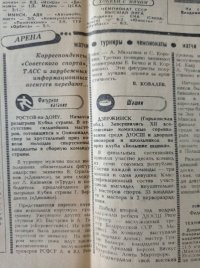
ROSTOV-ON-DON. The competition for the National Cup has begun. In the absence of the top-tier masters who are currently preparing for the Olympics, the battle for the crystal prize is being contested by young athletes and candidates for the national team.
In the men's tournament, V. Oralnov (Dynamo) took the lead after completing the compulsory figures, followed by L. Kaznakov (Trud) and last year's National Cup winner, G. Vardanyan (Dynamo).
In the pair skating event, the competitors performed their short programs. Yu. Bystrova and A. Tarasov (Burevestnik) performed more confidently than the others; their composition was dynamic and featured an interesting concept. Currently in second place are A. Malgina and S. Korovin, who, like the leaders, are students of the Honored Coaches of the RSFSR A. and Yu. Rennik. The third position is held by Leningrad skaters E. Bechke and V. Kornienko. These skaters received the highest marks for artistry.​

V. KOVALEV.
1769023632287.jpeg
 
Last edited:
1984
USSR CUP

FIGURE SKATING

(the article published in russian 'Sovetskiy Sport' on January 21, 1984)

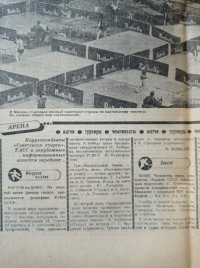
ROSTOV-ON-DON. The USSR Cup competition continues at the Ice Palace arena.
In the first discipline of the program—compulsory figures—high results were shown by Muscovites M. Serova (Spartak) and A. Antonova (DSO Trade Unions). They won second and third places, respectively. The victory here was celebrated by N. Lebedeva from Sverdlovsk, a student of Honored Coach of the RSFSR I. Ksenofontov.
The three compulsory dances—pasodoble, the Westminster Waltz, and the rhumba—were best performed by the Dynamo duo T. Kuzmina and I. Chinyaev. They are followed by the duos Yu. Romanova and D. Smirnov (Trud) and E. Vasyukova and D. Blyakhman (Lokomotiv).
On the second day of the men's competition, there was a change of leader. L. Kaznakov (Trud) moved into first place based on the total scores from the compulsory and short programs, with G. Vardanyan (Dynamo) in second. Third place is shared by A. Efremov (Spartak) and V. Oralnov (Dynamo).​
V. KOVALEV.
1769024355505.jpeg
 
Last edited:
1984
USSR CUP

FIGURE SKATING

(the article published in russian 'Sovetskiy Sport' on January 22, 1984)

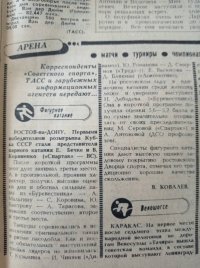
ROSTOV-ON-DON. The first winners of the USSR Cup competition were the pair skaters E. Bechke and V. Kornienko (Spartak - Armed Forces).
After the short program, this duo was in third place. In the free skate, however, displaying character, they received the highest scores of the day and overtook the strong pairs from Burevestnik—A. Malgina and S. Korovin, Yu. Bystrova and A. Tarasov—who finished in second and third place respectively.
The ice dancers competed in the original dance in the rhythm of a pasodoble. The top three leaders remained unchanged from the compulsory dances: T. Kuzmina and I. Chinyaev (Dynamo), Yu. Romanova and D. Smirnov (Trud-1), E. Vasyukova and D. Blyakhman (Lokomotiv).
On the Rostov ice, N. Lebedeva (Burevestnik) is performing easily and confidently in the women's single skating event. She received scores of 5.6-5.7 points in the short program and has significantly pulled away from her pursuers M. Serova (Spartak) and A. Antonova (DSO Trade Unions) in the overall total.
Figure skating specialists highly praised the ice surface of the Rostov Sports Palace, noting its traditionally good gliding qualities.​
V. KOVALEV.
1769025853144.jpeg
 
1984
CANADIAN CHAMPIONSHIPS

OPPONENT PROFILE
EXPERIENCE AND MUTUAL SUPPORT

(the article published in russian 'Sovetskiy Sport' on January 18, 1984)

David Dore, President of the Canadian Figure Skating Association, isn't exactly overly superstitious. However, in his view, the prospect of Canadian skaters winning Olympic medals in Sarajevo is so realistic that, fearing a jinx almost to the point of panic, he avoids going into deep predictions. "The only thing I can say," he hints, "is that for the first time since the Squaw Valley Olympics, Canada is sending such strong figure skaters to the Olympic Games."
In 1960 in Squaw Valley, Canadians Barbara Wagner and Robert Paul won Olympic gold medals in pair skating, and Donald Jackson took the bronze in the men's competition. In Sarajevo, the skaters from the Land of the Maple Leaf will be contenders for medals in these same disciplines.
The main Olympic hope for the Canadian Figure Skating Association is Barbara Underhill and Paul Martini, who are bronze medalists from last year's World Championship in pair skating. Due to a minor injury to Underhill, the pair did not compete in the national championship that concluded on Saturday in Regina. However, local specialists assert that this will hardly prevent them from competing for the top award in Sarajevo. According to Dore himself, Underhill and Martini have significantly improved the artistry of their program execution this season, which was previously considered their weak point.
Brian Orser, the bronze medalist from last year's World Championship in Helsinki, is another favorite on the Canadian team. In Regina, he faced stiff competition from Gary Beacom, who was leading after the compulsory program. But Orser managed to catch up through his free skating and become the Canadian champion for the fourth time. Beacom, who skates quite effectively visually and generally elicits more sympathy from the audience than from the judges, still hopes to beat Orser in Sarajevo.
In the women's competition, Kay Thomson became a three-time Canadian champion. In pair skating, in the absence of Underhill and Martini, Kathy Matousek and Lloyd Eisler won, and in ice dance, Tracy Wilson and Robert McCall, who also won the title of Canadian champions for the third time.
Paul Martini, captain of the Canadian Olympic figure skating team, believes that their successful performance in Sarajevo will be greatly facilitated by the relationships of camaraderie and mutual support established between the athletes, which was clearly lacking in Lake Placid. Moreover, the Canadians also have experience to their credit. Many of the skaters began preparing for the Sarajevo '84 Olympics six years ago, participating in numerous international competitions.
Dore believes that the main rivals for Underhill and Martini in the fight for Olympic medals will be pairs from the Soviet Union and the GDR. In men's skating, in his opinion, the Canadians will compete for prizes with Soviet, American, and West German skaters.​

A. SANDAKOV.
(APN Own Correspondent – for Sovetsky Sport).

OTTAWA.
View attachment 10765
When we heard that Barb and Paul were skipping Canadians in the 1983/84 season, and might have been out for the year with her injury, we did wonder briefly if we should have stayed in one more year. I forget if we'd been 5th or 6th in 1983, but the marks were very close. Could we have maybe taken bronze with them out, and gone to the Olympics since Canada had three pairs spots? We'll never know. Probably not. 🤷‍♀️🤷‍♂️
 
1984
USSR CUP

FIGURE SKATING

(the article published in russian 'Sovetskiy Sport' on January 24, 1984)

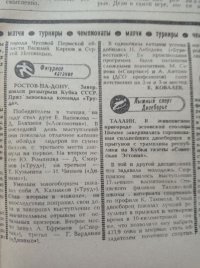
ROSTOV-ON-DON. The competition for the USSR Cup has concluded. The trophy was won by the "Trud" team.
The winners in ice dance were the duo E. Vasyukova and D. Blyakhman (Lokomotiv). On the final day of performances, they displayed excellent skating and, by overtaking the leaders in total points, moved from third place to first. In second place were Yu. Romanova and D. Smirnov (Trud), and in third were T. Kuzmina and I. Chinyaev (Dynamo).
L. Kaznakov (Trud) proved himself to be a skilled all-around competitor. After placing second in the "school" (compulsory figures), he subsequently improved his standing and finished his performance with a significant lead over the other medalists. Second place was taken by A. Efremov (Spartak), and third by G. Vardanyan (Dynamo).
In the ladies' singles, success was achieved by N. Lebedeva (Burevestnik). Her free program was packed with difficult elements. M. Serova (Spartak) and A. Antonova (DSO Trade Unions) took 2nd and 3rd place, respectively.​

V. KOVALEV.
1769026923860.jpeg
 
Back
Top