Archive of newspaper articles | Page 19 | Golden Skate

Archive of newspaper articles

1984
WINTER OLYMPIC GAMES

A LINE IN THE OLYMPIC ANNALS

THE DUET OF THE SNOWFLAKE AND THE KNIGHT

(the article published in russian 'Sovetskiy Sport' on March 1, 1984)

After appearing on the scoreboard of the Palace of Sports “Zetra”, Olympic medalists and debutants of the 14th Winter Olympics Marina Klimova and Sergei Ponomarenko, having changed clothes, went to the stands to watch the performances of the ice dance duos. A short time later, a commotion began behind the scenes—the organizers of the competition were looking for our athletes to invite them now to the podium. The debutants won bronze medals at the White Olympics.
We had a chance to talk with them and their coach, Honored Coach of the RSFSR Natalia Ilyinichna Dubova. We talked about figure skating, about their studies (Marina and Sergei are students of the Moscow Institute of Physical Culture), about home, about the numerous letters and telegrams that arrived at the Moimilo Olympic Village from people both familiar and unfamiliar.
"They believed in us. We had no right to perform any other way," said Sergei. "And now I so much want to go home, to the skating rink in Sokolniki..."
They arrived in Moscow in the evening. There were many greeters, but the athletes especially remembered their younger colleagues—skaters who enthusiastically greeted their clubmates with the Spartak flag. And in the morning, Marina and Sergei came to the Sokolniki Sports Palace for training: that is the order in their group, and no one, even Olympic medalists, feels they have the right to break it.
"I started skating in Sverdlovsk's 'Snezhinka' (Snowflake)," says Marina. "In 1980, also an Olympic year, I first performed with Sergei Ponomarenko. I was very nervous—after all, I immediately became the partner of a two-time world junior champion. But Serezha is a real knight, a loyal friend. How many hours did he spend on the ice with me, how patient he was!"
Natalia Dubova, in turn, emphasized:
"Serezha is a very thorough person. Introverted by nature. And Marina, she’s all about flight, she loves to improvise. An exceptionally hardworking girl. The athletes complement each other, creating a creative, searching duo."
Last year's European Championship brought the ice dancers an honorable fourth place. They just barely missed the medals—after the compulsory dances, they were third. This means all attention must be paid to the free dance!
One evening, Natalia Dubova was watching a television program dedicated to Imre Kálmán. As the familiar melodies played, a dance pattern began to take shape before her eyes—spirited yet lyrical, passionate and captivating. Thus, the decision was made: she would prepare a free dance to the music of the Hungarian composer for this year’s European Championships.
In Budapest, spectators and judges alike were captivated by Marina’s elegance, Sergei’s noble bearing, and, of course, their flawless technique and unique, ethereal quality. This dance earned Klimova and Ponomarenko the bronze medal at the 1984 European Championships.
It goes without saying how happy the skaters, their coach, and choreographers E. Kholina and E. Matveeva were! They headed to the Winter Olympics with a firm resolve: to perform just as well as they had on the banks of the Danube.
But it was no easy task. Their main rivals, the American duo Judy Blumberg and Michael Seibert, put up fierce resistance. It was only the Soviet skaters’ free dance—performed in a single breath, without a single flaw, and with vivid inspiration—that secured them the prestigious third-place finish.
Shortly before that decisive day, Vučko was seen strolling through the streets of the Olympic Village. He happened to glance into a souvenir shop and saw Natalia Dubova holding the mascot of the '84 Games—a charming plush little wolf. When Marina Klimova and Sergei Ponomarenko officially became Olympic bronze medalists, the student Branko Ilić, who played the role of Vučko, tried to find Natalia Dubova and her students, but he could not track them down. He asked me to pass on his congratulations and his wishes for many more victories to come!"​
S. PALMOVA.
1770231861214.jpeg
 
1984
EXPRESS INFORMATION
(the article published in russian 'Sovetskiy Sport' on March 11, 1984)
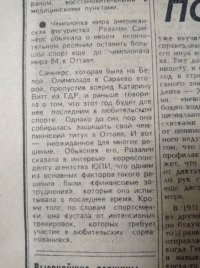
World champion American figure skater Rosalynn Sumners announced her final decision to leave elite sport even before the '84 World Championships in Ottawa.
Sumners, who was second at the Sarajevo Winter Olympics (finishing behind Katarina Witt of the GDR), had previously said that this would be her last year in amateur sport. However, until recently, she had intended to defend her championship title in Ottawa. But now she has made a decision unexpected by many. Explaining her choice, Rosalynn said in an interview with a UPI correspondent that one of the main factors for such a decision was the «financial difficulties» she had been experiencing lately. In addition, according to the athlete, she «is tired of the intensive training that participation in amateur competitions requires».
1770232301996.jpeg
 
1984
WINTER OLYMPIC GAMES

ECHO OF THE WHITE OLYMPICS​

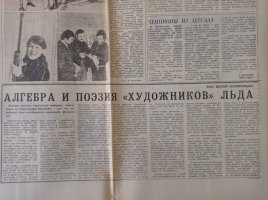
Algebra and Poetry of the "Artists" of the Ice

(the article published in russian 'Sovetskiy Sport' on March 14, 1984)

A strong character, creative impulse, and focus on talented youth—this is what defines the face of today's avant-garde figure skating.
The Olympic figure skating tournament in Sarajevo brought our masters many joyful moments: nine Soviet athletes ascended the podium at the Zetra Sports Palace.
The country's team has 5 medals – one gold, one silver, and three bronze (four years ago in Lake Placid there were four, two of which were gold). Currently, in terms of the number of medals, Soviet figure skaters have surpassed the US team (three medals), the GDR team (one medal), and British athletes (one medal).
But along with the successes, there were also annoying failures for our skaters. Our men in single skating could not get a single point, the duets of ice dancers O. Volozhinskaya and A. Svinin, and the pairs team of M. Avstriyskaya and Y. Kvashnin ended up outside the top six strongest, possessing considerable competitive experience.
Undoubtedly, the striking force of the USSR national team was comprised of masters of pair skating—Leningraders E. Valova and O. Vasiliev, L. Selezneva and O. Makarov—as well as the Moscow-based ice dancers N. Bestemianova and A. Bukin, and M. Klimova and S. Ponomarenko. The Olympic victory of Valova and Vasiliev, students of the Honored Coach of the USSR T. Moskvina, was especially weighty and significant.Characteristically, all foreign judges unanimously recognized the style of the Soviet champions as the most harmonious and modern.
The model of the '84 Olympian was by no means born easily; its outlines were sketched in coaching plans and visions as early as four years prior. However, bringing this model to life required the inexhaustible energy and creative imagination of the mentors, as well as the powerful mental fortitude, firm character, and bright individuality of the students. We must, first and foremost, give credit to the willpower of the future Olympic champions, Valova and Vasiliev. Three years of competing in All-Union tournaments were years of great trials and coming of age. Selezneva and Makarov found themselves in a similar situation. But they passed the test of strength!
Today, it must be said plainly: true Olympians are not formed in "greenhouse" conditions. Truth be told, in an atmosphere of universal attention and amidst a chorus of flattering praise, it is quite easy for figure skaters to believe in their own exceptionalism and uniqueness. But life teaches otherwise: only immense hard work, persistence in realizing one's vision, and the will to win bring genuine creative success. This is precisely the path chosen by the leading coaches. Even after winning the 1983 World Championships, Valova and Vasiliev did not alter their creative method of work by an iota; they remained maximally focused on mastering elements of the highest complexity. As early as October 1982, they ranked first in the national team regarding the fulfillment of all set plans and ideas. The champions met the 1984 season fully prepared.
A correct and clear search strategy within the four-year cycle, along with a focus on athletes possessing a creative streak and a competitive character, determined the new surge of the Soviet pair skating school in Sarajevo. Against the backdrop of the creative achievements of the Leningrad duos, lapses in the preparation of such a capable pair as Avstriyskaya and Kvashnin (coach S. Zhuk) became noticeable. Selecting a composition without considering the athletes' individuality and neglecting the program's visual appeal inevitably affected the results of this duo (9th place in Sarajevo).
The most heated discussion of the Olympic season erupted around ice dance, where the leaders of two schools—British and Soviet—engaged in a tense and captivating struggle. During these debates, opposing viewpoints were sometimes expressed: some completely denied the merits of the new programs of world champions J. Torvill and C. Dean, while others unconditionally gave them the palm of victory. It was only on the Olympic ice that the true picture of the balance of power appeared to everyone. While the advantage in the compulsory program lay with the British ice dancers, the Soviet masters—1983 European champions N. Bestemianova and A. Bukin, as well as national team debutants M. Klimova and S. Ponomarenko—showed their strong suits in the free dance.
The program set to Russian folk melodies, created by our top duo N. Bestemianova and A. Bukin under the guidance of Honored Coach of the USSR T. Tarasova, became a great creative success. It embodied the athletes' highest dance technique, their artistic temperament, musicality, and acting skills. The rivalry with the British school of dance will continue, and we believe that brilliant victories await our duos in the near future!
The outcome of the struggle in Sarajevo turned out to be quite unexpected for our men's singles skaters. Already after the compulsory figures, it became clear that only European champion A. Fadeev was capable of fighting for a podium finish. Our other singles skater, V. Kotin, effectively dropped out of the group of strongest competitors, taking 11th place.
And here we must admit that the group of students under the Honored Coach of the USSR E. Tchaikovskaya did not realize their potential in the past Olympic cycle, despite being provided with all the conditions for creative growth. In particular, the underestimation of the role of 'compulsory figures' in singles skating had a negative impact. Kotin lost a great deal due to deficiencies in his execution of the 'school' both at the European Championships and at the Sarajevo Olympics. Training without strong sparring partners also hindered his progress. The ice dance duo of O. Volozhinskaya and A. Svinin found themselves in a similar position, as they were unable to improve the quality of their compulsory program.
The strongest singles skaters of the CSKA school—A. Fadeev and E. Vodorezova (coach S. Zhuk)—suffered stinging setbacks during the most critical period of the season. Their preparation was affected by disruptions and irregularities in the training process permitted by the coach. The strategy of relying on luck through a 'crash program' effort did not pay off. After winning the European Championships in Budapest, Fadeev had good prospects for the Olympic tournament. However, his plans were thwarted by a leg injury. Vodorezova also failed to regain her former form; she lacked the strength to execute her free program. The nature of these failures lies in the coach's lack of control over both the technical and psychological state of the athletes.
Let us emphasize once more: the 'greenhouse conditions' created for some athletes never lead to anything good; they deprive figure skaters of their competitive spirit and mental fortitude. Might this have been the reason for the failures of some students in coach A. Mishin’s group during the Olympic season?
The results of our national team have once again clearly demonstrated the strengths and weaknesses of our coaching corps as a whole. Over the last two seasons, we have managed to renew the national team by almost 80 percent, injecting it with fresh blood. However, this was again achieved mainly thanks to the efforts of the leading specialists from Moscow and Leningrad — T. Moskvina, T. Tarasova, N. Dubova, I. Moskvin, E. Pliner, and others. Out of 26 points, 22 were earned by students from Moscow and Leningrad schools. Moreover, the lion's share of points belongs to figure skaters from just three sports societies: 'Trud', 'Spartak', and 'Zenit'.
A logical conclusion suggests itself: in the upcoming Olympic cycle, everything must be done to significantly raise the professional level of our coaches working in the Union republics. The need has arisen to create a unified scientific and methodological center based on the new Department of Figure Skating at the GCОLIFK (State Central Order of Lenin Institute of Physical Culture). An exceptionally important role in the near future must be played by the All-Union Arts Council, which will include specialists in ballet, music, theatre, and directing. Today, the value of spectacular, vivid compositions is especially great, and therefore consultations and constant contact with representatives of the arts significantly enrich both coaches and the athletes themselves with new ideas...
The last decade has passed under the banner of expanding the network of artificial ice rinks in the country. The ranks of coaches are constantly being replenished by university graduates. In short, the material and technical base of figure skating is improving. Beneficial shifts are noticeable in reserve training as well. Now, in the USSR junior national team, representatives of new centers have appeared, such as Odesa, Kyiv and Dnipropetrovsk. For the first time, the winner of the Junior World Championship was a skater from Odesa, V. Petrenko. But it seems this is just the first sign. We are all interested in further expanding the geography of our figure skating.
Practical steps are needed today aimed at stimulating the work of our young centers. This is not only about methodological assistance to coaches but also about the construction of the simplest training rinks and the production of training equipment developed specifically for figure skaters.
Apparently, we should think about more in-depth specialization in the work of individual schools and individual coaching staffs. For example, at least five or six experienced coaches for ice dancing work in Moscow schools; their groups raise about 40 ice dance duos, many of whom form the core of the USSR national team. Probably, given this situation, we can orient schools in other cities towards an in-depth search in the field of pair and singles skating, where the reserves are still insufficiently reliable.
There is also an urgent need to establish constant creative contacts between the country's leading coaches and individual sports regions, such as the Urals, the Volga region, Kazakhstan, Armenia, Latvia, and Estonia. The All-Union scientific and methodological center based at the GCOLIFK could do a lot in this area.
The experience of the past four-year Olympic cycle showed how great the role of accurate forecasting and foresight of major trends in figure skating is. The increasing demands for the complexity and spectacular nature of programs, a balanced composition—all this was reflected in coaching plans and ideas formulated four years ago and yielded excellent results in pair skating and ice dance.
Yet, many reserves in training Olympians were not fully realized. First and foremost, in singles skating.
Meanwhile, the demands for program complexity in single skating will increase. At the Olympics in Sarajevo, our competitors—figure skaters from the USA, Canada, and the GDR—achieved a certain advantage; their programs were distinguished by dynamism and a high tempo from the first to the last minute. A very important factor is the stability of execution of all complex elements, including triple jumps and the 3.5 rotation jump. The day will come when elements of the highest complexity, including quadruple jumps, will become the norm. We must be prepared for this.
The artistic side of compositions is another area where progress must be made. The fate of our talents will largely depend on how the problems of close connection with music, individual style, are solved. The synthesis of complexity and artistry is such a complex task that one coach can no longer lead this search at the highest level alone. Therefore, collective, brigade methods of work are being actively introduced into the work of sports schools. In this regard, the special group of coach T. Moskvina and the special group of coach T. Tarasova have accumulated valuable positive experience. We need to look closely at it and analyze the strengths and weaknesses of these approaches. Only along this path await us the brightest discoveries and achievements.
Self-sacrificing labor combined with a deep analysis of variable trends, firmness in conducting the chosen course, and energetic support for masters with a bright individuality—this is the main line of development for our figure skating for the new Olympic cycle.​

A. SINILKINA,
Honored Chairman of the USSR Figure Skating Federation.
1770363142845.jpeg
1770363172672.jpeg
 
1984
EXPRESS INFORMATION
(the article published in russian 'Sovetskiy Sport' on March 18, 1984)

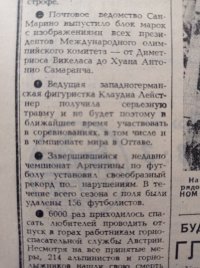
Leading West German figure skater Claudia Leistner has suffered a serious injury and will therefore not be competing in the near future, including the World Championships in Ottawa.
1770363662644.jpeg
 
1984
WORLD CHAMPIONSHIPS

APPOINTMENT AFTER SIX YEARS

(the article published in Ukrainian 'Sportyvna Hazeta' on March 20, 1984)

OTTAWA. More than one hundred athletes from 22 countries will compete for awards at the World Figure Skating Championships, which began in the Canadian capital, at the ice arena of the "Civic Center" Palace.
Among the participants (the tournaments have a history dating back to 1896, this is the 75th one) are all champions of the Sarajevo Olympics. J. Torvill and Ch. Dean (Great Britain) in ice dancing, and S. Hamilton from the USA in singles skating will defend their world titles for the fourth time. The Leningraders O. Valova and O. Vasilyev are ready to confirm their world champion title, which they won last year in Helsinki, in the pairs competition. And only among women in singles skating the gold medalist of the previous championship R. Summers will not take to the ice as she decided to sign a contract with a professional revue company.
Spectators and press representatives show great interest in the competitions. They are covered by nearly 300 journalists... The most ardent figure skating fans even came to the participants' training sessions.
The championship organizers expect that the greatest attention of the audience (the stands seat 9.5 thousand) will be attracted by the performances of ice dancers and men's singles skaters. It was in this hall six years ago that the great international debut of three-time world champions Torvill and Dean took place; now they will show their farewell dance here.
The first medalists among women will be determined on March 21, the next day the strongest in pairs skating will climb the podium, on the 23rd in men's singles, and on the last day the ice dancers will receive awards.
Yesterday morning the competition in the compulsory program opened the tournament for female skaters. Among them are Olympic champion K. Witt from the GDR, Olympic bronze medalist K. Ivanova from Podmoskovye, the new hope of American figure skating T. Chin, and Muscovite G. Kondrashova.​
(TASS).
1770365691535.jpeg
 
1984
WORLD CHAMPIONSHIPS

RENDEZVOUS AFTER SIX YEARS

(the article published in russian 'Sovetskiy Sport' on March 20, 1984)

OTTAWA, March 19. (TASS Special Correspondent). Over one hundred athletes from 22 countries will compete for awards in the World Figure Skating Championships which began today at the "Civic Centre" arena in the capital of Canada. Ottawa is hosting the spectacular tournament again after six years.
Among the participants in the current championships (these tournaments trace their history back to 1896, and this is the 75th) are all the champions of the Sarajevo Olympics. Jayne Torvill and Christopher Dean (Great Britain) in ice dancing, and Scott Hamilton from the USA in men's singles, will be defending their world titles for the fourth time. The Leningrad pair Elena Valova and Oleg Vasiliev, who won the world championship last year in Helsinki, are ready to confirm their title in the pairs competition. Only in ladies' singles, the winner of the world championship-83 gold medal, Rosalynn Sumners, will not take the ice as she has decided to leave amateur sport.
Early Monday morning, the championship was opened by female skaters with the compulsory figures competition. Among them are Olympic champion Katarina Witt from the GDR, and Olympic bronze medalist Kira Ivanova from near Moscow.
1770388990418.jpeg
 
1984
WORLD CHAMPIONSHIPS

A SIGNIFICANT APPLICATION

(the article published in Ukrainian 'Sportyvna Hazeta' on March 22, 1984)

OTTAWA. Olympic champion Katarina Witt from the GDR, after winning the compulsory program, made a significant bid for a medal at the World Figure Skating Championships, which began at the "Civic Centre" sports complex arena. The confident start by the 18-year-old schoolgirl from Karl-Marx-Stadt was no surprise. "I managed to perform all the figures surprisingly well," Witt said.
Our athletes were pleased with their steady performances. Olympic bronze medalist Kira Ivanova from near Moscow was second in the school figures, while Muscovite Anna Kondrashova was fourth (third place was taken by the experienced Manuela Ruben from the FRG).
The US team suffered its first loss to the lineup two weeks before the championship when last year's world champion Rosalynn Sumners announced she was switching to ice revues. At the last moment, due to injury, the new hope of American figure skating, 16-year-old Tiffany Chin, did not take the ice.
A total of 23 female athletes from 16 countries, as well as 12 pairs and 21 ice dance couples, are competing in the tournament. 26 participants from 17 countries gathered for the men's tournament. However, Norbert Schramm from the FRG refused to continue the fight after a few times on the ice, citing biased judging. This is an unprecedented case. After the short program, Alexander Fadeev and Vladimir Kotin were in fifth and ninth places respectively, while the American Scott Hamilton, whom local favourite Brian Orser promised to "dethrone" from the pedestal on local radio, was leading.
On Tuesday, the pairs performed their short program. Elena Valova and Oleg Vasiliev's performance caused a storm of applause; they received an artistic impression score of 5.8 from all judges. None of their rivals could approach these scores. In second place for now are the Canadians Barbara Underhill and Paul Martini, and in third are Larisa Seleznyova and Oleg Makarov.
The first medals were presented to the female single skaters early in the morning on March 22, Moscow time. After the short program, Witt is confidently leading. Ivanova retains second position. Kondrashova is also performing excellently, pushing several other athletes out of the prize three, including the Japanese woman Midori Ito, whose short composition was a revelation of the championship.​
(TASS)
1770389775564.jpeg
 
1984
WORLD CHAMPIONSHIPS

OUR SPECIAL CORRESPONDENT REPORTS FROM CANADA

SPRING FUSS IN THE ICE HOUSE

(the article published in russian 'Sovetskiy Sport' on March 22, 1984)

At the entrance of the Ottawa Sports Palace, stewards regulate the flow of cars and buses. In the hall of the Palace, administrators with walkie-talkies help fans. Their services are necessary, as there are an extremely large number of people wishing to attend the competitions: the World Figure Skating Championships have not been held in Canada since 1978. And the traditions of this sport in the country are long-standing and rich.
Donald Jackson, now a columnist for a number of Canadian newspapers, who once won a sensational victory at the 1962 World Championships in Prague, enjoys great popularity in Canada. Jackson was the first in the world to perform a triple lutz. His flight above the ice was so high and beautiful that even then experts predicted: after Jackson, jumps of a new type with 3.5 and 4 revolutions will come into fashion. Indeed, Jackson's successor, 22-year-old Brian Orser, now demonstrates these unique elements, conquering the audience with temperament, cleanliness of glide...
A large article in "The Globe and Mail" newspaper is devoted to a conversation with the technical director of the National Figure Skating Federation, Barbara Graham. She emphasizes that Orser is the main candidate for victory in Ottawa. He was already close to success in Sarajevo, and if he became only a silver medalist, it was only because the judges are too susceptible to the magnetic influence of titles. In Sarajevo, three-time world champion Scott Hamilton (USA) won, but here the judges will have a difficult task on March 24, when the men's world championships will end.
In the meantime, the women's competitions in "school" have begun. 23 athletes started. Among them were not world champion '83 Rosalynn Sumners and the USA team's new "star", Tiffany Chin. One of them refused further sports career, and the other fell ill. The medalists of the '83 World Championships C. Leistner (FRG) and our E. Vodorezova also did not compete.
K. Witt (GDR), K. Ivanova, A. Kondrashova (both USSR), Canadian K. Thomson and ex-world champion E. Zayak (USA) were among the best after the performance of the third compulsory figure. In the end, small medals were won by K. Witt, K. Ivanova and M. Ruben (FRG). Thus, 20-year-old Kira Ivanova for the first time received a small silver medal.
"I am convinced that the women's competitions in Ottawa will be even more spectacular and brighter than in Sarajevo," said the referee in women's single skating, Josef Dedic from Czechoslovakia. Masters who have systematically climbed to the peak of their sports form have come to Canada.
The short program competition for women can be called a necklace of brilliant concert numbers. Katharina Witt (GDR) was charming, cunning and perky in performing the csardas, our Anna Kondrashova conquered the audience with poetic and inspired skating (scores for artistry in the short program 5.7-5.8), and Kira Ivanova convincingly revealed the romantic image of the composition to the music of Beethoven.
These three girls were the best on the second day of the competition. Witt retained the lead, Ivanova continues the fight for "silver" in the all-around, and Kondrashova moved to third place, having the second result in the short composition.
In the morning of the second day, a curious scene occurred: ex-European champion Norbert Schramm (FRG) demonstratively addressed referee Sonja Bianchetti, announcing that he was stopping his performance. And he did it after the second compulsory figure, when a lot was still unclear in the men's competition. Bianchetti persuaded Schramm to go to the start for a long time. Then Schramm skated onto the ice, bowed to the four sides and... left for the locker room.
Later, in an interview with Canadian television, he stated that he was leaving the sport forever, as he was not satisfied with the position of an outsider (in the "school" he did not even make it into the top ten best). Schramm accused the judges of bias and malevolence. And yet, the main reason, I think, is not in this - the essence of the matter is in the change in the situation in the "ice house". Masters of a new formation are rising on the crest of the wave, and it is difficult to compete with them even for such a gifted skater as Schramm.
And so on the monitors we saw the list of leaders in men's skating after the "school": S. Hamilton (USA), R. Cerne and H. Fischer (both FRG), I. Sabovcik (Czechoslovakia), A. Fadeev (USSR), B. Boitano (USA), B. Orser (Canada), F. Fedronik (France) and V. Kotiv (USSR).
And late in the evening, thousands of spectators, enthusiastically waving miniature flags, greeted their favorites, Canadian champions Barbara Underhill and Paul Martini. This pair put in a lot of effort and diligence to compare in class of skating with Olympic champions E. Valova and O. Vasiliev. Their duel became the culmination of the evening competitions of duets. Fortune was on the side of the Canadians they started among the last, our duet fourth. But even that didn't help the home skaters. The Olympic champions were first. And fully deservedly so! Brilliant all-round technique, liveliness of emotions and subtle musical interpretation of the famous melody "Kalinka" - all this brought success to our skaters.
Another difficult duel was won by Soviet skaters L. Selezneva and O. Makarov, who managed to get the upper hand over ex-world champions S. Baes and T. Thierbach (GDR). Our duet currently holds third place. And another Soviet pair, V. Pershina and M. Akbarov, rounded out the top six.​

A. SHELUKHIN.

OTTAWA, March 21.
TECHNICAL RESULTS
World Figure Skating Championships. Ottawa, Civic Centre Sports Palace. March 20.
Pair skating. Short program. 1. E. Valova and O. Vasiliev (USSR) 0.4 points; 2. B. Underhill and P. Martini (Canada) 0.8; 3. L. Selezneva and O. Makarov (USSR) 1.2; 4. S. Baess and T. Thierbach (GDR) 1.6; 5. K. Matoushek and L. Eisler (Canada) 2.0; 6. V. Pershina and M. Akbarov (USSR) 2.4.
Women. Short program. 1. K. Witt (GDR) 0.4; 2. A. Kondrashova (USSR) 0.8; 3. K. Ivanova (USSR) 1.2; 4. M. Ito (Japan) 1.6; 5. E. Zayak (USA) 2.0; 6. K. Thomson (Canada) 2.4.​
1770396712421.jpeg
 
1984
WORLD CHAMPIONSHIPS

A SIGNIFICANT APPLICATION

(the article published in Ukrainian 'Sportyvna Hazeta' on March 22, 1984)

OTTAWA. Olympic champion Katarina Witt from the GDR, after winning the compulsory program, made a significant bid for a medal at the World Figure Skating Championships, which began at the "Civic Centre" sports complex arena. The confident start by the 18-year-old schoolgirl from Karl-Marx-Stadt was no surprise. "I managed to perform all the figures surprisingly well," Witt said.
Our athletes were pleased with their steady performances. Olympic bronze medalist Kira Ivanova from near Moscow was second in the school figures, while Muscovite Anna Kondrashova was fourth (third place was taken by the experienced Manuela Ruben from the FRG).
The US team suffered its first loss to the lineup two weeks before the championship when last year's world champion Rosalynn Sumners announced she was switching to ice revues. At the last moment, due to injury, the new hope of American figure skating, 16-year-old Tiffany Chin, did not take the ice.
A total of 23 female athletes from 16 countries, as well as 12 pairs and 21 ice dance couples, are competing in the tournament. 26 participants from 17 countries gathered for the men's tournament. However, Norbert Schramm from the FRG refused to continue the fight after a few times on the ice, citing biased judging. This is an unprecedented case. After the short program, Alexander Fadeev and Vladimir Kotin were in fifth and ninth places respectively, while the American Scott Hamilton, whom local favourite Brian Orser promised to "dethrone" from the pedestal on local radio, was leading.
On Tuesday, the pairs performed their short program. Elena Valova and Oleg Vasiliev's performance caused a storm of applause; they received an artistic impression score of 5.8 from all judges. None of their rivals could approach these scores. In second place for now are the Canadians Barbara Underhill and Paul Martini, and in third are Larisa Seleznyova and Oleg Makarov.
The first medals were presented to the female single skaters early in the morning on March 22, Moscow time. After the short program, Witt is confidently leading. Ivanova retains second position. Kondrashova is also performing excellently, pushing several other athletes out of the prize three, including the Japanese woman Midori Ito, whose short composition was a revelation of the championship.​
(TASS)
View attachment 10860
Katarina Witt had a subtle trick she'd play in the school figures section. After completing a figure, instead of just skating off and leaving the judges to study it, she'd pause and examine her tracings herself. Then she'd give an emphatic little nod of satisfaction and smile confidently at the judges before skating away. It seemed to work ;).
 
1984
WORLD CHAMPIONSHIPS

OUR SPECIAL CORRESPONDENT REPORTS FROM CANADA

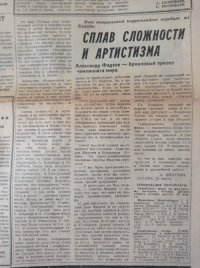
FORTUNE SMILES ON VIRTUOSOS

(the article published in russian 'Sovetskiy Sport' on March 23, 1984)
Silver medal of the World Figure Skating Championships awarded to Muscovite Anna Kondrashova
Covering her face with a bouquet of spring lilies, Anna Kondrashova tried to hide the glow of a happy smile from others. Never before had she been the focus of such press attention. And journalists' questions poured in from all sides on the owner of the silver medal, and Anna had to go far from the interview area to exit the press center.
"Anya, who was your first coach?"
"Moscow coach Irina Yantseva in the Children's Town in Luzhniki. My journey began there in a regular enrollment group. Only at the age of ten did I transfer to the CSKA school. For the last four seasons, I've been training at the Young Pioneers' stadium school with coach Eduard Pliner."
"What is your idea of mastery model?"
"In the field of artistry, my ideal has always been the ice dances of former world champions Irina Moiseeva and Andrey Minenkov. They stayed with me because of their sincerity, sense of choreography. It's probably not accidental that Elena Matveeva, who gave her strength and imagination to the ice dances of Moiseeva and Minenkov, became my choreographer."
Eduard Pliner emphasized that even in such a difficult Olympic season, Kondrashova continued to gain sports form and literally surpassed herself in Ottawa.
A number of observers, including the former European champion Ingrid Wendl (Austria), the former US champion Misha Petkevich noted the special attractiveness of Kondrashova's style, her grace and charm.
The Olympic champion Katarina Witt (GDR), the pupil of coach Jutta Müller, won this championship, as expected. However, she looked somewhat tired on the ice of Ottawa.
But this is quite understandable: the victories on the ice rinks of Budapest and Sarajevo required a great deal of effort!But that is the skill of Müller, that she encourages her student to constantly improve, and it is natural that now in Ottawa, Witt’s free skate enriched itself with new colors, and the lyric theme became tangible in her performance.
Witt had a psychologically difficult role. By the draw, she started after the local favorite (by the way, a native of Ottawa) Elizabeth Manley. What was happening in the stands during Manley's skating! The ovations roared for several minutes. And whistling and the hum of protest that followed the scores of 5.4 and 5.5 lasted a long time: "Oh, those judges..."
Of course, it was not easy to take the ice in such a situation. But Katarina Witt immediately won the hearts of the audience. Four scores of 5.9 and five scores of 5.8 were her reward for her courage.
Our Kondrashova also demonstrated strong willpower, as she had to perform right after the Canadian figure skater Kay Thomson. Once again, the walls of the Sports Palace shook with applause, and once again, Kondrashova had to fight to win over the audience. She handled this brilliantly, proving herself a true virtuoso of ice art. Her triple loop was particularly impressive. Anna achieved the third-best result in the free program, which propelled her to second place overall in the all-around competition.
Unfortunately, the performance of another of our figure skaters, Kira Ivanova, ended unsuccessfully. She performed somehow the same jump twice, so the judges lowered her score and dropped the figure skater. As a result, Ivanova was seventh and lost the bronze medal to Zayak.
It is necessary to note the performance of the debutant of this championship Japanese Midori Ito, a 14-year-old schoolgirl, who performed a cascade with a triple loop and other triple jumps throughout the program with incredible ease. She also tried to perform a triple lutz. The “ultra-c” elements brought her the fourth best result in the free skate.
So, the first final in Ottawa is behind us. It turned out to be a step forward for our female figure skaters: last year Elena Vodorezova became a world bronze medalist for the first time, now Kondrashova has won silver! And it is especially pleasant that our athlete achieved stable technique in a school that sets the tone for the entire tournament.
The ice dance duets, which perform pasadoble, the Westminster Waltz, rumba, also started the fight. Again, as at the Olympics, the struggle for leadership was led by two outstanding duets - the English J. Torvill and Ch. Dean and the Soviet figure skaters N. Bestemyanova and A. Bukin.
A. SHELUKHIN.
OTTAWA, March 23.

TECHNICAL RESULTS
World Figure Skating Championships. Ottawa, Civic Centre Sports Palace. March 21.
Women. Sum of all-around:

PlaceSkaterCountryPoints
1.K. WittGDR2.0
2.A. KondrashovaUSSR6.2
3.E. ZayakUSA9.4
4.K. Ivanova USSR9.4
5.K. ThomsonCanada11.0
6.M. RubenFRG12.6
7.M. ItoJapan15.2
8.E. ManleyCanada17.4
9.S. DubravcicYugoslavia18.8
10.S. CariboniSwitzerland23.6
1770406529273.jpeg
 
1984
WORLD CHAMPIONSHIPS

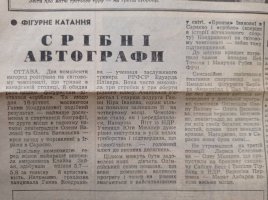
SILVER AUTOGRAPHS

(the article published in Ukrainian 'Sportyvna Hazeta' on March 24, 1984)

OTTAWA. Two sets of awards were contested at the world championship, which is ongoing in the Canadian capital, and both times our figure skaters got "silver". And if for 18-year-old Muscovite Anna Kondrashova such a result is the highest achievement in her sports biography, then the second place in pair skating for Leningraders Elena Valova and Oleg Vasyliev is a step backward compared to the Games in Sarajevo.
The free composition among women was best performed by American Elaine Zayak, who received marks of 5.7-5.8 for technique and artistry. Anna Kondrashova danced inspiringly and gracefully, a student of the Honored Coach of the RSFSR Eduard Pliner. She cleanly performed three triple jumps of different types. Anna's older friend Kira Ivanova also attacked the pedestal, however, several mistakes left her in fourth place. The champion, as expected, became Katarina Witt from the GDR. The student of Jutta Müller performed very evenly in all disciplines of all-around and confirmed that versatility is the main key to high achievements.
Our girls can be quite satisfied. The Olympic season showed that they have made great progress and are now competing equally with the strongest in the world. Ivanova's "bronze" in Sarajevo and Kondrashova's "silver" (for the first time in the history of domestic sports) at the world championship are further proof of this.
The Canadian Kay Thomson and Manuela Ruben from the FRG also made it into the top six.
The pairs competition ended sensationally. Canadian figure skaters Barbara Underhill and Paul Martini, not without the help of the judges, overtook Olympic champions Elena Valova and Oleg Vasyliev in the free program, becoming first. Undoubtedly, the Leningraders did not use all their rich opportunities, however, the rise of the Canadians is impressive. Let's recall that in Sarajevo they were seventh...
Larysa Seleznyova and Oleh Makarov did not stay in third position, letting Sabina Baess and Tassilo Thierbach from the GDR onto the bronze step. Veronika Pershina and Marat Akbarov took eighth place.
1770534534381.jpeg
 
1984
WORLD CHAMPIONSHIPS

SILVER AUTOGRAPHS

(the article published in Ukrainian 'Sportyvna Hazeta' on March 24, 1984)

OTTAWA. Two sets of awards were contested at the world championship, which is ongoing in the Canadian capital, and both times our figure skaters got "silver". And if for 18-year-old Muscovite Anna Kondrashova such a result is the highest achievement in her sports biography, then the second place in pair skating for Leningraders Elena Valova and Oleg Vasyliev is a step backward compared to the Games in Sarajevo.
The free composition among women was best performed by American Elaine Zayak, who received marks of 5.7-5.8 for technique and artistry. Anna Kondrashova danced inspiringly and gracefully, a student of the Honored Coach of the RSFSR Eduard Pliner. She cleanly performed three triple jumps of different types. Anna's older friend Kira Ivanova also attacked the pedestal, however, several mistakes left her in fourth place. The champion, as expected, became Katarina Witt from the GDR. The student of Jutta Müller performed very evenly in all disciplines of all-around and confirmed that versatility is the main key to high achievements.
Our girls can be quite satisfied. The Olympic season showed that they have made great progress and are now competing equally with the strongest in the world. Ivanova's "bronze" in Sarajevo and Kondrashova's "silver" (for the first time in the history of domestic sports) at the world championship are further proof of this.
The Canadian Kay Thomson and Manuela Ruben from the FRG also made it into the top six.
The pairs competition ended sensationally. Canadian figure skaters Barbara Underhill and Paul Martini, not without the help of the judges, overtook Olympic champions Elena Valova and Oleg Vasyliev in the free program, becoming first. Undoubtedly, the Leningraders did not use all their rich opportunities, however, the rise of the Canadians is impressive. Let's recall that in Sarajevo they were seventh...
Larysa Seleznyova and Oleh Makarov did not stay in third position, letting Sabina Baess and Tassilo Thierbach from the GDR onto the bronze step. Veronika Pershina and Marat Akbarov took eighth place.
View attachment 10865
"Not without the help of the judges" :points:Where have we heard that line before? So many times!
 
1984
WORLD CHAMPIONSHIPS

Our special correspondent reports from Canada

In a Fair Contest

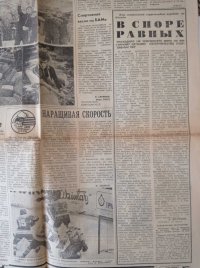
(the article published in russian 'Sovetskiy Sport' on March 24, 1984)

Competition between pairs took place at the World Figure Skating Championships

Twenty-five men presented their skills to the public and judges in the short program. West German champion Rudi Cerne set the tone, performing a routine that earned scores ranging from 5.6 to 5.8. He was followed by Jozef Sabovčík (Czechoslovakia), American Scott Hamilton, Canadian Brian Orser, and USSR champion Alexander Fadeev.
Sabovčík’s skating was soft and elegant, but he struggled with his combination involving a triple lutz, receiving technical marks of 5.6 and 5.7. Then came our own Fadeev. He has finally regained his form following an injury sustained in February. In Ottawa, Alexander mastered every jump; he captured the complexity and wit of the Charleston in a two-minute composition. A polished triple lutz combination, virtuoso footwork, and unexpected musical accents delighted the crowd of 10,000. Five scores of 5.7, six of 5.8, and two of 5.9 clearly reflected his mastery. In the official standings, Fadeev placed third. The judges put Olympic champion Scott Hamilton (USA) and Olympic silver medalist Brian Orser (Canada) ahead. Notably, Hamilton received seven 5.8s and two 5.9s for technique. Our other skater, Vladimir Kotin, received marks between 5.5 and 5.7, placing him seventh. Heading into the free skate, the leaders were ranked as follows: Hamilton, Cerne, Sabovčík, Fadeev, Orser, Heiko Fischer (FRG), Brian Boitano (USA), and Kotin.
Surprises awaited the audience in the evening during the pairs competition. Defying predictions, Canadians Barbara Underhill and Paul Martini, coached by G. Stone, took the victory. Five years ago, this duo won the World Junior Championships. At the time, everyone was struck by their height difference of over 30 centimeters. Over the years, the pair’s aesthetic has remained consistent: a powerful, athletic male partner alongside a miniature, graceful female partner.
The draw dictated that Olympic champions Elena Valova and Oleg Vasiliev would open the performances for the top-seeded group. Credit must be given to the Leningraders; despite the intensity of the Olympic season, they once again demonstrated the harmony and balance of their program.
The athletes poured all their strength into the struggle, yet at a certain point, many specialists detected a trace of nervousness and stiffness. If a scale existed to weigh the compositions of the Canadian pair against our duo, it is possible neither would have outweighed the other. However, in this situation, some judges were, in my view, not entirely objective—lowering the scores for our athletes while somewhat inflating the marks for their main rivals. Nevertheless, there is a simple rule in sports: to win, you must be head and shoulders above the rest.
Valova and Vasiliev’s superiority was absolute in Budapest and Sarajevo. But the moment they slightly eased the tension of their "on-ice dialogue," their rivals immediately caught up. In Ottawa, Valova and Vasiliev received eight scores of 5.8 and three scores of 5.9. Even so, this was not enough for victory. Underhill and Martini, performing later, were awarded seven 5.9s and eight 5.8s. As a result, they became world champions for the first time. At the press conference, our duo’s coach emphasized:
"I have had the opportunity to visit many ice rinks around the world, but I must note that the audience in Ottawa is unusually emotional and possesses a sophisticated understanding of the merits of figure skating... Let us recall that the Canadian school of pairs skating has its own history. In 1960, the Olympics were won by Canadians Barbara Wagner and Robert Paul, from whom Soviet masters learned a great deal. Therefore, the success of Underhill and Martini can be considered a surprise that was nonetheless well-founded”.
We have nothing to reproach our other Leningrad pair for—Larisa Selezneva and Oleg Makarov. They skated with inspiration. Their program included unique elements: a triple toe loop, a double Axel combination, and a triple twist lift. In short, they confirmed their high status as Olympic medalists. However, their artistic marks were low, and they lost the 'bronze' to former world champions Sabine Baeß and Tassilo Thierbach (GDR).
Unfortunately, our third duo—Veronika Pershina and Marat Akbarov—had several mistakes during pivotal moments. As a result, they finished in only eighth place.​

A. SHELUKHIN
OTTAWA, March 23
TECHNICAL RESULTS

World Figure Skating Championships. Ottawa. "Civic Centre" Sports Palace. March 22.

Pairs Skating. Combined Standings. 1. Barbara Underhill / Paul Martini (Canada) – 1.8; 2. Elena Valova / Oleg Vasiliev (USSR) – 2.4; 3. Sabine Baeß / Tassilo Thierbach (GDR) – 4.6; 4. Larisa Selezneva / Oleg Makarov (USSR) – 5.2; 5. Katerina Matousek / Lloyd Eisler (Canada) – 7.0; 6. Birgit Lorenz / Knut Schubert (GDR) – 9.2; 7. Cynthia Coull / Mark Rowsom (Canada) – 9.8; 8. Veronika Pershina / Marat Akbarov (USSR) – 10.4; 9. Babette Preußler / Tobias Schröter (GDR) – 13.4; 10. Lea Ann Miller / William Fauver (USA) – 13.6.
1770545965666.jpeg
 
1984
WORLD CHAMPIONSHIPS

Our special correspondent reports from Canada

In a Fair Contest

(the article published in russian 'Sovetskiy Sport' on March 24, 1984)

Competition between pairs took place at the World Figure Skating Championships

Twenty-five men presented their skills to the public and judges in the short program. West German champion Rudi Cerne set the tone, performing a routine that earned scores ranging from 5.6 to 5.8. He was followed by Jozef Sabovčík (Czechoslovakia), American Scott Hamilton, Canadian Brian Orser, and USSR champion Alexander Fadeev.
Sabovčík’s skating was soft and elegant, but he struggled with his combination involving a triple lutz, receiving technical marks of 5.6 and 5.7. Then came our own Fadeev. He has finally regained his form following an injury sustained in February. In Ottawa, Alexander mastered every jump; he captured the complexity and wit of the Charleston in a two-minute composition. A polished triple lutz combination, virtuoso footwork, and unexpected musical accents delighted the crowd of 10,000. Five scores of 5.7, six of 5.8, and two of 5.9 clearly reflected his mastery. In the official standings, Fadeev placed third. The judges put Olympic champion Scott Hamilton (USA) and Olympic silver medalist Brian Orser (Canada) ahead. Notably, Hamilton received seven 5.8s and two 5.9s for technique. Our other skater, Vladimir Kotin, received marks between 5.5 and 5.7, placing him seventh. Heading into the free skate, the leaders were ranked as follows: Hamilton, Cerne, Sabovčík, Fadeev, Orser, Heiko Fischer (FRG), Brian Boitano (USA), and Kotin.
Surprises awaited the audience in the evening during the pairs competition. Defying predictions, Canadians Barbara Underhill and Paul Martini, coached by G. Stone, took the victory. Five years ago, this duo won the World Junior Championships. At the time, everyone was struck by their height difference of over 30 centimeters. Over the years, the pair’s aesthetic has remained consistent: a powerful, athletic male partner alongside a miniature, graceful female partner.
The draw dictated that Olympic champions Elena Valova and Oleg Vasiliev would open the performances for the top-seeded group. Credit must be given to the Leningraders; despite the intensity of the Olympic season, they once again demonstrated the harmony and balance of their program.
The athletes poured all their strength into the struggle, yet at a certain point, many specialists detected a trace of nervousness and stiffness. If a scale existed to weigh the compositions of the Canadian pair against our duo, it is possible neither would have outweighed the other. However, in this situation, some judges were, in my view, not entirely objective—lowering the scores for our athletes while somewhat inflating the marks for their main rivals. Nevertheless, there is a simple rule in sports: to win, you must be head and shoulders above the rest.
Valova and Vasiliev’s superiority was absolute in Budapest and Sarajevo. But the moment they slightly eased the tension of their "on-ice dialogue," their rivals immediately caught up. In Ottawa, Valova and Vasiliev received eight scores of 5.8 and three scores of 5.9. Even so, this was not enough for victory. Underhill and Martini, performing later, were awarded seven 5.9s and eight 5.8s. As a result, they became world champions for the first time. At the press conference, our duo’s coach emphasized:
"I have had the opportunity to visit many ice rinks around the world, but I must note that the audience in Ottawa is unusually emotional and possesses a sophisticated understanding of the merits of figure skating... Let us recall that the Canadian school of pairs skating has its own history. In 1960, the Olympics were won by Canadians Barbara Wagner and Robert Paul, from whom Soviet masters learned a great deal. Therefore, the success of Underhill and Martini can be considered a surprise that was nonetheless well-founded”.
We have nothing to reproach our other Leningrad pair for—Larisa Selezneva and Oleg Makarov. They skated with inspiration. Their program included unique elements: a triple toe loop, a double Axel combination, and a triple twist lift. In short, they confirmed their high status as Olympic medalists. However, their artistic marks were low, and they lost the 'bronze' to former world champions Sabine Baeß and Tassilo Thierbach (GDR).
Unfortunately, our third duo—Veronika Pershina and Marat Akbarov—had several mistakes during pivotal moments. As a result, they finished in only eighth place.​

A. SHELUKHIN
OTTAWA, March 23
TECHNICAL RESULTS

World Figure Skating Championships. Ottawa. "Civic Centre" Sports Palace. March 22.

Pairs Skating. Combined Standings. 1. Barbara Underhill / Paul Martini (Canada) – 1.8; 2. Elena Valova / Oleg Vasiliev (USSR) – 2.4; 3. Sabine Baeß / Tassilo Thierbach (GDR) – 4.6; 4. Larisa Selezneva / Oleg Makarov (USSR) – 5.2; 5. Katerina Matousek / Lloyd Eisler (Canada) – 7.0; 6. Birgit Lorenz / Knut Schubert (GDR) – 9.2; 7. Cynthia Coull / Mark Rowsom (Canada) – 9.8; 8. Veronika Pershina / Marat Akbarov (USSR) – 10.4; 9. Babette Preußler / Tobias Schröter (GDR) – 13.4; 10. Lea Ann Miller / William Fauver (USA) – 13.6.
View attachment 10866
An unusually fair and gracious acknowledgment that Underhill and Martini deserved the win over the Russians. :clap:
 
1984
WORLD CHAMPIONSHIPS

Our special correspondent reports from Canada
FUSION OF COMPLEXITY AND ARTISTRY
(the article published in russian 'Sovetskiy Sport' on March 25, 1984)
Alexander Fadeev - World Championship bronze medalist
On the ice in Ottawa, the ice dance competition featuring the paso doble rhythm in the original dance sparked unprecedented interest. Both Canadian spectators and experts sensed that artistic imagination here could elevate the sporting spectacle to the level of a masterpiece. Indeed, we need not hesitate to call it a masterpiece—what Olympic champions Jayne Torvill and Christopher Dean, as well as Sarajevo silver medalists Natalia Bestemyanova and Andrei Bukin, created on the ice that day.
Canadian commentators meticulously calculated that throughout their career, Torvill and Dean had already earned 107 perfect marks of 6.0 in major tournaments. Now, nine more "sixes" were added to that tally for their performance in Ottawa.
The synthesis of technical complexity and artistry in their programs is incredibly convincing. Our duo is following a similar path; Bestemyanova and Bukin are equally persistent in their pursuit of perfection. This season, they have mastered the art of pantomime and acting, which was fully evident in their original dance. Ten thousand spectators cheered as our duo managed to surpass the Americans, Judy Blumberg and Michael Seibert. Our pair received nine scores of 5.8. Their "dialogue" reflected both the noble spirit of Spanish dance and effortless technique.
It should be noted, however, that the Americans were also strong in this segment, earning seven marks of 5.8 and securing a solid third place. Following them are Soviet skaters Marina Klimova and Sergei Ponomarenko (eight marks of 5.7). Our third duo, Elena Batanova and Alexei Soloviev, is locked in a battle with Canadian champions Tracy Wilson and Rob McCall. Both pairs received scores ranging from 5.4 to 5.7, and only the free dance will determine who becomes the sixth-ranked pair in the world.
On the fifth evening of the World Championships, spectators snapped up hundreds of pin badges featuring Canadian champion Brian Orser. Everyone was waiting for his triumph in the free program. The Canadian indeed performed it superbly, landing a triple axel. However, he did not quite reach perfection in terms of artistry. While the judges gave him eight scores of 5.9 for technical merit, he received only three such marks for artistry.
This result was enough for him to move into second place overall. However, he was unable to catch up in total points to Olympic champion Scott Hamilton (USA). The American won the World Championship for the fourth consecutive time, though it must be admitted that he held virtually no advantage in the free skating segment.
The performances of Alexandr Fadeev and Vladimir Kotin deserve the highest praise. At a press conference, the European champion Fadeev was asked:
— "You had a wonderful short program, worthy of first place. How did you feel about the judges giving you only the third-best result?"
— "I wasn't upset at all," Fadeev replied, "because I knew my free program wouldn't let me down."
Indeed, the following day Fadeev (who, by draw, was the first to start in the strongest group) skated powerfully and with great inspiration. Like Orser, he brilliantly executed a triple-and-a-half axel. Nine scores of 5.8 lit up the scoreboard after his performance. As it later turned out, this was the third-best result of the championship. Thus, after a frustrating slip-up at the Olympic tournament, Fadeev restored his reputation as a great virtuoso and won a world championship bronze medal for the first time. This allows our national team to field three athletes for the next season. At the press conference, Orser emphasized that the Soviet figure skater, who possessed the most difficult set of elements in his arsenal, brought the greatest intensity to the competition.
Our second skater, Vladimir Kotin, also finished the difficult season on a high note. He opened his program with a triple lutz. The finale—a tarantella—sounded spirited as Kotin effortlessly performed his fifth consecutive triple jump. The judges gave our athlete eight scores of 5.7 and one score of 5.8. He took sixth place in the free skate.
Well, as they say, the ice has been broken. The World Championships in Ottawa clearly indicated the direction for future work.
A. SHELUKHIN
OTTAWA, March 24,
TECHNICAL RESULTS
World Figure Skating Championships. Ottawa. "Civic Centre" Sports Palace. March 23.

Men. All-around
1. Hamilton (USA)3.0
2. Orser (Canada)6.0
3. Fadeev (USSR)7.2
4. Sabovcik (Czechoslovakia)8.0
5. Cerne (FRG)8.2
6. Boitano (USA)13.0
7. Fischer (FRG)14.0
8. Kotin (USSR)14.2
9. Forbes (Canada)17.6
10. Beacom (Canada)20.6
Ice dances. Sum of compulsory and original dance.
1. Torvill / Dean (England)1.0
2. Bestemianova / Bukin (USSR)2.4
3. Blumberg / Seibert (USA)2.6
4. Klimova / Ponomarenko (USSR)4.0
5. Barber / Sawyers (America)5.0
6. Wilson / McCall (Canada)6.8
7. Batanova / Solovyov (USSR)7.0
1770911267771.jpeg
 
1984
WORLD CHAMPIONSHIPS

FAREWELL "BOLERO" OF THE CHAMPIONS

(the article published in Ukrainian 'Sportyvna Hazeta' on March 27, 1984)

OTTAWA. The ice ball of the world's strongest figure skaters concluded at the Civic Centre arena in the Canadian capital.
20-year-old Muscovite Alexander Fadeev became the bronze medalist of the World Championship. He brilliantly (according to most experts) performed the short and free programs, which decided the fundamental rivalry in favor of our athlete against Sabovčík (Czechoslovak Socialist Republic), Cerne (Federal Republic of Germany), and the American Boitano, who took 4th–6th places, respectively.
The top award, as in the previous three championships, went to Olympic champion Scott Hamilton (USA). On the second step of the podium, as at the Sarajevo Games, stood Canadian Brian Orser.
"I was confident of victory," Hamilton said. "It is especially valuable because it might be the last in my amateur sports career. I look at life soberly and must note: I am happy that I proved that even a person with very small physical stature can achieve success in sports if they have the desire and work ethic." Muscovite Vladimir Kotin finished eighth.
The last day of competition was a triumph for the four-time world champions, ice dancers from Great Britain, Jayne Torvill and Christopher Dean. "Bolero," set to Ravel's music, sounded like the final chord of their career in amateur sports. And what a chord! For the first time in the history of this sport, the judges gave 13 scores of 6.0 (9 of them for artistic merit). The English managed to exceed the record of the six-time world champions in this discipline—Muscovites Lyudmila Pakhomova and Alexander Gorshkov—by one "six." In total, over seven years of international performances, Jayne and Christopher received 136 perfect scores.
In the free dance, the champions took to the ice second to last and, upon seeing their scores, happily threw themselves into the arms of fellow countrymen Karen Barber and Nicky Slater.
The wonderfully performed free dance to Russian folk melodies, "The Fairground," by Natalia Bestemianova and Andrei Bukin did not leave the audience indifferent. Silver medals were a worthy reward for the Muscovites. In third place were Judy Blumberg and Michael Seibert from the USA. The ice dancers finished in the same order at last year's World Championship.
Also included in the top six were: Olympic bronze medalists from Sarajevo, Muscovites Marina Klimova and Sergei Ponomarenko; Barber and Slater; and Tracy Wilson and Robert McCall from Canada. Muscovites Elena Batanova and Alexei Soloviev were in seventh place.
"After a mistake during the performance of the original dance, we were still confident that we would win silver medals," Bukin told TASS correspondents. "The Olympic season was very intense and, naturally, we are a bit tired, and the rivalry in Ottawa turned out to be surprisingly sharp. Now we will prepare to move up a step next year in Tokyo."
1770912226119.jpeg
 
1984
WORLD CHAMPIONSHIPS

Our special correspondent reports from Canada
THE CHARM OF THE GRAND BALL

(the article published in russian 'Sovetskiy Sport' on March 27, 1984)

“RUSSIAN FAIRGROUND” EARNS SILVER MEDALS FOR BESTEMIANOVA AND BUKIN

Frankly speaking, March 24th was a hot day for the ice dance duets concluding the World Championships in Ottawa. By 2 p.m., the Sports Palace was filled with thousands of spectators. But soon the lights went out in all the rooms. A faulty transformer substation caused a fire. No matter how hard the repairmen tried, the competition had to be postponed. The organizers moved the ice dancers' starts to 8 o'clock that evening.
Still, the "Grand Ball" in Ottawa was a success on Saturday. The ice dancers performed with inspiration and in one breath. Sophisticated costumes and hairstyles, original lifts and pirouettes—everything was thrown onto the scales of victory.
There were "hidden currents" in the tournament. The situation escalated to the limit, as the judging panel split: some gave second place to Natalya Bestemianova and Andrei Bukin, others to the Americans J. Blumberg and M. Seibert. Only the question of first place caused no disagreement. The Canadian press, the public, and ISU specialists spoke with respect about the Olympic champions J. Torvill and C. Dean. In Ottawa, two books about the creative journey of Englishmen were instantly sold out.
At the press conference, Natalya Bestemianova, speaking about her impressions, noted:
— Andrei and I are glad that for four years we competed with the beloved masters Torvill and Dean and learned from them. We will try to maintain their high level in ice dancing in the future. We will strive to update our arsenal. We have many plans, and while skating brings us joy and we enjoy our work and bring happiness to people, we will compete.
Christopher Dean emphasized in his interview:
— The rivals in the person of the best Soviet duet constantly stimulated our search, made us prepare with full commitment. Jane and I worked daily on compulsory dances for many hours, being aware that much of our success depends on them. In four years, we never allowed ourselves to relax and rest for even a month. Our path was not easy, and yet it is hard to part with big-time sports. It serves as a consolation that the last evening of the free dance in Ottawa turned out wonderful.
The competition of the strongest was opened by Natalia Bestemianova and Andrei Bukin. Their composition, titled 'Russian Fair', became famous this season and has been seen more than once. Yet in Ottawa, it felt like a revelation, especially against the backdrop of programs that almost entirely lacked folkloric elements. One cannot help but recall that a year ago (and very timely!) there were calls to use Russian national music more creatively. This call was heard by figure skaters and coaches alike. The most convincing example of a successful turn to folklore is the joyful dance of Natasha and Andrei.
Note that 14 scores of 6.0 and two scores of 5.9 clearly discouraged those who tried to challenge the lead of our duo. At the start, the USA champions Blumberg and Seibert were very nervous. For them, two obvious disruptions in the first half of the dance significantly cooled the skaters' impulse. And although some judges tried to place the Americans in second place, the attempt proved hopeless. The dance of Bestemianova and Bukin, for the third year in a row, was named silver!
M. Klimova and S. Ponomarenko stood out with their charm, coordination, and soft skating. The skill of our young duo was also rated very high: 5.7–5.8. What can I say, Klimova and Ponomarenko were very close to the bronze medal, losing to the Americans only by a small margin in the compulsory program.
The last start of Torvill and Dean (and they already stated they are moving to ice ballet), was awaited by everyone with great interest. Their “Bolero” once again proved that in conditions of sharp competition, only a bright artistic image can bring success. The English pair displayed an exceptionally romantic performance combined with remarkably virtuosic skating technique. With thirteen perfect scores of 6.0 and five scores of 5.9, they became World Champions for the fourth consecutive time.
Mexican melodies and a Spanish dance formed the composition for our third duo, E. Batanova and A. Soloviev. They had a long break in competitions: first the start at the match of the strongest in December, and now in March, the performance in Ottawa. But they endured this trial and maintained high athletic form, shining with temperament, technique, and high speed. In short, the dance was at the level of the top 5 strongest at the world championships.
Note that all three Soviet duets performed stably and confidently, thereby proving that their coaches chose the correct methodological course.
Here is what the honored coach of the USSR Tamara MOSKVINA says about the results of the championship in Ottawa:
— There is a logic of its own in the fact that our figure skaters won medals in all four disciplines, showcasing high-quality skating. In my opinion, the coaches of the USSR national team clearly identified the main trend of the season and created a fusion of high modern technique and artistry in contemporary programs. This was visible in the performances of the three ice dance pairs, the Olympic champions E. Valova and O. Vasiliev, their teammates L. Selezneva and O. Makarov, as well as in the programs of the singles skaters A. Kondrashova, A. Fadeev, and V. Kotin. They all demonstrated diverse skill and a variety of styles.
I will note that the spectators and judges today are widely erudite and technically knowledgeable, and therefore have become more demanding of the programs. This is exactly what the winners of the championship in Ottawa took into account.
Express commentary from Honored Coach of the USSR Tatiana TARASOVA:
Active mental work, imaginative thinking, and self-demandingness distinguish the leaders of the USSR national team today. This is especially evident in the example of Bestemianova and Bukin. While remaining athletes, they simultaneously act as coaches, since they do not learn everything mechanically but try to deeply understand each of their movements.
Referee in women's single skating Jozef DĚDIČ (Czechoslovakia):
The championship in Ottawa pleased us with progressive figure skating, and we owe this primarily to the magnificent compositions performed by the silver medalist Anna Kondrashova. She proved that an athlete can perfectly combine movements with music, inhabit an image, and create a truly moving spectacle. I think this trend will develop based on high technique in other disciplines of figure skating as well.
Thus, the conclusion of the current season has proved to be highly successful for Soviet figure skaters. Next year at the World Championships in Tokyo, our national team will be represented in all four events by three entries. In other words, it will be the largest team.​

A. SHELUKHIN.
OTTAWA, March 26.
TECHNICAL RESULTS
World Figure Skating Championships. Ottawa. March 24.
Ice Dance. Overall Standing. 1. J. Torvill and C. Dean (Great Britain) — 2.0; 2. N. Bestemianova and A. Bukin (USSR) — 4.4; 3. J. Blumberg and M. Seibert (USA) — 5.6; 4. M. Klimova and S. Ponomarenko (USSR) — 8.0; 5. K. Barber and N. Slater (Great Britain) — 10.0; 6. T. Wilson and R. McCall (Canada) — 12.8; 7. E. Batanova and A. Soloviev (USSR) — 14.0; 8. С. Fox and R. Dalley (USA) — 14.2; 9. P. Born and R. Schönborn (FRG) — 18.0; 10. E. Spitz and S. Gregory (USA) — 20.4.
1770919435158.jpeg
 
1984
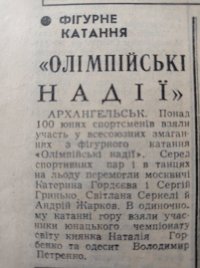
OLYMPIC HOPES

OLYMPIC HOPES

(the article published in Ukrainian 'Sportyvna Hazeta' on April 3, 1984)

ARKHANGELSK. More than 100 young athletes participated in the all-Union figure skating competitions "Olympic Hopes." Among the pairs and in ice dance, the winners were Muscovites Ekaterina Gordeeva and Sergei Grinkov, and Svetlana Serkeli and Andrei Zharkov. In the singles event, the top spots were taken by participants of the World Junior Championships: Natalia Gorbenko from Kyiv and Vladimir Petrenko from Odesa.
1770920112924.jpeg
 
1984
WORLD CHAMPIONSHIPS

Our special correspondent reports from Canada
THE CHARM OF THE GRAND BALL

(the article published in russian 'Sovetskiy Sport' on March 27, 1984)

“RUSSIAN FAIRGROUND” EARNS SILVER MEDALS FOR BESTEMIANOVA AND BUKIN

Frankly speaking, March 24th was a hot day for the ice dance duets concluding the World Championships in Ottawa. By 2 p.m., the Sports Palace was filled with thousands of spectators. But soon the lights went out in all the rooms. A faulty transformer substation caused a fire. No matter how hard the repairmen tried, the competition had to be postponed. The organizers moved the ice dancers' starts to 8 o'clock that evening.
Still, the "Grand Ball" in Ottawa was a success on Saturday. The ice dancers performed with inspiration and in one breath. Sophisticated costumes and hairstyles, original lifts and pirouettes—everything was thrown onto the scales of victory.
There were "hidden currents" in the tournament. The situation escalated to the limit, as the judging panel split: some gave second place to Natalya Bestemianova and Andrei Bukin, others to the Americans J. Blumberg and M. Seibert. Only the question of first place caused no disagreement. The Canadian press, the public, and ISU specialists spoke with respect about the Olympic champions J. Torvill and C. Dean. In Ottawa, two books about the creative journey of Englishmen were instantly sold out.
At the press conference, Natalya Bestemianova, speaking about her impressions, noted:
— Andrei and I are glad that for four years we competed with the beloved masters Torvill and Dean and learned from them. We will try to maintain their high level in ice dancing in the future. We will strive to update our arsenal. We have many plans, and while skating brings us joy and we enjoy our work and bring happiness to people, we will compete.
Christopher Dean emphasized in his interview:
— The rivals in the person of the best Soviet duet constantly stimulated our search, made us prepare with full commitment. Jane and I worked daily on compulsory dances for many hours, being aware that much of our success depends on them. In four years, we never allowed ourselves to relax and rest for even a month. Our path was not easy, and yet it is hard to part with big-time sports. It serves as a consolation that the last evening of the free dance in Ottawa turned out wonderful.
The competition of the strongest was opened by Natalia Bestemianova and Andrei Bukin. Their composition, titled 'Russian Fair', became famous this season and has been seen more than once. Yet in Ottawa, it felt like a revelation, especially against the backdrop of programs that almost entirely lacked folkloric elements. One cannot help but recall that a year ago (and very timely!) there were calls to use Russian national music more creatively. This call was heard by figure skaters and coaches alike. The most convincing example of a successful turn to folklore is the joyful dance of Natasha and Andrei.
Note that 14 scores of 6.0 and two scores of 5.9 clearly discouraged those who tried to challenge the lead of our duo. At the start, the USA champions Blumberg and Seibert were very nervous. For them, two obvious disruptions in the first half of the dance significantly cooled the skaters' impulse. And although some judges tried to place the Americans in second place, the attempt proved hopeless. The dance of Bestemianova and Bukin, for the third year in a row, was named silver!
M. Klimova and S. Ponomarenko stood out with their charm, coordination, and soft skating. The skill of our young duo was also rated very high: 5.7–5.8. What can I say, Klimova and Ponomarenko were very close to the bronze medal, losing to the Americans only by a small margin in the compulsory program.
The last start of Torvill and Dean (and they already stated they are moving to ice ballet), was awaited by everyone with great interest. Their “Bolero” once again proved that in conditions of sharp competition, only a bright artistic image can bring success. The English pair displayed an exceptionally romantic performance combined with remarkably virtuosic skating technique. With thirteen perfect scores of 6.0 and five scores of 5.9, they became World Champions for the fourth consecutive time.
Mexican melodies and a Spanish dance formed the composition for our third duo, E. Batanova and A. Soloviev. They had a long break in competitions: first the start at the match of the strongest in December, and now in March, the performance in Ottawa. But they endured this trial and maintained high athletic form, shining with temperament, technique, and high speed. In short, the dance was at the level of the top 5 strongest at the world championships.
Note that all three Soviet duets performed stably and confidently, thereby proving that their coaches chose the correct methodological course.
Here is what the honored coach of the USSR Tamara MOSKVINA says about the results of the championship in Ottawa:
— There is a logic of its own in the fact that our figure skaters won medals in all four disciplines, showcasing high-quality skating. In my opinion, the coaches of the USSR national team clearly identified the main trend of the season and created a fusion of high modern technique and artistry in contemporary programs. This was visible in the performances of the three ice dance pairs, the Olympic champions E. Valova and O. Vasiliev, their teammates L. Selezneva and O. Makarov, as well as in the programs of the singles skaters A. Kondrashova, A. Fadeev, and V. Kotin. They all demonstrated diverse skill and a variety of styles.
I will note that the spectators and judges today are widely erudite and technically knowledgeable, and therefore have become more demanding of the programs. This is exactly what the winners of the championship in Ottawa took into account.
Express commentary from Honored Coach of the USSR Tatiana TARASOVA:
Active mental work, imaginative thinking, and self-demandingness distinguish the leaders of the USSR national team today. This is especially evident in the example of Bestemianova and Bukin. While remaining athletes, they simultaneously act as coaches, since they do not learn everything mechanically but try to deeply understand each of their movements.
Referee in women's single skating Jozef DĚDIČ (Czechoslovakia):
The championship in Ottawa pleased us with progressive figure skating, and we owe this primarily to the magnificent compositions performed by the silver medalist Anna Kondrashova. She proved that an athlete can perfectly combine movements with music, inhabit an image, and create a truly moving spectacle. I think this trend will develop based on high technique in other disciplines of figure skating as well.
Thus, the conclusion of the current season has proved to be highly successful for Soviet figure skaters. Next year at the World Championships in Tokyo, our national team will be represented in all four events by three entries. In other words, it will be the largest team.​

A. SHELUKHIN.
OTTAWA, March 26.
TECHNICAL RESULTS
World Figure Skating Championships. Ottawa. March 24.
Ice Dance. Overall Standing. 1. J. Torvill and C. Dean (Great Britain) — 2.0; 2. N. Bestemianova and A. Bukin (USSR) — 4.4; 3. J. Blumberg and M. Seibert (USA) — 5.6; 4. M. Klimova and S. Ponomarenko (USSR) — 8.0; 5. K. Barber and N. Slater (Great Britain) — 10.0; 6. T. Wilson and R. McCall (Canada) — 12.8; 7. E. Batanova and A. Soloviev (USSR) — 14.0; 8. С. Fox and R. Dalley (USA) — 14.2; 9. P. Born and R. Schönborn (FRG) — 18.0; 10. E. Spitz and S. Gregory (USA) — 20.4.
View attachment 10887
Even then, Tamara Moskvina was mentioning fans becoming more demanding. I wonder what she thinks of the online trolls of today!
 
1984
USSR CHAMPIONSHIPS

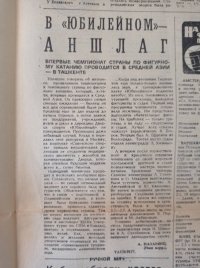
FULL HOUSE AT "YUBILEYNY"

(the article published in russian 'Sovetskiy Sport' on April 6, 1984)

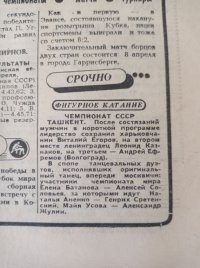
FOR THE FIRST TIME, THE NATIONAL FIGURE SKATING CHAMPIONSHIP IS HELD IN CENTRAL ASIA — IN TASHKENT

It is unnecessary to mention the interest shown by Tashkent residents in the national figure skating championship, which, by the way, is being held in Central Asia for the first time. It surpassed the boldest expectations: tickets for all days of the competition were sold out two weeks before the tournament began, and the flow of requests from enterprises, institutions, universities, and schools to the management of the "Yubileyny" Palace of Sports does not stop. There was even a funny incident. While I was transmitting this report to Moscow, an impressive delegation of students from a medical institute arrived at the "Soviet Sport" regional office with a complaint against the Palace administration, which refused the future doctors a mere... hundred tickets.
The current championship is taking place at a somewhat unusual time. You must agree that the beginning of April is not the most optimal time for a figure skaters' ice ball. This is explained by the fact that due to preparations for the Olympic Games, which drew primary attention, the dates for the national championship had to be shifted. Nevertheless, despite the absence of several leading skaters (they are currently on a tour of the USA and Canada), the interest in the competitions, I repeat, is great. Apparently, the desire of young athletes to distinguish themselves in the last competitions of a difficult, packed Olympic year is also great.
...When dawn was only just breaking over spring Tashkent, a bus rolled up to the training rink of "Yubileyny." Figure skaters and judges stepped out, shivering from the morning chill. Men opened the first discipline. They were to perform compulsory figures. There are only coaches in the stands, while athletes and judges are on the ice. V. Egorov from Kharkiv performed the "school" [compulsory figures] best of all. A. Efremov from Volgograd was second. The judges gave third place to L. Kaznakov from Leningrad.
In the evening, after the solemn and colorful opening of the championship, pair skating masters introduced the spectators and judges to their short program. Bronze medalists of Sarajevo, Leningraders L. Selezneva and O. Makarov, were forced to yield the lead to A. Avstriyskaya and Yu. Kvashnin. During the performance of a double loop, Selezneva made a mistake. Overall, scores for technical merit and artistic impression were within the range of 5.5–5.7. Third place went to the capital's Dynamo members V. Pershina and M. Akbarov.
A Tashkent pair, I. Shishova and A. Suleymanov, made a successful debut at such a prestigious tournament. They currently hold the twelfth spot.​
A. NAZARYANTS (Our corr.).
TASHKENT.
1770921359412.jpeg
URGENT…

USSR CHAMPIONSHIP

(the article published in russian 'Sovetskiy Sport' on April 6, 1984)

TASHKENT. After the men's short program competition, Vitaly Egorov from Kharkiv maintained his lead. In second place is Leningrader Leonid Kaznakov, and in third is Andrei Efremov (Volgograd).
In the ice dance competition, following the original dance, Muscovites are in the lead: World Championship participants Elena Batanova and Alexei Soloviev, followed by Natalia Annenko and Genrikh Sretensky, and Maya Usova and Alexander Zhulin.
1770922329345.jpeg
 
Last edited:
Back
Top