Archive of newspaper articles | Page 2 | Golden Skate

Archive of newspaper articles

1979
Prize of Moscow News

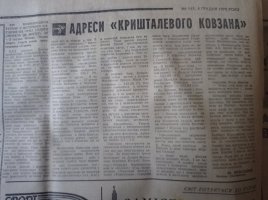
ADDRESSES OF THE "CRYSTAL SKATE"

(the article published in Ukrainian 'Sportyvna Hazeta' on December 4, 1979)

XIV INTERNATIONAL FIGURE SKATING TOURNAMENT FOR THE PRIZE OF THE NEWSPAPER "NOUVELLE DE MOSCOU". November 28 - December 2. Moscow. Palace of Sports. Representatives of 13 countries took part.
The BALL is over. The spotlights have gone out. The venue has emptied. The fans have left it, full of impressions. After all, so many new programs have been released in five days! It seems that the members of the coaching council are also satisfied: two months before the Olympic exam, most of the candidates for the national team have shown good readiness.
The complete change of winners does not explain much here. It's just that Kovalev, Rodnina - Zaitsev, Cherkasova - Shakhrai, and some others, polishing literally every detail, are in no hurry to present unfinished works to the audience. They limited themselves to performances in the short program, where the rough work is already behind them. After the pairs competition, the girls raffled off a crystal vase topped with a skate (what's not Cinderella's fabulous boot?). According to Stanislav Zhuk, our positions on the world stage have not changed for the better. Elena Vodorezova is sick, Kira Ivanova still feels unsure about performing the compulsory exercises, and Natalia Strelkova seems to be afraid of triple jumps.
After school and the short program, Strelkova was in the lead, but several falls during the free skating tipped the scales in favor of her younger rival. Ivanova, who skated next, boldly performed extremely difficult elements, demonstrating excellent physical fitness. The judges rightly awarded more modest points for artistry, but in total it turned out to be unattainable - 105.7 (9). Strelkova is second. And on the third step - 17-year-old Renata Baierova from Czechoslovakia, the only foreign athlete who managed to make a worthy competition to the hosts. She is a real discovery of the tournament. Zhuk, who saw the skater six months ago, is frankly surprised by her progress. Leaping, flexible Renata has an accurate feel for music, and thanks to her high technique, she easily performs complex figures. The student of the famous Czechoslovak athlete Karol Divin will perform in Lake Placid. It is not yet clear who among our girls will meet Renata there.
Vladimir Kovalev has long been famous for performing compulsory exercises. Now he has simply surpassed himself and immediately gained such an advantage over his rivals that even a failure of one or two elements in the short program would not affect the balance of forces. But Kovalev was at his best in the short program. Such an early high form somewhat alarmed the world champion, and he, as the reader already knows, refused to continue fighting. The same was done by Kharkiv resident Vitaliy Egorov, who is preparing for the world junior championship according to an individual plan.
And Igor Bobrin, who is now coached by Yuri Ovchinnikov together with Igor Moskvin, won - 143.50 (7). He made a lot of mistakes in the new version of the free program. However, this is not surprising - the first performance. But what we were once again convinced of is Bobrin's enormous acting talent. The image, created to the music of the rock opera by organist Rick Wakeman, contained many discoveries and unexpected continuations. Creative communication with Ovchinnikov diversified the skater's palette of expressive means. The judges gave him a score of 5.7-5.8 for artistry.
The dancers' competition traditionally brought together a full hall during the compulsory performances. In the absence of Irina Moiseeva and Andrey Minenkov, the advantage of Natalia Linichuk and Gennady Karponosov was already indisputable in "Kilian". "Star Waltz" and tango "Romance", created by Lyudmila Pakhomova and Alexandr Gorshkov, consolidated the success of the world champions. But they did not give themselves a break and continued the tournament with full dedication. As a result, Natalia and Gennady were ahead of their closest rivals by almost 8 points. Their total is 160.48 (7). Natalia Bestemianova - Andriy Bukin - 152.90 (17). Dnipropetrovsk Natalia Karamysheva and Rostislav Sinitsyn took third place - 152.64 (18).
As you can see, Natalia and Rostislav lost only one vote to the silver medalists. It's a shame, because after the school dances and the original composition, they were in second place. It is characteristic that the judges from England and Canada leaned in their favor even after the finish, but most of the judges still liked the dance of Bestemyanova and Bukin to russian and gypsy melodies.
The eloquent testimony of the skill of our dancers was given by the former world champion B. Ford, who came to Moscow as the coach of the Canadian team:
- Your couples took six first places. And this is natural. I brought here the third and fourth prize winners of the Canadian championship, but I believe that even the champions would not have been able to push any Soviet duet. I, in particular, really liked Olga Volozhinskaya, who skates with Alexandr Svinin. But sixth place is unlikely to allow them to enter the international arena in the near future. It is very unfortunate that there are strict restrictions. The Soviet team could quite easily have fielded two squads in this discipline for any championship.
Ford finished with a joke:
- So, for now, all we have to do is study and… win beauty contests.
The last remark of the famous figure skater requires explanation. At the Nouvelle de Moscou competitions, the journalistic jury traditionally chooses the “Miss of the Tournament". There have already been six such contests, and three times Canadians have won. In 1974 and 1975, journalists recognized Barbara Berezovska as the most charming participant, and now her compatriot Gina Aucoin, who performed in dances with Hans Peter Ponikau and took eighth place, has been named the number one beauty. Of course, this did not upset her, because for a woman no medal can replace male recognition.
Y. YAROSLAVOV.
Moscow (by phone)
1752398217921.jpeg
 
1979
FIGURE SKATING:

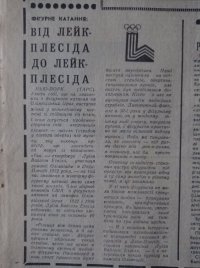
FROM LAKE PLACID TO LAKE PLACID

(the article published in Ukrainian 'Sportyvna Hazeta' on December 6, 1979)

NEW YORK. (TASS). Imagine that in the figure skating competition at the Olympic Games, a woman is performing in a velvet suit with a knee-length skirt, and she is preparing to demonstrate her "crown" element - an axel (a one-and-a-half-turn jump) to the music performed by an orchestra located next to the rink.
“Yes,” says Louise Weigel Atwill, a participant in the 1932 Lake Placid Winter Olympics, “that’s what women’s figure skating looked like at that time.” A member of the U.S. figure skating team at the 1932 and 1936 Winter Olympics, Louise Weigel Atwill notes how much it has changed in the past 40 years.
"The difference between these two levels is huge, I would even say that figure skating has made such a leap that no skater has yet in their technical arsenal. First of all, a lot of acrobatics has been introduced into our sport. Our performances were judged on the basis of jumps, spins, dance steps, but the axel was the greatest achievement. None of us even did double jumps. It's an amazing fact, but in the 1930s, figure skating, like no other sport, was dominated by routine, and skaters had practically no free choice of music... If we had danced like we do today - to disco or rock 'n' roll rhythms, I'm sure we would have been simply asked off the ice.
The main difficulty was the performance of the skaters to the orchestra: it performed the same melody at different tempos, which was annoying.
In those days, skaters also did not have the opportunity to train every day - there were no skating rinks or qualified coaches. As a rule, athletes trained only three to four times a week for three hours each day.
"I watched the pre-Olympic international figure skating competition in Lake Placid with great interest," Louise Weigel Atwill said at the end, "and I am looking forward to the tournament at the Winter Olympics."
1752400920773.jpeg
 
Last edited:
1979
CANDIDATE MINIMUM AND PROGRAM MAXIMUM

(the article published in Ukrainian 'Sportyvna Hazeta' on December 8, 1979)

AFTER THE FIRST ICE TEST OF SOVIET FIGURE SKATERS
ON THE DAY before the international tournament for the prizes of the newspaper "Nouvelle de Moscou", the candidates for the USSR national team met with the public of the capital at the Palace of Culture of the Moscow Automobile Plant named after Lenin Komsomol AZLK. They were greeted by Hero of the Soviet Union Colonel-General I. Kuzovkov, Hero of Socialist Labor T. Fedorova, Secretary of the Central Committee of the Komsomol D. Okhromiy, and AZLK fitter I. Lavrukhin. On behalf of the athletes, the solemn Olympic oath was pronounced by multiple world champion Irina Rodnina. Deputy Chairman of the USSR Sports Committee V. Igumenov presented a large group of skaters with candidate certificates and badges, wishing them golden patterns on the ice.
AND THE FIRST ROUND OF SELECTION IS OVER. 30 out of 35 applicants for 16 Olympic tickets took part in it. Elena Vodorezova, as well as the partners in the pairs of dancers Moiseeva - Minenkov, Durasova - Ponomarenko fell ill and will prove their right to a place in the team at the end of December in Leningrad. Let's walk through the cars of a conventional train, the destination station of which is Lake Placid. Let's see how everyone feels there ...
Pair skating. It has already been written that Rodnina and Zaitsev started as if there was no missed season. In an interview with an APN correspondent, Irina said that she was satisfied with the performance in Moscow and that she and Alexandr performed the minimum program. Now it's time to polish a new free composition. The champions, of course, could limit themselves to the already known option. After all, it is quite complex and has the most stringent requirements. But Rodnina and Zaitsev do not want to live with old baggage. They believe in the inexhaustibility of their creative potential and experiment in a situation where their very return to the ice is already a discovery!
After the competition, the coaching staff members particularly emphasized the athletes' resilience and confidence. Even in demonstration performances, where participants usually skip the most difficult elements, Rodnina and Zaitsev performed all the twists and a double-turn jump. But the famous couple's closest competitors lacked the stamina. Vorobyova and Lisovsky clearly performed a triple salchow in the warm-up before the free composition, but messed it up in the program. Cherkasova and Shakhrai made a mistake in the joint "swallow" rotation, although in training with their eyes closed they perform much more complex elements accurately and simultaneously. They brilliantly proved this on the final day, when together with Pestova and Leonovich, the four of them demonstrated a unique show dance “The Gemini Constellation.” The amazing synchronicity in the actions of the foursome testifies to the great potential of all their participants and to the tirelessness and extraordinary nature of Stanislav Zhuk’s searches. The coach, however, as colleagues believe, should urgently pay attention to the psychological preparation of his charges.
Ladies. If in other categories we can field three “combat units”, here – only one. Frankly, in the absence of Vodorezova, the other candidates have vague prospects for now. Strelkova and Ignatova are primarily let down by poor discipline and inability to hold weight. Ivanova, on the other hand, gives her rivals too much of a head start in school exercises, which was confirmed during the pre-Olympic week in Lake Placid, where she performed in September of this year. Ivanova came closest to Vodorezova in mastering complex elements. However, even the new versions of her program lack harmony in composition. The stability of the jumps also does not stand up to criticism. These are the main remarks of Stanislav Zhuk, addressed to the girls who currently make up the "candidate minimum."
At the concert dedicated to the finish of the competition, 10-year-old Irina Klimova from the CSKA school made her first appearance on stage in front of an audience. The girl impressed the experts with her flexibility, jumping skills and at the same time lyricism. It is noteworthy that Irina is studying with Galina Alekseeva, who at one time also found Vodorezova ... Let's be optimistic and remember the name of the newcomer. Suddenly it will come in handy!
Men. Although Kovalev did not show the updated (two parts out of four have been replaced) free program, experts are unanimous: Vladimir is ready to perform maximum tasks. He has always surpassed his competitors in the "clean" of school figures, and now he has not increased this distance only because the pursuers have moved forward. Leningraders Bobrin, Kotin, and Kharkiv resident Egorov began to draw figures more clearly and at a better speed than before. True, their speed fades towards the end, but Kovalev manages to maintain it, hence the better geometry of circles and arcs. However, there is a serious justification for Egorov. Since the Kharkiv native is still a junior, he rarely practices figures from the senior program. Therefore, his skating attempt in such a well-known company (fourth place) should be considered successful. In the short program, despite the inclusion of new elements (for example, the combination of jumps is now crowned with a loop), our leading masters skated freely. It felt like performing each of the six compulsory elements was not a problem for them and they could focus on revealing the character of the composition, conveying the music and choreography to the audience at once - this is the conclusion of the honored USSR coach Viktor Kudryavtsev.
Egorov retained fourth place after the second day, and in the final event of the triathlon, like Kovalev, he did not compete. It was there that even future medalists made the most mistakes. But if Bobrin and Kotin eventually managed to overcome their nerves, then Muscovite Raschotnov once again confirmed the truth well-learned by our football players: there is a huge distance between friendly meetings (for figure skaters, demonstration performances) and official meetings (mandatory performances), and without the ability to give your all always and everywhere, it cannot be overcome.
Dances. The influence of Linichuk and Karponosov's art on the development of the sport as a whole is evidenced at least by the fact that every second duet dances to disco music (their program from the year before last), and now many have rock-n-roll (last year's opening of the champions) in their repertoire. However, Natalia and Gennady probably decided to perform all the dances in the world during their sports career. They never keep their free programs for more than a season, they are insatiable. As for the show numbers, Irina Moiseeva in the press box tried in vain to guess what dance the champions would present to the audience even during their fifth (!) call to the ice. No one in the world can boast such an enviable repertoire. And Natalia and Gennady, as true pioneers and trendsetters, offered another novelty in the Olympic season - slow and fast fragments of a composition with banjo - in the style of "country" music.
According to the ex-world champion of England, Bernard Ford, our other couples participating in the tournament also have a high musical culture and the ability to play the image. Thus, the Dnipropetrovsk dancers Natalia Karamysheva and Rostislav Sinitsyn showed a program created by, in addition to coach Tatyana Rozhina, the ballet masters of the Shevchenko Kyiv Academic Opera and Ballet Theatre and the State Symphony Orchestra of the Ukrainian SSR. The creative communication turned out to be fruitful. The magnificent production combined with the fine technique of the performers ensured the recognition of both the judges and the audience. It would be fair if the audience at the Olympic Lake Placid saw this dance to the music from the movie "Serenade of the Sun Valley".
G. KUZMIN.
1752414770749.jpeg
 
1979
Amber Skates

FIGURE SKATING

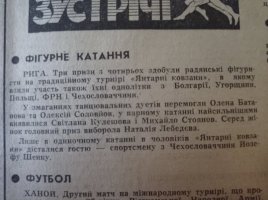
(the article published in Ukrainian 'Sportyvna Hazeta' on December 22, 1979)

RIGA. Three out of four prizes were won by Soviet figure skaters at the traditional tournament "Amber Skates", in which their peers from Bulgaria, Hungary, Poland, West Germany and Czechoslovakia also took part.

Elena Batanova and Alexey Solovyov won the ice dance competition, while Svetlana Kuleshova and Mikhail Stoyanov were the strongest in pairs. Among women, the main prize was won by Natalia Lebedeva.
Only in men's single skating did the "Amber Skates" go to a guest - an athlete from Czechoslovakia, Josef Schenk.
1752504169978.jpeg
 
1979
MATCH OF THE STRONGEST FIGURE SKATERS OF THE USSR

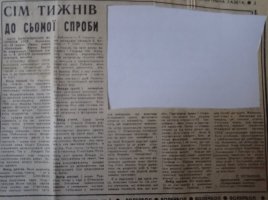
SEVEN WEEKS UNTIL THE SEVENTH ATTEMPT

(the article published in Ukrainian 'Sportyvna Hazeta' on December 27, 1979)

MATCH OF THE STRONGEST FIGURE SKATERS OF THE USSR. Leningrad. December 25-29. Palace of Sports "Yubileiny". 86 athletes participate. Referee - V. ANOKHIN (international category - Moscow).
IN THE WALL NEWSPAPER OF THE USSR team, released on the eve of the match, it is written: "Olympian! Seven weeks until the Games-80! Are you ready for a victorious exit to the ice?"
Exit one. Halfway from the hotel where the participants are staying to the Sports Palace, the Leningraders show the guests the Admiralty Garden: it was here that Nikolai Panin-Kolomenkin prepared for his Olympic debut in 1908 on a tiny skating rink. The skaters then drew individual figures. Moreover, they presented sketches of future drawings to the judges in advance, and during the competition they had to accurately embody their plans on the ice. Panin-Kolomenkin wielded a skate like a brush. Seeing his impeccable drawing, some of his rivals, including the famous Swede Ulrich Salchhov, refused to demonstrate their handwriting. So in London Panin-Kolomenkin became the first russian to be awarded an Olympic gold medal.
The second exit. It had to be waited for more than half a century. And now in the American Squaw-Valley, our sports couple Nina and Stanislav Zhuk took second place. It is interesting that Stanislav Zhuk believes that the current world champions T. Babilonia - R. Gardner are very similar to the Canadians B. Wagner - R. Paul - the triumphants of Games-60. In his opinion, Babilonia and Gardner also prefer spectacle, as if they are preparing themselves in advance for performances in a professional ballet troupe. They do everything beautifully, dynamically, but according to Zhuk, they have too few paired elements and absolutely no ultra-c to shake our Olympic authority in this event.
The third and fourth exits. They were crowned with gold awards. The rinks of Innsbruck and Grenoble were dominated by fans of artistry. However, Stanislav Zhuk was already preparing a pair, the appearance of which marked a new direction in figure skating ...
The fifth exit. It was Irina Rodnina and Alexei Ulanov who opened the world to cascades of jumps, the most complex sequences of steps, lifts on one hand. They performed new moves so quickly that it was as if they were on a regular floor, not ice. Meanwhile, that was one of Stanislav Zhuk's secrets. His students trained much more on the ground than others. There they honed complex elements to automatism, which made it easier for them to learn on the ice.
The sixth exit. And again Rodnina, now paired with Alexandr Zaitsev, returned home with the main awards. Having absorbed in their performances all the best that is characteristic of the domestic school of figure skating - speed, a tendency to extremely complex elements, a clear composition of programs, Irina and Alexandr captivated the world with brilliant technique. No one can perform a spin or a parallel jump so synchronously and at such a close distance from each other (and this is very appreciated). No one, except for Marina Cherkasova and Sergey Shakhrai, is able to sustain a frantic pace for five minutes. No one allows themselves to update their program so decisively every season in pair skating.
Champions have another trait that is unique to them. It is the calmness of virtuosos who are confident that they will always show everything they can. Remember, Irina and Alexandr performed without music at the 1975 World Championships. They performed even when one of their partners was unwell. Now they have returned to the ice after a year's break. For others, it would have been extremely difficult. Their place as the flagships remained unoccupied. And not because the pursuers were embarrassed. It's just that our famous duet appeared in an updated quality. Several new lifts, different musical design - just details. The main thing is greater expressiveness and plasticity, which can be achieved at high speed, for example, a short program, or the technical versatility of the free skate - a great art.
The seventh exit. It will take place in seven weeks in distant Lake Placid. Rodnina and Zaitsev are ready for it. The control start in Leningrad confirmed this to the fullest extent. The participants knew that for the sake of future victories, the leadership of the USSR Figure Skating Federation suggested that the judges be especially meticulous and unforgiving towards the contenders. Perhaps this influenced the young ones. Shakhrai fell, Vorobyova and Lisovsky and Pestova and Leonovich made several mistakes. The champions did not falter. They skated widely and freely and earned maximum points. Six 6.0 marks are the best pre-Olympic certification.
G. Kuzmin, special correspondent of Sportyvna Hazeta
Leningrad (by phone)
1752519414676.jpeg
 
1979
MATCH OF THE STRONGEST FIGURE SKATERS OF THE USSR

COMPARISON IN WHOSE FAVOR?

(the article published in Ukrainian 'Sportyvna Hazeta' on December 29, 1979)

MATCH OF THE STRONGEST FIGURE SKATERS OF THE USSR. Leningrad. December 25-29. Palace of Sports "Yubileiny". 86 athletes participate. Referee - V. ANOKHIN (international category - Moscow).
Even such a seemingly conservative sport as figure skating was hit by a wave of reforms a few years ago. The proportion of school exercises in the final result was noticeably reduced, short programs were introduced, where participants perform six mandatory elements in any order. The dancers developed an original dance.
However, this did not calm the supporters of the changes. More and more often, voices began to be heard against the "school" in general. They said that it did not attract spectators and did not enrich the skaters, and it would be better if the athletes concentrated all their strength on developing their imagination in free compositions, and left the drawing of cumpolsory figures, which are indispensable when learning technical innovations, behind the scenes. The main argument is this: figure skating is the most harmonious synthesis of sport and art and it is a sin to keep it within rigid limits…
Several trial tournaments have already been held with the “school” canceled, and the participants themselves protested, the referees got nervous. Performing identical elements allowed for comparison and an accurate idea of the skater's technical capabilities, stability, and versatility. In a free program, an athlete could mask weaknesses by emphasizing their strengths. And although it also has certain requirements, objectively judging who is who based on a piece on an arbitrary theme is quite a difficult problem. One judge, for example, prefers the classical style, another prefers the grotesque. What to do here! The following come to the rescue: dictation - mandatory exercises and "recitation" - a short program or an original dance. In addition, a loser in any exercise under the three-round system still has hope of winning in others, which guarantees a new plot every time.
So, let's come to the competition in the morning, when the dancers demonstrate the variations of the "star waltz" and foxtrot, and we will start comparing. We will be helped by the honored coach of the Russian Federation, one of the mentors of the national team (dance team) Natalia Dubova:
- As in the kilian, in the tango and waltz, the judges unanimously placed Natalia Karamysheva and Rostislav Sinitsyn on the third Olympic step. Their main rivals, Natalia Bestemyanova and Andrey Bukin, again lost by almost a point.
What is the advantage of Dnipropetrovsk skaters? First of all - in the staging of numbers, each of which has its own zest. Yes, in the waltz Karamysheva flirts, but the solemnity of the moment, the atmosphere of the ball restrain her feelings. The coldness of beauty, the inaccessibility of manners - everything she has from the waltz, but her eyes, hands seem to whisper to her partner: I can be different - impudent, hot-tempered and frivolous. This is how Karamysheva appears in the foxtrot, where her high skating technique allows her to maintain the pace in all three series of the dance. Moreover, the partner is not limited to the role of an extra; in each individual case, he leads his party, either as a ballroom regular in the waltz or as a happy lover in the foxtrot. In this component, Rostislav approaches world champion Gennady Karponosov, who never remains just a shadow of the charming lady Natalia Linichuk ...
And the other candidates for a trip to Lake Placid - Bestemyanova and Bukin? They are suited to sharply characteristic, emotional dances, but the classics are clearly not up to the task. In a free composition, this is hardly noticeable, but in a waltz, you can't hide it. Bestemyanova knows how to captivate the audience. However, insufficient school training leads to the fact that she performs dances that are completely different in nature in a similar expressive manner. The judges rightly lower the score for such reprises. I think it would be natural if Karamysheva and Sinitsyn remain third after the free program, - summed up N. Dubova.
And ahead were Linichuk - Karponosov and Moiseeva - Minenkov. If the world champions flawlessly conducted the dress rehearsal of the season, then Andriy and Irina made mistakes. The break in training due to the partner's illness is noticeable. The results of the performances of sports couples also speak about the benefit of comparisons. Experience and the ability to please the public could not replace the clear triple jumps of Irina Vorobyova and L. Lysovsky, which were demonstrated by the young Marina Pestova and Stanislav Leonovich. They, along with Irina Rodnina - Alexandr Zaitsev and Marina Cherkasova - Sergey Shakhrai - are our most likely Olympians in this event.
The vacancies in the men's category are also filled. Vladimir Kovalev - 193.08 (9), Igor Bobrin - 188.32 (18), Konstantin Kokora - 182.84 (27) significantly outperform other contenders. Though it’s true, none of them avoided a failure.
G. KUZMIN, special correspondent of "Sportyvna Hazeta"
Leningrad (by phone)
1752590652344.jpeg
 
1980
European Figure Skating Championships

ROSES AND THORNS ON ICE

(the article published in Ukrainian 'Sportyvna Hazeta' on January 29, 1980)

TO THE RESULTS OF THE EUROPEAN FIGURE SKATING CHAMPIONSHIPS
TASS REPORT. All sets of awards of the 70th continental championship were played in Gothenburg (Sweden). The champions in ice dancing were Soviet athletes Natalya Linichuk and Gennady Karponosov - 205.50 (11). Silver medals went to Hungarian representatives Kristina Regoesczy and András Sállay - 199.98 (25), bronze to our Irina Moiseeva and Andrey Minenkov - 200.62 (25). Natalia Bestemyanova and Andrey Bukin were limited to sixth place - 189.52 (54).
Among the women, Anett Poetszch (GDR) had no equal, winning the highest title for the fourth time in a row – 187.84 (9). Dagmar Lurz (FRG) and Susanna Driano (Italy) took the next places. Kira Ivanova (USSR) was eleventh – 165.96 (99).

COMMENTARY OF "SH":
THE MASTERS of dance have three exits to the ice and three tasks. Mandatory exercises are a test of technique, where you can most accurately compare rivals with different styles and tastes. An original dance is a fantasy on a given theme, limited by the nature of the movements and music. And, finally, a free composition is a calling card of all the best that a couple can do.
The viewer, as a rule, sees only the final result. And draws conclusions from it. Perhaps that is why the viewer is surprised by some of the ratings. But it should be taken into account that the judges already have an accurate idea of the technical capabilities of the participants, and you will not convince them with a beautiful production, popular music, original costumes. You need powerful means.
In Gothenburg, Linichuk and Karponosov once again demonstrated a technique close to exemplary in performing the compulsory dances, and their foxtrot is a ready-made exhibition number. According to Lyudmila Pakhomova's first teacher, Viktor Ryzhkin, this original dance is full of new elements. However, the partners are so proficient in them that all our attention is focused on the nature of the relationship between their characters (in this case, obviously, old friends, between whom a conflict arose ...).
Foxtrot provided Natalia and Gennady with three points of advantage. But the dispute over other places was to be resolved by the evening of free programs. As is customary, the outsiders begin. And it became obvious what influence the Soviet school of ice dances had on them. This was felt primarily in the selection of music, in the attempt to resolve each of the four fragments as an independent, logically completed novella. Some lacked technique, others lacked artistic taste... The champions of England and Czechoslovakia, close to the podium, had many complex elements and lifts. And these programs are somewhat colorful, created on the basis of different dances. It seems that their choreographers and trainers lack the imagination to saturate each fragment with dance steps of the same character.
And how can we not be happy for our athletes. They have no foreign elements in the fabric of the dance. They dance. All three of our duets do it differently. This is not liked by such referees as the Englishwoman Pamela Davis-White. Once, when the English dance school prevailed, she herself was the European champion. However, those times are long forgotten… With this victory, Linichuk and Karponosov have broken the record set in the 1950s, when the English won ten consecutive times at such competitions. Now, Soviet athletes have 11 such triumphs.
Ms. Davis-White is perhaps also furious because our skaters are not training at her private rink, which she declared a "champion factory" and in which she was very mistaken. The 5.5 marks for technique and artistry, the third places that Davis placed our champions in - a challenge to the atmosphere of objectivity and nobility, which the leaders of the International Skating Union advocate in words. Even Swedish newspapers criticized the gallant lady. Officials seemed to have taken it in their mouths.
Meanwhile, Davis, who was eager not to give "her" first place to the representatives of the USSR, deprived our Moiseeva and Minenkov of the "silver". And Irina and Andrey scored enough points, and stood high in terms of the total number of places, and most importantly, they managed to complicate the technical part of the new program without betraying their expressive-romantic style.
Sixth place can hardly satisfy Bastemyanova and Bukin. After all, in the fall this couple prevailed over their rivals, who have now become higher. And the matter is not in the accidental fall of the partner. The athletes, especially Bestemyanova, abuse the parody style. What was attractive in the previous program to Chaplin's music is alarming in the new one - to russian and gypsy melodies.
So, our skaters won two gold, one silver and three bronze medals in Gothenburg. They also have fourth (Bobrin) and sixth places. This is 35 points according to the Olympic scoring system. Such an amount in Lake Placid would be quite enough to win the event in the unofficial team standings. However, there is no reason to calm down. Due to the competition of overseas masters, it will be much more difficult for our compatriots to win medals in pair skating and in the men's competition. It is already clear that Kokora and the pair of Bestemyanova - Bukin are unlikely to make it to the top six. So, shouldn't we send other, more promising masters to the Games in these categories? After all, the domestic school of figure skating is so rich in them.
G. KUZMIN
1752653138987.jpeg
 
1980
THEY - TO MAKE US HAPPY!

(the article published in Ukrainian 'Sportyvna Hazeta' on January 29, 1980)

TODAY, there is probably no more popular sport in our country than figure skating. And if earlier the spheres of influence were clearly divided - boys preferred football and hockey, and girls gravitated towards figure skating, now boys, before putting on their skates, think for a long time about which ones: hockey or figure skating.
Sociologists quickly identified the reasons for the boom. The first was television. And the second and no less important was the growth of the skill of Soviet skaters. After a modest Olympic debut in 1960 (0 points), they already took second place in the unofficial team standings in 1964 and 1968, and in 1972 and 1976 they were first. In the period between Innsbruck and Lake Placid, the leading positions were maintained. It is worth recalling that last year at the World Championships in Vienna, the USSR representatives won 2 gold medals (out of 4 possible), a silver medal and a bronze medal, and at the European Championships-80 in Gothenburg these figures were as follows: 2-1-3.
In a fortnight, our eyes will be fixed on the Olympic rink in Lake Placid. There, the fate of four sets of medals will be decided, medals that are more expensive than anything in the world of sports! Thirty-four male and female figure skaters represented our country at the previous Games. They brought home a total of five gold and five silver medals. And although no one is going to give them new titles without a fight, we are sure: there will be awards!
Who exactly should definitely please us?
1. Irina RODNINA and Alexandr ZAYTSEV
(pair skating)
FACTS. Irina Rodnina.
Honored Master of Sports. Born on September 12, 1949 in Moscow. Height - 152 cm. Weight - 46 kg. Higher education. Teacher. Member of the Central Sports Club of the Army (Moscow). Has been engaged in figure skating since 1958. Has been a member of the USSR national team since 1967. Ten-time European and world champion (1969-1978). Champion of the Olympic Games in 1972 (paired with A. Ulanov) and 1976 (together with A. Zaitsev). Coaches - S. A. Zhuk (until 1975) and T. A. Tarasova. Awarded the Order of Lenin.
Alexandr Zaitsev. Honored Master of Sports. Born in 1952 in Leningrad. Height - 178 cm. Weight - 69 kg. Higher education. Military serviceman. Member of the Central Sports Club of the Army (Moscow). Has been engaged in figure skating since 1960. Has been a member of the USSR national team since 1972. Six-time European and world champion (1973-1978). Champion of the 1976 Olympic Games. Coaches - S. A. Zhuk (until 1975) and T. A. Tarasova. Awarded the Order of the Red Banner of Labor.
Emotions. Irina and Alexandr Zaitsev. Our love and glory. Their winged flight is familiar to us in every detail and is eternally new - the embodiment of storm and pressure. It takes our breath away when the blades of their skates play in a fiery whirlwind, and when the melody of the dance becomes singing, and in the hands of the champions - the boundless Russian expanse and youthful courage. They are wise and uncompromising – towards others, and above all towards themselves. They are simple, they are charming, they are very close to our hearts, otherwise we would not love them so much.
Irina, who gave birth to her son Alexandr on February 23, has already taken to the ice on April 23. She is just as graceful and unstoppable. And she skates with the same courage and poise. And next to her on the ice is her closest friend - a man, a person who did everything to ensure that Irina returned to the big sport as soon as possible. Winning the European Championship-80 is a recognition that Rodnina and Zaitsev accomplished a feat.
2. Natalia LINICHUK and Gennady KARPONOSOV
(ice dancing)
FACTS.
Natalia Linichuk. Honored Master of Sports. Born on February 6, 1956 in Moscow. Height - 167 cm. Weight - 53 kg. Higher education. Teacher. Member of the Dynamo society (Moscow). Has been engaged in figure skating since 1965. Has been a member of the USSR national team since 1974. Participant of the Olympics-76 (fourth place). European Champion 1979 and 1980. World Champion 1978 and 1979. Coach - E. A. Tchaikovskaya.
Gennady Karponosov. Honored Master of Sports. Born on November 21, 1950 in Moscow. Height - 171 cm, weight - 65 kg. Higher education. Economist. Member of the Dynamo society (Moscow). Has been engaged in figure skating since 1959. Has been a member of the USSR national team since 1968. With Linichuk has been skating in pairs since 1972. Participant of the Olympics-76 (fourth place). European Champion 1979 and 1980. World Champion 1978 and 1979. Coach - E. A. Tchaikovskaya.
Emotions. Natalia Linichuk and Gennady Karponosov, like all skaters of a similar rank, have not just their own style, but their own motives, their own, if you will, role. The male partner is bravura and bright. His element is to command, he has a proud posture, and it seems that when he raises his heels, non-existent spurs ring on them...
Natalia on the ice is a flirtatious and at the same time modest beauty, obedient to the impulses of her partner. And you already believe that obeying is her fate, her element, when you notice the cunning in her eyes. And then you understand the secret: she is not so submissive, and the dance is just a duel, where she slowly, imperceptibly, but invariably wins.
3. Vladimir KOVALEV
(single skating)
FACTS.
Honored Master of Sports. Born on February 2, 1953 in Moscow. Height - 175 cm. Weight - 68 kg. Higher education. Teacher. Member of the Dynamo society. Has been engaged in figure skating since 1958. Has been a member of the USSR national team since 1969. Participant of the Olympics-72 (eighth place) and the Olympics-76 (silver medal). European Champion in 1975. World Champion in 1977 and 1979. Coach - E. A. Tchaikovskaya.
Emotions. Vladimir Kovalev can be impudent, arrogant, and angry in short, free, and show programs. He chops and slashes the ice with his skates like a saber, his movements are always on the verge of risk, and it seems that only risk can satisfy him, satiate his troubled soul...
At the same time, Kovalev is able to tame all his fiery temperament, all his unconventionality, when it comes time to draw the compulsory figures - "eights", "braces", "nooses". He is a recognized master of the "school", has many gold medals for it, although the moderation and accuracy necessary for ice calligraphy seem to be absolutely contraindicated for his ebullient nature. Seemingly uncoordinated and at the same time surprisingly courageous, emphatically cold towards the audience and at the same time a favorite of the public. Understandable to everyone in the dance and mysterious outside the arena even to his own coach... That's what he is, world champion Kovalev...
Our Olympic hopes in Lake Placid are not limited to the above-mentioned. These notes do not exhaust the creative characteristics of those we have introduced to the reader. February will come, and new touches will surely be able to be added to the portraits of the best Soviet figure skaters, and then we will try to continue the champion gallery.
Y. YAROSLAVOV.
1752737225427.jpeg
 
1980
Winter Olympic Games

SPARKS OF TALENT, EXPLOSIONS OF EMOTIONS ...
(the article published in Ukrainian 'Sportyvna Hazeta' on Febuary 23, 1980)
THE FIGURE SKATERS apparently decided to keep up with their Olympic neighbors in terms of the number of surprises and cooked up a "soup" on the ice of the Sports Palace in Lake Placid that is still being sipped. All the most reliable forecasts went awry. It is worth recalling that the world champions of 1979 did not bring their teams any points in two disciplines. The sports pair Babilonia-Gardner from the USA withdrew from the competition before the short program due to an injury to their male partner, and our Vladimir Kovalev caught a cold and covered his skates after performing "school" exercises.
Even dancers Linichuk and Karponosov, although they held their positions, experienced several dramatic minutes after Natalia's mistake, which was assessed too strictly by the judges. And only Rodnina - Zaitsev, like a rock in a blizzard, were unshakable. Neither the newspaper story, nor the fabrications of Babilonia – Gardner coach about mythical violations of the rules did not throw our athletes off balance! On the contrary, the victory of Rodnina and Zaitsev was so bright, their younger comrades Cherkasova - Shakhrai and Pestova - Leonovich skated so confidently, that Babilonia and Gardner announced their farewell to amateur sports ... Perhaps they will change their minds. However, experts believe that the psychological trauma of this pair is too severe for the athletes to recover and perform adequately in three weeks at the world championship in Dortmund (West Germany) ...
Our Igor Bobrin and Konstantin Kokora, left without a leader, courageously argued for honorable places, and in the end Bobrin made it to the top six, and Kokora closed the top ten. Kira Ivanova is doing much worse. Once again, she is let down by the compulsory figures, where Kira had only a seventeenth result.
Now - about the leaders. Kovalev's illness did not reduce the tension in the men's competition, where the European champion-80 from England Robin Cousins, the European champion-79 Jan Hoffman from the GDR and the world champion-78 the American Charles Tickner were almost equally claiming victory. Cousins, as usual, barely lagged behind after the "school". But he performed the short program with such brilliance that he received a 6.0 from one of the judges - an unprecedented phenomenon! And yet the gap between him and Hoffman, who was in the lead, was almost two points. This is more than it was a month ago in Gothenburg (Sweden) at the European Championships, when Robin managed to jump to the top step of the podium. How will it turn out now?
From the first bars of the music, the Englishman captivated the audience with his art. The artistry of the skating was so expressive and original that only technical errors could prevent Robin from getting the highest points. Cousins did not fail, showing the tenacity of a fighter and still outpaced his formidable competitor. Five out of nine judges gave him first place, which settled the matter.
Now Hoffman, who limited himself to a silver medal, must "be revenged on" by his compatriot Anett Poetszch, who is leading among women after the compulsory and short programs. However, Anett's advantage over the 1979 world champion, American Linda Fratianne, is not so significant as to feel safe ...
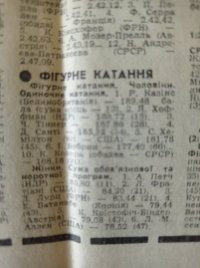
FIGURE SKATING
Figure Skating. Men. Single Skating.
1. R. Cousins (Great Britain) – 189.48 (total places - 13), 2. J. Hoffman (GDR) - 189.72 (15), 3. C. Tickner - 187.86 (28), 4. D. Santee – 185.52 (34), 5. C. Hamilton (all – USA) – 181.78, 6. I. Bobrin – 177.40 (66)… 10. K. Kokora (both – USSR) – 168.18 (91).
Women. Total of compulsory and short programs. 1. A. Poetszch (GDR) – 85.80 (11), 2. L. Fratianne (USA) – 84.20 (21), 3. D. Lurz (FRG) – 83.44 (21), 4. E. Watanabe (Japan) – 79.44 (43), 5. K. Kristofics-Binder (Austria) – 79.08 (43), 6. L.-M. Allen (USA) – 78.52 (47).
1752830290465.jpeg
1752830316976.jpeg
 
1980
USSR Figure Skating Cup

AXEL IS NOW DEAR
(the article published in russian 'Sovetskiy Sport' on March 1, 1980)
IZHEVSK, February 29. (By phone). Applause is heard in the local Sports Palace in honor of the winners of the USSR Cup in figure skating. In pair skating, the winners were Muscovites I. Volyanskaya and V. Spiridonov, students of coach G. Proskurin.
In this tournament, the Moscow sports pair competed with experienced masters from Sverdlovsk, Yu. Bystrova and M. Vazhenin. However, this time the advantage of I. Volyanskaya and V. Spiridonov was overwhelming. They performed the free program with particular success, which was decorated with a number of complex elements, including a 2.5-turn axel and a double lutz.
In the women's competition, the tone was set by N. Strelkova from Leningrad. She was the best in the "school". But in the performance of the short program, the greatest success was achieved by A. Fomicheva, representing the Moscow region. N. Avramova (Ukraine) also started the tournament successfully.​
The dancers also entered the fray. After two dances, N. Karamysheva and R. Sinitsyn (Ukraine) are in the lead, Muscovites E. Garanina and I. Zavozin, O. Volozhinskaya and A. Svinin.
In the men's tournament, V. Raschetnov (Moscow) confidently began the fray. He took first place in the compulsory exercises.
G. ALEKSEEV,
All-Union category judge.

TECHNICAL RESULTS
USSR Figure Skating Cup. Izhevsk, Sports Palace. February 28.
Pair skating.
1. I. Volyanskaya and V. Spiridonov (Moscow - 132.40 (9); 2. A. Malgina and S. Korovin (RSFSR) - 130.08 (18); 3. Yu. Bystrova and M. Vazhenin (RSFSR) - 124.50 (31).
1752833871351.jpeg
 
1980
World Figure Skating Championships
Special correspondent of "Sportyvna Hazeta" at the world figure skating championship, Georgy KUZMIN, reports:


FROM GOETHE'S OBJECTIVES TO THE TRIPLE JUMP

(the article published in Ukrainian 'Sportyvna Hazeta' on March 11, 1980)
SOMETIMES life gives the most unexpected discoveries. In the house-museum of Johann Wolfgang Goethe in Frankfurt am Main, Soviet coaches and journalists were shown a painting dated 1773, which belongs to the brush of Wilhelm von Kaulbach - a friend of the writer. In it, young Goethe, together with his mother and sister, dance on ... the ice of a winter lake, "with their feet shod with sharp iron"! So we got involved in figure skating, before we even reached the scene - Dortmund, where the world championship starts today.
Meanwhile, the plot of the picture is not accidental. It is known that Goethe was a versatile talented person: a writer, meteorologist, geologist, botanist, pioneer of Darwinism. Until recently, we almost did not know about his passion for ice skating. A new work by Czechoslovak researcher Ivan Mauer sheds light on this story.
Dr. Mauer's publication was prompted by a discovery in the Slovak city of Trnava, where archaeologists unearthed the oldest skate. According to scientists, it is five thousand years old. The skate was made of horse bone in the Stone Age, where such a tool was used to move across frozen bodies of water. For better movement, it was greased with fat, and for pushing, people used sticks, like today's ski poles.
Much later, when wooden skates appeared, the Dutch were the first (around 1300) to put a blade with edges into a wooden base. This made it possible to get rid of sticks. The Dutch were the first to use skates not only for transportation, but also for entertainment. Speed competitions were organized on holidays, which, one might say, laid the foundation for the sport of skating.
The next step was taken by the English. They switched to skates with iron blades later than others (around 1500), but they introduced a small but very important detail into their design - they bent the blade like a bow, which allowed them to not only run on skates, but also jump and even dance in them.
In the Middle Ages, it was a fashionable pastime at the courts of the rulers of many European countries, although it did not become as widespread as speed competitions. The first speed skates were brought to Russia from a European trip by Peter I. In the second half of the 18th century, educated Europeans paid increasing attention to the aesthetic possibilities of ice skating. This is especially felt in Germany, where Lessing, Goethe, the poet Klopstock themselves were fond of ice dancing, and were the first to promote it among women. Some scholars are inclined today to consider Goethe and his contemporaries the founders of figure skating ...
Perhaps this is too bold an assumption. But the fact that figure skating, especially at first, developed thanks to advanced, all-roundly gifted people is confirmed by facts from our history. It is enough to recall the first russian Olympic champion (1908), Nikolai Panin-Kolomenkin, who won a gold medal at the Summer Games in London for drawing complex patterns on ice (a modern "school"!). He also played football and tennis well, was an excellent rower and yachtsman, and was a 12-time national shooting champion. During Soviet rule, Panin-Kolomenkin taught at the Leningrad Institute of Physical Culture, defended his dissertation, published over 20 scientific papers, and at the age of 56 became the champion of the 1928 All-Union Spartakiad in pistol shooting...
And our current champions and coaches!? The erudition and breadth of interests of Tarasova, Ovchinnikov, Rodnina, Karponosov can be sincerely envied. Here - music and ballet, economics and sociology, literature and history, active participation in public life. The head of the West German company DER, which organized our excursion in Frankfurt am Main, Mr. Walter, after visiting the Goethe Museum, could not resist a compliment: "If we were the champions of figure skating during its childhood, then you are the undisputed leaders today, when figure skaters set the tone in the aesthetic education of people."
However, when we stopped three young German women in Dortmund and asked them if they were going to visit the Westfalenhalle these days, all three of them didn't even know what it was about, and one of them asked if Madame Uze's theater would be performing at the Sports Palace. As the guide reluctantly explained, Madame Beate Uze makes millions from explicit pornography. And now with her "performances" she reaches the sports stage.
However, let's not rush to conclusions after the first acquaintance with Dortmund, which outwardly looks a bit like our Donetsk. We can say that it is a green oasis of the Ruhr coal basin, although the "black gold" is mined here less and less. Of the 20 mines, 17 were closed. The steel and chemical industries, as well as banking operations, are now coming to the fore. And yet, entrepreneurs understand that without trade with the Soviet Union and other socialist countries they will have to struggle. That is why local businessmen so welcomed contracts for the construction of phosphate plants in Shymkent, the GDR, and Czechoslovakia. And now they are persistently looking for new similar agreements ...
After a short tour of the city streets, where a record number of posters advertising beer catch our eye, we approach the Westfalenhalle. The sports palace is located in Westpark, whose oaks and beeches were planted by Napoleon's soldiers on the territory of an old cemetery. In a few weeks, everything will be green here. For now, the trees are bare, and you can see the playgrounds and courts grouped around the round Palace; Westfalen is a stadium whose stands still remember the events of the 1974 World Cup and the recent match of the local Borussia against the symbolic national team of the planet with Oleg Blokhin in the center of attack.
Above this entire sports town rises the famous Dortmund TV tower, which adorns the coat of arms of the city - the economic and cultural center of the state of North Rhine-Westphalia - and is traditionally included in the emblems of sports competitions, which are not uncommon here. Only in recent years have Soviet track and field athletes, gymnasts, and handball players been applauded in Dortmund, and now it is the turn of figure skating masters.
The current championship is characterized by the fact that for some of the "stars" - Cousins, Babilonia and Gardner - this is their last performance in amateur sports. Unfortunately, Irina Rodnina and Alexandr Zaitsev are unlikely to be able to take to the ice. Irina injured her shoulder during the last training session. Substitutes were urgently called from Moscow - Veronika Pershina and Marat Akbarov, young students of Stanislav Zhuk.
In order not to disappoint the hosts, Irina and Alexandr promised to take part in exhibition performances. So Mr. Walter and the driver of our bus, who decorated the windshield with a portrait of Rodnina, will be pleased.
Dortmund (by phone).
1752948827272.jpeg
 
1980
World Figure Skating Championships
Special correspondent of "Sportyvna Hazeta" at the world figure skating championship, Georgy KUZMIN, reports:

THE FIRST AND THE LAST DANCE
(the article published in Ukrainian 'Sportyvna Hazeta' on March 13, 1980)
POST-OLYMPIQUE figure skating competitions have their own characteristics. This includes farewells to many “stars,” desperate attempts by second-place finishers to emerge from the shadows, and a significant number of newcomers who are eager to make a name for themselves.
The previous report already mentioned that Rodnina and Zaitsev, unfortunately, will be limited to the role of spectators. Irina has a shoulder injury. However, the hosts did not think to give our famous masters peace. Every day, German newspapers publish 4-5 photos of Irina and Alexandr, interviews with them. Six television companies out of 24 that cover the Dortmund championship asked Rodnina and Zaitsev to appear on the screen on the eve of the grand opening in the Westfalenhalle; there is no end to private invitations to visit.
The Lake Placid heroes are very friendly, although their workload is quite heavy. After all, they need to slowly train for the final concert and not let down those who are waiting to communicate with them.​
Irina and Alexander's authority here is enormous. As soon as Rodnina told the newspapermen to pay attention to the Soviet debutants Pershina and Akbarov, photos of these young skaters instantly filled the sports pages.
Zaitsev only hinted that he no longer believed in the strength of the Americans Babilonia and Gardner and - an amazing coincidence! - they refused to go to Dortmund, although they were no longer threatened by competition from the Olympic champions. The persistent persuasions of the leaders of the US Figure Skating Federation did not change the decision of Ty and Randy. They themselves stated that, they said, they were "not interested in repeating what has been done." The Springer tabloids spread rumors that overseas athletes were protesting against the "Afghan crisis" in this way, but the organizers themselves assessed the situation realistically in another bulletin: "Babilonia and especially her partner are so stunned by the collapse of their Olympic hopes that now they simply do not believe in themselves."
What can be added? Only the words of the coach of the now ex-world champions, John Nicks, in the newspaper "Westdeutsche Allgemeine" that Gardner has never dared to perform the ill-fated double flip - a jump from the short program - in the last two weeks, although he has already restored his physical condition.
The continuation is known: the Americans are moving to the professional troupe "Holiday on Ice", which, by the way, is currently touring in Germany with Toller Cranston at the helm.
By the way, Olympic bronze medalist Dagmar Lurz dreams of becoming a participant in the variety show under the direction of the famous West German singer Udo Jurgens, but Cousins, who is also ending his amateur career, is still weighing up lucrative offers. He arrived in Dortmund with the firm intention of achieving a new triumph. Robin is accompanied by a hundred fans from his native Bristol, his father, mother and even an 80-year-old grandmother, who risked visiting the continent after a quarter-century break. True, Cousins did not become an excellent student at “school”. After three compulsory figures, he is only fifth and is 4 points behind the leader Jan Hoffman from the GDR – a huge gap. Between Jan and Robin are Americans Santee and Tickner and Frenchman Simon, and our Bobrin is still sixth. The second representative of the USSR team is the 1980 world junior champion, 15-year-old Alexandr Fadeev – sixteenth among 22 participants. The judges evaluated him strictly. Meanwhile, Alexandr's technique is on par.
... Oh, figure skating judges! Will the day come when your emotions far from sports will be tamed at least a little by electronics? On Tuesday evening, when the pairs performed the short program, it was simply uncomfortable for the American Mary-Louise Wright, who gave 4.5 points for technique to the Chinese athletes Luan Bo and Yao Bing. These, if I may say so, skaters entertained the audience for two minutes, almost without getting up from the ice floor, and deservedly received from most of the judges marks for technique of 2.8-3.2. The American, however, had a "special opinion" ...
To put an end to this painful issue, I will give the lists of those who have now been chosen to rule the court. The pairs' performances are judged (in numerical order) by representatives of Yugoslavia, the USSR, England, Czechoslovakia, Canada, Japan, the GDR, the FRG, and the USA; the men are judged by judges from England, the USSR, the USA, Canada, the GDR, the FRG, France, Japan, and Sweden; the dancers are judged by judges from Czechoslovakia, the USA, the FRG, Hungary, France, England (of the ill-fated memory of Mrs. Pamela Davis), the USSR, Canada, and Japan and finally, women - servants of Themis from the USA, Austria, the USSR, Italy, Switzerland, the GDR, Japan, Holland, West Germany. Everything else an attentive viewer will see and understand for himself ...
And on the opening day, the six thousand people in the Westfalenhalle (average ticket price $15) were treated to a modest opening ceremony, during which 23 young skaters in the national costumes of the participating countries led their peers in ice dances. Then 15 pairs of athletes performed.
When Maryna Pestova and Stanislav Leonovich froze in anticipation of the music on the arena of the round Palace of Sports, which more resembles a track, Stanislav Zhuk was whiter than snow. He was worried not because it was his students who had to open the program (unfortunately, this often happens to them this season). The reason for the "fever" was different. For the first time, all the sports pairs in the USSR national team are students of Zhuk. What is the inexhaustible energy of this specialist?
Pestova and Leonovich did not disappoint. They were precise, careful, and the female partner was sometimes playful, which was not pleasing before. Scores of 5.4-5.6 for technique and artistry allow them, together with two duets from the GDR (Mager - Beversdorf and Baess - Thierbach), to compete for a prize place. Pershina and Akbarov performed freely, at high speed, and their parallel rotation, according to Alexandr Zaitsev, was excellent. The scores of 5.2-5.4 indicate that the debut of the young people was successful.
And the leadership, as expected, was taken by Marina Cherkasova and Sergey Shakhrai. It was felt that the responsibility of the moment barely prevented them from fully revealing themselves in the passionate pasodoble, choreographed by Nina Domanovska, but in terms of elegance and dance culture, Marina and Sergey noticeably surpassed the others. For technique, they received 5.5-5.8, for artistry - 5.7-5.8. This is an application for the championship.​
Dortmund (by phone).
1752961591005.jpeg
 
1980
World Figure Skating Championships
HOT ON THE TRACE


WHO WILL TAKE UP THE MELODY?

(the article published in russian 'Sovetskiy Sport' on March 19, 1980)
The USSR figure skating team finished the World Championships in Dortmund with one gold, one silver and two bronze medals. For the first time in recent years, our masters were left without awards in single skating. If we take into account that in Lake Placid our figure skaters had their main performance of the season and they gave their maximum effort for the sake of Olympic success, it becomes obvious that the athletes did not start in the best shape and at the same time did not realize their full potential due to injuries. I. Rodnina and A. Zaitsev, V. Kovalev were unable to enter the competition, E. Vodorezova dropped out of the tournament halfway through (after the short program), and a difficult test also fell to the lot of S. Shakhrai and M. Akbarov, who courageously overcame the consequences of injuries.
A major championship is somewhat similar to many performances: first the tension builds, conflicts arise, then the climax arrives, and in the finale everything ends to the delight of the spectators. And in Dortmund, events unfolded according to an interesting scenario.
M. Mager and U. Beversdorf (GDR) made a decisive bid for leadership. And yet, in the most acute situation, the scales tipped in favor of the Soviet duets of M. Cherkasova and S. Shakhrai, M. Pestova and S. Leonovich, V. Pershina and M. Akbarov. Please pay attention to the age of the female partners: 15, 16 and 13 years old. Our pair skating team turned out to be the youngest at the World Championships, and the presence of a first-class reserve determined the success of the Soviet school - 1st, 3rd and 6th places!
The culmination of the championship is the dancers' tournament. These were the most exciting hours on the ice of the Westfalenhalle Sports Palace, and they brought a lot of aesthetic pleasure to both fans of the Soviet dancers and supporters of the English school. What thoughts does the success of the Hungarian pair, who spent nine years working towards their first gold medals, suggest? Everyone noticed that K. Regoczy and A. Szalai, having turned to the best choreographers of Budapest, introduced many ballet elements and emotional notes into their dance. In other words, they sensitively treated the experience of the best Soviet duets. International judge I. Kabanov, who was part of the judging panel in Dortmund, notes:
- High performing culture, mastery, choreography are needed not only in the free program, but also in all the compulsory dances. It is precisely this nuance that our "stars" - L. Pakhomova and A. Gorshkov, N. Linichuk and G. Karponosov - have always paid attention to. Regoesczy and Sallay took this into account well. In this regard, a direct conclusion suggests itself for our promising couples - N. Karamysheva and R. Sinitsyn, N. Bestemyanova and A. Bukin, E. Garanina and I. Zavozin, O. Volozhinskaya and A. Svinin. It is not enough to have a desire to comprehend the secrets of compulsory dances; deep creative work on each number of the compulsory program is necessary. After all, it is with the help of these dances that one must achieve recognition from judges...
The level of ice dancing has grown significantly, and in order to be ahead again, a new breakthrough is needed, a search in the field of technique, music, choreography.
The canons of a classical play require a happy ending. Unfortunately, the final was different for our team. The most important task was not solved - to secure a place in the top ten in women's singles and a place in the top five in men's singles. The senior coach of the national team A. Vedenin rightly emphasized:
- Vodorezova's return to the ice arena despite her failure in Dortmund is a joy. We are confident that she will fight for the highest places in the World and European Championships. But we still have difficult and painstaking work ahead of us with the youth to expand the circle of candidates for the team....
Unfortunately, the Olympic season as a whole showed that we have no one to represent the team on the world stage except Vodorezova. Our girls are also in a weak position at the Junior World Championships. It is characteristic that technical flaws are visible not only in the "school" but also in the short program. Meanwhile, as the silver medalist of the World Championship D. Lurz said, all the strongest single skaters pay maximum attention to the short program, demonstrate the most polished technique of elements. The most striking example is R. Cousins.
Of course, finding a new Cousins in a children's sports school is far from easy, noted Honored Coach of the USSR S. Zhuk. - But the coaches of the children’s sports schools exist for the purpose of conducting a targeted search and selection of gifted figure skaters for years. And in matters of selection, our coaches are still quite confused.
This opinion is shared by our other specialists who attended the World Championship, A. Gorelik, I. Dzhaparidze, M. Kudryavtseva.
The current World Junior Champion A. Fadeev from Kazan was noticed and included as a candidate for the national team two years ago. And he has now shone on the ice of Dortmund in the free program. At the age of 12, J. Müller's new student K. Witt also made it into the GDR team. And now she is already being called the heir to the traditions of the Olympic champion A. Pötszch. The gifted figure skater E. Zayak has appeared in the US team. She is now 15. And we learned about her two years ago. It is clear that selection problems need to be solved creatively at the first stage, after three or four years of training.
The next ISU congress, as it became known in Dortmund, will consider issues of a clear age division of figure skaters. The proposed age limit for the transition to seniors is 16 years. Obviously, by this age, candidates for the national team should have all the modern arsenal of equipment, and not rely on progress at 20 years. In Dortmund, the team was led by I. Bobrin, an original master. But who else will pick up the melody of the ice artists? Maybe Leningrader V. Kotin? Maybe Kharkover V. Egorov? I would like to get an answer this season, since the USSR Championship is in Kharkov in four weeks (April 16-20).
A. SHELUKHIN.
(Our special correspondent)
DORTMUND - MOSCOW.
1752999839947.jpeg
 
1980
USSR Figure Skating Championships

CONTACT? THERE IS CONTACT!

(the article published in russian 'Sovetskiy Sport' on April 19, 1980)

KHARKIV, April 18 (Our special correspondent). The first set of medals of the USSR figure skating championship was contested by sports pairs. The victory was won by M. Pestova and S. Leonovich (CSKA), the second place was taken by I. Vorobyeva and I. Lisovsky (Leningrad, VS), the third - by I. Volyanskaya and V. Spiridonov (Moscow, "Trud"). In the women's short program, the strongest was E. Vodorezova (CSKA). In ice dancing, the leaders are N. Karamysheva and R. Sinitsyn from Dnipropetrovsk.
The free program for pair skating at the 1980 national championship can be divided into two theatrical acts: in one case, the debutants, representatives of the youth wave, were on the front stage, and in the other case, the role of soloists was taken by the main performers, contenders for medals.
In the first "act" we must immediately single out the Leningrad duet - N. Chervotkina and V. Teslya. They skated very easily, with enthusiasm and eventually moved from 8th to 6th place. But it is not even about the result, but about the quality of the proposed program. Coach N. Velikov took the risk of completely replacing the entire composition in the middle of the season for the first time, this refreshed the duet's style, but the skaters made a lot of mistakes.
And finally, the second "act" of the ice show. Here, the new national champions Marina Pestova and Stanislav Leonovich showed their best side, skating at high speeds, with a large amplitude in all combinations, expressively, musically. And what was a pleasant surprise: Marina's new manner of holding herself on the ice. She smiled at her partner and seemed to say: "This program brings us joy. We have already left the category of young people and can show real skating." The scores were quite high: 5.7-5.9. After the competition, at a short press conference, Stanislav Leonovich said:
- Many people are interested in the question of why we have not made any mistakes during such a long season. I will answer this way: the secret is probably in the ability to work and in the fact that our characters are compatible with each other. Marina and I have excellent contact - one look is enough, and everything is clear.
The coach of the champions, Honored Coach of the USSR S. Zhuk, accepting congratulations, noted:
- The young duo has endured the difficult trials of the Olympic season, acquired moral fortitude. And now they have to go further, master new elements and combinations. I will note that this is a very complex creative work - to move from sketches to the creation of a new ice picture. But I believe in the success of the skaters ...
The warm applause of the audience went to the Leningraders I. Vorobyeva and I. Lisovsky.
- We have not performed in major tournaments for a very long time. We missed them, - said Vorobyeva ...
It is impossible not to note the noticeable progress of Muscovites I. Volyanskaya and V. Spiridonov. The beautiful music of the ballet "Swan Lake" became their ally in all respects. The duet had an excellent tempo of the program, interesting lifts. The reward was the first bronze medals in their lives.
In conclusion, about the little sensations of the evening. The first sensation was the performance of 16-year-old Elena Vodorezova in the short program. Her miniature to the melody "Ochi chernye" thrilled the entire hall. The brilliant technique of performing the elements brought her unusually high marks: 5.8-5.9 points. The second small sensation was the debut of 16-year-old Leningrad resident S. Frantsuzova at the national championship. She managed to perform a combination with a triple toe loop in the short program. This allowed her to receive marks of 5.0-5.3.​
Yu. GROT,
A. SHELUKHIN.
TECHNICAL RESULTS
USSR Figure Skating Championships. Kharkiv. Sports Palace. April 17.
Pairs skating.
1. M. Pestova and S. Leonovich (Moscow) - 144.02 (9): 2. I. Vorobyova and I. Lisovsky (Leningrad) - 141.76 (18) 3. I. Volyanskaya and V. Spiridonov (Moscow) - 128.70 (28): 4. A. Malgina and S. Korovin (Sverdlovsk) - 126.42 (35); 5. M. Guryeva and V. Radchenko (Sverdlovsk) - 121.66 (49); 6. N. Chervotkina and V. Teslya (Leningrad) - 120.52 (55).
Single skating. Men. Compulsory program.1. I. Bobrin (Leningrad) - 40.36 (9); 2. V. Raschetnov (Moscow) - 37.40 (23); 3. K. Kokora (Moscow) - 37.24 (25); 4. A. Fadeev (Kazan) - 36.72 (33); 5. V. Kotin (Leningrad) - 36.64 (39); 6. B. Uspensky (Odessa) - 34.44 (55).
1753033131587.jpeg
 
1980
World Figure Skating Championships
HOT ON THE TRACE


WHO WILL TAKE UP THE MELODY?

(the article published in russian 'Sovetskiy Sport' on March 19, 1980)
The USSR figure skating team finished the World Championships in Dortmund with one gold, one silver and two bronze medals. For the first time in recent years, our masters were left without awards in single skating. If we take into account that in Lake Placid our figure skaters had their main performance of the season and they gave their maximum effort for the sake of Olympic success, it becomes obvious that the athletes did not start in the best shape and at the same time did not realize their full potential due to injuries. I. Rodnina and A. Zaitsev, V. Kovalev were unable to enter the competition, E. Vodorezova dropped out of the tournament halfway through (after the short program), and a difficult test also fell to the lot of S. Shakhrai and M. Akbarov, who courageously overcame the consequences of injuries.
A major championship is somewhat similar to many performances: first the tension builds, conflicts arise, then the climax arrives, and in the finale everything ends to the delight of the spectators. And in Dortmund, events unfolded according to an interesting scenario.
M. Mager and U. Beversdorf (GDR) made a decisive bid for leadership. And yet, in the most acute situation, the scales tipped in favor of the Soviet duets of M. Cherkasova and S. Shakhrai, M. Pestova and S. Leonovich, V. Pershina and M. Akbarov. Please pay attention to the age of the female partners: 15, 16 and 13 years old. Our pair skating team turned out to be the youngest at the World Championships, and the presence of a first-class reserve determined the success of the Soviet school - 1st, 3rd and 6th places!
The culmination of the championship is the dancers' tournament. These were the most exciting hours on the ice of the Westfalenhalle Sports Palace, and they brought a lot of aesthetic pleasure to both fans of the Soviet dancers and supporters of the English school. What thoughts does the success of the Hungarian pair, who spent nine years working towards their first gold medals, suggest? Everyone noticed that K. Regoczy and A. Szalai, having turned to the best choreographers of Budapest, introduced many ballet elements and emotional notes into their dance. In other words, they sensitively treated the experience of the best Soviet duets. International judge I. Kabanov, who was part of the judging panel in Dortmund, notes:
- High performing culture, mastery, choreography are needed not only in the free program, but also in all the compulsory dances. It is precisely this nuance that our "stars" - L. Pakhomova and A. Gorshkov, N. Linichuk and G. Karponosov - have always paid attention to. Regoesczy and Sallay took this into account well. In this regard, a direct conclusion suggests itself for our promising couples - N. Karamysheva and R. Sinitsyn, N. Bestemyanova and A. Bukin, E. Garanina and I. Zavozin, O. Volozhinskaya and A. Svinin. It is not enough to have a desire to comprehend the secrets of compulsory dances; deep creative work on each number of the compulsory program is necessary. After all, it is with the help of these dances that one must achieve recognition from judges...
The level of ice dancing has grown significantly, and in order to be ahead again, a new breakthrough is needed, a search in the field of technique, music, choreography.
The canons of a classical play require a happy ending. Unfortunately, the final was different for our team. The most important task was not solved - to secure a place in the top ten in women's singles and a place in the top five in men's singles. The senior coach of the national team A. Vedenin rightly emphasized:
- Vodorezova's return to the ice arena despite her failure in Dortmund is a joy. We are confident that she will fight for the highest places in the World and European Championships. But we still have difficult and painstaking work ahead of us with the youth to expand the circle of candidates for the team....
Unfortunately, the Olympic season as a whole showed that we have no one to represent the team on the world stage except Vodorezova. Our girls are also in a weak position at the Junior World Championships. It is characteristic that technical flaws are visible not only in the "school" but also in the short program. Meanwhile, as the silver medalist of the World Championship D. Lurz said, all the strongest single skaters pay maximum attention to the short program, demonstrate the most polished technique of elements. The most striking example is R. Cousins.
Of course, finding a new Cousins in a children's sports school is far from easy, noted Honored Coach of the USSR S. Zhuk. - But the coaches of the children’s sports schools exist for the purpose of conducting a targeted search and selection of gifted figure skaters for years. And in matters of selection, our coaches are still quite confused.
This opinion is shared by our other specialists who attended the World Championship, A. Gorelik, I. Dzhaparidze, M. Kudryavtseva.
The current World Junior Champion A. Fadeev from Kazan was noticed and included as a candidate for the national team two years ago. And he has now shone on the ice of Dortmund in the free program. At the age of 12, J. Müller's new student K. Witt also made it into the GDR team. And now she is already being called the heir to the traditions of the Olympic champion A. Pötszch. The gifted figure skater E. Zayak has appeared in the US team. She is now 15. And we learned about her two years ago. It is clear that selection problems need to be solved creatively at the first stage, after three or four years of training.
The next ISU congress, as it became known in Dortmund, will consider issues of a clear age division of figure skaters. The proposed age limit for the transition to seniors is 16 years. Obviously, by this age, candidates for the national team should have all the modern arsenal of equipment, and not rely on progress at 20 years. In Dortmund, the team was led by I. Bobrin, an original master. But who else will pick up the melody of the ice artists? Maybe Leningrader V. Kotin? Maybe Kharkover V. Egorov? I would like to get an answer this season, since the USSR Championship is in Kharkov in four weeks (April 16-20).
A. SHELUKHIN.
(Our special correspondent)
DORTMUND - MOSCOW.
View attachment 9492
Always interesting to see among the names of hopeful prospects skaters who did become famous -- and others who dropped off the radar and whose names are unknown today.
 
1980
USSR Figure Skating Championships
FIGURE SKATING: USSR CHAMPIONSHIPS


Vodorezova's Return
(the article published in russian 'Sovetskiy Sport' on April 20, 1980)
KHARKIV, April 19. (Our special correspondent). The women's competition at the USSR figure skating championship has ended. E. Vodorezova (CSKA) won the gold medal, N. Strelkova (Leningrad, Burevestnik) won the silver medal, and A. Fomicheva (Moscow Region, Dynamo) won the bronze medal. The strongest in the men's short program was I. Bobrin (Leningrad, Armed Forces).
The All-Union Conference of Coaches has just taken place in Kharkiv, where the problems of single skating were in the center of attention. 150 coaches who took part in the conference came to a common conclusion: the methods of training single skaters must be radically changed.
And the best illustration of this idea was the third evening of the national championship, when medals were being played for in women's single skating. As it turned out, the circle of contenders for prizes had narrowed to the limit: out of 11 participants, only four skaters showed programs worthy of attention. It was sad to watch our youth echelon stall!
And of the four medal contenders, only E. Vodorezova managed to perform the free program with masterful confidence and dash. This athlete had a difficult period in her life behind her - she could not go out on the ice for a year and a half due to illness. Meanwhile, all her thoughts and plans were directed towards the world of dance and music.
"My dream is to skate, despite everything, at any cost!" - this is what she said, starting her first training in November last year. The ability to subordinate all thoughts to one goal, a strong will - this is what brought Elena back to the podium. And who knows, perhaps it is in the field of psychology and moral education that we should look for the reasons for many of our other singles skaters' failures?
The performance of the former national champion K. Ivanova was completely disappointing, as she even received such marks as 4.3-4.4 for her program. A. Fomicheva could not keep up with high tempo.
Much hope is now pinned on 16-year-old N. Avramova from Kharkiv. She glides easily, gracefully, and can do a 2.5-turn axel. However, the lack of general physical training has brought to naught her efforts in the fight for high places.
E. Vodorezova has once again won the title of national champion almost without a fight. Only in her program we saw high speeds, a variety of elements, and inspiration.
Elena's dream came true: she returned to the ice. Leningrader Igor Bobrin is close to fulfilling his dream of showing harmonious skating, which combines both artistry and virtuoso technique. On the Kharkiv ice, despite the long season, he demonstrates a high class. For example, his short program to the melody of Paganini once again caused general delight. He succeeded brilliantly in his unique role as a conductor in a small ice orchestra: nine marks for artistry were 5.9.
Y. GROT,
A. SHELUKHIN.
TECHNICAL RESULTS
USSR Figure Skating Championships. Kharkiv. Sports Palace. April 18.
Men. Short program.
1. I. Bobrin - 41.80 (9); 2. V. Kotin (both - Leningrad) - 39.40 (19); 3. K. Kokora (Moscow) - 37.96 (32); 4. L. Koznakov (Leningrad) - 37.56 (36); 5. V. Egorov (Kharkov) - 37.08 (46): 6. V. Kuznetsov (Moscow region) - 37.12 (47).
Women. Final result. 1. E. Vodorezova (Moscow) - 184.54 (9); 2. N. Strelkova (Leningrad) - 161.58 (22); 3. A. Fomicheva (Moscow region) - 159.50 (29); 4. N. Avramova (Kharkiv) - 159.26 (30); 5. S. Frantsuzova (Leningrad) - 154.96 (48); 6. K. Ivanova (Moscow region) - 152.96 (52).
1753073728532.jpeg
 
Last edited:
1980
Trade Union Prize

FIGURE SKATING

(the article published in Ukrainian 'Sportyvna Hazeta' on November 4, 1980)

VOROSHILOVGRAD. The traditional international figure skating tournament for the trade union prize, which brought together about 70 athletes from Hungary, the GDR, Italy, Poland, Czechoslovakia and the USSR, ended in Severodonetsk.
The first three places were won by Leningraders. Svetlana Frantsuzova and Igor Bobrin were the strongest in singles, and Zhanna Ilyina and Alexandr Vlasov won among sports pairs. First place among dance duets went to Muscovites Elena Garanina and Igor Zavozin.
The best among the guests were Kerstin Wolf from the GDR (third place among women) and Gabriela Remport and Sándor Nagy from Hungary (the same result among dancing couples).
1753104886030.jpeg
 
Last edited:
1980
ARE THERE ANY HEIRS?

(the article published in russian 'Sovetskiy Sport' on December 5, 1980)

BUDAPEST. (TASS). Ice dancing world champions Kristina Regoesczy and Andras Sallay (incidentally, the first Hungarian world champions in figure skating after 1950) are known to have left the ice. They intend to perform in the Ice Cups revue for a year, and then will probably return to their university studies. Now the Hungarian sports community is concerned with the question: who will replace them?
During the international tournament "Prague Skates" in the capital of the Czechoslovak Socialist Republic, E. Tertak, the "godfather" of the golden Hungarian pair, was present. Admitting that after the departure of the champions, a vacuum had formed in Hungarian figure skating, he added: "I myself would like to know who will replace Kristina and Andras. Our sport is not popular in the country, and only a few young men and women practice it. However, the Hungarian coaches have a promising pair in mind - Judit Peterfy - Csaba Balint, who have already managed to take second place at the junior world championship.​
1753105071661.jpeg
 
Last edited:
1980
Prize of Moscow News

ON THE ICE - "STARS" OF THE FUTURE OLYMPIADS
(the article published in russian 'Sovetskiy Sport' on December 5, 1980)
The first review of the new Olympic reserve will be the popular international figure skating tournament for the prizes of the newspaper "Moskovskie Novosti", which will be held from December 10-14 in the Sports Palace in Luzhniki. Athletes from England, Belgium, Bulgaria, Hungary, the GDR, Italy, the Netherlands, Poland, Finland, Czechoslovakia, Sweden and the USSR will take part in it.
As always at this tournament, Soviet figure skaters will be represented by all the strongest, as well as young people, from whose ranks new Olympians will certainly grow.
For the first time, a team from Bulgaria will take part in the tournament - a country where figure skating is only taking its first steps.
Representatives of the GDR, England and a number of other countries will perform at the tournament in all the disciplines. All teams will bring to Moscow young promising athletes, who experts predict will have an Olympic future.
The upcoming tournament for the prizes of the newspaper "Moskovskiye Novosti" was discussed at a meeting of journalists with representatives of the tournament's Organizing Committee and the USSR Figure Skating Federation. Olympic champions Irina Rodnina and Alexandr Zaitsev also took part in it. The champions told journalists that their departure from big-time sports does not mean parting with sports in general and that they will be glad to meet with spectators in exhibition performances more than once.​
(TASS Corr.).
(The original text of the article can be seen in the previous post)
 
1980
Prize of Moscow News

ON THE ICE - "STARS" OF THE FUTURE OLYMPIADS
(the article published in russian 'Sovetskiy Sport' on December 5, 1980)
The first review of the new Olympic reserve will be the popular international figure skating tournament for the prizes of the newspaper "Moskovskie Novosti", which will be held from December 10-14 in the Sports Palace in Luzhniki. Athletes from England, Belgium, Bulgaria, Hungary, the GDR, Italy, the Netherlands, Poland, Finland, Czechoslovakia, Sweden and the USSR will take part in it.
As always at this tournament, Soviet figure skaters will be represented by all the strongest, as well as young people, from whose ranks new Olympians will certainly grow.
For the first time, a team from Bulgaria will take part in the tournament - a country where figure skating is only taking its first steps.
Representatives of the GDR, England and a number of other countries will perform at the tournament in all the disciplines. All teams will bring to Moscow young promising athletes, who experts predict will have an Olympic future.
The upcoming tournament for the prizes of the newspaper "Moskovskiye Novosti" was discussed at a meeting of journalists with representatives of the tournament's Organizing Committee and the USSR Figure Skating Federation. Olympic champions Irina Rodnina and Alexandr Zaitsev also took part in it. The champions told journalists that their departure from big-time sports does not mean parting with sports in general and that they will be glad to meet with spectators in exhibition performances more than once.​
(TASS Corr.).
(The original text of the article can be seen in the previous post)
I remember we always kept an eye on the Moscow News competition results. As a run-up to Europeans, they'd get posted in Canadian newspapers in the sports section, in the Events Results corner with a lot of other sports.
 
Back
Top