Are You Smarter Than a Fifth Grader? | Page 2 | Golden Skate

Are You Smarter Than a Fifth Grader?

I must admit that I think Catholic schools are better at teaching basics - may be related to having nuns from a much older generation as teachers. In 7th grade, Sister Carol Ann made us diagram sentences - so, I know what a gerund and a participial phrase are in grammar. My college roommate used to review her papers because my grammar skills are better than hers.
 
pronoun = a noun that has relinquished its amatuer status, and is therefore no longer elligible for Olympic competition.


as for being taught Geography we learned US geography in K-2 (that would be 1990-93) , 3-5 we had World Geography (I was in advanced back in 1-2 so I had world then as well) and then we hit middle school which went more into history tha geography...

I placed second in the school geography bee I was in 7th grade and lost to an 8th grader on a pretty tough question (it was spelling a country's name and I can't spell to save my life so I was screwed lol)....

so yeah... I don't know what the 'lower 48' teaches, but we get a fair dosage of it (that doesn't mean any of it sinks in. A lot of the 'smart' kids from my graduating class think the Disney version of Pocahontas is the correct one!)
 
pronoun = a noun that has relinquished its amatuer status, and is therefore no longer elligible for Olympic competition.


as for being taught Geography we learned US geography in K-2 (that would be 1990-93) , 3-5 we had World Geography (I was in advanced back in 1-2 so I had world then as well) and then we hit middle school which went more into history tha geography...

:laugh:

The only actual "geography" course I ever took was something called Geography of Europe in college. I assumed it was going to be in-depth about locations of places and geographical features of Europe, but essentially it was a 3-month long slide show of the professor's trips to Europe. My personal favorite class was the "Public Restrooms of Europe" session. And I'm telling you, unless things have gotten MUCH better in the last 20 years -- if ever in Spain -- HOLD IT TILL YA GET BACK TO THE HOTEL!!! Euuuuuwww!! :laugh: :laugh:

I STILL need to look up what a rhombus is.....
 
Who's Calpurnia?
The new Pussycat Doll? .......

Kwanford Wife, don't fret, the show is fixed, they all are.
Which does not, however, mean that Americans aren't living in a state of blissful (?) ignorance when it comes to stuff like geography, history, readin', ritin', rithmetic and all that good stuff.

I remember an episode of the History Detectives on PBS, they were trying to ascertain the provenance of some sort of dagger, when the 'detective' said something about Napoleon crossing the duh-KNOB river.
I was trying to figure out which tributary of the Neva or Dniepr he might be talking about, when all of a sudden it dawned on me that he means the freaking DANUBE !!!!!!
He's a 'history detective' on an 'educational' channel and doesn't know how to pronounce Danube !!!!!!
Yikes!

There's a fair amount of difference between the American and European school systems (and there are, of course, differences within Europe as well, every country does things differently....).
US education is more focused, European education broader.
A European student is more likely to know a little about geography, a little about history, some math, some this, some that.
An American student might know absolutely everything there is to know about photons and neutrons, but is completely lost when he has to tie his shoes or boil an egg.
Schools in Europe are often dreary places where you go to have massive amounts of information literally drilled into your head. No proms, no recess, no football or other sports teams, no bake sales.
American schools are just as much social institutions (it seems the vast majority of Americans meet their significant others at school) as they are places of learning, perhaps more so.

Am I smarter than a 5th grader?
Depends on the 5th grader........
I'm definitely more educated[/].
Those two are often equated, which is wrong.
Smart is something you're either born with or not, anybody can - at least theoretically - get an education.
 
then Alaska must use a Eurpean approach, because we got a little bit of everything... *shrugs*
 
I think the biggest problem with American school educational approach is that it takes things 1 year at a time. You are likely to get one year of biology - if this is an AP course, this crams so much info into your brain, you don't have a sense of where is the information that is essential to retain, and what you can forget after the test. A wiser approach (IMHO) is teaching biology twice week from grade 7 to grade 11 inclusive, with each semester's learning building on top of what has been learned previously. Same applies to humanities - how many times does an average American kid hear the story of Pilgrims landing in Plymouth over the course of K through 12?! The solution, IMO, is in considering the whole length of a student's learning, as opposed to just having a narrow view of one year.
 
I think the biggest problem with American school educational approach is that it takes things 1 year at a time. You are likely to get one year of biology - if this is an AP course, this crams so much info into your brain, you don't have a sense of where is the information that is essential to retain, and what you can forget after the test. A wiser approach (IMHO) is teaching biology twice week from grade 7 to grade 11 inclusive, with each semester's learning building on top of what has been learned previously. Same applies to humanities - how many times does an average American kid hear the story of Pilgrims landing in Plymouth over the course of K through 12?! The solution, IMO, is in considering the whole length of a student's learning, as opposed to just having a narrow view of one year.

OMGosh, Intelligent & Pretty. Don't tell us you skate too or I am going to faint.

Very good thought IMO.:bow: :bow: :bow:
 
OMGosh, Intelligent & Pretty. Don't tell us you skate too or I am going to faint.
Can't take all the credit. We do now have a charter school in mass - Advanced Math and Science Academy - opened with the help of the Republic governor Mitt Romney who overturned the legislative decision to stop opening new charter schools - that practices this approach. Here is a page where they summarize this - http://www.amsacs.org/ashco/index.php?option=content&task=view&id=92&Itemid=98 (see bullet 3 specifically). If you click "next" from that page, you see the curriculum they developed according to those principles. Of course, they only opened up last year with grade 6 and 7, so they currently have 6th, 7th, and 8th graders. I'm keeping my fingers crossed that they do become successful as both middle and high school.
 
You guys haven't seen this!
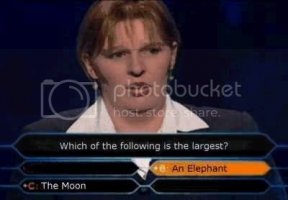
stupid.jpg

NEW YORK - Idaho resident Kathy Evans brought humiliation to her friends and family Tuesday when she set a new standard for stupidity with her appearance on the popular TV show, "Who Wants To Be A Millionaire."

It seems that Evans, a 32-year-old wife and mother of two, got stuck on the first question, and proceeded to make what fans of the show are dubbing "the absolute worst use of lifelines ever."
After being introduced to the show's host Meredith Vieira, Evans assured her that she was ready to play, whereupon she was posed with an extremely easy $100 question. The question was:

"Which of the following is the largest?"
A) A Peanut
B) An Elephant
C) The Moon
D) Hey, who you calling large?

Immediately Mrs. Evans was struck with an all consuming panic as she realized that this was a question to which she did not readily know the answer.

"Hmm, oh boy, that's a toughie," said Evans, as Vieira did her level best to hide her disbelief and disgust. "I mean, I'm sure I've heard of some of these things before, but I have no idea how large they would be."

Evans made the decision to use the first of her three lifelines, the 50/50. Answers A and D were removed, leaving her to decide which was bigger, an elephant or the moon. However, faced with an incredibly easy question, Evans still remained unsure.

"Oh! It removed the two I was leaning towards!" exclaimed Evans. "Darn. I think I better phone a friend."

Using the second of her two lifelines on the first question, Mrs. Evans asked to be connected with her friend Betsy, who is an office assistant.

"Hi Betsy! How are you? This is Kathy! I'm on TV!" said Evans, wasting the first seven seconds of her call. "Ok, I got an important question. Which of the following is the largest? B, an elephant, or C, the moon. 15 seconds hun."

Betsy quickly replied that the answer was C, the moon. Evans proceeded to argue with her friend for the remaining ten seconds.

"Come on Betsy, are you sure?" said Evans. "How sure are you? Puh, that can't be it."

To everyone's astonishment, the moronic Evans declined to take her friend's advice and pick 'The Moon.'

"I just don't know if I can trust Betsy. She's not all that bright. So I think I'd like to ask the audience," said Evans.

Asked to vote on the correct answer, the audience returned 98% in favor of answer C, 'The Moon.' Having used up all her lifelines, Evans then made the dumbest choice of her life.

"Wow, seems like everybody is against what I'm thinking," said the too-stupid-to-live Evans. "But you know, sometimes you just got to go with your gut. So, let's see. For which is larger, an elephant or the moon, I'm going to have to go with B, an elephant. Final answer."
Evans sat before the dumbfounded audience, the only one waiting with bated breath, and was told that she was wrong, and that the answer was in fact, C, 'The Moon.'

 
Back
Top