
Gymnasts, Figure Skaters, and Other Artistic Athletes Are Up Against an Unlikely Foe | Page 5 | Golden Skate

Gymnasts, Figure Skaters, and Other Artistic Athletes Are Up Against an Unlikely Foe

I think it is unreasonable to expect individual skaters -- or for that matter, children who lip sync a popular song for the third grade talent show -- to negotiate these legal quagmires, matching wits with teams of lawyers -- however "simple" this field of law is purported to be.

Surely this is the responsibility of "the powers that be" (skating federations, event organizers, TV networks -- who have their own legal staffs (staves?). What good are powers that be if they don't be any power or offer any assistance.)

There was a case in Detroit where some guy set up a hot dog stand outside a local Home Depot. He called it "Franks Anatra" Farnks, get it? Ha ha.

The lawyers of the famous singer's estate came down on him like a ton of bricks. (I think they sued Home Depot. too -- it wouldn't have been worth it otherwise, just to seize a pushcart and grill.))
 
Last edited:
And what about playing a character who is an actual person, like Elvis Presley?
Probably comes under fair use otherwise we would never get any historical fiction...
 
I think it is unreasonable to expect individual skaters -- or for that matter, children who lip sync a popular song for the third grade talent show -- to negotiate these legal quagmires, matching wits with teams of lawyers -- however "simple" this field of law is purported to be.
Skaters themselves don't have to negotiate anything. They simply have to know that an artist is not on the licensing roster and then get a lawyer to deal with it. Of course, they can seek advice from their Federation, coaches etc.. and end up with a warhorse instead ;)

I don't think novice skaters are the ones who choose these kinds of bands anyways, and the point is pretty moot because a novice skater using such a band wouldn't get on the radar of said band...

We are talking here about elite, Olympians, future world champions, from the country where most of the copyright infringement lawsuits come from... This is the context I have used when I said " they didn't do their homework"...

Surely this is the responsibility of "the powers that be" (skating federations, event organizers, TV networks -- who have their own legal staffs (staves?). What good are powers that be if they don't be any power or offer any assistance.)
yes.
 
Depend, is the same artist are the songwriter they own the rights what that create but if they just sings a song that other person compose usually a content creator in the record company , are just a performer and don't own nothing except their image rights. Nowadays the 90% of the songs others writes and the artist is just a performer
This can be very complicated - copyright may be divided and there may be certain agreements transfering it. You all remeber the Taylor Swift case :shrug:
 
And what about playing a character who is an actual person, like Elvis Presley?
Elvis is dead :slink: so there are no rights to his image (not sure if it's proper word) that can be exercised - at least in most continental jurisdictions I know. In PL the use of such image could be argued on grounds that it harms the good memory of him and it would be a personal good of all people connected to him - not only family but also friends and fans.
Yup, complicated AF
 
Elvis is dead :slink: so there are no rights to his image.
This is part of the tangle, I believe. Dead people do not have legal rights, but their heirs, estates, assignees, etc, do.

In general, though, I think that it all comes down to money. You can't use protected images, words, artistic expression, whatever, to make money that cuts into the profits of the rights holder.

In the 1970s someone produced an underground comic book that depicted Mickey Mouse as a sex-crazed drug dealer. Disney sued on the basis that this affected their bottom line by undermining the company's image as wholesome family entertainment.

After 8 years in court, Disney won. The satirist, now in his 80s, is still under court injunction that if he ever draws a picture of Mickey Mouse again he will spend a year in prison and pay a $200,000 fine. (Disney v. Air Pirates, 1971)
 
Last edited:
This is part of the tangle, I believe. Dead people do not have legal rights, but their heirs, estates, assignees, etc, do.

In general, though, I think that it all comes down to money. You can't use protected images, words, artistic expression, whatever, to make money that cuts into the profits of the rights holder.

In the 1970s someone produced an underground comic book that depicted Mickey Mouse as a sex-crazed drug dealer. Disney sued on the basis that this affected their bottom line by undermining the company's image as wholesome family entertainment.

After 8 years in court, Disney won. The satirist, now in his 80s, is still under court injunction that if he ever draws a picture of Mickey Mouse again he will spend a year in prison and pay a $200,000 fine. (Disney v. Air Pirates, 1971)
Your case is something different than cosplaying another person. In continental jurisdiction you can't put this type of injunction. The satirist would probably be forced to pay Disney specified amount, probably a hefty one, and all comic books would be destroyed. But no prison or ban on drawing specified character. If he drew the character again, it would be a new case. TBH American law is quite strange.
In most of continental jurisdictions you can cosplay or impersonate another person, even as parody, and the court will rule in your favour as long as you are using only this part of image that is connected with professional activities of a person. This means you can record a parody of politican's unhinged behaviour during some official activities, you can't suggest anything about their behaviour in private.
In PL you can't inherit moral rights, when you die, they go away.
 
Elvis is dead :slink: so there are no rights to his image (not sure if it's proper word) that can be exercised - at least in most continental jurisdictions I know. In PL the use of such image could be argued on grounds that it harms the good memory of him and it would be a personal good of all people connected to him - not only family but also friends and fans.
Yup, complicated AF
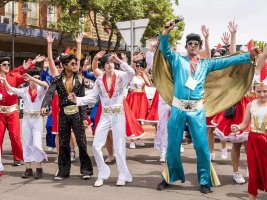
Possibly a non sequitur, but this reminds me of the Elvis Presley Festivals held every year at Parkes, NSW though I doubt anyone would claim it was harmful...
elvii.jpg
 
A company called CKS used to own all rights to Elvis, including licensing fees for any Elvis Impersonation contests that charged the public a fee to watch. They also owned the rights to images of boxer Muhammad Ali.

In 2022 the company was bought out by the U.S. branch of Sony.

So if any ice dancers want to skate to “I'm All Shook Up” in the rhythm dance next season (1950s rock and roll), that’s where they have to go for permission. ;)
 
A company called CKS used to own all rights to Elvis, including licensing fees for any Elvis Impersonation contests that charged the public a fee to watch. They also owned the rights to images of boxer Muhammad Ali.

In 2022 the company was bought out by the U.S. branch of Sony.

So if any ice dancers want to skate to “I'm All Shook Up” in the rhythm dance next season (1950s rock and roll), that’s where they have to go for permission. ;)
TBH this is wild that you can own the copyright to dead persons image and I don't think they could sue and win in any jurisdiction that has different regulation :shrug:
 
So many famous dead people are probably rolling in theirs graves wiht what is being done with their rights T_T
Tolkien is rotating at high speed.

Funny you should say that. Somewhat appropriately, I was listening to a radio programme this morning while making out my predictions for the GP Final, and this song was played:

A House - "Endless Art"

CaroLiza_fan
 
Finland has two federations, Gramex and Teosto, who forwards the music copyright convensions. I found Gramex's rules. There are 16 A4-pages of it written in small font. Finland has clear instructions on their own page: https://www.stll.fi/seurat/edut/teosto-ja-gramex/ There is list about federation's contract with those federations where skaters can use the music and where not. "Nots" are international big competitions, I guess it means EC, WC and GP, not sure about CS but small competitions are ok. Social media need a permission of it's own and they have instructions for it too. The contract is made by several sport accosications together. I suppose in bigger competitions somebody else than local fed takes care of the rights It is clear that skaters do not need to take care of these things themselves here, but they are responsible for what they publish on social media. I think they have instructions for it also. I think every fed should have similar clear rules, but do they?

I quickly read some part of Gramex's instructions. One interesting part was that copyright benefit may belong to someone else as first thought.

OT, but about copyright issues overall:

I know hairdressers, stores etc pay one fixed fee to be able to have radio on. But I know there are some who do not even know they should pay. It was already 1998 when we were told in an office where I shared a room with a colleague that we must turn off the radio music channels if some client arrives, though there were not many of them who even needed to see us as we made mostly paperwork. I have also wondered how gym instructors choose their music, does they employee buy or do they even think about the rights?

At my branch copyright issues can be weird. As a technical document writer I also draw technical pieces. Standards tell what some small things like must look like. It is illegal to copy-paste a subject somebody else has drawn without permission. But I can draw exactly similar subject myself and then me or the company I work for has the rights to the things I have drawn. Simplest ones and almost everything I draw are very easy to draw using programs.
 
I am pretty sure that the song that has generated the most money in licensing fees in U.S. history (possibly in the world) is “Happy Birthday to You,” grossing in the tens of millions of dollars (U.S.). Written in the 1890s for inclusion in a song book for kindergarten children, claims of ownership of copyright were bandied about in the courts for more than a humdred years.

Finally, in 2015, a federal judge ruled that, first, the lyrics (Happy Birthday to You repeated four times) cannot be copyrighted (ancient Egyptians chanted it to the Pharaoh 6000 years ago, so it was already in the public domain.). Only the accompanying piano sheet music qualified for copyright protection. Furthermore there were legal inconsistencies in how the original copyright was set up in the first place, and the company that claimed to own rights to the song had to give back a few million dollars that it had collected in licensing fees. So now you can sing it at your five-year-old’s birthday party without fear of the long arm of the law. (The European Union ruled similarly in 2017.)
 
Last edited:
Back
Top