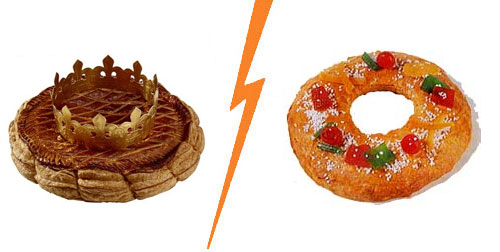
Today in many Christian denominations (not with most Orthodox: for them January 6th is Christmas because they keep the Julian calendar, and Epiphany is January 19th) was Epiphany. I think it's in Spain that it's most celebrated? As in Spain, this is the day when gifts come to children (as the Kings gave presents to Baby Jesus).
In France, we "draft the King" or so? We have a "broadbean" (often, a porcelain figure) in the cake, the cake is cut and each guest gets a share, and the guest who has the slice with the "broadbean" is named the king or queen and wears a paper crown, optionally choosing a consort. The cake itself is usually a fluffy pastry filled with almond cream in Northern France, and a crown-shaped brioche with candied fruits over it to make the gems in Southern France; it's nearly a war between the "kingdoms".
The best known carol for Epiphany is the March of Kings, it's an old carol from Provence (South-Eastern France). In the late XVIIth Century, Lully gave it French words and harmonization. It came to further fame when Bizet used it in his Opera, L'Arlésienne.
I didn't find the best interpretations, this one isn't bad (beware : the singers have a South-Western, not South-Eastern accent; except the soloist) and has English subtitles:
Enjoy the videos and music you love, upload original content, and share it all with friends, family, and the world on YouTube.

www.youtube.com
Historically, little is known of the Magi/Kings/Wise Men, even their number; although one of them is rather likely Gondophares I (Caspar), not yet a King personally but a prince of the House of Suren, probably the main House in the Parthian Empire, who were often kings of semi-autonomous kingdoms in the Eastern parts of the empire. He made his own (Indo-Parthian) independent Kingdom from 19 to his death in 45; after the Death and Resurrection of Christ, he called for an Apostle to preach there. Traditionally, they're shown as coming from Asia, Europe and Africa with three different ages, in a sign of universality.