Twelve Years, One Partnership, and a New Beginning for Veillon and Brandys
After more than a decade skating together, Canadian ice dancers Layla Veillon and Alexander Brandys are preparing for the next chapter of their career: the transition to the senior ranks.
The longtime partners, who have been skating together since they were just eight and nine years old, enter the 2026-27 season following a successful final junior campaign that included a Junior Grand Prix victory, qualification for the Junior Grand Prix Final, another Canadian junior national title, and a fourth-place finish at the 2026 ISU World Junior Figure Skating Championships.
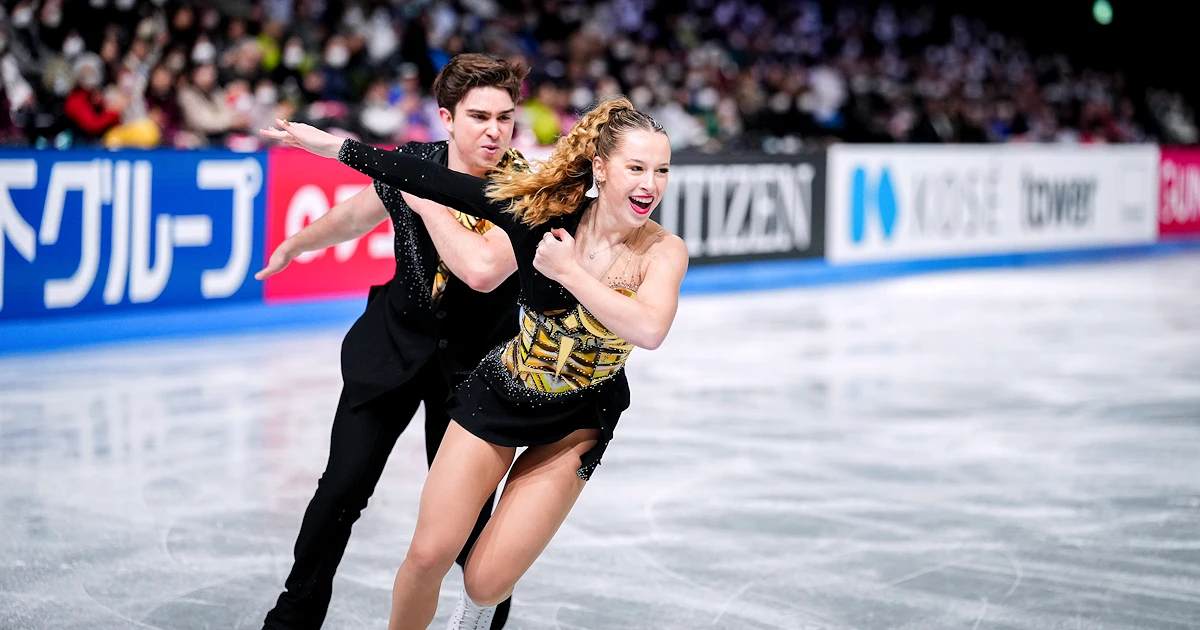
Layla Veillon and Alexander Brandys of Canada compete in the rhythm dance at the 2026 ISU World Junior Figure Skating Championships, where they finished fourth overall.
Their partnership began thanks to a connection through coaches and twin sisters Alma and Carol Moir. When Brandys expressed interest in ice dance after watching his older brother compete in the discipline, Carol suggested he try skating with Veillon.
“My brother also did ice dance for a year or two before I did when I was younger,” recalled Brandys. “I saw that he was doing it as well as a couple other people, so I was like, ‘Oh, that seems like fun, maybe I’ll try it out.’ So, I just asked Alma.
“I was eight,” Veillon recalled with a laugh. “For fun, why not? My cousin did it as well.”
Veillon points to their victory at the Canadian Novice Championships as a turning point.
“I think that’s when we really kind of came together and we were starting our junior career and thought to ourselves, ‘Wow, we’re skating really well together,'” she said. “We were starting to hear that we had potential, and I feel like that was the point where we kind of started to really believe it.”
As their confidence grew, so did their ambitions.
“We started to really push ourselves and set goals,” Veillon continued. “We started to think to ourselves, ‘Yeah, maybe the Olympics one day is really a possibility.'”
Different Personalities, Common Goals
Despite spending most of their lives together on the ice, Veillon and Brandys readily acknowledge that they are very different people.
Brandys describes himself as the easygoing partner who is quick with a joke, while Veillon admits to being highly competitive. Over time, those contrasting personalities have become one of the partnership’s greatest strengths.
“We’re very different people,” Veillon explained. “But we bring very different perspectives and balance each other out.”
Their ability to communicate and understand one another has evolved significantly in recent years.
“We’ve started to really understand how to communicate,” Veillon said. “That communication is continuously improving, which has been a big advantage for us.”
Learning from an Elite Training Environment
The pair train in London, Ontario, under an accomplished coaching team that includes two-time Olympic champion Scott Moir, along with Alma Moir, Cara Moir, Sheri Moir, Adrián Diaz, Madison Hubbell and Justin Trojek.
Having access to multiple coaching voices has played a major role in their development.
“Every coach brings a different perspective,” Veillon said. “Not everything is going to work for every team, so it’s trying different ways of doing things.”
Brandys said he finds the opportunity to learn from both coaches and senior training mates invaluable.
“Watching people on the ice, we can see how different people do the same thing in different ways,” he said.
“It’s a very collaborative environment,” Veillon added. “Whether it’s with teams helping each other learning new tricks or learning from each other’s skating styles. We come in and we’re all really great friends and I feel like we’re happy to see each other succeed.”
Working with Scott Moir has been particularly meaningful for the young Canadians.
“It’s very inspirational,” Brandys said. “The way he demonstrates things on the ice is very unique. Both his technical and his presentation side of showing things or demonstrating things is very fun to watch.”
For Veillon, one of Scott’s greatest strengths is his honesty.
“He pushes us every day to be better,” she said. “He knows how to keep it real. He’s not one to sugarcoat things. He will be real with you, and I think that’s also a great aspect because sometimes you need that and that makes you better. You aren’t seeing everything through rainbow-colored glasses.”
Experiences Over Results
One lesson has consistently been reinforced by their coaches: success is measured by experiences and growth rather than medals alone.
Following a disappointing Rhythm Dance at the Junior Grand Prix Final, Veillon remembers Scott reminding them that results do not define their journey.
“He said, ‘I’m proud of you guys no matter what,'” she recalled. “It’s not about the medals; it’s about the experiences and what you take away. “Also, our coach Cara will say, ‘In 20 years, you’re not going to remember the silver medal at this competition. What you’re going to remember is your experiences.'”
That philosophy has shaped the way they approach competition.
“We knew if we skated to the best of our capabilities and how we’ve been training, the results would follow,” Veillon said.
Brandys said one lesson that has stayed with him is the importance of trusting the work done in training.
“Put the effort in at practice and you’ll find that it will guide you,” he said.
Sports psychology has also become an important part of their preparation. Working with a mental performance specialist helped them develop tools for staying focused and avoiding distractions, particularly during major events.
“We’ve learned how to communicate with each other about how we’re feeling before competition,” Veillon said. “That helps with our confidence.”
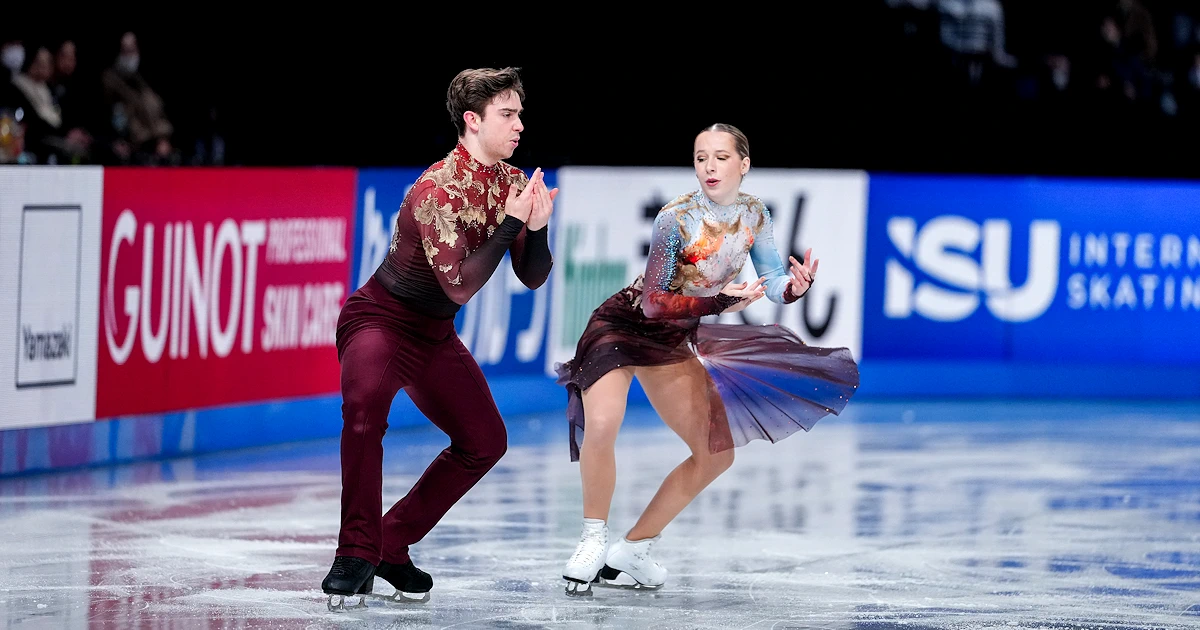
Layla Veillon and Alexander Brandys of Canada compete in the free dance at the 2026 ISU World Junior Figure Skating Championships, where they finished fourth overall.
A Memorable Final Junior Season
Both skaters pointed to qualifying for the Junior Grand Prix Final as one of the defining achievements of their final junior season.
“Getting to the Final and knowing there were only six teams felt like a lot of our work had paid off,” Veillon said.
She explained that the pair entered the season with a different mindset than in previous years, focusing less on placements and more on their own development.
“We were really driven and goal-oriented,” she said. “But it was more so on ourselves and our own journey.”
That approach proved especially valuable when things did not go according to plan. Following mistakes at the Final, Brandys said the experience reinforced lessons they had learned from their coaches about resilience and perspective.
“Even though mistakes happen, there are still things you can learn from them,” he said. “Because it happened at a bigger event, now I know what’s the best way for me to deal with it and how to move on from it.”
Rather than dwelling on the result, the pair chose to view the experience as preparation for the challenges that await them at the senior level.
Preparing for Senior Debut
Although they are officially moving into the senior ranks, Veillon and Brandys say the transition has felt surprisingly natural.
“As a junior team, we were always training to be a senior team,” Veillon said. “We were training to be a successful junior team, but the end goal was always to be prepared to move up.”
The pair continue to focus on improving every aspect of their skating rather than targeting one specific area.
“Everything can always be a little bit better,” Veillon noted.
For Brandys, one of the most exciting aspects of competing as seniors will be sharing more events with the veteran teams he trains alongside every day.
“I’ll be able to travel with some of our training mates a little more,” he said. “Most of our camp is senior teams, so that’ll be exciting.”
Brandys says he draws inspiration from all of the senior athletes in his training environment, often studying the details that make them successful.
“I watch people around me and see what they do,” he explained. “I look at what makes something look good and think about how I can apply that to my own skating.”
Veillon echoed that sentiment, but singled out fellow training mates Christina Carreira and Anthony Ponomarenko as a team she particularly admires.
“Obviously, you look up to all the teams you train with, but I’d say for sure Christina and Anthony,” she said. “They’re such great people as well, and I’m always rooting for them.”
New Programs, New Opportunities
The team’s rhythm dance for the upcoming season will feature music by Queen, combining “Innuendo” with “The Millionaire Waltz” in a program choreographed by Diaz.
“We wanted to take a different approach,” Veillon said. “We both really liked the idea of incorporating the waltz. We’re excited to come out with a bang and bring something powerful to the ice.”
Their free dance will be set to music from the Tron soundtrack, with choreography by Cara and Diaz.
“The main idea is kind of getting absorbed into the game and trying to escape,” Brandys explained, adding that there will be more layers.
“We like that powerful feeling; that’s one of our strong suits,” added Veillon. “There’s that intensity but also just a lot of movement.”
Veillon said selecting the music from Tron was not an easy process given the number of options available.
“There were so many good pieces that we were like, ‘Okay, we need to narrow this down,'” she said. “They all sounded great, but we had to figure out which ones were going to be the best for us.”
Brandys hopes audiences connect with the music and storytelling in both programs.
“If it was the Tron program,” he said, “maybe someone leaves wanting to go watch that movie. Or for the Rhythm Dance, maybe they want to go listen to Queen.”
Looking Ahead
Away from the rink, both skaters are balancing university studies at Western University. Veillon is pursuing Childhood and Youth Studies with the goal of becoming an elementary school teacher, while Brandys is studying psychology. Both ice dancers have expressed an interest in becoming coaches in the future.
As they prepare for their senior debut, neither skater is focused on specific placements or assignments. Instead, they remain committed to the philosophy that has guided them throughout their career: trust the work, embrace the experience and continue growing.
“I want to make sure I do my all,” Brandys said.
Veillon echoed that sentiment.
“Just giving it my all, trying to improve every time we step on the ice and leading with our values,” she said.
After twelve years together, the pair are ready to take the next step—one built on the same partnership, perspective and work ethic that brought them to this point.
Veillon said the team’s season is expected to begin at the 2026 Quebec Summer Championships (Championnats québécois d’été), scheduled for Aug. 6–9 in Pierrefonds, Quebec. They will also make their Grand Prix debut at Skate Canada in Kelowna, BC, Oct 30 – Nov 1, 2026.
Related Info: