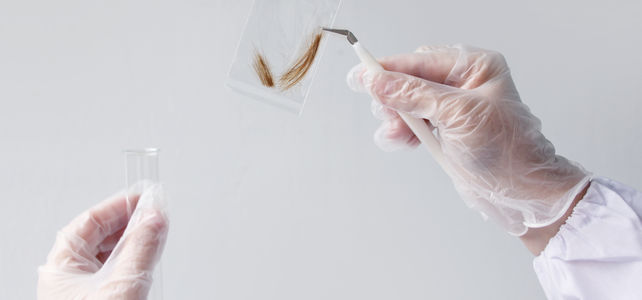
esanum: Professor Kintz, why is hair analysis booming among athletes?
Prof. Kintz: Hair analysis is a technique frequently used in toxicology to detect drugs, pharmaceuticals or environmental contaminants. In forensic medicine, this technique has been recognised since 1995. It was originally used in cases of murder or rape under the influence of subtances. Now, some countries will only return a suspended driver's licence if the results of a hair analysis are presented to prove that the driver has not recently used cannabis or cocaine.
In my laboratory, we apply this forensic technique in several areas, including doping. Athletes who test positive use it to support their defence. They come mainly from Anglo-Saxon countries, where the legal system is based on adversarial proceedings. The burden of proof is on the accused to show that they are innocent.
If the athlete proves that he or she was accidentally contaminated by a product, and if they can prove its origin, then the anti-doping authorities pronounce a "no fault" and there is no sanction. A hair analysis costs only two to three thousand euros, a small amount compared to a lawyer's fees. To defend cyclist Christopher Froome [who was cleared by the World Anti-Doping Agency after testing positive for salbutamol in 2017], his team and sponsors paid 7.5 million euros in the legal case. This is unthinkable for lesser known or independent athletes.
The first time I used this technique at the request of a sportsman was in 1997. The Olympic judoka champion Djamel Bouras tested positive for nandrolone, an anabolic steroid. There was a scientific controversy about the fact that he could produce it naturally. For my part, I did not find any nandrolone in his hair. The initial sanction - a two-year suspension - was reduced to fifteen months. But it is since the Gasquet case in 2009, that the technique of hair analysis is really recognised by the international
Court of Arbitration for Sport (CAS, also known as the
Tribunal Arbitral du Sport or
TAS].
Since then, demand has boomed. I now carry out around ten analyses of this type every month. Very few laboratories in the world are capable of doing them, and even fewer know how to detect the presence of SARMs [Selective Androgen Receptor Modulators are anabolic agents, such as ligandrol or ostarine]. But it is mainly these substances that are looked for.
We can also detect diuretics used to mask the intake of a doping product. They favour the urinary elimination of this product, often an anabolic, or increase blood retention, which lowers the urinary concentration. Some hormones, erythropoietin (EPO) or growth factors are undetectable in the hair. These molecules are too large to pass from the capillaries to the follicles. If diuretics are detected, this may indicate an attempt to mask them. If not, it is an exculpatory element for the athlete.
esanum: When is this test relevant?
Prof. Kintz: Hair analysis is valuable when urine analysis shows almost nothing - either because the amount of substance in the body is small or because it has been consumed for a long time - but especially when the concentration measured is uninterpretable. In these borderline cases, hair analysis can help. Each centimetre of hair represents what has circulated in the body during the corresponding month: if the substance is clearly found in it, this indicates chronic and long-standing consumption, and therefore reinforces the hypothesis of doping. If there is nothing in the hair, then accidental contamination is supported.
How can an athlete unintentionally have a doping substance in the body? Two scenarios are possible. Firstly, they could have ingested the product without their knowledge. Doping substances have already been found in meat or toothpaste. The same applies to certain diuretics which are prohibited by the anti-doping authorities because they "mask" the use of doping products. Traces of these diuretics can be found in medicines that are authorised. Second scenario: the athlete has unintentionally been impregnated with a prohibited product, either through contact with a person who regularly consumed it - this is known as "cross-contamination" - or because he or she has been exposed to "environmental" contamination.
Several cross-contaminated athletes have been cleared by hair analysis. Examples include world pole vault champion Shawnacy Barber, who was able to compete in extremis in the 2016 Olympics after being suspected of doping with cocaine, and Laurence Vincent-Lapointe, 11-time world canoe champion, whose urine analysis revealed the presence of ligandrol, an SARM.
Very recently, three female athletes with abnormal urine results were given a "no fault". They had a very low concentration of the substance or its metabolites in their urine and a negative hair analysis. They were also able to prove that their partners had consumed the substance, which we confirmed by analysing their hair. In all these cases, hair analysis supported the hypothesis of cross-contamination.