Part 4 (final)
In this last segment, Davydenko really takes over, and for me, the most important bit is his willingness to back Mozalev up. They also talk about music. Mozalev, as usual, invests in this topic, and is visibly happy to bring up his sister. I couldn't help it, but wish it was rather Mozalev talking about his musical preferences, given the long list of styles he listed in his Olimpic profile. The last part gives off strong macho vibes.
(This commercial break was a weather report, and it was wet, chilly and windy in St. Petersburg on that day, though not cold. AMM gets restless, swivels in his chair, talks to Davydenko longer and more animatedly than during the interview.)
Host: Whenever we talk about figure skating, there are a lot of questions and time is brutal. We’ll try to pack in as much as we can in the remaining time slot. In our studio—Andrei Mozalev, an Olympian, along with his coach, Kyrill Davydenko.
Let’s start with the main thing.
You have voiced often one opinion about Andrei. Maybe some would find your words trivial, but, in my view, you never say things just to say things. You emphasized many times that Andrei is a very stable athlete. Considering, that as an athlete, Andrei is still in his infancy as an athlete—for an athlete, 16 or 18 is young… Everything is changing (around that age). Does this description—stable—stay with him? Have you ever hesitated to describe him that way, during the time you have worked together?
KAD: Regardless of what the viewers would say—as in 'how could you say that? He falls, and stuff—I had explained already whys and what-fores of it.
But yes, as a coach, just as before, I have faith in him. I am 200% sure that we’ll achieve the maximum results we are aiming for. That’s how I’m going to answer this.
Host: That’s great. Let’s move on to another important moment. Many people think that every figure skating team, coach and the figure skater, has a music specialist. They chose the music, and it is hard work. Or that the athlete himself picks the music, or even that the Federation assigns music for specific programs. In your case, it must be something you are interested in. As I recall, Kyrill, you are a music connoisseur.
KAD: The choice of music is a complex endeavor.
For the short we had had before we had changed it, the one we had intended to show in the Olympics, I came across that music accidentally.
There is a lot of streaming music now. Unlike the old times, when we had the cassette tapes, then copied it, or had to hunt down the vinyl recordings, hell knows how. Or we had to listen to the compact disks in the stores, to figure out if you liked it or not. Now, the streaming services allow you to widen your range, then buy from a quality provider, ensuring quality sound. I had come across Enigma’s new album, so we used Bach’s arrangement.
Overall, I live with music on, continuously. Even in the bathroom I have a set of speakers, and in the living room, a quality system, close to the high end. Music is important to me. For example, in the morning while I was brushing my teeth, I was listening to ‘Cure’. Then I switched to Vivaldi. Imagine that, from ‘Cure’ to Vivaldi.
Host: Quite the transition.
(AMM fidgets, swivels and gives Davydenko lopsided grins once in a while during that musical discussion)
KAD: And in the car, I was listening to Pink Floyd's soloist.
Host: So, I take it our playlist here, at Zenith (radio-station) is close to your heart.
KAD: When we came in, you were playing Bruce Springsteen, and I immediately thought, “Oh, yeah, good music.”
So, yes, I like a broad selection of music. A lot of factors go into selecting music—it’s an art form in itself.
For example, for the new short program…
(AMM reaches for the water bottle)
…the program you had seen in the Olympics, Andrei suggested the music. For the free program, it’s Vangelis, and I love Vangelis.
Host: It’s hard not to love Vangelis.
KAD: I adore it. Our colleague suggested using it before, but I said—too early. Then I saw it was the right time. Even last year we had that conversation, and I said, “Wait, let’s keep it in store.”
Choice of music is a complicated endeavor.
AMM (returns bottle to the table, clasps hands together in his lap): Everyone participates, even your family. (Opens up his hands, gesticulates) My sister helped me with advice. And we had used it.
Host: Does your sister skate?
AMM: Yes, she had done figure-skating before, synchronized skating.
Host: The Paradise Team?
AMM: No, she didn’t make it to Paradise. She was skating with Sunrise-2. There were changes in the team, so she finished with her skating.
Host: I hear the ticking clock. It’s not neuralgia, we are about out of time.
Let’s remind people about your school at the end of our show. There is a prevailing opinion that it’s hard to start in figure skating—and even harder to decide to commit to it. Let’s remind people how you could do that.
KAD: We’re with the Figure Skating Academy of St. Petersburg on Tupolevskaya, 4.
I’m very grateful to our school and its principal, Tatyana Anatol’evna Men’shikova. The simplest example is that when we had to travel to receive the Olympic uniforms, I called Tatyana Anatol’evna. With the pandemic and all that, hell knows what to do. Maybe you could requisition a bus for us? She had immediately provided us with a bus and a driver, and they took us right to the equipment distributor, then immediately drove back.
So, anything you could possibly wish for, we have. Food, for example. We also have a wonderful recovery center, medical staff, and massage therapists.
Our school, our Academy, creates ideal conditions for quality training. It’s not just getting the ice time, it’s also medical support, nutrition, personal touch.
Tat’yana Anatol’yevna is always ready to call an athlete in to talk to. She’s like our mom. Yes, Tat’yana Anatol’evna is our second mom, and it’s not just empty words. I’m saying this from the bottom of my heart.
We love our school, and if anyone is interested, you can always come in the second half of August, when we have kid's auditions.
Host: Auditions and skating trials?
KAD: Yes, and you are welcome to come. Our website will have the information, so you could look it up. Maybe someone will end up on my team that way.
Host: There is a probability of that?
KAD: How else? Of course.
Host: People are not born an elite skater, right? You must become one.
KAD: Yes. First, you must come and show us what your kid could do. Then, we’ll think about it.
Host: The specialists will figure it out.
The time segment had come to an end, incredibly fast. I have an impression we had only been talking for 10 minutes. In truth, it had been a bit longer.
Thank you to Andrei and Kyrill for coming. My only conclusion at the end of our chat is that you simply must visit us again. We barely scratched the surface of what we wanted to talk about.
KAD: Yes, about the intergenerational relationships…
Host: Yes, I had prepared for this topic.
KAD: My father was an accredited coach. My colleagues always say that he would have been happy to see us. I would have liked so badly during EC for Andrei to remain in first. After the free, I thought, I’ll dedicate the first senior big medal to my dad. Well, Andryusha, we’ll yet do that, dedicate a medal to my dad.
AMM: Yes.
KAD (wagging his finger): The first senior medal would be dedicated to my dad. For how much he had given me in terms of understanding figure skating and life in general. So, I am very grateful, and the first big victory I would dedicate to my dad.
Host: That’s great. We’ll do all we can to discuss this topic next time.



 and national medallist. I don't think he is likely to switch to any other country in future, I think he will succeed in Russia. I'm glad to hear that he is focused on the next quad cycle (I want him to go to 3 Olympics)!


 More precisely, it never occurred to me that in context this word could have a different meaning than “four-turn jump”. Sorry, my vocabulary is still poor but I'm working on it
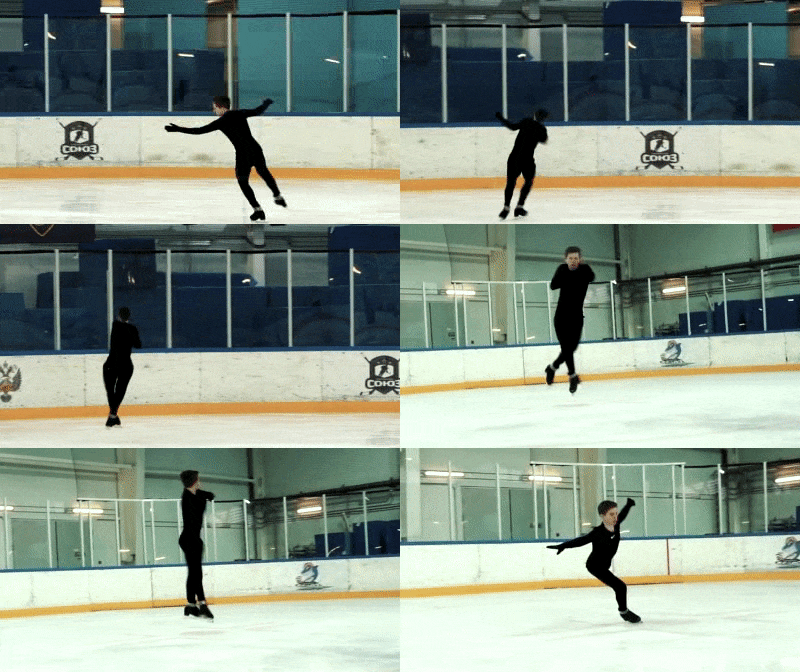

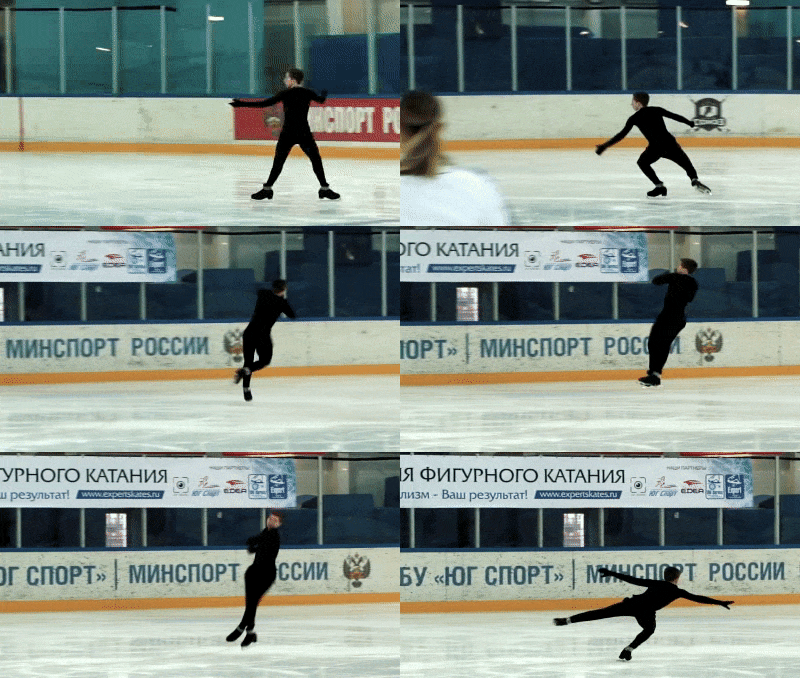
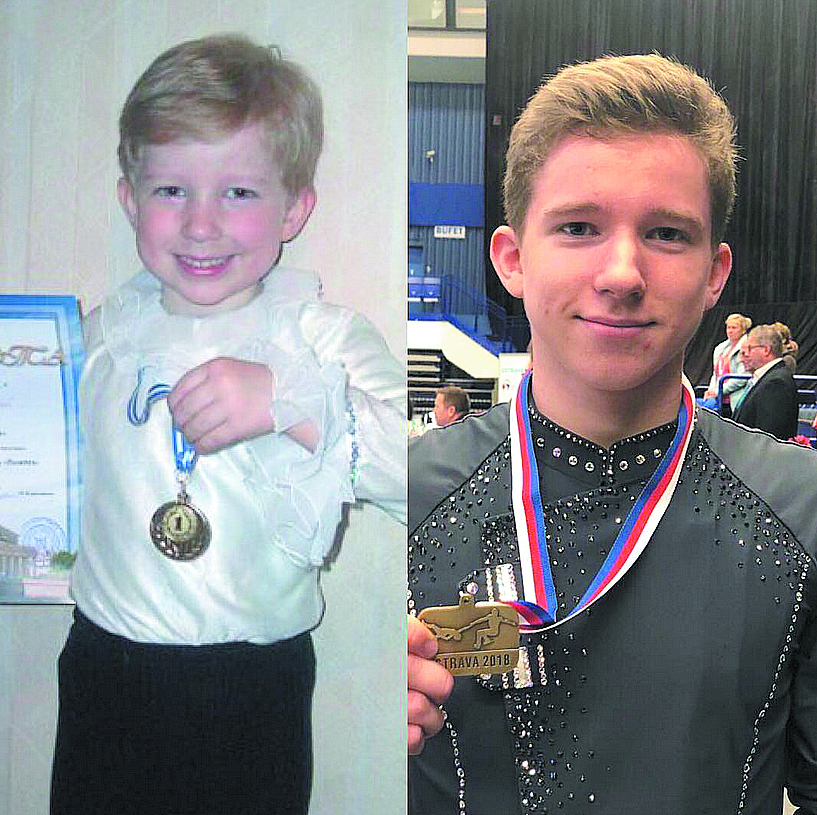


 but yes, it will be a joy to see Mozalev once again this season. I kinda low key hope we’ll see a new exhibition program.
 Star Wars!


 "
"


