Gendai media dropped an informative interview with Daisuke about the concept of Kassouya 2.0, the audition process and production details. I didn't know that "Love on the Floor" was one of the inspirations for Kassouya, but it actually makes a lot of sense as the latter is basically ensemble dance on ice with scenes that are connected by a common concept and a mood that weaves throughout (without having a linear storyline - just like the former). I also really love how much Daisuke's passion for this project shines through.

Part 1:
これまで大旋風をまきおこしている、高橋大輔さんが演出する氷上エンタテインメント「滑走屋」の「第二巻」が2026年3月19日から22日までオーヴィジョンアリーナ福岡で幕をあける。ライターの田中亜紀子さんによる高橋大輔さんの特別インタビューを2回に分けてお届けする。第1回は、大きな話題となったオーディションについて詳しく聞く。

gendai.media
Machine translation:
Dance moves copied to perfection? Daisuke Takahashi discusses the “Kassouya” auditions and the passion of young skaters
Special Interview for “Kassouya” Volume 2: Part One
The second instalment of “Kassouya”, the ice entertainment production directed by Daisuke Takahashi that has caused a huge sensation, will open at O'Vision Arena Fukuoka from 19th to 22nd March 2026. We present a special interview with Daisuke Takahashi by writer Akiko Tanaka, split into two parts. Part 1 delves into the much-discussed auditions.
‘I thought if this failed, I couldn't do it again.’
Produced by Daisuke Takahashi, ‘Kassouya’ has garnered immense acclaim for its overwhelming power – complex formation group dances where internationally competing skaters and young ensemble members perform together without distinction. Following its premiere in Fukuoka in February 2024 and a revival in Hiroshima in March 2025, the stage now moves to ‘Volume Two’. Pricing and timing are set to be accessible for both skating fans and those who have never seen an ice show before. Alongside the show's innovative appeal, attention is also focused on the energy of the young skaters, raw talents scouted by producer Daisuke Takahashi himself during visits to domestic local competitions.
"For the first run, I thought if this failed, it would be the end. It was decided suddenly, time was tight, and we faced all sorts of difficulties, but we managed to open the curtain and see it through to the end. After the performances, I found myself eagerly awaiting audience reactions and comments on social media and such."
"Regarding the content, choreographer Yuma Suzuki is someone I admired after seeing her theatre troupe's performance. I was particularly impressed by the sense of speed, the constantly shifting developments, and the intricate formations where people intermingled. I asked her to create an unprecedented ice show with that kind of content, so I knew she'd produce something wonderful. The added element would be the skaters' performances, and since we were using many young athletes with little show experience, it was an unknown how far we could take it." (Daisuke Takahashi. All subsequent quotes by him)
Following a revival in Hiroshima in March 2025, Volume 2 will open in March 2026 in Fukuoka, the show's birthplace. What will its theme be?
"This time we're completely changing the content and creating something new. Thanks to everyone, some fans have embraced the entire “Kassouya” concept. The first show and the revival were wonderful. Precisely because of that, there's immense pressure to surpass them as we begin Volume 2.
This time, the theme is “Four”. The sound “shi” in “four” carries various meanings; there are four cardinal directions, east, west, north, and south; there are four seasons, spring, summer, autumn, and winter – many things are made up of four. For the show, we're imagining four ice pillars, grouping elements into fours, and expanding our ideas around the theme of “four”. We'll then weave in the dramatic, story-like elements I've long wanted to explore within this atmosphere. While we creators have a broad narrative in mind for our creation, we won't reveal it to the audience. We hope everyone will feel and interpret it in their own way."
What the “White Poster Visual” Signifies
This production's poster visual features a white aesthetic, quite distinct from the black theme of the previous instalment.
"Last time, partly due to time constraints, I conceived the visual myself. This time, however, I communicated my vision to professional designers who created it. White isn't the theme colour; it represents the icy atmosphere and the white world of the skating rink. Within this cold air, a mysterious figure stirs up a world of eerie atmosphere. What might happen? I hope it sparks all sorts of imaginings."
The style remains consistent: Mr Takahashi handles all music selection, while Ms Suzuki Yuma choreographs.
"This time, I've chosen music with an oriental mood, but it's grounded in the modern, dark feel of the original Kassouya. Since I select the music, it naturally leans towards a dark worldview. After the first production, Yuma took up skating and has now reached a level where she passes badge tests. Her mobility on the ice during rehearsals is noticeably different. During the first production, we communicated off-ice with a microphone, but now she's on the ice with us. She moves swiftly to be near the skaters, so discussions are quicker, and she grasps the skating movements better than before. Above all, it's wonderful to see Yuma's genuine enjoyment of skating."
An audition brimming with incredible passion
Having decided on themes such as this, a first-ever audition for young skaters to perform in the show was conducted, running from summer into autumn, attracting numerous applicants.
"We'd always wanted to try selecting performers through auditions. We don't know if we'll do it every year, but we thought it would be our challenge to see how it turned out, and also a chance to feel the passion the skaters have for the show. When we actually did it, we felt an incredible amount of passion. Ultimately, passion alone isn't enough, but as producers, we were truly grateful for that energy."
The selection process involved document screening and video screening, with approximately 60 candidates progressing to the final in-person practical assessment.
The documents assessed basic requirements like holding a badge. The video screening involved footage of the skater performing to showcase themselves. The final assessment had three components. First, a video of Takahashi and Muramoto dancing to a set piece was sent to applicants about two weeks prior; the applicants then performed it individually during the final. Second was a freestyle performance, where the skater showed what they wanted to dance. There was also a unique floor assessment.
"On the floor, we had everyone learn a dance choreographed by Yuma Suzuki together for 30 minutes, then perform it individually during the assessment. There was a reason for this: Kassouya involves a lot to memorise, yet the preparation period is relatively short. We wanted to see how quickly each person could learn. If they could learn quickly, they could then progress to the next level of quality. So, we made the speed of learning one of the assessment criteria."
"For the set piece, we had them perform the choreography from a video sent two weeks prior. We assessed how closely they matched the steps, how well they interpreted the music, and whether they had the rhythm. Since everyone performs the same movements in the actual show, we wanted to see their movements to that specific piece. The freestyle is for self-promotion. The appeal and presentation could be completely different between the set piece and freestyle. In freestyle, they confidently showcased their strengths, and we also observed this contrast. On top of that, we could consider things like, “This skater shines in this kind of scene,” or “This role suits them well.”"
Judging the final auditions of 60 people and watching three types of performances seems like quite a demanding task.
"With about 30 skaters each from East and West, it wasn't demanding for us at all – it was very interesting. I think we saw everything we needed to see. Plus, unlike before, we could meet everyone beforehand during the rehearsal camp, so it wasn't a case of “nice to meet you” when we started. Above all, it was wonderful to feel the passion each skater brought to the performance."
There is no distinction between main cast and ensemble
Having seen previous performances of “Kassouya”, I was amazed by Mr Takahashi's discerning eye, discovering just how many wonderful skaters Japan possesses. The members announced as the first group this time, alongside those who have appeared before, include many new faces, creating a remarkably diverse line-up. Incidentally, apart from Mr Takahashi, Ms Muramoto, and Ms Murakami, all members announced in the first wave – including those who appeared in the previous production – are formidable talents who earned their places through auditions.
"With the exception of the skaters who performed in the previous production, we actually judged them with virtually no prior information, starting from scratch. We wanted to see them as they truly are. Furthermore, this time there are no designated roles for main skaters or ensemble skaters among the performers. While there are differences in their roles during the actual performance, and there are key skaters who form the backbone, for this audition, as with the previous one, we aimed to select skaters who fit the four distinct worlds I mentioned earlier, based on speed and power. Watching their performances, our own imaginations expanded – thinking, “This skater would suit this kind of scene,” or “This role might fit them well.”"
One inspiration for the “Kassouya” performance was the dance production “LOVE ON THE FLOOR”, a floor-based stage show Takahashi previously co-starred in. This production featured only American dancers and skaters alongside Takahashi.
"It told the story through dance, without dialogue. Back then, the theme was love expressed through performance. The message came across without feeling forced, and the dance performance itself drove the narrative with real power. Cheryl Burke led as both star and director, while the group dances by the international, top-class American backup dancers were incredibly compelling. It made me realise that the presence of such performers really allows the soloist to shine."
"Kassouya incorporates these elements, but being a stage on ice, there's an absolute sense of speed and expression achievable only through skating. We aim to create something as fresh as possible through collaboration between the skaters and the choreography from the floor-based dance world. This year has been truly enjoyable with various activities, but from here until year-end and into the new year, we'll be creating together with everyone, pushing ourselves to the absolute limit. It's demanding, but the process of creation is the most enjoyable part, so I believe it will be an even more enjoyable time."



 :
: ️
️


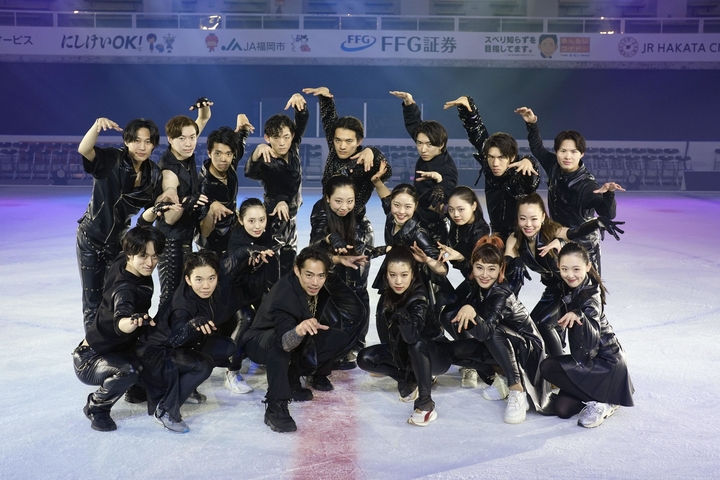

 Kassouya Event Confirmed!


 :
:

 :
:



 :
:


 :
:
 He hinted at it in an interview just after 4CC, which was later edited, and some fans said they could hear him in the background on someone's IG story. So I thought he'd turn up at Kassouya as a surprise appearance on the day. The fact that they announced his participation in advance was the surprise for me, but it seems like they added a disclaimer that it's still subject to change, which is fair enough.


