A few days ago, Meisupo Web published a post-season interview with Kosho Oshima, which was conducted back in April and focuses, among other topics, extensively on his experience as a cast member of "Kassouya":
各選手がさまざまな思いを抱え駆け抜けた今シーズン。全日本フィギュアスケート選手権(全日本)に6人が出場、日本学生氷上競技選手権(インカレ)では男子が団体部門で優勝を果たすなど活躍した1年となった。本インタビューではシー […]

meisupo.net
I want to particularly highlight this quote, because it describes the essence of Kassouya and how the show helps young skaters to grow and find their unique "voices" in skating:
--You have performed in other ice shows as well, but what do you think is the unique charm of Kassouya?
As students, we all start from the same starting line, not knowing who has room to grow and in which direction. In that situation, we all had to be greedy and give it our all for two weeks so that we could give 120%, and in terms of growth rate, I think “Kassouya” is different from other ice shows. After all, a professional ice show is a professional ice show when the right people and the right weapons are in place, making use of the original weapons that each and every individual has, and the perfection there is top-notch. There may be nothing that exceeds that, but rather than an ice show that makes the most of your strengths, ‘Kassouya’ is a story of each individual finding their own strengths, finding ways to attract people and weapons, fighting, and perfecting their skills. It's not for me to say this, but I don't think we started with the final product in sight, so each person spent two weeks thinking about how they were needed, and it was an ice show that started from zero with no end in sight. I think the excitement of seeing the final product with each passing day was different from other ice shows."
________________________
Machine translation of all Kassouya related parts:
--What made you decide to skate a program that was different from your usual style?
"For the free program, I had already decided to use a piece of music, and for the short program, I had performed in 'Kassouya' and 'Hyoen' before the season started, and as I was challenging myself with different expressions [in these shows], I began to feel like I wanted to try something new. But when I thought about choosing the music myself and how I wanted to do it, I thought, "I'll end up going down the same path I've followed up until now," so I asked Kana Muramoto to do the entire program. I told her that I wanted to challenge myself to express myself in a new way, different from my previous image. I think the opportunity to try different expressions through ice shows was what prompted me to use a new piece of music."
[...]
-We would now like to ask you about the ice show “Kassouya”, which took place in March. How do you feel looking back?
I think we were able to show a more complete version of the show than last year's Fukuoka show, where we were able to put all the things we couldn't do last year and the things I personally regretted.
--What exactly were the parts of the Fukuoka performance that were frustrating for you?
First of all, it was the most frustrating part that we couldn't finish the whole run with all the members of “Kassouya”. The lack of numbers meant that we were not as complete as we would have liked, and the completeness of each individual program was lacking in some areas. In that sense, I think the biggest thing was that we were all able to finish “Kassouya” this time.
--What was the most memorable number?
I think the most memorable number for me was the newly added song “Centuries”. I was given a role and had time to skate by myself, so it was a number that left a particularly strong impression on me.
--What were some of your most memorable moments in the process of creating the number?
I was really happy when Dai-chan (Daisuke Takahashi) told me directly that “Kosho and Saki-chan (Saki Miyake) will skate this part like a battle”. I was really happy at the time. But as it became more and more realistic, I gradually felt a sense of responsibility and pressure, but the number was not choreographed by Yuma-san (Yuma Suzuki), but by Dai-chan and Kana-chan (Kana Muramoto). Kana was in charge of Saki-chan's part and Dai-chan was in charge of my part, so it was the moment when one of my dreams of having Dai-chan choreograph my part came true. It was a really exciting period of choreography and I have very fond memories of it.
--You also had new members. Did you give them any support or encourage them?
We realised at the Fukuoka performances that there was a lot of work to be done in terms of learning and choreographing in the busy “Kassouya”. We had to help each other out, especially the new members and those who didn't perform last year. I think that if you try to handle the parts you don't understand by yourself, you will become very unstable both mentally and physically, so in order for us to all be able to complete the performance, we were conscious of helping each other out from the rehearsals onwards, so that we could all finish the show together. I had participated from the rehearsals in the Kanto region, so I was hoping to be able to help in the parts I could recognise, and in the numbers I was in, so that I could actively help the cast members who didn't know or hadn't mastered those parts. Anyway, I think we practised while helping each other."
--How did you feel about performing this year's Carmen number?
Last year we had a number called “Carmen”, and it was the number before Dai-chan's solo program, so I thought it would be the most prominent scene, the coolest number and the star number of “Kassouya”. I was really excited about it because I had to audition for it. I was very enthusiastic about the audition, and since I was given one of the performances, I think it became one of the numbers that I am most attached to in "Kassouya". It was also a number that I won myself through the audition, so in that sense, I think it was a number that really led to my growth."
--Did Suzuki-san and Takahashi-san, the choreographers, do the selection for the audition?
Yes. Yes, I auditioned in front of them. It was the first time for me to have an audition in skating, so I experienced something new and found a new me.
--How do you feel looking back on the few minutes you actually performed?
I only performed in one of the six performances, but because I hadn't performed in five performances, I felt the weight of one performance was very important. It was the same during the auditions, but those few minutes when I put my soul into one dance, put my whole body and soul into one performance, were really big and memorable for me."
--Kassouya features a lot of student skaters, which is unusual for an ice show. How do you feel about that objectively?
"Compared to other ice shows, I don't know if I should say so, but I think that the amount of activity and intensity that they can handle is something that only students can achieve, thanks to their youth and physical strength, so in that sense I think it's the most lively ice show of all time. And yet, there were three performances a day over two days for a total of six performances, so there are many areas where we fell short of professional skaters, but each skater has plenty of room to grow, and I think it's an ice show where you can really feel their growth with each performance. I think that the fact that it's an ice show that feels more real and human, and very lively, is something that only students can do."
-At the press conference, Mr Takahashi said, “I want the students to develop their ability to attract and a sense of speed”. Did you ever feel that these skills have been acquired by yourself and the skaters around you?
"When I watched the audition video for 'Carmen,' which is the only footage available, I realized that everyone had improved their level by several levels in preparation for the actual performance. As we were also performing other numbers, it was hard to see what was going on around us, so I didn't really feel it, but when I watched the video later, I could feel the sense of unity and the sparkle in each of our eyes, and I think it was a time in which we really grew."
--You have performed in other ice shows as well, but what do you think is the unique charm of Kassouya?
As students, we all start from the same starting line, not knowing who has room to grow and in which direction. In that situation, we all had to be greedy and give it our all for two weeks so that we could give 120%, and in terms of growth rate, I think “Kassouya” is different from other ice shows. After all, a professional ice show is a professional ice show when the right people and the right weapons are in place, making use of the original weapons that each and every individual has, and the perfection there is top-notch. There may be nothing that exceeds that, but rather than an ice show that makes the most of your strengths, ‘Kassouya’ is a story of each individual finding their own strengths, finding ways to attract people and weapons, fighting, and perfecting their skills. It's not for me to say this, but I don't think we started with the final product in sight, so each person spent two weeks thinking about how they were needed, and it was an ice show that started from zero with no end in sight. I think the excitement of seeing the final product with each passing day was different from other ice shows."
--Did the leader of the troupe, Takahashi Daisuke, say anything to you?
"He didn't say anything specifically, but I was really happy to be chosen to audition for 'Carmen' and to have solo time in 'Centuries', and to have had the opportunity to feel needed. After the show my father contacted me and said, 'There were many times when Kosho really helped out,' and I thought to myself, if I had been able to contribute even a little to 'Kassouya', I would have been really happy."
-Thank you very much.




 He debuted with Haruno Yajima (it seems that their shared last name is a mere coincidence) at the Chris Reed Trophy yesterday: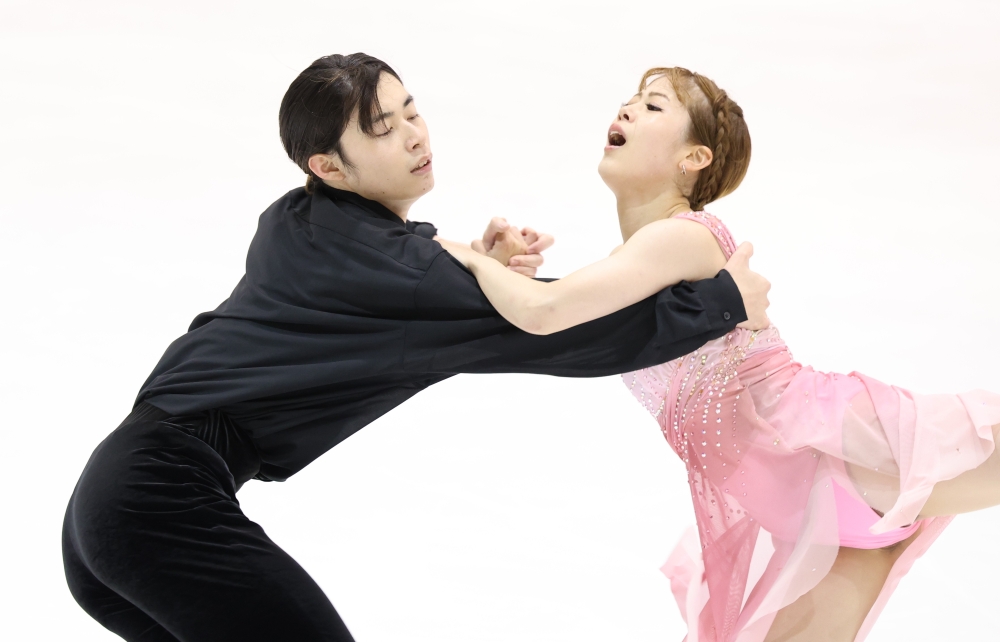
 deepedgeplus.kyodonews.jp

 :
:


