Archive of newspaper articles | Page 35 | Golden Skate

Archive of newspaper articles

1987
"STARS" OF SPORT VISITING OUR NEWSPAPER

Katarina WITT: AFTER ALL, I AM AN ACTRESS!

(the article published in russian 'Sovetskiy Sport' on January 17, 1987)

The Olympic champion, multiple winner of European and world championships, Katarina Witt, is called the successor to the famous figure skaters from the GDR, Gabriele Seyfert and Anett Pötzsch. An unusually artistic, charming athlete, a pupil of coach Jutta Müller, she delights us, the spectators, not only with her flawless execution of ultra-complex technical elements.
Our editorial office receives many letters with requests to arrange a virtual meeting with the celebrated figure skater. We gladly fulfill our readers' request.​

— Please tell us, Katarina, about the beginning of your sporting journey (Yu. Kapitalinina, Sverdlovsk).
— I was born in the small town of Staaken, not far from Berlin. I put on skates for the first time back in kindergarten when I was five years old. Once, my mother and I were walking past the local stadium, and I really liked how beautifully the figure skaters moved on the ice to melodious music. I began to beg my mother to enroll me in a figure skating section. She yielded to my pleas and took me to a children's coach, Heinz Weide, to whom I owe my first success...​
— And how did your creative collaboration with coach Jutta Müller begin? (G. Pilipenko, Radomyshl).
— This happened in 1975. Heinz Weide wrote to Müller that he had a promising student and suggested arranging an audition for me. I came to Karl-Marx-Stadt to the Big Ice Palace where Müller works, and performed several elements. Apparently, she liked my technique because Jutta took me into her group.
— It must have been difficult for you at first to train with such a teacher—strict and demanding, as Jutta Müller is reputed to be? (K. Morozov, Severodonetsk).
— Having started training in her group, I felt a great responsibility all the time — after all, I was skating alongside the world champion Anett Pötzsch. She, by the way, often encouraged me, supported me with a kind word, with advice. But at first it was really not easy for me. Jutta Müller demanded new successes every day. She did not let me relax, calm down for a single second. It was she who taught me how to truly work, and even now I believe that labor is the foundation of all foundations.
Once, in an interview, I read these words by Jutta Müller about me: "Katarina's distinguishing feature is her hard work. None of my students can work as persistently as she does." These words were the highest praise for me. When it gets especially hard, when some element doesn't work out, and it seems impossible to overcome the fatigue, I remember these words of my coach — and a second wind literally opens up.
— Your performances are always distinguished by an interesting dramaturgical concept. You don't just skate a program to a certain music, but you try to create a clear image on the ice. We see you both in the costume of a strict teacher's well-deserved favorite student, and in a jabot and breeches of the little Mozart, and in black lace of a "femme fatale". Whom do you want to surprise — the audience or the judges? (N. Kupriyanov, Vologda).
— In my opinion, there are two groups of figure skaters: athletes and artists. In her time, Peggy Fleming created her own image of a female single skater: grace plus high technique. The synthesis of these two components brought the American figure skater an Olympic gold medal.
But in the early 70s, figure skating began to rapidly complicate, heavily increasing the technical potential of our sport, and women completely forgot about artistry. There were, however, fortunate exceptions — my compatriot Gabriele Seyfert, Janet Lynn. But the general trend was this: women yielded to men in the spirituality of skating, in artistry. John Curry, Robin Cousins achieved a harmonious fusion of the highest technique and the highest artistry, which female single skaters could not even dream of at that time. They honed the technique of steps, performed truly fearless jumps, trying to catch up with men in difficulty. But artistry was left outside their field of vision.
But then the time came when the leaders of the International Skating Union (ISU), prominent figures in figure skating, began to think about the future development of our sport.
And there was something to think about: the championship crown was passing from hand to hand, champions changed one after another, but there was not a single bright, memorable personality among them. The exception was Gaby Seyfert. Wherever she performed, stadiums applauded the golden-haired, mischievous Gaby. It is a pity that she left competitive sports so early — after all, she was only 21 years old at the time, and during the next two or three seasons she would have had no equals in the struggle for world supremacy.
But let's return to the problems of modern figure skating. Artistry is in vogue again. And if in 1981, Sanda Dubravčić from Yugoslavia only needed to maximize her program with triple jumps, two years later she found herself only tenth in the ranking table.
It is very important for figure skaters on ice to be both athletes with pronounced fighting qualities and actresses at the same time.​
— How did the failure last season affect you, when you lost the world champion title? (V. Telegina, Kostroma).
— I believe that failures are an extremely useful thing. They teach you a lot. I never try to blame anyone else for my misfortunes — opponents, the coach, judges. My coach Jutta Müller and I carefully analyzed my performances and the performances of my rivals, primarily Debi Thomas and Tiffany Chin.
Apparently, during the preparation for the 1986 season, we made some miscalculations, underestimated our competitors, and as a result, lost the championship title. Well, in sports, patience and the ability to survive your failures mean a great deal. I hope that the loss last season will serve as a good lesson for me for the future.
— Katarina, why did you change your initial decision regarding your choice of profession — you didn't enroll in a physical education institute, but in a theater institute, in the acting department? (G. Primakov, Vladivostok).
— Probably, this step explains a lot. After all, I am more of an actress than an athlete. But I am not going to part with sports. My closest and main goal is to win back the title of world champion.​
Katarina Witt was interviewed by D. POLYAKOV,
(Special correspondent of APN for "Sovetsky Sport").
1784203135591.jpeg
 
1987
ANOTHER ATTEMPT

(the article published in Ukrainian 'Sportyvna Hazeta' on January 22, 1987)

WEST GERMAN figure skater Claudia Leistner had declared that she was saying goodbye to competitive sports. But not so long ago, reports appeared that she had entered into an agreement with Olympic champion Ondrej Nepela (Czechoslovak Socialist Republic) and, under his guidance, had prepared for the new season.
1784203523997.jpeg
 
1987
EUROPEAN CHAMPIONSHIPS

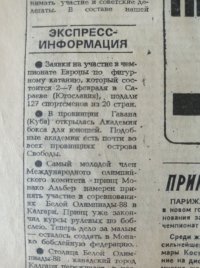
EXPRESS INFORMATION

(the article published in russian 'Sovetskiy Sport' on January 28, 1987)

Applications for participation in the European Figure Skating Championship, which will take place on February 2–7 in Sarajevo (Yugoslavia), have been submitted by 127 athletes from 20 countries.
1784203820236.jpeg
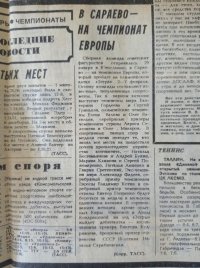
TO SARAJEVO — FOR THE EUROPEAN CHAMPIONSHIP

(the article published in russian 'Sovetskiy Sport' on January 31, 1987)

The Soviet figure skating national team departed on January 29 for Yugoslavia, to Sarajevo — for the European Championship, which will take place at the "Zetra" Olympic ice rink on February 2–7. The core of the team consists of well-known, titled athletes. Thus, in pair skating, the reigning world champions Ekaterina Gordeeva and Sergei Grinkov, Olympic champions Elena Valova and Oleg Vasiliev, and silver medalists of the country's championship Larisa Selezneva and Oleg Makarov will compete. In ice dance, those who swept the entire podium at last year's continental championship will lead the fight for medals: Natalya Bestemianova and Andrei Bukin, Marina Klimova and Sergei Ponomarenko, and Natalya Annenko and Genrikh Sretenskii. Former world champion Aleksandr Fadeev, European championship silver medalist Vladimir Kotin, and country's championship silver medalist Viktor Petrenko will fight for medals in the men's singles event. In the women's singles, alongside the experienced Kira Ivanova and Anna Kondrashova, a debutante will take the ice of "Zetra" — a pupil of coach Viktor Kudryavtsev, 16-year-old USSR championship bronze medalist Natalia Skrabnevskaya.​
(TASS Corresp.)
1784204170500.jpeg
 
1987
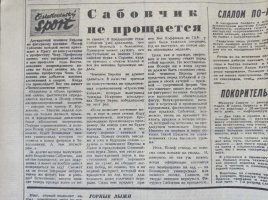
Sabovčík Is Not Saying Goodbye

(the article published in russian 'Sovetskiy Sport' on February 1, 1987)

The two-time European figure skating champion Jozef Sabovčík comes to Prague every month for a consultation with Professor Čech. The professor performed surgery on his knee last May. Recovery of the damaged knee will not be easy, but according to Professor Čech, Sabovčík will still achieve the highest achievements in sports. When will this happen? This is what "Czechoslovak Sport" writes:
"The character and volume of training are currently determined strictly by the doctor, and Jozef is a very disciplined patient," says his coach I. Buržilová. "For many weeks in autumn he only skated; jumps and rotational movements were absolutely forbidden. The first competition in which Jozef will participate will probably be the World Winter Universiade, which takes place at the end of February in Czechoslovakia. And after that, we will see..."
During the long months of forced inactivity, Sabovčík, as he himself admits, doubted more than once: is it even worth returning to the ice? Will he be able to regain the same form he had before after the operation? Naturally, a lot now depends primarily on himself. In previous years, Sabovčík has already proven that he knows how to fight illnesses. An example could be his performance at the Winter Olympic Games in Sarajevo, where he arrived with a swollen knee and still won the bronze medal.
The European Champion does not intend to give up. As a spectator, he attended the traditional "Prague Skate" competition, which he had won three times. He sincerely applauded Petr Barna, who won this time.
"If my health allows, I will compete again this season, repeating last year's free program. There will be no time for a new one, although I believe that I will be able to skate well in the future. To be honest, I am already thinking about next season—I am thinking about the European Championship in Prague and the upcoming Olympic Games. I know that such a long forced break in performances does not bode well for me, does not promise easy victories, but I remember that I am not the first figure skater who returns to the ice after a long, even year-long, break. I am inspired by the example of Jan Hoffmann from the GDR: he had a serious operation, did not compete for a year, but then returned to win medals."
The goals, as before, that the athlete and his coach set for themselves are high. But the recovery of Jozef should by no means be rushed: the European Champion wants to appear before the public and judges in his best—former—athletic shape. This means, as all figure skating fans know: flawless execution of compulsory figures, faultless skating in short and free programs, filigree triple jumps. Sabovčík may, quite possibly, again not fail to show a quadruple toe loop, which he performed at the previous European Championship. He was the first in the world to show such a jump in competitions of such a high level.
Thus, Jozef has by no means hung up his skates. And probably, it is not so important when his official return to the ice will take place—at the World Universiade or a bit later. The main thing is that he firmly intends to return. Figure skater Sabovčík is not saying goodbye...
1784366190261.jpeg
 
1987
EUROPEAN CHAMPIONSHIPS

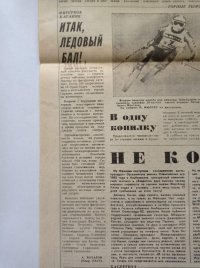
AND SO, THE ICE BALL!

(the article published in russian 'Sovetskiy Sport' on February 3, 1987)

A bold stroke left by a figure skater’s blade on the blue ice is the main detail of the emblem of the European Figure Skating Championships. More than 100 athletes from 18 countries will compete in the Yugoslav city of Sarajevo for the title of the strongest on the continent.
Meetings with leading masters of this popular sport were eagerly anticipated by the residents of ancient Sarajevo. Their hospitality will undoubtedly help turn the championship into a colorful and bright celebration on the ice of the "Zetra" Sports Palace.
The hosts' organizational skills and their ability to create excellent conditions for athletes have been demonstrated more than once at many major international competitions. The year 1984 is written in golden letters into the history of the city, when Sarajevo was the capital of the XIV Winter Olympic Games. Many of the participants in the current European Championship were able back then to get acquainted with the excellent sporting facilities of the city, the objectivity, and the hospitality of local sports fans.
Great attention is paid by the Yugoslav press to the Soviet masters of figure skating, considering them the main favorites in all events of the competition. The chances of success for Aleksandr Fadeev and Viktor Petrenko, the ice dance duets Natalya Bestemyanova – Andrey Bukin, Marina Klimova – Sergey Ponomarenko, and the pairs skaters Elena Valova – Oleg Vasiliev, Ekaterina Gordeeva – Sergey Grinkovo are highly rated.​
A. BOCHAROV.
(TASS Corr.).
1784370581538.jpeg
 
1987
EUROPEAN CHAMPIONSHIPS

FIGURE SKATING

(the article published in russian 'Sovetskiy Sport' on February 4, 1987)

BELGRADE. At the European Figure Skating Championships, the first leaders in the men's event have been determined. These are USSR champion Aleksandr Fadeev, Vladimir Kotin, and Viktor Petrenko. They were the best in the compulsory program.
A total of 23 figure skaters from 17 countries are participating in the men's competition. Late Tuesday evening, the pairs competition began with the performance of the short program. These are 9 duets from Great Britain, GDR, France, FRG, Czechoslovakia, and the USSR.
1784370931982.jpeg
 
1987
EUROPEAN CHAMPIONSHIPS

A Wonderful Start

(the article published in Ukrainian 'Sportyvna Hazeta' on February 5, 1987)

On the Olympic ice rink in the Yugoslav city of Sarajevo, the current European Figure Skating Championships have started, bringing together over a hundred athletes from 18 countries.
The Soviet national team includes world pairs skating champions E. Gordeeva and S. Grinkov, Olympic gold medalists E. Valova and O. Vasiliev, and Winter Games bronze medalists L. Selezneva and O. Makarov. The ice dance trio looks strong: European and World champions N. Bestemianova and A. Bukin, silver medalists of these tournaments M. Klimova and S. Ponomarenko, and bronze medalists N. Annenko and G. Sretenski.
Coaches also have high hopes for the singles skaters—A. Fadeev, V. Kotin, and V. Petrenko. The women also have what it takes to compete for medals—K. Ivanova, A. Kondrashova, and N. Skrabnevskaya.
The men, representing 17 countries, were the first to start the competition. It is pleasing that Aleksandr Fadeev, Vladimir Kotin, and Viktor Petrenko topped the standings after the compulsory figures. Fans of this sport from our republic are, of course, following the performance of the young Odesa skater Viktor Petrenko with particular attention, who is coached by the Honored Coach of the Ukrainian SSR Galina Zmievskaya. Well, our compatriot passed the test in the "school" [compulsory figures] wonderfully. Keep it up!
The relay from the men was taken over by the Soviet pairs. After the short program, Valova–Vasiliev, Selezneva–Makarov, and Gordeeva–Grinkov are in the lead.
1784371569816.jpeg
 
1987
EUROPEAN CHAMPIONSHIPS

A FAMILIAR ROAD LEADING UPWARD

(the article published in russian 'Sovetskiy Sport' on February 6, 1987)

Our special correspondent reports from Yugoslavia

The title of European Champions in pairs skating has been won by Soviet figure skaters Larisa Selezneva and Oleg Makarov.


I must confess that I initially wanted to dedicate the opening of this first report from the European Figure Skating Championships in Sarajevo to the capital of the XIV Winter Olympic Games—what it looks like now, three years later. However, the events that took place in the "Zetra" Sports Palace completely rewrote those intentions.
Therefore, I will start with the most important news: on Wednesday evening, the gold medals of the European Champions in pairs skating were won by Leningrad athletes Larisa Selezneva and Oleg Makarov. Moreover, the plot of the struggle for the tournament's top awards unexpectedly took on a highly dramatic character.
First, a look at how the events unfolded on the ice. After the first day of competition for pairs in the short program, the leaders were E. Valova and O. Vasiliev. They were followed by L. Selezneva and Oleg Makarov, while the 1986 world champions, E. Gordeeva and S. Grinkov, held the third position. Fourth place (out of nine competing pairs in total) was occupied by K. Kanitz and T. Schröter from the GDR.
...Everything was pointing toward the likelihood that three Soviet pairs would ascend the podium. The only question was: in what order?
And so, nine duets from six countries started in the decisive phase of the competition. The final group of the strongest competitors featured three Soviet pairs. Gordeeva and Grinkov were the first to step onto the ice (they were "lucky" in this regard, as they had also opened the tournament in the short program).
The touching, still childishly delicate Katya Gordeeva and her noble knight Sergey Grinkov began to effortlessly and naturally conduct their ice "conversation" to popular jazz tunes. About a minute, perhaps a little more, had passed when the music suddenly stopped. In the ensuing silence, the referee's whistle blew. The referee signaled that the performance must be halted. However, at that exact moment, the arena had already begun to loudly support the athletes with applause, and they continued skating without music.
Memories shifted back to 1973 at the World Championships in Bratislava, when I. Rodnina and A. Zaitsev continued their free program under similar circumstances. Back then, the music had also cut out.
But what happened here? Was it the same thing? No, the referee noticed that the strap on the partner's trousers had unfastened. This posed a risk of a potential injury. That was the reason the whistle blew.
Did Katya and Sergey hear it? They should have heard it.
It was impossible to ask them about this—they left for the locker room and remained there. The skaters' coach, S. Leonovich, also seemingly failed to adapt to the situation, likely forgetting the rules.
I must emphasize that because of the noise in the arena, it was immediately difficult to grasp the situation. Our kids skated their program to the very end. However, this performance was ruled "invalid." They were offered the chance to step onto the ice once more at the very end of the competition. It was easy to notice how Katya Gordeeva immediately looked demoralized. Who could have known that such an ordeal would fall to their lot! Looking ahead, I will say that making a "double," as in a movie, turned out to be simply beyond the kids' strength. The judges waited for two minutes. However, Ekaterina and Sergey did not appear on the ice; they withdrew from the competition.
By all accounts, our athletes were not sufficiently aware of the international rules. According to one of the rule points, they were obligated to interrupt their performance immediately after the referee's signal...
E. Valova and O. Vasiliev, who performed next, felt the "psychological weight" of the struggle. The female partner fell at the very beginning of the program. Nevertheless, the Olympic champions managed to hold onto second place.
And what about L. Selezneva and O. Makarov, who started at the very end? They executed their free program at the highest level, moreover without any technical mistakes, earning scores predominantly of 5.8 and 5.9 points. The composition of the new champions, set to the music of A. Rybnikov and melodies by composer de Falla, made the spectators forget about everything else.
Selezneva and Makarov rightfully became the Champions of Europe, proving once again the high class of Soviet figure skaters in pairs skating. The winners demonstrated a true sporting character, confidently moving toward victory despite any external circumstances.
Every unexpected event has its own internal logic. This was the case this time as well. Already after the short program (let me remind you, Larisa and Oleg were second then), I heard the most flattering reviews about them in conversations with leading coaches. They also made a strong impression at the national championship in January in Vilnius. One could feel that they were ready for big things. And this was fully confirmed.
In general, the new European champions are well known to sports fans. They have won tournaments for the prizes of the Moskovskie Novosti newspaper many times. Under the guidance of Leningrad coach I. Moskvin, they were bronze medalists of the XIV Winter Olympic Games and medalists of the European Championships. And here is a new milestone: Larisa and Oleg are the best pair on the continent in pairs skating! Along with the Honored Coach of the USSR I. Moskvin, this success is shared by choreographers V. Pechersky, Yu. Potemkin, and E. Usubova.
...The road to the "Zetra" Sports Palace leads upward from the very center of Sarajevo, to where the snow is always brighter and cleaner. Larisa Selezneva and Oleg Makarov learned this road three years ago at the Winter Olympics. And now, it has led them to the gold medals of the European tournament. A familiar road leading upward.

On Thursday, the women began their competition. After the execution of the three compulsory figures, the silver medalist of the 1986 European Championship, Kira Ivanova, is leading. In second place is Claudia Leistner (FRG), and in third is USSR champion Anna Kondrashova. Olympic champion Katarina Witt (GDR) currently holds fourth place.
Following the performance of the original dance "Viennese Waltz" by the ice dance duets, Natalia Bestemianova and Andrey Bukin continue to lead. Marina Klimova and Sergey Ponomarenko are in second place, with Natalia Annenko and Genrikh Sretenski in third.​
A. DOBROV.
SARAJEVO, February 5.
TECHNICAL RESULTS
European Figure Skating Championships. Sarajevo (Yugoslavia). "Zetra" Sports Palace. February 4.
Pairs Skating. All-Around Total.
1. L. Selezneva – O. Makarov – 1.8; 2. E. Valova – O. Vasiliev (all – USSR) – 2.4; 3. K. Kanitz – T. Schröter (GDR) – 4.6; 4. L. Knapova – R. Novotny (Czechoslovakia) – 6.0; 5. C. Peake – A. Naylor (Great Britain) – 7.4; 6. S. Adalbert – D. Caprano (FRG) – 9.2.
Men's Singles. Total of Compulsory Figures and Short Program. 1. A. Fadeev – 1.0; 2. V. Kotin – 2.4; 3. V. Petrenko (all – USSR) – 2.6; 4. F. Kirsten (GDR) – 5.8; 5. F. Harpagès (France) – 6.4; 6. R. Zander (FRG) – 7.2.
1784376129746.jpeg
1784376146475.jpeg
 
1987
EUROPEAN CHAMPIONSHIPS

Conceded Only One Medal

(the article published in Ukrainian 'Sportyvna Hazeta' on February 7, 1987)

At the European Figure Skating Championships held in the Yugoslav city of Sarajevo, winners have been decided in two disciplines. Notably, five out of the six medals went to Soviet masters.
AS IS KNOWN, after the first day of competition, the leaders were E. Valova – O. Vasiliev, L. Selezneva – O. Makarov, and E. Gordeeva – S. Grinkov. However, the free program was skated best by the students of Honored Coach of the USSR Igor Moskvin—24-year-olds Selezneva and Makarov (seven out of nine judges awarded first place to the Leningrad skaters), which allowed them to capture the championship title. Meanwhile, the leaders made two major mistakes, finishing in second place as a result.
Naturally, we were counting on the bronze medals as well, but the unexpected happened. During the performance of world champions E. Gordeeva and S. Grinkov, the music suddenly cut out. Figure skating fans surely remember a similar incident that occurred at the 1973 World Championships in Bratislava with our renowned masters I. Rodnina and A. Zaitsev. Back then, the Soviet skaters continued their performance in silence and were rewarded with applause and top titles. This time, Ekaterina and Sergey also brilliantly finished their composition. However... the issue was that the referee, American B. Wright, noticed that the foot-strap on the partner's trousers had snapped after a double-and-a-half Axel jump, and he ordered the music to be stopped. Of course, the reason for the stoppage remained unnoticed by the athletes. Imagine their disappointment when they were asked to repeat their entire routine from the beginning ten to fifteen minutes later. They simply did not have the stamina left to do so. Consequently, the bronze medals went to the pair from the GDR, K. Kanitz and T. Schröter.
On the other hand, our representatives in the men's singles event completely swept the podium. The best was A. Fadeev, followed by V. Kotin and V. Petrenko. We must highlight the success of the "graduate" of the Odesa figure skating school, V. Petrenko, who became the first in our republic to pave the way to a medal in this sport. The audience generously showered applause on the image of Spartacus created by Viktor to the music of Aram Khachaturian. It was a wonderful mini-spectacle of solo theater.
Soviet athletes continue to set the tone in the other two disciplines as well. Following the execution of the original dance "Viennese Waltz" by the ice dance duets, N. Bestemianova and A. Bukin are in the lead. They are followed by M. Klimova – S. Ponomarenko and N. Annenko – G. Sretenski.
In the women's event, K. Ivanova is in first place, C. Leistner from the FRG is second, and USSR champion A. Kondrashova is third.
1784377117165.jpeg
 
1987
EUROPEAN CHAMPIONSHIPS

AN EQUATION WITH THREE KNOWNS

(the article published in russian 'Sovetskiy Sport' on February 7, 1987)

Our special correspondent reports from Yugoslavia

Our figure skaters have set quite a few records of their own. For example, at last year's championship in Copenhagen, the entire podium in ice dance and pairs skating belonged to them. Yesterday, another step was taken—three Soviet athletes were awarded medals based on the results of the men's singles competition. Aleksandr Fadeev became the European Champion, Vladimir Kotin took the silver, and the bronze medal went to Viktor Petrenko.
Is it pleasing? Very much so! However, it is not just about winning three medals. The overall progress of our men's figure skating is what truly brings joy. It is also gratifying that the awards went to athletes who are genuinely the strongest in Europe today. True, Jozef Sabovčík (Czechoslovakia), a universally recognized master, did not compete. Heiko Fischer from the FRG, another tested warrior, was also absent. Sabovčík recently suffered a second injury, putting his entire sporting future in question, while Fischer fell ill with the flu. Well, these things happen. It has happened to our skaters too—for instance, injuries plagued Aleksandr Fadeev last season. Nevertheless, it is clear that today both Sabovčík and Fischer are already trailing behind Fadeev and Kotin. Undoubtedly, their participation could have intensified the struggle at the European Championships in Sarajevo. Even in a direct face-off, though, I am confident our guys would have won.
This, of course, does not mean they lacked worthy competitors or that victory came easily and automatically. No, that was not the case, as the most unpredictable obstacles could have arisen on the path to this triumph. Do we need to look far for examples? Remember: right here in Sarajevo, we were certain of the total success of our pairs. In the end, we lost one "one-hundred-percent" medal from Gordeeva and Grinkov.
Furthermore, returning to singles skating, the opponents faced by our boys were quite strong. Take the Polish skater Grzegorz Filipowski, who has been training in the USA for two years. There was also Falko Kirsten from the GDR. Others have emerged too—young, ambitious, and hungry for competition.
What we see is a battle for the supremacy of our figure skating school across all disciplines. It is a fair, truly sporting struggle. At its core lies the immense work of athletes and specialists, along with the attention of sports organizations both at the national and local levels. Finally, there is a rivalry of creative trends and schools. These are represented by widely known authorities as well as coaches who have proven themselves exceptionally well recently (the example of the Odesa school is already becoming classic).
However, I have distracted myself a bit. So, how did the events unfold during the three days of the men's performances? I will say right away: Fadeev, Kotin, and Petrenko were the best from start to finish. This held true in the compulsory figures, the short program, and the free skate.
I will note that Kotin improved his performance in the compulsory figures (which did not escape the attention of the ISU technical committee). Petrenko looked more confident, especially in the short program where he took second place right behind Fadeev. However, in the combined total of the "school" [compulsory figures] and the short program, Kotin remained in the second position. Sasha Fadeev was the leader for all three days.
In the evening, when the tournament medals were being decided, Fadeev stepped onto the ice of the "Zetra" Sports Palace in the final warm-up group ahead of his main rivals—Kotin and Petrenko. Russian folk melodies filled the arena, and Fadeev began his routine with his most difficult jumps. He did not simply skate; he danced on the ice, commanding the space with complete freedom. Both the spectators and the judges appreciated this performance. The latter rewarded him with exceptionally high marks, especially for artistic impression: two 6.0s, five 5.9s, and only two 5.8s.
Sometime later, I asked the former world champion and current coach S. Volkov, who became our very first global singles champion nearly 15 years ago, how Fadeev’s technical execution differs from the technique of the top figure skaters of those earlier years.
"In the past, even the strongest masters executed only three triple jumps, whereas Sasha demonstrated five triples and one triple-and-a-half Axel jump. This represents a massive difference," Volkov stated. "Yet, even that is not everything. We must emphasize the immense progress made by today's skaters, not only in technical terms but also in choreographic preparation, music selection, and other components."
Vladimir Kotin was also magnificent yesterday. He is undeniably gifted with artistic talent, which the spectators feel with particular intensity. Kotin, through the musical background of his routines, which combined classical melodies, brought genuine joy to everyone present. He was also at his peak from a technical standpoint, resulting in a second-place finish. This marks a great success for both the athlete and his coach, E. Tchaikovskaia.
Viktor Petrenko will turn 18 only in June. He is a truly young athlete, seemingly the youngest among all the singles skaters competing here. Yet, in terms of mastery, he displays a maturity far beyond his years. Yesterday, unfortunately, his performance was not at its absolute best (such is the dialectic of sports), as he missed two jumps while striving to display his maximum capabilities. However, the judges fell under the sway of his magical talent and still awarded Petrenko high marks. This is his very first medal at a senior Championship, and it marks a premiere success of this scale for his coach, G. Zmievskaia from Odesa.
The Polish skater G. Filipowski proved what true talent means. He performed beautifully yesterday, despite not being in the final group of the strongest skaters. After placing eighth on the second day, he finished fourth overall.
And so, our guys performed at their absolute peak yesterday. After all, three years ago at the Winter Olympic Games right here in Sarajevo, Fadeev and Kotin did not please us at all, finishing seventh and eighth respectively. Now, everything has flipped. Is this not clear evidence of their growth? There is one more detail—small, yet telling—regarding the reaction of not the spectators, but our Austrian television colleagues, who are well-known figures in the skating world: Emmerich Danzer and Ingrid Wendl. They applauded all three of our masters with genuine delight.
And how many questions were directed at Fadeev, Kotin, and Petrenko by journalists at the press conference! The conversation covered many topics, including how they plan to perform at the upcoming World Championships in Cincinnati. "Better than today," was the concise response from our athletes.
It appears that our ice dancers, who currently hold the top three positions, will be able to answer in a similar fashion. In the women's event, the situation is shaping up differently. There is a fierce battle ahead between our Kira Ivanova and Anna Kondrashova against their main foreign rivals. We will see how it ends.​
A. DOBROV.
SARAJEVO, February 6.
TECHNICAL RESULTS
European Figure Skating Championships. Sarajevo (Yugoslavia). "Zetra" Sports Palace. February 5.
Men's Singles. All-Around Total.
1. A. Fadeev – 2.0; 2. V. Kotin – 4.4; 3. V. Petrenko (all – USSR) – 5.6; 4. G. Filipowski (Poland) – 11.4; 5. F. Kirsten (GDR) – 12.8; 6. R. Zander (FRG) – 13.2.
1784379173281.jpeg
1784379194329.jpeg
FIGURE SKATING

(the article published in russian 'Sovetskiy Sport' on February 7, 1987)

SARAJEVO. The women's short program competition was won by Olympic champion K. Witt (GDR). Muscovite A. Kondrashova was second, and K. Ivanova was third. In the combined total of the two segments, Ivanova continues to lead. She is followed by Kondrashova and Witt. A debutante of the European Championship, 16-year-old N. Skrabnevskaya, is in ninth place.​
(TASS).
1784379542841.jpeg
 
Last edited:
1987
EUROPEAN CHAMPIONSHIPS

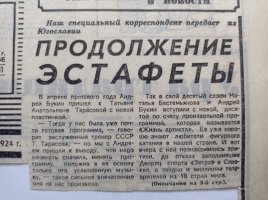
CONTINUATION OF THE RELAY

(the article published in russian 'Sovetskiy Sport' on February 8, 1987)

Our special correspondent reports from Yugoslavia

In April of last year, Andrey Bukin came to Tatyana Anatolyevna Tarasova with a new vinyl record.
"Back then, we already had a nearly completed program," says Honored Coach of the USSR T. Tarasova, "but Andrey and I came to the conclusion that we needed to start over from scratch, to change the program, making the just-heard music its foundation—it made such a powerful impression on us."
Thus, in their tenth season, Natalya Bestemianova and Andrey Bukin entered with a new, tenth consecutive free dance program, which is called "An Artist's Life." It is already well known to figure skating fans in our country. And yesterday, it was introduced to the spectators who packed the "Zetra" Sports Palace in Sarajevo to capacity, as well as to millions of television viewers from 18 countries around the world.
The arena was simply stunned. Yes, right here in Sarajevo, the Olympic figure skating tournament took place, in which the best masters participated—including Bestemianova and Bukin (who became silver medalists back then). But that was three years ago. In the time since, figure skating in general, and Soviet skating in particular, has taken a new step forward. And the spectators could clearly see this.
A four-minute sporting masterpiece on ice—that is what the now four-time European Champions demonstrated yesterday. Their supreme mastery and artistic skill could not leave anyone indifferent. The spectators witnessed a mini-spectacle in which the partners' characters and the concept of an extraordinarily complex composition, executed, as they say, in a single breath, were fully revealed.
During the awards ceremony, I asked T. Tarasova what primarily distinguishes her students.
"The main thing is that they perceive ice dance with both mind and heart," she answered. And she added: "And I am also proud that my students are becoming champions. This is another trait inherent to them."
Well, this may have been said a bit loudly, but not without basis. Let us remember Moiseeva and Minenkov, and now Bestemianova and Bukin. The relay continues, and it began in the work of coach T. Tarasova two decades ago, when she herself was not yet 20 years old. She has managed to achieve a lot, and she will do even more over the years.
The coach of the now four-time European Champions also spoke about how wonderful it is that we have three ice dance couples who are completely different in their performance style but are all incredibly interesting. It is impossible to disagree with this, and it is impossible not to rejoice in it.
Indeed, the duets M. Klimova – S. Ponomarenko and N. Annenko – G. Sretenski, who took second and third places respectively, represented different schools and creative directions. Yet, they share the most critical traits with Bestemianova and Bukin—supreme technical mastery, choreographic culture, and an emotional depth that triggers profound empathy from the audience.
Annenko and Sretenski were the first of our couples to step onto the ice (they skated second in the final group of the strongest competitors). As students of our outstanding former figure skater Lyudmila Pakhomova, they are developing her traditions—now under the guidance of G. Akkerman. The duet virtually soars over the ice to the music of Tchaikovsky—noiselessly, mesmerizing the arena.
Klimova and Ponomarenko performed right after Bestemianova and Bukin. The champions' scores were the highest: for technical merit—all 5.9s; for artistic impression—six maximum 6.0s and three 5.9s. Outdoing them was practically impossible, but the goal remained—to perform successfully. And Marina and Sergey coped with this task beautifully. The spectators witnessed another brilliant dance, set to Hungarian melodies by Liszt. Is it possible to express a deeply national musical character in ice dance any better? It feels like this is already the limit. For today—yes, but what about tomorrow? That is already the concern of the athletes and their coach, N. Dubova, who has trained more than one first-class dance couple in her school and continues to work persistently and creatively.
Among the 18 ice dance duets, not counting the three Soviet couples, attention was drawn to those who are closer in style to our figure skaters—a style of composition that allows for the creation of vivid images rather than simply demonstrating a well-coordinated execution of dances on ice. The brightest example in this regard is the French sister and brother, Isabelle and Paul Duchesnay. They performed to Spanish melodies and demonstrated a very interesting, unique mini-spectacle in the traditions of our figure skating school. By the way, the two-time champions of France utilized consultations from Soviet coaches. The judges appreciated their style too: from seventh place, they ultimately moved up to fifth.
And onto the podium, just like a year ago in Copenhagen, ascended three Soviet ice dance duets—N. Bestemianova – A. Bukin, M. Klimova – S. Ponomarenko, and N. Annenko – G. Sretenski. It might seem like a mere repetition of past success, but no—this is a brand-new triumph, a new peak in the creative journey of the athletes, coaches, and everyone who forged this remarkable victory.​
A. DOBROV.
SARAJEVO, February 7.
TECHNICAL RESULTS
European Figure Skating Championships. Sarajevo. "Zetra" Sports Palace. February 6.
Ice Dance. All-Around Total. 1. N. Bestemianova – A. Bukin – 2.0; 2. M. Klimova – S. Ponomarenko – 4.0; 3. N. Annenko – G. Sretenski (all – USSR) – 6.0; 4. K. Beck – C. Beck (Austria) – 8.0; 5. I. Duchesnay – P. Duchesnay (France) – 11.6; 6. K. Engi – A. Tóth (Hungary) – 11.6.
Women's Singles. Total of Compulsory Figures and Short Program. 1. K. Ivanova – 1.8; 2. A. Kondrashova (both – USSR) – 2.6; 3. K. Witt (GDR) – 2.8; 4. C. Leistner (FRG) – 2.8; 5. S. Becher (FRG) – 5.0; 6. C. Villiger (Switzerland) – 6.4; ... 9. N. Skrabnevskaya (USSR) – 9.8.​
1784385616700.jpeg
1784385642167.jpeg
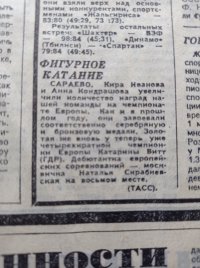
FIGURE SKATING

(the article published in russian 'Sovetskiy Sport' on February 8, 1987)

SARAJEVO. Kira Ivanova and Anna Kondrashova have increased our team's medal count at the European Championships. Just like last year, they won the silver and bronze medals, respectively. The gold once again belongs to the now four-time European Champion, Katarina Witt (GDR). A debutante of the European competitions, Muscovite Natalia Skrabnevskaya, finished in eighth place.​
(TASS).
1784385918005.jpeg
 
1987
EUROPEAN CHAMPIONSHIPS

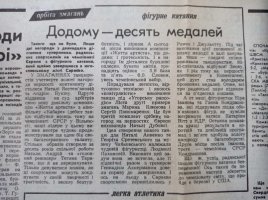
Home — Ten Medals

(the article published in Ukrainian 'Sportyvna Hazeta' on February 10, 1987)

Such a thing has never happened before. Only two awards out of twelve went to competitors of Soviet athletes at the European Figure Skating Championships, which recently concluded in the Yugoslavian city of Sarajevo.
IN THE ICE DANCING COMPETITION, the fourth gold awards of the continental championship went to Natalia Bestemianova and Andrei Bukin. Presenting for the second time their new free program to the judges, set to the film "Cabaret" (which debuted a month ago at the USSR Championship in Vilnius), our leaders once again beautifully demonstrated another side of their multifaceted talent. So many images have been created over ten years of collaborative work by Natalia, Andrei, and "chief director" Tatiana Tarasova, that they are impossible to count. One can only marvel at how these athletes can combine tragedy, cheerful carefreeness, and lyricism in their creativity. Today, after performing the composition "Life of an Artist", we will add: grotesque too. In return, they received stormy applause, bouquets of flowers, thirteen marks of 5.9 points and five — 6.0 points. In short, the entire championship set.
Marina Klimova and Sergei Ponomarenko, the second-prize winners of the competition, delighted everyone with their lightness, virtuoso technique, and a certain "airiness" in performing a dance to Liszt's "Hungarian Rhapsody". This was the third set of silver awards at the European Championships for the pupils of Natalia Dubova.
The idea of creating a new dance for Natalia Annenko and Genrikh Sretenski to the music of Tchaikovsky belonged to the wonderful figure skater Liudmila Pakhomova. She did not have time to fulfill this dream, but her students, together with coach Gennady Akkerman, brought the matter to completion. And so on the ice in Sarajevo, the athletes transformed into Romeo and Juliet. During the performance of this melody, filled with lyricism, silence reigned in the hall — the audience sympathized with the dancers. The mini-performance was a success! Just like a year ago at the continental championship in Copenhagen, this duet became the winners of bronze medals. Thus, all three Soviet couples stepped onto the podium of honor.
But our figure skaters Kira Ivanova and Anna Kondrashova, who led after the compulsory figures, could not withstand the pressure of Katarina Witt from the GDR. The latter showed the best results in the short and free programs and won the gold medal in the all-around for the fifth time. Second place was taken by Ivanova, and third by USSR champion Kondrashova.
Well, the success of the Soviet school of figure skating is undeniable! Now, it would be great to maintain this victorious mood until the World Championships, which will take place in March in the USA.
1784438786451.jpeg
 
1987
EUROPEAN CHAMPIONSHIPS

Repeat of the Past

(the article published in russian 'Sovetskiy Sport' on February 10, 1987)

Our special correspondent reports from Yugoslavia

The final day of the showcase of the best masters of European figure skating concluded with the performance of female athletes in the free program; the fourth set of medals was being contested. The main struggle for the champion title was led by Soviet figure skaters K. Ivanova and A. Kondrashova, multiple winner of the European and World championships K. Witt from the GDR, and C. Leistner from the FRG.
The three days of competition can be called days of joys and disappointments for all the leaders. After the performance of the first compulsory figure, A. Kondrashova pulled ahead, followed by K. Ivanova who eventually won the compulsory figures 'school'. Kondrashova occupied only the third position, Leistner was second, and Witt was fourth.
In the short program, the athlete from the GDR makes a surge: she has the best result. Kondrashova, who performed excellently, is second. Behind them are Ivanova and Leistner. However, in the sum of the compulsory and short programs, Ivanova and Kondrashova are in the lead. Witt is only third, and Leistner is fourth. No one else could get close to them.
And so, on the final day of the competition, this top four entered a decisive battle among themselves. Recall that at this point, the Soviet team already had three gold medals to its credit.
Would a sensation occur that had never happened before in the history of European championships—would one national team take home all four gold awards?
No, it did not happen. Katarina Witt became the champion with a brilliant performance. She wrapped up the final skating group, performing last, right after A. Kondrashova and then K. Ivanova had both skated before her.
Anna started her program excellently. She glided quickly, effortlessly, and looked very elegant. But then the slips began: at first not very serious, and then disappointing ones. Neither the scores nor Kondrashova's performance as a whole could possibly be called championship-level. Apparently, even the computer 'felt' this and placed our athlete behind Leistner on the display screen. Fortunately, the computer managed to right itself quite quickly.
Now it was Ivanova’s turn, the student of Honored Master of Sports V. Kovalev. The "Gypsy Melodies" by Sarasate play. And Kira starts excellently, confidently. But, as could be seen, her reserve of strength was insufficient. Demonstrating a program filled with elements of the highest difficulty, Kira made several mistakes. But for now, she is first.
But only for the time being, because the four-time European Champion K. Witt takes the ice. This Sarajevo ice is a happy one for her—it was here that she became an Olympic champion. True, last year she conceded the top spot at the World Championships to the American D. Thomas.
Did the star of Witt fade?
No. Both the audience and the judges, naturally, immediately recognized the championship style of the figure skater from the GDR. She did not simplify her program, although she could have; she executed all elements cleanly, demonstrating technique, fluidity, and charm. The scores were the highest! Among them were seven 5.9 marks for presentation. A well-deserved victory! Note that the top three figure skaters of Europe stepped onto the podium of honor in the exact same order as at the previous continental championship in Copenhagen.
Our girls lacked stability and confidence in their abilities. And both Ivanova and Kondrashova certainly possess them. However, the Soviet figure skaters have been eyeing the prestigious titles for far too long. They are making progress, but their rivals—primarily from the GDR, the USA, and Canada—are moving forward at a much faster pace.
On the whole, the European Championships in Sarajevo passed with success for the USSR team. Our female skaters conceded only one gold medal to the competitor from the GDR. Now it is important to reinforce this victorious mood until the World Championships in Cincinnati, where the competition will be significantly higher, especially in single skating disciplines.​
A. DOBROV
SARAJEVO, 9 February.
Technical Results
European Figure Skating Championships. Sarajevo, Zetra Palace. 7 February.
Women. Final result.
1. K. Witt (GDR) — 3.8; 2. K. Ivanova (USSR) — 3.8; 3. A. Kondrashova (USSR) — 5.6; 4. C. Leistner (FRG) — 6.8; 5. S. Becher (FRG) — 10.0; 6. C. Villiger (Switzerland) — 14.4… 8. N. Skrabnevskaya (USSR) — 16.8.
1784443510603.jpeg
 
1987
TRADE UNION SOCIETIES CHAMPIONSHIP

FIGURE SKATING

(the article published in russian 'Sovetskiy Sport' on February 11, 1987)

GORKY. The figure skating championship of trade union sports societies took place at the Palace of Sports.
An interesting struggle for medals unfolded in the men's singles category and in ice dance. The winners were Yu. Tsimbalyuk (Odesa) and Moscow ice dancers L. Fedorinova and E. Platov. Among women, first place was taken by L. Zamotina from Sverdlovsk, and in pair skating, her compatriots Yu. Bystrova and A. Tarasov excelled.​
V. MELNIKOV.
1784459839772.jpeg
 
Last edited:
Back
Top