- Joined
- Nov 30, 2016
1987
— Please tell us, Katarina, about the beginning of your sporting journey (Yu. Kapitalinina, Sverdlovsk).
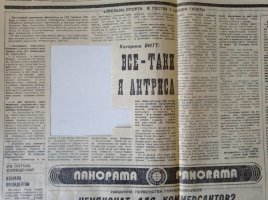
"STARS" OF SPORT VISITING OUR NEWSPAPER
Katarina WITT: AFTER ALL, I AM AN ACTRESS!
(the article published in russian 'Sovetskiy Sport' on January 17, 1987)
Katarina WITT: AFTER ALL, I AM AN ACTRESS!
(the article published in russian 'Sovetskiy Sport' on January 17, 1987)
The Olympic champion, multiple winner of European and world championships, Katarina Witt, is called the successor to the famous figure skaters from the GDR, Gabriele Seyfert and Anett Pötzsch. An unusually artistic, charming athlete, a pupil of coach Jutta Müller, she delights us, the spectators, not only with her flawless execution of ultra-complex technical elements.
Our editorial office receives many letters with requests to arrange a virtual meeting with the celebrated figure skater. We gladly fulfill our readers' request.
Our editorial office receives many letters with requests to arrange a virtual meeting with the celebrated figure skater. We gladly fulfill our readers' request.
— Please tell us, Katarina, about the beginning of your sporting journey (Yu. Kapitalinina, Sverdlovsk).
— I was born in the small town of Staaken, not far from Berlin. I put on skates for the first time back in kindergarten when I was five years old. Once, my mother and I were walking past the local stadium, and I really liked how beautifully the figure skaters moved on the ice to melodious music. I began to beg my mother to enroll me in a figure skating section. She yielded to my pleas and took me to a children's coach, Heinz Weide, to whom I owe my first success...
— And how did your creative collaboration with coach Jutta Müller begin? (G. Pilipenko, Radomyshl).— This happened in 1975. Heinz Weide wrote to Müller that he had a promising student and suggested arranging an audition for me. I came to Karl-Marx-Stadt to the Big Ice Palace where Müller works, and performed several elements. Apparently, she liked my technique because Jutta took me into her group.
— It must have been difficult for you at first to train with such a teacher—strict and demanding, as Jutta Müller is reputed to be? (K. Morozov, Severodonetsk).
— Having started training in her group, I felt a great responsibility all the time — after all, I was skating alongside the world champion Anett Pötzsch. She, by the way, often encouraged me, supported me with a kind word, with advice. But at first it was really not easy for me. Jutta Müller demanded new successes every day. She did not let me relax, calm down for a single second. It was she who taught me how to truly work, and even now I believe that labor is the foundation of all foundations.
Once, in an interview, I read these words by Jutta Müller about me: "Katarina's distinguishing feature is her hard work. None of my students can work as persistently as she does." These words were the highest praise for me. When it gets especially hard, when some element doesn't work out, and it seems impossible to overcome the fatigue, I remember these words of my coach — and a second wind literally opens up.
— Your performances are always distinguished by an interesting dramaturgical concept. You don't just skate a program to a certain music, but you try to create a clear image on the ice. We see you both in the costume of a strict teacher's well-deserved favorite student, and in a jabot and breeches of the little Mozart, and in black lace of a "femme fatale". Whom do you want to surprise — the audience or the judges? (N. Kupriyanov, Vologda).
— In my opinion, there are two groups of figure skaters: athletes and artists. In her time, Peggy Fleming created her own image of a female single skater: grace plus high technique. The synthesis of these two components brought the American figure skater an Olympic gold medal.
But in the early 70s, figure skating began to rapidly complicate, heavily increasing the technical potential of our sport, and women completely forgot about artistry. There were, however, fortunate exceptions — my compatriot Gabriele Seyfert, Janet Lynn. But the general trend was this: women yielded to men in the spirituality of skating, in artistry. John Curry, Robin Cousins achieved a harmonious fusion of the highest technique and the highest artistry, which female single skaters could not even dream of at that time. They honed the technique of steps, performed truly fearless jumps, trying to catch up with men in difficulty. But artistry was left outside their field of vision.
But then the time came when the leaders of the International Skating Union (ISU), prominent figures in figure skating, began to think about the future development of our sport.
And there was something to think about: the championship crown was passing from hand to hand, champions changed one after another, but there was not a single bright, memorable personality among them. The exception was Gaby Seyfert. Wherever she performed, stadiums applauded the golden-haired, mischievous Gaby. It is a pity that she left competitive sports so early — after all, she was only 21 years old at the time, and during the next two or three seasons she would have had no equals in the struggle for world supremacy.
But let's return to the problems of modern figure skating. Artistry is in vogue again. And if in 1981, Sanda Dubravčić from Yugoslavia only needed to maximize her program with triple jumps, two years later she found herself only tenth in the ranking table.
It is very important for figure skaters on ice to be both athletes with pronounced fighting qualities and actresses at the same time.
— How did the failure last season affect you, when you lost the world champion title? (V. Telegina, Kostroma).— It must have been difficult for you at first to train with such a teacher—strict and demanding, as Jutta Müller is reputed to be? (K. Morozov, Severodonetsk).
— Having started training in her group, I felt a great responsibility all the time — after all, I was skating alongside the world champion Anett Pötzsch. She, by the way, often encouraged me, supported me with a kind word, with advice. But at first it was really not easy for me. Jutta Müller demanded new successes every day. She did not let me relax, calm down for a single second. It was she who taught me how to truly work, and even now I believe that labor is the foundation of all foundations.
Once, in an interview, I read these words by Jutta Müller about me: "Katarina's distinguishing feature is her hard work. None of my students can work as persistently as she does." These words were the highest praise for me. When it gets especially hard, when some element doesn't work out, and it seems impossible to overcome the fatigue, I remember these words of my coach — and a second wind literally opens up.
— Your performances are always distinguished by an interesting dramaturgical concept. You don't just skate a program to a certain music, but you try to create a clear image on the ice. We see you both in the costume of a strict teacher's well-deserved favorite student, and in a jabot and breeches of the little Mozart, and in black lace of a "femme fatale". Whom do you want to surprise — the audience or the judges? (N. Kupriyanov, Vologda).
— In my opinion, there are two groups of figure skaters: athletes and artists. In her time, Peggy Fleming created her own image of a female single skater: grace plus high technique. The synthesis of these two components brought the American figure skater an Olympic gold medal.
But in the early 70s, figure skating began to rapidly complicate, heavily increasing the technical potential of our sport, and women completely forgot about artistry. There were, however, fortunate exceptions — my compatriot Gabriele Seyfert, Janet Lynn. But the general trend was this: women yielded to men in the spirituality of skating, in artistry. John Curry, Robin Cousins achieved a harmonious fusion of the highest technique and the highest artistry, which female single skaters could not even dream of at that time. They honed the technique of steps, performed truly fearless jumps, trying to catch up with men in difficulty. But artistry was left outside their field of vision.
But then the time came when the leaders of the International Skating Union (ISU), prominent figures in figure skating, began to think about the future development of our sport.
And there was something to think about: the championship crown was passing from hand to hand, champions changed one after another, but there was not a single bright, memorable personality among them. The exception was Gaby Seyfert. Wherever she performed, stadiums applauded the golden-haired, mischievous Gaby. It is a pity that she left competitive sports so early — after all, she was only 21 years old at the time, and during the next two or three seasons she would have had no equals in the struggle for world supremacy.
But let's return to the problems of modern figure skating. Artistry is in vogue again. And if in 1981, Sanda Dubravčić from Yugoslavia only needed to maximize her program with triple jumps, two years later she found herself only tenth in the ranking table.
It is very important for figure skaters on ice to be both athletes with pronounced fighting qualities and actresses at the same time.
— I believe that failures are an extremely useful thing. They teach you a lot. I never try to blame anyone else for my misfortunes — opponents, the coach, judges. My coach Jutta Müller and I carefully analyzed my performances and the performances of my rivals, primarily Debi Thomas and Tiffany Chin.
Apparently, during the preparation for the 1986 season, we made some miscalculations, underestimated our competitors, and as a result, lost the championship title. Well, in sports, patience and the ability to survive your failures mean a great deal. I hope that the loss last season will serve as a good lesson for me for the future.
— Katarina, why did you change your initial decision regarding your choice of profession — you didn't enroll in a physical education institute, but in a theater institute, in the acting department? (G. Primakov, Vladivostok).
— Probably, this step explains a lot. After all, I am more of an actress than an athlete. But I am not going to part with sports. My closest and main goal is to win back the title of world champion.
Apparently, during the preparation for the 1986 season, we made some miscalculations, underestimated our competitors, and as a result, lost the championship title. Well, in sports, patience and the ability to survive your failures mean a great deal. I hope that the loss last season will serve as a good lesson for me for the future.
— Katarina, why did you change your initial decision regarding your choice of profession — you didn't enroll in a physical education institute, but in a theater institute, in the acting department? (G. Primakov, Vladivostok).
— Probably, this step explains a lot. After all, I am more of an actress than an athlete. But I am not going to part with sports. My closest and main goal is to win back the title of world champion.
Katarina Witt was interviewed by D. POLYAKOV,
(Special correspondent of APN for "Sovetsky Sport").
(Special correspondent of APN for "Sovetsky Sport").