2026 Olympics | Ice Dance | Page 9 | Golden Skate

Replay Lounge 2026 Olympics | Ice Dance

Replay Lounge Dance
Want to know why the US got 2nd instead of 1st on the Rhythm Dance? Comes down to one step. Look at the linked video for Chock & Bates. Skip to 2:11 where they do a step where the guy is on two feet and the girl steps over the guy’s leg. It is step 29 from the pattern dance Tango Romantica.

Chock & Bates take this on a flat (straight line) instead of a deeply curved edge. Bates should have been leaning hard to his left. He wasn’t.

For reference, look at my own performance of the pattern dance Tango Romantica at 1996 US Nationals. (Link below) Skip to 1:32 and 2:23. We did it twice back in the day, making it a pattern. Note how I am leaning HARD to my left to make it curve rather than go straight.

This seems to be the point and the step that made a half point difference between 1st and 2nd on the Rhythm Dance and possibly the difference between Gold and Silver. Don’t get me wrong. Chock & Bates are the better dancers and it would have been an easy fix. The real question should be why didn’t their coaches see this earlier? Why did the judges wait until the end of the season to take issue with this? Chock & Bates did what they trained. Did they train with a Silver medal performance in mind. Don’t think so.

Chock & Bates Olympic Rhythm Dance (2:11)
https://youtu.be/4M-FW8rTNJ8?si=dCdGj75C0wf_pd7z

Kuchiki & Smull 96 US Nationals (1:32 & 2:23)
https://youtu.be/wPJIZPmkMtg?si=cuoAfWzDmFy_GWg8

Why don’t we know this? Because most of the commentators for the Ice Dance event are Singles skaters that haven’t skated with a partner longer than a hug. It’s like having the World Wrestling Federation comment on a Ballet except the wrestlers would have done more partner work.
Wonderful post! The ISU really needs to invest in a graphic of how these levels and GOE change in real time upon review all the way to the point the skaters are in the kiss and cry receiving their scores and the commentators really need to point out these errors and changing of levels as the skaters await their score to explain these types of discrepancies. It makes me wish the US could have former ice dancers Susie Wynne or Renee Roca do commentary again. NBC did have Tracy Wilson, but for obvious reasons, they don’t want her pointing out any mistakes that may have been committed by C/B. The lack of transparency and lack of expertise in educating the audience about the rules and scoring in real time is a major problem with this sport and it’s a big reason why there is so much public mistrust in the judging. NBC sadly thinks we’d rather hear nonsensical fluff from Tara and Johnny.
 
Last edited:
All these results, including yesterday's were upsetting to me. If the French won on SS, I would have been fine with it. What they are doing isn't to my taste and their dance isn't particularly creative or difficult but their flow and glide can't be ignored. That's the only quality they clearly excel at and it should have been what brought them the win. But, they didn't win primarily because of PCS. They won because elements with clear mistakes were given ridiculous GOE. That GOE can't be defended and so people are not defending it. Instead, they are deflecting. C/B being overscored at another competition does not mean Cizeron didn't mess up his twizzles, almost drop his partner, or botch his steps. This is just the latest example of terrible judging but we've seen a lot this season. This kind of judging regardless of who it is for is problematic.
THIS. Competitions are independent from each other. Winning via bad judging or poor performances in a different competition should not affect the correct judgment of this competition—if anything because it's the Olympics, it SHOULD be judged the most accurately (I know, wishful thinking). The twizzles, shaking rotational lift, and serpentine steps RBO twizzle flub all needed to be reflected in presentation, and GOE on those elements — and that's the key thing, these were mistakes on ELEMENTS.

I agree they have sublime flow and glide, but the stumbles on the twizzles and poor rotational footwork by Guillaume on that lift, are exemplary of less-than-ideal skating skills in this performance. And that's another distinction, it's not about if a skater/team has good skating skills in general - if they did not demonstrate those skating skills to the best of their ability and had issues in their edges or balance or flow, then the SS score should go down from what that skater/team would optimally score on SS without any edge/balance/flow issues.

It's a huge peeve I have when people are like "So-and-so should score higher because they have better skating skills" (but they don't actually note issues in that particular competition) - this was the case with Shun Sato in the team FS where people complained that his SS are better than Ilia's (I kinda agree, though I think Ilia has more speed while Shun has more refinement) but they completely ignored moments where Shun lost balance (hence why I think their SS relative to each other was actually fair judging IMO - in that particular FS). The judges shouldn't be typing in a 9 for skating skills before the skater's music starts because they've previously scored around that.
 
Bring on the AI judging system!

Only partially kidding - I actually think it would work for technical calls.
I think it could but it would require extensive refinement and calibration to each skater/couple. And it would be hella expensive.

I mean, at least it wouldn't be biased.
 
I'm not seeing anything that stands out on the French judge's scoring on the RD or the FD. Everything seems in line with the other judges, so not sure what that's all about.
Uhhh... there's literally a points comparison to the deviation compared to the rest of the judging panel.

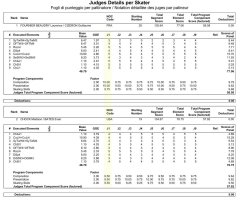
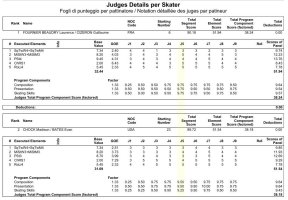
Between the RD and FD combined, her scoring of FB/C (French) was 6.45 points higher than the other judges, and her scoring of C/B (US) was 7.19 points lower than the other judges.

Pretty damning Dabouis' history of scoring FB/C compared to other skaters (and funny I say "history" when FB/C haven't even competed a whole year together, and yet there've been multiple instances of favouritism!). Other than the Olympics, here's probably the worst example: FB/C fell in their RD at the GP France (an event they should have 100% lost to F/G because of said fall) - she (Judge 6) still gave them 9.50/9.50/9.50 for PCS, which is totally unjustifiable https://results.isu.org/results/sea...------QUAL000100--_JudgesDetailsperSkater.pdf

Marie-Reine Le Gougne sends her regards! 😏
 
Last edited:
Uhhh... there's literally a points comparison to the deviation compared to the rest of the judging panel.

Between the RD and FD combined, her scoring of FB/C (French) was 6.45 points higher than the other judges, and her scoring of C/B (US) was 7.19 points lower than the other judges.

I'm talking about the protocols. I wasn't scraping through Skate Scores or Dabouis' historical scoring. Was just studying the Protocols for this particular event. I was also looking at the other judges scoring in relation to Dabouis'.

And I found the graph that Magill posted interesting as well.

Someone on X made a graph of scores from all the judges and concluded that if you take out both the French judge and the US judge, France still wins. I do not really have time now to analyze this graph and whether it is correct, but someone asked here about such an analysis earlier on, and I came across it so I'm putting it here, and you can analyze it yourself and share conclusions.


HBAtcYAXwAA2qqr
 

Attachments

  • fd.jpg
    fd.jpg
    129.6 KB · Views: 46
  • rd.jpg
    rd.jpg
    110.3 KB · Views: 49
Last edited:
I'm just wondering why we still keep this judges from different countries structure. They should be professional judges who work for the ISU and are therefore accountable to the governing body of the sport.
That would assume the ISU doesn’t have its own goals (e.g. spreading out medals across countries) that could unfairly influence judging.
 
I mean, at least it [AI judging] wouldn't be biased.
That is by no means clear. Computer learning builds in whatever biases are present in the data set that it is given to work with.

If AI notices that skaters are scored higher if they wear red costumes instead of blue, or if a judge from Azerbaijan is or is not on the panel, then away we go.
 
Last edited:
To be honest, I kind of find this whole controversy misplaced. I watched the FD with a non figure skating fan, trying to explain the scoring, etc. His reaction was, "The weird thing about ice dance is that what they are judged on and what people watch them for are completely different things." Even fans can't really tell the difference between 1st and 15th, we are just relying on the experts. For the 4 year fan, their favorites never win and they don't know why. So even if scoring was more even, and even if patterns and such were brought back, and even if choreo elements were eliminated, most people cannot discern what makes a good ice dancer anyway! And part of this is the education on the broadcasts. I've said it before, I can watch a football game with friends and understand what happens because they slo-mo the play and draw yellow lines and talk about the rule book during the broadcast. I've watched ice dance for years with commentary and don't know my rocker from my bracket. If the levels are determined by the key turns, why not show the key turns zoomed in on the slo mo replay, let the commentators discuss/draw lines to show whether or not it is clean? Why not reduce the elements of what makes good GOE to a manageable amount, have a judge for each on one the list, and let viewers know, they got a yes for speed, no for flow, no for creativity, etc.? Bring back the pattern, and then show on the replay the outline of the pattern, dots for the key turns, etc. The weird jump tracker at the Olympics shows we have the technology for it. As it stands, scoring is a black box, fans look to random podcasts for scoring hints instead of the actual sports org, so, of course, we fans are as vibed based as the judges. Rather than trying to make the sport more entertaining, but then making the technical aspect more obtuse (what is retrogression?!!), explain and simplify the technical elements to make them accessible.
 
That would assume the ISU doesn’t have its own goals (e.g. spreading out medals across countries) that could unfairly influence judging.
While I know there is a great deal of suspicion regarding the ISU, I think the likelihood of this is far less than what we have seen with the nationalistic bias that has existed. I would add that while the IJS may have dealt with other issues with the judging of figure skating, I never felt that it would address the issue of unfair judging based on nationalistic bias, which was really the problem at the SLC 2002 Olympics. The issue has always been the judges themselves. If you don't do something about the people actually doing the scoring, the method by which they score really isn't going to make much difference.
 
That is by no means clear. Computer learning builds in whatever biases are present in the data set that it is given to work with.

If Ai notices that skaters are scored higher if they wear red costumes instead of blue, or if a judge from Azerbaijan is or is not on the panel, then away we go.
I think it depends on the inputs. If the ISU could define "clean turns" in a way that the model could understand, it could work.

The easiest examples actually apply to a non-dance element. I think an AI could be programmed relatively easily to identify under-rotations and edge calls. I saw "relatively easily" because you know I couldn't do that. LOL. But a smart person could.
 
I feel I should clarify that my idea for professional judges is not for all figure skating competitions. I'm just saying to have this set of judges for the Olympics and the ISU championships, i.e., Worlds, Europeans, and Four Continents. The Grand Prix, Senior B's, and the like would still be judged using the current method (mainly because of financial considerations).
 
This lift is so creative. And the core strength! I hope they stick around.

“The last time I felt like this was actually in Boston,” said Dieck. “I fully felt like I was in a movie. Yesterday I gave our team a little picture—it was us standing on top of a dune in the desert, both looking out. That’s exactly how I felt today. Fully committed to the story. That’s what made it so special. We knew the crowd was there, but being fully in that moment, and after the final position… it was absolutely amazing. Those are the moments we do this for.”

Next month they plan to compete at their third world championships.

“We just finished on an absolute high at our first Olympics together,” said Dieck of their future. “Worlds are next, and then we’ll see what next season holds. But we’ve definitely said we want to continue. We’re taking it season by season.”

 
Last edited:
I'm just wondering why we still keep this judges from different countries structure. They should be professional judges who work for the ISU and are therefore accountable to the governing body of the sport.
Interesting point. I don't know what has been said/published in the past about the topic, but I am riffing on your comment and imagining a scenario where, depending upon availability/a "blind drawing", etc., there could conceivably be three American judges, two French, four Canadians, etc. for the same program. However, upon a few seconds of reflection, what about an imbalanced panel, such as four American judges and only one French judge? Would that really be just? Judges are just people; they're not robots. They have been raised in cultures which are more accustomed to certain music, certain movements, certain tastes, certain media influences, and I can see the desire to spread out judges based on those differences so you don't have five Spanish judges putting a Spanish team in the top three while no one else has them top five, for instance.

I wonder who will show up for Worlds.
 
Last edited:
To be honest, I kind of find this whole controversy misplaced. I watched the FD with a non figure skating fan, trying to explain the scoring, etc. His reaction was, "The weird thing about ice dance is that what they are judged on and what people watch them for are completely different things." Even fans can't really tell the difference between 1st and 15th, we are just relying on the experts. For the 4 year fan, their favorites never win and they don't know why. So even if scoring was more even, and even if patterns and such were brought back, and even if choreo elements were eliminated, most people cannot discern what makes a good ice dancer anyway! And part of this is the education on the broadcasts. I've said it before, I can watch a football game with friends and understand what happens because they slo-mo the play and draw yellow lines and talk about the rule book during the broadcast. I've watched ice dance for years with commentary and don't know my rocker from my bracket. If the levels are determined by the key turns, why not show the key turns zoomed in on the slo mo replay, let the commentators discuss/draw lines to show whether or not it is clean? Why not reduce the elements of what makes good GOE to a manageable amount, have a judge for each on one the list, and let viewers know, they got a yes for speed, no for flow, no for creativity, etc.? Bring back the pattern, and then show on the replay the outline of the pattern, dots for the key turns, etc. The weird jump tracker at the Olympics shows we have the technology for it. As it stands, scoring is a black box, fans look to random podcasts for scoring hints instead of the actual sports org, so, of course, we fans are as vibed based as the judges. Rather than trying to make the sport more entertaining, but then making the technical aspect more obtuse (what is retrogression?!!), explain and simplify the technical elements to make them accessible.
Yeah, tbh, I've been watching ice dance regularly since 2006, and I really can't tell the difference between ice dancers even when there's a significant difference in placement. I can see obvious mistakes, but ice dance is the one place where I don't understand the levels at all. I've also seen positive GOE given (including +4) even when there's a noticeable error if it's a favored couple. This is why I don't think I can watch competitive ice dance in good conscious anymore.
 
This lift is so creative. And the core strength! I hope they stick around.

“The last time I felt like this was actually in Boston,” said Dieck. “I fully felt like I was in a movie. Yesterday I gave our team a little picture—it was us standing on top of a dune in the desert, both looking out. That’s exactly how I felt today. Fully committed to the story. That’s what made it so special. We knew the crowd was there, but being fully in that moment, and after the final position… it was absolutely amazing. Those are the moments we do this for.”

Next month they plan to compete at their third world championships.

“We just finished on an absolute high at our first Olympics together,” said Dieck of their future. “Worlds are next, and then we’ll see what next season holds. But we’ve definitely said we want to continue. We’re taking it season by season.”

Embedded HTML content
It really is. It impresses me every time.
 
I really feel like this team is underrated. Maybe it's because they are a bit too quirky for a lot of people's taste? I'm also a HUGE Björk fan :)

“It went very well,” said Lopareva. “We skated both programs clean, so we’re very happy that at our first Olympics we were able to show what we’ve worked on and not let the stress get to us. We prepared mentally, and everything went according to the work we put in, so we’re really glad about that.”

The 2025 European silver medalists are looking forward to another Olympic cycle.

“We want to be stronger, better,” said Brissaud. “We just want to continue pushing our originality and our skills for the next Olympics. We’ve been fighting hard for medals and for what we want.”

 
Last edited:
That is by no means clear. Computer learning builds in whatever biases are present in the data set that it is given to work with.

If Ai notices that skaters are scored higher if they wear red costumes instead of blue, or if a judge from Azerbaijan is or is not on the panel, then away we go.
I think for something objective, like how many degrees was that skate turned when it landed on the ice, AI bias shouldn't come into play.

Of course, if AI were judging PCS it could (as with existing AI bias) score them based on preconceived notions / preconceived nations.
 
Back
Top