


It's official. She's out of the entry list.did Alysa officially announce she's skipping worlds? the way she talked here about it sounded like she really wanted to be there.
My guess is that the interview was recorded before she withdrew.

Follow along with the video below to see how to install our site as a web app on your home screen.
Note: This feature may not be available in some browsers.
It's official. She's out of the entry list.did Alysa officially announce she's skipping worlds? the way she talked here about it sounded like she really wanted to be there.


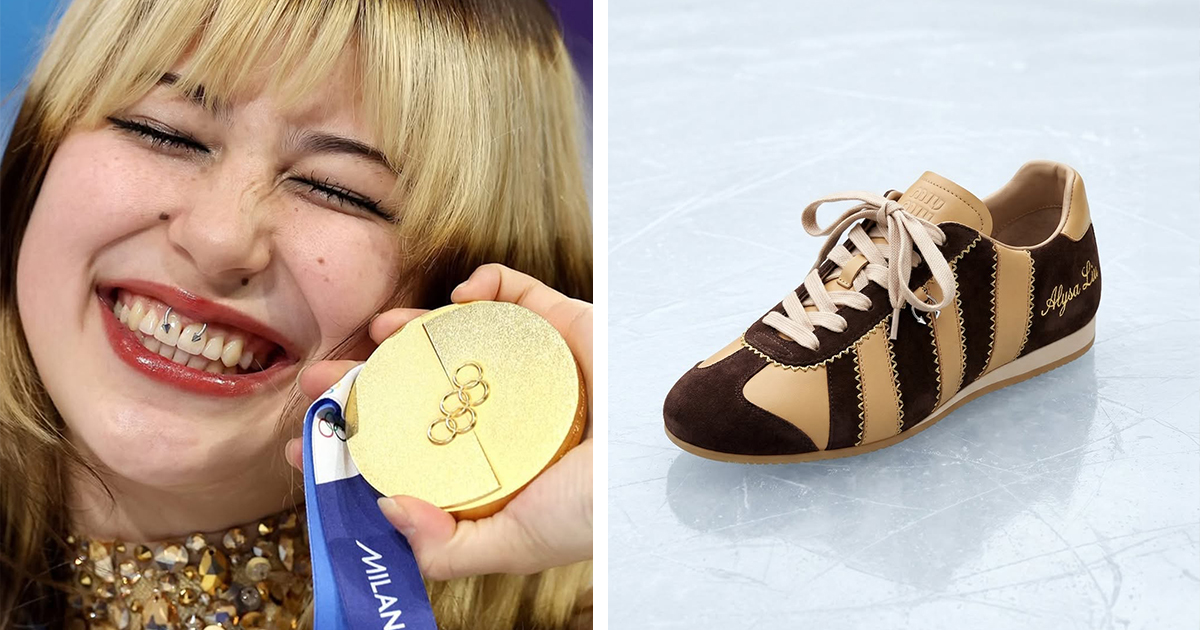
I'm still not so sure about Alysa's hair, but would definitely consider wearing these shoes if they ever become a reality.Ever since Olympic gold medal-winning figure skater Alysa Liu took to the ice at the 2026 Winter Games, people around the world have crowned her an icon. We recently shared how artists across all mediums have been paying tribute to Liu, and now, AI creative Emanuele Jane Morelli has imagined a shoe inspired by the athlete’s signature style.

 mymodernmet.com


 www.nytimes.com

 about.nike.com


 www.sportico.com
As Alysa Liu Goes Mainstream, Figure Skating Sign-Ups Surge
By Sara Germano
As the Olympic gold medalist has become a mainstream celebrity, figure skating executives are working to commercially transform the sport.
Since winning double Olympic gold in Milan last month, figure skater Alysa Liu has amassed 8 million Instagram followers (and counting), attended Paris fashion week, hobnobbed at the Vanity Fair Oscar Party, received a key to the city of Oakland and received murals painted in her honor.
For the first time this century, figure skating has minted a mainstream, global celebrity in Liu. And with the figure skating World Championships kicking off tomorrow in Prague, executives are strategizing how to grow the sport alongside her.
“We have some of the most famous Olympians in history with Kristi Yamaguchi, Dorothy Hamill and Peggy Fleming,” U.S. Figure Skating chief executive officer Matt Farrell told Sportico. “But Alysa and the [2026 U.S. Olympic] team have transcended that.”
In the weeks since the 2026 Winter Games concluded, both USFS and the International Skating Union have been hard at work attempting to translate Liu’s popularity and other feel-good moments from the Games into commercial growth.
Liu “is fantastic for the sport,” Colin Smith, director general for the ISU, said. “She’s not only a great talent, but she’s a great person, and [her] personality and the charisma and the character and the sort of the laid-back approach [she takes] to our sport, it’s fantastic.”
Preliminary metrics suggest Liu and the Olympic competition as a whole is leading to a direct surge in participation. In the four weeks since the Milan Cortina Olympics, Farrell said USFS has received anecdotal reports of 20% to 30% increases in learn-to-skate sign ups at rinks around the country, compared to about 10% or less in other Olympic years over the past two decades.
Especially noteworthy, he said, is that sign ups are skyrocketing in communities not traditionally known for being skating hotbeds, like Kansas, Indiana and Alabama. In New Mexico, one Albuquerque rink reported 300 sign ups for skating lessons in February—roughly equivalent to what the rink sees in a typical year.
“I think the skaters of today are opening the aperture, if you will, of people looking at [the sport] like, ‘Oh, this might be something for me,’” Farrell said.
The learn-to-skate sign ups are a significant metric, Farrell said, since membership in the federation accounts for between 30% to 40% of USFS revenues.
Meanwhile, the ISU sent out a request-for-proposal last week for combined sponsorship and broadcast rights agreements for figure skating, as well as speedskating, which the federation also oversees. Though planned before Milan, Smith said the RFP was targeted to hit right after the 2026 Games to capitalize on the Olympic momentum.
“What we want, frankly, is the widest possible distribution and viewership for our sports,” Smith said. “What we don’t want to do is to be behind too many paywalls and limit the number of eyeballs. We really believe our sports should be as widely available as possible.”
Traditionally, figure skating has had strong appeal in East Asia, Russia and the U.S. But the ISU said it saw surprisingly strong interest from new markets during Milan, including in Mexico, Indonesia and Thailand. “These are countries with huge populations, so huge growth potential, for us,” Smith said.
One major limiting factor for figure skating’s broadcast opportunities has been the sport’s reliance on music, the licensing for which has required Kafkaesque levels of clearance, even in the lead-up to Milan. The cost and legwork required to clear figure skating music has largely suppressed the sport’s presence on streaming platforms and social media, where highlights largely disappear after 48 hours.
As a result, developing the sport’s relationships with record labels has been “the No. 1 priority since Milan,” according to Farrell. Given the impact that Liu’s MacArthur Park and Stateside performances resulted in substantial streams and downloads of both songs, Farrell said the ultimate goal would be for skaters to become, effectively, music influencers.
“I think we’ve shown as a sport, and not just in the United States, that we can be a marketing partner for an artist,” he said. Going forward, he thinks skaters can even help musicians release new music. “That’s a key place where we are going and actively working on.”
On the global level, Smith said “every label we’ve spoken to” has agreed music use in figure skating isn’t controversial.
“It’s not a car advert, it’s not something very, very commercial,” he said. “This is being used for live art, for performance, for sport.”
Meantime, leaders are considering amending figure skating’s rules and technical requirements that will prioritize athlete longevity, potentially at the expense of boundary-pushing quadruple jumps. It is something Liu herself has advocated for since winning Olympic gold, telling Vanity Fair this month that “the impact of our jumps makes longevity hard. I would love for there to be a spin competition, a jump competition, an artistry competition—separated, so we could really give it our all.”
Before Liu, the winners of the preceding three Olympic women’s figure skating gold medals were each teenagers from Russia who competed in one Games and didn’t return. The pressure to fill programs with demanding quadruple jumps and triple axels, while innovating the sport, prompted Liu to retire, burnt-out, at 16.
Smith said the ISU listens to skater feedback and holds regular discussions with athletes, choreographers and technical specialists about amending competitions in the future.
“You’ll always have people who come in for a shorter period of time and leave, and those that want to stay longer,” Smith said.
But he was unequivocal about the ISU’s preference. “We don’t want them to do one Olympic cycle and then stop skating. We want them to stay on longer,” he said. “As a governing body, it’s easier for us to build profiles, to make heroes of people if they stay longer.”
In Prague this week, Liu’s fellow medalists Kaori Sakamoto and Ami Nakai of Japan will compete alongside her U.S. teammates Amber Glenn and Isabeau Levito for the world title. Missing from the competition will be Liu, whose rep from WME told Sportico she is “taking a breather” after a whirlwind victory lap.
“Would we like [Liu] to be with us? Absolutely,” Smith said of the World Championships, where tickets are already sold out. “But we have 11 out of 15 medalists [from Milan] coming to Prague, so it’s not exactly a B team lineup.”
I know! And I thought the writer did a great job laying out that yes, Alysa is the rising star right now, but there is real work that needs to be done (that is not Alysa's work to do). But also, they have real numbers like the rise in LTS sign-ups after her win and the 2026 Olympics (not sure if they only compared to 2022 Olympics to say 2026 is higher - 2022 was still in the midst of COVID).^
Great find. That article is addressing the elephant in the room I was talking about in the other thread, blocking the sport - visibility problems caused by music rights issues. You can't grow a sport that only allows 24-48 hours viewing. You need 24/7 viewing like we had before the 2022 lawsuit and that's just to get the engine started again.


 www.instagram.com
Would love this actually. I really hope this comes to fruition.^
Great find. That article is addressing the elephant in the room I was talking about in the other thread, blocking the sport - visibility problems caused by music rights issues. You can't grow a sport that only allows 24-48 hours viewing. You need 24/7 viewing like we had before the 2022 lawsuit and that's just to get the engine started again.
Colin Smith at the ISU:
“What we want, frankly, is the widest possible distribution and viewership for our sports,” Smith said. “What we don’t want to do is to be behind too many paywalls and limit the number of eyeballs. We really believe our sports should be as widely available as possible.”
Make it happen.
The cost and legwork required to clear figure skating music has largely suppressed the sport’s presence on streaming platforms and social media, where highlights largely disappear after 48 hours.
As a result, developing the sport’s relationships with record labels has been “the No. 1 priority since Milan,” according to Farrell. Given the impact that Liu’s MacArthur Park and Stateside performances resulted in substantial streams and downloads of both songs, Farrell said the ultimate goal would be for skaters to become, effectively, music influencers.
“I think we’ve shown as a sport, and not just in the United States, that we can be a marketing partner for an artist,” he said. Going forward, he thinks skaters can even help musicians release new music. “That’s a key place where we are going and actively working on.”
Get someone who knows how to close deals and this could be fixed for next season. Is anyone sharp as a tack at the ISU? Guess we're about to find out.
Off to sleep . . .


