1983
ECHO OF THE SEASON
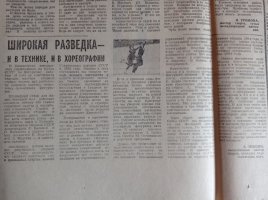
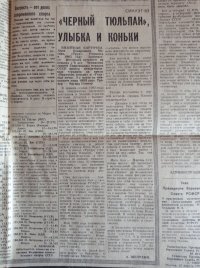
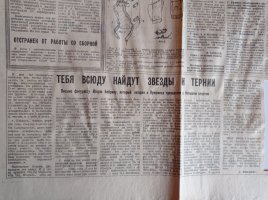
"Ice artists" chart the course for the future
(the article published in russian 'Sovetskiy Sport' on April 13, 1983)
The pre-Olympic season is rightly called the key season in the four-year cycle, as it reveals both the decisive balance of power and the main trends for the future. And for figure skaters, it was exceptionally important and crucial, which is why we saw so many difficult yet almost flawless programs and so many new features at the major competitions. The 1983 season was also rich in surprises, presented by debutants on the national teams.
Here are a few interesting details. At the World Championships in Helsinki, serious setbacks were experienced by 1982 World Champion E. Zayak (USA), who dropped out of the competition after the "school" stage, and 1983 European Champion K. Witt (GDR), who only finished eighth in the "school" stage. At the same time, new names appeared in the table of ranks: B. Orser (Canada) in the men's tournament, K. Leistner (FRG) in the women's competition, B. Underhill and P. Martini (Canada) in pair skating.
Figure skating is on the verge of a new qualitative leap forward. Many new technical advances have been achieved. Now, not just one, but four or five skaters are attacking a 3,5-rotation jump. Pairs are executing triple jumps and triple twists without much effort.
The singles skaters' programs became somewhat akin to dance, full of fire and passion. In this regard, true exemplary performances were provided by masters such as A. Fadeev (USSR) in his short program, European champion N. Schramm (FRG), world champion S. Hamilton (USA), and our figure skaters V. Kotin and A. Kondrashova in their free skates.
Another unique feature: today, the world's leading figure skaters have learned to perform complex routines virtually without a single error! And this is happening while actively mastering ultra-c elements in singles and pairs skating. For example, the new USSR men's champion, A. Fadeev, demonstrated flawless triple jump technique in five variations. Furthermore, on the ice in Dortmund, he flawlessly executed a triple axel, and on the ice in Helsinki, a quadruple jump (albeit with an error). In this regard, only two skaters could compete with Fadeev: B. Orser (Canada) and J. Sabovcik (Czechoslovakia).
Our team emerged from the trials of the pre-Olympic year with flying colors. We remember its highs, when the team won three gold medals. But we also haven't forgotten last year's season, when our skaters didn't win a single gold medal. They have now won one gold, three silver, and one bronze medal at the European Championships, and one gold, silver, and bronze at the World Championships. New World Champions E. Valova and O. Vasiliev, and new European Champions N. Bestemianova and A. Bukin, have continued our school's tradition with their victories. The flawless programs of E. Vodorezova, A. Fadeev, O. Volozhinskaya, and A. Svinin clearly strengthened the team's power.
Yes, the rate of skill growth is encouraging. But it's too early to optimistically conclude that the generational change problem has already been solved.
In the 1983 season, one-third of the USSR national team's roster was renewed. Our debutants, Valova and Vasiliev, won the world championship on their first attempt, Muscovite A. Kondrashova took fifth place at the European and World Championships, and two young ice dancing couples, M. Klimova and S. Ponomarenko, E. Batanova and A. Soloviev left the most encouraging impression, finishing fourth at the European Championships and eighth at the World Championships, respectively. Another debutant pair, M. Avstriyskaya and Yu. Kvashnin, took fifth place at the European Championships in Dortmund.
So, nine figure skaters tested their skills at the highest level, and quite successfully.
From 1979 to 1981, E. Vodorezova was absent from the national team due to illness. But now she's returned to the ice rink, and what she accomplished can rightfully be called a sporting feat. Lena displayed the best qualities of an all-around skater—composure, virtuoso technique, and a will to win. She achieved top results in the "school" (first place in Dortmund, third in Helsinki) and in the short program (third places in Dortmund and Helsinki).
It seems the flawless execution of their programs was one of the main reasons for the remarkable success of the new world pairs champions, Valova and Vasiliev. A curious situation developed on the Helsinki ice: the performance of the East German team's leaders, S. Baess and T. Thierbach, was almost technically perfect. Our masters were equally confident in their triple jumps, triple twists, and flawless spins. But the balance was tipped in their favor by a more harmonious program, which exuded emotion, expressiveness, and a uniquely joyful spirit.
It's important to note that both Valova and Vasiliev came to pairs skating as experienced figure skaters, masters of singles skating. Valova was accepted into the group of Honored Coach of the USSR Tatyana Moskvina at age 15, and Vasiliev at 19. Today, they can no longer be considered mere executors of their coach's plans. Moskvina herself emphasized that during the '83 season, her students demonstrated their creative potential, capable of actively creating new things. It's telling that after the competitions in Dortmund, Valova and Vasiliev, on their coach's advice, changed the composition of their short program within days, making it more expressive and spectacular.
The gold medal in pairs skating confirms that our duos' overall training program is on track. The 1983 season highlighted the strengths of the reserve team. In the autumn, the young duos of the USSR national team won five international tournaments (in the USA, Holland, England, France, and West Germany).
Meanwhile, M. Pestova and S. Leonovich didn't perform particularly well at the World Championships, and V. Pershina and M. Akbarov didn't perform well at the European Championships. While they retained their places in the world's top six, these experienced athletes failed to make any significant progress.
Clearly, methodologically, pairs training needs to be conducted in various areas, not limited to early specialization. The most effective approach is to develop figure skaters in comprehensive schools that simultaneously train both singles and pairs (incidentally, this has been clearly demonstrated by the experience of leading schools in Moscow, Leningrad, and Sverdlovsk.) A number of experts are proposing the experimental introduction of three programs to stimulate the search for original technical elements. This is a constructive idea with great potential.
In ice dancing, England's J. Torvill and Ch. Dean won three consecutive world championships, but each season they tackled the challenge of creative growth differently. In the 1981 season, their primary weapons were their highly technical skating and precise execution of their compulsory dances. At the same time, the duo was inferior to the Soviet masters in terms of artistry and emotion. Therefore, the 1982 tournaments saw a shift in emphasis: the English team focused all their efforts on the expressiveness of their free skate.
In the 1983 season, the British ice dancers completely embraced the idea of originality in their free program, as well as the dances that preceded it. The inclusion of elements borrowed from acrobatics and circus acts in the program marked another direction in the development of ice dance. It's possible that some of these new elements will be incorporated into the ice dancers' repertoire. The question is, what will be the ISU Ice Dance Sport Committee's attitude toward all programs with an acrobatic focus? Will such a trend undermine the danceability and musicality of future compositions?
So far, the judges in Helsinki have been unanimous, giving the world champions a 6.0. Perhaps they wanted to avoid heated debate in the first round. But I think the debate will flare up again at the next European Championships in Budapest in 1984.
I'd like to emphasize that Torvill and Dean are not pioneers in the creation of eccentric dance. A number of unique techniques and elements had already been performed in their early programs by current European champions Bestemianova and Bukin. And to some extent, the Englishmen adopted their opponents' techniques. In fact, there is a constant mutual enrichment of programs with ideas and plastic means.
Bestemianova and Bukin put forth great effort in the 1983 season to achieve the highest level of performance in both the compulsory dances and the free dance. At the same time, they emerged as a daring and eccentric duo, with a love of the grotesque in their dance. This is a testament to the steadfast direction chosen by coach T. Tarasova.
And yet, even our all-around leaders still have untapped potential.
What can we say about those following them? E. Batanova and A. Solovyov's free skate captivated with its impeccable taste and musicality. M. Klimova and S. Ponomarenko delighted with their purity of line and coherence. But much remains to be done to reveal the originality of these duets’ styles, so that their technique can shine in all its facets in all three sections of the competition.
Two versions of compulsory dances are currently being introduced at the World Championships, European Championships, and the Olympics. Three days before the start, a draw will determine the competition version. This means that only top-notch technique will provide the key to performing the six compulsory dances, taking into account the individuality of the partners. Innovations in ice dance will require coaches to have a deeper understanding of modern techniques and the laws of musical art.
In a letter to the editor, readers S. Akulov and L. Akulova (Novosibirsk Oblast) pose a very pressing question: "Where are you, the proud Russian Kalinka that rings out across the world?" The question is not only about the specific Kalinka, but also about the choice of strategic direction, the bold development of our traditions, and musical exploration.
In their letters, figure skating fans rightly point out that the field of musical exploration is being unjustifiably narrowed. Many striking melodies were created in Soviet musical art, but so few of these works have been adopted by our figure skaters. For some reason, coaches are less willing than before to turn to the rich heritage of folk music, in particular to Russian folk melodies, full of energy and cheerfulness.
Perhaps it would make sense to establish special prizes at our internal tournaments for compositions that successfully utilize melodies from both folklore heritage and works by contemporary Soviet composers?
The season's results once again confirmed: success comes when honed skill is combined with inspiration, generous emotion, artistry, and a high level of choreographic culture.
A. SHELUKHIN.