Archive of newspaper articles | Page 37 | Golden Skate

Archive of newspaper articles

1987
"FRIENDSHIP" JUNIOR INTERNATIONAL

(the article published in russian 'Sovetskiy Sport' on April 10, 1987)
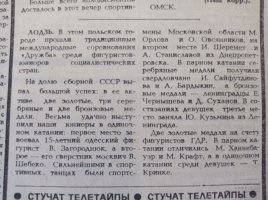
LODZ. The traditional international "Druzhba" (Friendship) competitions among junior figure skaters from socialist countries took place in this Polish city.
The USSR national team achieved great success, winning two gold, three silver, and two bronze medals. Our junior singles skaters performed very successfully: first place was won by 15-year-old Odesa figure skater V. Zagorodniuk, and second place went to his peer, Muscovite V. Shebeko. The strongest in ice dance were the athletes from the Moscow Oblast, M. Orlova and O. Ovsyannikov. In second place were I. Sheremet and A. Stanislavov from Dnipropetrovsk. In pair skating, the silver medals went to Sverdlovsk residents I. Sayfutdinova and A. Bardykin, while the bronze medals were taken by Leningraders E. Chernysheva and D. Sukhanov. In the ladies' singles competition, third place was taken by Yu. Kuzmina from Leningrad.
Two gold medals went to the figure skaters of the GDR. M. Hannebauer and M. Kreft excelled in pair skating, while T. Krienke won the ladies' singles competition.
1785132033570.jpeg
 
1987
STRENGTH AND GRACE

(the article published in Ukrainian 'Sportyvna Hazeta' on April 11, 1987)

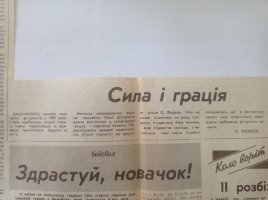
The main competitions for figure skaters in 1987 have concluded. The names of the winners and medalists of the European and World Championships have now become a part of sports history.
They brought no major surprises. Our figure skaters performed successfully in ice dance and pair skating. However, misfortune plagued the singles skaters. A. Fadeev has firmly "grown into" second place. Kira Ivanova simply cannot seem to climb to the top step of the podium.
But the youth are growing up, and new names are appearing. Let us hope that next season our athletes will bring joy to figure skating fans.​
O. MENKIN.
1785132710779.jpeg
 
1987
USSR CUP

Award for Courage

(the article published in russian 'Sovetskiy Sport' on April 11, 1987)

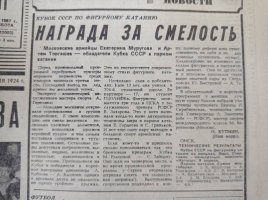
Moscow Army Club members Ekaterina Murugova and Artem Torgashev are the winners of the USSR Cup in pairs skating.

Before the free program, the silver medalists of the World Junior Championship were in third place. Their final performance brought them their desired success.
Express commentary by Honored Master of Sports A. Gorelik:
"The young Muscovites opened the competition in the group of the strongest skaters. In their composition, they boldly included several complex elements, cleanly executing a 'triple toe loop' jump, thereby putting their competitors in a difficult position. The remaining pairs made errors, likely caused by nerves and fatigue accumulated by the end of the season. The Dynamo pair, L. Koblova and A. Kalitin, contended for the Cup and won the short program. However, there was not a single triple jump in the arsenal of this duo. This does not correspond to the modern style of figure skating."
A few words about the winners. Katya is 13 years old; she studies at the 704th capital school. Her partner is 17; he is a student of GTSOLIFK (State Central Order of Lenin Institute of Physical Culture). The figure skaters have been training for three years at CSKA under Honored Coach of the RSFSR V. Zakharov. This is the coach who once started training the now two-time world champions in pairs skating, E. Gordeeva and S. Grinkov. And now, the great army mentor brings out another pair.
If anyone really had to worry, it was the bronze medalists of the Cup, M. Eltsova and S. Zaitsev. They were in fourth place, and during the free program, Sergey’s strap broke (again, that ill-fated strap!). The athletes' performance was coming to an end, so the referee took responsibility and did not order the music to be stopped. The young figure skaters did not lose their composure in this tense moment. They did not flinch, and in the final protocol, they placed higher than the experienced pair from Sverdlovsk, Yu. Bystrova and A. Tarasov.
In the compulsory and short programs for women, the highest total scores were achieved by European Championship participant N. Skrabnevskaya, Winter Universiade champion L. Zamotina (both from the RSFSR), and international master of sports M. Tveretinova (Moscow).​
O. Kutmin
(Our correspondent)
OMSK
Technical Results
USSR Figure Skating Cup. Omsk. Sports and Concert Complex "Irtysh". April 9.
Pairs skating. Total score.
1. E. Murugova – A. Torgashev — 2.2; 2. L. Koblova – A. Kalitin (all from Moscow) — 2.4; 3. M. Eltsova – S. Zaitsev (Leningrad – Kazakhstan) — 4.6.
1785162689303.jpeg
 
1987
USSR CUP

In Different Keys

(the article published in russian 'Sovetskiy Sport' on April 12, 1987)

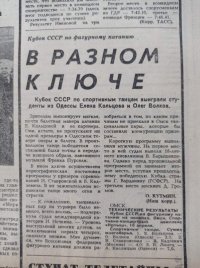
The USSR Cup in ice dancing was won by students from Odesa, Elena Koltsova and Oleg Volkov.

The audience is charmed by the soft, almost balletic skating style of E. Koltsova and her partner. By the way, they never miss a single premiere at the Odesa Opera and Ballet Theater. In the free dance, the winners of the competition were precise in conveying an elegant image inspired by the music of Franck Pourcel.
The choreographic staging of the program for the runners-up, I. Stavrovskaya and V. Kadzevich, is implemented in a different key. In their fiery Spanish dance, there is plenty of fire and passion.
"Unfortunately, there were not many ice dance couples at the tournament, only eight," emphasized international category judge I. Nechkina. "The level of performances by many duos, with the exception of the top four, turned out to be low. It seems to me that the All-Union Figure Skating Federation should look into the reasons why ice dance couples who could compete with the prize-winners did not come to Omsk..."
The men performed their short program. The judges placed 18-year-old Kyiv resident V. Baryshevtsev in first place. However, ahead of the free program, he holds second place, trailing last year's Cup winner G. Vardanyan (RSFSR). In third place is Muscovite D. Gromov.​
O. Kutmin
(Our correspondent)
OMSK.
Technical Results
USSR Figure Skating Cup. Omsk. Sports and Concert Complex "Irtysh". April 10.
Ice dancing. Total score.
1. E. Koltsova – O. Volkov (Odesa) — 2.0; 2. I. Stavrovskaya – V. Kadzevich (Moscow) — 4.0; N. Linets – A. Kislitsyn (Odesa) — 7.0.
1785163559834.jpeg
 
1987
USSR CUP

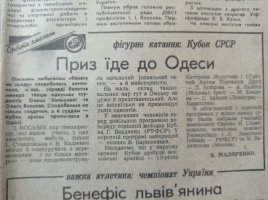
The Prize Goes to Odesa

(the article published in Ukrainian 'Sportyvna Hazeta' on April 14, 1987)

Omsk fans of "ballet on ice" loved the refined, soft, truly balletic style of dancing of Odesa students Elena Koltsova and Oleg Volkov. It was liked not only by the spectators but also by the judges—the Cup of the country has taken up residence in Odessa.
Out of the EIGHT couples of ice dancers who took part in these competitions, probably only I. Stavrovskaya and V. Kadzevich could compete with the winners. And not only in style—they demonstrated a fiery Spanish dance, but also in high skill.
Unfortunately, the lineup of ice dance couples here in Omsk was not very representative. But this does not diminish the success of the Odesa skaters at all.
In the men's competition, ahead of the free program, last year's Cup winner G. Vardanyan (RSFSR) is in the lead. In the short program, the best was Kyiv resident V. Baryshevsev.
Let us remind you that in pairs skating, the Cup was won by Moscow Army Club members: 13-year-old Ekaterina Murugova and 17-year-old Artem Torgashev. Second were L. Koblova – A. Kalitin (Moscow); third—M. Eltsova – S. Zaitsev (Leningrad – Kazakhstan).
In the compulsory and short programs for women, the highest total scores were achieved by European Championship participant N. Skrabnevskaya, Winter Universiade champion L. Zamotina (both from the RSFSR), and M. Tveretinova (Moscow).​
V. MALYARENKO
1785164258844.jpeg
 
1987
USSR CUP

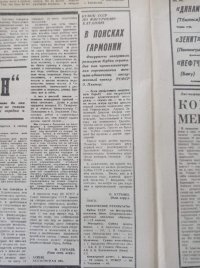
In Search of Harmony

(the article published in russian 'Sovetskiy Sport' on April 14, 1987)

The figure skaters have finished competing for the Cup of the country. This is how the women's singles competition was reviewed by Honored Coach of the RSFSR E. Pliner:
"If we view the sporting rivalry as a creative contest for artistic youth," he said, "then in first place I would have awarded a first-degree diploma to Winter Universiade champion Larisa Zamotina. I would give the second-degree diploma to Natalia Skrabnevskaya, who competed this year at the European Championship. Third place should not be awarded to anyone. There simply was no skater at the Cup who could stand alongside the two prize-winners."
A few minutes later, Pliner’s forecast regarding the first two spots was confirmed. And the bronze medal was won by last year's world junior champion Natalia Gorbenko.
Unfortunately, not a single new name came to light during the men's singles event at the USSR Cup. Just like last year, the main figure was G. Vardanyan. He won, despite two falls in the free program.
O. Kutmin
(Our correspondent)
OMSK.
Technical Results
USSR Cup in figure skating. Omsk. Sports and Concert Complex "Irtysh". April 11–12.
Women. Total score.
1. L. Zamotina (Sverdlovsk) — 3.0; 2. N. Skrabnevskaya (Moscow Oblast) — 4.0; 3. N. Gorbenko (Kyiv) — 8.0.
Men. Total score. 1. G. Vardanyan (Moscow Oblast) — 2.4; 2. D. Gromov (Moscow) — 4.8; 3. V. Baryshevtsev (Kyiv) — 5.2.
Team standings. 1. Moscow — 76 points, 2. RSFSR — 66, 3. Ukraine — 44.
1785165453206.jpeg
 
1987
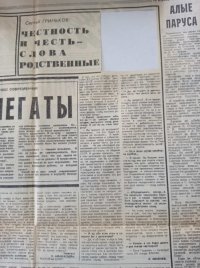
Sergei Grinkov: Honesty and Honor are Kindred Words

(the article published in russian 'Sovetskiy Sport' on April 15, 1987)

The USSR champion and two-time world figure skating champion, Sergei Grinkov, learned that he had been elected as a delegate to the 20th Komsomol (VLKSM) Congress far from home—in the United States of America, where our figure skaters were participating in the World Championships and, subsequently, in exhibition performances. The national team returned home only on the evening of April 9, and on the sunny Saturday morning of April 11, Sergei came to the St. George Hall of the Grand Kremlin Palace to receive his delegate mandate.
"Sergei, imagine to yourself that you are standing at the podium of the Congress, speaking before the delegates. What would you say to them?"
"You are asking me about an impromptu speech? I must admit it wouldn’t be entirely impromptu... I have often thought about the problems, both objective and subjective, that face our Komsomol today. And I wasn't the only one. More than once, my teammates and fellow members of the USSR national team discussed the state of affairs in the Komsomol. And I must admit that in these conversations, we criticized the Komsomol as if from the outside, without thinking much about our own involvement in the youth organization. But time has sobered us up. With each passing day, with every step of perestroika, we understand more an more clearly that everything depends precisely on us.
Perestroika must begin with oneself. At the Komsomol Congress, such sharp questions will be raised that a doubt involuntarily arises: is each of us ready for such a serious conversation? Won't the inertia of past years overpower us? I am confident that the work at the Congress will require maximum focus and composure from the delegates. The ratio between general words and concrete words has changed drastically in the Komsomol — expressing it in the language of mathematics, 'to the inverse fraction.' Every word must have real weight, a real goal. And that is why I am preparing myself for intense work.
"And would you talk about all of this with the delegates?"
"Yes, about this and about the fact that the time has come when much is to be decided. Our honor depends on our honesty. In the Russian language, the words chestnost (honesty) and chest (honor) are kindred words. Without honesty to oneself, to teammates, and to the Komsomol, we will not maintain the pace of perestroika. Transparency, democratization, and intensification of the economy — all of this is unthinkable without an honest and direct conversation about accumulated problems."
"Yes, pointing fingers and criticizing is easier than doing the job yourself... "
— Are you sure? I am not. Calling things by their true names is an Action with a capital letter. Of course, one must separate criticism from mere fault-finding. But under no circumstances should we avoid or smooth over sharp corners — the spring has been compressed for too late... At the same time, we must not lose our sense of reality, and we need to ensure that everyone doesn't just criticize, but also proposes constructive solutions to problems! The difficulty is that the current situation is unfamiliar to us; we have little historical experience in many areas of public life. Well, then! That means time places an even greater responsibility upon us."
"But in that case, mistakes are inevitable..."
"I would say even more: if someone claims years later that the work is being done without a single mistake and that history is written as a final draft is a troubling symptom of complacency and self-satisfaction. Complex tasks lie ahead of us! There will be mistakes too. We just need to speak about them openly and not be afraid to redo certain things from scratch — only then will the work progress.
" 'To redo from scratch...' At the recent European Championship, you and your partner Katya Gordeeva lacked the strength to 'redo' from scratch the routine that was not counted by the referees."
"I will not look for excuses in the fact that we were inspired by the 'canonized' example of Irina Rodnina and Alexander Zaitsev, who continued their routine without music. In the end, rules are rules... I accept the reproach. If, contrary to the theory of probability, this happens to us again, we will re-skate the routine."
"By the way, what will your partner do while the Congress is underway?"
"Katya Gordeeva is an honorary guest of the XX Congress of the Komsomol."​
E. AVSENEV.
1785169302516.jpeg
 
1987
WINTER IN THE MIRROR OF OUR MAIL

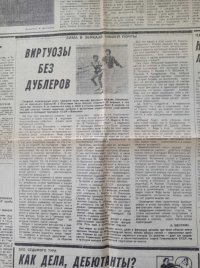
VIRTUOSOS WITHOUT UNDERSTUDIES

(the article published in russian 'Sovetskiy Sport' on April 15, 1987)

A complex, intense season was experienced by our figure skating masters. Let us recall that at the European Championship-87 in Yugoslavia, our national team won 10 medals, including three golds. And at the World Championship in the USA, the team's tally was 5 medals, two of them gold. Quite a few serious problems in training world-class athletes were also highlighted by the recent USSR Championship in Vilnius.
Our constant readers—numerous sports lovers—reflect on these three most important milestones in their letters to the editorial office.
"The review on the ice of Vilnius," notes F. Granenkov from Kharkiv, "clearly showed that figure skating is still characterized by a narrow geography. After all, among the prize-winners, we saw mainly representatives of Moscow, Leningrad, and Odesa. We have brilliant leaders, but who is standing behind them? In recent years, quite a few experienced figure skaters have finished their performances. But we do not see them as coaches in the union republics. Unfortunately, the majority prefer not coaching work, but touring in ice ballets. I am sure that in many cities, in our provinces, there are wonderful talents, but they still need to be discovered and brought out to the wide road. I think the All-Union Federation should show persistence in these matters..."
These thoughts are further developed in his letter by V. Vorozheikin (Penza). He emphasizes: "The most acute problem in our figure skating remains the preparation of female athletes in singles skating. Back in Vilnius, it caught the eye that we have a very short bench of substitutes. Practically, there was no fierce struggle for medals. And the gaps in the technical preparation of our women were clearly revealed at the World Championship in the USA. It is offensive that in the upcoming Olympic season, our national team has no one to present on the world arena as a strong leader in the women's competition. When will the coaches finally show real pride? It is time to seriously prepare a new generation."
The question of raising figure skaters with a fighting character is also raised by Muscovite V. Levashova. She believes it is necessary to boldly advance young talents, especially in women's singles skating, where for three consecutive years, the same athletes have been competing for the national team.
"Our men—A. Fadeev, V. Kotin, V. Petrenko—met the World Championship in far from their best form," writes V. Smirnova (Moscow) to the editorial office. "While previously they successfully fought in all types of single skating (at the European Championship, all three became medalists), in the USA at the World Championship, they failed to realize their capabilities in the free program."
Problems, problems. They do not disappear on their own, even amidst the most impressive victories of the national team's leaders. Our readers persistently talk about them. For example, an anxious letter was written by M. Baranovskaya from Grodno. She is troubled by an important circumstance—the lack of sufficiently broad and multifaceted promotion of the best achievements of the domestic school of figure skating. Television broadcasts dedicated to outstanding masters of our national team have become too rare. Top coaches too rarely give talks and lectures.
Right now, the USSR national team features world champions N. Bestemianova and A. Bukin, E. Gordeeva and S. Grinkov, Olympic champions E. Valova and O. Vasiliev, silver medalists of the World and European Championships M. Klimova and S. Ponomarenko, and European champion A. Fadeev. Their mastery is unique. But where are the films about their programs and training sessions? What will remain in a few years when today's "stars" leave the sports arena? We need to think about this today!
There is another important aspect to improving the mastery of our figure skaters. We are talking about the number of competitive starts.
Here is what Yu. Kalugin (Sverdlovsk) writes in this regard: "How, without competitive practice, are our figure skaters supposed to attain true competitive form? Where will they acquire endurance and determination if they take part in only one all-Union tournament — the national championship?!
It has already become a sad tradition to withdraw from participating in the majority of all-Union competitions. This is often done by V. Petrenko, E. Valova and O. Vasiliev, K. Ivanova, and A. Kondrashova. Under any pretext, leading masters evade fierce competition in domestic tournaments and refuse to compete. I consider it a logical consequence that on the ice of Cincinnati, our single skaters committed so many falls and mistakes. After all, they rarely test themselves in harsh competitive conditions. It is time for our all-Union federation to firmly make its voice heard!"
Yes, talents need moral support. But we must also demand more from them, and strictly so. Otherwise, we will be doing these young people a disservice; we will not help them cultivate maximum self-discipline.
"It will be a shame if the national team loses a talent like A. Kondrashova," continues the conversation I. Dyukov (Novosibirsk). "After all, this athlete possesses fluidity, grace, and a sense of music. But she often lacks just one step to reach the top. This means there is some flaw in her psychological preparation. To fix this, she needs to compete more often in the most challenging conditions!"
The pre-Olympic season demonstrated yet another obvious reality: victory can only be achieved through flawlessly executing super-complex and original programs. Recall the incident in Sarajevo: at the European Championship, E. Gordeeva and S. Grinkov performed their program without music, and the judges left them without any scores because they remembered an important clause in the rules (the referee's command after a music stoppage is mandatory). This incident, as many newspaper readers emphasize—specifically A. Korneev (Severodonetsk) and I. Akopov (Taganrog)—should serve as a lesson for all our candidates for the Olympic national team in all sports. After all, a single unfortunate accident or blunder can undo the efforts of many years.
The sports season has practically finished and has once again presented our figure skaters with new, highly serious problems on the threshold of the Olympic starts. The mail from readers reminds our athletes and coaches: do not get conceited, always look forward in search of new, original compositions!​
A. SHELUKHIN.
As can be seen from this mail overview, even in figure skating, where our national team holds strong positions on the international arena, there are quite a few "blank spots"—unresolved problems. The main one is the cultivation of a reliable reserve. This is a task for specialists of both the Winter Sports Administration of the USSR State Committee for Sports (Goskomспорт), and the coaches of the Olympic training centers at the local level.
1785171777003.jpeg
 
1987
"STROITELNAYA GAZETA" PRIZE JUNIOR INTERNATIONAL

FIGURE SKATING

(the article published in russian 'Sovetskiy Sport' on April 16, 1987)

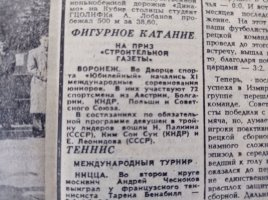
For the Prize of "Stroitelnaya Gazeta" (Construction Newspaper)

VORONEZH. The XI International Junior Competitions have begun at the "Yubileyny" Sports Palace. Participating in them are 72 athletes from Austria, Bulgaria, North Korea (DPRK), Poland, and the Soviet Union.
In the girls' compulsory program competition, the top three leaders included N. Palkina (USSR), Kim Son Suk (DPRK), and E. Leonidova (USSR).
1785172323947.jpeg
 
1987
"STROITELNAYA GAZETA" PRIZE JUNIOR INTERNATIONAL

FIGURE SKATING

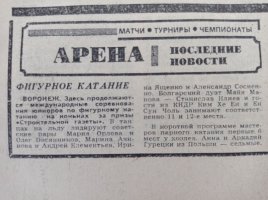
(the article published in russian 'Sovetskiy Sport' on April 17, 1987)

VORONEZH. The international junior figure skating competitions for the prizes of "Stroitelnaya Gazeta" (Construction Newspaper) continue here. In ice dancing, the Soviet couples Maria Orlova and Oleg Ovsyannikov, Marina Achinova and Andrei Klementiev, and Irina Yashchenko and Alexander Sosnenko are in the lead. The Bulgarian duo Maya Manova and Stanislav Iliev, and guests from North Korea (DPRK) Kim He Yon and Yen Sun Chol occupy 11th and 12th places, respectively.
In the short program for pairs skating masters, the first 6 places are held by the hosts. Anna and Arkadii Gurecki from Poland are seventh.
1785172800623.jpeg
 
1987
"STROITELNAYA GAZETA" PRIZE JUNIOR INTERNATIONAL

"STROITELNAYA GAZETA" (Construction Newspaper)

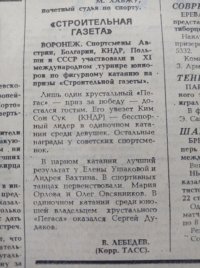
(the article published in russian 'Sovetskiy Sport' on April 21, 1987)

VORONEZH. Athletes from Austria, Bulgaria, North Korea (DPRK), Poland, and the USSR participated in the XI International Junior Figure Skating Tournament for the prizes of "Stroitelnaya Gazeta."
Only one crystal "Pegasus"—the prize for victory—went to the guests. It will be taken home by Kim Son Suk (DPRK), the undisputed leader in the girls' singles skating. The remaining awards went to Soviet female athletes.
In pairs skating, the best result belonged to Elena Ushakova and Andrei Vakhtin. In ice dancing, Maria Orlova and Oleg Ovsyannikov took first place. In the boys' singles skating, the owner of the crystal "Pegasus" turned out to be Sergei Dudakov.​
V. LEBEDEV.
(TASS Correspondent).
1785173207079.jpeg
 
1987
MORZINE TROPHY

FIGURE SKATING

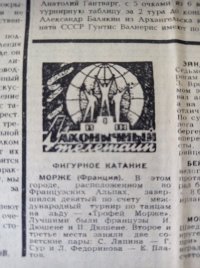
(the article published in russian 'Sovetskiy Sport' on April 25, 1987)

MORZINE (France). In this town, located in the French Alps, the ninth international ice dancing tournament, the "Morzine Trophy," has concluded. The best were the French ice dancers I. Duchesnay and P. Duchesnay. Second and third places were taken by two Soviet couples: S. Lyapina – G. Sur and L. Fedorinova – E. Platov.
1785173558200.jpeg
 
1987
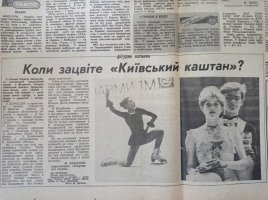
KYIV CHESTNUT ALL-UNION TOURNAMENT

When Will the "Kyiv Chestnut" Bloom?

(the article published in Ukrainian 'Sportyvna Hazeta' on April 28, 1987)

The all-Union traditional figure skating tournament "Kyiv Chestnut" has concluded in the capital of Ukraine. Representatives from different cities across the country—about 130 people in total—competed for prizes in two groups: senior and junior.
In the SENIOR category, the singles champions were V. Kretova (Odesa) and S. Dudakov (Moscow Oblast); in pairs skating—O. Pavelieva and V. Fomin (Perm); and in ice dancing—the winners of the USSR Cup E. Koltsova and O. Volkov (Odesa).
Among the JUNIORS, the first-place winners were: I. Ovcharova (Kharkiv), D. Dmitrenko (Kyiv), L. Kameniuk and O. Podvalnyi (Kyiv), and A. Mitrofanova and V. Kretskiy (Minsk).
But now, let us discuss the "other accomplishments" of the tournament. To be completely honest, the organizing committee did a poor job. There was no publicity; the "resourceful" mind of the organizers failed to find ways to attract at least, students from Kyiv schools to the arena. In short, the giant bowl of the Sports Palace was empty. Sitting in the stands were mostly grandmothers, grandfathers, and parents of the participants... Agreeably, the standard hall of the Sports Palace is somewhat oversized for such family gatherings.
Now a few words about the lineup of participants. The geography was broad. Figure skaters from Moscow, and Yerevan, Tbilisi, and Kaunas competed here. However, strong athletes were scarce. Only the winners of the USSR Cup in ice dancing, E. Koltsova and O. Volkov, stood out, which is frankly not enough.
N. Vorobiova, a ten-time champion of the republic in figure skating and now a coach, recalls with sadness the times when the "Kyiv Chestnut" was not only an all-Union tournament but an international one as well. Traditional and, by all logic, it should not decrease in status. Yet the year before last, it didn't take place at all...
The fact that the 'Kyiv Chestnut' has been unable to bloom properly in recent years is the result of the neglected, downright deplorable state of figure skating in the capital of Ukraine. This is all the more regrettable because Kyiv has plenty of both personnel and material resources...​
V. BUDANOV,
Correspondent of "Sportyvna Hazeta".
IN THE IMAGES:
Singles skater at the finish line.
The winners in ice dancing—holders of the USSR Cup, Odesa residents Elena Koltsova and Oleg Volkov.
Photo by M. Bochok.
1785175161828.jpeg
 
1987
WINTER IN THE MIRROR OF OUR MAIL

VIRTUOSOS WITHOUT UNDERSTUDIES

(the article published in russian 'Sovetskiy Sport' on April 15, 1987)

A complex, intense season was experienced by our figure skating masters. Let us recall that at the European Championship-87 in Yugoslavia, our national team won 10 medals, including three golds. And at the World Championship in the USA, the team's tally was 5 medals, two of them gold. Quite a few serious problems in training world-class athletes were also highlighted by the recent USSR Championship in Vilnius.
Our constant readers—numerous sports lovers—reflect on these three most important milestones in their letters to the editorial office.
"The review on the ice of Vilnius," notes F. Granenkov from Kharkiv, "clearly showed that figure skating is still characterized by a narrow geography. After all, among the prize-winners, we saw mainly representatives of Moscow, Leningrad, and Odesa. We have brilliant leaders, but who is standing behind them? In recent years, quite a few experienced figure skaters have finished their performances. But we do not see them as coaches in the union republics. Unfortunately, the majority prefer not coaching work, but touring in ice ballets. I am sure that in many cities, in our provinces, there are wonderful talents, but they still need to be discovered and brought out to the wide road. I think the All-Union Federation should show persistence in these matters..."
These thoughts are further developed in his letter by V. Vorozheikin (Penza). He emphasizes: "The most acute problem in our figure skating remains the preparation of female athletes in singles skating. Back in Vilnius, it caught the eye that we have a very short bench of substitutes. Practically, there was no fierce struggle for medals. And the gaps in the technical preparation of our women were clearly revealed at the World Championship in the USA. It is offensive that in the upcoming Olympic season, our national team has no one to present on the world arena as a strong leader in the women's competition. When will the coaches finally show real pride? It is time to seriously prepare a new generation."
The question of raising figure skaters with a fighting character is also raised by Muscovite V. Levashova. She believes it is necessary to boldly advance young talents, especially in women's singles skating, where for three consecutive years, the same athletes have been competing for the national team.
"Our men—A. Fadeev, V. Kotin, V. Petrenko—met the World Championship in far from their best form," writes V. Smirnova (Moscow) to the editorial office. "While previously they successfully fought in all types of single skating (at the European Championship, all three became medalists), in the USA at the World Championship, they failed to realize their capabilities in the free program."
Problems, problems. They do not disappear on their own, even amidst the most impressive victories of the national team's leaders. Our readers persistently talk about them. For example, an anxious letter was written by M. Baranovskaya from Grodno. She is troubled by an important circumstance—the lack of sufficiently broad and multifaceted promotion of the best achievements of the domestic school of figure skating. Television broadcasts dedicated to outstanding masters of our national team have become too rare. Top coaches too rarely give talks and lectures.
Right now, the USSR national team features world champions N. Bestemianova and A. Bukin, E. Gordeeva and S. Grinkov, Olympic champions E. Valova and O. Vasiliev, silver medalists of the World and European Championships M. Klimova and S. Ponomarenko, and European champion A. Fadeev. Their mastery is unique. But where are the films about their programs and training sessions? What will remain in a few years when today's "stars" leave the sports arena? We need to think about this today!
There is another important aspect to improving the mastery of our figure skaters. We are talking about the number of competitive starts.
Here is what Yu. Kalugin (Sverdlovsk) writes in this regard: "How, without competitive practice, are our figure skaters supposed to attain true competitive form? Where will they acquire endurance and determination if they take part in only one all-Union tournament — the national championship?!
It has already become a sad tradition to withdraw from participating in the majority of all-Union competitions. This is often done by V. Petrenko, E. Valova and O. Vasiliev, K. Ivanova, and A. Kondrashova. Under any pretext, leading masters evade fierce competition in domestic tournaments and refuse to compete. I consider it a logical consequence that on the ice of Cincinnati, our single skaters committed so many falls and mistakes. After all, they rarely test themselves in harsh competitive conditions. It is time for our all-Union federation to firmly make its voice heard!"
Yes, talents need moral support. But we must also demand more from them, and strictly so. Otherwise, we will be doing these young people a disservice; we will not help them cultivate maximum self-discipline.
"It will be a shame if the national team loses a talent like A. Kondrashova," continues the conversation I. Dyukov (Novosibirsk). "After all, this athlete possesses fluidity, grace, and a sense of music. But she often lacks just one step to reach the top. This means there is some flaw in her psychological preparation. To fix this, she needs to compete more often in the most challenging conditions!"
The pre-Olympic season demonstrated yet another obvious reality: victory can only be achieved through flawlessly executing super-complex and original programs. Recall the incident in Sarajevo: at the European Championship, E. Gordeeva and S. Grinkov performed their program without music, and the judges left them without any scores because they remembered an important clause in the rules (the referee's command after a music stoppage is mandatory). This incident, as many newspaper readers emphasize—specifically A. Korneev (Severodonetsk) and I. Akopov (Taganrog)—should serve as a lesson for all our candidates for the Olympic national team in all sports. After all, a single unfortunate accident or blunder can undo the efforts of many years.
The sports season has practically finished and has once again presented our figure skaters with new, highly serious problems on the threshold of the Olympic starts. The mail from readers reminds our athletes and coaches: do not get conceited, always look forward in search of new, original compositions!​
A. SHELUKHIN.
As can be seen from this mail overview, even in figure skating, where our national team holds strong positions on the international arena, there are quite a few "blank spots"—unresolved problems. The main one is the cultivation of a reliable reserve. This is a task for specialists of both the Winter Sports Administration of the USSR State Committee for Sports (Goskomспорт), and the coaches of the Olympic training centers at the local level.
View attachment 11790

Nothing new in that list of worries. Somehow figure skating survives.
 
1987
OLD ACQUAINTANCES
WITH ICE DANCING — AROUND THE WORLD

(the article published in russian 'Sovetskiy Sport' on April 30, 1987)

"We will gladly answer your questions exactly one hour from now, right after we finish our practice session," said Christopher Dean, and then, together with Jayne Torvill, slowly skated toward the center of the "Kristall" ice rink...
The British figure skaters, 1984 Olympic champions and four-time world champions in ice dancing, ended their competitive amateur career three years ago. Externally, they have not changed at all: Christopher is just as elegant and slender, and Jayne is miniature.
For a whole hour they did not, as the saying goes, sit down, and took a breather only when it was necessary to change the tape in the tape recorder.
"We know that you arrived in our country as tourists. And yet, you are having such intensive practice sessions. What is the reason behind this?"
"We practice on the ice every day," Christopher Dean answers. "And we are very grateful that we have the opportunity to do this here in Moscow. By the way, the ice at this rink is excellent. Having left amateur sports, we did not quit figure skating. At first, we simply continued to train out of habit, and then, at the beginning of 1985, we decided to organize a troupe. That is how the worldwide show 'Torvill and Dean World Tour' was born.
A total of 16 figure skaters perform with us in the shows. Among them are such well-known names as Karen Barber. She and her partner Nicky Slater were the number two couple in Great Britain for a long time, trailing only us. Canadian skaters Kelly Johnson and Gary Beacom, Petra Born and Rainer Schönborn from West Germany (FRG), and Lea Ann Miller from the USA also participate in the production."
"We are sure that you follow what is happening right now in ice dancing, specifically at the World and European Championships."
"Sometimes, due to our tour schedule, we didn't have the chance to watch these competitions. However, we followed the recent World Championship in Cincinnati very closely. We had plenty of free time there — Chris unfortunately injured his wrist, and we canceled all our tour dates.
What are our impressions? The mastery of the ice dancers has grown significantly compared to our competitive era, both in terms of program difficulty and artistic appeal. An unforgettable impression was left by the performances of the two leading Soviet duos — Bestemianova and Bukin, and Klimova and Ponomarenko."
"What were you working on today?"
"Those were elements of our future program. Right now, over the course of an evening, we perform 6–7 routines in which the two of us skate together, featuring numbers like 'Pasodoble', 'Mack and Mabel', 'Tango', 'Bolero', ‘Barnum’) and together with the other members of the troupe."
"This is not your first time visiting our country. What are your plans for this visit?"
"We have only visited the USSR once before, in 1982. That was a very brief, flying visit. But it stayed in our memory for a long time. Back then, we saw a wonderful circus production in Moscow, which actually gave us the idea to create our program 'Barnum'. We won with it during the 1983 season. So visiting the circus this time around is a must for us. On the very day of our arrival, we were already at the Bolshoi Theater and saw Maya Plisetskaya. It was absolutely spectacular!
And right now, taking this opportunity, we want to pass along our warmest greetings to all Soviet figure skating fans."​
V. MAKMILIN,
A. NOVIKOV.
(TASS Correspondents).
1785176835665.jpeg
 
Back
Top