Archive of newspaper articles | Page 31 | Golden Skate

Archive of newspaper articles

1986
VI. WINTER SPARTAKIAD of the PEOPLES of the USSR

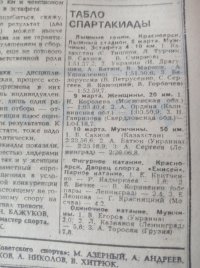
Figure Skating

(the article published in russian 'Sovetskiy Sport' on March 12, 1986)

Krasnoyarsk. "Yenisei" Palace of Sports. Pairs Skating
1. E. Kvitchenko — R. Kadyrkaev — 1.8;
2. E. Bechke — V. Kornienko (both pairs — Leningrad) — 2.4;
3. E. Leonova — G. Krasnitsky (Moscow) — 4.2.
Single Skating. Men.
1. V. Egorov (Ukraine) — 2.0;
2. L. Kaznakov (Leningrad) — 5.8;
3. A. Torosyan (Georgia) — 7.8.
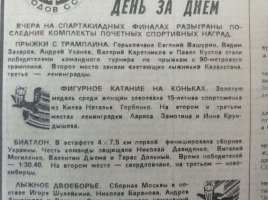
Day by Day

(the article published in russian 'Sovetskiy Sport' on March 12, 1986)

Yesterday, the last sets of honorary sports awards were contested at the Spartakiad finals.
FIGURE SKATING. The women's gold medal was won by 15-year-old athlete from Kyiv, Natalya Gorbenko. In second and third places were Leningraders Larisa Zamotina and Inna Krundysheva.
1781765679719.jpeg
1781765699169.jpeg
 
1986
WORLD CHAMPIONSHIPS

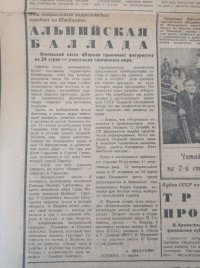
ALPINE BALLAD

(the article published in russian 'Sovetskiy Sport' on March 18, 1986)

Our special correspondent reports from Switzerland

The Geneva ice rink "Vernets" welcomes figure skaters from 24 countries—participants in the World Championships.


The ridges of the Alps, which occupy more than half of Switzerland's territory, sleep under a perpetual blanket of snow. But there is one place in the south where the mountains seem to have halted their march and frozen before a magical canvas of water expanse. The valleys surrounding the famous Lake Geneva sparkle under the spring sun.
Here, on the waterfront near the fountain, I suddenly spotted a very familiar profile: a girl's head with a small braid. Of course, it is 14-year-old blue-eyed Katya Gordeeva. She arrived in Geneva as part of our national team. (By the way, it is the largest at the World Championships, with 18 figure skaters in it). And there are only two debutants—this is precisely Katya Gordeeva and Sergei Grinkov, who managed to become the silver medalists of Europe this winter.
— "Katya, what have you managed to see on the ice at 'Vernets'?" I asked Gordeeva.
— "A lot of impressions. I watched the training sessions of European Champion Jozef Sabovčík, our World Champion Sasha Fadeev, and the Canadian Brian Orser. Sabovčík is doing quite well with a quadruple toe loop jump. And Fadeev also showed his trump card—a combination of a triple Axel and a triple toe loop. The Americans had an unpleasant surprise. Remember, Bowman came to Moscow and was a medalist at our tournament? He was preparing for Geneva after that, but he was unlucky: he broke his leg and arrived in Geneva on crutches. Now the Americans have only one hope—Brian Boitano..."
The tournament organizers suggested that guests and spectators take part in a lottery: predict who will become a medalist in all four disciplines of the program. A "Mercedes" car awaits the winner. At the draw, we met with the honored coach of the USSR, Tamara Moskvina. When we asked her to give her forecast, she threw up her hands:
— "I'm afraid the 'Mercedes' will remain with the tournament organizers. Naming the 12 best out of 129 figure skaters is a practically impossible task. I can only give a firm prediction in the women's singles. Here, Katarina Witt's chances are the highest..."
In total, 28 men, 15 pairs, 22 ice dance duos, and 27 women from 24 countries are participating in the competitions. Among the contenders named here is a familiar acquaintance—the American Caryn Kadavy, who won the Moscow tournament three months ago.
A. Fadeev performed the compulsory program better than anyone else and was awarded the small gold medal. Second place in the compulsory program was taken by J. Sabovčík, third by H. Fischer. In the top six are also B. Boitano (USA), Canadian B. Orser, and R. Zander (FRG). V. Petrenko is in seventh place, and V. Kotin is in ninth.​
A. SHELUKHIN.
GENEVA, March 17.
1781766923725.jpeg
 
1986
WORLD CHAMPIONSHIPS

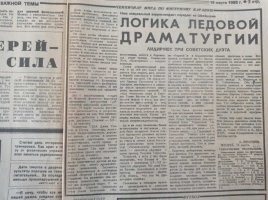
THE LOGIC OF ICE DRAMATURGY

(the article published in russian 'Sovetskiy Sport' on March 19, 1986)

Our special correspondent reports from Switzerland

THREE SOVIET DUOS ARE LEADING

A day when a short program is performed—skaters call it the "Hamlet day"—because the main question is decided: "to be or not to be" in the eyes of the judges, at the top, or to face a long path to the podium.
On the ice of the "Vernets" rink, everyone's attention was drawn to the charmingly coquettish 15-year-old Katrin Kanitz. Slipping out for the warm-up, she literally fluttered like a butterfly in her crimson dress and captivated the audience with her execution of the lift and the twist (by the way, her partner Tobias Schröter is also very confident and elegant).
— "They are trying too hard, overdoing it. Don't they want to win too much?" — I heard a remark from one of the coaches of our team, I. Ksenofontov, who knows a thing or two about the psychology of sports. And his observation turned out to be prophetic.
The hall follows the stormy finale of the GDR figure skaters' program with bated breath. Only the last element remains — the death spiral. And suddenly, the skaters' fingers unclasp, and the athletes fall onto the ice. All the advantage gained with such hard work melted away. Ratings — 5.0–5.1 for technique.
The Champions of the USA, Jill Watson and Peter Oppegard, perform a flawless step sequence, but then, at the moment of the lift, the female partner loses her orientation, flies straight into the boards, and the stunned Peter falls too. For such a clear mistake, they receive 5.1–5.3 for technique.
Perhaps never before had so many dramatic moments fallen upon the share of sports duos. The favorite of our national team, 14-year-old Katya Gordeeva, also made everyone worry. During the warm-up, she lost her balance while performing that same death spiral. Her partner Sergei Grinkov’s eyes grew large with worry. Both, frightened, rushed to the boards where coach Stanislav Zhuk was standing. "Repeat it!" — came the command.
Once again, a swift approach, and this time the death spiral goes perfectly. As it turned out, the entire emphasis in the battle shifted to the psychological aspect. Larisa Selezneva and Oleg Makarov, who returned to the team after a three-month break caused by an injury, knew no peace. Only world and European champions Elena Valova and Oleg Vasiliev walked into the hall where the press center was located, and under the flashes of camera strobes, calmly repeated their lifts, while even nodding their heads in response to greetings from acquaintances. What kind of nerves are needed to maintain such composure!
Yes, and on the ice, the champions were magnificent and made the judges be generous. What a subtle feeling of the rhythm of Raimonds Pauls' music, what a sense of style and line, what brilliant execution of all elements! "Championship inspiration," remarked Tatyana Tarasova, who was sitting with us.
Perhaps all of us had the feeling that Valova and Vasiliev, with scores of 5.7–5.9, would remain the leaders. But Elena Valova herself, having come up to the press box, reacted differently: "Oh, I'm afraid these are not ultimate scores."
Selezneva and Makarov lost slightly in lightness of skating to their teammates and, in the opinion of the majority of judges, conceded 0.1 points. A logic of ice dramaturgy required a culmination. Everyone anticipated it, waited for it. It struck when the last four pairs were called to the start. Among them were Gordeeva and Grinkov. About their original 'Charleston,' which combines both lyricism and humorous Chaplin-esque notes, specialists say: 'A rarely danceable composition.' Gordeeva and Grinkov had already performed it several times, but now, at the end of the season, it was as if they had caught a second wind.
Then followed a long ovation. And, as the final touch, the first bouquet of velvet roses on this world championship went to Katya Gordeeva. On the scoreboard, digits flared up — ten times - 5.8, three times - 5.9. First place went to Gordeeva and Grinkov. Now all three duos — the Moscow one and two Leningrad ones — closed the upper lines of the protocol. Which is to say, highest craftsmanship.
However, let's save our epithets for the final. It promises to be, oh, so difficult. In the next theatrical 'act,' there will be many new heroes. Much is expected from the strong Canadian duo of D. Benning (18 years old) and L. Johnston (25 years old). The Canadians possess a full arsenal of the most complex combinations, and their coach, Kerry Leitch, who specially came to Moscow to study the 'secrets of the Russians,' has succeeded greatly in this. His protégés could present a surprise. And, finally, two more 'tough nuts to crack' — the American duos.
The sharpest situations are developing in men's single skating. In the center of attention is the duel between A. Fadeev and J. Sabovčík. Both came to this meeting in their best form. After the execution of the "school," which was won by Fadeev, European Champion Sabovčík said: "As I expected, the competition in Geneva became much more interesting. The elite has gathered here, capable of showing miracles of complexity. And we will continue our duel in the short program."
Yesterday, another small gold medal was won by Kira Ivanova. She won the compulsory figures, ahead of D. Thomas (USA) and K. Witt (GDR). Anna Kondrashova is in sixth place.​

A. SHELUKHIN.
GENEVA, March 18.
TECHNICAL RESULTS
World Figure Skating Championships. Geneva. March 17. Palais des Sports "Vernets".
Pairs. Short program. 1. E. Gordeeva — S. Grinkov — 0.4; 2. E. Valova — O. Vasiliev — 0.8; 3. L. Selezneva — O. Makarov (all USSR) — 1.2; 4. C. Coull — M. Rowsom (Canada) — 1.6; 5. G. Wachsman — T. Waggoner (USA) — 2.0; 6. D. Benning — L. Johnston (Canada) — 2.4; 7. K. Kanitz — T. Schröter (GDR) — 3.2; 8. N. Seybold — W. Seybold (USA) — 3.6.
1781771825692.jpeg
 
1986
WORLD CHAMPIONSHIPS

THE LOGIC OF ICE DRAMATURGY

(the article published in russian 'Sovetskiy Sport' on March 19, 1986)

Our special correspondent reports from Switzerland

THREE SOVIET DUOS ARE LEADING

A day when a short program is performed—skaters call it the "Hamlet day"—because the main question is decided: "to be or not to be" in the eyes of the judges, at the top, or to face a long path to the podium.
On the ice of the "Vernets" rink, everyone's attention was drawn to the charmingly coquettish 15-year-old Katrin Kanitz. Slipping out for the warm-up, she literally fluttered like a butterfly in her crimson dress and captivated the audience with her execution of the lift and the twist (by the way, her partner Tobias Schröter is also very confident and elegant).
— "They are trying too hard, overdoing it. Don't they want to win too much?" — I heard a remark from one of the coaches of our team, I. Ksenofontov, who knows a thing or two about the psychology of sports. And his observation turned out to be prophetic.
The hall follows the stormy finale of the GDR figure skaters' program with bated breath. Only the last element remains — the death spiral. And suddenly, the skaters' fingers unclasp, and the athletes fall onto the ice. All the advantage gained with such hard work melted away. Ratings — 5.0–5.1 for technique.
The Champions of the USA, Jill Watson and Peter Oppegard, perform a flawless step sequence, but then, at the moment of the lift, the female partner loses her orientation, flies straight into the boards, and the stunned Peter falls too. For such a clear mistake, they receive 5.1–5.3 for technique.
Perhaps never before had so many dramatic moments fallen upon the share of sports duos. The favorite of our national team, 14-year-old Katya Gordeeva, also made everyone worry. During the warm-up, she lost her balance while performing that same death spiral. Her partner Sergei Grinkov’s eyes grew large with worry. Both, frightened, rushed to the boards where coach Stanislav Zhuk was standing. "Repeat it!" — came the command.
Once again, a swift approach, and this time the death spiral goes perfectly. As it turned out, the entire emphasis in the battle shifted to the psychological aspect. Larisa Selezneva and Oleg Makarov, who returned to the team after a three-month break caused by an injury, knew no peace. Only world and European champions Elena Valova and Oleg Vasiliev walked into the hall where the press center was located, and under the flashes of camera strobes, calmly repeated their lifts, while even nodding their heads in response to greetings from acquaintances. What kind of nerves are needed to maintain such composure!
Yes, and on the ice, the champions were magnificent and made the judges be generous. What a subtle feeling of the rhythm of Raimonds Pauls' music, what a sense of style and line, what brilliant execution of all elements! "Championship inspiration," remarked Tatyana Tarasova, who was sitting with us.
Perhaps all of us had the feeling that Valova and Vasiliev, with scores of 5.7–5.9, would remain the leaders. But Elena Valova herself, having come up to the press box, reacted differently: "Oh, I'm afraid these are not ultimate scores."
Selezneva and Makarov lost slightly in lightness of skating to their teammates and, in the opinion of the majority of judges, conceded 0.1 points. A logic of ice dramaturgy required a culmination. Everyone anticipated it, waited for it. It struck when the last four pairs were called to the start. Among them were Gordeeva and Grinkov. About their original 'Charleston,' which combines both lyricism and humorous Chaplin-esque notes, specialists say: 'A rarely danceable composition.' Gordeeva and Grinkov had already performed it several times, but now, at the end of the season, it was as if they had caught a second wind.
Then followed a long ovation. And, as the final touch, the first bouquet of velvet roses on this world championship went to Katya Gordeeva. On the scoreboard, digits flared up — ten times - 5.8, three times - 5.9. First place went to Gordeeva and Grinkov. Now all three duos — the Moscow one and two Leningrad ones — closed the upper lines of the protocol. Which is to say, highest craftsmanship.
However, let's save our epithets for the final. It promises to be, oh, so difficult. In the next theatrical 'act,' there will be many new heroes. Much is expected from the strong Canadian duo of D. Benning (18 years old) and L. Johnston (25 years old). The Canadians possess a full arsenal of the most complex combinations, and their coach, Kerry Leitch, who specially came to Moscow to study the 'secrets of the Russians,' has succeeded greatly in this. His protégés could present a surprise. And, finally, two more 'tough nuts to crack' — the American duos.
The sharpest situations are developing in men's single skating. In the center of attention is the duel between A. Fadeev and J. Sabovčík. Both came to this meeting in their best form. After the execution of the "school," which was won by Fadeev, European Champion Sabovčík said: "As I expected, the competition in Geneva became much more interesting. The elite has gathered here, capable of showing miracles of complexity. And we will continue our duel in the short program."
Yesterday, another small gold medal was won by Kira Ivanova. She won the compulsory figures, ahead of D. Thomas (USA) and K. Witt (GDR). Anna Kondrashova is in sixth place.​

A. SHELUKHIN.
GENEVA, March 18.
TECHNICAL RESULTS
World Figure Skating Championships. Geneva. March 17. Palais des Sports "Vernets".
Pairs. Short program. 1. E. Gordeeva — S. Grinkov — 0.4; 2. E. Valova — O. Vasiliev — 0.8; 3. L. Selezneva — O. Makarov (all USSR) — 1.2; 4. C. Coull — M. Rowsom (Canada) — 1.6; 5. G. Wachsman — T. Waggoner (USA) — 2.0; 6. D. Benning — L. Johnston (Canada) — 2.4; 7. K. Kanitz — T. Schröter (GDR) — 3.2; 8. N. Seybold — W. Seybold (USA) — 3.6.
View attachment 11550

I really doubt that line about "nodding to their friends while practising lifts". A bit of an exaggeration, I think. I've had friends speak to me while they're on the ice and I'm up in a lift, and had to explain later that I wasn't ignoring them. The movement of even just diaphragm muscles in speech could upset the balance at that particular point, so I hear and see them but don't respond until I'm back down on my feet. It's my partner who shouts "Don't talk to her!" when that happens.

We've all had death spirals come apart. At least it's not far to fall, but you do feel silly, sitting down abruptly (him) or sliding down the rink on your stomach (her) :oops:
 
1986
WORLD CHAMPIONSHIPS

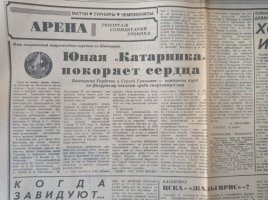
Young "Katarinka" Captures Hearts

(the article published in russian 'Sovetskiy Sport' on March 20, 1986)

Our special correspondent reports from Switzerland

Ekaterina Gordeeva and Sergei Grinkov — Pairs Figure Skating World Champions

Judging by everything, the pairs figure skating final at the Geneva World Championships will be remembered as unique in the history of world championships. On the eve of the event, no one could have predicted the podium setup. Even experts did not anticipate that young Soviet figure skaters E. Gordeeva and S. Grinkov, debutants of the world championship, students of coaches S. Zhuk and S. Leonovich, would win a convincing victory. Just a year ago, this pair was competing in the junior category, and today they embody a very elegant, aesthetic style of skating.
At midnight, the press conference hall at the Les Vernets rink was packed to capacity. With massive bouquets of flowers, the new world champions Gordeeva and Grinkov, and silver medalists E. Valova and O. Vasiliev, were welcomed. The applause greeted not only the athletes but also their coaches, Honored Coaches of the USSR S. Zhuk and T. Moskvina. Over the last 20 years, it is they who have done a great deal to establish the traditions of the domestic school.
"You ask how Gordeeva and Grinkov made the leap to gold medals within a year?" said Stanislav Zhuk to the journalists at the press conference. "But our school remembers a similar case. In 1973, A. Zaitsev received twelve 6.0 scores at the European Championships in Cologne just ten months after pairing up with I. Rodnina. This means the experience has been accumulated..."
Of course, the local public fell in love with the blue-eyed schoolgirl Katya Gordeeva right away. Spectators affectionately called her in their own way, "Katarinka." At just 14 years old, she is not afraid of any questions and gives completely sincere answers:
"About dolls, I have already forgotten how to think. I am interested in more than anything electronics and computers. Maybe I will learn to work on a display screen to write school essays on it..."
And she will learn!
Inevitably, one recalls that just as rapidly as they broke into the elite of world figure skating, so did their senior teammates from the national squad: Valova and Vasiliev, who debuted in 1983 at the World Championships in Helsinki. Back then, they also won gold medals.
"Stars" break out periodically like fireworks on the Geneva ice. A year ago, no one knew the American figure skaters Debi Thomas and Caryn Kadavy, and now they are competing with recognized virtuosos Kira Ivanova, and Katarina Witt — this is another main event of the tournament.
However, the path of young figures to the podium is far from a triumphant path. Roses are handed out for painstaking, titanic work and the will to win. It was enough for Gordeeva and Grinkov to falter in the short program, and a heavy price would have to be paid to make up for lost ground. After all, the competition in modern pairs skating is unusually high. It seems that the class of our pairs skating is embodied in the brilliant compositions of E. Valova and O. Vasiliev, A. Selezneva and O. Makarov.
We emphasize that the credit of the coaches, spouses Tamara Moskvina and Igor Moskvin, in the art of leading their students in various artistic directions is immense. One duo maximally dramatizes their compositions, while another emphasizes an athletic, sporting foundation.
A few words about how the battle unfolded. First in the leaders group came Gordeeva and Grinkov. Their free program, combining a gentle melody of old classical jazz, was flawless in execution technique. Not a single mistake! And as a result, 12 scores of 5.8, and three scores of 5.9 points. After this, the battle unfolded mainly for second and third places. Valova and Vasiliev skated with just as much temperament as at the European Championship, but made several mistakes. Selezneva and Makarov lost the bronze medals in a fierce battle to pairs champions from Canada: 20-year-old Cynthia Coull and 27-year-old Mark Rowsom.
The culmination in the men's event is near. The prediction of the multiple world champion E. Danzer from Austria was completely confirmed. On the eve of the event, he promised a grand spectacle and noted that at least ten athletes would participate in it. And so it turned out. Aleksandr Fadeev, Vladimir Kotin, and Viktor Petrenko set the tone in the dispute. They do not lack courage—in the short program, they fought with maximum dedication. As a result, Fadeev took second place with scores of 5.8 and 5.9. Kotin was third with scores of 5.6 and 5.8, and Petrenko finished sixth with scores of 5.5 and 5.6. The short program was won by 25-year-old Canadian Brian Orser. In technique he was inferior to Fadeev, but in the scores for artistry he had one tenth of a point more. The overall leader remains world champion Aleksandr Fadeev, followed by Jozef Sabovčík from Czechoslovakia, and in third place is Orser.​

A. SHELUKHIN.
GENEVA, MARCH 19.
TECHNICAL RESULTS
World Figure Skating Championships. Geneva. Rink "Les Vernets". March 18.
Pairs Skating. Overall Standings.
1. E. Gordeeva and S. Grinkov — 1.4; 2. E. Valova and O. Vasiliev (both USSR) — 2.8; 3. C. Coull and M. Rowsom (Canada) — 4.6; 4. L. Selezneva and O. Makarov (USSR) — 5.2; 5. D. Benning — L. Johnston (Canada) — 8.4; 6. J. Watson and P. Oppegard — 8.6; 7. G. Wachsman — T. Waggoner — 9.0; 8. N. Seybold — W. Seybold (all USA) — 11.2.
1782048980501.jpeg
 
1986
WORLD CHAMPIONSHIPS

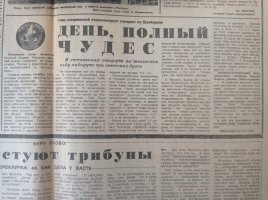
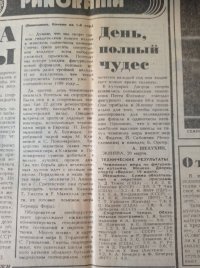
A Day Full of Wonders

(the article published in russian 'Sovetskiy Sport' on March 21, 1986)

Our special correspondent reports from Switzerland

In the Ice Dance Competition, Three Soviet Duos Take the Lead

The Geneva lake has wrapped itself in a shroud of fog. A light, persistent rain is drizzling. It is gloomy on the narrow streets. The weather, in a certain sense, matches the mood...
The Japanese skater Midori Ito wept, having started poorly in her short program. The reigning Olympic champion, Katarina Witt, who had lost her leadership, smiled sadly at autograph hunters. American figure skater Caryn Kadavy was escorted by the arms to a car, having suffered a painful, minor injury during her performance. How many hopes were dashed on this day! And how hard it is now for the coaches to rebuild the competitive spirit of their students. Perhaps, for the first time at this championship, we witnessed such an unprecedented cocktail of flights and falls.
But let us recount everything in order. In the group of strongest contenders, Natalia Lebedeva was the first to start—an athlete of powerful, athletic style. The judges are well familiar with her composition to the melody of the czardas (with which Natalia took 4th place at the European Championship) is familiar. She was close to a high result again, but at the last moment, a difficult element let her down—a combination with a triple jump. This unfortunate landing cost her dearly: only tenth place. Lebedeva was bypassed by very strong athletes from West Germany and Canada: Claudia Leistner and Tracy Wainman. They had scores at the level of 5.3–5.5.
The psychological tension in the tournament reached its highest peak when our Kira Ivanova, the leader of the championship, stepped onto the ice. A thunder of applause accompanied her as she flawlessly executed a cascade with a triple toe loop and spins to a lively Russian dance melody. And suddenly, on the next jump—a double Axel—Kira falls. The referees immediately lower her score: for technique—5.2, 5.3, and for artistry—5.5, 5.7.
What will be the response of the 19-year-old US Champion, Debi Thomas? The tall, slender African-American skater is master of all elements of the short composition. True, she consciously slows down the tempo of her skating, but all her movements are calibrated to the millimeter. And her double Axel and lutz, executed deep and easily, are particularly impressive. The American had the highest scores both for technique and for artistry—5.7, 5.8. For now, she leads the tournament.
But a challenge to her was thrown by our charming 20-year-old Muscovite, Anna Kondrashova. The sounds of the familiar 'Kalinka' at the beginning of the track stirred the entire audience. The Genevans passionately supported the figure skater, and she flawlessly made it through all the difficulties of the tough program. She perfectly executed a cascade of jumps and a dashing path of steps. Ten scores of 5.7 points propelled her to second position.
Both the American Caryn Kadavy and Olympic champion Katarina Witt made attempts to catch up with Kondrashova. However, both of them suffered a failure in the jumps. Kadavy received 5.1 (9th place) from the judges, and Witt received 5.2–5.3. However, Witt mesmerized the judges with the striking fluidity of her Oriental dance. At that moment, their hearts softened. They flashed two scores of 5.9 on the scoreboard, which ultimately secured fourth place for Witt. However, in the overall standings, she fell behind three skaters at once—Thomas, Ivanova, and America's T. Chin. And Kondrashova practically caught up with Witt: Anna's total score is 4.4, while Witt's is 3.4.
An express-commentary from the multiple European champion, Karol Divín (Czechoslovakia):
"I am amazed by the high level of mastery in the women's tournament. The best performers demonstrate an example of a synthesis of virtuoso technique and great artistic expression. I would like to highlight the programs of the leaders—Thomas, Witt, Kondrashova, Chin, Leistner. I do not remember a championship where so many original styles were presented."
And here is what the former world champion, Vladimir Kovalev, emphasized:
- I think that we will soon witness a new surge in women's singles skating. Right now, about ten female athletes possess the entire repertoire of complex jumps. Therefore, we will soon see figure skaters of a new formation, ready to perform even a triple axel. And it is not ruled out that such an athlete will appear as early as the 1988 Olympic Year."
Yes, the third day of the championship turned out to be rich in surprises. They were also present in the ice dance events, where 22 duos demonstrated the rumba, pasodoble, and Westminster waltz. Viewers greeted the ice miniatures performed by world and European champions N. Bestemianova and A. Bukin, as well as world silver medalists M. Klimova and S. Ponomarenko, with an ovation. The lead was taken by the most decorated couple, but Klimova and Ponomarenko managed to achieve the best scores of the day in the waltz. So the struggle between the two magnificent duos is in full swing. Our third couple —Muscovites H. Annenko and G. Sretenski—also brought joy; they managed to overtake Canadian champions T. Wilson and R. McCall (by the way, they are coached by world champion Bernard Ford).
Observers from Swiss newspapers continue to animatedly comment on the sensational outcome of the pairs competition. Many praises were sent toward world champions E. Gordeeva and S. Grinkov. Newspapers emphasize that the Soviet school of figure skating possesses a vast creative potential; practically every year it brings forward new bright talents.
In the lobbies of the Sports Palace, Olympic champion Peggy Fleming, a "star" of 1960s figure skating, appeared. She arrived in Geneva specifically to commentate on the two singles skating finals for television. Let me remind you that among the men, our A. Fadeev, J. Sabovčík (Czechoslovakia), and Canadian B. Orser have the highest chances for the world champion title.​
A. SHELUKHIN.
GENEVA, March 20.
TECHNICAL RESULTS
World Figure Skating Championships. Geneva. "Vernets" Sports Palace, March 19.
Women. Sum of compulsory and short programs. 1. D. Thomas (USA) — 1.6; 2. K. Ivanova (USSR) — 3.0; 3. T. Chin (USA) — 3.2; 4. K. Witt (GDR) — 3.4; 5. A. Kondrashova (USSR) — 4.4; 6. K. Leistner (FRG) — 7.4; 7. T. Wainman (Canada) — 7.4; 8. C. Kadavy (USA) — 7.8; 9. N. Lebedeva (USSR) — 8.8.
Ice Dance. Compulsory program. 1. N. Bestemianova and A. Bukin — 0.6; 2. M. Klimova and S. Ponomarenko — 1.2; 3. N. Annenko and G. Sretenski (all — USSR) — 1.8; 4. T. Wilson and R. McCall (Canada) — 2.4; 5. S. Semanick and S. Gregory (USA) — 3.0; 6. R. Roca and D. Adair (USA) — 3.6; 7. K. Beck and C. Beck (Austria) — 4.2; 8. A. Becherer and F. Becherer (FRG) — 4.8.
1782105244708.jpeg
1782105263565.jpeg
 
Last edited:
Back
Top