Archive of newspaper articles | Page 29 | Golden Skate

Archive of newspaper articles

1986
USSR CHAMPIONSHIPS
CONVERSATION BY THE RINK SIDE


A Happy Choice

(the article published in russian 'Sovetskiy Sport' on January 5, 1986)

Is it easy to become a coach, let alone a specialist in a sport as complex as figure skating? Do not expect a categorical answer from Ardo Rennik. He began his path to this profession 20 years ago and believes that only now, at the 50th USSR Championship, his students can demonstrate programs with a quality mark.
"— However, this is not yet my year," says Ardo with a gentle smile. "I expect a real revenge from my guys in 1987. That is how I have it planned."
Ardo started working as a coach at the age of 17.
"— I was shocked that for the first lesson my female students came in bloomers [harem pants] rather than in sports attire," he recalls. "I asked them what the matter was. And they replied: 'We are shy around you.' To them, I was like a suitor. That's when I realized it is not so simple to establish contact with students. Two years later, I left Tallinn for Leningrad and entered the Lesgaft Institute of Physical Education..."
"— Is that where you mastered the coaching profession?"
"— No. Back then, in my year, I met a girl—Yulia Pavlina (she was a student of coach Igor Moskvin)—and suggested we form a sports duo. For eleven years we competed in pairs skating. And our last season—1978—became our peak season. Our program included a double Axel jump and double-rotation throws. At the 1978 Winter Spartakiad of the Peoples of the USSR, we won the 'bronze' in a struggle against the future world champions Marina Cherkasova and Sergei Shakhrai."
"— And what about studying at the institute?"
"— We took our exams honestly. I knew that without solid knowledge, we wouldn't be able to process our competitive experience. And later, we were invited to work at the Sverdlovsk figure skating school..."
"— Still, what attracted you to the coaching profession?"
"— And here Ardo unexpectedly recalled his youth in Tallinn again. He uttered just two words: 'Lii Piir.' The connection between generations immediately became clear. Lii Piir, an extraordinarily energetic, emotional woman, taught figure skating lessons on natural open ice and revealed the romance of winged skates to her boys. It was then that Ardo 'fell ill' with figure skating."
"— Ardo, you and your wife Yulia have been running the pairs skating school in Sverdlovsk for fifteen years now. Do you regret your choice?"
"— Not at all, the work is to my liking. Even now, I sometimes demonstrate complex elements to the kids. And our new pair, currently competing in Leningrad—Yulia Bystrova and Aleksandr Tarasov—possesses a full modern technical arsenal. They are medalists of the Winter Universiade and a major tournament in England. By the way, Sasha also graduated from the Leningrad Institute of Physical Education. He is 24 years old, and Yulia Bystrova is 19. For pairs skating, in my opinion, this is the time of true blossoming."
"— Ardo, why do you think that your year will be 1987?"
"— There are many reasons. We are looking for reserves in the artistry of the program performance and in the complexity of elements. Under the new rules, parallel triple jumps, a triple Axel twist, and triple throws represent the highest difficulty. These will form the foundation of our pursuit."​
A. SHELUKHIN.
(Our spec. corr.).
LENINGRAD

WHAT DO YOU KNOW ABOUT THIS?

What is the Filling of the "Pie"?

(the article published in russian 'Sovetskiy Sport' on January 5, 1986)

The "Yubileiny" Sports Palace has dressed up and looks younger. After eighteen years of operation, its main ice arena has undergone a capital renovation. The ice gleams and shimmers under the rays of the light fixtures. And few people think about how complex the "filling" of such an ice field is. If you ask figure skaters, "How do they 'brew' the ice for you?", at best you will hear the answer: "It is frozen on concrete. And the cold is supplied through pipes." But is it really that simple?
"— Our 'pie' has a multi-layered filling," explains the chief engineer of "Yubileiny," Viktor Ilyich Mini. "If the pipes were simply embedded in concrete, such a foundation would quickly crumble into pieces. A complex waterproofing system is needed, along with special layers that cushion, so to speak, the expansion and contraction of the arena caused by temperature differences. What is included in the eleven layers? There is a mastic primer for the foundation, styrofoam, glass-fiber roofing felt, a layer of talc, reinforcing mesh, a protective concrete slab, and only then, on top of all this, 18 kilometers of pipes are installed, 'dressed' in a new concrete jacket."
The chief engineer's story makes one remember with respect those who put their labor into the mirror-smooth ice surface. In particular—the builders of Trust No. 16 of "Glavleningradstroy" and its numerous subcontractors. They brought to life a project developed at the Leningrad Zonal Research and Design Institute of Experimental Design. At first, it was assumed that the old arena would have to be dismantled and a new one laid in its place. But it turned out to be simpler and more economical to make a multi-layered "pie" on top of the old foundation. Time was saved, and the rink was only raised by 30 centimeters.
"— But this is only part of the renovation," clarifies the chief engineer. "The entire sound reinforcement system for sports and other entertainment events has been replaced. We received the equipment from the Leningrad Optical and Mechanical Association named after V. I. Lenin]. A cosmetic renovation of many premises has been carried out. All work was completed on schedule.
Right now, 'Yubileiny' is hosting the jubilee figure skating championship. And the highest evaluation for those who prepared the multi-layered ice 'pie' will be the high mastery of the athletes."​
B. AVLAS.
(Our corr.).
LENINGRAD
View attachment 11482

He doesn't mention a deep layer of sand in the base, used in newer rinks in Canada. It makes for a much quieter landing of jumps and throws. You can always tell whether the base is concrete or sand without asking the ice men -- land anything on concrete and there's a thud, but it's almost silent on a sand base. I actually prefer learning a new element or beginning work on a new program on an old concrete-based surface. I work more to roll out smoother landings to reduce the clank. Then when we transfer to sand-based ice my landings are silent and my much heavier partner makes just a hiss on a solid runout. Interesting to read about the developing process in this article, though, especially after reading the earlier one about skating on natural outdoor ice.
 
1986
USSR CHAMPIONSHIPS

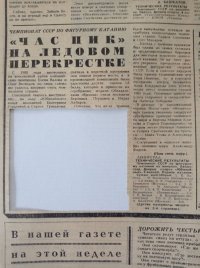
"Rush Hour" at the Ice Crossroads

(the article published in russian 'Sovetskiy Sport' on January 7, 1986)

Since 1980, Olympic champions Elena Valova and Oleg Vasiliev have been competing on the all-Union arena, but only now have they managed to become country champions for the first time.
The sensation of the tournament was the performance on the ice of the "Yubileyny" Sports Palace by young Muscovites Ekaterina Gordeeva and Sergei Grinkov. At first, in the short program, they took first place, and in the free program, they were awarded ten 5.8 scores and took the silver medals. The bronze medal winners were Muscovites Veronika Pershina and Marat Akbarov.
We should note that due to injury, last year's champions of the country, Larisa Selezneva and Oleg Makarov, were forced to stay in the stands.
...A combination with a triple jump was one of the most difficult and hard-to-pass hurdles for the masters of women's single skating. But this time it was confidently overcome by the strongest female skaters of the USSR national team. Although the leader after the short program was Olympic bronze medalist Kira Ivanova, Anna Kondrashova (who, by the way, holds the title of the country's champion for 1985) broke ahead. Excellent chances for success are also maintained by Natalia Lebedeva from Sverdlovsk.
The ice dance tournament is in full swing. After three compulsory dances, the silver medalists of the World and European Championships, Marina Klimova and Sergei Ponomarenko, are confidently leading. In second place are Natalia Annenko and Genrikh Sretenskii, and in third are Maya Usova and Alexander Zhulin.
The competition in "school" [compulsory figures] was won by world champion Alexander Fadeev.​
(From our special correspondent).
LENINGRAD.

Technical Results
USSR Figure Skating Championship. Leningrad. "Yubileyny" Sports Palace. January 5.
Pairs Skating. Combined Total. 1. E. Valova – O. Vasiliev (Leningrad) — 1.8 points; 2. E. Gordeeva – S. Grinkov (Moscow) — 2.4 points; 3. V. Pershina – M. Akbarov (Moscow) — 5.2 points; 4. E. Kvitchenko – R. Kadyrkaev (Leningrad) — 5.8 points; 5. E. Bechke – V. Kornienko (Leningrad) — 7.0 points; 6. L. Koblova – A. Kalitin (Moscow) — 8.6 points.
1780651553985.jpeg
 
Last edited:
1986
USSR CHAMPIONSHIPS

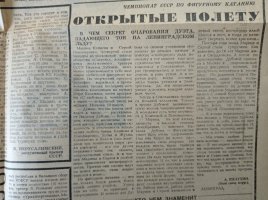
Open to Flight

(the article published in russian 'Sovetskiy Sport' on January 7, 1986)

What is the secret of the charm of the duo setting the tone on the Leningrad ice?

Marina Klimova and Sergei Ponomarenko. The fourth-season ice dancers from the Moscow school of the "Spartak" society, students of the Merited Coach of the USSR Natalia Dubova, invariably captivate the attention of figure skating fans. Their artistic progress has been vividly expressed in the free dances of recent years: first, a composition to the music of Imre Kálmán, then the program "With Love to the Champions," and now — an airy dance to the music of Johann Strauss.
"I think we found our key to the dance," says Natalia Dubova. "To all the couples raised in our school, a sense of ease and precision in executing any dance is inherent. Klimova and Ponomarenko, Usova and Zhulin, Krykanova and Platov (who won three World Junior Championships) — all these duos reflect our Spartak style, so to speak. And the dance of Marina and Sergei attracts, above all, with its vitality. Moreover, they eagerly search for the new, and they themselves are drawn to it..."
But figure skating is not just the glare of the spotlights, the shine of smiles. Success does not come to athletes on its own. And it took Natalia Dubova and her students a lot of years to "roam" through various ice rinks in search of "free ice," because at that time the construction of the Spartak complex in Sokolniki was still underway. They often trained after midnight and early in the morning. And in the hot season, when dances were being "composed," they would travel to Elektrostal. Yes, these athletes know how to cherish every single hour on the ice.
Now a large team works in Sokolniki. Eight ice dance couples train in Dubova's group. And the youth have plenty to learn from Klimova and Ponomarenko.
"Marina, in my opinion, is a highly unique personality," notes Natalia Dubova. "As a figure skater, she can be very restrained. She is careful not to spill her energy, catching every thought, every idea of the coach instantly, absorbing it with ultimate precision. On the ice, a transformation occurs. And what in our minds looked complex and unclear, a few weeks later looks finished in its form. I know that every discovery is preceded by complex internal work. A work of the mind, a work of the soul. Marina and Sergei inhabit the new dance, gradually falling in love with it, and then it begins to sparkle with all its colors..."
A year and a half ago, Marina and Sergei became husband and wife. Until the age of 14, Marina lived in Sverdlovsk. And then, at the invitation of Dubova, she arrived in Moscow at the Spartak figure skating center. She was supposed to stay in a hotel. But Sergei Ponomarenko's parents, very hospitable people, immediately offered Marina their daughter’s room in their apartment. And that is how Marina met her future partner’s family. And as for how she knows how to work on the ice, Sergei Ponomarenko himself said it best:
"I am always amazed by how demanding Marina is of herself on the ice. She does not forgive herself a single mistake. That is probably why our dances are so light and elegant."
"We love to dance in general," remarks Marina. "Lately, we have been working on masterclasses from famous ballroom dance masters Lyudmila and Stanislav Popov. Everything we see in life, in art, we perceive through the prism of dance. And this, of course, reflects in our programs."​
A. SHELUKHIN.
(From our special correspondent).

LENINGRAD.
1780668126674.jpeg
 
Last edited:
1986
USSR CHAMPIONSHIPS
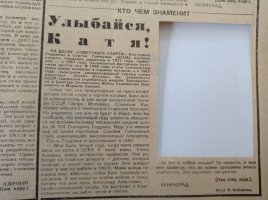
WHO IS FAMOUS FOR WHAT


Smile, Katya!

(the article published in russian 'Sovetskiy Sport' on January 7, 1986)

From the Dossier of "Sovetsky Sport". Ekaterina Gordeeva and Sergei Grinkov (CSKA), Masters of Sports. Gordeeva was born in 1971. Grinkov was born in 1967. They have been figure skating for ten years. In 1984, they became world junior champions in pairs skating. In 1985, they won the international senior tournament "Skate Canada". At the USSR Championship, they won silver medals. They train under Stanislav Zhuk, Stanislav Leonovich, and Marina Zueva.
Many specialists attended the press conference after the pairs skating competition. This included Honored Coaches of the USSR Tamara Moskvina and Stanislav Zhuk. World championship medalist Stanislav Leonovich was also there. We hope they will not be offended by this report. A real barrage of questions rained down on an eighth-grader. She attends Moscow secondary school No. 704. Her name is Ekaterina Gordeeva. She and her partner Sergei Grinkov caused numerous surprises.
Let Gordeeva tell her own story:
"I was four years old when my mom brought me to the CSKA rink. My mom, Elena Lvovna, has a very interesting profession. She works with a complex machine—a display screen. It types and shows text on a monitor. This equipment is located at her workplace at TASS. Mom always told me: 'My dream is for Katya to dance better than anyone.' She has a special love for dance because my dad, Aleksandr Alekseevich, is a professional dancer. He performs in the Red Banner Song and Dance Ensemble."
"Why do I love skating? I love the speed. I also like that you can smile during a program. It lifts your mood."​
(Our Special Correspondent)
LENINGRAD
1780669012632.jpeg
 
1986
USSR CHAMPIONSHIPS

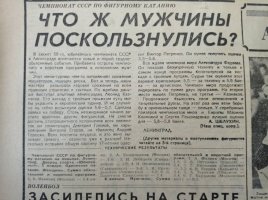
Why Did the Men Slip?

(the article published in russian 'Sovetskiy Sport' on January 8, 1986)

New and sometimes difficult-to-explain events are woven into the plot of the 50th anniversary USSR Championship in Leningrad. The men's short program added intensity to the championship.
This mini-tournament somewhat resembles a battle of musketeers seeking risk. And now, our masters played out an ice battle according to all the rules of strategy and tactics. By draw, the experienced Leningrader Leonid Kaznakov performed earlier. His combination with a triple lutz jump could have graced a European tournament as well. And it was no accident that scores of 5.6–5.7 flashed on the scoreboard. A bid for victory was made.
Such an unexpected start caught other skaters by surprise. Neither Dmitry Gromov from Leningrad, nor Vitaly Egorov from Kharkov, nor Andrei Torosyan from Tbilisi could achieve 100% execution of all elements. Failure befell them all, and this is clearly cause for concern—the season is already in full swing! 17-year-old Viktor Petrenko from Odessa somewhat improved the overall picture. He managed to get scores of 5.5–5.6.
Everyone was waiting for world champion Aleksandr Fadeev. He showed flawless technique and only at the very end of the program "stumbled" on a combination with a triple lutz. The judges scored this version of the composition as follows: 5.5 for technique and 5.9 points for artistry. The world champion continues to lead after the total of two programs. Petrenko moved into second place, Kaznakov into third.
Dance duets also continue to "settle their scores." This time they competed in the original dance—the polka. World and European Championship silver medalists Marina Klimova and Sergei Ponomarenko received the best scores of the day—5.8–5.9 points.​
A. SHELUKHIN.
(Our Special Correspondent).

LENINGRAD
Technical Results
USSR Figure Skating Championship. Leningrad. "Yubileyny" Sports Palace.
January 5. Single Skating. Women. Sum of compulsory and short programs. 1. K. Ivanova (Moscow) — 1.4 points; 2. A. Kondrashova (Moscow) — 1.6 points; 3. N. Lebedeva (Sverdlovsk) — 3.0 points; 4. N. Ovchinnikova (Sverdlovsk) — 5.4 points; 5. I. Krundysheva (Leningrad) — 6.8 points; 6. L. Zamotina (Sverdlovsk) — 7.4 points.
January 6. Men. Sum of compulsory and short programs. 1. A. Fadeev (Moscow) — 1.0 points; 2. V. Petrenko (Odessa) — 2.4 points; 3. L. Kaznakov (Leningrad) — 3.2 points; 4. V. Egorov (Kharkiv) — 3.4 points; 5. A. Torosyan (Tbilisi) — 5.4 points; 6. G. Vardanyan (Moscow Region) — 6.2 points.
1780670016642.jpeg
 
1986
USSR CHAMPIONSHIPS
From the Coach's Point of View

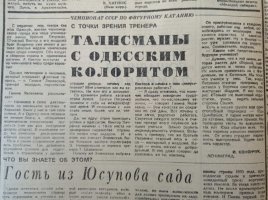
TALISMANS WITH AN ODESSA FLAIR

(the article published in russian 'Sovetskiy Sport' on January 8, 1986)

Recently, speaking "for all of Odessa," residents of the Black Sea city increasingly mention the names of the Petrenko brothers. 17-year-old Viktor and his younger brother Vladimir already hold gold medals as world junior champions. Both are members of the national singles team. Viktor has also competed in the senior World Championship.
But let us talk about the person who discovers Odessa's talents—about Galina Zmievskaya, a young and promising coach.
Galina Yakovlevna says:
"I began my career on a small rink in Kharkiv. We had our successes there too. But I was invited to Odessa not for personal privileges, but for the promised opportunities to work productively (a Sports Palace had just been built there). This year we celebrated the tenth anniversary of our Odessa school.
However, even in our sports home, there are problems. For instance, while fighting to improve conditions for training, I would ask the palace administration: 'Why is the ice bad?' They would reply: 'We flood it the way you skate.'
Over time, the kids started skating better. The Petrenko brothers made a name for themselves on the international stage. And the attitude toward us became different, warmer, so to speak."
Yes, success did not come to the Odessans all at once. Viktor Petrenko started from 16th place at the country's junior championship. But then he became a leader. And in this, as Zmievskaya believes, there is great merit due to choreographer E. Nemirovskaya and first coach T. Shalaeva.
Why did Zmievskaya choose Viktor out of everyone and begin working with him so purposefully?
"I noticed right away that the boy possessed an enviable work ethic, because he was truly passionate," says Galina Yakovlevna. "He has preserved these qualities to this day. That is why it is easy and joyful to work with him. I consider the primary secret of any success to be an unquenchable desire to learn. It is important to develop the individuality of the student. Take those same Petrenko brothers, for example: the older one takes after his father—stubborn, while the younger one, Volodya, is very soft and kind-hearted. I even tell him sometimes: 'Come on, get angry for once!'"
He listens to every piece of advice, works on himself, freeing himself from flaws that hinder his character. And it is very noticeable: he is growing and maturing. As for Viktor, he has already developed as an athlete. He is thorough and reliable.
How do you envision the future of your students?
"I think that in the upcoming generation joining the national team, there will be a place for my kids as well. They cannot be compared yet to Fadeev or Kotin. For now, we are learning from them. Just yesterday, Viktor skated his program and stayed by the boards to watch Fadeev perform. I told him: 'Don't just look for flaws, look at the strong points of Sasha's skating.'"
There is another talented boy in our group—Yura Tsymbalyuk. The boy has a soft skating style and good jumps. We conducted spin tests, and Yura beat everyone. But for now, the boy is overly emotional. The reliability of his performances suffers from this. We will temper his character.​
I. KONONCHUK
LENINGRAD
1780671240441.jpeg
 
1986
USSR CHAMPIONSHIPS
WHAT DO YOU KNOW ABOUT THIS?


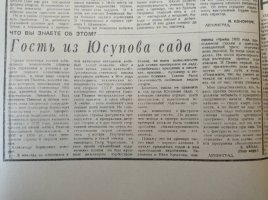
Guest from Yusupov Garden

(the article published in russian 'Sovetskiy Sport' on January 8, 1986)

Among the honored guests of the country's anniversary championship are associates and students of our first Olympic champion in this sport—Nikolai Panin. His gold medal, won at the London Olympics in 1908, is now preserved in the State Hermitage Museum. Aleksandr Borisovich Gandelsman—now a professor and doctor of medical sciences—was a student of Panin and creatively collaborated with him for nearly a quarter of a century. He began figure skating in 1928. Twice, together with his wife Raisa Nikolaevna Novozhilova, in 1937 and 1939, he was the champion of the country in pairs skating.
Aleksandr Borisovich says:
"I have never belonged to that category of veterans who like to declare: 'Now back in our day, people really knew how to skate!' The achievements of the Soviet figure skating school in the 1980s are undeniable. The technical mastery of today's USSR national team evokes admiration. In Nikolai Panin's time, a single-revolution jump was considered world-class. Now, beginners start their very first steps with it. But let's compare the conditions: today, skaters train in beautiful sports palaces in a hundred cities across the country, whereas during our sporting youth, we sometimes had to warm our feet by a fire between sessions. It is instructive to recall an episode involving Leningrader Petr Chernyshev, who was the country's strongest single skater at the time (and later became a prominent steam-turbine engineer). Lacking opportunities for summer training on ice, he practiced spinning a 'scratch spin' by attaching... a button to the sole of his boot. Such was his dedication to his favorite sport.
Of course, the pond of the Yusupov Garden, where the first steps of our figure skaters are linked, can in no way be compared with today's artificial ice arenas.
Yes, the changes in figure skating are countless. However, I believe that the main problem must always remain at the center of coaches' attention: the balance of skating and its individual elements.
I will demonstrate this using the example of pairs skating. In the early 1930s, acrobatics predominated. Valentina and Ivan Krylov, the country's 1933 champions, presented the judges and spectators with an unprecedented trick: a headbanger. No one had ever done it before. But after a brief period of enthusiasm came a time for analysis. And Panin was the first to realize: trickery for the sake of trickery is a dead end. 'Show me that you know how to skate on skates!' he demanded of us, his students.
It seems to me that today, fighting against blandness, we must not forget the priority of the athletic foundation. Figure skating is a sport, a passion, a complexity, and not a ballet on ice. But art needs a bit more attention—the ability to create a spectacular program. When the viewer doesn’t understand the actor, all his majesty remains for him. Then, the figure skater's technical perfection can 'shine' to its full potential, but only if the entire program is balanced."​
B. AVLAS.
(Our Special Correspondent).
LENINGRAD
1780672401181.jpeg
 
Last edited:
1986
USSR CHAMPIONSHIPS
WHAT DO YOU KNOW ABOUT THIS?


Guest from Yusupov Garden

(the article published in russian 'Sovetskiy Sport' on January 8, 1986)

Among the honored guests of the country's anniversary championship are associates and students of our first Olympic champion in this sport—Nikolai Panin. His gold medal, won at the London Olympics in 1908, is now preserved in the State Hermitage Museum. Aleksandr Borisovich Gandelsman—now a professor and doctor of medical sciences—was a student of Panin and creatively collaborated with him for nearly a quarter of a century. He began figure skating in 1928. Twice, together with his wife Raisa Nikolaevna Novozhilova, in 1937 and 1939, he was the champion of the country in pairs skating.
Aleksandr Borisovich says:
"I have never belonged to that category of veterans who like to declare: 'Now back in our day, people really knew how to skate!' The achievements of the Soviet figure skating school in the 1980s are undeniable. The technical mastery of today's USSR national team evokes admiration. In Nikolai Panin's time, a single-revolution jump was considered world-class. Now, beginners start their very first steps with it. But let's compare the conditions: today, skaters train in beautiful sports palaces in a hundred cities across the country, whereas during our sporting youth, we sometimes had to warm our feet by a fire between sessions. It is instructive to recall an episode involving Leningrader Petr Chernyshev, who was the country's strongest single skater at the time (and later became a prominent steam-turbine engineer). Lacking opportunities for summer training on ice, he practiced spinning a 'scratch spin' by attaching... a button to the sole of his boot. Such was his dedication to his favorite sport.
Of course, the pond of the Yusupov Garden, where the first steps of our figure skaters are linked, can in no way be compared with today's artificial ice arenas.
Yes, the changes in figure skating are countless. However, I believe that the main problem must always remain at the center of coaches' attention: the balance of skating and its individual elements.
I will demonstrate this using the example of pairs skating. In the early 1930s, acrobatics predominated. Valentina and Ivan Krylov, the country's 1933 champions, presented the judges and spectators with an unprecedented trick: an upside-down spin. No one had ever done it before. But after a brief period of enthusiasm came a time for analysis. And Panin was the first to realize: trickery for the sake of trickery is a dead end. 'Show me that you know how to skate on skates!' he demanded of us, his students.
It seems to me that today, fighting against blandness, we must not forget the priority of the athletic foundation. Figure skating is a sport, a passion, a complexity, and not a ballet on ice. But art needs a bit more attention—the ability to create a spectacular program. When the viewer doesn’t understand the actor, all his majesty remains for him. Then, the figure skater's technical perfection can 'shine' to its full potential, but only if the entire program is balanced."​
B. AVLAS.
(Our Special Correspondent).
LENINGRAD
View attachment 11488
Now I'm trying to figure out what an "upside down spin" looked like :scratch2:. Him spinning with her in a handstand position on his boots, maybe? Or just a SBS reverse camel, with both in a supine position? :shrug:
 
1986
HELLO, KYIV!


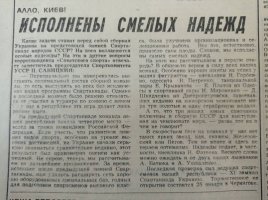
FILLED WITH BOLD HOPES

(the article published in russian 'Sovetskiy Sport' on January 8, 1986)

What tasks has the Ukrainian national team set for itself ahead of the upcoming Winter Spartakiad of the Peoples of the USSR? On whom are the highest hopes being pinned? These and other questions from a "Soviet Sport" correspondent are answered by P. Savitsky, Deputy Chairman of the Sports Committee of the Ukrainian SSR:
— Originally, we intended to field the most optimal lineup for the national team—meaning, to compete in absolutely all events on the Spartakiad program. However, at the last minute, it was decided to withdraw from the bandy tournament, as this sport is only just taking its first timid steps in our republic.
At the previous Spartakiad, our republic's team took fourth place, following the three teams from the Russian Federation. Considering that the development of winter sports, especially at the high-achievement level, only began to be taken seriously in Ukraine relatively recently, this result was rightly judged as a success. I won't hide that we are now counting on further advancement. In the time that has passed since the last Winter Spartakiad, we have managed to expand the network of well-equipped specialized training bases capable of preparing high-class athletes; organizational and talent scouting work has also been improved. All of this, naturally, has borne fruit. In short, we are filled with the boldest hopes.
Whom are we counting on first and foremost? Generally speaking, we believe in the strength of all our teams. The chances are particularly high for our figure skaters: Natalya Gorbenko from Kyiv, Viktor Petrenko from Odesa, the ice dance couple Elena Krykanova and Evgeni Platov from Odesa, and the pairs team Irina Mironenko and Dmitri Shkidchenko from Dnipropetrovsk, who recently won three gold medals and one silver medal at the World Junior Championships.
And the fact that three of our young luge athletes have been included in the USSR national team for the World Championships—doesn't that speak for itself?
In speed skating, we do not have such bright stars as, say, Zhelezovsky or Pegov. Nevertheless, we are not losing our optimism here either. In particular, Inga Fateeva from Kyiv shows great promise. We can also expect strong performances from two of our cross-country skiers, Alexander Batyuk and Alexey Ushkalenko.
The final test of strength for our republic's leading athletes will be the 11th Winter Spartakiad of Ukraine. Its ceremonial opening will take place on January 25th in Chernihiv.
1780832977672.jpeg
 
1986
USSR CHAMPIONSHIPS

WHO IS FAMOUS FOR WHAT

FROM THE "SOVIET SPORT" DOSSIER. Master of Sports of International Class Anna Kondrashova (CSKA). Born in 1965. Has been figure skating since age six. First coach — Nina Zhuk.
Has been competing on the USSR national team since 1982. Won a silver medal in the singles event at the 1984 World Championships. In 1985, she placed in the top five at both the World and European Championships. Two years in a row — in 1985 and now here in Leningrad — she became the National Champion. Currently training under Honored Coach of the USSR Stanislav Zhuk and choreographer Nina Domanovskaya.​

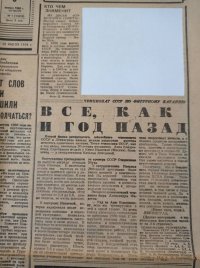
EVERYTHING IS THE SAME AS A YEAR AGO

(the article published in russian 'Sovetskiy Sport' on January 9, 1986)

The second final of the 55th, jubilee USSR Championship in Leningrad is over: the medals for the ladies' singles event have been decided. The title of USSR Champion, just like last year, was won by 20-year-old Muscovite Anna Kondrashova. The silver medal went to Kira Ivanova (Moscow), and the bronze to Natalya Lebedeva from Sverdlovsk.
The contenders' performances for the highest award were opened by Kira Ivanova. In the current season, she presented a bright and dynamic composition to the judges and audience. In the very first minute, she attempted to execute almost all of her complex elements, which was largely successful. However, the finale was not completely convincing. The result—scores ranging from 5.4 to 5.6—was, let's say, not very high.
Ivanova's rival, who had been leading after the "school" [compulsory figures] and short program, saw a real opportunity to turn the tide of the competition in her favor. And she seized it. Anna Kondrashova, who included four cascades of "ultra-C" elements into her composition—featuring triple jumps of different types—executed everything accurately, beautifully and dynamically. Six scores of 5.8 and one 5.9 spoke to the definitive victory of the student of Honored Coach of the USSR Stanislav Zhuk.
For Sverdlovsk's Natalya Lebedeva, the program was also powerful and original. Skating at high speed, she executed three triple jumps and secured second place in the free skate.
Express commentary by World Champion Aleksandr Fadeev:
— I am happy for Anna Kondrashova, since we train together in the same group. The development of her 1986 program happened right before my eyes. Anna has greatly improved psychologically and completed a massive amount of training. As a result, her composition sparkled with triple jumps: the Salchow, the toe loop. I think Kondrashova has significantly elevated her class for the European Championship. I also liked Natalya Lebedeva. She has not lost her speed qualities, and she continues to improve her jump technique. Thus, there is a clear trend toward significant progress in the 85/86 season. I believe Kira Ivanova hasn't said her final word either. She knows how to pull herself together at the most critical moment.
Let me emphasize that a 14-year-old skater from the CSKA school, Elena Taranenko, made an excellent debut at the national championship. Her four triple jumps, including a difficult triple Lutz, speak to her vast potential. And her fourth place in the free skate, was, if you like, a little sensation of the championship.​
(From our special correspondents),
LENINGRAD.

TECHNICAL RESULTS
USSR Figure Skating Championships. Leningrad. Yubileyny Sports Palace. January 7. Women. Final Placements. 1. A. Kondrashova (Moscow) — 2.6 points; 2. K. Ivanova (Moscow) — 4.4; 3. N. Lebedeva (Sverdlovsk) — 5.0; 4. I. Krundysheva (Leningrad) — 10.8; 5. N. Ovchinnikova (Sverdlovsk) — 11.4; 6. E. Taranenko (Moscow) — 12.6.
1780835667771.jpeg
 
1986
USSR CHAMPIONSHIPS

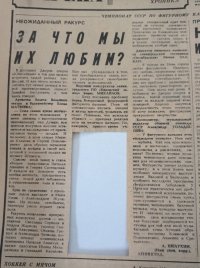
WHY ARE THEY LOVED?

(the article published in russian 'Sovetskiy Sport' on January 9, 1986)

In the backstage corridors of the Yubileyny Sports Palace these days, you can meet people of various professions. And you can hear a great variety of opinions here—sometimes highly contradictory! Let's listen to what people are saying here.
Elena Matveeva, Bolshoi Theatre Ballet Artist and Ballet Master
— So far, my most vivid impressions at this championship are connected with the performances of the ice dance couples. I think all the spectators received true aesthetic pleasure from the original dance—the polka. In my opinion, this season Marina Klimova and Sergei Ponomarenko gave an example of absolute harmony between skating and music in their airy and elegant polka to Strauss's music.
Natalya Annenko and Genrikh Sretenski presented a completely different dance in a "retro" style. In their every turn, there is a special softness and transparency of style; at times, you even forget about the existence of ice and skates.
Maya Usova and Aleksandr Zhulin look much brighter compared to last year. Their polka is original, the partners skillfully play their respective roles.
I am delighted by the appearance of wonderful new junior duos—Muscovites Svetlana Serkeli and Andrei Zharkov (coached by Gennady Akkerman), Oksana Grishuk and Aleksandr Chichkov, who are being trained by Olympic Champion Natalya Linichuk, as well as the Odesa couple Ilona Melnichenko and Gennady Kaskov. You see once again how a dance is transformed when the unique talent of its performers unfolds.
Boris Mikhailov, Leading Design Engineer of the Leningrad Production Association "Kirov Plant":
— I want to raise a problem before the All-Union Figure Skating Federation. It is time for them to thoroughly study the opinions and tastes of the spectators, to hear their voice. I understand that cries of "Bravo!" are a pleasant reaction from the arena to excellent skating. But, surely, the time has come to establish a special audience award for the best free program of the championship. I propose conducting such an experiment at the next championship—to do a survey, and present a special prize to the winner at the conclusion of the competitions.
Rimma Zalkan, Director of the Catering Complex of the Leningrad Oktyabrskaya Hotel:
— In the city on the Neva, figure skaters are deeply loved. I hope the athletes feel this love right now, while staying at our Oktyabrskaya Hotel. They have no problems with accommodation, food, transport, or leisure. They are right at home here. I have visited the Sports Palace and realized what a colossal amount of work goes into every ice composition. I strongly felt the festive atmosphere of this tournament. And I want to wish the figure skaters continued beautiful creativity.
Aleksandr Goldstein, Composer, Musical Director of the USSR National Team:
— Figure skating has an "undercurrent." Its name is music. It matters how it is arranged and how organically it is embodied in movements and lines. In my opinion, the first half of the championship gives grounds for optimistic assessments. The figure skaters know how to listen to music, and in this regard, I am particularly impressed by the performances of Valova and Vasiliev, and especially the latest program of Sverdlovsk's Natalya Lebedeva. Natalya has practically no problems with jump execution technique, so this skater listens very closely to the complex motives and intonations of the ballet music to which she performs. And finally, I cannot help but express my admiration for how brilliantly costumes are selected for a given musical theme. The best examples are the costumes of Klimova and Ponomarenko, and Annenko and Sretenski...​
A. SHELUKHIN.
(Our special correspondent).
LENINGRAD.
1780840851049.jpeg
 
1986
USSR CHAMPIONSHIPS
PROBLEM


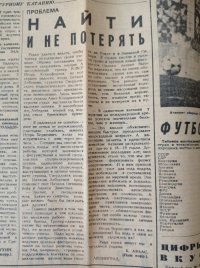
TO FIND AND NOT TO LOSE

(the article published in russian 'Sovetskiy Sport' on January 9, 1986)

It is rare to see a coach applaud their own student. Usually, instructors try to suppress their emotions. But Honored Coach of the RSFSR Igor Ksenofontov could not hide his joy when Natasha Lebedeva, a student at the Sverdlovsk Pedagogical Institute, finished her free program. Only the strict judges awarded higher marks to the national champion, Anna Kondrashova Muscovite. In the overall standings, Lebedeva became the bronze medalist for the second year in a row.
— I was rejoicing not over the scores, — a happily smiling Igor Borisovich who hadn't yet cooled down from the excitement noted when we met with him half an hour later. — Today we were able to show the fruits of that multi-year work we have been doing with the figure skaters in our Sverdlovsk specialized singles skating group. After all, among the ten athletes competing in the national championship, the Sverdlovsk region is represented, besides our Natasha Lebedeva, by Natasha Ovchinnikova, and Larisa Zamotina.
— So, the Sverdlovsk school has some secrets that could be revealed to others?
— The main secret is that success comes to those schools where the work of coaching teams is well-established. A solo coach, no matter how talented, cannot achieve sustainable success. We must go further: spread the influence of leading figure skating centers to entire regions of the country. We, for example, strive to maintain contact with specialists in our sport both in the Urals and in Western Siberia. There are thousands and thousands of groups and cohorts of young figure skaters in the country. However, it would be naive to hope that someone from these recreational subscription groups will step up to athletic peaks on their own. The sooner we establish constant control over these grassroots schools, the greater the probability that we will find bright talents and not lose them along the way.
— In men's singles skating, our successes on the international arena are significantly greater than in women's...
— This is completely understandable: boys overcome the "transitional age" faster. Genuine talents in women's singles skating unfold somewhere around 18–19 years of age. An achievement of recent years, it seems to me, is that we have stopped rushing the development of female athletes. And successes have come to us: for two years in a row now, we have been winning competitions for girls on the world arena. This allows us to avoid psychological breakdowns, while gradually improving the artistry of the programs and their complexity. Meanwhile, the period of true maturity coincides with the final phase of perfecting the "school" — the compulsory figures, where self-control and increased personal responsibility are especially important.
— Igor Borisovich, what about emotions? You can't contain them yourself, can you?
— For the sake of such moments, we work for years.​
B. AVLAS.
(Our special correspondent).
LENINGRAD.
1780842205956.jpeg
 
No, I have found the correct translation with the help of AI. It is called "headbanger". Watch this video https://www.youtube.com/watch?v=7IMjW-DP0xM
Ah. I wouldn't call that an upside-down spin, but I guess AI couldn't figure out what to call it. I've done hundreds of headbangers myself for fun in practices, for many decades with different partners, but not in performances because it worries the audience. I've done it looking down at the ice and looking up at the ceiling and never hit the ice once. But prone I arch my back a lot (like a swan dive in diving) and would hit with my chest, and supine I clasp my hands behind my head so that if anything brushed the ice it would be the backs of my hands. It's fun, but it makes me so dizzy my partners just set me down flat on the ice and I lie there laughing until the ceiling stops spinning 😵. (I have that on an old practice videotape that I haven't been able to get transferred to a DVD or I'd post it here :), with my partner pretending to be a boxing referee and counting me out as he stands over me.) I wouldn't be able to do it in a program unless it was the finish!
 
1986
USSR CHAMPIONSHIPS

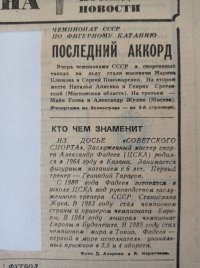
LAST ACCORD

(the article published in russian 'Sovetskiy Sport' on January 10, 1986)

Yesterday, Muscovites Marina Klimova and Sergei Ponomarenko became the USSR champions in ice dancing. In second place were Natalya Annenko and Genrikh Sretenskii (Moscow Oblast). In third place were Maya Usova and Alexander Zhulin (Moscow).

WHO IS FAMOUS FOR WHAT
From the Dossier of "Soviet Sport". Honored Master of Sports Alexander Fadeev (CSKA) was born in 1964 in Kazan. He has been figure skating since the age of 6. His first coach was Gennady Tarasov.
Since 1980, Fadeev has been training at the CSKA school under the guidance of Honored Coach of the USSR Stanislav Zhuk. In 1983, he became the champion of the country and a medalist at the European Championship. In 1984, he won the European Championship in Budapest. In 1985, he became the World Champion in Tokyo. Fadeev is the first person in the world to perform unique jumps of 3.5 and 4 revolutions.
1780929690217.jpeg
 
1986
USSR CHAMPIONSHIPS

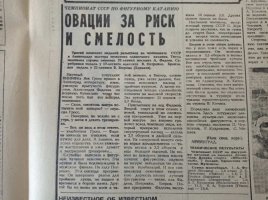
OVATIONS FOR RISK AND COURAGE

(the article published in russian 'Sovetskiy Sport' on January 10, 1986)

The third set of medals at the USSR Championship in Leningrad was contested by the masters of men's singles. The champion title was won by 22-year-old Muscovite A. Fadeev. The silver medal went to 17-year-old V. Petrenko from Odessa. The bronze medal went to 22-year-old V. Egorov (Kharkiv).
Research associate of VNIIPK, Yak Gross, brought equipment to Leningrad that measures the jumping ability of figure skaters. He met Alexander Fadeev literally an hour after he won the championship.
"Sasha, can we test my equipment tomorrow?" Gross asked.
"Probably, but not in the morning. I have practice at nine," Fadeev replied.
"There he is, completely in that answer," Gross smiled. "Fadeev will never refuse if it is necessary for work. And most importantly, he barely had time to rest after a heavy performance and is already thinking about tomorrow's practice..."
It is impossible to win by accident in figure skating. This truth was confirmed once again in the men's final. Petrenko is on the ice. The 20th second of the program. He completes his run-up for a triple Lutz but falls and crashes into the rink boards. Anyone else would not have stood up on their feet at that moment, but Viktor, like a bird, was already flying further. Next, he brilliantly executes a combination with a triple toe loop. Then followed four more of the most difficult elements at high speed. The arena applauds: 11 scores of 5.7 points.
Fadeev is called to the ice. His second start this season with a new, uniquely difficult program. Already in the first minute, the hall gasps as the reigning world champion flawlessly executes a super-difficult combination—a triple Axel and a double Salchow. In the next minute, a new burst of applause—now a triple Axel with even greater height. The courage of our best skaters, storming unprecedentedly complex combinations, cannot help but conquer. All specialists note the creative audacity of our best skaters—such as Fadeev, Petrenko, and Egorov. Fadeev's new program earned 18 scores of 5.9. There were simply no other scores.
The champion's mentor, Honored Coach of the USSR S. Zhuk, later shared that just a day before the start, the entire second half of the composition was re-choreographed and its complexity was increased.
Egorov also proved in this tournament that there is still life in the old dog. He executed a triple Axel and sparked admiration with a triple Lutz. It was this "slightly more complex" element, so necessary in a modern program, that allowed Egorov to outplay the virtuous skater from Leningrad, A. Kaznakov, at the last moment. Let's note that this intense spectacle could have been even brighter, but the absence of last year's champion of the country, V. Kotin, due to an injury had an impact.
Our junior echelon also brought joy. Elements of "ultra-c" are being stormed here by several talented figure skaters, primarily Muscovites P. Chernousov, R. Kudryavtsev, and S. Minaev.​
(Our Special Correspondent).​
LENINGRAD.
TECHNICAL RESULTS
USSR Figure Skating Championship. Leningrad. Yubileyny Sports Palace. January 7th. Men's Singles.
Total combined score. 1. A. Fadeev (Moscow) — 2.0 points; 2. V. Petrenko (Odesa) — 4.4 points; 3. V. Egorov (Kharkiv) — 6.4 points; 4. A. Kaznakov (Leningrad) — 7.2 points; 5. G. Vardanyan (Moscow Oblast) — 11.2 points; 6. A. Torosyan (Tbilisi) — 12.4 points.
1780938656393.jpeg
 
1986
USSR CHAMPIONSHIPS
THE UNKNOWN ABOUT THE KNOWN


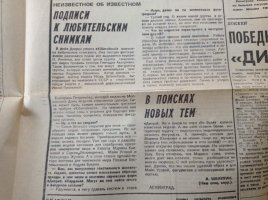
Captions for Amateur Photographs

(the article published in russian 'Sovetskiy Sport' on January 10, 1986)

In the foyer of the "Yubileyny" Sports Palace, a fascinating wall newspaper has been put up. It is filled with photographs of various styles: here stands out a portrait of N. Annenko, there stands an entire group of ice dancers, and over there you can see the profile of coach Gennady Akkerman. This photo-montage shows how the figure skaters of the group, which is led by Olympic champion Lyudmila Pakhomova, live. The author of the photos is a student and Master of Sports, Igor Shpilband, who competes in the USSR Ice Dancing Championship alongside Moscow ninth-grader Inna Pronkina.
"Igor, how long have you been involved in photography?"
"For three years. I have shot dozens of rolls of film documenting the life of our group. Of course, they do not claim to be of high artistic class, but they allowed me to see my companions in a new way."
"What did you notice that was characteristic in the performances of your friends?"
"A new generation has entered ice dancing. These skaters are capable of solving the most complex athletic tasks. Their intellect, responsiveness to music, and desire to work—it all pours into completely unexpected dance concepts. The best example is the composition of Annenko and Sretenskii set to Shostakovich’s ballet music."
"I will also note the fantastic progress of the skaters in choreography. In my opinion, it was brought about by the arrival of Tatyana Vladimirovna Stepanova, a famous artist of the Bolshoi Theater Ballet, to our group. From the very first days, she invited us to the choreographic barre and revealed the beauty of simple movements in a completely new way. Personally, I saw and understood the plasticity of the highest class."​

IN SEARCH OF NEW THEMES

Ekaterina Pozdnyakova, a young fashion designer from the Moscow House of Sports Apparel Models, was perhaps the most attentive spectator in the stands of "Yubileyny." At the championship, she was looking for new themes and solutions for future costumes, trying to understand the psychology of figure skating.
"So, what did you see?"
"The biggest discovery for me is the unique character of the people who create the programs. Their true faces can only be seen here, in the heat of ice battles. Their eyes, posture, and gait transform. For three years now, I have been designing costume models for world and European championships silver medalists Marina Klimova and Sergei Ponomarenko, Maya Usova and Alexander Zhulin. And for this season, I made four costumes for world champions Natalya Bestemyanova and Andrey Bukin."
"As a graduate of the textile institute, you are likely familiar with the most exquisite clothing designs, including costumes from the Paris firms 'Dior' and 'Cardin'. Can they find a place in figure skating?"
"Of course, I could make a costume in the style of 'Dior.' But to some extent, it would be a copy of a well-known model. We set a more interesting task for ourselves—to highlight the individual personality of the figure skater. For example, the costume for Marina Klimova in her new dance to Strauss's music (we used a train in it) is a new discovery for the ice dancer's image. At the competition, she appeared as if she were a fairy at a grand ball. I want to note that Marina herself gives a lot of advice, understands many nuances deeply, and working with her is a real pleasure. I believe we also found a successful image for Maya Usova, a figure skater with an unforgettable appearance."​
A. Shelukhin.
(Our Special Correspondent).
LENINGRAD.
1780939900404.jpeg
 
1986
USSR CHAMPIONSHIPS

OVATIONS FOR RISK AND COURAGE

(the article published in russian 'Sovetskiy Sport' on January 10, 1986)

The third set of medals at the USSR Championship in Leningrad was contested by the masters of men's singles. The champion title was won by 22-year-old Muscovite A. Fadeev. The silver medal went to 17-year-old V. Petrenko from Odessa. The bronze medal went to 22-year-old V. Egorov (Kharkiv).
Research associate of VNIIPK, Yak Gross, brought equipment to Leningrad that measures the jumping ability of figure skaters. He met Alexander Fadeev literally an hour after he won the championship.
"Sasha, can we test my equipment tomorrow?" Gross asked.
"Probably, but not in the morning. I have practice at nine," Fadeev replied.
"There he is, completely in that answer," Gross smiled. "Fadeev will never refuse if it is necessary for work. And most importantly, he barely had time to rest after a heavy performance and is already thinking about tomorrow's practice..."
It is impossible to win by accident in figure skating. This truth was confirmed once again in the men's final. Petrenko is on the ice. The 20th second of the program. He completes his run-up for a triple Lutz but falls and crashes into the rink boards. Anyone else would not have stood up on their feet at that moment, but Viktor, like a bird, was already flying further. Next, he brilliantly executes a combination with a triple toe loop. Then followed four more of the most difficult elements at high speed. The arena applauds: 11 scores of 5.7 points.
Fadeev is called to the ice. His second start this season with a new, uniquely difficult program. Already in the first minute, the hall gasps as the reigning world champion flawlessly executes a super-difficult combination—a triple Axel and a double Salchow. In the next minute, a new burst of applause—now a triple Axel with even greater height. The courage of our best skaters, storming unprecedentedly complex combinations, cannot help but conquer. All specialists note the creative audacity of our best skaters—such as Fadeev, Petrenko, and Egorov. Fadeev's new program earned 18 scores of 5.9. There were simply no other scores.
The champion's mentor, Honored Coach of the USSR S. Zhuk, later shared that just a day before the start, the entire second half of the composition was re-choreographed and its complexity was increased.
Egorov also proved in this tournament that there is still life in the old dog. He executed a triple Axel and sparked admiration with a triple Lutz. It was this "slightly more complex" element, so necessary in a modern program, that allowed Egorov to outplay the virtuous skater from Leningrad, A. Kaznakov, at the last moment. Let's note that this intense spectacle could have been even brighter, but the absence of last year's champion of the country, V. Kotin, due to an injury had an impact.
Our junior echelon also brought joy. Elements of "ultra-c" are being stormed here by several talented figure skaters, primarily Muscovites P. Chernousov, R. Kudryavtsev, and S. Minaev.​
(Our Special Correspondent).​
LENINGRAD.
TECHNICAL RESULTS
USSR Figure Skating Championship. Leningrad. Yubileyny Sports Palace. January 7th. Men's Singles.
Total combined score. 1. A. Fadeev (Moscow) — 2.0 points; 2. V. Petrenko (Odesa) — 4.4 points; 3. V. Egorov (Kharkiv) — 6.4 points; 4. A. Kaznakov (Leningrad) — 7.2 points; 5. G. Vardanyan (Moscow Oblast) — 11.2 points; 6. A. Torosyan (Tbilisi) — 12.4 points.
View attachment 11501
I notice the mention of quad attempts by Peter Tchernyshev, who was a multi-talented skater. Given his size, I was surprised he didn't do pairs also, but perhaps with the ankle injury that ended his singles career he never got around to trying pairs while he could still jump.
 
I notice the mention of quad attempts by Peter Tchernyshev, who was a multi-talented skater. Given his size, I was surprised he didn't do pairs also, but perhaps with the ankle injury that ended his singles career he never got around to trying pairs while he could still jump.
I am afraid you mean another person. Peter Tchernyshev was a famous ice dancer. The article mentions Pavel Chernousov. This is what AI told me about this skater.
Pavel Nikolaevich Chernousov is a Russian figure skater who is primarily known today for his work as a coach, elite-level technical specialist, and national-grade judge in Russia. Unlike international stars, his career has been focused heavily on the domestic Russian skating circuit. [1, 3]

1. Competitive Background
  • Discipline: He competed in singles and pair skating.
  • Achievements: According to user discussions on Russian skating portals like 1780992684949.png⁠Tulup.ru, he achieved domestic success earlier in his career, including winning a Russian championship title in younger/junior divisions. However, he did not transition into a major international senior competitor. [1, 2, 4, 5]

2. Judging and Technical Career
Chernousov built a highly active career behind the scenes in the Russian Figure Skating Federation (FSRussia): [, 2, 3]
  • Official Status: He holds the title of Sports Judge of the All-Russian Category (the highest domestic designation).
  • Specialized Roles: He serves as an official Technical Specialist for both singles and pairs skating. In the ISU judging system, technical specialists are responsible for identifying the exact elements performed (such as the level of a spin or the exact rotation of a jump) in real time.
  • Activity: He frequently works at domestic junior and senior events across Russia, including prominent events in the Moscow region. [1, 2, 3]

3. Coaching
Chernousov works as a coach for developmental and competitive skaters in Moscow. Elite skaters from smaller international federations also occasionally seek out his technical expertise. For instance, Cypriot skater Daniella Vanessa Ipsaridou noted in an 1780992684954.png⁠interview with Philenews that she trained under him to improve her jump and spin technique. [1, 2, 3]
 
1986
USSR CHAMPIONSHIPS

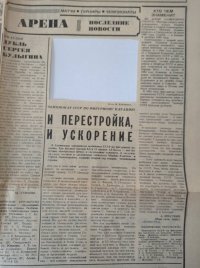
"Perestroika" and Acceleration

(the article published in russian 'Sovetskiy Sport' on January 11, 1986)

The USSR Figure Skating Championship has concluded in Leningrad. Three perfect scores of 6.0 and fifteen scores of 5.9—this is truly a beautiful finale in the competition of ice dancers. And the well-deserved laudatory and concise "epithets" are for Marina Klimova and Sergei Ponomarenko, who became champions of the country for the second year in a row.
Here is what the mentor of the champions—Honored Coach of the USSR Natalia Dubova—says in this regard:
— The best masters must be able to do everything. In last year's program, where there were four dance miniatures, my students demonstrated universality, the ability to reveal the spirit of a highly character-driven dance. Now we turned to classics—to the music of Strauss. And here too, the naturalness, full relaxation, and virtuosity they achieve is, in my opinion, of the highest degree.
Indeed, the dance of the champions of the country stands out as completely special. All the other couples competing in Leningrad positioned themselves on the approaches to the highest peaks of dance mastery. Closest of all to the Muscovites were Natalia Annenko and Genrikh Sretenski, students of Lyudmila Pakhomova, and Maya Usova and Aleksandr Zhulin, students of Dubova. They rightfully received the silver and bronze medals respectively.
"Perestroika" on the Olympic model—this is the main tone of the past championship. Maximum speeds with the utilization of unique, difficult elements characterized the programs of such figure skaters as A. Fadeev, V. Petrenko, V. Egorov, A. Kaznakov, D. Gromov, E. Gordeeva and S. Grinkov, E. Kvitchenko and R. Kadyrkayev, L. Koblova and A. Kalitin. In this same key, demonstrating excellent skating, executed their compositions the best couples of ice dancers. Matching them were the very young — for example, Muscovites S. Lyapina and G. Sur, who amazed everyone with their temperament in a dance set to the music from the movie “Hussar Ballad”.
Here is how the two-time world champion Vladimir Kovalev assesses the results:
— We have already felt the closeness of the Olympics in Calgary. A telling fact — the difficult triple Axel has become the norm for the men's event. A. Fadeev, who performs this unique jump twice, in my view, possesses even greater potential than most spectators realize.
From our reserve pool, I would like to highlight the Leningrad resident Gromov — our coaching council should take a very close and attentive look at him.
In the women's team, Anna Kondrashova, Kira Ivanova, and Natalia Lebedeva went far ahead in their class from the rest of the field. Each of them has an original style and extensive competition experience. But who is next? So far, no individuality is visible. This worries us. Here, a stubborn search for talent lies ahead...
— I would like to call upon all our referees to raise the prestige and authority of the USSR Championship even higher, because our school is a world leader, — emphasized Honored Coach of the USSR Tamara Moskvina in her commentary. — Given our position, we must take an even stricter approach to every element in the programs of leading masters. Then every single athlete will prepare with maximum dedication. Our figure skaters, especially the reserve, need to execute an intensive acceleration to worthily pass the Olympic exam in Calgary!​
A. Shelukhin
(Our special correspondent)
Leningrad.
Technical Results
USSR Figure Skating Championship. Leningrad. Sports Palace "Yubileyny". January 9.
Ice Dancing. Total Points.
1. M. Klimova – S. Ponomarenko (Moscow) – 2 points; 2. N. Annenko – G. Sretenski (Moscow Oblast) - 4; 3. M. Usova – A. Zhulin - 6; 4. O. Volozhinskaya – A. Svinin - 8; 5. S. Liapina – G. Sur - 10; 6. I. Zhuk – O. Petrov (all Moscow) - 12.
Who is Famous for What
From the Files of "Soviet Sport". Masters of Sports of International Class Marina Klimova and Sergei Ponomarenko ("Spartak", Moscow). Marina was born in Sverdlovsk on June 28, 1966; Sergei was born in Moscow on October 6, 1960.
Ponomarenko, with his first partner Tatyana Durasova, was a two-time world junior champion in ice dancing. Since 1981, he has been performing with Marina Klimova. Their debut at the USSR Championship in 1982 brought the duet 6th place. In the following season, the figure skaters joined the USSR national team and competed for the first time at the European Championship. The result was 4th place. In 1984, Klimova and Ponomarenko won bronze medals at the European Championship in Budapest and at the Winter Olympic Games in Sarajevo. At the World Championship in Ottawa, they placed fourth.
In 1985, the figure skaters became USSR champions, as well as silver medalists at both the World and European Championships. They train under the guidance of Honored Coach of the USSR Natalya Dubova.​
1780993073358.jpeg
 
Back
Top