Archive of newspaper articles | Page 8 | Golden Skate

Archive of newspaper articles

1982
MOSCOW NEWS PRIZE

FIGURE SKATING

(the article published in Ukrainian 'Sportyvna Hazeta' on December 4, 1982)

MOSCOW. The first day of the international figure skating competition for the prize of the newspaper "Moscow News" introduced sports fans to most of the participants. The women who performed compulsory exercises, the masters of pair skating with a short program and the ice dancers who showed three compulsory dances (quickstep, Ravensburg waltz and Argentine tango) took to the ice.
The largest representation of foreign athletes at the tournament is among singles female skaters - nine out of fourteen. But so far only Canadian Andrea Hall has managed to enter the top three after the "school". Apparently, she is not against repeating last year's success of compatriot Kay Thomson, who took one of the "crystal skates" across the ocean. It can be predicted that after the next two types of triathlon, the winner of the Junior World Championship, Janina Wirth (GDR), will improve her position. And the best here was the Soviet figure skater Kira Ivanova.
- The short program of the pairs placed the participants in the top three according to their skill and the ranking table,- said Honored Master of Sports Alexander Gorelik. - Undoubtedly, both Pestova-Leonovich, Pershina-Akbarov, and last year's winners of these competitions Seleznyova-Makarov must achieve greater clarity in the performance of compulsory elements, add speed. Irina Rodnina's students - Lyudmila Koblova and Andrey Kalitin - successfully debuted at the tournament.
It is not yet quite common to see a three-time Olympic champion on the coaching "bridge" ... Let us recall that her wards are Veronika Pershina and Marat Akbarov. And here Irina also "looks after" Finnish skaters Maija and Pekka Pekkala. In the summer they interned in Rodnina's group.- We are not yet aiming for high places at such representative competitions, - say the Pekkala brother and sister.
- But the performances in Moscow are an excellent school of skill for us. As you know, the World Championships will be held in Helsinki and we would like to perform as well as possible in front of our compatriots.
The highest marks from the judges were given to Marina Pestova and Stanislav Leonovich.
1755190321012.jpeg
 
1982
MOSCOW NEWS PRIZE

ADDRESSES OF THE "CRYSTAL SKATE"

(the article published in Ukrainian 'Sportyvna Hazeta' on December 7, 1982)

ON THE FINAL day of the international figure skating tournament in Moscow, the winners in men's single skating and ice dancing were determined.
The free program was brilliantly performed by nineteen-year-old Josef Sabovczyk from Czechoslovakia. High scores (including one 6.0) allowed him to take third place overall. And in total, the winner was eighteen-year-old Soviet figure skater Alexander Fadeev. Vladimir Kotin was second. Vitaliy Egorov from Kharkiv closed the top five, also letting Igor Bobrin ahead.
Among the ice dancers, for the second time in a row, the "Crystal Skate" was won by world vice-champions Natalia Bestemyanova and Andrey Bukin. In second place were Olga Volozhinskaya and Alexander Svinin. The surprise was the "bronze" of Marina Klimova and Sergey Ponomarenko, who were ahead of many famous masters, in particular Dnipropetrovsk's Natalia Karamysheva and Rostislav Sinitsyn.
The day before, Soviet figure skaters took all the prizes in female single skating. The first was Kira Ivanova from the Moscow region. In second place was Anna Kondrashova, who demonstrated the most interesting free program, and in third place was Anna Antonova from Leningrad.
The results of the international tournament for the prize of the newspaper "Moskovskiye Novosti", which brought together figure skaters from 14 countries, are commented on by three-time Olympic champion Irina Rodnina:
- Never before have Soviet athletes started the season so early. This allowed both experienced and young athletes to approach the December starts in good shape, with new programs already tested. The Soviet team is capable of fighting for high places on the international stage in all categories. I think that our leaders among pairs, Marina Pestova and Stanislav Leonovich, who did not perform in Moscow with a free composition, since the female partner has not fully recovered from an injury, will compete for the title of world champions. They should be adequately supported by Pershina - Akbarov and Seleznyova - Makarov.
There is a wide choice of ice dancers who are clearly on the rise. However, the candidates for places in the national team in single skating sometimes lack the fusion of artistry and high technique, the stability of performing triple jumps in combinations. The next test is January 5-10 in Chelyabinsk at the USSR championships.
1755253995220.jpeg
 
1982
CHAMPIONS' FATE
(the article published in Ukrainian 'Sportyvna Hazeta' on December 14, 1982)
Multiple European champion, 1965 world champion in figure skating Alain Calmat heads the surgical department of one of the Parisian hospitals. But he has not said goodbye to sports. He can often be seen at competitions as a judge. His book "Living Better Through Sport" was recently published. It analyzes the causes of injuries, recommendations are given for activities with children.
1755254616460.jpeg
 
1983
WORLD JUNIOR CHAMPIONSHIPS

FIGURE SKATING

(the article published in Ukrainian 'Sportyvna Hazeta' on December 21, 1982)

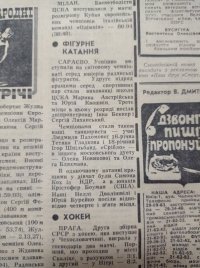
SARAJEVO. Soviet figure skaters successfully performed at the World Junior Championships. For the second time in a row, the best among pairs were CSKA school students Marina Avstriyskaya and Yuri Kvashnin. Third place in this category was taken by Dnipropetrovsk Inna Becker and Serhiy Lykhansky.
Our ice dancers, students of Lyudmila Pakhomova, 16-year-old Tatyana Gladkova and 18-year-old Igor Shpilband, also became champions. Another Moscow duo, Elena Novikova and Oleg Blyakhman, won silver.
In single skating, the best among girls was Simona Koch from the GDR, and among boys was Christopher Bowman (USA). Our Nellie Dvalishvili and Yuriy Bureiko took fourth and fifth places, respectively.
1755255606059.jpeg
 
1983
USSR CHAMPIONSHIPS

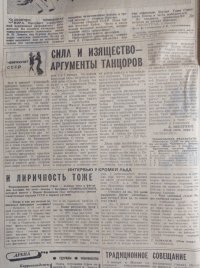
STRENGTH AND GRACE - THE ARGUMENTS OF DANCERS

(the article published in russian 'Sovetskiy Sport' on January 6, 1983)

Here comes another celebration of beauty, strength and grace - the USSR Figure Skating Championships have begun in the Chelyabinsk Sports Palace "Yunost". 14 pairs, 14 dance duets, 16 men and 14 women in single skating are participating.
On the eve of 1983, the Ural city was decorated with a new artificial skating rink, which was built next to the main Palace and connected to it by a convenient passage. Two ice arenas are at the skaters' disposal. The chief engineer of the Palace, M. Vinnitsky, told us that new locker rooms, a radio center, and a press center were specially equipped for these starts.
The competition program is clearly thought out. For example, the ice dancers began the competition in the morning on the first day, and pairs compete in the evenings of January 5 and 7. According to the new rules, pairs received an important day off. By the way, this will also be the case at the 1983 European Championships in Dortmund.
The first small medals of the national championship for the execution of the "school" were won yesterday by three of the most famous single skaters - Alexander Fadeev, Vladimir Kotin (both from Moscow) and Leningrader Igor Bobrin. It should be noted that for 18-year-old Fadeev, the small gold medal for "ice geometry" is of fundamental importance, since he made a bid for victory in the triathlon, where without a stable "school" it is difficult to stay on top of the situation. In terms of entertainment, the "school" of single skating is significantly inferior to the compulsory program of ice dancers, but in terms of technique, they are equal. And it is quite logical that the judges now very meticulously assessed the quality of gliding and turns and especially the change of edges of the skate in dance positions. The tournament opened with the most difficult dance - Argentine tango, in which technique is evident from the first steps.
The spectators watched the performance of the silver medalists of the world championship Natalia Bestemianova and Andrey Bukin with true pleasure. The skaters traced the ice field with wide and steep arcs. The black and white color scheme of their costumes emphasized the synchronicity of all lines. The tango as interpreted by this duet left a feeling of strength and grace at the same time. And equally excellent scores - 5.7-5.8 points.
Only one experienced couple was able to approach this level - these are participants of the World and European Championships Olga Volozhinskaya and Alexander Svinin. Their tango was awarded 5.6-5.7 points.
I will note that among the participants there are no prize winners of the World Championships Irina Moiseeva and Andrey Minenkov. Due to the illness of the female partner, the skaters were unable to start on the ice of Chelyabinsk.
In this situation, the preparation of our reserve is of particular interest. And a large group of attractive duets stands out in it. Among them are Muscovites Marina Klimova and Sergey Ponomarenko, Elena Batanova and Alexey Solovyov, Natalya Annenko and Genrikh Sretensky. Figure skaters from Dnipropetrovsk Natalia Karamysheva and Rostislav Sinitsyn have joined this youth group. An interesting detail: the judges' votes were divided when assessing third place. Three judges gave preference to Klimova and Ponomarenko, and three to Karamysheva and Sinitsyn.​
A. SHELUKHIN.
(Our special correspondent).
CHELYABINSK.
TECHNICAL RESULTS
USSR Figure Skating Championships. Chelyabinsk. Sports Palace "Yunost". January 5.
Singles. Men. Compulsory program.

1. A. Fadeev - 0.6 points; 2. V. Kotin (both Moscow) - 1.2; 3. I. Bobrin (Leningrad) - 1.8; 4. B. Uspensky (Odesa) - 2.4; 5. V. Egorov (Kharkiv) - 3.0; 6. G. Vardanyan (Moscow) - 3.6
1755423224001.jpeg
 
1983
USSR CHAMPIONSHIPS

INTERVIEW AT THE ICE EDGE

AND LYRICITY TOO

(the article published in russian 'Sovetskiy Sport' on January 6, 1983)

Formation of an original style is an important topic in figure skating. This is the topic of a conversation with Valery SPIRIDONOV, who together with Inna Volyanskaya became the winner of the Winter Spartakiad of the Peoples of the USSR in pair skating.
- When and how did you start figure skating?

- I've been skating since I was 11. In total, I've been on the ice for 14 years. Of those, 12 have been dedicated to pair skating. I've been performing with Inna since 1978.
In Podolsk, in the physical education team of the Kalinin Mechanical Plant, there was a figure skating section. I came to study myself. They didn't accept me right away: after all, 11 years old is not the right age for figure skating. But I didn't give up, I skated. And, apparently, the coach liked me.
- What were your results at the USSR championships?
- Since 1975, I have been competing in youth championships. By the way, my debut took place in Chelyabinsk, on the ice of the Yunost Sports Palace. Zoya Akinfieva and I performed successfully: we were third. A year later, we became winners at the national championship in Tomsk. We have been participating in national championships since 1976. Unfortunately, I started from eleventh place.
Two years later I was seventh at the match of the strongest figure skaters of the USSR, and in 1980 I became a bronze medalist of the national championship.
- Do you think that your programs have a unique style? If so, what is this style?
- Yes, our program has its own style. It differs from others by the combination of skating, I would say, lyrical and athletic-powerful. In our opinion, it is beautiful, modern. We ourselves try to improve the skating style, to introduce new elements into it. Of course, our coaches T. Tarasova and G. Proskurin deserve a lot of credit for this, who, as is known, performed together at one time and were always distinguished by their unique style and original technical solutions. We were greatly assisted by the Ukrainian champion in parquet dancing Stanislav Shklyar, as well as choreographer Esfandir Kashani.
- Your favorite judge? Your favorite score?
Favorite judge?... This is a difficult question. I think I will be right if I say that a favorite judge is not the one who gives the highest score, but a fair judge. Favorite rating is a score that you get for a performance that brings joy to both yourself and the coaches. So far, such a score is 5.7, received at the final of the V Winter Spartakiad of the Peoples of the USSR.
G. ROMANOV. (Our Correspondent).
CHELYABINSK.
(The original text of the article can be seen in the previous post)
 
1983
USSR CHAMPIONSHIPS

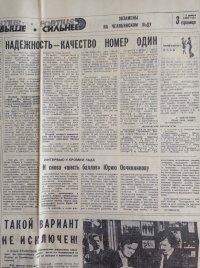
RELIABILITY - QUALITY NUMBER ONE

(the article published in russian 'Sovetskiy Sport' on January 7, 1983)

The ice of Chelyabinsk turned out to be lucky for many young figure skaters participating in the national championship. The desire to get an Olympic ticket to the ice arena in Sarajevo is very great, it, more than ever, spurred on the youth in both ice dancing and pair skating.
Immediately after the short program competitions for pairs, I met with two prominent experts and asked them to express their opinions on the nature of the competition in the 1983 season.
The first express commentary. It is made by the associate professor of the State Central Institute of Physical Culture, Master of Sports, and international category judge Viktor Solovyov:
- When I watched the spirited performances of Leningraders Larisa Selezneva and Oleg Makarov (they are only 19 and 20 years old), I thought: "Well, after the first minute of skating, the palm of primacy could be given to them." But when the second minute of the program ended, my opinion changed. I noticed an error in the execution of the step sequence and a somewhat sluggish finale. It seems that the composition was not equal. Hence the fourth place of the Leningraders after the first round of the struggle, although I am convinced that the pair has great potential.
In my opinion, the Muscovites Veronika Pershina and Marat Akbarov were close to the first place in the short program. Clean gliding, excellent flip jump, good execution technique and other elements, with the exception of the death spiral, but they still had to take the second line in the table, because they again lacked a bright dynamic finale. And who tipped the scales in their favor? This was done by the silver medalists of the world championship Marina Pestova and Stanislav Leonovich.
Their style of performance, beautiful and graceful, was most in line with the international standard. All the fragments of the composition were equal. And only the roughness in two elements of the female partner slightly weakened the impression.
Two-time world junior champions Marina Avstriyskaya and Yuri Kvashnin pleased with their stability. Moreover, they were not at all embarrassed by the weighty titles of their rivals...
The second express commentary. It is made by international category judge Eduard Estis:
- Yes, the test of strength in pair skating showed how important the reliability of the short program is. I think five duets out of sixteen were already close to the level of precision that our team needs. I would especially like to single out Pestova and Leonovich, Pershina and Akbarov, and third-place finishers Vorobyeva and Lisovsky, who returned to their dancing style.
The purity of elements in Pershina and Akbarov is impressive. They have preserved the quality of the school taught to them by Stanislav Zhuk. But they have also adopted the new course proposed this year by Irina Rodnina. This is about the ability to emphasize musical accents, enrich the program with plastic nuances. True, I would like to see more freedom, more freedom of movement. I hope that they are quite capable of this.
The death spiral and the lift performed by Pestova and Leonovich seemed perfect to me. I think that for the young people this was a very instructive spectacle.
Special mention should be made of the program of Selezneva and Makarov. It clearly shows the signature of coach Igor Moskvin, who strives to build the program pattern taking into account each musical measure and aims his students at this super task.
The opening of the tournament are Muscovites Avstriyskaya and Kvashnin, pupils of coaches Vladimir Zakharov and Stanislav Zhuk. The duo stands out for their drive and cheerful courage. And their fifth place is already a major success. Finally, I would like to single out another young pair from Leningrad, Tatyana Khotsko and Oleg Efimov (coach Alexander Vlasov) ...
The experts' statements confirm that significant changes are planned in pair skating, especially in the reserve echelon. The pre-Olympic season served as an incentive for young people to finally catch up with the leaders. Here are the characteristic details of the first round: Pestova and Leonovich's scores were 5.7 - 5.8 points, Pershina and Akbarov's scores were 5.6 - 5.8, Vorobyeva and Lisovsky's scores are 5.5 - 5.6, and finally, Selezneva and Makarov's results are from 5.2 to 5.6, and Avstriyskaya and Kvashnin's are from 5.3 to 5.5. The density of the results indicates increased competition. It remains to be hoped that the young duets will have enough of the remaining months to gain full Olympic reliability in their programs.
Another exciting page of the championship is the fight of ice dancers in the original dance rock-n-roll.
In the performance of rock-n-roll, our leaders Natalia Bestemyanova and Andrey Bukin, Olga Volozhinskaya and Alexander Svinin pleased with their virtuoso technique. The first duet received scores of 5.8 and one score of 5.9, and the second duet - 5.7-5.8.​
A. SHELUKHIN.
(Our special correspondent).
CHELYABINSK.
TECHNICAL RESULTS
USSR Figure Skating Championship. Chelyabinsk. Sports Palace "Yunost". January 5.
Pair skating. Short program.
1. M. Pestova and S. Leonovich – 0.4 points; 2. V. Pershina and M. Akbarov (all from Moscow) – 0.8; 3. I. Vorobyova and I. Lisovsky - 1.2; 4. L. Selezneva and O. Makarov (all from Leningrad) - 1.6; 5. M. Avstriyskaya and Yu. Kvashnin - 2.0; 6. L. Koblova and A. Kalitin (all from Moscow) – 2.4.
Ice dancing. Compulsory program. 1. N. Bestemyanova and A. Bukin – 0.8; 2. O. Volozhinskaya and A. Svinin - 1.2: 3-4. M. Klimova and S. Ponomarenko (all - Moscow) - 1.8; N. Karamysheva and R. Sinitsyn (Dnipropetrovsk) – 1.8; 5. E. Batanova and A. Solovyov - 3.0: 6. E. Garanina and I. Zavozin (all - Moscow) - 3.6.​
1755435945187.jpeg
 
1983
USSR CHAMPIONSHIPS

INTERVIEW AT THE ICE EDGE

AND LYRICITY TOO

(the article published in russian 'Sovetskiy Sport' on January 6, 1983)

Formation of an original style is an important topic in figure skating. This is the topic of a conversation with Valery SPIRIDONOV, who together with Inna Volyanskaya became the winner of the Winter Spartakiad of the Peoples of the USSR in pair skating.
- When and how did you start figure skating?

- I've been skating since I was 11. In total, I've been on the ice for 14 years. Of those, 12 have been dedicated to pair skating. I've been performing with Inna since 1978.
In Podolsk, in the physical education team of the Kalinin Mechanical Plant, there was a figure skating section. I came to study myself. They didn't accept me right away: after all, 11 years old is not the right age for figure skating. But I didn't give up, I skated. And, apparently, the coach liked me.
- What were your results at the USSR championships?
- Since 1975, I have been competing in youth championships. By the way, my debut took place in Chelyabinsk, on the ice of the Yunost Sports Palace. Zoya Akinfieva and I performed successfully: we were third. A year later, we became winners at the national championship in Tomsk. We have been participating in national championships since 1976. Unfortunately, I started from eleventh place.
Two years later I was seventh at the match of the strongest figure skaters of the USSR, and in 1980 I became a bronze medalist of the national championship.
- Do you think that your programs have a unique style? If so, what is this style?
- Yes, our program has its own style. It differs from others by the combination of skating, I would say, lyrical and athletic-powerful. In our opinion, it is beautiful, modern. We ourselves try to improve the skating style, to introduce new elements into it. Of course, our coaches T. Tarasova and G. Proskurin deserve a lot of credit for this, who, as is known, performed together at one time and were always distinguished by their unique style and original technical solutions. We were greatly assisted by the Ukrainian champion in parquet dancing Stanislav Shklyar, as well as choreographer Esfandir Kashani.
- Your favorite judge? Your favorite score?
Favorite judge?... This is a difficult question. I think I will be right if I say that a favorite judge is not the one who gives the highest score, but a fair judge. Favorite rating is a score that you get for a performance that brings joy to both yourself and the coaches. So far, such a score is 5.7, received at the final of the V Winter Spartakiad of the Peoples of the USSR.
G. ROMANOV. (Our Correspondent).
CHELYABINSK.
(The original text of the article can be seen in the previous post)
Learned a couple of new terms here. "Lyricity" seems to be an invention, but English is an ever-changing language, called the mongrel of languages, so why not :)? It took me a moment to figure out that "parquet dancing" is probably ballroom dancing. I'll have to tell my ballroom teacher that! 💃🕺
 
Learned a couple of new terms here. "Lyricity" seems to be an invention, but English is an ever-changing language, called the mongrel of languages, so why not :)? It took me a moment to figure out that "parquet dancing" is probably ballroom dancing. I'll have to tell my ballroom teacher that! 💃🕺

You see, Google enriches the English language with new words. In russian "parquet" is a special wooden floor. So, you were quite right guessing that it is ballroom dancing.
 
1983
USSR CHAMPIONSHIPS

INTERVIEW AT THE ICE EDGE

And again “six points” to Yuri Ovchinnikov

(the article published in russian 'Sovetskiy Sport' on January 7, 1983)

…Two more of his students - Igor Bobrin and Leonid Kaznakov - had just started in the national championship, started skating “school”, and he, handsome, smiling, was already accepting congratulations, flowers, and applause from the spectators. The secret is simple - immediately after the grand opening of the championship, an unusual ceremony took place: the first six graduates of the figure skating coaching department of the State Institute of Theatre Arts received brand new diplomas. Yuri Ovchinnikov remained true to himself here too: he passed all his exams with "six points" and received a diploma with honors. Ovchinnikov is a restless man, nothing is enough for him. He was a unique athlete, he is becoming an outstanding coach, he starred in a feature film, graduated from the Physical Education Institute, and now he has received a second diploma.
Master of Sports of International Class Yuri OVCHINNIKOV tells our special correspondent I. Vanyat about the years spent at GITIS (the abbreviation which means State Institute of Theatrical Art):
- I spent a total of 19 years at the "desk" in my life. The science course at GITIS, I can safely say, was the most interesting and useful. I generally like impromptu, searching for unconventional solutions, and our department was experimental in nature. The future of this department, unusual for GITIS, depended on us, the first graduates. And if at first we were received somewhat cautiously, then with each academic year the rector's office, the dean's office, and the teachers grew more confident: this is a useful, modern, necessary thing. This is what the famous prima of the Bolshoi Theater Olga Lepeshinskaya, the chairperson of the state commission, told us after the last exam. And now the issue of creating this special department of ballet masters of sports is being seriously discussed. It is as necessary as air for figure skaters and specialists in rhythmic gymnastics and acrobatics.
Four years of study ... I remember with pleasure the lectures and seminars of the People's Artist of the USSR Rostislav Vladimirovich Zakharov - a teacher with a world-wide reputation. And how interesting were the classes of Anatoly Borzov, a former famous soloist of the Igor Moiseyev ensemble! Borzov's record-breaking, "signature" jump adorned the ensemble's poster for many years. The course "Composition of Classical Dance" was conducted beautifully and subtly by the teacher Margarita Smirnova.
A deep bow to all our teachers! We will now try to justify in practice the high title of a GITIS graduate.​
CHELYABINSK.
(The original text of the article can be seen in post 147)
 
1983
USSR CHAMPIONSHIPS

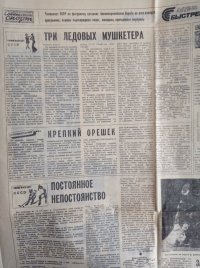
THREE ICE MUSKETEERS

(the article published in russian 'Sovetskiy Sport' on January 8, 1983)

He came out onto the ice in a black suit with the characteristic lace collar that d'Artagnan's contemporaries wore. He rushed into battle, full of desire to fight until the last second, and as if with an invisible sword, he struck left and right. He was thirsty for revenge and did everything in his power. The triple toe loop combination was good, and sparks of inspiration flared up in the serpentine step sequence. You have probably already guessed that we are talking about the performance of the former European Champion Igor Bobrin.
Igor has always been strong in short programs - a kind of small performances - and it is not difficult to assume that Bobrin will show his class in Chelyabinsk. I will say right away that the skater received eight 5.7 marks for technique, and three 5.9 marks and six 5.8 marks for artistry. In the old days, such scores were considered a dream for many. And even now they are only available to the highest-class masters.
But the paradox of the Chelyabinsk situation this time was that Bobrin took only second place, not first, among all nine judges. And the judges quite deservedly gave the palm to the blond, strong man Alexander Fadeev, who brilliantly played the role of a dashing musketeer in a special, energetic style.
Using the previous metaphor, I will note that in this case Fadeev's epee was in everything a little faster, a little more ringing. This time his arsenal included a brilliant combination with a triple lutz jump, a stunningly fast step sequence and witty combinations of spins. And now the numbers are flashing on the scoreboard - Fadeev's scores: for technique - 5.9 (six times), for artistry - 5.9 (nine times)!
The leap in technical mastery that Fadeev has made this year has been noticed by many rivals and coaches – the skater proved it at the tournament in Tokyo, and then at the tournament in Moscow. And now a new step forward in Chelyabinsk.
His mentor, Honored Coach of the USSR Stanislav Zhuk says:
- On the Moscow ice in December, Fadeev looked a little tired after the flight from Tokyo. I foresaw this moment, but still insisted that he take the start. Fadeev passed this test, and now, in January, he has fully regained his form. The short program turned out to be original in concept and tempo. Alexander does not have a single flaw in the elements. It is extremely difficult to perform a program at such a level. And it is even more pleasant that Fadeev coped with it in Chelyabinsk, and received almost the maximum marks for artistry...
The 19-year-old Leningrader Leonid Kaznakov was rightfully included in the cohort of ice musketeers that evening. He succeeded in the most difficult "serpentine" sequence, a combination with a triple flip. In short, the student of coach Yuri Ovchinnikov was awarded the honorable marks of 5.5-5.6 for the first time and took third place in the short program.
It would be unfair to focus all attention on these three masters. And first of all because, unlike in previous years, now 15 athletes have mastered the very complex combinations of jumps and showed dynamic skating. It is necessary to highlight the expressive style of B. Uspensky from Odesa, the grace of B. Kurashvili from Tbilisi, the swift style of 16-year-old Leningrader A. Vaskovsky, V. Mertents from Chelyabinsk, young A. Zakaryan from Yerevan, and Kyivian A. Lunin. These skaters skate with great energy, and I would like to wish that powerful jumps would be combined with the beauty of sliding, and would be distinguished by a variety of plasticity. Especially since they have someone to learn from in our team.
Readers have the right to ask, where is another contender for medals - Muscovite Vladimir Kotin? Why did he, having taken second place in the "school", disappear from the list of medal contenders? Unfortunately, an injury he sustained two weeks ago prevented him from taking part in the competition. The injury was caused by poor preparation of the ice rink at the Moscow Dynamo skating rink. The best ice-surfacing machine broke down, and problems immediately arose at the rink.By the way, the newspaper "Sovetskiy Sport" has repeatedly raised the issue that the work of a number of Sports Palaces is periodically in turmoil due to the lack of modern ice-filling combines. And this happens not only in Moscow, but also in other cities. Probably, it is time to create a division capable of taking control of the ice arenas of expensive Sports Palaces.
And now a few words about the situation in the women's tournament. After the "school" performance, the group of leaders was made up of the most experienced masters - Muscovites Elena Vodorezova, Kira Ivanova, Anna Kondrashova.​
A. SHELUKHIN.
(Our special correspondent)
CHELYABINSK.
TECHNICAL RESULTS
USSR Figure Skating Championships. Chelyabinsk. Yunost Sports Palace, January 6.
Singles. Men. Short Program.
1. A. Fadeev (Moscow) - 0.4 points; 2. I. Bobrin - 0.8; 3. L. Kaznakov (both from Leningrad) - 1.2; 4. B. Uspensky (Odesa) - 1.6; 5. V. Egorov (Kharkiv) - 2.0; 6. G. Vardanyan (Moscow) - 2.4.
Ladies. Compulsory program. 1. E. Vodorezova – 0.6; 2. K. Ivanova - 1.2. 3. A. Kondrashova (all - Moscow) – 1.8; 4. A. Antonova (Leningrad) – 2.4; 5. N. Lebedeva - 3.0: 6. N. Ovchinnikova (both - Sverdlovsk) - 3.6.​
1755537287412.jpeg
 
1983
USSR CHAMPIONSHIPS

HARD DIE

(the article published in russian 'Sovetskiy Sport' on January 8, 1983)

At the request of our special correspondent I. VANYAT, international category judge Igor KABANOV comments on one of the most difficult sections of the dance program.
- Original dance... About seven years ago it was included in the ice dance competitions. class=y2iqfc>And, perhaps, rock and roll turned out to be the toughest nut to crack. And that's natural. Waltz and blues can be polished using textbooks, learned without hesitation using a cheat sheet. But today's original dance has neither a theoretical foundation nor methodological manuals. Exactingness, fantasy, and the taste of trainers are of decisive importance in rock and roll.
Of the 14 ice dance duets, a good half still did not find the key to the original dance. "Rock" has a clear, inexorable rhythm, requires the performers to have the utmost musicality - one of the pillars of dance art. Alas, many participants danced out of time: the music itself, the athletes' movements themselves.
The second typical mistake. This dance does not tolerate the slightest pauses, it is extremely dynamic. And many couples forgot about this, allowed themselves mini-intermissions, for which they were rightly punished by the judges.
And the last remark. It is not forbidden to include elements of free skating in the composition of the original dance. Use it in good health, but with one indispensable condition. This element should not look alien, please justify it completely, skillfully and organically weave it into the composition of the original dance. Otherwise you will have to pay with dropped tenths of a point.
To the credit of our leaders, the duets of N. Bestemyanova - A. Bukin, O. Volozhinskaya - A. Svinin, M. Klimova - S. Ponomarenko, E. Batanova - A. Soloviev, N. Karamysheva - R. Sinitsyn managed to avoid all the dangerous reefs. They performed with inspiration, passion, in one breath, subtly feeling every nuance, every chord. Thanks to their virtuoso skating skills, they easily dealt with all the numerous technical difficulties. Therefore, they danced freely and elegantly. The successful search of their coaches (T. Tarasova, E. Tchaikovskaya, N. Dubova, L. Pakhomova) allowed the five duets to create five completely different compositions in character and design.
If the leadership of Bestemianova - Bukin and Volozhinskaya - Svina is now beyond doubt, then the fight for the third prize place is very tough. Some "centimeters" separate the rivals. I don't remember such a tense situation. I wonder what the outcome will be? Everyone is waiting for the decisive battle in the free dance.
(The original text of the article can be seen in the previous post)
 
1983
USSR CHAMPIONSHIPS

"YUNIST" ACCEPTS APPLICATIONS

(the article published in Ukrainian 'Sportyvna Hazeta' on January 8, 1983)

USSR FIGURE SKATING CHAMPIONSHIPS. Chelyabinsk, January 5-9. Palace of Sports "Yunist". 90 participants. Chief judge - P. ROMAROVSKY (international category, Chelyabinsk).
THE CITY in the Urals gladly welcomed the skaters. They live in the "Malachite" hotel, which is a five-minute-walk from the competition site. Nearby is another skating rink - a training rink, connected to the main one by an underground passage. The Palace of Sports itself has dozens of little things for the convenience of skaters. However, this is not surprising. The director of the Palace is one of the most authoritative domestic figure skating experts, an international referee, Pavlo Romarovsky.
"He even improved the program to make it easier for us," the pair skating representatives joked on the eve of the ice show. But here the director, who is also the chief judge, was guided by the new rules of the ISU (International Skating Union), according to which the pairs received a much-needed day of rest between the short and free programs.
The positions of Olga Volozhinskaya - Alexander Svinin, whose scores did not fall below the grandmaster level of 5.6-5.7, are also not in doubt. But the third place is under a question mark. This is evidenced by a unique incident that occurred after the performance of the compulsory dances: Dnipropetrovsk's Natalia Karamysheva - Rostislav Sinitsyn and young Muscovites' Marina Klimova - Sergey Ponomarenko scored the same number of points. The judges liked the Muscovites' rock-n-roll more, and now Klimova and Ponomarenko are ahead.
Among the men, we have to talk about a new leader - Alexander Fadeev. We have long known him as an excellent jumper, a master of ultra-c. In Chelyabinsk, he revealed his extraordinary abilities as a performer of school exercises, winning the compulsory program from Igor Bobrin himself! True, Vladimir Kotin also beat Igor. However, the ex-European champion did not give up and gave a fight to the young ones in the short program. He did not catch up with Fadeev - Alexander had already grown into a stable triathlete, but he made Kotin nervous. As a result, Kotin went to the triple lutz several times, took a risk and ... dropped out of the competition due to an injury.
So it turned out that on the morning of the third day, when I am dictating this report, no champion has yet been announced. But the arguments in the fight for tickets to Dortmund (European Championships) and Helsinki (World Championships) have been "put on ice" by all participants.
The ice dancers opened the curtain. Due to the female partner's illness, we did not see our famous masters Irina Moiseeva and Andrey Minenkov. This greatly aggravated the dispute over the vacant place in the national team. I think the fate of the two tickets has been decided. Both the compulsory and the original rock-n-roll dance were brilliantly performed by Natalia Bestemyanova and Andrey Bukin. With such an optimistic mood, you can go for the "gold" of the highest grade. Well, the programs of Tatyana Tarasova's students have long been champion like ...
In this nervous atmosphere, Odesa resident Boris Uspensky did not lose his cool. Having successfully bypassed all the short program riffs, he came in third place overall.​
S. BELITS-GEIMAN,
Master of Sports of international class.
1755628980616.jpeg
 
1983
USSR CHAMPIONSHIPS

LET THE ENERGY OF SEARCH NEVER BE DRIED OUT!

(the article published in russian 'Sovetskiy Sport' on January 9, 1983)

The title of national champions in pair skating on the Chelyabinsk ice was won for the third time by the CSKA school pupils Marina Pestova and Stanislav Leonovich. The female partner is 19 years old, the male partner is 24. Silver medals were won by figure skaters from the capital's Dynamo school Veronika Pershina (16) and Marat Akbarov (21). Bronze medalists are figure skaters from the CSKA school Marina Avstriyskaya (16) and Yuri Kvashnin (18).
Such a friendly offensive of young duets gives hope for the future - in the coming years we will have a strong and reliable team in pair skating. An important moment in the Chelyabinsk review is the intense rivalry between the two leading schools, representatives of Moscow and Leningrad. Both schools have long been famous for their traditions, and it is all the more pleasant to note that now the creative efforts of Moscow coaches Stanislav Zhuk, Irina Rodnina, Vladimir Zakharov, Leningrad specialists Tamara Moskvina, Igor Moskvin, Alexander Vlasov are producing tangible results.
Perhaps the greatest success of both pair skating schools was achieved in the area of composition. In the selection of musical fragments, the six leading duets do not repeat each other in any way. The uniqueness of the strongest pair - Pestova-Leonovich - is in its lyrical artistry, and the second duet of the country - Pershina and Akbarov - in the combination of power and graceful plasticity. It seems that the musicality and artistry of our leading duets (and we should also include Leningraders Elena Valova and Oleg Vasiliev, who did not perform in Chelyabinsk due to illness) give our team significant trump cards in the 1983 season.
As for the technical level of the programs, today the problem of reliability has been most successfully solved by the duets of the Moscow school. Pershina - Akbarov and debutants - world junior champions Avstriyskaya - Kvashnin pleased with the clarity of the most difficult combinations.
There are only 20 days left until the European Championships, but even in this short time frame, the task of fully mastering the elements of the “ultra-c”, and first of all jumps, twists and “Kaufmann” type throws, will be solved.
- The third gold medal of the champions came at the highest price, - said Stanislav Leonovich. - The January championship caught us in the midst of the search, when we were preparing three elements of "ultra-c". But I believe that the premiere of our program will take place in Dortmund at the European Championship ...
An interesting detail - not only coaches from Moscow and Leningrad, but also from other cities took part in the active search for talents. For example, all three partners in the best duets - Stanislav Leonovich, Marat Akbarov and Yuri Kvashnin - began their careers in Sverdlovsk in the Spartak and Lokomotiv schools. Their individuality was guessed in time, revealed later by the best experts in pair skating in Moscow. Pestova and Leonovich were trained in the CSKA club for six years. Pershina and Akbarov trained with them for four years, and Yuri Kvashnin has been preparing in Moscow for more than three years. How much energy, imagination, patience and willpower our coaches, choreographers, musicians and psychologists have shown to bring out the best qualities in these skaters and bring them to the podium! It is impossible not to note that, for example, the musical composition for Pestova and Leonovich was created by People's Artist of the Russian Federation Alexandra Pakhmutova. It should be noted that the graduate of the Moscow Conservatory R. Dazhdamirov worked in close collaboration with Irina Rodnina, as a result of which an unusually bright program was born.
And it all started with the performance of Avstriyskaya and Kvashnin, who were awarded a 5.7 point rating for technique, and this was quite natural, since the program included a flawless 2.5-turn axel, high twists, a Kaufman throw, and a virtuoso camel spin. The athletes showed the program with maximum reliability. Nobody knew yet how the opponents would respond, but it became clear that Avstriyskaya and Kvashnin would remain in the lead.
And finally, the final minutes of the championship. The winners of the tournament in Holland, Selezneva and Makarov, had to complete a difficult task - to stun everyone with speed, cascades of spins, twists. They fought with some kind of desperation. Maximum tempo, then a short pause and again - tempo. But in this heat of battle they ... forgot to perform the main element of the program - "death spiral". The miscalculation cost the skaters dearly: the technical score is 5.3-5.6.
The initiative is given to the rivals, and it is immediately seized by Pestova - Leonovich, Pershina - Akbarov. The strength of these leaders is in the clear balance of their programs, which is what international rules require now. The pairs demonstrated a variety of elements, the beauty of gliding and the contrast of musical parts. The scores of the champions and silver medalists were very close – from 5.6 to 5.8.
It is impossible not to note that new complex elements appeared in the composition of Pershina and Akbarov - an axel with 2.5 turns, a throw with a triple rotation. How did our second echelon look? It showed a new quality of gliding, and here we must highlight the graceful, swift L. Koblova and A. Kalitin (coach I. Rodnina), T. Khotsko and O. Efimov (coach A. Vlasov), dynamic N. Chervotkina and V. Teslya (coach A. Vlasov). Sverdlovsk residents A. Malgina and S. Korovin (coaches Yu. and A. Rennik) pleased with their choreography. In a word, the energy of the search does not run out.​
A. SHELUKHIN.
(Our special correspondent).
CHELYABINSK.
TECHNICAL RESULTS
USSR Figure Skating Championships. Chelyabinsk. Sports Palace "Yunost". January 7.
Pair skating. Sum of two programs. 1. M. Pestova and S. Leonovich – 1.4 points; 2. V. Pershina and M. Akbarov – 2.8; 3. M. Avstriyskaya and Yu. Kvashnin (all – Moscow) – 5.0; 4. L. Selezneva and O. Makarov – 5.6; 5. I. Vorobyova and I. Lisovsky – 6.2; 6. N. Chervotkina and V. Teslya (all – Leningrad) – 9.2.
Singles Skating. Ladies. Short Program. 1. E. Vodorezova – 0.4; 2. A. Kondrashova (both – Moscow) – 0.8; 3. N. Lebedeva (Sverdlovsk) – 1.2; 4. K. Ivanova (Moscow Region) – 1.64; 5. A. Antonova – 2.0; 6. S. Frantsuzova (both – Leningrad) – 2.4.​
1755630833178.jpeg
1755630306797.jpeg
 
Last edited:
1983
USSR CHAMPIONSHIPS
Elena VODOREZOVA:


I WANT TO ALWAYS BE PLEASED BY THE AUDIENCE

(the article published in russian 'Sovetskiy Sport' on January 9, 1983)

We continue our conversation about the formation of an original style in figure skating. Today our interlocutor is the national champion, third-year student of the State Central Institute of Physical Culture and Sport Elena Vodorezova. She performed excellently in the short program and won.
- When and how did you start figure skating?

- At four years old. My mother was a gymnast and wanted me to follow in her footsteps. My father, a basketball coach, dreamed of his daughter taking up his sport. But the decisive role in this family rivalry was played by... my grandmother. She enrolled me in a health group for figure skating at our place on Petrovka.
I skated for pleasure. But gradually I got a taste for it. At the age of seven I was already in the CSKA figure skating school. True, they didn’t take me there right away. For some reason, apparently, the coaches didn’t like me at first. I got into the school only during a new intake, so to speak, on the second try. My first mentors were Galina Borisovna Titova and choreographer Nina Valentinovna Domanovskaya, who, I am pleased to note, is still working with me. By the way, Nina Valentinovna instilled in me a truly great love for figure skating. Since 1974, I have been working in Stanislav Alekseevich Zhuk's group. I consider the beginning of the big, difficult, but always fascinating work with Stanislav Alekseevich to be the happiest day of my life.
- What results did you have at the USSR Championships?
- Always was the first. And I owe this first of all to two wonderful people. They are always there. It's not hard to guess - these are Stanislav Alekseevich and Nina Valentinovna.
- Do you think that your programs have a unique style? If so, what is their style?
- Each skater should be different from the others in something unique to him. After all, if you try to adapt to someone, copy, then, God forbid, you can get lost and become an ordinary athlete.
The coach sees some, I would say, special features in the athlete. For one, it is good jumping ability, for another, artistry, for a third, a great perception of music and rhythm. And the coach, naturally, strives to do everything possible to use these qualities, to truly develop them, to give scope to talent. I try to show the audience complex elements in my programs and at the same time demonstrate artistry. And I am always happy when the plan works out.
- Your favorite judge?
- Favorite judge ... the audience. The highest appreciation is when the audience likes my performance. That is why we present our new programs to the audience at the beginning of the season. And often the viewers, who give their love to figure skating, in the letters that we receive, express their good advice, suggestions. I would say that the assessment itself is not so important. The main thing is that the skating is liked by the viewers and especially the coach and choreographer. And for me this is the highest score.
… While talking to Elena Vodorezova at the ice edge, we naturally, every now and then, deviated from the questions given above. It turned out that the range of interests of the champion is diverse. She loves the theater very much, and although she has almost no free time.
(institute, studies, training, competitions and more training), she has watched almost all the ballet performances at the Bolshoi Theater. "And every performance, especially with the participation of such ballet masters as Ekaterina Maximova and Vladimir Vasiliev, is a real holiday for me," Lena admits. The champion likes modern pop music - disco. Her favorite composer is Raymond Pauls.​
Interview conducted by G. ROMANOV.
(Our Correspondent).
CHELYABINSK.
(The original text of the article can be seen in the previous post)
 
1983
USSR CHAMPIONSHIPS

"GOLD" FOR MUSCOVITES

(the article published in russian 'Sovetskiy Sport' on January 9, 1983)

CHELYABINSK. Dance duets finished the competition yesterday. For the second year in a row, gold medals were won by Muscovites Natalia Bestemyanova and Andrey Bukin, who received six top scores of 6.0 for their free program. Silver medalists were their fellow countrymen Olga Volozhinskaya and Alexander Svinin. Bronze medals were won by figure skaters from Dnipropetrovsk Natalia Karamysheva and Rostislav Sinitsyn. Great success also fell to the lot of young Moscow ice dancers Elena Batanova and Alexey Solovyov, who took fourth place, Marina Klimova and Sergey Ponomarenko, who took fifth place.
Today, Muscovite Alexander Fadeyev became the USSR champion in figure skating. Leningrader Igor Bobrin received the silver medal, and Kharkiv resident Vitaliy Egorov received the bronze medal.

(Our Corr.).
(The original text of the article can be seen in post 154)
 
1983
USSR CHAMPIONSHIPS

POETRY OF DANCE AND VARIETY OF GENRES

(the article published in russian 'Sovetskiy Sport' on January 11, 1983)

With all due respect to the representatives of single skating, I am forced to begin my final review of the national championship finals with the most spectacular event - ice dancing. And not because there are more spectators at ice dances, or because the audience applauds more often, and not because the programs of single skaters are less reminiscent of theatrical performances. No, the events of the Chelyabinsk championship themselves convinced us that it was in the struggle of ice dance duets that the most intense struggle was this time.
The victory (by the way, for the second year in a row) of Muscovites Natalia Bestemyanova and Andrey Bukin, students of Tatyana Tarasova, was indisputable. Six top marks of 6.0 - for artistry - speak of the high skill of the partners.
Natasha herself said this about her free program: - At every performance I look at my partner Andrey and am amazed at how perfectly he controls his skates, how accurately he feels every musical beat. And the fact that we are equal in our parts in the duet is the main achievement of this season...
Andrey Bukin adds:
- Music gives us scope for humor, and for lyricism, and for daring dancing...
A variety of intonations, a universal plastic arsenal - these virtues have always been present in the dances of Olga Volozhinskaya and Alexander Svinin. But this duet has added new qualities - precision in the execution of many complex combinations in terms of design. It is no coincidence that they were awarded 5.8 - 5.9 ratings for the first time.
Our two leading duets were obliged to improve in the 1983 season, because they know that the pursuit of them is intensifying. It is led by several couples at once - Elena Batanova and Alexey Solovyov, Marina Klimova and Sergey Ponomarenko from Moscow, the duet from Dnipropetrovsk Natalya Karamysheva and Rostislav Sinitsyn. They brought some spice and drama to the Chelyabinsk tournament.
Klimova and Ponomarenko were excellently prepared for the championship. In terms of choreographic culture, they are already second to none in our team, they dance harmoniously and softly. And yet, in the decisive phase, they lost to their peers - Batanova and Solovyov, as well as to the champions of the Winter Spartakiad of the Peoples of the USSR Karamysheva and Sinitsyn. The leap in skill of Batanova and Solovyov is amazing: in a year, the duo has succeeded so much in the technique of soft gliding, in artistry, that it seems that any composition is within their power. And here is the first major success: scores of 5.6 - 5.8 brought the athletes third place in the free composition and overall fourth place in the all-around.
Karamysheva and Sinitsyn fought with energy and sporting passion. They were especially good in the free dance, in the fast parts, where reactive speed is needed. The athletes deservedly received the "bronze" in the all-around.
In the absence of Vladimir Kotin, the men's tournament turned into a duel between two masters - Alexander Fadeev, the winner of the international tournament in Moscow, and Igor Bobrin, the former European champion. And again, the advantage was on Fadeev's side, to whom the judges gave (and quite deservedly) the highest scores - 6 times 5.9 for technique.
Express - commentary by the All-Union category judge Arkady Khitrov: In Fadeev, our team has a master with a great future. He has practically no problems with the "ultra-c" elements. Now he has performed combinations - a triple lutz and a triple toe loop, a triple salchow and a double toe loop. And this is not the limit for him: he is also ready for a 3.5-turn axel.
Now in Dortmund at the European Championships we would like to see Fadeev who knows how to find contact with the public, a skater who listens attentively to the music of his program in the "disco" style...
When I told Fadeev about this comment, he answered seriously, without a shadow of a smile:
- Everything is going according to plan. There will be good jumps - there will be a smile from the heart...
The mentor of the silver medalist of the national championship Bobrin - Yuri Ovchinnikov frowned after the competition, believing that his protégé did not do everything he planned. Apparently, that was the case. But in fairness, we should note that the composition to the music of the composer Rick Wakeman left a strong impression. The figure skater, working in alliance with choreographer Natalia Volkova from Leningrad, revealed both the dramatic side of the program, and notes of humor, and his own unique plasticity. The judges' scores for technique and artistry - 5.7 - 5.9 - reflect the class of this program.
The tournament clearly demonstrated the artistic style of such young figure skaters as Vitaliy Egorov (Kharkiv), Leonid Kaznakov (Leningrad), Badri Kurashvili (Tbilisi). But unlike ice dance, the intensity of the competition among men was clearly lower. The USSR champion Fadeev was too far ahead of everyone else.
The final of the women's tournament was marked by a real storm of difficult jumps. The premiere of Elena Vodorezova's multi-faceted lyrical program was unusually successful. As a result, the gold medal of the USSR champion was again won by the protégé of coach S. Zhuk and choreographer N. Domanovskaya. By the way. Elena was first in all sections of the competition.
The small silver medal and the large bronze medal in the all-around were won by 17-year-old Leningrad resident Anna Antonova. She had three triple jumps in her arsenal, but she skated with the inspiration of a true prima ice skater and received high marks for artistry - 5.6 - 5.7. Her coach, Honored Master of Sports Alexei Mishin, notes:
- In the special group that I lead, with figure skaters Anna Antonova, Marina Serova, Vitaliy Egorov, coach Tatyana Mishina, choreographer Nikolai Tagunov, and coach of the USSR Sports Committee Sergei Volkov worked fruitfully. This union gave such a high result - two bronze medals for Antonova and Egorov ...
Anna Kondrashova from Moscow also performed confidently at the championship. She has a large silver medal to her credit. Perhaps for the first time in many years, our team has three strong and different-style figure skaters - Vodorezova, Kondrashova, Antonova.​
A. SHELUKHIN.
(Our special corr.).
CHELYABINSK.
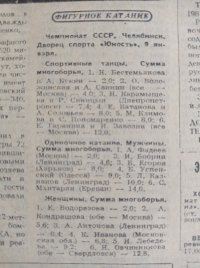
USSR Championships. Chelyabinsk. Sports Palace "Yunost". January 9.
Ice dancing. All-around sum. 1. N. Bestemyanova and A. Bukin - 2.0; 2. O. Volozhinskaya and A. Svinin (all - Moscow) - 4.0; 3. N. Karamysheva and R. Sinitsyn (Dnipropetrovsk) - 7.4; 4. E. Batanova and A. Solovyov - 8.0; 5. M. Klimova and S. Ponomarenko - 8.0; 6. E. Garanina and I. Zavozin (all - Moscow) - 12.0.
Single skating. Men. All-around sum. 1. A. Fadeev (Moscow) - 2.0; 2. I. Bobrin (Leningrad) - 4.6; 3. V. Egorov (Kharkiv) - 8.0; 4. B. Uspensky (Odesa) - 9.0; 5. L. Kaznakov (Leningrad) - 10.0; 6. S. Mkhitaryan (Yerevan) - 14.0.
Ladies. All-around total. 1. E. Vodorezova - 2.0; 2. A. Kondrashova (both - Moscow) - 5.6; 3. A. Antonova (Leningrad) - 6.4; 4. K. Ivanova (Moscow region) - 6.8; 5. N. Lebedeva - 9.2; 6. N. Ovchinnikova (both - Sverdlovsk) - 12.8.
1755715674058.jpeg
1755715707913.jpeg
1755715732125.jpeg
 
1983
USSR CHAMPIONSHIPS

HAPPY URAL ICE

(the article published in Ukrainian 'Sportyvna Hazeta' on January 11, 1983)

ON THE PEDESTAL OF HONOR – THE MASTERS OF WINGED SKATING OF OUR REPUBLIC

USSR FIGURE SKATING CHAMPIONSHIPS. Chelyabinsk, January 5-9. Palace of Sports "Yunost". 90 participants. Chief judge - P. ROMAROVSKY (international category, Chelyabinsk).
- HOW MANY gold medals do you have as a coach of champions? – journalists asked Stanislav Zhuk at a press conference.
- I don't remember exactly, - Stanislav Alekseevich answered. – About twenty-five.
The uniqueness of this collection will be better understood by the reader if we recall that in figure skating only four sets of awards are played. So, in Chelyabinsk, Zhuk's students were declared champions three times!
This brilliant series was opened by Marina Pestova and Stanislav Leonovich, who won the pairs tournament. Their skate is a stable performance of complex elements at high speed. Now the skaters have paid more attention to choreographic training, music, and their program has blossomed with new colors. Scores: 5.6-5.8.
It is noteworthy that yesterday's wards of Zhuk, Marina Pershina and Marat Akbarov, who have recently been training with Irina Rodnina, came second, while the "bronze" went to the youngest of Stanislav Alekseevich's pupils - world junior champions Marina Avstriyskaya and Yuri Kvashnin. There are many opponents of the training method used by Zhuk (early mastery of super-complex elements). But no one has yet been able to refute his system on ice, in a face-to-face debate. An additional confirmation of this is the uncontested victory in singles by Alexander Fadeev and Elena Vodorezova.
Vodorezova had practically no competitors, and she allowed herself to limit herself to two triple jumps in her free program. Elena skated with restraint, remembering that major international starts were ahead, and her physical condition still needed improvement.
Fadeev's performance deserves only exclamation marks. Over the season, the Muscovite has grown into an all-around athlete without any weak spots. And in the short program, he simply stunned with his hurricane speed and precise, high jumps, receiving fifteen 5.9 scores! Experienced Igor Bobrin performed confidently, without any noticeable flaws. But Odessa's Borys Uspensky often made mistakes in the free skate and "gave" the bronze medal to Kharkiv's Vitaliy Egorov, whose program resembled a well-learned lesson. Now the coaching council has a difficult task. Who to send to the European Championship: Egorov or the more famous Volodymyr Kotin, who did not finish the competition in Chelyabinsk, but continues intense training?
Ice dancing traditionally enjoys special favor from the audience: spectacularity, rich musical accompaniment, charming partners, costumes in the latest fashion - who will leave such a performance indifferent? But the Ural production surpassed, perhaps, all the previous ones. If not by the level of skill of the participants (there were breakdowns here), then by the plot intrigue.
As you remember, the leadership was taken by Natalia Bestem'yanova - Andrey Bukin and Olga Volozhinskaya- Aleksandr Svinin. Both couples showed so many original steps and lifts in the free dance, that one can only marvel at the inexhaustible imagination of the coaches-directors Tatyana Tarasova and Elena Tchaikovskaya. And in the fragment to gypsy melodies, the fiery Bestemyanova was simply inimitable. Six "sixes" for artistry are the most vivid confirmation of this.
However, the highlight of the dance evening at Yunost was the duel for third place. Young Muscovites Marina Klimova and Sergey Ponomarenko, who delighted with some special ease of skating, held the bronze medal with scores from 5.4 to 5.8, even after the performance of Dnipropetrovsk's Natalia Karamysheva and Rostislav Sinitsyn, who were somewhat deprived of points for artistry by the judges. But Elena Batanova and Alexey Solovyov danced, they danced cheerfully, in one breath, and several judges even brought them to third place. As a result, this influenced ... the fate of Klimova and Ponomarenko, who stopped a step away from the podium. And the bronze medals and tickets to the European Championship went to the Dnipropetrovsk team.
Karamysheva and Sinitsyn, like Egorov, were already champions of the Winter Spartakiad of the Peoples of the USSR in the absence of the team members. But for the first time in the history of the championships, where all the strongest started, Ukrainian skaters won medals in two disciplines.​
S. BELITS-GEIMAN,
Master of Sports of International Class.
Chelyabinsk (by phone).
1755750947312.jpeg
 
1983
USSR CHAMPIONSHIPS
· FIGURE SKATING


TRACKS LEAD TO SARAJEVO

(the article published in Ukrainian 'Sportyvna Hazeta' on January 15, 1983)

AFTER THE USSR CHAMPIONSHIPS
The season for figure skaters is fleeting - a little over three months. If you haven't had time to get in shape in time, learn new programs - consider that winter is gone. There is no time to correct the situation. And for those who are just preparing to storm the podiums, it is also very important to show yourself to the judges in all your glory in advance, to force them to take the new name seriously, so to speak, on the first try.
The USSR national team is undergoing a generational change. The process is painful. Suffice it to recall that at the last world championships, our skaters were left without gold medals for the first time in many years. Adjustments were made in each of the disciplines. But one innovation is common: athletes took to the ice much earlier than the traditional deadlines with ready-made programs, and already in November and December they solidly polished them at representative competitions in the GDR, the USA, Canada, Japan, Great Britain, Holland, Czechoslovakia, and our country. Moreover, this was done not only by the first, but also by the second and youth teams. As a result, the main qualifying start of the pre-Olympic season was met by most of its participants fully armed, having three or four rides with a full roster behind them.
How did this affect the competitions? What was the most characteristic of the Chelyabinsk tournament? Members of the coaching council of USSR Figure Skating Federation answer the questions of a correspondent of Sportyvna Hazeta.
Three-time Olympic champion Irina RODNINA - about pairs:
The loss of the championship title in this sport was especially painful for domestic figure skating. After all, our pairs have consistently held the palm of the championship for almost twenty years… And now the new generation will have to return what was lost. I think this task is within their power this year. I mean first of all Marina Pestova – Stanislav Leonovich, as well as Marina Pershina and Marat Akbarov.
The former - supporters of athletic skating. But now it is organically combined in them with the expressiveness, variety of ice patterns. Pershina and Akbarov have finally gained stability, self-confidence, which they had previously lacked so much. In terms of the richness of their programs with elements that are particularly highly appreciated by the judges, both pairs, as far as I know, significantly outperform their main competitors from the GDR. Now the main thing for them is to show the best versions of their programs in Dortmund and Helsinki, that is, to pass the test of character.
As for other pairs, two trends prevailed on the Ural ice. I would call the bronze medalists Marina Avstriyskaya and Yuri Kvashnin the brightest representatives of power skating. And the supporters of a soft style, where choreography often comes to the fore, were led by ex-world champions Irina Vorobyova and Igor Lisovsky (fifth place). Of course, it is not easy to combine the aesthetics of dance with super-complex elements, to find one's own path in this synthesis. However, only such a path, as practice shows, is the most fruitful. After long doubts and hesitations, Pestova-Leonovich, Pershina-Akbarov took it. Their example is a science to others.
Honored Master of Sports Aleksey MISHIN - about the men's performance:
- Our masters seem to have managed to eliminate the lag in physical training, which was so noticeable at international tournaments two or three seasons ago. Now not only the leaders but also the skaters who closed the top ten withstood the load of the free program to the end, and some could even repeat it for an encore. Another requirement of the ISU (International Skating Union) has also been met: individual elements, primarily jumps, have become more diverse and are not repeated, allowing judges to get a more complete picture of the athlete's technical arsenal.
But almost everyone lacks stability in the performance of the composition as a whole. Even Fadeev, whose progress has stunned many experts, has not avoided falls. I see one reason. In training, the guys often take the quantity, not the quality of the exercises. In order to bring complex triple jumps to automatism, to do them easily, naturally, you should jump more at full power in classes and not to separate elements from each other, but to repeat them in connections, best of all – in minute parts.
It seems that Bobrin is experiencing a third youth. His new dance is an event. Kotin's organic mastery attracts. He is close to both Bobrin's artistry and Fadeev's athleticism. It's a pity, but Egorov from Kharkiv, whom I am training, is progressing more slowly than I would like. Vitaliy lacks the ability to please the audience and judges, although in terms of technicality there are fewer complaints about him. The very talented Borys Uspensky from Odesa only partially realizes his potential due to weak psychological preparation and strange indifference to his own results.
Honored Coach of USSR Viktor KUDRYAVTSEV - about the women's performance:
- The main conclusion is pleasant: in women's single skating, a crisis has been overcome, the likes of which our kind of sport has never known. The merit in this is primarily the All-Union Federation, which sent the best coaches to train the single skaters. Only three years have passed since then, and the situation has become much clearer. Vodorezova, who finally overcame her illness, and Ivanova, whose trump card is clear reliable skating, have found worthy rivals: Leningraders Anna Antonova, Marina Serova, and Muscovite Anna Kondrashova. These girls are growing so rapidly that in Chelyabinsk they pushed the experienced Ivanova off the podium. Her defeat is the result of some complacency, an attempt to hold on to old baggage.
Personally, I am delighted with Carmen of Antonova. The directors – coach Mishin and choreographer Tagunov – abandoned the traditional diverse fragments and presented a free program as a single whole. And the young Antonova brilliantly embodied the idea on the ice stage, demonstrating amazing plasticity, high musical culture, beautiful triple jumps - peculiar outbursts of emotions of the charming Carmen.
International category referee Igor KABANOV - about the ice dancers:
- We, the judges, were primarily interested in the preparation of couples in compulsory and original dances, since it was here that the English champions Torvill - Dean gained a slight advantage, which they maintained until the end. Well, the athletes improved their so-called school handwriting very noticeably. And the variants of Bestemianova - Bukin, Volozhinskaya - Svinin, I think, are not inferior to the best world examples.
Much more problems were caused by learning the original dance. Rock and roll is a non-classical dance. You cannot master it, like a waltz or tango, by looking at textbooks. And when there are no methodological developments, the coaches' exactingness, their taste and imagination become crucial. Unfortunately, few couples managed to cope with "rock". Perhaps the best among them were the Dnipropetrovsk ice dancers Karamysheva and Sinitsyn, who firmly held the rhythm, avoided pauses contraindicated for this dance, and categorically refused alien, albeit original, elements of "rock".
On the final day, the Dnipropetrovsk team lacked some temperament. However, their high class, their right to places in the first team was rightly assessed as “bronze”. Despite the general major tone of the statements, none of the experts did not do without remarks. Such exactingness is understandable. The traces of skates laid by Soviet skaters in Chelyabinsk lead through Helsinki, Dortmund and Moscow, where qualifying competitions will be held on the eve of the White Games, to the Olympic Sarajevo, where we will meet again in a year.
Y. YAROSLAVOV.
1755759807009.jpeg
 
1983
USSR CHAMPIONSHIPS

OLYMPIC LANDMARK


"TYPHOON" IN THE ICE OVAL

(the article published in russian 'Sovetskiy Sport' on January 15, 1983)

Last autumn, numerous figure skating tournaments in Europe, America, and Asia opened up a whole galaxy of new talented masters to sports fans, both in the USSR national team and in a number of foreign teams. But the autumn try-ons served mainly as reconnaissance for the second echelon of figure skaters, dotted lines outlining the trends of the 1983 winter season. And the January USSR Championships in Chelyabinsk should undoubtedly be considered one of the major ice battles, where our masters demonstrated programs at full power. Here the fashion was dictated by those who received tickets to the upcoming European and World Championships, and in this dispute we saw not only the real strength of our leaders, but also the closest Olympic reserve.
In pair skating, the main fight for leadership was between Moscow duets - M. Pestova and S. Leonovich, V. Pershina and M. Akbarov. These masters effectively solved the problem of mastering the short program. The originality of the style, the purity of gliding, the dynamics - all this is present in both the three-time national champions - Pestova - Leonovich, and the silver pair - Pershina - Akbarov. Many of their qualities were also manifested in the free composition. Modern rules emphasize the special role of harmony in all parts of the program, the balance of elements, and in this regard, our leading duets looked fresh and interesting.
This is how the champions' performance was assessed by their mentor, Honored Coach of the USSR Stanislav Zhuk:
- Last year we did a lot to form an artistic style, to express a bright lyrical theme in the Pestova-Leonovich programs. I am glad that this style has become dominant for the skaters. Pestova also demonstrated her fighting qualities, managing, despite a recent injury, to cope with the tasks set. Now it's the turn of the "ultra-c" elements...
- For Pershina and Akbarov, this season was a turning point, - emphasized the figure skaters' coach, Olympic champion Irina Rodnina. - The transition from the CSKA school to a new team, as usual, entailed a restructuring in all aspects - technically, psychologically, morally. The guys overcame barriers at every training session, and ultimately showed increased power and complex combinations at the championship...
The inclusion of a 2 1/2-turn axel in the program gave Pershina and Akbarov both energy and confidence.
Curious phenomena are also happening in our immediate reserve. Immediately after winning the junior world championship, the pair from Moscow M. Avstriyskaya and Yu. Kvashnin began preparing for the senior national championship and met the Chelyabinsk starts fully armed. Perhaps no other pair has demonstrated such a degree of reliability in the technique of complex elements as Avstriyskaya and Kvashnin. They were especially successful in the free composition and managed to move from fifth to third place overall, contrary to many predictions. The score of 5.7 is far from the limit for the young duet, considering that its arsenal also includes triple jumps.
In this regard, the question of who will come to stable execution of elements of the highest difficulty faster is especially relevant in the pre-Olympic season. Incidentally, not only Moscow duets, but also young couples from Leningrad should have their say here.
After the 1980 Winter Olympics, a change of leaders occurred not only in pair skating, but also in men's single skating, where we had previously had strong positions. The 1981 season brought victory in the European Championship to Leningrader I. Bobrin. But then he did not feel serious support from the youth; representatives of the new generation.
A different picture emerged in the 1983 season. Already at the December international tournament in Moscow, success was achieved by masters of the new formation - Alexander Fadeev (coach Stanislav Zhuk) and Vladimir Kotin (coach Elena Tchaikovskaya). They outplayed not only Bobrin, but also the rapidly progressing J. Sabovcik (Czechoslovakia). The scales were thrown with the most complex programs, where the honorable place was taken by cascades with a triple jump, a 3.5-turn axel, and step sequences at maximum speed.
At the same time, the axiom remains in force: in single skating, it is primarily the all-rounders who win. And the best proof of this is the performance in Chelyabinsk of 19-year-old Fadeev, who, in a fierce competition with Bobrin, took first place in all sections of the competition.
It is characteristic that Fadeev started the competitive season earlier than many of our singles skaters; in November, he performed brilliantly at a tournament in Tokyo. On the ice of Chelyabinsk, he demonstrated the strength, power, and energy of his complex cascades.
This energetic acceleration in preparation was also characteristic of the best ice dance duets, claiming tickets to the future Olympic team. Muscovites E. Batanova and A. Solovyov left a bright impression at competitions in England, Japan, their compatriots M. Klimova and S. Ponomarenko shone with beautiful dances on ice in France, Germany.
National champions N. Bestemyanova and A. Bukin tested their new free program more than 15 times before they started in Chelyabinsk, and this circumstance allowed them to achieve amazing freedom and ease in performing the temperamental dance. It was not for nothing that it was awarded six top marks - 6.0.
The wind of new ideas, the bold use of both classical rhythms and musical folklore turned the dancers' competitions into a real "typhoon" on the Chelyabinsk ice. Our leading specialists are Honored Coaches of the USSR Tatyana Tarasova, Elena Tchaikovskaya, Olympic Champion Lyudmila Pakhomova, Honored Coach of the Russian SFSR Natalia Dubova found the right orientation, achieving first-class technique of performing compulsory dances, original dance from their students.
The problems of preparing new duets with a bright individuality, apparently, have become more complicated. This season, according to the new rules, the original dance has acquired a large specific weight - it has actually become the second part of the triathlon. And it is no coincidence that in this section the competitions at the national championship were extremely tense: the silver pair O. Volozhinskaya and A. Svinin received scores of 5.7-5.8, and three pairs - M. Klimova and S. Ponomarenko, E. Batanova and A. Soloviev, N. Karamysheva and R. Sinitsyn - mostly 5.5-5.6. No championship has ever seen such a density of results.
Our dances have always been strong in original ideas, bold concepts in staging programs, and research in this area has allowed such coaches as Pakhomova and Dubova to raise the artistic skills of their students to a new level, bringing them closer to the leaders in their class.
Pershina - Akbarov, Avstriyskaya - Kvashnin, Fadeyev, Kotin, Batanova - Soloviev, Klimova - Ponomarenko - all these are figure skaters who are capable of forming the core of our future team in the new Olympic cycle. But even today they are eager to establish themselves in new positions.
The 1983 season added other names to the list of Olympic hopes: in women's singles skating, these were Muscovite A. Kondrashova, A. Antonova (Leningrad), N. Lebedeva (Sverdlovsk), and in men's skating, these were V. Egorov (Kharkiv), L. Kaznakov (Leningrad), S. Mkhitaryan (Yerevan), B. Kurashvili (Tbilisi).
However, not everything is well in the education of our reserve. Considering the new requirements for a balanced harmonious program, it must be acknowledged that there is a large gap in skill between, for example, the leading four - E. Vodorezova, A. Kondrashova, A. Antonova, N. Lebedeva and the rest of the young skaters. At the Junior World Championships in single skating we only had 4th and 5th places. The gaps in the gliding and spinning techniques of many young athletes are also alarming.
Our reserve in singles and pairs skating have not yet fully resolved the issues of choreographic training. Here is what Leningrad choreographer, former soloist of the Maly Academic Opera and Ballet Theatre Lyudmila Baskakova says in this regard:
- In both ballet and figure skating there are no trifles, no trivial details. The rink is the same stage. That is why the slightest mistakes are so clearly visible here - lack of posture, an inexpressive entrance to the arena, stiffness before performing complex elements. After all, the task of coaches and choreographers is not only to construct complex compositions, but also to give them lightness, airiness, elegance. In a word, I am for such programs, where there is strength, and play, and charm ...
Yes, we expect artistic, original in style, impressive in complexity compositions from our skaters. The traditions of our team allow us to hope for this. Let us recall the results of the performances of Soviet skaters in the Olympic arena over the past 20 years. They have 7 gold, 6 silver, 1 bronze medals.l Here are the results of other national teams: USA - 4 gold, 2 silver, 6 bronze; Austria - 2 gold, 1 silver; England - 2 gold; GDR - 1 gold, 3 silver, 4 bronze; Canada - 1 gold, 1 silver, 4 bronze; FRG - 1 gold, 1 silver, 2 bronze; Czechoslovakia - 1 gold, 1 silver, 1 bronze medal.
The 1983 season will give us an answer to the question of what the current balance of power is in the international figure skating arena. The culmination of the season is already near. Here is the calendar of the main starts:
European Championships. January 31 - February 5. Dortmund (FRG).
World Championships. March 7-13. Helsinki (Finland)
USSR Cup. April 6-10. Tashkent.
USSR Junior Cup. March 24-28. Tallinn.

A. SHELUKHIN.
1755846123600.jpeg
1755846147084.jpeg
 
Back
Top