Archive of newspaper articles | Page 3 | Golden Skate

Archive of newspaper articles

1980
FIGURE SKATING


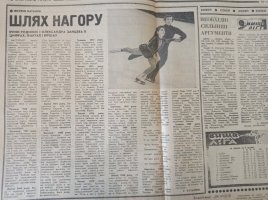
THE WAY UP

OF IRINA RODNINA AND ALEXANDR ZAITSEV IN FIGURES, FACTS AND POEMS

(the article published in Ukrainian 'Sportyvna Hazeta' on December 6, 1980)

NEXT Sunday they will say goodbye to the great sport. They will dance the legendary "Kalinka", - and all.
They will leave the ice arena forever, covered with the glory of the best skaters of our time. Let's remember together what their way up was.
February 1958. The sickly 8-year-old Irochka Rodnina was brought by her parents to the skating rink at the Young Pioneers Stadium. There were no ambitious thoughts. They simply wanted to improve her health. Brother and sister Elena and Alexei Ulanov were already practicing in the section at the same rink. That's how Irina met her first partner. Their passion for skating soon led them both to the CSKA school.
May 1966. That's how long it took Rodnina and Ulanov to get their "secondary education" and team up. Coach Stanislav Zhuk singled them out for their courage and ambition.
November 1967. Debut on the big ice. The judges and participants of the Moscow Open Championship, where all our best masters competed, were stunned by the complexity of the novices' program and the speed at which the record elements were performed. Of course, there were some mistakes. However, the coaching council did not hesitate to include Rodnina and Ulanov in the USSR national team. And although they did not make it to the 68 Olympics, their baptism of fire at the European Championships a month earlier gave the duo confidence.
February 1969. They are European champions! Here is what Sovetsky Sport wrote on February 7: “It is not customary to say about figure skaters: they accomplished a feat. But judge for yourself: 19-year-old Irina and 21-year-old Alexey, starting at the European Championship for only the second time, managed to outdo the entire world elite. They skated their unique in complexity free program at excellent speed, boldly and temperamentally. It was a fusion of grace and courage. The judges, with rare unanimity, gave them scores of 5.8 and 5.9 points. I would like to hope that today on the ice of Garmisch-Partenkirchen (Germany) the “star” of a new wonderful couple has risen, both participants of which have just been awarded the title of Honored Masters of Sports.”
February 1972. Having won all the European and world championships of the inter-Olympic cycle, Rodnina and Ulanov also became first in Sapporo. But that was their last joint performance. Alexey married Lyudmila Smirnova and began dancing with her ...
October 1960. Among the newcomers to the figure skating section of Leningrad coach O. Davydenko, 8-year-old Sashko Zaitsev did not stand out in anything, except for his increased sociability, although it is difficult to impress with this quality in a children's company. We did not accidentally deviate from the chronology. After all, it was Zaitsev, then already a singles skater from the top ten of the All-Union, that Stanislav Zhuk would look at eleven and a half years later when he was looking for a partner for Irina. And not the least role in that choice was played by Aleksandr's generous nature towards friendship, his great contact.
May 1972. The time of the birth of a new pair. A pair destined to set a unique record in figure skating. Irina Rodnina and Alexandr Zaitsev did not suffer a single defeat during their joint performances! They were only the first!
February 1973. The first European victory in the new combination. The surprise of experts, journalists, and spectators was perhaps best conveyed by the newspaper "Rude Pravo": "We met a new couple, and in them - a new Rodnina. The same impeccable technique, crazy pace, ultra-c cascades, and the character of the dance is different: firmer, more purposeful. Rodnina sets the tone in it, she is the leader, and this gives her skill still unknown colors."
February 1976. The Olympic history of figure skating has never known such an advantage of champions over other participants as Rodnina and Zaitsev achieved in Innsbruck. And the point is not so much in the numerical indicators, but in the skating itself, which Irina and Alexandr professed. Under the guidance of coach Tatyana Tarasova, they proved that it is possible to harmoniously combine filigree technique, speed, complexity with high choreography, attractive musical pattern. So the victory was achieved at a new qualitative level. The champions showed others which path in the development of figure skating is the most fruitful, the most promising.
February 1979. February again... The attentive reader has already noticed that this winter month is the happiest for Irina. On the 23rd, she and Alexandr had a son, Alexandr Zaitsev Jr. But on the horizon are the Winter Games in Lake Placid. Who will stand in for the champions?
March 1979. They decided that they would stand up for themselves. Four weeks after giving birth, Irina went to her first training session – cross-country. After another month and a half, she returned to the ice.
January 1980. The Swedish city of Gothenburg hosts the next European Championship. Irina and Alexandr are back on the horse. Comment by English figure skater John Curry, gold medalist of Games-76: "I believe the most important feature of Rodnina and Zaitsev's skill is that there is nothing superfluous in their program, everything is in its place. The break did not make itself felt at all. On the contrary, the external pattern of the dance became even more spectacular."
February 1980. Neither native walls, nor a pre-planned psychological attack, nor pressure on the judges - nothing helped the Americans Babilonia and Gardner in the fight for the Olympic title with our masters. When the time for the match struck, the Americans simply threw up the white flag. The Lake Placid Games were another triumph for Rodnina and Zaitsev. They brought Irina her twenty-fourth and Alexandr his fifteenth gold medal as European, world and Olympic champions. And yet, on the podium, as the poet said:
"An anthem is playing.
About the most important thing
You can't say it in a single phrase.
And on the screen in close-up
eyes of Irina Rodnina,
Threefold ... And not by chance
a tear slowly falls.
It has not become a secret for anyone,
what were those eyes saying..."
March 1980. They did not start at the World Championships in Dortmund. They came there to pass the glorious baton to their descendants – Marina Cherkasova and Sergey Shakhrai.
April 1980. By decree of the Presidium of the Supreme Soviet of the USSR dated April 9, for high sporting achievements at the XIII Winter Games, the holder of the Orders of Lenin and the Red Banner of Labor, Irina Konstantinovna Rodnina, was awarded the second Order of the Red Banner of Labor, and Alexandr Gennadievich Zaitsev was awarded the same award for the second time.
May 1980. The Finnish newspaper "Helsingin Sanomat" wrote: "In the chronicle of figure skating, Irina Rodnina remains a unique phenomenon. She dominated the ice for 11 years, during which she won all possible prizes and titles. Fate severely tested her: a change of partner, coach, a long break under the curtains of her career, associated with the birth of her son... Rodnina overcame everything. And we are grateful to her not for the medals, but first of all, for the greatness of the spirit, for the character of a fearless fighter.”
On December 14, they will dance in front of the audience for the last time. Let's not forget to turn on the TVs ...
G. KUZMIN.
1753115474152.jpeg
 
1981
USSR Figure Skating Championships

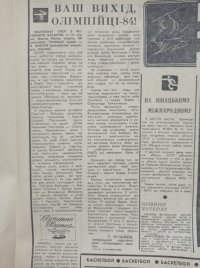
YOUR EXIT, OLYMPIANS-84!

(the article published in Ukrainian 'Sportyvna Hazeta' on January 8, 1981)

USSR FIGURE SKATING CHAMPIONSHIP. January 7-11. Odesa. Palace of Sports. 88 participants. Chief judge - B. ANOXIH (all-Union category, Moscow).
IT'S EASY TO CALCULATE: those who are currently making their debut among the strongest, on their way to the Olympic peaks in Sarajevo, will have "only" 12-15 starts in three years. But which ones? Only European championships - four, three - world. The championship in Odesa opens this gallery. Therefore, the skill of its participants must be approached with high standards, with Olympic standards, if not yet the 1984 model, then at least based on what the Lake Placid medalists demonstrated.
In pair skating, the relay from Rodnina and Zaitsev was taken over by Marina Cherkasova and Sergey Shakhrai. Supported by their CSKA schoolmates Marina Pestova and Stanislav Leonovich, they will probably set the tone on the world stage this season as well. However, in order to become worthy successors to their glorious predecessors Marina and Sergey, according to most experts, should improve their skating synchronicity, present their percussion elements more vividly, and diversify their musical design.
The Leningrad pairs of Tamara Moskvina are to take part in the prize distribution. Of course, it is very interesting what programs the two duets of the ice masters will present to the judges: Svitlana Kulishova - Mikhailo Stoyanov and Tetyana Khristova - Vladimir Zhivolup.
In the dances ahead - the eternal seekers of the new Natalia Linichuk and Gennady Karponosov. The champions of Games-80 do not want to repeat themselves, they go further. In the post-Olympic season they saluted with a bright new program, in which the Odesa audience will especially like, probably, the final part - Charleston. Irina Moiseeva and Andrey Minenkov hold high positions, their manner of performance, while retaining poeticity, has become more universal and dynamic.
Behind the leaders - a whole round dance of wonderful couples, among which to single out the best for the first team is a puzzle for the judges, you will not envy them here.
Among those who have come so far to watch others, first of all, and only then to show themselves, are Kyiv residents Maria and Oleksandr Tumanovsky.
After the retirement of two-time world champion Vladimir Kovalev, Soviet single skating masters will have to storm the podiums of international competitions with renewed vigor. This assault group is headed by the experienced Igor Bobrin. In terms of expressiveness and plasticity, he is not inferior to the famous Englishman Cousins. If we add to this the will of Kovalev and the stability of Hoffman (GDR), all questions would be removed.
It is nice that among those on whom the coaching council members are looking, our compatriots - Vitaliy Egorov from Kharkiv and Boris Uspensky from Odesa - are less optimistic so far.
The prospects of the female figure skaters are less optimistic. In Vodorezova's absence, none of her friends managed to build on her success. Now Elena has returned to active performances (by the way, she is only 17 years old). Svetlana Frantsuzova and Marina Serova from Leningrad have started the season successfully, and Nina Avramova from Kharkiv and muscovite Anna Kondrashova are also full of desire to distinguish themselves. Everyone has modern programs with triple jumps in their arsenal. All that remains is to show the goods with their faces.​
G. KUZMIN,
special correspondent of "Sportyvna Hazeta".

Odesa (by phone).
1753194530659.jpeg
 
1981
USSR Figure Skating Championships

Business Card

(the article published in Ukrainian 'Sportyvna Hazeta' on January 8, 1981)

PROBABLY, never before have Ukrainian figure skating masters been represented at the main competitions of the year, which are the USSR championships, by so many skaters as at the current championship in Odesa. But it is worth mentioning not only the increase in representation, but also the qualitative leap, which allows our compatriots - graduates of figure skating schools in Odesa, Kharkiv, Dnipropetrovsk - to fight for places in the top six in all categories. During the championship, under the heading "Business Card", we will introduce readers to the participants - representatives of our republic.​
Natalia KARAMYSHEVA - Rostyslav SINITSYN,
ice dancing

(Dnipropetrovsk)​
THESE ARE OUR MOST EXPERIENCED skaters, leaders of the Ukrainian national team. 20-year-old Natalia started drawing figures as a first-grader. Her husband, 25-year-old Rostyslav, has 16 years of experience. Both are members of the Dnipropetrovsk sports club "Meteor", have been members of the USSR national team since 1977. Twice - in 1978 and 1980 - they were champions of the country, and in the pre-Olympic season they won "bronze". Their debut at the European Championship the year before last brought a fifth result, at last year's world championship the pair took seventh place.
Natalia and Rostislav, together with their permanent coach, Tatyana Rozhina, practice skating, the basis of which is the technique of ballet and folk dances on the floor. It is not without reason that Irina and Stanislav Shklyar, a multiple prize-winner of all-Union ballroom dancing tournaments, also perform the choreographic functions together with Rozhina.
Another characteristic feature of a duet is that it is difficult to single out one of the partners, as is often the case even among first-class dancers. In this case, anyone can take on the role of leader of a small team!
1753198783202.jpeg
 
1981
USSR Figure Skating Championships

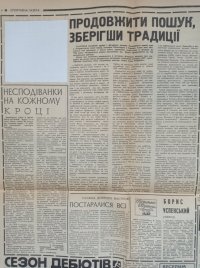
CONTINUE THE SEARCH, PRESERVING TRADITIONS

(the article published in Ukrainian 'Sportyvna Hazeta' on January 10, 1981)

The national figure skating championship has begun. A new stage in the four-year cycle before the Winter Olympics in Sarajevo begins. It is now that the direction in which athletes and coaches will work until 1984 is chosen, and the foundations of the compositions that will be presented to the Olympic judges are laid.
TASS sports commentator Irina RODNINA, ten-time world champion and Honored Master of Sports, expresses her opinion on the problems of Soviet and world figure skating, and on the tasks facing skaters.

- I will note right away that my view of the problems of our sport and the tasks that it will have to solve in the new Olympic cycle, at the annual world and European championships may seem too strict and picky. But I will note that a critical attitude towards ourselves has helped us throughout our long life in sports. I would like to follow the principles I have learned and not deviate from them, leading a conversation about the current state of affairs in Soviet and world figure skating.
We are often asked who we see as our heirs, who are the main contenders for the place of leaders of pair skating in the upcoming season and in the future? There is no doubt that the heavy burden of leadership will fall on Marina Cherkasova and Sergey Shakhrai. They are ready for it, as they proved last year by winning the world crown in Dortmund. But they still have a lot of work to do to achieve stability as leaders and improve their style. They are certainly on the right track and it can be assumed that in the next two years, their rivals will hardly be able to overtake them in the European and world championships.
Their CSKA clubmates Marina Pestova and Stanislav Leonovich proved themselves well last season. But if in terms of creativity they have made significant progress, in terms of technical skill they have, in my opinion, not reached the required level for the first season. I also don't like the fact that the third sports couple, Stanislav Zhuk's pupils, who are claiming a place in the main team - Veronika Pershina and Marat Akbarov, a couple that is certainly very promising - performs in the same manner, as Cherkasova - Shakhrai, and Pestova - Leonovich. Will this uniformity give "trumps" to the opponents, will it not reduce the combat effectiveness of the national team, which will face difficult tests in the coming years?
Who is preparing to "throw down the gauntlet" to the Soviet pair skating masters? First, the duets from the GDR - a country that has wonderful traditions in this discipline of figure skating. I am sure that the change of such masters as Manuela Mager - Uwe Beversdorf, Sabina Baess - Tassilo Thierbach will not take long, and new attractive pairs will appear in the GDR national team in the near future.
At the end of last year, at international competitions in London and Sapporo, the Canadian pair Barbara Underhill and Paul Martini, coached by former figure skater Sandra Bezic, made a very good impression on the experts. They skate easily and technically, and their program is interestingly structured. I wouldn't be surprised if at the next European Championship, Christina Riegel and Andreas Nischwitz from West Germany will fight for a place in the top three, and finally, we should expect the emergence of new sports duos in the USA, where, as a rule, they are made up of strong single skaters, which allows them to master complex technical elements quite quickly.
The most difficult task is to be solved by our athletes and coaches in women's single skating. Unsuccessful performances at the European and world championships in recent years have led to the fact that this season the USSR national team can include only one single skater in its composition. I will say right away that I consider the talented Elena Vodorezova to be an athlete capable of achieving the highest results. She is a courageous person, infinitely devoted to figure skating. I really want to hope that her health will allow her to win the right to join the national team.
I would like to hope that in the near future we will have other athletes who are able to fight for high places on the international stage. As the competitions preceding the national championship showed, our coaches are conducting a stubborn and unsuccessful search in this direction. And yet it needs to be revived. As for the world women's single skating, the leader remains Anett P oetszch (GDR). Among the favorites are also Denise Biellmann from Switzerland and Austrian skater Claudia Kristofics-Binder. Talented girls Sanda Dubravčić from Yugoslavia, Lisa-Maria Allen and other athletes from the USA, where there has never been a shortage of good single skaters, are also improving their skills.
For several years now, men's single skating has been attracting increased interest both in our country and on the international stage. This season we will not see on the ice such skaters as Jan Hoffmann (GDR), Robin Cousins (Great Britain), Charles Tickner (USA), and our Vladimir Kovalev. However, I am convinced that we will witness an exciting rivalry of single skaters for the places that have become vacant on the podium of European and world tournaments.
Of course, our Igor Bobrin has good chances in competition with foreign athletes. He has sufficient international experience on his side, and high skill, artistry, and originality of compositions. But he also still lacks stability, especially when performing the compulsory program.
I am also convinced that he will have a hard time competing with the youth at this year's national championship, and certainly with Konstantin Kokora, Vladimir Kotin, and Alexander Fadeev, who have made significant progress recently. They all have complex jumps, glide at high speed, and have experienced mentors. And the main thing that impresses me is that everyone has their own style, which, let's hope, will become more confident over time. I would still like to wish them more confidence, courage and daring in their performances at international tournaments.
Ice dancing is a type of figure skating that probably causes the most controversy among experts. The subjectivity of opinions sometimes has too much weight here. But one thing is certain: the recognized leaders were and remain the Soviet duets Natalia Linichuk - Gennady Karponosov and Irina Moiseeva - Andrey Minenkov. Their merits in the development and promotion of ice dancing are enormous. Their creative search is an excellent example for those who are to succeed these wonderful masters.
It is important to consolidate and develop what has been accumulated in the "workshop" of domestic sports dance. The rivals, despite many years of defeats, persistently strive for victories (let's remember the "gold" of the Hungarian couple at the World Championship-80). The English Jayne Torvill - Christopher Dean claim the highest places. This season we will see others with whom we will have to compete for medals at the upcoming Olympics.
"Olympians among us" - this became the slogan of the participants of the national championship of the new Olympic cycle. The Sarajevo-84 pedestal awaits the most persistent, selfless athletes, those who are not afraid of difficulties and those who see a high goal before them.
1753271773626.jpeg
 
1981
USSR Figure Skating Championships

SURPRISES AT EVERY STEP

(the article published in Ukrainian 'Sportyvna Hazeta' on January 10, 1981)

USSR FIGURE SKATING CHAMPIONSHIP. Odesa. January 7-11. Palace of Sports. 88 participants. Chief judge - B. ANOKHIN (all-Union category, Moscow).

PREVIOUS predictions fell apart like a house of cards on the first evening. World champions Marina Cherkasova and Sergey Shakhrai found themselves outside the top three after the short program ... The preface to the sensation is as follows.
Shortly before the new year, Marina suffered from the flu. And already in Odesa, she injured her back during training. Doctors were against the performance of this pair. However, the coach, after consulting with the students, made a different decision. It is clear that Sergey was very worried about his partner, especially about how the jumps would turn out. Cherkasova held up well, although she skated with difficulty. But Shakhrai, having lost his vigilance for a moment, forgot about one of the elements, and the judges were merciless.
The experienced Vorobyova and Lisovsky took advantage of the favorite's misfire the best, taking the lead. Pestova and Leonovich held on to second place, Pershina and Akbarov - third.
The next day, the surprises continued. Feeling the proximity of victory, Vorobyova and Lisovsky were excited. When Irina “froze” after a parallel jump on two legs, and then stumbled on a twist, it became clear: the “gold” was swimming past them. At that moment, the “shares” of Pestova and Leonovich jumped sharply. But the excitement did not bypass them either. Stanislav could not hold Marina in what seemed to be her favorite element – the twist. In such a situation, Cherkasova and Shakhrai had a ghostly chance to return to their “rightful” first place. But alas! Two new mistakes finally dashed their hopes.
And then, as if from an ambush, the least famous and youngest - Pershina and Akbarov - jumped forward. They also had some mistakes in performing a technically very complex program. But not so significant, although the judges noticed them. As a result, Veronika and Marat, performing for the first time at the senior USSR championship, became winners. An enviable debut!
They started in Sverdlovsk with coach Vladimir Zakharov, were world champions among juniors. The second year they moved to Moscow, where they are honing their skills at Stanislav Zhuk's school. After the results were announced, tiny Veronika could not hide her happiness. Interestingly, before going out on the ice, Zhuk suggested simplifying the program a little to avoid risk. Marat seemed to agree, but Veronika strongly protested: "Did I really fall so much in training for nothing?" she begged Stanislav Alekseevich and finally got what she wanted.
Leningraders Vorobyova and Lisovsky came second, while Cherkasova and Shakhrai rounded out the top three.
The chain reaction of mistakes, unfortunately, was also passed on to the men who demonstrated a two-minute composition. Only three of the 13 participants avoided serious mistakes. These were Igor Bobrin from Leningrad, who, by the way, won the "school", Alexander Fadeev from Kazan and Vitaliy Egorov from Kharkiv. Insufficient choreographic training did not allow our countryman to rise above fifth place. But Fadeev pushed the more eminent Konstantin Kokora to fourth place.
Vladimir Kotin secured second place. Despite falling while performing a spinning top jump, he left the brightest impression with his excellent technique and complete dedication, high emotional mood. It's amazing how many reserves Elena Tchaikovskaya has revealed to this 18-year-old young man in just six months of joint training.
The single ladies didn't spoil the overall picture either. When drawing the compulsory figures, they also forgot about "subordination". The list, however, was headed by those who belonged to it: Vodorezova and Ivanova. But then there was complete confusion. The heroines of the season - Frantsuzova and Serova - are not even in the top five. Our compatriot Nina Avramova settled only in ninth place ...
In short, eyewitnesses are satisfied. The plot twist is brilliantly twisted. But there are some regrets. Natalia Karamysheva has pneumonia. She and Rostyslav Sinitsyn had to put their skates away for now.​
G. KUZMIN,
special correspondent for Sportyvna Hazeta.

Odesa (by phone).
(The original text of the article can be seen in the previous post)
 
1981
USSR Figure Skating Championships

CONTINUE THE SEARCH, PRESERVING TRADITIONS

(the article published in Ukrainian 'Sportyvna Hazeta' on January 10, 1981)

The national figure skating championship has begun. A new stage in the four-year cycle before the Winter Olympics in Sarajevo begins. It is now that the direction in which athletes and coaches will work until 1984 is chosen, and the foundations of the compositions that will be presented to the Olympic judges are laid.
TASS sports commentator Irina RODNINA, ten-time world champion and Honored Master of Sports, expresses her opinion on the problems of Soviet and world figure skating, and on the tasks facing skaters.

- I will note right away that my view of the problems of our sport and the tasks that it will have to solve in the new Olympic cycle, at the annual world and European championships may seem too strict and picky. But I will note that a critical attitude towards ourselves has helped us throughout our long life in sports. I would like to follow the principles I have learned and not deviate from them, leading a conversation about the current state of affairs in Soviet and world figure skating.
We are often asked who we see as our heirs, who are the main contenders for the place of leaders of pair skating in the upcoming season and in the future? There is no doubt that the heavy burden of leadership will fall on Marina Cherkasova and Sergey Shakhrai. They are ready for it, as they proved last year by winning the world crown in Dortmund. But they still have a lot of work to do to achieve stability as leaders and improve their style. They are certainly on the right track and it can be assumed that in the next two years, their rivals will hardly be able to overtake them in the European and world championships.
Their CSKA clubmates Marina Pestova and Stanislav Leonovich proved themselves well last season. But if in terms of creativity they have made significant progress, in terms of technical skill they have, in my opinion, not reached the required level for the first season. I also don't like the fact that the third sports couple, Stanislav Zhuk's pupils, who are claiming a place in the main team - Veronika Pershina and Marat Akbarov, a couple that is certainly very promising - performs in the same manner, as Cherkasova - Shakhrai, and Pestova - Leonovich. Will this uniformity give "trumps" to the opponents, will it not reduce the combat effectiveness of the national team, which will face difficult tests in the coming years?
Who is preparing to "throw down the gauntlet" to the Soviet pair skating masters? First, the duets from the GDR - a country that has wonderful traditions in this discipline of figure skating. I am sure that the change of such masters as Manuela Mager - Uwe Beversdorf, Sabina Baess - Tassilo Thierbach will not take long, and new attractive pairs will appear in the GDR national team in the near future.
At the end of last year, at international competitions in London and Sapporo, the Canadian pair Barbara Underhill and Paul Martini, coached by former figure skater Sandra Bezic, made a very good impression on the experts. They skate easily and technically, and their program is interestingly structured. I wouldn't be surprised if at the next European Championship, Christina Riegel and Andreas Nischwitz from West Germany will fight for a place in the top three, and finally, we should expect the emergence of new sports duos in the USA, where, as a rule, they are made up of strong single skaters, which allows them to master complex technical elements quite quickly.
The most difficult task is to be solved by our athletes and coaches in women's single skating. Unsuccessful performances at the European and world championships in recent years have led to the fact that this season the USSR national team can include only one single skater in its composition. I will say right away that I consider the talented Elena Vodorezova to be an athlete capable of achieving the highest results. She is a courageous person, infinitely devoted to figure skating. I really want to hope that her health will allow her to win the right to join the national team.
I would like to hope that in the near future we will have other athletes who are able to fight for high places on the international stage. As the competitions preceding the national championship showed, our coaches are conducting a stubborn and unsuccessful search in this direction. And yet it needs to be revived. As for the world women's single skating, the leader remains Anett P oetszch (GDR). Among the favorites are also Denise Biellmann from Switzerland and Austrian skater Claudia Kristofics-Binder. Talented girls Sanda Dubravčić from Yugoslavia, Lisa-Maria Allen and other athletes from the USA, where there has never been a shortage of good single skaters, are also improving their skills.
For several years now, men's single skating has been attracting increased interest both in our country and on the international stage. This season we will not see on the ice such skaters as Jan Hoffmann (GDR), Robin Cousins (Great Britain), Charles Tickner (USA), and our Vladimir Kovalev. However, I am convinced that we will witness an exciting rivalry of single skaters for the places that have become vacant on the podium of European and world tournaments.
Of course, our Igor Bobrin has good chances in competition with foreign athletes. He has sufficient international experience on his side, and high skill, artistry, and originality of compositions. But he also still lacks stability, especially when performing the compulsory program.
I am also convinced that he will have a hard time competing with the youth at this year's national championship, and certainly with Konstantin Kokora, Vladimir Kotin, and Alexander Fadeev, who have made significant progress recently. They all have complex jumps, glide at high speed, and have experienced mentors. And the main thing that impresses me is that everyone has their own style, which, let's hope, will become more confident over time. I would still like to wish them more confidence, courage and daring in their performances at international tournaments.
Ice dancing is a type of figure skating that probably causes the most controversy among experts. The subjectivity of opinions sometimes has too much weight here. But one thing is certain: the recognized leaders were and remain the Soviet duets Natalia Linichuk - Gennady Karponosov and Irina Moiseeva - Andrey Minenkov. Their merits in the development and promotion of ice dancing are enormous. Their creative search is an excellent example for those who are to succeed these wonderful masters.
It is important to consolidate and develop what has been accumulated in the "workshop" of domestic sports dance. The rivals, despite many years of defeats, persistently strive for victories (let's remember the "gold" of the Hungarian couple at the World Championship-80). The English Jayne Torvill - Christopher Dean claim the highest places. This season we will see others with whom we will have to compete for medals at the upcoming Olympics.
"Olympians among us" - this became the slogan of the participants of the national championship of the new Olympic cycle. The Sarajevo-84 pedestal awaits the most persistent, selfless athletes, those who are not afraid of difficulties and those who see a high goal before them.
View attachment 9508
Interesting to read Rodnina's assessment of what were my generation of competitors. I never rose to the level of competing against her internationally, but friends who did said she was always intense and focused in the dressing rooms and ignored non-Russian skaters. They'd be surprised to read how impartial she could be, and capable of being critical of her own team's weak areas.
 
1981
USSR Figure Skating Championships

GOOD MOOD SERVICE​

Everyone Tried Their Best

(the article published in Ukrainian 'Sportyvna Hazeta' on January 10, 1981)

A COLORFUL holiday has aroused unprecedented interest among Odessans. The Palace of Sports cannot satisfy even a tenth of the applications that came only from organizations and enterprises of the hero city. Television helps out. And what's more, the participants happily perform at factories, institutes, and schools in their free time.
Odessans love figure skating. The city has created close to optimal conditions for training. There is excellent ice, a good technical base. What is very important is that there is its own figure skating school, the best representatives of which compete at the championship.
The hosts did their best. Both athletes and spectators felt at home. Almost all the premises of the Palace of Sports have been renovated. The press center, where about 50 journalists work, has been reequipped. Another ice-filling machine has been delivered from Zaporizhzhia. Workers from dozens of enterprises have worked hard to fulfill the orders of the organizing committee. Among those who particularly distinguished themselves were the stamper of the Odessa factory A. Kondratiev, the engravers S. Shaposhnikov and M. Pashkovsky, the electroplater N. Shapovalov, and the craftsmen of the leather goods factory S. Mykhailiuk, L. Farber.
The guests are accommodated in the best hotels. They are sponsored by the city's Komsomol. A large cultural program has been developed, the implementation of which is not hindered by the rare cold even for Odessa in January.
O. BORYSENKO.
(The original text of the article can be seen in post 44)
 
Interesting to read Rodnina's assessment of what were my generation of competitors. I never rose to the level of competing against her internationally, but friends who did said she was always intense and focused in the dressing rooms and ignored non-Russian skaters. They'd be surprised to read how impartial she could be, and capable of being critical of her own team's weak areas.
Thanks a lot for sharing your thoughts on these articles. I have never skated myself and don't know what it feels like. I am really amazed that you are a skater and know skaters who competed against Rodnina.
 
Thanks a lot for sharing your thoughts on these articles. I have never skated myself and don't know what it feels like. I am really amazed that you are a skater and know skaters who competed against Rodnina.
The sanity of pairs girls tends to be questioned by even other skaters :scratch2:. We're a close-knit group where friendships last a long time :ghug:. I was still in juniors when she was competing, but I heard about her from older pairs girls in Canadian rinks.
 
1981
USSR Figure Skating Championships

Business Card

BORIS USPENSKY

(ODESA)

(the article published in Ukrainian 'Sportyvna Hazeta' on January 10, 1981)

It would be more accurate to call him a Kharkiv native. Boris has been living in the Black Sea city for only his second year. But it is with him that the skater's first serious successes are associated. Last fall, for example, the 22-year-old student of coach V. Kaprov won the Moscow Open Championship and made a serious bid for a place in the national team.
The specialists are captivated by Uspensky's athletic skating style, his stormy temperament (although sometimes it interferes with the athlete), and his high jumps. By the way, Boris has almost a complete set of triple jumps. He has already included a lutz in the program, and is polishing a flip and an axel. The coach notes the great diligence of his protégé, who is currently serving in the army and still finds time for intense training on the ice.
And there is something to work on. The champion of Ukraine is not yet quite successful in school exercises, and choreographic training requires better. However, when you know about your mistakes, it is easier to correct them. The short program, encouraged by the audience, Uspensky performed with excitement and a smile on his face. True, he messed up one of the seven mandatory elements - a jump in two and a half turns and was limited to marks for technique - 4.8-5.0. Of course, he was upset, but he did not show it. He carefully followed the performances of his rivals - he was tuning up for the further struggle. After all, the championship for Boris is, first and foremost, school, and he dreams of being an excellent student there.
(The original text of the article can be seen in post 44)
 
1981
USSR Figure Skating Championships

A BADGE, MORE EXPENSIVE THAN A MEDAL

(the article published in Ukrainian 'Sportyvna Hazeta' on January 13, 1981)

USSR FIGURE SKATING CHAMPIONSHIP. Odesa. January 7-11. Palace of Sports. 88 participants. Chief judge - B. ANOKHIN (all-Union category, Moscow).

Stanislav Zhuk dubbed the tournament a FESTIVAL of debutants. It was not just a catchy phrase. After Pershina and Akbarova (pair skating), for the first time on such a high pedestal of honor were Alexander Fadeev, Vladimir Kotin, Alla Fomicheva, Marina Serova (all - single skating), Natalia Bestemyanova - Andrey Bukin (ice dancing).
However, the award for the award is not a pair. When two-time Olympic champion Alexander Zaitsev (now deputy head of the Department of Winter Sports of the USSR Sports Committee) presented medals to the winners, he did not add another award to each of them - the badge of a member of the USSR national team. And at the same time, some of the winners of fourth, fifth, even sixth places received an honorary badge ...
The coaching council, which met immediately after the dancers' farewell ball, decided to base its selection of candidates for the European and World Championships this season on the results shown in Odessa. But when completing the backbone of the future Olympic team, it resorted to forward-looking planning, so to speak. And here, those who live with old baggage had a hard time.
Let's take the situation in the women's team as an example. Elena Vodorezova, although she won both the "school" and the short program, refused to start the final day (not everything is ready in the new free skate). The "gold" went to Kira Ivanova from the Moscow region, the "silver" to her compatriot Alla Fomicheva. However, both are technically very mediocre. They have only one triple jump, a minimum of complex spins and bends. At the same time, with these two pupils of Viktor Kudryavtsev in Odessa, 14-year-old students of Alexei Mishin - Marina Serova and Anna Antonova - performed. Their results are third and fifth. But what these girls can and are already able to beautifully show on the ice is beyond anyone, not even Vodorezova. It is clear that both have been invited to the national team. And Serova will even double for Ivanova at the European Championship-81.
Technical progress has not bypassed the new programs of the Sverdlovsk girls Loshkareva and Ovchinnikova, although they still lack spontaneity and purity of lines. Well, all the representatives of the "new wave" should be wished stability. It was the falls, sometimes on a flat surface, and gross mistakes in performing simple mandatory elements that prevented the capable single skaters from adding medals (today's recognition from the judges) to their badges of honor (our hopes!).
It's a pity, but there are no compliments for our countrymen who competed in female single skating. Quite experienced Kharkiv resident Nina Avramova, who was on the verge of joining the youth team the year before last, passed her school exams with a "deuce" (ninth place). This finally threw her off balance and led to a complete failure in the short composition (fourteenth place). The next evening, Nina did not go out on the ice at all ...
Svitlana Pyrlya from Odessa competed until the end. However, competitions of this rank are not yet up to her. The hostess hospitably let almost everyone who skated according to the full program go ahead.
The achievement of the Kyiv avant-garde Tumanovskys in dancing is also very modest. However, here at least there is a sense of search, the reality of progress. This cannot be said today about any of the two sports couples of our republic, represented in Odessa.
The organizers dared to make adjustments to the long-standing schedule and left the dances for dessert. The audience was very grateful to them. The bravura of the final chord did not leave even the judges' hearts indifferent. The couples who eventually closed the top six received scores of 5.6-5.7. It is here where there was a lack of medals or badges! But there was enough applause and praise from the specialists. The champions Linichuk and Karponosov, as well as their youngest friends from the Dynamo school, Kuzmin and Chinyaev (eighth place), deserved them. The flying questionnaire in the press center gave the palm to another of Elena Tchaikovskaya's "chicks" Olga Volozhinskaya and Alexander Svinin - for the generosity of talent, a storm of emotions, and for the audacity in attacking the peaks.
G. KUZMIN,
special correspondent of "Sportyvna Hazeta".

Odesa (by phone).
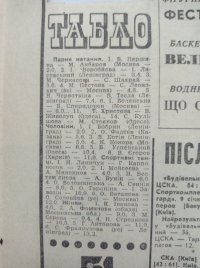
SCOREBOARD
Pair skating.
1. V. Pershina - M. Akbarov (Moscow) - 2.0. 2. I. Vorobyova - I. Lisovsky (Leningrad) - 3.4. 3. M. Cherkasova - S. Shakhrai - 3.6. 4. M. Pestova - S. Leonovich (all - Moscow) - 4.8. 5. N. Chervotkina - V. Teslya (Leningrad) - 7.4. 6. I. Volyanska - V. Spiridonov (Moscow) - 8.0 ... 11. T. Khristova - V. Zhivolup (Odesa) ... 14. S. Kulishova - M. Stoyanov (Odesa).
Men. 1. I. Bobrin (Leningrad) - 2.0. 2. O. Fadeev (Kazan) - 5.6. 3. V. Kotin (Leningrad) - 5.6. 4. K. Kokora (Moscow) - 6.8. 5. B. Uspensky (Odesa) - 10.4. 6. V. Egorov (Kharkiv) - 11.6.
Ice dancing.1. N. Linichuk - G. Karponosov - 2.0. 2. I. Moiseeva - A. Mynenkov - 4.0. 3. N. Bestemyanova - A. Bukin - 6.0. 4. O. Volozhinskaya - A. Svinin - 8.0. 5. E. Garanina - I. Zavozin - 10.0. 6. E. Batanova - A. Solovyov (all - Moscow) - 12.0.
Women. 1. K. Ivanova - 4.0, 2. A. Fomicheva (both - Moscow region) - 9.0, 3. M. Serova - 9.4, 4. N. Strelkova - 10.5, 5. G. Antonova - 11.0, 6. S. Frantsuzova (all - Leningrad) - 13.2.​
1753336336365.jpeg
1753336381777.jpeg
 
1981
USSR Figure Skating Championships

Business Card

VITALIY EGOROV

(KHARKIV)
(the article published in Ukrainian 'Sportyvna Hazeta' on January 13, 1981)
AMONG his peers - comrades in the USSR youth national team - he stands out for his prudence, poise. As the session with the famous hypnotist, where Vitaliy was brought by his coach Alexei Mishin, showed, it isn’t only the external impression. The experiment confirmed that Egorov is a very holistic nature, it is difficult to confuse him. Even in a hypnotic state, the figure skater refused to perform sports elements that he did not master well, and on the contrary, he clearly performed all his favorite exercises.
Unfortunately, so far the 16-year-old tenth grader of Kharkiv school 77 does not have such a rich arsenal of technical and especially choreographic means. But what is mastered is his forever, as they say.
Such fundamentality also has its drawbacks. Sometimes you have to work on a simple technique for months. However, in the end, all the costs pay off, and Mishin believes that this will be the case at the highest level, to which Egorov is currently preparing.
His sports experience is a whole decade. Coach Galina Melnikova spotted the blond boy in paid groups at the small skating rink "Pioneer", where Vitaliy began to practice thanks to the persistence of his parents - ardent sports enthusiasts. Outwardly similar to Sergei Volkov, he tries to imitate the ex-world champion in the impeccability of his "school" technique. Another idol is Yuri Ovchinnikov, who also studied with Mishin.
If we add to this that Vitaly is a diligent and tireless worker, it turns out that we will congratulate him more than once, as we did in March 1979. Then the Kharkiv native became the first Soviet figure skater to become the world junior champion.
Odesa (by phone).
(The original text of the article can be seen in the previous post)
 
1981
USSR Figure Skating Championships

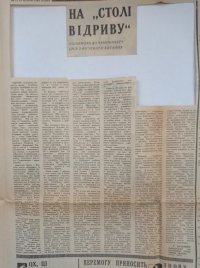
ON THE "BREAKAWAY TABLE"

A POSTSCRIPT TO THE USSR FIGURE SKATING CHAMPIONSHIP

(the article published in Ukrainian 'Sportyvna Hazeta' on January 15, 1981)

The Odessa еvent will occupy a special place among similar tournaments not even because they opened a new Olympic cycle. This is a merit of the calendar. The content of the competitions, which were marked by a wide offensive of young people, was unusual.
It may be argued that the post-Olympic USSR championships were almost always characterized by a generational change, the emergence of new figures on the pedestal. All this is true. But, as a rule, a mechanical process took place: some left the sport, others took their places. The Games for many masters become the ultimate goal of their careers, and after Lake Placid we also missed the leaders in two categories (Rodnina - Zaitsev and Kovalev). However, the charm of the current championship is that young people with open visors competed with eminent people who are in no hurry to cover their skates. Competed and won!
Watch: Kotin and Fadeev cleanly beat Kokora, a long-time member of the USSR national team, in single skating; 14-year-old Serova, who only made her debut among juniors a month ago, although she was limited to an overall third place in Odessa, wins the free program, having "jumped" the champion, the experienced Ivanova, by a long way. Ice dancers Bestemyanova - Bukin, Volozhinskaya - Svinin are pushing away the prize-winners of many European tournaments, Garanina and Zavozin, who have switched to a new coach - Tarasova and, it would seem, should count on a better life.
But today, exquisite technique and ballet training are not enough. Constant searching is needed. Of course, great discoveries are not made every day. But with such a jostling for the podium, with such a high level at which our leading figure skaters compete, even small, tiny discoveries are important. All our honored coaches are well aware of this, but those who are in the pursuit - preparing young or new students - realize it better in their work.
As you know, the biggest changes on the podium occurred in pair skating, although it was here (the only category!) that we did not see any truly promising newcomers. What's the point? After all, the victory of Cherkasova and Shakhrai at the 1980 World Championships in Dortmund seemed to answer the question of who would replace Rodnina and Zaitsev.
It has already been written about Marina's illness on the eve of the start. However, there are more serious reasons for the failure. Cherkasova is growing, reaching up, as if mocking those who were recently struck by the difference in the height of these partners, while Shakhrai has already completed his physical development. So it turns out that every season they have to perform lifts and twists differently, slightly changing their technology. This prevents polishing the program as a whole, looking for brighter colors in it.
In short, both the coach and the students knew that they would have a hard time in Odessa, because there was simply not enough time to complete the required amount of loads before the new year. Under these conditions Stanislav Zhuk was convinced of the victory of Pestova and Leonovich, who have both experience of responsible starts and perfectly master the complex program. However, this pair tried to achieve their goal with "little blood", skating too cautiously. Even the most experienced in this group - Vorobyova and Lisovsky - lost their nerves. But Zhuk's other wards - Pershina and Akbarov - did not lose their heads, confirming the glory of the CSKA school.
The new champions were distinguished primarily by their courage and ease in performing lifts. It is characteristic that the coach was at first even confused by this turn of events. And then he searched his file for an article published in Izvestia immediately after the 1980 World Championship, where Veronika and Marat made their debut. It turns out that a questionnaire was conducted in Dortmund among journalists and coaches, according to the results of which Pershina and Akbarov were named the most promising pair skating skaters on the planet... As for Cherkasova and Shakhrai, Stanislav Alekseevich has no doubts about their psychological stability and rapid restoration of fighting form.
After a long lull, the ice in the figure skaters' condition has been broken. In Odesa, we saw three athletes at once, who have several triple jumps and complex spins in their arsenal. Since all three - Serova, Antonova, Frantsuzova - are from Leningrad and train with Alexei Mishin and his wife Tatyana Mishina-Oleneva, it is worth listening to what the head of the school of the "Trud" society, Mishin, says about their training:
- We have learned to select talented girls and bring them to a masterly level for a long time. But then things went badly. And the girls trained a lot, and they mastered the triple technique thoroughly, but they could not perform stably, with a full set. Then I turned to the dancers for help.
The thing is that during classes they perform whole parts of compositions, while we break the program into small episodes. So it turns out that during competitions a high-class figure skater should perform 20 complex elements in 4 minutes (that is, five - every minute), while in training she does no more than one per minute. With such intensity, no amount of hours spent on the ice will be enough.
We had to condense the time, teach the girls to work in a mode of 6-7 elements per minute. And although we are working with such a system for the first season, the special physical training of the figure skaters has already noticeably improved, and their technique has stabilized. Thus, the foundation for further improvement became stronger.
It was not by chance that Alexey Mishin mentioned the experience of our dancers. Today, they set the tone in domestic figure skating, others emulate them. In most cases, participants who have completed the competition and have not been among the prize-winners, hurry home to continue their classes in the usual conditions. But almost no one left Odessa ahead of schedule, everyone wanted to watch the dancers' ball, which crowned the championship. Moreover, even the training sessions of the masters of sports dance gathered several hundred spectators, not to mention the specialists and representatives of single and pair skating.
Such authority is fully deserved. It is worth observing how Olympic champions Linichuk and Karponosov maintain their regime, with what dedication they use every minute on the ice and at the ballet stage, how meticulous they are about the details of the costume and musical design, in order to understand how much work, nerves, and sometimes tears are hidden behind the tenderness, uniqueness, and winged lightness of their dance.
Champions are very demanding of themselves. Otherwise, they will not be able to stay on Olympus. Literally next to them are Moiseeva and Minenkov, who are clearly experiencing a new creative upsurge. The pairs Bestemyanova - Bukin, Volozhinskaya - Svinin, Batanova - Antonov, Klimova - Ponomarenko are progressing rapidly. When a correspondent for Odessa Television asked Viktor Ryzhkin, one of the founders of ice dance sports in the USSR, what the secret of such a rapid growth in the skills of the young people was, he did not hesitate:
- The attractiveness of the new generation of dancers lies in the equality of partners, their equally high artistic and technical culture. Until recently, there were few such duets. Breeders limited themselves to selecting a beautiful female partner and a slender, tall male partner who only highlighted her performance. Now they dance (they dance!) together, and this has greatly enriched the palette of the discipline revealing its previously unseen possibilities, especially in choreography and performance art. A sign of the times is the significant influx of ballet masters into figure skating. Together with the coaches, they become the main figures in the training of international-level masters.
The programs (especially the short ones) demonstrated by the male singles at the championship were distinguished by great artistic taste and integrity of design. In this category, the beneficial influence of the directors is also felt, although repetitions are also noticeable. Yes, some of the young skaters are too openly copying artistic techniques from Igor Bobrin's programs. Almost every second one shoots a bow, conducts, and sends fairy-tale lightning bolts at the audience. But this "disease" is easily treated.
Another thing that worries me is insufficient physical training. After Lake Placid, Cousins' coach Carlo Fassi said that it is precisely the lack of endurance that prevents our skaters from fully realizing what they are capable of on the ice. Unfortunately, there has been little improvement here so far. Only Kotin and Fadeev boldly jump to the end, not afraid of falling. But Kokora, Egorov, even Bobrin in the last minutes of the performance because of this replace triple jumps with other, more accessible ones. The judges notice this and punish the athletes. After all, the instructions of the International Skating Union state that an unsuccessful attempt is penalized less than a refusal to do so. All skaters should remember this firmly. The current tournament was a kind of "breakout table" for them, like ski jumpers from a springboard. Now the best of them are going on a "flight" to the European and world championships, and a lot of responsibility should not throw anyone off balance.
The skaters of our republic were represented quite widely at the Odesa event. The assessment of their performance is ambiguous. The male singles were pleased and at the same time the female singles "failed". Due to the illness of their female partner, last year's USSR champions in ice dances, Karamysheva and Sinitsyn, did not perform. The sports couples turned out to be helpless.
However, criticizing our leaders is too easy a way out. After all, it is not their fault that today they are the strongest in the republic. I want to blame the coaches. Even in Odessa, where excellent conditions have been created for classes with children and they successfully work with young people, they still do not know how to bring the matter to its logical conclusion. Obviously, it is not enough to just imitate the experience of advanced schools. We should, without complacency, look for our own ways. As Stanislav Zhuk said: “Improvise, based on the accumulated knowledge, experience and the material from which you dream of sculpting a champion.”​
G. KUZMIN,
special correspondent for “Sportyvna Hazeta”.

Odesa-Kyiv
1753373981208.jpeg
 
1981
USSR Figure Skating Championships

Business Card

VITALIY EGOROV

(KHARKIV)
(the article published in Ukrainian 'Sportyvna Hazeta' on January 13, 1981)
AMONG his peers - comrades in the USSR youth national team - he stands out for his prudence, poise. As the session with the famous hypnotist, where Vitaliy was brought by his coach Alexei Mishin, showed, it isn’t only the external impression. The experiment confirmed that Egorov is a very holistic nature, it is difficult to confuse him. Even in a hypnotic state, the figure skater refused to perform sports elements that he did not master well, and on the contrary, he clearly performed all his favorite exercises.
Unfortunately, so far the 16-year-old tenth grader of Kharkiv school 77 does not have such a rich arsenal of technical and especially choreographic means. But what is mastered is his forever, as they say.
Such fundamentality also has its drawbacks. Sometimes you have to work on a simple technique for months. However, in the end, all the costs pay off, and Mishin believes that this will be the case at the highest level, to which Egorov is currently preparing.
His sports experience is a whole decade. Coach Galina Melnikova spotted the blond boy in paid groups at the small skating rink "Pioneer", where Vitaliy began to practice thanks to the persistence of his parents - ardent sports enthusiasts. Outwardly similar to Sergei Volkov, he tries to imitate the ex-world champion in the impeccability of his "school" technique. Another idol is Yuri Ovchinnikov, who also studied with Mishin.
If we add to this that Vitaly is a diligent and tireless worker, it turns out that we will congratulate him more than once, as we did in March 1979. Then the Kharkiv native became the first Soviet figure skater to become the world junior champion.
Odesa (by phone).
(The original text of the article can be seen in the previous post)
Interesting experiment, and safer than using drugs! But while learning self-hypnosis can help with stage fright/competition nerves, it's true that you can't be persuaded under hypnosis to do something you know is dangerous. (My mother was an adolescent psychologist and professor of psychology, and taught self-hypnosis to some patients if needed. I used to volunteer as an example when she covered the topic at UBC.)
 
1981
AT THE BEGINNING OF THE PATH

(the article published in Ukrainian 'Sportyvna Hazeta' on January 22, 1981)

- WE ARE HAPPY that Soviet specialists are helping our skaters in a difficult time for them, when they are taking their first steps in a relatively new sport for them, - said the coach of Finnish figure skaters Annu-Liisa Wattila. - The first to come to Finland to share experience was Viktor Kudryavtsev. We learned a lot of useful things from the lessons of Igor Moskvin, who came to replace him. And how effective were the joint trainings of our skaters with your masters Igor Bobrin, Vladimir Kotin, Kira Ivanova!
The Finnish coach expressed gratitude to the coaches and athletes from the Soviet Union for the help they provided. “It was especially useful now, when Finnish boys and girls became interested in figure skating. They come to our rink from gymnastics, ice hockey, athletics ... ", - says Wattila.
30-year-old Annu-Liisa herself is a relatively new person in figure skating. She took up the new sport for herself only a few years ago, having come from gymnastics. And she brought with her several gymnasts, her former students, who also "got sick" with figure skating. That's where Finnish figure skaters get their plasticity and flexibility from. For example, Anna Jaskelainen loves to perform the "Biеllman pirouette", which is accessible to few.
- Figure skating in Finland is only taking its first steps, - says Wattila. - We have to fight for the ice with representatives of ice hockey and bandy, speed skaters. But things seem to have picked up. If four years ago the number of people who were fond of figure skating in our country was in the hundreds, now there are several thousands of them. For a country with a population of four million, that is not so little...
Annu-Liisa's students have already achieved their first successes: Jaskelainen led the way at the last Nordic Championships. Lotta Isaksson was second. The coach has a girl in mind who, she says, has a future. Now Wattila wants to help her students “shoot” more often in important tournaments. “That is why the tournament for the prizes of the newspaper “Moskovskie Novosti” is so important for us, and we are grateful to the organizers for the invitation,” the Finnish coach says in conclusion.​
Y. SALOMAKHIN,
correspondent TASS.
1753442647196.jpeg
 
1981
"FROM "A" TO "Z" - MY HELP" -

the game "Sportloto" could rightly say

(the article published in Ukrainian 'Sportyvna Hazeta' on January 31, 1981)

This was the main surprise of the recent All-Union Championship in Odesa: 14-year-old Veronika and 19-year-old Marat won in pair skating, ahead of a large group of much more experienced rivals led by world champions Marina Cherkasova - Sergey Shakhrai.

The path to figure skating began with Veronika - eight, and Marat - eleven years ago. Both of them are from Sverdlovsk, where this sport has long gained wide popularity. However, the conditions for practicing in the open air in winter, even on artificial ice, clearly did not meet modern requirements. Everything changed in 1974, when the Palace of Sports "Yunost" appeared in the largest city of the Urals, built with the help of funds "Sportloto".
It was on its basis that a specialized school for figure skaters was opened under the leadership of Igor Ksenofontov. Pershina and Akbarov soon became students. Their direct coach, Volodymyr Zakharov, was famous for his ability to determine the future "profession" of his charge faster than other colleagues. And where, if not on the ice, are the reserves of young people revealed, their potential! Twice a day, the Sverdlovsk residents got on their skates, and their teachers, mentally thanking "Sportloto", spared no effort in searching for talents.
Small in stature, Veronika was distinguished by both courage and stubbornness. When a difficult element did not work out, she would secretly stay after training and learn it in the semi-darkness, until she fell into the arms of ... a guard.
The sensible, balanced Marat, already as a teenager, surpassed many of his friends in technique and physical strength. Today it seems quite natural that Zakharov paired them. At the time, his colleagues did not welcome such a decision: they said, you are losing two promising single skaters.
- But the coach's calculation was accurate. After just three years of joint training, Pershina and Akbarov became world junior champions. "Their technique and speed are such," wrote the newspapers of West Germany, where the 1979 championship was held, "that it seems that the dark-haired hero and the tiny brown-haired girl have been on skates since birth" ...
However, the pair lacked the complexity and variety of the program, and together with the coach they moved to the CSKA school to the famous specialist Stanislav Zhuk.
In winter, CSKA army training sessions are held on a rather old skating rink. However, just two seasons ago it was radically reconstructed, in particular, new refrigeration equipment was installed. And here the important word was spoken again by "Sportloto". Even in the summer, when going to a sports camp near Sukhumi, Stanislav Zhuk's figure skaters, perhaps without knowing it, fell under the wing of the sports and numerical lottery, the deductions from which contributed to the emergence of a wonderful medical and rehabilitation complex, games and gymnastics halls.
Well, the happiest place for Veronika and Marat was the ice of the Odesa Palace of Sports, where they were proclaimed USSR senior champions on January 8, 1981. It was on the ice made of Black Sea water that the last stage of training before the debut, which turned into a triumph, took place.
Meanwhile, the Odesa Palace of Sports is almost a hundred percent the brainchild of "Sportloto". Built five years ago, it immediately became a favorite among Moscow and Leningrad figure skaters. And it's not just about the hospitality of Odesans, their passionate love for winged skate masters. The funders didn't skimp on the base, and next to the Palace, a full-length skating rink without spectator seats for training grew up, which works on the same refrigeration machines. The project of a rehabilitation center with a hotel is also being implemented, which will become an integral part of the entire complex.
It is therefore not surprising that in the last four years the USSR championship has been held in Odessa for the second time, that each tournament reveals interesting names here, and often these are young local athletes; that our best masters consider the city on the Black Sea a happy starting point for the busy international season. Odesa ice became memorable for Veronika Pershina - Marat Akbarov. All figure skating fans, all supporters of the interesting and good game "Sportloto" wish them new successes, scores of "6.0".​
Y. MAR'YANCHENKO.
1753448527586.jpeg
 
1981
European Figure Skating Championships

A WEEK OF MYSTERIES

(the article published in Ukrainian 'Sportyvna Hazeta' on February 3, 1981)

Prior to the OPENING of the EUROPEAN FIGURE SKATING CHAMPIONSHIPS

It is usually easier to make predictions in figure skating than in most other sports. The high authority of the leaders, combined with the conservatism of the judges; the peculiarity of the rules, according to which participants are not necessarily punished for falling in the free program (the main thing is not to disturb the general pattern of the program, to perform a sufficient number of ultra-c) - all this somewhat protects the favorites from disappointments, and lovers of predictions - from mistakes. But the predictions regarding the results of the 73rd European Championships in Innsbruck (Austria) are almost in a complete fog ...
After Lake Placid, vacant places appeared on the pedestals. By tradition, some of the famous hung up their skates. This process is typical for the beginning of each Olympic cycle. However, last year, the departure of the “stars” from the ice was especially massive: Irina Rodnina and Alexander Zaitsev, all the prize-winners in single skating among men and women (except for the champion Anett Poetszch (from the GDR), dancers from Hungary Regoesczy/Sallay (“silver” at the Games-80). Some of the closest people could not stand the long wait on the verge of medals. In short, there are vacancies. In addition, the autumn international tournaments, the championships of the USSR and the GDR not only did not clarify the situation, but also confused it a little.
Look: at the start of the season, world champions 1980 Marina Cherkasova and Sergey Shakhrai lost, Poetszch and her compatriots - representatives of pair skating Mager - Beversdorf, Baess - Thierbach - did not perform for a long time due to injuries, Frenchman Simon was ill. At the same time, the Czech Sabovčyk, who was little known to the referees, our Fadeev and Kotin, Pershina - Akbarov, and 15-year-old pupil of Jutta Muller Katarina Witt loudly declared themselves. If we add to this list Bobrin (USSR), the Swiss Biellmann, the expansive Dubravčić from Yugoslavia, the English dancers - all those who have been successfully moving forward for a long time, it becomes clear how many mysteries the judges, the spectators, and the participants themselves will have to solve in Innsbruck.
It is very important to seize the team heights right now. Practice shows that the winners of the European and world championships in the post-Olympic year become the main contenders for the “gold” of the next Olympics. And if we take the list of prize-winners of both competitions, then a future “Olympian” has always been among them with a 100% guarantee. So you can imagine the intensity of the struggle that will unfold on the ice of Innsbruck.
Changes in the rules of judging will also make adjustments. And quite significant ones, since a mistake at each stage will definitely affect the finish. From now on, it is not enough to be an excellent student at "school", perform three or four different triple jumps or charm with choreography. Preference is given to stable all-rounders. It is they who will receive awards.
The USSR national team included Linichuk - Karponosov, Moiseeva - Minenkov, Bestemyanova - Bukin (ice dancing); Cherkasova - Shakhrai, Vorobyova - Lisovsky, Pershina - Akbarov (pair skating); singles - Ivanova, Bobrin, Fadeev and Kotin. The last two are debutants, and the most titled are Olympic champions Natalia Linichuk and Gennady Karponosov.
On February 4th, the pairs’ relationship will be revealed, the next day - the men, then the dancers will pick up the baton, and the women's performances will complete the sports part of the program. On February 8th - the laureates' concert.
Although the only contender for a medal from the host country is Claudia Kristofics-Binder (her international experience is 7 years), all tickets for the competition have long been sold out. Even the prices did not stop figure skating enthusiasts: from 5 to 25 dollars per evening. And for those who dare to buy a subscription, a week of mysteries will cost a thousand shillings (about 80 dollars).​
G. KUZMIN.
1753506301448.jpeg
 
1981
European Figure Skating Championships

PERSONALITIES AND PERFORMERS

(the article published in Ukrainian 'Sportyvna Hazeta' on February 5, 1981)

INNSBRUCK. After the short program, the leadership among pairs at the European Figure Skating Championships was taken by Soviet masters Irina Vorobyova and Igor Lisovsky, in second position - world champions Marina Cherkasova and Sergey Shakhrai, third place went to the West German pair Christina Riegel and Andreas Nischwitz. Young USSR champions Veronika Pershina and Marat Akbarov are currently fourth.
The men competed for awards in compulsory exercises. After performing three figures, the Frenchman Jean-Christophe Simon received a small gold medal. USSR champion Igor Bobrin won the "silver". In third place was Herman Schulz from the GDR. It was not an easy start for the debutants of the European Championship, Vladimir Kotin and Alexander Fadeev. After the "school", they occupy eighth and ninth places. After the short program, Bobrin retained second position, while Schulz and Simon swapped places.

CURIOUS, but a fact: for the seventh time in the last three seasons, Marina Cherkasova has drawn the first starting number during the draw. Last year, the partners had already “changed hands”, but Sergey Shakhrai also failed to avoid the “unit”. And so history repeated itself ... Our most experienced pair skated without mistakes, but a little cautiously, and the judges did not give them higher than 5.6 points. The best - 5.7 - were found by Vorobyova and Lisovsky. However, it is known that Irina lacks stability in jumping and it will be difficult for an experienced duo to maintain such a high position.​
In the absence of the best pairs from the GDR due to injuries, the main rivals of our athletes were Christina Riegel and Andreas Nischwitz (West Germany). Many years of experience in the international arena allow them to quite realistically claim one of the awards.
It is worrying that only six couples are competing in the competition. Not only was there a change of generations in several teams, but also a big difference in class between the leaders and the representatives of the second echelon. Western coaches will have to seriously reconsider the methods of training pairs if they want to compete with their colleagues from the USSR and the GDR in the foreseeable future.
In the men's category, those who will replace the heroes of last year's Olympic season on the podium have been determined. Since we have already written about Igor Bobrin more than once, it is appropriate to tell a little about the championship leader, the Frenchman Simon, and the 20-year-old Schulz from the GDR, who is in third place after school.
Jean-Christophe Simon spent the summer and autumn in Colorado Springs (USA), where he trained under the guidance of the famous coach Carlo Fassi. In November, he won the international tournament in the Hague. Then he took a time-out due to an injury, and this year he became the French champion for the fifth time. Simon has a full set of triple jumps, has extensive international experience. Previously, he lacked endurance, and most importantly, confidence. As Fassi told reporters, he and Simon did not learn any new things. They simply polished what they had already mastered, worked on strength, and a clear exit after the jumps.
- I am determined, - said 20-year-old Jean-Christophe before going out on the ice. I dream of continuing the winning traditions of my predecessors Gilletti and Calma.
And here is how his compatriot, world champion-80 Jan Hoffmann, commented on the victory in the GDR championship of Hermann Schulz.
- I came to Karl-Marx-Stadt specifically to see our change. After all, besides me, Liebers, who was seventh at the European Championship last year, stopped performing. I liked Schulz, although rumors spread in the fall that he would also hang up his skates. Previously, Hermann could only boast of high triple jumps, now he has made clear progress in choreographic training. His skating has become plastic, spectacularly attractive. Only a short experience of international performances can prevent Hermann from climbing the podium in Innsbruck.​
G. KUZMIN
1753510283008.jpeg
 
1981
European Figure Skating Championships

"GOLD" IS POURED

(the article published in Ukrainian 'Sportyvna Hazeta' on February 7, 1981)

Iryna Vorobyova – Igor Lisovsky in pair skating, Igor Bobrin - in singles - became European champions in 1981.

INJURY and illness did not allow Marina Cherkasova and Sergey Shakhrai to skate at high speed, to dance with full dedication ...

However, the leadership was preserved. The couple from Leningrad I. Vorobyova - I. Lisovsky, having shown high fighting qualities in a difficult situation, won the highest awards. "Bronze" - M. Cherkasova with S. Shakhrai, V. Pershin with M. Akbarov - fifth.
Leningrader Igor Bobrin performed brilliantly. In competition with four approximately equal rivals, he demonstrated versatile, emotional skating and deservedly became the champion. "Silver" - Frenchman J.-Ch. Simon, "bronze" - N. Schramm (Germany). Our debutant V. Kotin - sixth, O. Fadeev - in ninth place.​
(TASS).
1753529136746.jpeg
 
1981
European Figure Skating Championships

CHANGING OF THE GUARD

(the article published in Ukrainian 'Sportyvna Hazeta' on February 10, 1981)

EUROPEAN FIGURE SKATING CHAMPIONSHIPS

A complete change of all winners was marked at the continental championships in Innsbruck, which ended last Sunday. The English Jayne Torvill - Christopher Dean won in the dances, and Denise Biellmann from Switzerland clearly dominated in the women's singles. Irina Moiseeva - Andrey Minenkov became second in the ice dancing, Natalia Linichuk – Gennady Karponosov - third. Kira Ivanova's seventh place will allow our team to field two participants in single skating next year.
So, the USSR team reaped the harvest of 2 gold, silver and 2 bronze medals. None of the other 17 national teams managed to even come close to such a result. But there were also disappointments. If it is difficult to blame our famous dancers for losing the "gold": according to Lyudmila Pakhomova and other experts, the judges were too biased, then the pairs M. Cherkasova - S. Shakhrai, V. Pershina - M. Akbarov performed worse than expected. Let's hope that in four weeks at the world championship in Hartford (USA), Zhuk's students, despite greater competition, will rectify the situation.
As the Austrian press notes, the hero of the tournament should be Igor Bobrin, the 27-year-old figure skater has achieved a harmonious combination of plasticity with high technique, stage skills with excellent physical training. The "king" of the show performances has also become the king of the championship, the newspapers write.​
(TASS).
1753531014860.jpeg
 
Back
Top