- Joined
- Nov 30, 2016
1980
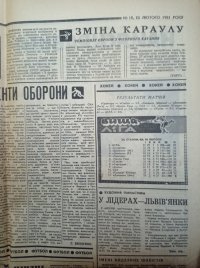
FIGURE SKATING
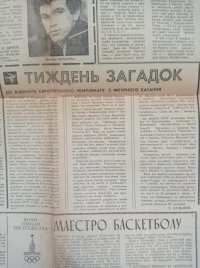
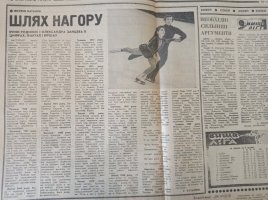
OF IRINA RODNINA AND ALEXANDR ZAITSEV IN FIGURES, FACTS AND POEMS
FIGURE SKATING
THE WAY UP
OF IRINA RODNINA AND ALEXANDR ZAITSEV IN FIGURES, FACTS AND POEMS
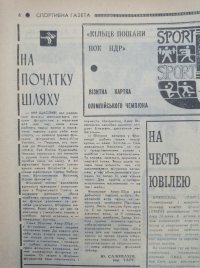
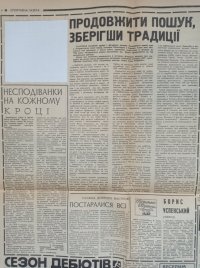
(the article published in Ukrainian 'Sportyvna Hazeta' on December 6, 1980)
NEXT Sunday they will say goodbye to the great sport. They will dance the legendary "Kalinka", - and all.
They will leave the ice arena forever, covered with the glory of the best skaters of our time. Let's remember together what their way up was.
February 1958. The sickly 8-year-old Irochka Rodnina was brought by her parents to the skating rink at the Young Pioneers Stadium. There were no ambitious thoughts. They simply wanted to improve her health. Brother and sister Elena and Alexei Ulanov were already practicing in the section at the same rink. That's how Irina met her first partner. Their passion for skating soon led them both to the CSKA school.
May 1966. That's how long it took Rodnina and Ulanov to get their "secondary education" and team up. Coach Stanislav Zhuk singled them out for their courage and ambition.
November 1967. Debut on the big ice. The judges and participants of the Moscow Open Championship, where all our best masters competed, were stunned by the complexity of the novices' program and the speed at which the record elements were performed. Of course, there were some mistakes. However, the coaching council did not hesitate to include Rodnina and Ulanov in the USSR national team. And although they did not make it to the 68 Olympics, their baptism of fire at the European Championships a month earlier gave the duo confidence.
February 1969. They are European champions! Here is what Sovetsky Sport wrote on February 7: “It is not customary to say about figure skaters: they accomplished a feat. But judge for yourself: 19-year-old Irina and 21-year-old Alexey, starting at the European Championship for only the second time, managed to outdo the entire world elite. They skated their unique in complexity free program at excellent speed, boldly and temperamentally. It was a fusion of grace and courage. The judges, with rare unanimity, gave them scores of 5.8 and 5.9 points. I would like to hope that today on the ice of Garmisch-Partenkirchen (Germany) the “star” of a new wonderful couple has risen, both participants of which have just been awarded the title of Honored Masters of Sports.”
February 1972. Having won all the European and world championships of the inter-Olympic cycle, Rodnina and Ulanov also became first in Sapporo. But that was their last joint performance. Alexey married Lyudmila Smirnova and began dancing with her ...
October 1960. Among the newcomers to the figure skating section of Leningrad coach O. Davydenko, 8-year-old Sashko Zaitsev did not stand out in anything, except for his increased sociability, although it is difficult to impress with this quality in a children's company. We did not accidentally deviate from the chronology. After all, it was Zaitsev, then already a singles skater from the top ten of the All-Union, that Stanislav Zhuk would look at eleven and a half years later when he was looking for a partner for Irina. And not the least role in that choice was played by Aleksandr's generous nature towards friendship, his great contact.
May 1972. The time of the birth of a new pair. A pair destined to set a unique record in figure skating. Irina Rodnina and Alexandr Zaitsev did not suffer a single defeat during their joint performances! They were only the first!
February 1973. The first European victory in the new combination. The surprise of experts, journalists, and spectators was perhaps best conveyed by the newspaper "Rude Pravo": "We met a new couple, and in them - a new Rodnina. The same impeccable technique, crazy pace, ultra-c cascades, and the character of the dance is different: firmer, more purposeful. Rodnina sets the tone in it, she is the leader, and this gives her skill still unknown colors."
February 1976. The Olympic history of figure skating has never known such an advantage of champions over other participants as Rodnina and Zaitsev achieved in Innsbruck. And the point is not so much in the numerical indicators, but in the skating itself, which Irina and Alexandr professed. Under the guidance of coach Tatyana Tarasova, they proved that it is possible to harmoniously combine filigree technique, speed, complexity with high choreography, attractive musical pattern. So the victory was achieved at a new qualitative level. The champions showed others which path in the development of figure skating is the most fruitful, the most promising.
February 1979. February again... The attentive reader has already noticed that this winter month is the happiest for Irina. On the 23rd, she and Alexandr had a son, Alexandr Zaitsev Jr. But on the horizon are the Winter Games in Lake Placid. Who will stand in for the champions?
March 1979. They decided that they would stand up for themselves. Four weeks after giving birth, Irina went to her first training session – cross-country. After another month and a half, she returned to the ice.
January 1980. The Swedish city of Gothenburg hosts the next European Championship. Irina and Alexandr are back on the horse. Comment by English figure skater John Curry, gold medalist of Games-76: "I believe the most important feature of Rodnina and Zaitsev's skill is that there is nothing superfluous in their program, everything is in its place. The break did not make itself felt at all. On the contrary, the external pattern of the dance became even more spectacular."
February 1980. Neither native walls, nor a pre-planned psychological attack, nor pressure on the judges - nothing helped the Americans Babilonia and Gardner in the fight for the Olympic title with our masters. When the time for the match struck, the Americans simply threw up the white flag. The Lake Placid Games were another triumph for Rodnina and Zaitsev. They brought Irina her twenty-fourth and Alexandr his fifteenth gold medal as European, world and Olympic champions. And yet, on the podium, as the poet said:
"An anthem is playing.
About the most important thing
You can't say it in a single phrase.
And on the screen in close-up
eyes of Irina Rodnina,
Threefold ... And not by chance
a tear slowly falls.
It has not become a secret for anyone,
what were those eyes saying..."
March 1980. They did not start at the World Championships in Dortmund. They came there to pass the glorious baton to their descendants – Marina Cherkasova and Sergey Shakhrai.
April 1980. By decree of the Presidium of the Supreme Soviet of the USSR dated April 9, for high sporting achievements at the XIII Winter Games, the holder of the Orders of Lenin and the Red Banner of Labor, Irina Konstantinovna Rodnina, was awarded the second Order of the Red Banner of Labor, and Alexandr Gennadievich Zaitsev was awarded the same award for the second time.
May 1980. The Finnish newspaper "Helsingin Sanomat" wrote: "In the chronicle of figure skating, Irina Rodnina remains a unique phenomenon. She dominated the ice for 11 years, during which she won all possible prizes and titles. Fate severely tested her: a change of partner, coach, a long break under the curtains of her career, associated with the birth of her son... Rodnina overcame everything. And we are grateful to her not for the medals, but first of all, for the greatness of the spirit, for the character of a fearless fighter.”
On December 14, they will dance in front of the audience for the last time. Let's not forget to turn on the TVs ...
G. KUZMIN.
They will leave the ice arena forever, covered with the glory of the best skaters of our time. Let's remember together what their way up was.
February 1958. The sickly 8-year-old Irochka Rodnina was brought by her parents to the skating rink at the Young Pioneers Stadium. There were no ambitious thoughts. They simply wanted to improve her health. Brother and sister Elena and Alexei Ulanov were already practicing in the section at the same rink. That's how Irina met her first partner. Their passion for skating soon led them both to the CSKA school.
May 1966. That's how long it took Rodnina and Ulanov to get their "secondary education" and team up. Coach Stanislav Zhuk singled them out for their courage and ambition.
November 1967. Debut on the big ice. The judges and participants of the Moscow Open Championship, where all our best masters competed, were stunned by the complexity of the novices' program and the speed at which the record elements were performed. Of course, there were some mistakes. However, the coaching council did not hesitate to include Rodnina and Ulanov in the USSR national team. And although they did not make it to the 68 Olympics, their baptism of fire at the European Championships a month earlier gave the duo confidence.
February 1969. They are European champions! Here is what Sovetsky Sport wrote on February 7: “It is not customary to say about figure skaters: they accomplished a feat. But judge for yourself: 19-year-old Irina and 21-year-old Alexey, starting at the European Championship for only the second time, managed to outdo the entire world elite. They skated their unique in complexity free program at excellent speed, boldly and temperamentally. It was a fusion of grace and courage. The judges, with rare unanimity, gave them scores of 5.8 and 5.9 points. I would like to hope that today on the ice of Garmisch-Partenkirchen (Germany) the “star” of a new wonderful couple has risen, both participants of which have just been awarded the title of Honored Masters of Sports.”
February 1972. Having won all the European and world championships of the inter-Olympic cycle, Rodnina and Ulanov also became first in Sapporo. But that was their last joint performance. Alexey married Lyudmila Smirnova and began dancing with her ...
October 1960. Among the newcomers to the figure skating section of Leningrad coach O. Davydenko, 8-year-old Sashko Zaitsev did not stand out in anything, except for his increased sociability, although it is difficult to impress with this quality in a children's company. We did not accidentally deviate from the chronology. After all, it was Zaitsev, then already a singles skater from the top ten of the All-Union, that Stanislav Zhuk would look at eleven and a half years later when he was looking for a partner for Irina. And not the least role in that choice was played by Aleksandr's generous nature towards friendship, his great contact.
May 1972. The time of the birth of a new pair. A pair destined to set a unique record in figure skating. Irina Rodnina and Alexandr Zaitsev did not suffer a single defeat during their joint performances! They were only the first!
February 1973. The first European victory in the new combination. The surprise of experts, journalists, and spectators was perhaps best conveyed by the newspaper "Rude Pravo": "We met a new couple, and in them - a new Rodnina. The same impeccable technique, crazy pace, ultra-c cascades, and the character of the dance is different: firmer, more purposeful. Rodnina sets the tone in it, she is the leader, and this gives her skill still unknown colors."
February 1976. The Olympic history of figure skating has never known such an advantage of champions over other participants as Rodnina and Zaitsev achieved in Innsbruck. And the point is not so much in the numerical indicators, but in the skating itself, which Irina and Alexandr professed. Under the guidance of coach Tatyana Tarasova, they proved that it is possible to harmoniously combine filigree technique, speed, complexity with high choreography, attractive musical pattern. So the victory was achieved at a new qualitative level. The champions showed others which path in the development of figure skating is the most fruitful, the most promising.
February 1979. February again... The attentive reader has already noticed that this winter month is the happiest for Irina. On the 23rd, she and Alexandr had a son, Alexandr Zaitsev Jr. But on the horizon are the Winter Games in Lake Placid. Who will stand in for the champions?
March 1979. They decided that they would stand up for themselves. Four weeks after giving birth, Irina went to her first training session – cross-country. After another month and a half, she returned to the ice.
January 1980. The Swedish city of Gothenburg hosts the next European Championship. Irina and Alexandr are back on the horse. Comment by English figure skater John Curry, gold medalist of Games-76: "I believe the most important feature of Rodnina and Zaitsev's skill is that there is nothing superfluous in their program, everything is in its place. The break did not make itself felt at all. On the contrary, the external pattern of the dance became even more spectacular."
February 1980. Neither native walls, nor a pre-planned psychological attack, nor pressure on the judges - nothing helped the Americans Babilonia and Gardner in the fight for the Olympic title with our masters. When the time for the match struck, the Americans simply threw up the white flag. The Lake Placid Games were another triumph for Rodnina and Zaitsev. They brought Irina her twenty-fourth and Alexandr his fifteenth gold medal as European, world and Olympic champions. And yet, on the podium, as the poet said:
"An anthem is playing.
About the most important thing
You can't say it in a single phrase.
And on the screen in close-up
eyes of Irina Rodnina,
Threefold ... And not by chance
a tear slowly falls.
It has not become a secret for anyone,
what were those eyes saying..."
March 1980. They did not start at the World Championships in Dortmund. They came there to pass the glorious baton to their descendants – Marina Cherkasova and Sergey Shakhrai.
April 1980. By decree of the Presidium of the Supreme Soviet of the USSR dated April 9, for high sporting achievements at the XIII Winter Games, the holder of the Orders of Lenin and the Red Banner of Labor, Irina Konstantinovna Rodnina, was awarded the second Order of the Red Banner of Labor, and Alexandr Gennadievich Zaitsev was awarded the same award for the second time.
May 1980. The Finnish newspaper "Helsingin Sanomat" wrote: "In the chronicle of figure skating, Irina Rodnina remains a unique phenomenon. She dominated the ice for 11 years, during which she won all possible prizes and titles. Fate severely tested her: a change of partner, coach, a long break under the curtains of her career, associated with the birth of her son... Rodnina overcame everything. And we are grateful to her not for the medals, but first of all, for the greatness of the spirit, for the character of a fearless fighter.”
On December 14, they will dance in front of the audience for the last time. Let's not forget to turn on the TVs ...
G. KUZMIN.


 . We're a close-knit group where friendships last a long time
  . I was still in juniors when she was competing, but I heard about her from older pairs girls in Canadian rinks.