- Joined
- Nov 30, 2016
1983
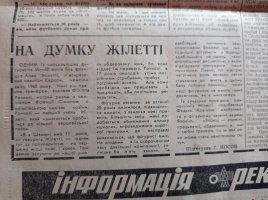
Match of the USSR's strongest figure skaters
Men. Compulsory program. 1. A. Fadeev — 0.6 points; 2. V. Kotin (both Moscow) — 1.2; 3. V. Egorov (Kharkiv) — 1.8; 4. B. Uspensky (Odesa) — 2.4; 5. G. Vardanyan (Moscow) — 3.0; 6. L. Kaznakov (Leningrad) — 3.6.
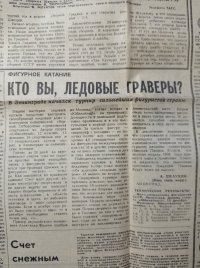
Match of the USSR's strongest figure skaters
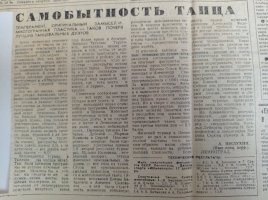
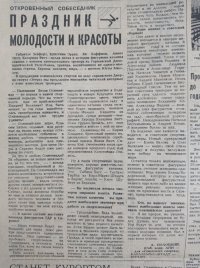
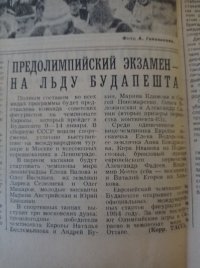
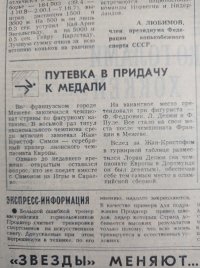
WHO ARE YOU, ICE ENGRAVERS?
(the article published in russian 'Sovetskiy Sport' on December 14, 1983)
(the article published in russian 'Sovetskiy Sport' on December 14, 1983)
A tournament of the country's strongest figure skaters has begun in Leningrad.
Our masters of "ice lace" must build a metaphorical "ice house" to frame the contours of the Olympic team. Qualifying competitions have kicked off at the Yubileyny Sports Palace. 12 men, 13 women, 16 pairs, and 15 ice dance duets are competing in Leningrad for Olympic berths.
Now, with 20 days to go before the European Championships, simple metrics no longer suffice—such as skater "X" having three triple jumps in their arsenal while skater "Y" has four. As the saying goes, man does not live by jumps alone! A different calculation is now at play: what is the athlete's level of artistry, and what objective are they aiming for? The focus of the struggle has shifted toward psychology and aesthetics, making it impossible to avoid the topic of reaching peak athletic form. While it was too early to speak of a peak in November, in December, it is time to dot the "i's."
European medalist Alexander Fadeev headed straight to the Yubileyny Sports Palace for training immediately after arriving from Moscow. The meticulous nature of his current preparation was evident from the very first day of competition. For his third figure—the "paragraph with loops"—he received scores almost entirely at the 4.0 level (the benchmark for international-class skaters). He also posted the highest scores of the day in other exercises, making him the overall leader of the competition.
Vladimir Kotin, the winner of a recent international tournament in Moscow, also proved to be a skilled "ice engraver" and moved into second place. The surprise of the tournament has to be the high scores achieved by 19-year-old Vitaly Egorov from Kharkiv. As a reminder, he was the World Junior Champion several years ago. During the first half of this season, he remained in the shadows. He later shone at a tournament in Tallinn, though he faced no major rivals there. Now, it seems, he planned his "main shot" for this Leningrad match. Egorov executed his patterns with great precision and took third place. It appears he is finally capable of intervening in the rivalry between our two leaders.
In conclusion, it should be emphasized that the competitions in Leningrad are dedicated to the memory of the first Olympic champion in figure skating, Leningrad’s own Nikolai Panin. Notably, his 1908 gold medal is now kept in the Hermitage. One hopes that the current successors to Panin's traditions will also rise to the occasion.
Our masters of "ice lace" must build a metaphorical "ice house" to frame the contours of the Olympic team. Qualifying competitions have kicked off at the Yubileyny Sports Palace. 12 men, 13 women, 16 pairs, and 15 ice dance duets are competing in Leningrad for Olympic berths.
Now, with 20 days to go before the European Championships, simple metrics no longer suffice—such as skater "X" having three triple jumps in their arsenal while skater "Y" has four. As the saying goes, man does not live by jumps alone! A different calculation is now at play: what is the athlete's level of artistry, and what objective are they aiming for? The focus of the struggle has shifted toward psychology and aesthetics, making it impossible to avoid the topic of reaching peak athletic form. While it was too early to speak of a peak in November, in December, it is time to dot the "i's."
European medalist Alexander Fadeev headed straight to the Yubileyny Sports Palace for training immediately after arriving from Moscow. The meticulous nature of his current preparation was evident from the very first day of competition. For his third figure—the "paragraph with loops"—he received scores almost entirely at the 4.0 level (the benchmark for international-class skaters). He also posted the highest scores of the day in other exercises, making him the overall leader of the competition.
Vladimir Kotin, the winner of a recent international tournament in Moscow, also proved to be a skilled "ice engraver" and moved into second place. The surprise of the tournament has to be the high scores achieved by 19-year-old Vitaly Egorov from Kharkiv. As a reminder, he was the World Junior Champion several years ago. During the first half of this season, he remained in the shadows. He later shone at a tournament in Tallinn, though he faced no major rivals there. Now, it seems, he planned his "main shot" for this Leningrad match. Egorov executed his patterns with great precision and took third place. It appears he is finally capable of intervening in the rivalry between our two leaders.
In conclusion, it should be emphasized that the competitions in Leningrad are dedicated to the memory of the first Olympic champion in figure skating, Leningrad’s own Nikolai Panin. Notably, his 1908 gold medal is now kept in the Hermitage. One hopes that the current successors to Panin's traditions will also rise to the occasion.
A. SHELUKHIN.
(Our Special Correspondent).
LENINGRAD.(Our Special Correspondent).
TECHNICAL RESULTS
Match of the USSR's strongest figure skaters. Leningrad. Yubileyny Sports Palace. December 13.Men. Compulsory program. 1. A. Fadeev — 0.6 points; 2. V. Kotin (both Moscow) — 1.2; 3. V. Egorov (Kharkiv) — 1.8; 4. B. Uspensky (Odesa) — 2.4; 5. G. Vardanyan (Moscow) — 3.0; 6. L. Kaznakov (Leningrad) — 3.6.
Last edited:


 . (And potentially dangerous too, of course, if she landed on him feet first!)