- Joined
- Nov 30, 2016
1986
CANDID INTERVIEWEE

CANDID INTERVIEWEE
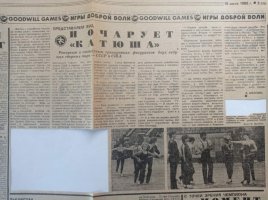
THE TALENT OF NATURALNESS, THE TALENT OF TRANSFORMATION
(the article published in russian 'Sovetskiy Sport' on May 17, 1986)
(the article published in russian 'Sovetskiy Sport' on May 17, 1986)
What was that? A performance where the game was preceded by a pre-game? However, I would not compare it to a warm-up before a performance. Everything was important, indispensable, inseparable from one another, though completely different. And then, after all, I remember perfectly—I remember from former times, when Gaby Seyfert, a young figure skater from the GDR, was not just a champion, but a figure symbolizing the modernity of sports life. She aroused intense interest the moment she barely touched the ice surface with her skate, like an artist touching a canvas. And even her warm-up before a performance was perceived as an anticipation of everything to come.
And yet, so many years after those triumphs, what I wanted most of all today was to imagine, to see Gaby in a new capacity—and not to surrender myself completely to the power of nostalgia for the unreturnable. We expected a continuation from Seyfert and, I will say right away, we were not deceived in our expectations.
What was that? Now I am firmly convinced that in just some hour and a half, I saw several different self-portraits of Gaby. Each was interesting in its own way, and each, what is most surprising, conveyed a talent for naturalness and a talent for transformation.
Now I understand that her current warm-up, just like in the years gone by, was a kind of commentary.
Or maybe a continuation of our conversation?
She conversed with me in the dressing room of the Small Sports Arena in Luzhniki, and in her form-fitting elastic wear, she looked like a speed skater ready for the start. And I expected a performance from her in a strictly sporting, or rather, a sports-memoir key—daring, on the verge of risk. But nothing of the sort: an actress stepped onto the ice, and the character dance in the persona of a cabaret singer, whose elegance stems from the naturalness of behavior, had nothing in common with my perception of the athlete Seyfert.
That evening, under the impression of what I had seen and heard, I felt as if I had attended an autobiographical performance by Gaby Seyfert—soloist of the 'Friedrichstadt-Palast,' multiple World and European champion, and Olympic silver medalist.
– Is there a noticeable difference between sporting success and artistic success?
- Does a difference between them even exist at all?..Yes, yes, you are right, of course, it exists. Although in the feeling of success, there is, of course, much, much in common. What is the difference then? An athlete trains with all their might for the sake of the main and, sometimes, the only moment in their life when they have a true chance to prove that they are the best in the world. Few achieve this goal. The rest are forced to stop competing without realizing their main dream. Yet both groups have to work, generally speaking, equally hard. It cannot be helped: complete happiness in sports falls to the lot of only a few.
An athlete's success is expressed in titles and medals. An artist's success is, above all, an immediate response in the hearts of the audience. Although an athlete is not indifferent to the audience's attitude toward them either. But an artist senses the audience's reaction every evening more professionally—jealously or, better to say, skillfully—after all, they draw the appropriate conclusions from it… An athlete, on the other hand, is forced to react much more sharply to the judges' scores.
- Figure skating competitions are also quite often called a performance. In your opinion, Gaby, is such a comparison justified?
- A competition is always a competition. There is nothing to compare it to. There is the absolute accuracy of the displayed result. True, a competition, just like a performance, always has its own plot. But a sports plot is, to a greater extent, new and unexpected. With a bit of a stretch, one could compare our exhibition performances, which always crown figure skating competitions, to a show.
- In artistic life, just like in sports, there is also its own competition, its own…
…struggle? And what a struggle it is! In a good sense of the word, the competition among artists does not seem any less sharp to me than that among contenders for a sports championship. In both fields, young rivals emerge, capable of asserting their rights by offering something new. It is not enough to remain at your previous level—even if it is quite high. It will still turn out to be painfully insufficient if someone else is now working better than you. If you cannot 'step it up,' as athletes say, it is better to leave entirely.
- What is the difference between the physical form of a figure skater and a soloist in an ice ballet?And yet, so many years after those triumphs, what I wanted most of all today was to imagine, to see Gaby in a new capacity—and not to surrender myself completely to the power of nostalgia for the unreturnable. We expected a continuation from Seyfert and, I will say right away, we were not deceived in our expectations.
What was that? Now I am firmly convinced that in just some hour and a half, I saw several different self-portraits of Gaby. Each was interesting in its own way, and each, what is most surprising, conveyed a talent for naturalness and a talent for transformation.
Now I understand that her current warm-up, just like in the years gone by, was a kind of commentary.
Or maybe a continuation of our conversation?
She conversed with me in the dressing room of the Small Sports Arena in Luzhniki, and in her form-fitting elastic wear, she looked like a speed skater ready for the start. And I expected a performance from her in a strictly sporting, or rather, a sports-memoir key—daring, on the verge of risk. But nothing of the sort: an actress stepped onto the ice, and the character dance in the persona of a cabaret singer, whose elegance stems from the naturalness of behavior, had nothing in common with my perception of the athlete Seyfert.
That evening, under the impression of what I had seen and heard, I felt as if I had attended an autobiographical performance by Gaby Seyfert—soloist of the 'Friedrichstadt-Palast,' multiple World and European champion, and Olympic silver medalist.
– Is there a noticeable difference between sporting success and artistic success?
- Does a difference between them even exist at all?..Yes, yes, you are right, of course, it exists. Although in the feeling of success, there is, of course, much, much in common. What is the difference then? An athlete trains with all their might for the sake of the main and, sometimes, the only moment in their life when they have a true chance to prove that they are the best in the world. Few achieve this goal. The rest are forced to stop competing without realizing their main dream. Yet both groups have to work, generally speaking, equally hard. It cannot be helped: complete happiness in sports falls to the lot of only a few.
An athlete's success is expressed in titles and medals. An artist's success is, above all, an immediate response in the hearts of the audience. Although an athlete is not indifferent to the audience's attitude toward them either. But an artist senses the audience's reaction every evening more professionally—jealously or, better to say, skillfully—after all, they draw the appropriate conclusions from it… An athlete, on the other hand, is forced to react much more sharply to the judges' scores.
- Figure skating competitions are also quite often called a performance. In your opinion, Gaby, is such a comparison justified?
- A competition is always a competition. There is nothing to compare it to. There is the absolute accuracy of the displayed result. True, a competition, just like a performance, always has its own plot. But a sports plot is, to a greater extent, new and unexpected. With a bit of a stretch, one could compare our exhibition performances, which always crown figure skating competitions, to a show.
- In artistic life, just like in sports, there is also its own competition, its own…
…struggle? And what a struggle it is! In a good sense of the word, the competition among artists does not seem any less sharp to me than that among contenders for a sports championship. In both fields, young rivals emerge, capable of asserting their rights by offering something new. It is not enough to remain at your previous level—even if it is quite high. It will still turn out to be painfully insufficient if someone else is now working better than you. If you cannot 'step it up,' as athletes say, it is better to leave entirely.
- The difference is very significant. When you train knowing that you have to perform at the World Championships in March, you do everything in your power to peak exactly in March. And not just in March, but on the very day your turn to take the ice falls. I must demonstrate the maximum of my will and everything I have for victory on that day, at that exact hour—not a minute earlier, not a minute later…
When performing on the ballet ice, however, I understand just as clearly that a success not achieved today has not left me forever. I still have a chance to achieve what I want tomorrow, or, in the worst-case scenario, the day after tomorrow. Therefore, the nervous tension of an athlete before the start is incomparable to anything else—there might be no tomorrow at all.
- You know sports life well and understand the psychology of an athlete. Why, in that case, did you not want to choose the profession of a coach?
- Simply because I do not like this profession, although I have tried my hand at coaching.
I have noticed time and again that at the most critical moments, the athlete is left on the ice all alone: they are the only one who knows how they feel right at that moment. Meanwhile, the coach has to stand and wait: at that second, the coach cannot influence what is happening in any way. Most likely, this kind of trial—I mean the coach's lot—is not for me.
On the other hand, in a director's role, I suppose I feel more confident. When I choreograph a dance at my Friedrichstadt-Palast as the leader of the figure skating group, I feel like I am exactly where I belong.
- How do you envision the future of ballet performances on ice?
- Right now, every ballet troupe has its own direction. For example, 'Holiday on Ice' and the Leningrad Ballet on Ice are very different from each other. Inventing new dances is difficult, but no other path to perfection has been found yet. There is no other way but to achieve an impressive effect in dance through technically complex skating elements, and above all, jumps. There is also no escaping the artistic search for the most spectacular costumes.
- And also, Gaby, I would like to hear your opinion on which of your successors on the podium appeals to you the most?
- ...Perhaps," Seifert thought for a moment, "Katarina Witt. What I especially like about Katarina is her strength and expressiveness. She is constantly searching for new means of expression for her program. In addition, her program is a combination of complex jumps and pirouettes.
As for modern women's singles skating in general... There are problems. Women are physically weaker than men, yet their program is built on the same highly complex elements. The beauty suffers from this concentration of difficulty, which is why we suffer irreplaceable losses in terms of showmanship.
- What emotions do you feel stepping onto the Luzhniki ice now?
- This ice reminds me of my first serious successes in figure skating. Here in Moscow, back in 1965, I made it into the top five at the European Championships. This current visit has also been extremely useful and important for me as the leader of the Friedrichstadt-Palast figure skating group.
…In the Leningrad State Ballet on Ice program 'In the World of Dance,' Gaby Seifert performed alongside the famous Soviet figure skaters Lyudmila Smirnova and Alexei Ulanov.
'Gaby has a sports character of extraordinary strength,' says Master of Sports of International Class Smirnova. 'It seems to me that she inherited this character from her mother and coach, Jutta Müller, who raised a whole constellation of brilliant GDR figure skaters.'
'I have always been struck by her athleticism, cheerfulness, and spontaneity,' admits Honored Master of Sports Ulanov. 'Her smile…'
When performing on the ballet ice, however, I understand just as clearly that a success not achieved today has not left me forever. I still have a chance to achieve what I want tomorrow, or, in the worst-case scenario, the day after tomorrow. Therefore, the nervous tension of an athlete before the start is incomparable to anything else—there might be no tomorrow at all.
- You know sports life well and understand the psychology of an athlete. Why, in that case, did you not want to choose the profession of a coach?
- Simply because I do not like this profession, although I have tried my hand at coaching.
I have noticed time and again that at the most critical moments, the athlete is left on the ice all alone: they are the only one who knows how they feel right at that moment. Meanwhile, the coach has to stand and wait: at that second, the coach cannot influence what is happening in any way. Most likely, this kind of trial—I mean the coach's lot—is not for me.
On the other hand, in a director's role, I suppose I feel more confident. When I choreograph a dance at my Friedrichstadt-Palast as the leader of the figure skating group, I feel like I am exactly where I belong.
- How do you envision the future of ballet performances on ice?
- Right now, every ballet troupe has its own direction. For example, 'Holiday on Ice' and the Leningrad Ballet on Ice are very different from each other. Inventing new dances is difficult, but no other path to perfection has been found yet. There is no other way but to achieve an impressive effect in dance through technically complex skating elements, and above all, jumps. There is also no escaping the artistic search for the most spectacular costumes.
- And also, Gaby, I would like to hear your opinion on which of your successors on the podium appeals to you the most?
- ...Perhaps," Seifert thought for a moment, "Katarina Witt. What I especially like about Katarina is her strength and expressiveness. She is constantly searching for new means of expression for her program. In addition, her program is a combination of complex jumps and pirouettes.
As for modern women's singles skating in general... There are problems. Women are physically weaker than men, yet their program is built on the same highly complex elements. The beauty suffers from this concentration of difficulty, which is why we suffer irreplaceable losses in terms of showmanship.
- What emotions do you feel stepping onto the Luzhniki ice now?
- This ice reminds me of my first serious successes in figure skating. Here in Moscow, back in 1965, I made it into the top five at the European Championships. This current visit has also been extremely useful and important for me as the leader of the Friedrichstadt-Palast figure skating group.
…In the Leningrad State Ballet on Ice program 'In the World of Dance,' Gaby Seifert performed alongside the famous Soviet figure skaters Lyudmila Smirnova and Alexei Ulanov.
'Gaby has a sports character of extraordinary strength,' says Master of Sports of International Class Smirnova. 'It seems to me that she inherited this character from her mother and coach, Jutta Müller, who raised a whole constellation of brilliant GDR figure skaters.'
'I have always been struck by her athleticism, cheerfulness, and spontaneity,' admits Honored Master of Sports Ulanov. 'Her smile…'
L. TRAKHTENBERG.