Archive of newspaper articles | Page 33 | Golden Skate

Archive of newspaper articles

1986
VECHERNYAYA ODESSA PRIZE JUNIOR INTERNATIONAL

FIGURE SKATING

(the article published in russian 'Sovetskiy Sport' on October 24, 1986)

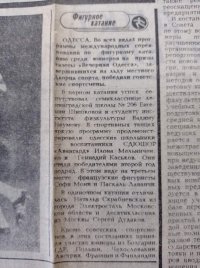
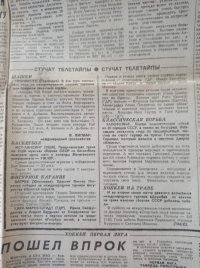
ODESA. Soviet athletes won in all disciplines of the international junior figure skating competition for the prizes of the "Vechernyaya Odessa" (Evening Odesa) newspaper, which concluded on the ice of the local Palace of Sports.
In pairs skating, success went to Evgenia Shishkova, a seventh-grade student from Leningrad school No. 206, and Vadim Naumov, a student at the Institute of Physical Education. In ice dance, a bright program was demonstrated by Odesa school students and trainees of the "Avangard" specialized children and youth sports school of Olympic reserve, Ilona Melnichenko and Gennady Kaskov. They became the winners for the second consecutive year. In this discipline, French figure skaters Sophie Moniotte and Pascal Lavanchy finished in third place.
In singles skating, Natalia Skrabnevskaya from the city of Elektrostal, Moscow Oblast, and Sergei Dudakov, a tenth-grade student from Moscow, distinguished themselves.
In addition to Soviet athletes, juniors from Bulgaria, the GDR, Poland, Czechoslovakia, Austria, France, and Finland participated in these competitions.
1783147804719.jpeg
 
1986
SKATE AMERICA
WE REPORT THE DETAILS


IT IS ALREADY CLEAR: THE SEASON WILL BE HOT

(the article published in russian 'Sovetskiy Sport' on October 28, 1986)

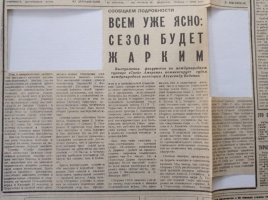
International judge Aleksandr Vedenin comments on the performances of figure skaters at the "Skate America" international tournament.

There is a very expressive ritual among American figure skating fans: after performances on the ice arena by outstanding athletes or performers of original compositions, all spectators rise from their seats and applaud enthusiastically. It was exactly this thrilling scene that we observed at the Palace of Sports in the American city of Portland (Maine) during the exhibition performances. Among the participants of the "Skate America" international tournament were athletes from 18 countries. But the 'headlining' routines were performed first and foremost by world champion Brian Boitano and Soviet figure skaters Viktor Petrenko and the sports pair Lyudmila Koblova and Andrey Kalitin. It was they who were greeted by the audience with a roaring ovation.
The "Skate America" tournament had several important sporting aspects. Many top skaters from Europe and America, who set the tone at the world championships, demonstrated their new compositions for the first time. Here, a test was undergone by figure skaters capable of securing spots on their national teams and competing at the Winter Olympic Games in Calgary. Finally, in Portland, the new trends of the starting winter season fully manifested themselves. Take a small example: European '85 bronze medalist G. Filipowski (Poland) showed the best version of his free program (he attempted to execute the most difficult axel in 3.5 rotations), and yet Gzegorz had to settle for only fourth place. The level of mastership among men was that high!
The central event was the duel between the world champion B. Boitano and our 17-year-old V. Petrenko. Last year, Viktor already competed at this tournament and was third. But this time, the figure skater from Odesa exceeded the expectations of specialists. It is fair to say that in the free skating, three judges gave Petrenko a 5.9 score for artistry, four other judges gave 5.8, and the same score went to Boitano.
Both masters left a bright impression in the short program. They managed to perform a unique element in the combination—a triple axel. Only a tiny fraction separated Petrenko from Boitano in the technical score. The fierce dispute continued in the free composition as well. Here, specialists noted the original compositional design in the program executed by Petrenko to the music of Khachaturian's ballet "Spartacus" (staged by Honored Coach of the USSR T. Tarasova). In the overall score, the trainee of Odesa coach G. Zmievskaya confidently took second place in the all-around event, which came as a pleasant surprise to the majority of experts. It must be noted that the audience at American rinks is very knowledgeable about the nuances of ice technique and choreography.
There was one more surprise in these competitions—the successful start of 19-year-old American D. Doran. His debut last year at the world championship brought him 8th place. But in Portland, Doran demonstrated a higher class in all three segments of the competition and confidently took third place, ahead of G. Filipowski and H. Fischer (FRG).
The US team has noticeably accelerated its preparation pace for the Winter Olympic Games. accelerated its training pace for the Winter Olympic Games. This manifested itself both in singles and pairs skating. Well-known coach John Nicks, who trained world champions T. Babilonia and R. Gardner, this time brought to the start a new duo—K. Keeley and J. Mero. A good technical arsenal and the entertainment value of the programs—all these qualities were fully present in Keeley and Mero, who won the tournament in Portland. Worthy competition was provided to them by our pair—A. Koblova and A. Kalitin, who possess a very beautiful, elegant style. In the short program, our masters were first. Only a lack of sufficient competitive experience and an unconfident execution of some elements did not allow them to maintain the lead.
The women's singles competition presented a special interest. We know that the US team currently possesses a large group of skaters of roughly equal class. World champion D. Thomas is preparing for the season (her first start is planned for the national championship). Meanwhile, in Portland, the host country was represented by world championship bronze medalist T. Chin. She has a rich history of performances, and even when not in her best athletic form, Tiffany Chin won confidently. But experts named 16-year-old US figure skater Tonya Harding as the brightest breakthrough of the competition. This was her debut in major international tournaments. But the young athlete, who possesses excellent natural talent, went through the tournament without errors. She was the strongest in the free program, executing all five types of triple jumps. In the height of her jumps, she is second to none of the men. And judging by everything, Tonya Harding will deliver more than one surprise in this Olympic cycle.
1783150739526.jpeg
 
1986
USSR TRADE UNIONS PRIZE INTERNATIONAL

AUTUMN SKETCHES

(the article published in russian 'Sovetskiy Sport' on October 31, 1986)

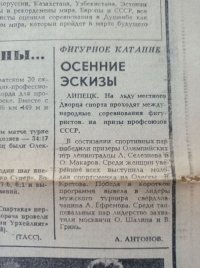
LIPETSK. International figure skating competitions for the prizes of the USSR trade unions are taking place on the ice of the local Palace of Sports.
In the pairs competition, the Olympic Games medalists L. Selezneva and O. Makarov from Leningrad won. Among women, a young athlete from Odesa, V. Kretova, performed more confidently than anyone else. Victory in the short program brought a native of Sverdlovsk, A. Efremov, into the lead of the men's tournament. Among ice dance couples, the leadership was seized by Muscovites O. Shalina and V. Grin.​
A. ANTONOV.
1783230042625.jpeg
 
Last edited:
1986
USSR TRADE UNIONS PRIZE INTERNATIONAL

FIGURE SKATING

(the article published in russian 'Sovetskiy Sport' on November 1, 1986)

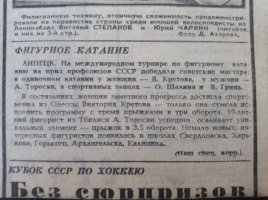
LIPETSK. At the international figure skating tournament for the prize of the USSR trade unions, Soviet masters won: in women's singles — V. Kretova, in men's — A. Torosyan, in ice dance — O. Shalina and V. Grin.
In the women's competition, notable progress was achieved by the athlete from Odesa, Viktoria Kretova — she was the only one who managed to perform a program with three triple jumps. The 19-year-old figure skater from Tbilisi, A. Torosyan, is successfully mastering a unique element — a 3.5-revolution jump (triple Axel). Quite a few new, interesting figure skaters have appeared in the schools of Sverdlovsk, Kharkiv, Gorky, Arkhangelsk, and Kalinin.​
(From our special correspondent).
1783231233950.jpeg
 
1986
SKATE CANADA

FIGURE SKATING

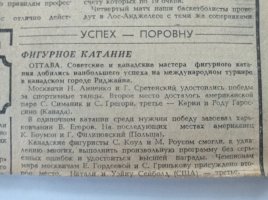
(the article published in russian 'Sovetskiy Sport' on November 2, 1986)

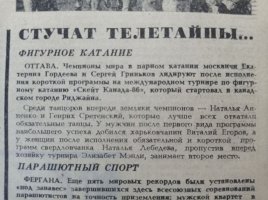
OTTAWA. World pairs champions, Muscovites Ekaterina Gordeeva and Sergei Grinkov, are leading after the short program at the international figure skating tournament "Skate Canada-86," which started in the Canadian city of Regina.
Among the ice dancers, the champions' fellow citizens are ahead — Natalia Annenko and Genrikh Sretenski, who skated the compulsory dances better than anyone else. Among the men, Vitaliy Egorov from Kharkiv achieved the greatest success after the first type of program. Among the women, after the compulsory and short programs, Natalia Lebedeva from Sverdlovsk occupies second place, letting the tournament host Elizabeth Manley move ahead of her.
1783231659749.jpeg
 
1986
BEHIND THE SCENES OF ARENAS


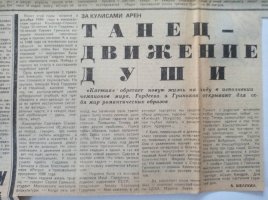
DANCE — THE MOVEMENT OF THE SOUL

(the article published in russian 'Sovetskiy Sport' on November 2, 1986)

“Katyusha” finds new life on ice as performed by the world champions. Gordeeva and Grinkov discover the world of romantic imagery for themselves.

The rise of this pair began in December 1984 in the American city of Colorado Springs. Back then, 12-year-old Katya Gordeeva and 16-year-old Serezha Grinkov won the World Junior Figure Skating Championships in pairs. And in March 1986, on the ice of Geneva's "Les Vernets" rink, their joyful and airy style was recognized as the gold standard—the Muscovites were awarded gold medals at the senior World Championships. Victory on their very first attempt in a competition of such caliber!
For a time, spectators noted with concern that pairs skating was becoming somewhat dull. However, the fragile, elegant Katya Gordeeva and her slender, tall partner, who wins people over with his kind smile, completely transformed this spectacle: their faces glow during performances, their eyes reflect a play of genuine feelings, and every on-ice combination is filled with daring, courage, and passion.
When reflecting on the art of theater, Konstantin Sergeyevich Stanislavski said that the most important thing is to love the art in oneself, not oneself in art. The same commandments apply to the world of figure skating. Not self-admiration, but the movements of the soul—that is what the audience looks for in modern compositions. Gordeeva and Grinkov managed to achieve this in their brilliant "Retro" routine for their 1986 free program.
"Our life on ice is hard," says Sergei Grinkov, a student at the Moscow Institute of Physical Education. "When five years ago we started our training, there were many bruises, injuries, and tears. Now, falls don't scare us. We've grown used to it. Now we are solving other problems: searching for new images and new directions. There are plenty of sharp corners here, too. Just this autumn, we had to work on two short programs at once. We grew attached to one, but immediately started a new version in a completely different key. But again, it's an exciting task—after all, the program is set to the music of the famous 'Katyusha'..."
"We recently visited an art exhibition by Ilya Glazunov, a People's Artist of the USSR," Ekaterina Gordeeva continues the conversation. "It seems to me that in some of the portraits, we saw the image of the girl, the heroine of 'Katyusha.' Art helps us understand the intent of our programs more deeply..."
Katya, who has entered the ninth grade of secondary school, naturally has new interests. She enthusiastically studies specialized literature on ballet, including monographs on the unique Anna Pavlova and the notes of ballet master Fyodor Lopukhov. On Sergei Grinkov's bookshelf are novels by Hemingway and Vonnegut, and poems by Russian poets.
"Yes, our champions are growing up," notes Marina Zueva, a choreographer at the CSKA school. "Before, they gladly welcomed any proposal, any routine. Now they ponder interesting ideas and display a discerning taste. At one point, we staged a composition on the ice that had once been performed by European champion Igor Bobrin. The kids called it the 'musketeer' routine. But that was three years ago. The musketeer hats have been left in the locker room; the time has come to try on Olympic headwear..."
On November 1, Gordeeva and Grinkov performed their new free program across the ocean—at the "Skate Canada" tournament. Busy days have begun for the world champions.​
A. SHELUKHIN.
1783233516682.jpeg
 
1986
SKATE CANADA

FIGURE SKATING

(the article published in russian 'Sovetskiy Sport' on November 4, 1986)

OTTAWA. Soviet and Canadian figure skating masters achieved the greatest success at the international tournament in the Canadian city of Regina.
Muscovites N. Annenko and G. Sretenski won the ice dance event. Second place went to the American couple S. Semanick and S. Gregory, and third went to Karyn and Rod Garossino (Canada).
In the men's singles event, V. Egorov from Kharkiv emerged victorious. He was followed by American C. Bowman and G. Filipowski (Poland).
To the surprise of many, Canadian figure skaters C. Coull and M. Rowsom managed to perform their free program without serious errors and take the top prize. World champions E. Gordeeva and S. Grinkov from Moscow were awarded second place, while Natalie and Wayne Seybold (USA) took third.
1783233984822.jpeg
 
1986
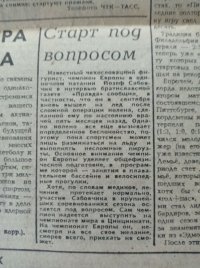
START IN QUESTION

(the article published in russian 'Sovetskiy Sport' on November 4, 1986)

The famous Czechoslovak figure skater and European men's singles champion Jozef Sabovčík stated in an interview with the Bratislava newspaper Pravda that in September he returned to the ice following a complex knee surgery, which was performed five months ago at the insistence of his doctors. However, the knee still causes a degree of concern, so for now, the athlete can only warm up on the ice and perform simple spins. The European champion is focusing his main attention on general physical conditioning, which includes sessions in a swimming pool and bicycle rides.
Although medics state that the treatment is progressing normally, Sabovčík's participation in the biggest competitions of the season remains in question. The champion himself hopes to compete at the World Championships in Cincinnati. Despite his strong desire, he will most likely not be able to come to the European Championships.
1783234393952.jpeg
 
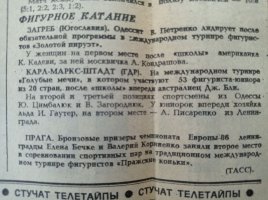
1986
FIGURE SKATING

(the article published in russian 'Sovetskiy Sport' on November 15, 1986)

GOLDEN SPIN
ZAGREB (Yugoslavia). Odesa native V. Petrenko leads after the compulsory program in the international figure skating tournament "Golden Spin."
In the women's event, American C. Kadavy is in first place after the "school" (compulsory figures), followed by Muscovite A. Kondrashova.​

BLUE SWORDS
KARL-MARX-STADT (GDR). At the international tournament "Blue Swords," which features 53 junior figure skaters from 20 countries, Australian J. Blee is ahead after the "school."
In the second and third positions are athletes from Odesa, Yu. Tsymbalyuk and V. Zagorodniuk. In the junior women's event, the host of the ice, I. Gauter, is ahead, with A. Pisarenko from Leningrad in second place.​

PRAGUE SKATE
PRAGUE.
Bronze medalists of the 86 European Championship, Leningrad natives Elena Bechke and Valeri Kornienko, took second place in the pairs competition at the traditional international figure skating tournament "Prague Skate."
(TASS).
1783316465851.jpeg
 
1986
FIGURE SKATING

(the article published in russian 'Sovetskiy Sport' on November 16, 1986)

GOLDEN SPIN
ZAGREB (Yugoslavia).
Odesa native Viktor Petrenko won the international figure skating tournament "Golden Spin."
The 17-year-old student of Galina Zmievskaya excelled in all program segments. French skater Philippe Roncoli finished in second place, and James Cygan (USA) took third.​

BLUE SWORDS
KARL-MARX-STADT (GDR). Irina Saifutdinova and Andrei Bardykin from Sverdlovsk took third place in pairs skating at the traditional international tournament "Blue Swords," which features junior figure skaters.
First and second places were taken by the hosts of the competition—athletes from the GDR, Mandi Hannebauer — Marno Kreft and Antje Schramm — Jens Müller.
In the men's junior event, Yuri Tsymbalyuk from Odesa leads after performing the short program. Riko Krahnert (GDR) is second, and Vyacheslav Zagorodniuk (Odesa) is third. Leningrad native Alina Pisarenko holds third place overall after the compulsory and short programs. Ahead of her are Inga Gauter and Tanja Krienke (both from the GDR).
1783317519664.jpeg
 
1986
PATTERNS ON THE ICE

(the article published in russian 'Sovetskiy Sport' on November 19, 1986)

BLUE SWORDS
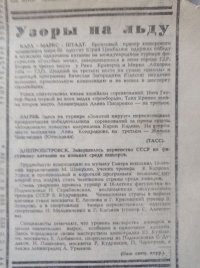
KARL-MARX-STADT. The bronze medalist of the '86 World Junior Championship, Odesa native Yuri Tsymbalyuk, secured a victory in the men's singles event at the "Blue Swords" international figure skating tournament, which concluded in this GDR city. Second and third places went to Riko Krahnert and Mirko Eichhorn (both from the GDR). Vyacheslav Zagorodniuk (Odesa), who was in third place after the sum of the "school" (compulsory figures) and the short program, performed his free skate program unsuccessfully and failed to finish in the top six.
Success also favored the young hosts of the competition. Inga Gauter placed first in all three segments of the competition, Tanja Krienke took second place, and Leningrad native Alina Pisarenko finished third.​

GOLDEN SPIN
ZAGREB. Here, at the "Golden Spin" tournament, victory went to last year's winner of the "Moscow News" newspaper prize competition, American Caryn Kadavy. In second place was Muscovite Anna Kondrashova, and in third was Željka Čižmešija (Yugoslavia).​
(TASS).

USSR JUNIOR CHAMPIONSHIPS
DNIPROPETROVSK.
The USSR Junior Figure Skating Championship has concluded.
The most difficult program, set to music by Glière, was performed by 16-year-old Kharkiv native M. Shmerkin, a student of coach V. Kaprov. Success in both the free skate and short programs allowed him to become the junior national champion for the second consecutive year.
N. Skrabnevskaya, a 16-year-old skater from the Moscow region and student of Honored Coach of the USSR V. Kudryavtsev, competed very confidently throughout the tournament. Muscovites E. Leonova and G. Krasnitskiy (coached by V. Zakharov) became national champions in pairs skating, while Odesa athletes I. Melnichenko and G. Kaskov (coached by S. Alekseeva) triumphed in ice dance.
Specialists note that the skill level of the juniors has significantly increased overall, especially in singles skating. Leningrad native Yu. Kuzmina, Muscovite E. Lyubimova, Moscow region athletes S. Dudakov and I. Pashkevich, Muscovites R. Kudryavtsev and P. Chernousov, as well as Leningrad native A. Urmanov, all delighted everyone here with their craftsmanship.​
(From our special correspondent).
1783318500358.jpeg
 
Back
Top