Archive of newspaper articles | Page 34 | Golden Skate

Archive of newspaper articles

1986
MOSCOW NEWS PRIZE
CROSSROAD OF OPINIONS


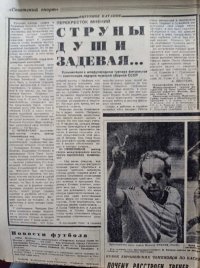
TOUCHING THE STRINGS OF THE SOUL...

(the article published in russian 'Sovetskiy Sport' on December 6, 1986)

The culmination of the international tournament of figure skaters—compositions by the leaders of the USSR men's singles team

The backstage areas of the Luzhniki Sports Palace erupted into a buzz as arguments flared and experts hunched over their clipboards, calculating dozens of judges' marks. Such a sporting excitement (passion in the best sense of the word) was triggered by the performances of the strongest men in the short program. Out of 18 figure skaters, at least six earned complimentary reviews that evening.​

Yu. ZIMMERMAN, international referee:
"Without exaggeration, I can say that the discovery of the Moscow ice ball is the 15-year-old Odesa athlete Vladidmir Petrenko, a student of coach Galina Zmievskaya. I happened to be at the very origins of the creation of the figure skating school in Odesa and participated in the admission of novices to this school. Yes, we noticed the Petrenko brothers, Viktor and Vladimir, when they were only 8–9 years old. But hardly any specialist could have predicted such a rapid growth. Both brothers are already on the USSR national team. As for the execution quality of the short program by Volodya Petrenko, the current World Junior Champion, it is a statement for a great future. After all, for the first time, he was awarded two scores of 5.7 and two scores of 5.9..."​

S. CHETVERUKHIN, Honored Master of Sports, Olympic medalist:
"It gave me great aesthetic pleasure to watch the performances of four athletes: Vladimir Kotin, Vitali Egorov, Vladimir Petrenko, and the American Paul Wylie. The artistry of Kotin, silver medalist of the European Championships is a unique phenomenon. His composition 'Spain' rightfully became the culmination of the entire evening. The figure skater was so emotionally charged that he gave in to his feelings, somewhat to the detriment of his excellent technique. Perhaps he was right: where else, if not at home, can one show complete freedom, a flight of the soul! However, a mistake on his double Axel prevented him from receiving the highest marks for technique. Yet, for his artistry, he received four scores of 5.9."
The stable Vitali Egorov has developed new features: absolute purity of lines and deeply meaningful gestures. This is exactly where his high second-place result stems from. I even got the impression that he can execute a powerful jump combination with a triple Lutz even more powerfully. His victory at the international tournament 'Skate Canada' was not accidental. Egorov's destiny makes one ponder over many things — after all, there are athletes who mature slowly. They need to be given time to, as they say, ripen."
I share the many compliments directed at the young Petrenko. The youth is talented, goal-oriented, and can achieve a great deal in sports. But he still needs to learn. In particular, it is worth looking more closely at the American school of singles skating, at the gliding style of the best representatives of this school. In Moscow, Paul Wylie shone with his footwork and rotation speed, and completely deserved his place among the top five..."​

Yu. OVCHINNIKOV, Master of Sports of International Class, European Championships medalist:
“We have witnessed once again that the modern masters of figure skating know how to speak directly to the hearts of the spectators, touching the strings of their souls while creating unique compositions within the strict technical constraints of the short program. The Spanish theme in Vladimir Kotin’s program completely captivated the entire arena. This premiere proves yet again that our singles skating leaders have taken another quality step upward on the ladder of mastery. I want to emphasize that the coaches of our singles skaters — Elena Tchaikovskaya, Aleksei Mishin, and Galina Zmievskaya — very keenly sense the general trend of modern sports."
In recent years, I have heard complaints of this kind: sometimes spectators seem to be disappearing from the stands. This is a troubling symptom. Spectators must be brought back to sports arenas. And how can this be accomplished? We need to boldly and resolutely restructure the choreography and creative training systems across our figure skating schools."
Currently, I am working with the 'All Stars' ice ensemble. This work is very interesting from a creative perspective. Recently at Luzhniki, we performed our new dance piece 'Bolero', and it was a joy to see that the spectators yearn for a world of beauty and deep emotions. There was a full house. I hope that full houses will become a regular occurrence for competitive sports tournaments as well..."​

The Moscow tournament is approaching its end, and another exciting premiere awaits us — the original dance routines of the ice dance duos. After the compulsory and original dances — the Viennese Waltz — the tournament is confidently led by three Soviet duos — Marina Klimova and Sergei Ponomarenko, Natalia Annenko and Genrikh Sretenski, and Maya Usova and Aleksandr Zhulin.

A. SHELUKHIN.

TECHNICAL RESULTS

International Figure Skating Tournament for the Prize of the "Moscow News" Newspaper. Moscow, Sports Palace, December 4.
Men's Singles. Combined Short and Compulsory Program Positions.
1. V. Kotin — 1.0; 2. V. Egorov — 2.0; 3. V. Petrenko — 3.0; 4. A. Torosian (all — USSR) — 4.6; 5. N. Köpp (GDR) — 5.2; 6. R. Burghart (Austria) — 6.0.
1783492688230.jpeg
 
1986
MOSCOW NEWS PRIZE

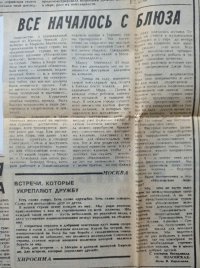
IT ALL STARTED WITH THE BLUES

(the article published in russian 'Sovetskiy Sport' on December 6, 1986)

An acquaintance with the ice dance duo from Canada, Erika Davenport and Mark Mitchell, who arrived in our country for the traditional figure skating tournament for the prize of the newspaper "Moscow News", began with a funny incident. Erika and Mark had just skated their final compulsory dance—a lazy, slow, mesmerizing blues—and were looking at the electronic scoreboard in anticipation, where the judges' marks were about to appear. The board blinked a few times with yellow lights and displayed... solid zeros. A funny mistake by the computer, honestly, was quickly fixed and only amused the athletes and the spectators alike.
Erika Davenport and Mark Mitchell are performing successfully at the current tournament, even though they have been training together for only two years. As Mark told me, they had long dreamed of coming to the Soviet Union capital and performing at such a prestigious tournament as the "Moscow News".
"Bernard Ford, who works at the National Ice Center in Toronto where we train, told us a lot about your country, about Moscow and about Luzhniki," says Mark. "That's how he gradually 'infected' us with the idea of a trip to the Soviet Union. And now the dream has come true. The expectations with which we traveled to Moscow have been fully met."
Mark Mitchell is 23 years old. For twelve years now, he has been involved in figure skating.
"Ice dancing is probably the most popular sport in Canada after ice hockey," says Mark. "Almost every family has a child involved in music and ice dancing. In every city, there are many figure skating clubs where everyone who wants to can skate—completely small children and quite elderly people. In any newsstand in town, you can buy a booklet—a self-tutor on figure skating, and a vinyl record with music for compulsory dances. That's how my parents brought me to a figure skating club to get, so to speak, a well-rounded education. For several years, my brother and I trained together, but music turned out to be closer to his heart. Now he is studying at a music college and plays the clarinet from morning till night, which sometimes makes me quite mad. After all, after hours of training, you want to stay in silence, to read peacefully."
Our conversation is joined by the athletes' coach, John Briscoll:
"The attention of journalists is still somewhat unusual and flattering for my athletes. After all, in the last National Championship, they took only seventh place. However, the couple is progressing very quickly, as, by the way, the entire Canadian school of ice dancing is progressing now. For a long time, Canadian ice dancers experienced a very strong British influence. But now we are gradually finding our own style."
"Figure skating is currently developing into a clash of two directions—the dramatic, expressive style, and the technically complex style packed with intricate footwork. Which direction do you support?"
"I am for the synthesis of these two schools of figure skating. High artistry plus flawless technique is the future of ice dancing.
"What are your impressions of the "Moscow News" tournament?"
"We don't go to international competitions very often yet. And at a representative tournament like the "Moscow News", we are performing for the first time. Competing with athletes like Klimova—Ponomarenko, Usova—Zhulin, Annenko—Sretenski is, of course, an excellent school for young athletes. We hope to visit your country again, where we have gained not only necessary competitive skills but also many new good friends."​
The guests were interviewed by O. POLONSKAYA.
1783494914414.jpeg
 
1986
MOSCOW NEWS PRIZE

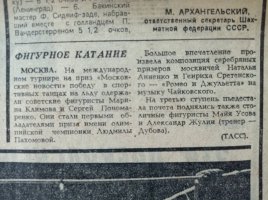
FIGURE SKATING

(the article published in russian 'Sovetskiy Sport' on December 7, 1986)

MOSCOW. At the international tournament for the prize of the "Moscow News" newspaper, the victory in ice dance was won by Soviet figure skaters Marina Klimova and Sergei Ponomarenko. They became the first recipients of the prize named after Olympic champion Lyudmila Pakhomova.
A great impression was made by the composition of the silver medalists, Muscovites Natalia Annenko and Genrikh Sretenski — "Romeo and Juliet" set to the music of Tchaikovsky.
The third step of the podium was taken by fellow Moscow figure skaters Maya Usova and Aleksandr Zhulin (coached by Dubova).​
(TASS).
1783495847498.jpeg
 
1986
MOSCOW NEWS PRIZE

Not even the rustle of skates is heard

(the article published in russian 'Sovetskiy Sport' on December 7, 1986)

In full swing — the international tournament for the prizes of the "Moskovskie Novosti" newspaper

The first... How does that sound for the figure skaters themselves? Probably, like music. By the way, the heads of Leningrad skaters Elena Kvitchenko and Rashid Kadyrkaev—winners in pair skating—did not spin after they stepped onto the podium.
In the struggle for prize-winning spots, two shifts occurred — European Championship '86 medalists E. Bechke and V. Kornienko managed to move into second place, ahead of L. Koblova and A. Kalitin. And finally, the Americans K. Keeley and J. Mero stood out, showing a decent result in the free program and taking fourth place. Small, but well-built and slender partner, like a butterfly, fluttered over the head of her partner. Katy and Joseph performed two original elements (with a momentary horizontal flip of the partner during the lift).
The performances of the ice dancers were filled with the charm of the Viennese Waltz. For the first time this season, the silver medalists of the World Championship, Muscovites Marina Klimova and Sergei Ponomarenko, were awarded the highest score — 6.0.
Here is what international category judge from Poland, Galina Gordon-Poltorak, says about the performance of Klimova and Ponomarenko's Viennese Waltz:
— Without hesitation, I gave this pair a score of 6.0 because Soviet ice dancers are creating a miracle before our eyes, a miracle of a grand, dazzling ball. Full merging with the music. They glide so smoothly that not even the rustle of skates is heard...​
A. SHELUKHIN.
Technical Results
International Figure Skating Tournament for the prizes of the "Moskovskie Novosti" newspaper. Moscow. Palace of Sports. December 5.
Pairs Skating.
1. E. Kvitchenko and R. Kadyrkaev — 1.4; 2. E. Bechke and V. Kornienko — 3.2; 3. L. Koblova and A. Kalitina (all — USSR) — 3.8; 4. K. Keeley and J. Mero (USA) — 6.0; 5. K. Kanitz and T. Schröter (GDR) — 7.0; 6. Yu. Bystrova and A. Tarasov (USSR) — 7.6.
Women's Single Skating. Total of compulsory and short program. 1. K. Ivanova — 1.0; 2. A. Kondrashova (both — USSR) — 2.4; 3. J. Conway (England) — 3.8; 4. J. Trenary (USA) — 4.0; 5. P. Neske (FRG) — 4.6; 6. T. Andreeva (USSR) — 6.2.
1783511943980.jpeg
 
1986
MOSCOW NEWS PRIZE

THE FINAL STROKE OF THE ICE ARTISTS

(the article published in russian 'Sovetskiy Sport' on December 9, 1986)

For two decades, the international figure skating competitions for the Moskovskiye Novosti newspaper prize have been held on the Luzhniki ice. While the team rosters keep changing, it is all the more pleasing to emphasize that most often, it is the Soviet masters who emerge in the roles of "troublemakers" (disruptors of the status quo). This time as well, they were the strongest in all disciplines of the program; Muscovites Vladimir Kotin and Kira Ivanova became the winners over the final two days.
1783589051565.jpeg
 
1986
MOSCOW NEWS PRIZE
TIMELY COMMENTARY


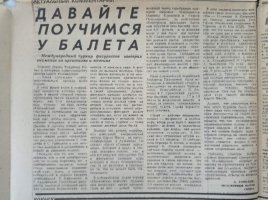
LET’S LEARN FROM BALLET

(the article published in russian 'Sovetskiy Sport' on December 9, 1986)

The international figure skating tournament highlighted artistry and aesthetics

Vladimir Kotin put it well in an interview with a Central Television correspondent:
— I am driven to improve myself, above all, by the struggle...
This phrase holds the key to understanding the processes taking place in our national team, which has just passed such an important test as the 21st international tournament for the Moskovskiye Novosti newspaper prize. Merely participating in the competitions on the Luzhniki ice is already an effective step toward making vital corrections to one's programs and making a new turn in mastery. Let us recall how last year, after the December competition, the composition design of E. Gordeeva and S. Grinkov was sharply "reshaped," and how much they subsequently won in the struggle for the world crown.
I am convinced that those who wanted to challenge anyone during these December days were not only fighting, but simultaneously creating a new style and finding an Olympic path. Take, for example, the winners in pairs skating, Leningrad skaters E. Kvitchenko and R. Kadyrkaev. The capable figure skaters have accumulated a solid arsenal of complex technical elements. And they skated with flair. Yet, it all failed to evoke excitement. It is time to look at many achievements critically: after all, it is important not only to execute a triple toe loop, but also to give a sense of lightness and flight in your programs. I believe figure skating has reached a level where work with salty sweat must recede into the background, as if dissolving and giving way to transformation; a figure skater can conquer the arena if they live on the ice, merging with the music. Lightness and a warm smile are also extra tenths of a point.
By the way, this is exactly what the famous American coach Carlo Fassi emphasized at a press conference in Luzhniki. He said: "The ballet Sleeping Beauty that I saw in Moscow conquers because everything in it is danced impeccably. And it is time for figure skating to enter an era of faultlessness. And do not include elements in a program that cannot be stable!"
In terms of aesthetics, the Moskovskiye Novosti tournament presented us with several bright premieres. One of them is the new free dance by the World Championships silver medalists, Marina Klimova and Sergei Ponomarenko. For their performance of Liszt's "Hungarian Rhapsody," they received five perfect scores of 6.0 (by the way, they also had three 6.0 marks for the Viennese Waltz). The harmony and variety of their footwork, the elegance of Klimova's entire routine, and Ponomarenko's deeply emotional performance—this is the soul of ice dance. The tournament winners do not repeat old technical tricks; they create and fantasize together with their coach N. Dubova, and this brings them new success.
The ideas of Olympic champion Lyudmila Pakhomova were embodied in the miniature "Romeo and Juliet" to the music of Tchaikovsky. The performers—N. Annenko and G. Sretenski—earned high marks of 5.7 and 5.8 points for their airy manner in dancing, and ability to empathize with the flight of emotions. Once again, aesthetics triumphed.
Sport is an unpredictable act—it intrigues with particular intensity when we talk about a fierce battle in men's singles skating, where there are always so many "ultra-c" elements. In Moscow a desperate assault on the triple Axel was underway. And the winner of the tournament, V. Kotin, and second-place prize winner V. Egorov, subordinated their competitive tactics to one single goal—to execute the triple Axel and permanently secure this jump in their arsenal. They did not fully succeed in everything, but there is no other way, because right now it is this element that, above all other components, opens the path to medals of higher merit. Five scores of 5.9 brought Kotin a completely clear advantage.
Several skaters attempted to break into the leaders' circle all at once: 15-year-old V. Petrenko from Odesa, American Paul Wylie, Tbilisi skater A. Torosyan, and N. Köpp (GDR). I am certain we will hear these names more than once this season.
The thirst for creativity has largely transformed the landscape of women's singles skating. There are many new elements in the programs of European Championship medalist K. Ivanova (who, by the way, also won the overall all-around tournament), as well as A. Kondrashova, N. Gorbenko, and L. Zamotina. But so far, none of them have reached their best form. As a result, 17-year-old American J. Trenary, despite not possessing any special renown, won the free program in Moscow by demonstrating precisely a highly stable technique on her triple jumps. It was as if she confirmed the chosen course of her mentor, Carlo Fassi.
I think a serious flaw of this tournament was the absence of a number of titled Soviet figure skaters at the start of prestigious competitions. We understand that the individual plans of certain leaders are mapped out this way... And yet, one must look for a competitive challenge primarily on one's own home arena. All the more so because right now, the question of attracting wide audiences to our sports arenas is very pressing.
Finally, let us recognize with a kind word the initiative of Central Television: for the first time, in many television broadcasts from Luzhniki, we heard express commentary from the coaches themselves, the athletes, and answers to viewers' questions.​
A. GORELIK,
Honored Master of Sports.
1783589244957.jpeg
 
1986
WORLD JUNIOR CHAMPIONSHIPS

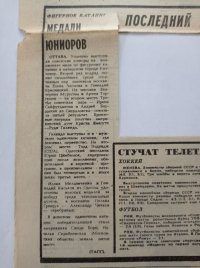
JUNIOR MEDALS

(the article published in russian 'Sovetskiy Sport' on December 9, 1986)

OTTAWA. Soviet juniors performed successfully at the World Figure Skating Championships in the Canadian city of Kitchener. For the second consecutive time, the title of the strongest in pairs skating was won by Muscovites Elena Leonova and Gennadi Krasnitski. Their compatriots Ekaterina Murugova and Artem Torgashev finished in second place. The third Soviet pair—Irіna Sayfutdinova and Andrey Bardykin from Sverdlovsk—claimed the fifth-place result. The bronze medals were captured by the American duo Kristi Yamaguchi and Rudy Galindo.
Galindo also competed in the men's singles discipline, where he won the championship. In second place was Todd Eldredge (USA). Odesa schoolboy Yuriy Tsymbalyuk, who was leading after the compulsory and short programs, placed fourth in the free skate and ultimately finished in third place overall.
Ilona Melnichenko and Gennadi Kaskov from Odesa were awarded gold medals for their victory in ice dance, while Muscovites Oksana Grishchuk and Aleksandr Chichkov took the silver.
In the women's singles discipline, the winner was Cindy Bortz of the United States. Natalia Skrabnevskaya (Moscow Region) finished in fifth place.​
(TASS).
1783589732171.jpeg
 
1986
MOSCOW NEWS PRIZE
FROM A SPECIALIST'S POINT OF VIEW


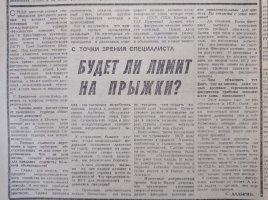
WILL THERE BE A LIMIT ON JUMPS?

(the article published in russian 'Sovetskiy Sport' on December 11, 1986)

Among the numerous figure skating specialists present at the Moscow international tournament Moskovskiye Novosti, there was also the chairwoman of the technical committee of the International Skating Union (ISU), Sonia Bianchetti (Italy). The technical committee controls all matters related to changes in figure skating competition rules and the work of international judges. The committee thoroughly analyzes the outcomes of the World and European Championships, as well as the largest international tournaments, including the Moscow one.
S. Bianchetti agreed to answer questions from our correspondent.
— What are your impressions of the current Moskovskiye Novosti tournament?
— I am coming to Moscow for the fourth time and I feel at home. Soviet people are remarkably hospitable. The organization of the tournament, as always, is magnificent.
— One can often hear complaints directed at the referees officiating various competitions. What, in your opinion, should be done to bring greater objectivity to judging?
— To begin with, I would say that the percentage of unsatisfactory judging at major international competitions is small. And yet, the problem of biased judging does exist. Some referees favor, say, an athletic skating style, while others prefer choreographic innovations.
Consequently, the evaluation criteria turn out to be blurred. At annual meetings with judges held in various countries, we try to develop a unified approach to evaluating programs. Referees officiating the World and European Championships, the Olympic Games, and other international competitions must pass examinations.
Unfortunately, there are cases when national federations put pressure on judges, urging them to overscore their compatriots. We are decisively fighting against this practice.
— In your opinion, what causes pair skating to barely develop in European countries? What is the ISU doing to rectify the current situation?
— The problem is indeed acute. A few years ago, pair skating was actively cultivated by only four countries — the USSR, the USA, Canada, and the GDR. The reasons? I think this discipline of figure skating is the most complex. Finding two strong singles skaters (who also live in the same city) and combining them into a pair is much harder than creating a good ice dance duo. Having felt a sharp lag behind the recognized trendsetters in pair skating, some countries seemed to give up on this sport.
Naturally, this situation does not satisfy us. The ISU has introduced changes to the rules. The requirements for program difficulty have been lowered. The emphasis is placed on making the programs strictly balanced. This is bearing fruit. And it is safe to say that interest in pair skating is gradually growing again both in Europe and in America.
— The famous American coach Carlo Fassi noted that an excessive obsession with ultra-complex elements makes figure skating less attractive to the spectator. Do you agree with this opinion?
— Yes, I agree. When a skater attempts to execute six triple jumps, forgetting about spins, footwork sequences, and original but simple elements, their program doesn't look right. Figure skating is akin to art. And artistry in it should never take a back seat. The ISU intends to introduce a limit on the execution of triple jumps for the sake of the artistic appeal of figure skating.
— How do you explain the fact that at many, even the largest figure skating competitions, the stands are only half full?
— This issue has been discussed more than once in the ISU. One of the reasons is television. After all, some people prefer home comfort and "interacting" with a color screen. Perhaps there are fewer bright "stars," and the viewer, as is well known, always seeks a true spectacle.
There is another reason — overly expensive tickets for prestigious competitions. Apparently, it makes sense to lower their cost. At the same time, I want to note that, for example, for the '87 World Championships in Cincinnati (USA), all tickets are already sold out, even though the championship will only begin in three months.
I believe that figure skating is not threatened by a crisis. And our task is to make it even more popular.​
S. DADYGIN.
1783591097198.jpeg
 
1986
Famous Faces — Close-Up


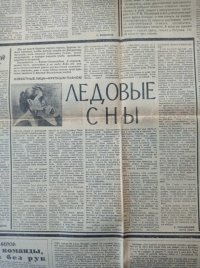
ICE DREAMS

(the article published in russian 'Sovetskiy Sport' on December 13, 1986)

We do not know of any other such case, any other such example, where a master of sports in figure skating, a member of the Soviet Union national team, became a popular and, primarily among the youth, famous actress.
Meet Elena Skorokhodova. However, perhaps there is no need for an introduction. After all, she was the one hosting the televised rhythmic gymnastics lessons and is already familiar, for this reason alone, to many, many millions of people.

Master of sports in figure skating Elena Skorokhodova is known not only to specialists in ice dancing. Yes, leading roles in the movies 'The Joke', 'Happy Zhenka', 'Evil Sunday', 'Date on the Milky Way', and notable works in performances of the Moscow Theater named after A.S. Pushkin became her first steps in the acting field. Fans of televised 'Rhythmic Gymnastics' recognized her as one of the first hosts of these television lessons.
Interestingly, during her first year at the Shchukin Theater School, when she had to give up training, she would only run up the stairs — her energy demanded its usual outlet.
— I always had fun at competitions. This is also a theater, a stage. While skating, I lived in character, I played the role of someone in love with my partner, — Elena recalls. — Probably, I lacked sports ambition. I valued artistry above victory.
In Elena's last phrase, I think, lies the seed from which her subsequent theatrical destiny grew. For her path to the stage, it seems to be, reflects not only a stroke of chance, but also a pattern. Her idols in figure skating are not accidental either — Canadian singles skater Toller Cranston and the irreplaceable queen of ice dancing Lyudmila Pakhomova, athletes whose art was marked by inspiration and emotionality.
Elena and Lyudmila trained side by side, with the same coach. Those who saw these training sessions noted how the twelve-year-old Elena would observe and try to incorporate the sophisticated artistry and dedication shown by Pakhomova into her own dance movements.
Smiles at training sessions remained the property of a narrow circle of teammates, but at competitions, the young couple made claims to quite serious mastery. They were predicted to have a brilliant future. To a journalist's question whether Lenochka believed that over time she would win the world championship, she answered briskly and cheerfully, as if at a pioneer meeting: "I believe it, you just have to want it very much and work very hard."
And she did work, indeed, with great dedication.
— ...We were testing a new program. For eight hours straight, we didn't leave the ice. I could barely make it home from practice. I barely had the strengthto undress. I'd collapse onto the bed. When I woke up, my arms and legs ached so badly, it felt like I hadn't rested at all.
Time passed in this environment of hard work. She successfully completed her graduation exams at a specialized French school. The top marks in her certificate demonstrate that Elena's diligence extended beyond sports into her academic pursuits. Skorokhodova was preparing to enter MSU, planning to follow in her parents' footsteps and become a mathematician. And, naturally, new competitions lay ahead of her. The future seemed completely mapped out. But right then, as the saying goes, chance intervened.
At the 'Nouvelles de Moscou' tournament, a figure skater was unable to start her routine for twenty minutes. Due to technical difficulties, the music couldn't be played. And through all those endless minutes of waiting, the TV camera operator kept filming the athlete's face in close-up. The consequences of that pre-start delay took quite an unexpected turn.
A phone call came from the film studio, asking to 'by all means, send that girl' in for screen tests. Lena went to the studio, but upon learning that she would have to travel to Argentina for two weeks of shooting, she flatly refused. 'How can I go to Argentina when I have training sessions every morning and evening?'
Not many girls her age would have shown such a profound sense of duty in a similar situation.
And yet, this cinematic episode stirred something in her soul. Otherwise, how could one explain why a prospective MSU student suddenly decided to take the entrance exams for the Boris Shchukin Theatre Institute?
The subsequent events are already familiar to us in broad strokes. Today, her world is the theatre stage rather than the ice rink. Yet, the memories remain... Lena constantly looks back on her years spent in sports. Sometimes she dreams that, while preparing to take the ice, she is putting on a practice uniform that hasn't dried since the last session, slipping into damp boots, and feeling a dread of the ice breathing its cold at her. And suddenly, Chaikovskaia appears and snaps like a gunshot: 'Alright, let's begin.' At that moment, the fatigue is forgotten, and she feels warm, even in her sleep.
— 'Are these good dreams? Are they happy memories?'
— 'Yes!' she answers with conviction. 'It was hard for me, but I was happy. An extreme situation demands the very best traits of human character. And elite sports are packed to the limit with such extreme situations. This is where a person steps beyond the boundaries of their potential. Where they feel things more intensely. It seems to me that the essence of sports lies in the struggle of the spirit.' (A pause for reflection).
— 'Yes, it is driven by the spirit rather than intellect or physiology. Willpower, overcoming obstacles — these are spiritual impulses just like the strive for honesty and purity. I do not accept the concept of "sporting rage/animosity." A different philosophy resonates with me: to understand your opponent in order to surpass them. And to understand them, you have to truly appreciate them. This explains why my main rival in sports and I were best friends both on and off the ice. Unfortunately, in art, you don't always see that level of openness in relationships.'
— 'How did you manage at the beginning in theater school? You must admit, it was a sharp turning point in your life...'
— 'Comparing my present self to who I used to be, I see that I was a completely different person. I could only open up on the ice. In everyday life, I kept to myself and didn't know how to socialize. The habit of always being disciplined suppressed the spontaneity needed for an actor — that's the flip side of the athletic coin, or rather, of a sports upbringing. Hard work — yes, I was conditioned for that. As much as it took. I showed up to classes like an automaton: precise, down to the minute.'
— 'Dependability and diligence are wonderful qualities...'
— 'But I had nothing else besides that,' Lena cuts in harshly. 'At the institute, the professors kept trying to shake me out of it: "Why are you acting like a machine? Give yourself a break, relax, end up being late for class after all."
During that difficult transitional period in her life, Lena began writing poetry. She was in no hurry to show it to anyone; she wrote strictly for herself. Apparently, the emotional charge that had previously found expression in dance now demanded new channels. Much like the way her muscular energy would discharge through sprinting up and down flights of stairs. As it turned out later, her poetry was worthy of more than just a family scrapbook. Recently, the actress's first collection of poems was published. Yet, the core focus of her student life was (and still remains) the search for her own unique identity within the acting profession.
I happened to see Skorokhodova a year before her graduation in the play 'The Team'. Since it was a play about athletes, one would think she held all the trump cards—after all, these personalities were intimately familiar to her. However, from the audience's perspective, you could sense Lena herself standing on stage, with her character's persona existing somewhere completely separate. A seamless merger had not yet occurred. A year later, I watched the play again, this time during her graduation performance. Skorokhodova's acting had become unrecognizable; the audience reacted to almost every single one of her lines.
I should have felt pure joy, yet a single question kept troubling me: how would Elena's destiny have unfolded if that very delay with the music before taking the ice had never happened, and if she hadn't walked away from sports at the age of seventeen but, say, at twenty-seven—making her too old to enter theater school? I put this exact question to Lena today.
Her shoulders drop, as if she has just heard something jarring.
— 'That would have been terrible. No, that could never happen!' (A pause). 'I think I would have eventually found my way into theater somehow anyway... It would have been terrible,' she repeats, shaking her head as if to completely reject the possibility of such an outcome. 'I got lucky,' she states firmly.
— 'So, does that mean sports weren't necessary at all? For you, specifically?'
— 'No. Sports are wonderful. It's just that, for me, they couldn't be the only thing in life. Generally, I believe sports should be a companion, something that goes alongside us through life, but not the main focal point... It taught me not to mope when facing failures; it taught me to love the exhaustion.'
An actor's fate can turn out successful or tragic, but in any case, this life path has never been easy for anyone. It seems to me that Elena Skorokhodova, judging by what we have learned about her today, made no mistake in her choice.​
K. TINOVITSKY,
Master of Sports.
1783675477434.jpeg
 
Last edited:
1986
MOSCOW NEWS PRIZE
OUR GUEST


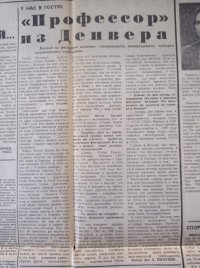
The "Professor" from Denver

(the article published in russian 'Sovetskiy Sport' on December 17, 1986)

Insights into figure skating from a specialist who has trained four Olympic champions.

Peggy Fleming... Dorothy Hamill... John Curry... Robin Cousins... Each of these names of outstanding figure skaters and Olympic champions is, to one degree or another, linked with the American coach Carlo Fassi, who has worked for many years at the renowned sports center in Denver. For twenty years, Carlo Fassi's school has amazed the world with its students. After all, every single champion who passed through this ice "academy" has been a vibrant, distinct personality.
For the past two years, Carlo Fassi has been coming to Moscow for the international competitions for the 'Moscow News' Prize. In 1985, his new student, Caryn Kadavy, won the tournament on the Luzhniki ice, and in 1986, another pupil of the American coach, Jill Trenary, took second place, delivering the best free skate performance.
Originally from Italy, Carlo Fassi competed for the Italian national team at the World and European Championships in men's singles for several years. In 1953 and 1954, he brilliantly won the European champion title. His rivals in those years were famous masters—Alain Giletti and Alain Calmat of France, and David Jenkins of the United States.
In the corridors of the Luzhniki Sports Palace, finding the US national team coach was no easy task. Carlo Fassi, a short man in modest metal glasses, usually occupying an observation post in the corner of the lobby, reading newspapers and only occasionally stepping out to the rink barrier to glance at the skaters' marks. Yet, how he transformed when his student was preparing to start! About twenty minutes before the performance, Fassi would begin circling around the athlete, saying with a gentle smile: "Please, a few jumps on the ice, a few knee bends, and a split!" He would escort the skater right to the edge of the ice, shouting during the warm-up: "Tighter, tighter... Keep gliding!" Every single one of his remarks hit the bullseye.
We spoke right after an entirely unexpected breakdown in the short program of 17-year-old Jill Trenary, who missed two elements. Fassi did not hide his disappointment, throwing up his hands: "For the first time in five years, I am seeing such a failure from her. I have always been proud of her consistency. She is a highly resilient athlete; she underwent a difficult leg surgery and managed to break back into the ranks of the country's top skaters within six months. What happened to her?"
However, Fassi quickly composed himself, sat down in an armchair, and said: "Alright, we will analyze the reasons later. Right now, I am at your service."
— Tell us, whom among the large group of your students do you consider the most naturally gifted skater? Who fully unlocked their potential?
— I think Robin Cousins, the 1980 Olympic champion. He progressed with astonishing speed: he was sixth at the European Championships in 1976, and by 1978, he was already the strongest in the free skate. His coordination and flexibility were unique. And as for the height of his jumps, it goes without saying—he soared! Another talented Englishman I had the privilege to work with was John Curry, an athlete of immense artistic talent. He truly expressed his full self in his compositions...
— You haven't mentioned any of the masters of ladies' singles...
— They are difficult to talk about. Take Peggy Fleming, for instance, who competed from 1962 to 1968; she belongs to a completely different generation of skaters. They weren't faced with the task of executing three or four triple jumps. The criteria for mastery were entirely different back then. Line beauty, movement grace, softness, and lyricism were highly valued. And the imperturbable Peggy embodied all of that. Amidst the raging passions, she was like an iceberg. If anything ever moved her, it was the music. Today, a different kind of athlete has entered figure skating. They have fast-paced, athletic programs that require executing highly complex jumps. I am not entirely sure that ladies' singles should look identical to men's...
— What, in your view, is the current state of world figure skating? What interesting things did you notice at the tournament in Moscow?
— I believe that right now, the tone in singles skating is being set by representatives of four nations—the USSR, the USA, Canada, and the GDR. By all indications, the unique duels between the leaders of the Soviet and American teams will be of particular interest at the upcoming 1987 World Championships.
The Moscow tournament was fascinating in many respects. I had just observed the competitions in Tokyo before flying straight to Moscow. And it was a pleasure for me to see that the Moscow audience understands the finest nuances of figure skating and responds keenly to everything bright and talented.
The Moscow competitions also give us food for thought regarding the direction in which we, coaches, should work. It seems to me that the obsession with maximum-difficulty jumps has somewhat detracted from thoughtful work on basic skating skills and composition. Today, elite sport must be flawless!
During this trip to Moscow, I happened to see 'The Sleeping Beauty' ballet. A beautiful production with exquisite performers. Not once did you feel anxious that someone would make a mistake or break the rhythm. That is true art! I believe athletes should also show respect for the audience, strive for a true understanding of their artistic presentation, aiming for maximum consistency.​
The interview was conducted by A. SHELUKHIN.
1783693012181.jpeg
 
Back
Top