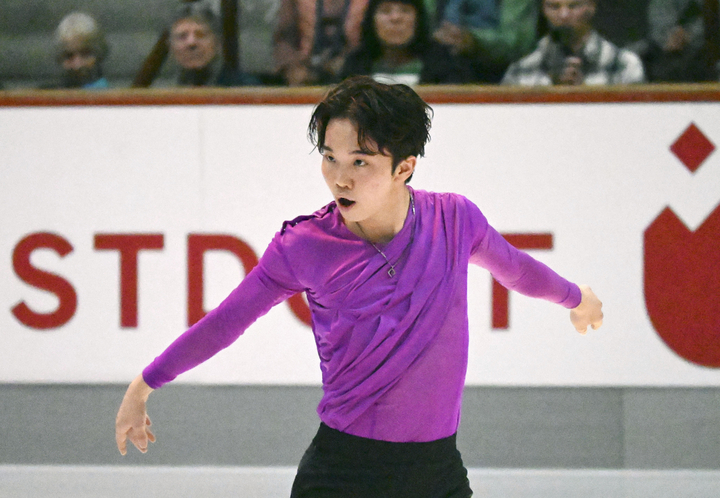
Kazuki Tomono | Page 288 | Golden Skate

Kazuki Tomono

Kazuki's just arrived for gala practice, hooray! He started with figures, then did some choreo that appears to be a fast pop song. Looking forward to hearing what it is! (ETA, nah I was wrong, it's slowish jazz!)
Edit, he's just made some funny faces for Isabeau and Amber who are recording, so fun stuff coming soon on their IG, I guess!
 
Last edited:
Kazuki's just arrived for gala practice, hooray! He started with figures, then did some choreo that appears to be a fast pop song. Looking forward to hearing what it is! (ETA, nah I was wrong, it's slowish jazz!)
Edit, he's just made some funny faces for Isabeau and Amber who are recording, so fun stuff coming soon on their IG, I guess!
I am so glad that you could be there to see him..I watched the gala.."Don't Fall in Love" the one Kana did for him..that we saw in France last yr and after JPN Champs..I liked the top from the # he did w Mao, Dai and Yuna from SOI
 
Thanks guys, for sharing the gala :love2: I really love 'Don't fall in love', though I'm wondering what happened to his EX 'Life is Beautiful' that he choreographed with Misha Ge a while ago.

Here are some cool pics - I saw fans saying that Dai-chan also wore his 'Sillhouete' costume recently, and wondering if it's really a coincidence or perhaps some sort of code 😆


What a cute quote - Kazuki's family seems so wholesome:


Post Nebelhorn interview (behind a paywall):
Along with fellow roommate Tsuboi, it seems he spent the day after the free skate relaxing. Here is the full comment from Kazuki Tomono during the interview the morning after the Nebelhorn Trophy!

Kazuki Tomono Reflects on His Culminating Season: "I'll probably realize it's over before I know it." Rain kept him from the mountains the morning after the free skate; he refreshed himself with reading time. 【The Day After the Nebelhorn Trophy】

 
Thanks guys, for sharing the gala :love2: I really love 'Don't fall in love', though I'm wondering what happened to his EX 'Life is Beautiful' that he choreographed with Misha Ge a while ago.

Here are some cool pics - I saw fans saying that Dai-chan also wore his 'Sillhouete' costume recently, and wondering if it's really a coincidence or perhaps some sort of code 😆


I was wondering about "Life is Beautiful" as well.
 
It's a shame Kazuki couldn't explore the mountains as he wanted, hopefully he'd done some exploring during his previous Oberstdorf visits! The weather turned much better on Sunday, but I guess Team Japan were already on their way back that morning, just like me. It's not a short commute to Munich, 2 hours IIRC, though the airport is reportedly closer.

He's either a very active man, or an early riser, to have had time for reading on Saturday morning. I saw him and Tatsuya walking briskly up the street, I suppose for gala practice, at around 11.30 AM. I just snapped a quick photo of them from behind, and they got out of sight quite soon, which was an unusual feeling for me as I'm normally a fast walker. But skaters are especially agile, so no wonder they quickly overtake an average mortal ;) Granted, I was still sleepy from watching pairs until late the previous evening (felt bad for RikuRyu, they would have won if not for that one fall), and from having got to sleep after midnight, so I wasn't at my best, but still, I'm much taller than Kazuki, so I would have expected myself to be the faster walker, especially when trying to get to free dances on time ;)

Kazuki's skating impressed me, he's faster and skates bigger than it looks on the screen. On both occasions I saw him at the practice rink, he was practising compulsory figures. I have read about this habit of his so I wasn't surprised. He was really focused on them, and I don't think I've seen any other skaters do that so far. He drew a nice series of rings on the ice with his skates and looked satisfied, so I guess he succeeded in whatever he was aiming for, and then went on to practice his jumps and runthrough.

And like I said previously, he just commands everyone's attention when he's on the ice. He got huge applause whenever he appeared.
Despite much fewer Japanese fans than last year, and people being not really as active in general as last year in their quests for autographs and photos, Kazuki was among the most sought-after skaters. I must say he wasn't easy to stumble upon (probably reading or exploring in the meantime ;) ) IIRC, only several fans managed to get autographs and photos with him. This time, there was no impromptu KnC meet and greet session, and Kazuki and pretty much everyone else disappeared backstage after the gala. I am thinking that perhaps this way is the standard way, and last year, with Sota, Kimmy, Frangipani and a few others wandering about the KnC post-gala, was an exception to be cherished. Still, I'm glad I managed to give Kazuki a gift and get a photo, thanks to both a lucky coincidence and me having decided to sacrifice several ID couples to watch men's gala practice (and head back into the hall again when there was still time, and skaters were exiting after the gala practice was over). In retrospect, I should have stayed for RikuRyu's gala practice, but I wanted to see ice dance, so no photo with them, or autographs, sadly.

I'm gonna be honest, I felt a little bit let down by 'Don't Fall in Love' as I had hoped for a more entertaining gala from Kazuki - I'm a huge fan of those! As far as I'm concerned, they belong in gala textbooks, along with other iconic galas from Javier, Cappellini/Lanotte and some others. But I guess Kazuki wanted his career to peak in a more intellectual style than the funny galas from before!

I hope he has a successful (perhaps) last season! He sounds unbothered in the article, and that's a good mindset to have. Hopefully he keeps the track from the past seasons, and gets stronger and stronger as the season progresses!
 
It's a shame Kazuki couldn't explore the mountains as he wanted, hopefully he'd done some exploring during his previous Oberstdorf visits! The weather turned much better on Sunday, but I guess Team Japan were already on their way back that morning, just like me. It's not a short commute to Munich, 2 hours IIRC, though the airport is reportedly closer.

He's either a very active man, or an early riser, to have had time for reading on Saturday morning. I saw him and Tatsuya walking briskly up the street, I suppose for gala practice, at around 11.30 AM. I just snapped a quick photo of them from behind, and they got out of sight quite soon, which was an unusual feeling for me as I'm normally a fast walker. But skaters are especially agile, so no wonder they quickly overtake an average mortal ;) Granted, I was still sleepy from watching pairs until late the previous evening (felt bad for RikuRyu, they would have won if not for that one fall), and from having got to sleep after midnight, so I wasn't at my best, but still, I'm much taller than Kazuki, so I would have expected myself to be the faster walker, especially when trying to get to free dances on time ;)

Kazuki's skating impressed me, he's faster and skates bigger than it looks on the screen. On both occasions I saw him at the practice rink, he was practising compulsory figures. I have read about this habit of his so I wasn't surprised. He was really focused on them, and I don't think I've seen any other skaters do that so far. He drew a nice series of rings on the ice with his skates and looked satisfied, so I guess he succeeded in whatever he was aiming for, and then went on to practice his jumps and runthrough.

And like I said previously, he just commands everyone's attention when he's on the ice. He got huge applause whenever he appeared.
Despite much fewer Japanese fans than last year, and people being not really as active in general as last year in their quests for autographs and photos, Kazuki was among the most sought-after skaters. I must say he wasn't easy to stumble upon (probably reading or exploring in the meantime ;) ) IIRC, only several fans managed to get autographs and photos with him. This time, there was no impromptu KnC meet and greet session, and Kazuki and pretty much everyone else disappeared backstage after the gala. I am thinking that perhaps this way is the standard way, and last year, with Sota, Kimmy, Frangipani and a few others wandering about the KnC post-gala, was an exception to be cherished. Still, I'm glad I managed to give Kazuki a gift and get a photo, thanks to both a lucky coincidence and me having decided to sacrifice several ID couples to watch men's gala practice (and head back into the hall again when there was still time, and skaters were exiting after the gala practice was over). In retrospect, I should have stayed for RikuRyu's gala practice, but I wanted to see ice dance, so no photo with them, or autographs, sadly.

I'm gonna be honest, I felt a little bit let down by 'Don't Fall in Love' as I had hoped for a more entertaining gala from Kazuki - I'm a huge fan of those! As far as I'm concerned, they belong in gala textbooks, along with other iconic galas from Javier, Cappellini/Lanotte and some others. But I guess Kazuki wanted his career to peak in a more intellectual style than the funny galas from before!

I hope he has a successful (perhaps) last season! He sounds unbothered in the article, and that's a good mindset to have. Hopefully he keeps the track from the past seasons, and gets stronger and stronger as the season progresses!
TY for the detailed review..As far as his gala..I suspect that he has been working so hard on refining his competitive programs..that a new gala would be secondary..His glide and smoothness were outstanding..And in both of his programs..every movement is finished and has meaning. He may not have the jumps that the other boys have..but..he is the best performer in the world..and I was glad to see his components recognized..
 
It's a shame Kazuki couldn't explore the mountains as he wanted, hopefully he'd done some exploring during his previous Oberstdorf visits! The weather turned much better on Sunday, but I guess Team Japan were already on their way back that morning, just like me. It's not a short commute to Munich, 2 hours IIRC, though the airport is reportedly closer.

He's either a very active man, or an early riser, to have had time for reading on Saturday morning. I saw him and Tatsuya walking briskly up the street, I suppose for gala practice, at around 11.30 AM. I just snapped a quick photo of them from behind, and they got out of sight quite soon, which was an unusual feeling for me as I'm normally a fast walker. But skaters are especially agile, so no wonder they quickly overtake an average mortal ;) Granted, I was still sleepy from watching pairs until late the previous evening (felt bad for RikuRyu, they would have won if not for that one fall), and from having got to sleep after midnight, so I wasn't at my best, but still, I'm much taller than Kazuki, so I would have expected myself to be the faster walker, especially when trying to get to free dances on time ;)

Kazuki's skating impressed me, he's faster and skates bigger than it looks on the screen. On both occasions I saw him at the practice rink, he was practising compulsory figures. I have read about this habit of his so I wasn't surprised. He was really focused on them, and I don't think I've seen any other skaters do that so far. He drew a nice series of rings on the ice with his skates and looked satisfied, so I guess he succeeded in whatever he was aiming for, and then went on to practice his jumps and runthrough.

And like I said previously, he just commands everyone's attention when he's on the ice. He got huge applause whenever he appeared.
Despite much fewer Japanese fans than last year, and people being not really as active in general as last year in their quests for autographs and photos, Kazuki was among the most sought-after skaters. I must say he wasn't easy to stumble upon (probably reading or exploring in the meantime ;) ) IIRC, only several fans managed to get autographs and photos with him. This time, there was no impromptu KnC meet and greet session, and Kazuki and pretty much everyone else disappeared backstage after the gala. I am thinking that perhaps this way is the standard way, and last year, with Sota, Kimmy, Frangipani and a few others wandering about the KnC post-gala, was an exception to be cherished. Still, I'm glad I managed to give Kazuki a gift and get a photo, thanks to both a lucky coincidence and me having decided to sacrifice several ID couples to watch men's gala practice (and head back into the hall again when there was still time, and skaters were exiting after the gala practice was over). In retrospect, I should have stayed for RikuRyu's gala practice, but I wanted to see ice dance, so no photo with them, or autographs, sadly.

I'm gonna be honest, I felt a little bit let down by 'Don't Fall in Love' as I had hoped for a more entertaining gala from Kazuki - I'm a huge fan of those! As far as I'm concerned, they belong in gala textbooks, along with other iconic galas from Javier, Cappellini/Lanotte and some others. But I guess Kazuki wanted his career to peak in a more intellectual style than the funny galas from before!

I hope he has a successful (perhaps) last season! He sounds unbothered in the article, and that's a good mindset to have. Hopefully he keeps the track from the past seasons, and gets stronger and stronger as the season progresses!
On the competition announcement, the organisers had warned that it was during Oktoberfest and that driving around Munich (the airport is to the North of the city, while Oberstdorf is to the South) could be longer, ant that teams would had better consider some extra time in order not to miss their planes.
Plus, that very weekend, there was the usual producer's market on Saturday morning in Oberstdorf, and the annual farmer's and artisan's market in the afternoon, with local folk music and all.
As the direct flights to Tokyo (ANA and Lufthansa) take off around 12, and the Gala ended late at night, I can very well guess that he didn't have any little bit of time for a strike, even just behind the rink? He'd be so cute in shepherd leather shorts (Lederhosen)!
 
Thank you @surimi for the heartwarming report 🥹 I'm glad you managed to take a photo with him, and enjoyed his skating despite the jump mistakes. I'm also glad he's so popular and 'sought after', despite not many Japanese fans attending this time. I really hope he got to soak up this love and support as much as possible :pray:

@kwanette I think you're right and he didn't have time to practice for a new EX. He didn't get to perform 'Don't fall in love' a lot either last season, and neither his GPs will have a gala anyway. Still, I want to see 'Life is Beautiful' someday!

Meanwhile, generous fans gifted the Nikkan Sports series for a limited time. I'm posting the machine translation here - really good read for anyone who wants to understand Kazuki's trajectory!

Part 1:
"The air guitar kid?" The program from his novice days that spread before his name did

Both the short and free programs used the same music—"I was obsessed with making it visually compelling."
There's one program Tomono, who turned 27 on May 15th, will never forget.

"That air guitar kid back then—was that you, Tomono-kun?"

Around the time his name started gaining recognition, Kanako Murakami once exclaimed in surprise.

One judge also remarked:

"That air guitar kid from back then!"

Before his name, the powerful impact of his performance had spread throughout the Japanese figure skating world.

Tomono laughs as he looks back.

Everyone called me 'the air guitar kid!' Even though I had no results, I became so famous that I thought, 'Isn't there anyone in the skating world who doesn't know me?' I used the same program for all four years of my novice career.

Beethoven's Symphony No. 5, "Fate." It was performed as a rock version by a band including Taro Hakase.

The choreography was handled by my coach, Taijin Hiraike.

When I went to competitions, he'd say this to me before my performance:

"Go out there and give 'em a show!"

Then Tomono took longer steps than usual.

He had always practiced by imitating great skaters like Alexei Yagudin and Kurt Browning, so his repertoire was diverse. It didn't matter if it was a competition.

"I was seriously enjoying myself. Truly enjoying it. Looking back now, I think my talent was that I wasn't shy and let my coach guide me well (laughs). I guess it was fun for him too, since I did exactly what he asked."

The memories never end.

The 2010-11 season, my final year as a novice skater in sixth grade. I finished third at the All Japan Novice Championships held at Aqualink Chiba, behind Shoma Uno and Taichi Honda.

Standing on the podium for the first time on a national stage earned me a ticket to the All Japan Junior Championships.

While only the free skate was required at the novice level, the short program (SP) would now be necessary. I had to create a new program, but...

"It didn't really stand out. In the end, the method devised was the same music for both the short and free programs, just with different lengths. The steps were the same too. There was no concept of aiming for a specific level. Like the old scoring system, I skated while (imaginatively) strumming a guitar, disregarding the step sequence points."

At the All Japan Junior Championships held at the Kasamatsu Sports Park Ice Skating Rink in Ibaraki Prefecture, he received Level 1 for his circular step sequence. He finished his first major competition in 15th place. He focused on captivating the audience without thinking about the numbers indicating levels.

When I skated in the next-generation skater category at 'THE ICE', I performed with an air guitar. Using the same music for both the short and free programs for four years straight—to put it bluntly, it's no wonder people might think I'd 'given up the fight'. Even if the steps are Level 1, I execute them at breakneck speed. I push through. If asked, 'What are you proud of?', I'd say, 'That everyone remembers my past programs.' Back then, my coach even said, 'Memory matters more than records.'

When I moved up to juniors, one judge told me:

"It's about time you started doing things properly."

I remember feeling conflicted.

"From my perspective, I felt like, 'I'm doing it properly! I'm just doing exactly what the coach said...' Now I understand the judges' perspective too—it's a competition. Still, I believe it remains the program that symbolizes me. It's unforgettable, an insurmountable program."

I grew up surrounded by ancient burial mounds.
The roots of this energetic boy, who would later take up air guitar, lay in Sakai City, Osaka Prefecture.

This ordinance-designated city, the second most populous in the prefecture after Osaka City, possesses many different "faces."

"I grew up surrounded by ancient burial mounds. The Mozu Kofun Group, the Emperor Nintoku Tomb... I often went to play in the kofun parks. The area around my house wasn't quite the city, nor was it the countryside; it felt like a residential neighborhood. I still love my hometown very much."

Since I started driving, I've been exploring unfamiliar parts of Sakai City. Even so, what I feel most connected to are the ancient burial mounds.

"There's usually a park around the burial mounds, and I have memories of playing catch with my father there. Sen no Rikyū also has ties to Sakai, so I've had experiences like tea ceremonies. Even back in elementary school, I had great experiences right here in my hometown."

The Ueno-shiba Skating Rink was located in the area where I was born and raised. It was within walking distance, and I first visited when I was about four years old.

The local rink was only open during the winter season. When the cold weather arrived, parents and children would head to the rink to play.

"I've heard I was just what you'd imagine a child to be: a very active kid. I loved being watched and making people happy. Skating was an extension of that."

In addition to skating, he also played softball in his local area and practiced karate. He took up a variety of extracurricular activities until he was in the fourth grade of elementary school.

Skating was just one of them.

Meeting Coach Hiraike: "I relive this moment."
At the age of five, I met Coach Hiraike, who still coaches me today.

I was introduced to him by someone who saw me at a skating class at Uenoshiba, and from there, I started going to Takaishi City's Rinkai Sports Center once a week. With Hiraike's coaching, I skated during public skating time.

"I just loved skating. I'd play tag on the ice, do speed skating impersonations, pretend to play hockey... I'd chase Mr. Hiraike's gloves like a dog and play. I loved skating on the ice."

Until the Ueno Shiba Skating Rink closed in 2011, I raced my mother on skates every year during the winter season.

It was a serious race around the entire rink, including the curves. Tomono, then an elementary school student, never won a single time.

"Just four or five years ago, I had the chance to skate with my mother again. When we raced for the first time in ages, I won for the first time. I could win even skating on one leg, but I did wonder, 'Why couldn't I win back then?' My mother also taught me how to do spins. She never forced me; she let me skate freely and enjoy it."

Once a week, I visited the Rinkai Sports Center, where I trained alongside male skaters of my generation like Sota Yamamoto and Mitsuki Sumoto. I also interacted with seniors like Itsuki Machida, who later competed at the 2014 Sochi Olympics, and Keiji Tanaka, who represented Japan at the 2018 Pyeongchang Olympics. The presence of these male skaters around me was significant.

"We hung out together every day. Nationally, there were few male figure skaters, so the chance to compete at national championships was high. I think it was an environment you wouldn't find easily in other sports."

At first, I took group lessons in general skating and received instruction from Hiraike for about two years. It felt like skating was just part of playing.

"I was made to do high-speed steps and taught techniques unrelated to competition... That experience has paid off now."


During the 2007-08 season, my first year in Novice B1, I hadn't achieved the required badge test level and didn't compete in the block tournament.

The following 2008-09 season, now in fourth grade, saw his advance through the Kinki Championships to make his debut at the All-Japan Novice Championships, where he placed sixth. However, in his first year of Novice A competition as a fifth grader, he returned to the national stage but struggled, finishing 13th.

Hiraike also nudged him, saying, "Maybe it's time to really give it your all." This became the catalyst that gradually shifted the focus toward skating. He began attending morning practices he had previously avoided, going to the rink after school. This accumulation naturally spurred his growth.

"I remember feeling frustrated about that 13th place. My coach told me, 'If you want to try harder, then practice.' I skated constantly—so much that I wonder, 'How many hours a day was I actually skating?'"

His days of practice paid off, and he had awakened.
During his four years as a novice, he never participated in the "Nobeyama training camp" that many top athletes experience.

Even so, Tomono steadily put down roots.

On holidays, public skating began at 10 a.m. and ended around 2 p.m. But...

The coach's energy is incredible. He'd say "Dismissed!" but it wasn't really dismissed (laughs). Practice ended once everyone finished their individual drills, but the coach would quietly watch from the broadcast room. Even after it ended, it felt awkward to say "I'm leaving," so the Hiraike team members just stayed on the rink the whole time (laughs).

Outside, Sota Yamamoto, Mitsuki Sumoto, and others who had already finished practice were playing baseball, using wooden sticks as bats.

"I couldn't wait to join them. That Rinkai team was bursting with energy back then. We had lots of rivals, and it was so much fun."

The second year in Novice A was the season when all those days paid off.

Third place at the Kinki Championships, third place at the All Japan Novice Championships. Most notably, her score at the All Japan Novice Championships—where she had finished 13th the previous year, head bowed in disappointment—jumped by a full 25.29 points.

The single Axel (one-and-a-half rotation) became a double (two-and-a-half rotations), and the 2-2 combination jump evolved into a 3-2 combination. At the All-Japan Junior Championships, as the only two skaters recommended from the Novice division, Uno and I advanced to the free skate.

I was awakened. During All-Japan Junior practice, I landed a triple toe loop and thought, 'Maybe I should try it in competition too.' Then I landed it in the free skate. I was thrilled to make it through the short program without falling at a competition where I skated alongside the older juniors.

Every single performance became an air guitar etched into people's memories.

Spring 2011. The boy, now a junior high student, plunged into the junior world with confidence in his heart. (To be continued)
 
On the competition announcement, the organisers had warned that it was during Oktoberfest and that driving around Munich (the airport is to the North of the city, while Oberstdorf is to the South) could be longer, ant that teams would had better consider some extra time in order not to miss their planes.
Plus, that very weekend, there was the usual producer's market on Saturday morning in Oberstdorf, and the annual farmer's and artisan's market in the afternoon, with local folk music and all.
As the direct flights to Tokyo (ANA and Lufthansa) take off around 12, and the Gala ended late at night, I can very well guess that he didn't have any little bit of time for a strike, even just behind the rink? He'd be so cute in shepherd leather shorts (Lederhosen)!
TY so much for this...What a great read!:love2:
 
Part 2 of the Nikkan Premium series, talking about his junior days

For six years, from his first year of junior high school through his third year of high school, Tomono competed primarily at the junior level.

Among the top skaters of his generation—those who share the same skating age—Shoma Uno spent four seasons at the junior level before moving up to senior competition. His close friend Taichi Honda, though the same age, is one year younger in skating age and also advanced to senior after four seasons.

Tomono recalled those days and smiled with a refreshing expression.

"I never even thought about wanting to climb the ranks quickly. That's something top athletes like Shoma think about. From the start, I wasn't even at the level of thinking things like 'I want to win first place at international competitions.' I just took the stimulation I received in each moment and carried it forward to the next."

His gaze was always fixed on what lay immediately before him.

He struggled within that.

The Hurdles That Stood in the Way
The 2011-12 season marked his first year in the junior division.

He placed second at the Kinki Championships behind Kohei Yoshino, and seventh at the West Japan Championships behind Keiji Tanaka, Ryuichi Kihara, Shoma Uno, Ryuju Hino, Haruji Tsuboi, and Sei Kawahara.

Starting with a recommendation from Novice, he placed 9th at the All-Japan Junior Championships for the second consecutive year. Before the season began, he was also sent to compete in the Asian Trophy, his first international competition, and it felt like he was steadily taking steps forward.

"It wasn't flashy, but I felt like I was consistently achieving results."

However, a certain hurdle stood in his way.

The domestic selection event for the Junior Grand Prix (GP) Series, a gateway to the world stage.

The 2012-13 season, his second year in juniors.

The 2013-14 season, his third year in juniors.

The 2014-15 season, his fourth year in juniors.

He missed out on selection all three times the opportunity came around.

On the way home after my third attempt. I shared my frustration with Coach Hiraike, who was driving.

"There was a year when only one person didn't make it. Nakamura Yu, (Yamakuma) Taichiro, (Yamamoto) Sota... Everyone else went to the Junior Grand Prix, but I wasn't chosen. I kept thinking, 'Why?'"

Even during my novice days, I never made it to the "Nobeyama training camp" where promising athletes from across the nation gathered.

At the end of the Junior GP Series trials, I'd be told, "Only the representatives stay."

Packing my bags and leaving before my rivals became mentally draining.

Fourth time's the charm, but it all went to waste.
After struggling and suffering, the light finally shone in his fifth junior season.

The 2015-16 season. He was now a sophomore at Osaka's Naniwa High School.

I finally realized why I couldn't make it to the Junior Grand Prix. Simply put, I didn't have a 3-3 combination. For three years of constant falls, I stuck to a style where I'd do a triple Lutz and make sure it was clean. That wasn't enough to even make the reserves. I think the selectors saw what was missing.

I resolved to master consecutive triple jumps.

Riding the momentum, he landed a triple Axel and even a quadruple Salchow.

The fourth Junior Grand Prix Series selection event.

When I secured a spot, everyone around me celebrated as if it were their own achievement.

"I don't think there are many skaters who fail three times. When I finally got the spot on the fourth try, even the judges said, 'Congratulations, Tomono!'"

August 2015. My long-awaited Junior Grand Prix debut came at the Riga event in Latvia.

In the free skate, my leg cramped up, and I finished 13th with a total score of 147.93 points.

"It was a competition where three years of hard work went completely down the drain. Now, whenever I meet up with (Yamamoto) Sota or (Sumoto) Mitsuki, everyone says, 'Let's watch Riga!' It's become one of our favorite competitions... (laughs). In the kiss and cry area, both Mr. Hiraike and I had faces like we were in hell."

Though it ended with a bittersweet result, the four selection trials I experienced became a turning point in my life.

"This is the world they were competing in."
If there is a god of skating, he might have given me some unexpected, meaningful opportunity.

Soon after the disappointment in Riga, the 17-year-old's mindset had shifted as he headed to domestic competitions.

At the All-Japan Junior Championships held in Hitachinaka City, Ibaraki Prefecture in November,she made a breakthrough by placing second. More than the score itself, he gained confidence from landing the quadruple Salchow cleanly at the start of his free skate.

The year-end All Japan Championships served as the selection event for the season's biggest stage: the World Junior Championships. While he took pride in her beloved free program "Maharaja," he fell during a flying sit spin. He struggled with nearly all his jumps, including the triple Axel he had considered reliable, finishing 16th overall with a total score of 173.72 points.

The tickets to the World Junior Championships were secured by Sota Yamamoto (6th place at the All-Japan Championships), Yu Nakamura (9th place), and Daichi Miyata (10th place).

The unexpected call came just before the tournament.

Early March. On the day the team representing Debrecen, Hungary, the host city, was set to depart, Coach Hiraike asked me, "Are you going?"

My rival and friend Yamamoto had fractured his right inner ankle and was forced to withdraw.

Tomono, who was hanging out at a friend's house, immediately replied, "I'm in!"

He canceled his original plans to stay overnight and hurried to Chukyo University, which was the National Training Center at the time.

The next day, he crossed the sea and joined the national team.

Two days of skating in a complete trance.

He started in 20th place with 58.33 points in the short program, but climbed to 12th place with 121.28 points in the free skate. His total of 179.61 points placed him 15th. More than the result itself, standing there taught him something.

I had competed in the Junior Grand Prix, but my first World Junior Championships were incredibly stimulating. I finally understood why Shoma and Sota are so strong. It simply dawned on me: 'Oh, that's the kind of world they've been competing in.' From the bottom of my heart, I thought, 'I want to be like that too.'

It wasn't just about jumps—skating, spins... I felt the need to raise my overall level.

It was one of the top three thrills of my life. It was incredible, so much fun—it made me think, 'I want to come back to places like this more often.'

Among the women, Marin Honda became the seventh Japanese skater to reach the pinnacle. He watched the final group skate, soaking up the atmosphere of the venue with his whole being.

"Experiencing that stage, sharing the same experience as the top skaters, made me decide to train at that level. From there, things moved quickly."

A skating career where experiencing something reveals the next goal.

For a junior who've tasted both the bitter and the sweet, the final season has arrived.

2016-17. The programs were completely renewed.

"My position changed completely. I became the ace for the first time, taking on the role of leading the junior team."

Despite struggling with injuries, Yamamoto moved up to the senior level. Tomono, who had competed in the World Junior Championships, was burning with a sense of mission.

For the short program, he chose "Destiny," which could be seen as a recreation of the "air guitar kid" performance.

With choreographer Misao Sato, he focused on updates from his novice days.

Free skate: "An American in Paris."

He attended ballet classes weekly, refining his physical movements.

He also smoothly cleared the Junior Grand Prix Series selection trials, having previously failed to qualify three times. He participated in the All-Japan Senior Training Camp. "I will change the image of Kazuki Tomono." He was in peak physical and mental condition.

The opening event of the Junior Grand Prix series was the Yokohama competition.

In the kiss-and-cry after the free skate, I rubbed my eyes in disbelief and gasped, "What?"

A total score of 212.04 points, significantly surpassing my personal best. Though I finished fourth and missed the podium, I felt the top skaters—like South Korea's Cha Jun-hwan, who won, and the United States' Vincent Zhou, who placed second—were within reach.

I practiced intensely and improved my efficiency. I actively sought feedback from my coach, asking things like, "Please teach me more about this part," and we had lively exchanges of ideas.

At times, I tearfully pleaded, "I need to build a foundation for my skating."

I claimed my first victory at the All Japan Junior Championships held in Sapporo and then placed fifth at the All Japan Championships, following Shoma Uno, Keiji Tanaka, Takahito Mura, and Ryuju Hino.

At his second World Junior Championships as the top seed, he improved his ranking to ninth place.

After becoming one of the top skaters, I heard this story:

"Apparently, a skater who couldn't make the Junior Grand Prix was told, 'Tomono-kun failed too, but look how well he's doing now—don't give up.' I wasn't consciously thinking about it, but perhaps I was walking a path that ended up giving others hope."

He seized his breakthrough opportunity at the World Junior Championships, where he entered as an alternate.

He would eventually come to be known as the "God of Pinch Hitters."

He never denied that nickname because he took pride in advancing step by step into uncharted territory.

My skating career is about experiencing things and seeing the next goal ahead. That's why I don't want to miss my chance. Having gone through that transformative experience as a substitute at the World Juniors, I can think, "This opportunity might be the turning point that changes my life," whenever one comes around.

Those six years in juniors were a time that built a mindset applicable to life itself. (To be continued)

Part 3 of the Nikkan Sports Premium series, about his senior career

The Olympics, a grand stage held once every four years.

Like other athletes, Tomono has aimed for that shining place.

He enters his ninth season since turning senior.

This marks his third Olympic challenge.

He has contemplated its meaning.

"Why I aim for the Olympics is because I believe the journey itself is what matters. I absolutely want to compete in the Games. I see the coolness in people heading toward the Olympics—like how Keiji Tanaka's demeanor changed over that month, or Machida's journey to Sochi. After experiencing that, I think about what kind of skater I'll become. I want to be a skater who has that kind of experience."

The Osaka Rinkai Sports Center, which had long served as our training base. Two seniors who sometimes shared the same training time competed in the Olympics at Sochi 2014 and Pyeongchang 2018.

As an athlete, I want to leave behind a legacy of pushing myself to the absolute limit. If I had to name one thing, it's that I haven't fully achieved that yet. I want to carve that into my final chapter. My biggest goal this season is to etch "Kazuki Tomono the athlete" into the record books. I believe that legacy will continue even after retirement, and the depth of skating changes even when you're performing in shows. As a skater, as a human being, this is the most electrifying year. This experience will undoubtedly be invaluable. Whether I can push through here or not—I believe that's what defines the moments when you give your all in life. I want to be someone who can give my all in every single moment."

Turning the clock back to 2017.

It was a turning point that changed my life.
In the 2017-18 season leading up to the PyeongChang Olympics, I enrolled at Doshisha University.

Over the previous year, I had achieved victories at the All-Japan Junior Championships and competed at the World Junior Championships, but I couldn't fully envision myself competing at the Olympics.

He was not selected in the Grand Prix (GP) Series trials. Ultimately, due to Daisuke Murakami's acute pneumonia, he secured a "replacement spot" at the NHK Trophy, but he felt the gap between himself and the senior elite.

"I wasn't particularly fired up. I thought, 'I probably won't be able to compete at the senior level.' Honestly, I was thinking, 'If I can make it to the Grand Prix Series once during my four years as a senior, I'll be satisfied and ready to find a job.' Back then, the Grand Prix felt like a distant dream."

At the World Championships in Helsinki, a key Olympic qualifier, Yuzuru Hanyu and Shoma Uno secured a one-two finish. Everyone around them saw the two world-leading skaters as certain for Olympic spots, expecting multiple skaters to compete for the third representative slot.

After finishing 7th at the NHK Trophy, the busy year-end season approached in the blink of an eye.

Even as the season reached its climax, the battle for the third spot remained fiercely contested.

The All-Japan Championships in December.

It was Tanaka who made his presence felt there.

He scored 91.34 points in the short program (SP), placing second behind Uno. After training where he himself said he "did everything he could," he secured the third spot.

Comparing that image to himself, Tomono also reflects on that time.

"The Olympics crossed my mind a bit, but I wasn't seriously aiming for it. Looking back now, I think if I'd been more self-aware from my first year... That guy back then was really cool. I had too much respect for the other skaters around me. I wish I'd been more cocky, thinking 'I'm the one who's going.'"

While he has a little regret about his mindset, his attitude of giving his all to every single opportunity hasn't changed since his junior days.

In March 2018, following the Pyeongchang Olympics, Hanyu withdrew from the World Championships in Milan due to treatment for his right ankle. As the next candidate, Takahito Mura gave up the spot, allowing me, the second alternate, to compete.

Depending on the results, I could have earned the right to compete in the Grand Prix Series in my second senior season.

"I was determined. Only the top skaters get to compete in the Grand Prix. I believed that if I could get there, it would change my life. My future was on the line. I felt I had to make it happen."

The fact that he was a "substitute" didn't matter.
He advanced to the free skate in 11th place, and his free skate, performed with utter abandon, earned him 173.50 points for 3rd place.

Total score: 256.11 points. Before he knew it, his name was there in 5th place.

"Combined with Shoma-kun's 2nd place, we secured three spots (for the next Worlds), but I didn't even know that. My 6-minute free skate practice felt like the best condition of my life, and in the actual performance, I nailed jumps worth 120 points. It was a performance where I gave 200%."

Even now, watching that original West Side Story production gives me a boost.

It also led to a sponsor being found for a man who had been considering a regular job after graduating college.

It was precisely because of his breakthrough in Milan that he met Central Sports, which in turn led to his current affiliation with Daiichi Juken Group.

This was a turning point that changed my life. While I had always dreamed of competing on the world stage, it was also true that I was placing a burden on my family. Without a sponsor, I couldn't continue competing at the highest level. Solving the financial issues felt like a door opening. It was an opportunity to pursue that long-held dream of the world stage, push myself to the limit, and transform my life.

Kazuki Tomono's Performance Sensibility
Over the four years leading up to the 2022 Beijing Olympics, I became acutely aware of the global stage.

I also recognize I was struggling.

"Those three years were tough. After Milan, I misunderstood things and tried to become stronger. I fixated on competing at the world's top level and became obsessed with results. I was growing, but the results just wouldn't come."

Meeting Misha Ge, who has choreographed for me since 2018, brought light into my gloomy days.

Performing the free skate "Moulin Rouge" in my second season, 2020.

Ahead of the All Japan Championships, my coach, Taijin Hiraike, advised me, "Why not try adding a bit more speed? Push through it with your spirit just once."

I felt like I saw something, faintly.

"Meeting Misha allowed me to step onto a new stage. Hearing Mr. Hiraike's words, I passionately pushed the choreography forward. That's where I found my own expression. It felt like Kazuki Tomono was performing, not Misha. I felt like I was making the choreography I'd just been executing in my first year my own, and I was controlling it myself."

It was the moment the instinct possessed by the "air guitar kid" from his novice days surfaced.

The 2021-22 season, my second Olympic campaign, arrived.

Alongside pursuing my own style in expression, I felt my results were steadily improving.

"My desire to compete at the Olympics was stronger than it had been for Pyeongchang. Setting 'personal best' as my goal, I delivered a solid performance in the free skate at the All Japan Championships."

Yuzuru Hanyu, Shoma Uno, and Yuma Kagiyama secured their Olympic tickets. Though his long-cherished dream wasn't fulfilled, he earned a spot at the World Championships held in Montpellier, France, in March 2022 through a replacement entry.

He started the SP in 3rd place with 101.12 points. It was a roundabout way, but the score matched his desire to compete on the world stage.

"Scoring 100 points in the short program was my personal goal. I even chose the 101 shoe box at the entrance to the hot springs and kept putting my shoes there. When I saw the 101 point score, I could honestly say 'Wow, that's amazing' and feel happy."

Free skate score of 168.25 points fell short. After the short program, the top three spots were occupied by Japanese skaters Uno, Kagiyama, and Tomono, making it a disappointing outcome.

"When I stepped onto the ice, the buzz made me think, 'Maybe I could get on the podium?' I also realized my mental strength wasn't enough to win a medal. I simply wasn't at that level yet."

The following 2022-23 season, he earned his first World Championships spot on his own merits.

He achieved the goal he had long pursued: breaking free from the role of "pinch hitter."

The atmosphere at Saitama Super Arena is unforgettable.

"The pressure was immense. For instance, at the All-Japan Championships, the cheers are spread among all the competitors. For the first time, I experienced the tension of having everyone rooting for me."

My condition was excellent. Although I fell on two jumps in both the short program and free skate, my overall performance proved itself through points and ranking.

I finished sixth with a total score of 273.41 points.

I could really feel the difference compared to my past two World Championships.

"In Montpellier, I gained technical confidence. In Saitama, I focused on the mental aspect—how to peak—and delivered results. The World Championships in Japan. The thunderous applause at the end of the bat sequence in the free skate was incredible. My short program step sequence earned Level 4, just shy of perfect. It's a small category, but I was also thrilled to be ranked number one in the world."

"It embodies all my strengths."
The three years leading up to Milan added new inspiration.

Among the many encounters, the presence of choreographers Lori Nichol and Shae-Lynn Bourne, with whom I collaborated, was significant.

Nichol was intensely particular about even a single crossover. It was all about learning.

Bourne has once again handled my short program this season, following last season.

"This program encapsulates all my strengths. Because I've developed the necessary skills, this season is bringing me closer to perfection. I think this year will also fly by in the blink of an eye. Every Olympic season, I manage to change something within myself. I hope I can have a good season."

The meaning of aiming for the Olympics is clear.

The potential for growth is also understood.

What Tomono said—"leaving behind a life lived to the absolute limit"—is something only possible now.

There is no doubt that his career as an athlete is nearing its end.

It was precisely because he wasn't held back that his individuality blossomed.

"He never stifled my strengths, but kept nurturing them all along. He didn't just train me to win—he developed Kazuki Tomono into an exciting skater. I can say with certainty that without Coach Hiraike, I wouldn't have become the skater I am today."

I didn't follow the elite path from my novice and junior days.

We've seen new horizons together, step by step.

There were many times I thought about parting ways.

Yet, considering financial circumstances, he was the coach who walked alongside me through it all.

"I was able to keep skating because of Coach Hiraike. (To use a high school sports analogy) I aimed high at my local high school. I do wonder, 'What if I had gone to a prestigious school?' But I can confidently say that it's because of Coach Hiraike that I've made it this far."

And then there is gratitude toward my family.

They understood my strengths better than anyone and guided me in the right direction without me even asking. I'm sure they had their own thoughts, but whenever I said, "I want to do this," they gave it their all. I wonder if I could do the same if I were a parent.

It was precisely because I didn't have an environment where I could skate without worry or travel overseas freely that I truly came to appreciate how incredible my parents were.

My parents have always been there for me. My mom gives me plenty of advice about daily life, but she never says a word about my skating. My dad just watches over me, saying, "That's amazing. You're really putting in the effort." It really hits me how incredibly lucky I am to have such wonderful parents. Even if I were reborn, I'd want this same family.

I believe that pursuing the Olympics with my whole heart and soul, purely for myself, ultimately brings happiness to those around me.

"Right now, I think repaying my parents' love means letting myself be as dependent on them as possible. I want to give back through skating what I've received. Coach Hiraike and I have a secret benchmark: 'Can we hug after the performance?' There have been times when I've hugged my coach, who usually watches silently, after pushing myself to the absolute limit. This season, I want to make that happen many times. I want to see his smile in the kiss-and-cry. My goal is to make this a year filled with his smiles. I want to make him laugh and cry."

The daily grind becomes the fertilizer that makes loved ones laugh and cry.

At 27, he made his resolve.

Because time is finite, because it never comes back, there is happiness that can only be cultivated. (End)

 
Last edited:
Part 2 of the Nikkan Premium series, talking about his junior days

For six years, from his first year of junior high school through his third year of high school, Tomono competed primarily at the junior level.

Among the top skaters of his generation—those who share the same skating age—Shoma Uno spent four seasons at the junior level before moving up to senior competition. His close friend Taichi Honda, though the same age, is one year younger in skating age and also advanced to senior after four seasons.

Tomono recalled those days and smiled with a refreshing expression.

"I never even thought about wanting to climb the ranks quickly. That's something top athletes like Shoma think about. From the start, I wasn't even at the level of thinking things like 'I want to win first place at international competitions.' I just took the stimulation I received in each moment and carried it forward to the next."

His gaze was always fixed on what lay immediately before him.

He struggled within that.

The Hurdles That Stood in the Way
The 2011-12 season marked his first year in the junior division.

He placed second at the Kinki Championships behind Kohei Yoshino, and seventh at the West Japan Championships behind Keiji Tanaka, Ryuichi Kihara, Shoma Uno, Ryuju Hino, Haruji Tsuboi, and Sei Kawahara.

Starting with a recommendation from Novice, he placed 9th at the All-Japan Junior Championships for the second consecutive year. Before the season began, he was also sent to compete in the Asian Trophy, his first international competition, and it felt like he was steadily taking steps forward.

"It wasn't flashy, but I felt like I was consistently achieving results."

However, a certain hurdle stood in his way.

The domestic selection event for the Junior Grand Prix (GP) Series, a gateway to the world stage.

The 2012-13 season, his second year in juniors.

The 2013-14 season, his third year in juniors.

The 2014-15 season, his fourth year in juniors.

He missed out on selection all three times the opportunity came around.

On the way home after my third attempt. I shared my frustration with Coach Hiraike, who was driving.

"There was a year when only one person didn't make it. Nakamura Yu, (Yamakuma) Taichiro, (Yamamoto) Sota... Everyone else went to the Junior Grand Prix, but I wasn't chosen. I kept thinking, 'Why?'"

Even during my novice days, I never made it to the "Nobeyama training camp" where promising athletes from across the nation gathered.

At the end of the Junior GP Series trials, I'd be told, "Only the representatives stay."

Packing my bags and leaving before my rivals became mentally draining.

Fourth time's the charm, but it all went to waste.
After struggling and suffering, the light finally shone in his fifth junior season.

The 2015-16 season. He was now a sophomore at Osaka's Naniwa High School.

I finally realized why I couldn't make it to the Junior Grand Prix. Simply put, I didn't have a 3-3 combination. For three years of constant falls, I stuck to a style where I'd do a triple Lutz and make sure it was clean. That wasn't enough to even make the reserves. I think the selectors saw what was missing.

I resolved to master consecutive triple jumps.

Riding the momentum, he landed a triple Axel and even a quadruple Salchow.

The fourth Junior Grand Prix Series selection event.

When I secured a spot, everyone around me celebrated as if it were their own achievement.

"I don't think there are many skaters who fail three times. When I finally got the spot on the fourth try, even the judges said, 'Congratulations, Tomono!'"

August 2015. My long-awaited Junior Grand Prix debut came at the Riga event in Latvia.

In the free skate, my leg cramped up, and I finished 13th with a total score of 147.93 points.

"It was a competition where three years of hard work went completely down the drain. Now, whenever I meet up with (Yamamoto) Sota or (Sumoto) Mitsuki, everyone says, 'Let's watch Riga!' It's become one of our favorite competitions... (laughs). In the kiss and cry area, both Mr. Hiraike and I had faces like we were in hell."

Though it ended with a bittersweet result, the four selection trials I experienced became a turning point in my life.

"This is the world they were competing in."
If there is a god of skating, he might have given me some unexpected, meaningful opportunity.

Soon after the disappointment in Riga, the 17-year-old's mindset had shifted as he headed to domestic competitions.

At the All-Japan Junior Championships held in Hitachinaka City, Ibaraki Prefecture in November,she made a breakthrough by placing second. More than the score itself, he gained confidence from landing the quadruple Salchow cleanly at the start of his free skate.

The year-end All Japan Championships served as the selection event for the season's biggest stage: the World Junior Championships. While he took pride in her beloved free program "Maharaja," he fell during a flying sit spin. He struggled with nearly all his jumps, including the triple Axel he had considered reliable, finishing 16th overall with a total score of 173.72 points.

The tickets to the World Junior Championships were secured by Sota Yamamoto (6th place at the All-Japan Championships), Yu Nakamura (9th place), and Daichi Miyata (10th place).

The unexpected call came just before the tournament.

Early March. On the day the team representing Debrecen, Hungary, the host city, was set to depart, Coach Hiraike asked me, "Are you going?"

My rival and friend Yamamoto had fractured his right inner ankle and was forced to withdraw.

Tomono, who was hanging out at a friend's house, immediately replied, "I'm in!"

He canceled his original plans to stay overnight and hurried to Chukyo University, which was the National Training Center at the time.

The next day, he crossed the sea and joined the national team.

Two days of skating in a complete trance.

He started in 20th place with 58.33 points in the short program, but climbed to 12th place with 121.28 points in the free skate. His total of 179.61 points placed him 15th. More than the result itself, standing there taught him something.

I had competed in the Junior Grand Prix, but my first World Junior Championships were incredibly stimulating. I finally understood why Shoma and Sota are so strong. It simply dawned on me: 'Oh, that's the kind of world they've been competing in.' From the bottom of my heart, I thought, 'I want to be like that too.'

It wasn't just about jumps—skating, spins... I felt the need to raise my overall level.

It was one of the top three thrills of my life. It was incredible, so much fun—it made me think, 'I want to come back to places like this more often.'

Among the women, Marin Honda became the seventh Japanese skater to reach the pinnacle. He watched the final group skate, soaking up the atmosphere of the venue with his whole being.

"Experiencing that stage, sharing the same experience as the top skaters, made me decide to train at that level. From there, things moved quickly."

A skating career where experiencing something reveals the next goal.

For a junior who've tasted both the bitter and the sweet, the final season has arrived.

2016-17. The programs were completely renewed.

"My position changed completely. I became the ace for the first time, taking on the role of leading the junior team."

Despite struggling with injuries, Yamamoto moved up to the senior level. Tomono, who had competed in the World Junior Championships, was burning with a sense of mission.

For the short program, he chose "Destiny," which could be seen as a recreation of the "air guitar kid" performance.

With choreographer Misao Sato, he focused on updates from his novice days.

Free skate: "An American in Paris."

He attended ballet classes weekly, refining his physical movements.

He also smoothly cleared the Junior Grand Prix Series selection trials, having previously failed to qualify three times. He participated in the All-Japan Senior Training Camp. "I will change the image of Kazuki Tomono." He was in peak physical and mental condition.

The opening event of the Junior Grand Prix series was the Yokohama competition.

In the kiss-and-cry after the free skate, I rubbed my eyes in disbelief and gasped, "What?"

A total score of 212.04 points, significantly surpassing my personal best. Though I finished fourth and missed the podium, I felt the top skaters—like South Korea's Cha Jun-hwan, who won, and the United States' Vincent Zhou, who placed second—were within reach.

I practiced intensely and improved my efficiency. I actively sought feedback from my coach, asking things like, "Please teach me more about this part," and we had lively exchanges of ideas.

At times, I tearfully pleaded, "I need to build a foundation for my skating."

I claimed my first victory at the All Japan Junior Championships held in Sapporo and then placed fifth at the All Japan Championships, following Shoma Uno, Keiji Tanaka, Takahito Mura, and Ryuju Hino.

At his second World Junior Championships as the top seed, he improved his ranking to ninth place.

After becoming one of the top skaters, I heard this story:

"Apparently, a skater who couldn't make the Junior Grand Prix was told, 'Tomono-kun failed too, but look how well he's doing now—don't give up.' I wasn't consciously thinking about it, but perhaps I was walking a path that ended up giving others hope."

He seized his breakthrough opportunity at the World Junior Championships, where he entered as an alternate.

He would eventually come to be known as the "God of Pinch Hitters."

He never denied that nickname because he took pride in advancing step by step into uncharted territory.

My skating career is about experiencing things and seeing the next goal ahead. That's why I don't want to miss my chance. Having gone through that transformative experience as a substitute at the World Juniors, I can think, "This opportunity might be the turning point that changes my life," whenever one comes around.

Those six years in juniors were a time that built a mindset applicable to life itself. (To be continued)

Part 3 of the Nikkan Sports Premium series, about his senior career

The Olympics, a grand stage held once every four years.

Like other athletes, Tomono has aimed for that shining place.

He enters his ninth season since turning senior.

This marks his third Olympic challenge.

He has contemplated its meaning.

"Why I aim for the Olympics is because I believe the journey itself is what matters. I absolutely want to compete in the Games. I see the coolness in people heading toward the Olympics—like how Keiji Tanaka's demeanor changed over that month, or Machida's journey to Sochi. After experiencing that, I think about what kind of skater I'll become. I want to be a skater who has that kind of experience."

The Osaka Rinkai Sports Center, which had long served as our training base. Two seniors who sometimes shared the same training time competed in the Olympics at Sochi 2014 and Pyeongchang 2018.

As an athlete, I want to leave behind a legacy of pushing myself to the absolute limit. If I had to name one thing, it's that I haven't fully achieved that yet. I want to carve that into my final chapter. My biggest goal this season is to etch "Kazuki Tomono the athlete" into the record books. I believe that legacy will continue even after retirement, and the depth of skating changes even when you're performing in shows. As a skater, as a human being, this is the most electrifying year. This experience will undoubtedly be invaluable. Whether I can push through here or not—I believe that's what defines the moments when you give your all in life. I want to be someone who can give my all in every single moment."

Turning the clock back to 2017.

It was a turning point that changed my life.
In the 2017-18 season leading up to the PyeongChang Olympics, I enrolled at Doshisha University.

Over the previous year, I had achieved victories at the All-Japan Junior Championships and competed at the World Junior Championships, but I couldn't fully envision myself competing at the Olympics.

He was not selected in the Grand Prix (GP) Series trials. Ultimately, due to Daisuke Murakami's acute pneumonia, he secured a "replacement spot" at the NHK Trophy, but he felt the gap between himself and the senior elite.

"I wasn't particularly fired up. I thought, 'I probably won't be able to compete at the senior level.' Honestly, I was thinking, 'If I can make it to the Grand Prix Series once during my four years as a senior, I'll be satisfied and ready to find a job.' Back then, the Grand Prix felt like a distant dream."

At the World Championships in Helsinki, a key Olympic qualifier, Yuzuru Hanyu and Shoma Uno secured a one-two finish. Everyone around them saw the two world-leading skaters as certain for Olympic spots, expecting multiple skaters to compete for the third representative slot.

After finishing 7th at the NHK Trophy, the busy year-end season approached in the blink of an eye.

Even as the season reached its climax, the battle for the third spot remained fiercely contested.

The All-Japan Championships in December.

It was Tanaka who made his presence felt there.

He scored 91.34 points in the short program (SP), placing second behind Uno. After training where he himself said he "did everything he could," he secured the third spot.

Comparing that image to himself, Tomono also reflects on that time.

"The Olympics crossed my mind a bit, but I wasn't seriously aiming for it. Looking back now, I think if I'd been more self-aware from my first year... That guy back then was really cool. I had too much respect for the other skaters around me. I wish I'd been more cocky, thinking 'I'm the one who's going.'"

While he has a little regret about his mindset, his attitude of giving his all to every single opportunity hasn't changed since his junior days.

In March 2018, following the Pyeongchang Olympics, Hanyu withdrew from the World Championships in Milan due to treatment for his right ankle. As the next candidate, Takahito Mura gave up the spot, allowing me, the second alternate, to compete.

Depending on the results, I could have earned the right to compete in the Grand Prix Series in my second senior season.

"I was determined. Only the top skaters get to compete in the Grand Prix. I believed that if I could get there, it would change my life. My future was on the line. I felt I had to make it happen."

The fact that he was a "substitute" didn't matter.
He advanced to the free skate in 11th place, and his free skate, performed with utter abandon, earned him 173.50 points for 3rd place.

Total score: 256.11 points. Before he knew it, his name was there in 5th place.

"Combined with Shoma-kun's 2nd place, we secured three spots (for the next Worlds), but I didn't even know that. My 6-minute free skate practice felt like the best condition of my life, and in the actual performance, I nailed jumps worth 120 points. It was a performance where I gave 200%."

Even now, watching that original West Side Story production gives me a boost.

It also led to a sponsor being found for a man who had been considering a regular job after graduating college.

It was precisely because of his breakthrough in Milan that he met Central Sports, which in turn led to his current affiliation with Daiichi Juken Group.

This was a turning point that changed my life. While I had always dreamed of competing on the world stage, it was also true that I was placing a burden on my family. Without a sponsor, I couldn't continue competing at the highest level. Solving the financial issues felt like a door opening. It was an opportunity to pursue that long-held dream of the world stage, push myself to the limit, and transform my life.

Kazuki Tomono's Performance Sensibility
Over the four years leading up to the 2022 Beijing Olympics, I became acutely aware of the global stage.

I also recognize I was struggling.

"Those three years were tough. After Milan, I misunderstood things and tried to become stronger. I fixated on competing at the world's top level and became obsessed with results. I was growing, but the results just wouldn't come."

Meeting Misha Ge, who has choreographed for me since 2018, brought light into my gloomy days.

Performing the free skate "Moulin Rouge" in my second season, 2020.

Ahead of the All Japan Championships, my coach, Taijin Hiraike, advised me, "Why not try adding a bit more speed? Push through it with your spirit just once."

I felt like I saw something, faintly.

"Meeting Misha allowed me to step onto a new stage. Hearing Mr. Hiraike's words, I passionately pushed the choreography forward. That's where I found my own expression. It felt like Kazuki Tomono was performing, not Misha. I felt like I was making the choreography I'd just been executing in my first year my own, and I was controlling it myself."

It was the moment the instinct possessed by the "air guitar kid" from his novice days surfaced.

The 2021-22 season, my second Olympic campaign, arrived.

Alongside pursuing my own style in expression, I felt my results were steadily improving.

"My desire to compete at the Olympics was stronger than it had been for Pyeongchang. Setting 'personal best' as my goal, I delivered a solid performance in the free skate at the All Japan Championships."

Yuzuru Hanyu, Shoma Uno, and Yuma Kagiyama secured their Olympic tickets. Though his long-cherished dream wasn't fulfilled, he earned a spot at the World Championships held in Montpellier, France, in March 2022 through a replacement entry.

He started the SP in 3rd place with 101.12 points. It was a roundabout way, but the score matched his desire to compete on the world stage.

"Scoring 100 points in the short program was my personal goal. I even chose the 101 shoe box at the entrance to the hot springs and kept putting my shoes there. When I saw the 101 point score, I could honestly say 'Wow, that's amazing' and feel happy."

Free skate score of 168.25 points fell short. After the short program, the top three spots were occupied by Japanese skaters Uno, Kagiyama, and Tomono, making it a disappointing outcome.

"When I stepped onto the ice, the buzz made me think, 'Maybe I could get on the podium?' I also realized my mental strength wasn't enough to win a medal. I simply wasn't at that level yet."

The following 2022-23 season, he earned his first World Championships spot on his own merits.

He achieved the goal he had long pursued: breaking free from the role of "pinch hitter."

The atmosphere at Saitama Super Arena is unforgettable.

"The pressure was immense. For instance, at the All-Japan Championships, the cheers are spread among all the competitors. For the first time, I experienced the tension of having everyone rooting for me."

My condition was excellent. Although I fell on two jumps in both the short program and free skate, my overall performance proved itself through points and ranking.

I finished sixth with a total score of 273.41 points.

I could really feel the difference compared to my past two World Championships.

"In Montpellier, I gained technical confidence. In Saitama, I focused on the mental aspect—how to peak—and delivered results. The World Championships in Japan. The thunderous applause at the end of the bat sequence in the free skate was incredible. My short program step sequence earned Level 4, just shy of perfect. It's a small category, but I was also thrilled to be ranked number one in the world."

"It embodies all my strengths."
The three years leading up to Milan added new inspiration.

Among the many encounters, the presence of choreographers Lori Nichol and Shae-Lynn Bourne, with whom I collaborated, was significant.

Nichol was intensely particular about even a single crossover. It was all about learning.

Bourne has once again handled my short program this season, following last season.

"This program encapsulates all my strengths. Because I've developed the necessary skills, this season is bringing me closer to perfection. I think this year will also fly by in the blink of an eye. Every Olympic season, I manage to change something within myself. I hope I can have a good season."

The meaning of aiming for the Olympics is clear.

The potential for growth is also understood.

What Tomono said—"leaving behind a life lived to the absolute limit"—is something only possible now.

There is no doubt that his career as an athlete is nearing its end.

It was precisely because he wasn't held back that his individuality blossomed.

"He never stifled my strengths, but kept nurturing them all along. He didn't just train me to win—he developed Kazuki Tomono into an exciting skater. I can say with certainty that without Coach Hiraike, I wouldn't have become the skater I am today."

I didn't follow the elite path from my novice and junior days.

We've seen new horizons together, step by step.

There were many times I thought about parting ways.

Yet, considering financial circumstances, he was the coach who walked alongside me through it all.

"I was able to keep skating because of Coach Hiraike. (To use a high school sports analogy) I aimed high at my local high school. I do wonder, 'What if I had gone to a prestigious school?' But I can confidently say that it's because of Coach Hiraike that I've made it this far."

And then there is gratitude toward my family.

They understood my strengths better than anyone and guided me in the right direction without me even asking. I'm sure they had their own thoughts, but whenever I said, "I want to do this," they gave it their all. I wonder if I could do the same if I were a parent.

It was precisely because I didn't have an environment where I could skate without worry or travel overseas freely that I truly came to appreciate how incredible my parents were.

My parents have always been there for me. My mom gives me plenty of advice about daily life, but she never says a word about my skating. My dad just watches over me, saying, "That's amazing. You're really putting in the effort." It really hits me how incredibly lucky I am to have such wonderful parents. Even if I were reborn, I'd want this same family.

I believe that pursuing the Olympics with my whole heart and soul, purely for myself, ultimately brings happiness to those around me.

"Right now, I think repaying my parents' love means letting myself be as dependent on them as possible. I want to give back through skating what I've received. Coach Hiraike and I have a secret benchmark: 'Can we hug after the performance?' There have been times when I've hugged my coach, who usually watches silently, after pushing myself to the absolute limit. This season, I want to make that happen many times. I want to see his smile in the kiss-and-cry. My goal is to make this a year filled with his smiles. I want to make him laugh and cry."

The daily grind becomes the fertilizer that makes loved ones laugh and cry.

At 27, he made his resolve.

Because time is finite, because it never comes back, there is happiness that can only be cultivated. (End)
TY so much..I love a boy who never gives up..
 
I love a boy who never gives up..
Same :love2: Reading his story again, he faced so many difficulties and uncertainties, and yet he made what seemed impossible happen several times. The boy who couldn't get into the JGP, and once thought getting one GP assignment in his senior career would be enough, is now aiming for the Olympics... That's pretty crazy.

Meanwhile, Daiichi Juken confirmed they renewed Kazuki's affiliation contract for the 2025-26 season 🎉 I thought that was a given but it's nice to have confirmation :pray:


and there was an interview with Hiraike-sensei published yesterday (behind a paywall as usual :cautious: )
 
Some more info from Daiichi Juken, the bouquet is from HD Holdings 🥹

Today's TMI (Bouquet of Cheers💐)
#KazukiTomono will continue his Olympic season with #DaiichiJukenGroup!
Just like last year, Kazuki attended our company-wide event where all employees gathered. He first announced his continued affiliation to the staff, then shared his passionate thoughts for the upcoming season.

The bouquets for the event were commissioned from HD Flower Holdings, the sponsor of athlete Tomono. 💐
I shared my bouquet illustration, suggested flower meanings like "victory" and "dreams come true," and discussed details like whether to include spray flowers. They provided professional advice. 🌻
And they brought my vision to life.

The completed bouquet features sunflowers symbolizing "passion," gentian representing "victory," and pincushion flowers signifying "success and glory." The ribbon color is also the desired gold ✨
HD Flower Holdings, thank you so much!
This season, I sincerely hope Tomono achieves "victory" and "glory" through his "passionate" performance.


Back
Top