The Olympics, a grand stage held once every four years.
Like other athletes, Tomono has aimed for that shining place.
He enters his ninth season since turning senior.
This marks his third Olympic challenge.
He has contemplated its meaning.
"Why I aim for the Olympics is because I believe the journey itself is what matters. I absolutely want to compete in the Games. I see the coolness in people heading toward the Olympics—like how Keiji Tanaka's demeanor changed over that month, or Machida's journey to Sochi. After experiencing that, I think about what kind of skater I'll become. I want to be a skater who has that kind of experience."
The Osaka Rinkai Sports Center, which had long served as our training base. Two seniors who sometimes shared the same training time competed in the Olympics at Sochi 2014 and Pyeongchang 2018.
As an athlete, I want to leave behind a legacy of pushing myself to the absolute limit. If I had to name one thing, it's that I haven't fully achieved that yet. I want to carve that into my final chapter. My biggest goal this season is to etch "Kazuki Tomono the athlete" into the record books. I believe that legacy will continue even after retirement, and the depth of skating changes even when you're performing in shows. As a skater, as a human being, this is the most electrifying year. This experience will undoubtedly be invaluable. Whether I can push through here or not—I believe that's what defines the moments when you give your all in life. I want to be someone who can give my all in every single moment."
Turning the clock back to 2017.
It was a turning point that changed my life.
In the 2017-18 season leading up to the PyeongChang Olympics, I enrolled at Doshisha University.
Over the previous year, I had achieved victories at the All-Japan Junior Championships and competed at the World Junior Championships, but I couldn't fully envision myself competing at the Olympics.
He was not selected in the Grand Prix (GP) Series trials. Ultimately, due to Daisuke Murakami's acute pneumonia, he secured a "replacement spot" at the NHK Trophy, but he felt the gap between himself and the senior elite.
"I wasn't particularly fired up. I thought, 'I probably won't be able to compete at the senior level.' Honestly, I was thinking, 'If I can make it to the Grand Prix Series once during my four years as a senior, I'll be satisfied and ready to find a job.' Back then, the Grand Prix felt like a distant dream."
At the World Championships in Helsinki, a key Olympic qualifier, Yuzuru Hanyu and Shoma Uno secured a one-two finish. Everyone around them saw the two world-leading skaters as certain for Olympic spots, expecting multiple skaters to compete for the third representative slot.
After finishing 7th at the NHK Trophy, the busy year-end season approached in the blink of an eye.
Even as the season reached its climax, the battle for the third spot remained fiercely contested.
The All-Japan Championships in December.
It was Tanaka who made his presence felt there.
He scored 91.34 points in the short program (SP), placing second behind Uno. After training where he himself said he "did everything he could," he secured the third spot.
Comparing that image to himself, Tomono also reflects on that time.
"The Olympics crossed my mind a bit, but I wasn't seriously aiming for it. Looking back now, I think if I'd been more self-aware from my first year... That guy back then was really cool. I had too much respect for the other skaters around me. I wish I'd been more cocky, thinking 'I'm the one who's going.'"
While he has a little regret about his mindset, his attitude of giving his all to every single opportunity hasn't changed since his junior days.
In March 2018, following the Pyeongchang Olympics, Hanyu withdrew from the World Championships in Milan due to treatment for his right ankle. As the next candidate, Takahito Mura gave up the spot, allowing me, the second alternate, to compete.
Depending on the results, I could have earned the right to compete in the Grand Prix Series in my second senior season.
"I was determined. Only the top skaters get to compete in the Grand Prix. I believed that if I could get there, it would change my life. My future was on the line. I felt I had to make it happen."
The fact that he was a "substitute" didn't matter.
He advanced to the free skate in 11th place, and his free skate, performed with utter abandon, earned him 173.50 points for 3rd place.
Total score: 256.11 points. Before he knew it, his name was there in 5th place.
"Combined with Shoma-kun's 2nd place, we secured three spots (for the next Worlds), but I didn't even know that. My 6-minute free skate practice felt like the best condition of my life, and in the actual performance, I nailed jumps worth 120 points. It was a performance where I gave 200%."
Even now, watching that original West Side Story production gives me a boost.
It also led to a sponsor being found for a man who had been considering a regular job after graduating college.
It was precisely because of his breakthrough in Milan that he met Central Sports, which in turn led to his current affiliation with Daiichi Juken Group.
This was a turning point that changed my life. While I had always dreamed of competing on the world stage, it was also true that I was placing a burden on my family. Without a sponsor, I couldn't continue competing at the highest level. Solving the financial issues felt like a door opening. It was an opportunity to pursue that long-held dream of the world stage, push myself to the limit, and transform my life.
Kazuki Tomono's Performance Sensibility
Over the four years leading up to the 2022 Beijing Olympics, I became acutely aware of the global stage.
I also recognize I was struggling.
"Those three years were tough. After Milan, I misunderstood things and tried to become stronger. I fixated on competing at the world's top level and became obsessed with results. I was growing, but the results just wouldn't come."
Meeting Misha Ge, who has choreographed for me since 2018, brought light into my gloomy days.
Performing the free skate "Moulin Rouge" in my second season, 2020.
Ahead of the All Japan Championships, my coach, Taijin Hiraike, advised me, "Why not try adding a bit more speed? Push through it with your spirit just once."
I felt like I saw something, faintly.
"Meeting Misha allowed me to step onto a new stage. Hearing Mr. Hiraike's words, I passionately pushed the choreography forward. That's where I found my own expression. It felt like Kazuki Tomono was performing, not Misha. I felt like I was making the choreography I'd just been executing in my first year my own, and I was controlling it myself."
It was the moment the instinct possessed by the "air guitar kid" from his novice days surfaced.
The 2021-22 season, my second Olympic campaign, arrived.
Alongside pursuing my own style in expression, I felt my results were steadily improving.
"My desire to compete at the Olympics was stronger than it had been for Pyeongchang. Setting 'personal best' as my goal, I delivered a solid performance in the free skate at the All Japan Championships."
Yuzuru Hanyu, Shoma Uno, and Yuma Kagiyama secured their Olympic tickets. Though his long-cherished dream wasn't fulfilled, he earned a spot at the World Championships held in Montpellier, France, in March 2022 through a replacement entry.
He started the SP in 3rd place with 101.12 points. It was a roundabout way, but the score matched his desire to compete on the world stage.
"Scoring 100 points in the short program was my personal goal. I even chose the 101 shoe box at the entrance to the hot springs and kept putting my shoes there. When I saw the 101 point score, I could honestly say 'Wow, that's amazing' and feel happy."
Free skate score of 168.25 points fell short. After the short program, the top three spots were occupied by Japanese skaters Uno, Kagiyama, and Tomono, making it a disappointing outcome.
"When I stepped onto the ice, the buzz made me think, 'Maybe I could get on the podium?' I also realized my mental strength wasn't enough to win a medal. I simply wasn't at that level yet."
The following 2022-23 season, he earned his first World Championships spot on his own merits.
He achieved the goal he had long pursued: breaking free from the role of "pinch hitter."
The atmosphere at Saitama Super Arena is unforgettable.
"The pressure was immense. For instance, at the All-Japan Championships, the cheers are spread among all the competitors. For the first time, I experienced the tension of having everyone rooting for me."
My condition was excellent. Although I fell on two jumps in both the short program and free skate, my overall performance proved itself through points and ranking.
I finished sixth with a total score of 273.41 points.
I could really feel the difference compared to my past two World Championships.
"In Montpellier, I gained technical confidence. In Saitama, I focused on the mental aspect—how to peak—and delivered results. The World Championships in Japan. The thunderous applause at the end of the bat sequence in the free skate was incredible. My short program step sequence earned Level 4, just shy of perfect. It's a small category, but I was also thrilled to be ranked number one in the world."
"It embodies all my strengths."
The three years leading up to Milan added new inspiration.
Among the many encounters, the presence of choreographers Lori Nichol and Shae-Lynn Bourne, with whom I collaborated, was significant.
Nichol was intensely particular about even a single crossover. It was all about learning.
Bourne has once again handled my short program this season, following last season.
"This program encapsulates all my strengths. Because I've developed the necessary skills, this season is bringing me closer to perfection. I think this year will also fly by in the blink of an eye. Every Olympic season, I manage to change something within myself. I hope I can have a good season."
The meaning of aiming for the Olympics is clear.
The potential for growth is also understood.
What Tomono said—"leaving behind a life lived to the absolute limit"—is something only possible now.
There is no doubt that his career as an athlete is nearing its end.
It was precisely because he wasn't held back that his individuality blossomed.
"He never stifled my strengths, but kept nurturing them all along. He didn't just train me to win—he developed Kazuki Tomono into an exciting skater. I can say with certainty that without Coach Hiraike, I wouldn't have become the skater I am today."
I didn't follow the elite path from my novice and junior days.
We've seen new horizons together, step by step.
There were many times I thought about parting ways.
Yet, considering financial circumstances, he was the coach who walked alongside me through it all.
"I was able to keep skating because of Coach Hiraike. (To use a high school sports analogy) I aimed high at my local high school. I do wonder, 'What if I had gone to a prestigious school?' But I can confidently say that it's because of Coach Hiraike that I've made it this far."
And then there is gratitude toward my family.
They understood my strengths better than anyone and guided me in the right direction without me even asking. I'm sure they had their own thoughts, but whenever I said, "I want to do this," they gave it their all. I wonder if I could do the same if I were a parent.
It was precisely because I didn't have an environment where I could skate without worry or travel overseas freely that I truly came to appreciate how incredible my parents were.
My parents have always been there for me. My mom gives me plenty of advice about daily life, but she never says a word about my skating. My dad just watches over me, saying, "That's amazing. You're really putting in the effort." It really hits me how incredibly lucky I am to have such wonderful parents. Even if I were reborn, I'd want this same family.
I believe that pursuing the Olympics with my whole heart and soul, purely for myself, ultimately brings happiness to those around me.
"Right now, I think repaying my parents' love means letting myself be as dependent on them as possible. I want to give back through skating what I've received. Coach Hiraike and I have a secret benchmark: 'Can we hug after the performance?' There have been times when I've hugged my coach, who usually watches silently, after pushing myself to the absolute limit. This season, I want to make that happen many times. I want to see his smile in the kiss-and-cry. My goal is to make this a year filled with his smiles. I want to make him laugh and cry."
The daily grind becomes the fertilizer that makes loved ones laugh and cry.
At 27, he made his resolve.
Because time is finite, because it never comes back, there is happiness that can only be cultivated. (End)



 I really love 'Don't fall in love', though I'm wondering what happened to his EX 'Life is Beautiful' that he choreographed with Misha Ge a while ago.
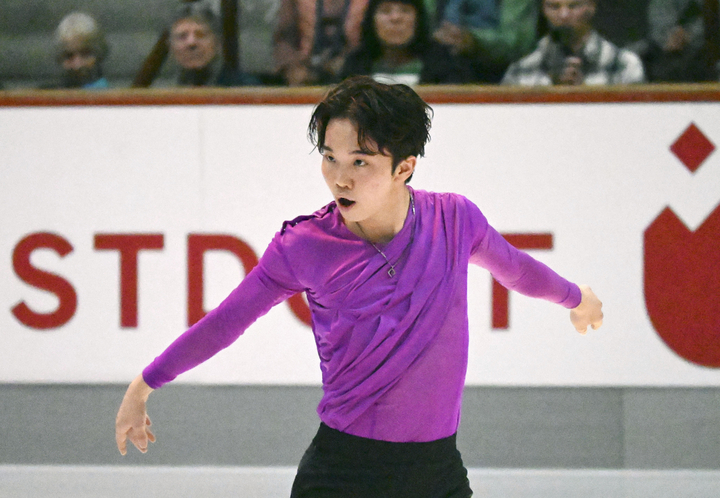

 Granted, I was still sleepy from watching pairs until late the previous evening (felt bad for RikuRyu, they would have won if not for that one fall), and from having got to sleep after midnight, so I wasn't at my best, but still, I'm much taller than Kazuki, so I would have expected myself to be the faster walker, especially when trying to get to free dances on time
  I'm glad you managed to take a photo with him, and enjoyed his skating despite the jump mistakes. I'm also glad he's so popular and 'sought after', despite not many Japanese fans attending this time. I really hope he got to soak up this love and support as much as possible
 I thought that was a given but it's nice to have confirmation
  )
) )
)


