
Mom brings kid to freestyle skating session | Golden Skate

Mom brings kid to freestyle skating session

Well. I had to look up "AITA" and "NTA," but the mother is in the wrong. Especially when she says that her child is too precocious for public sessions since they are so crowded that he can't flit about as he pleases.
 
I came across this and know that it happens more often than not!
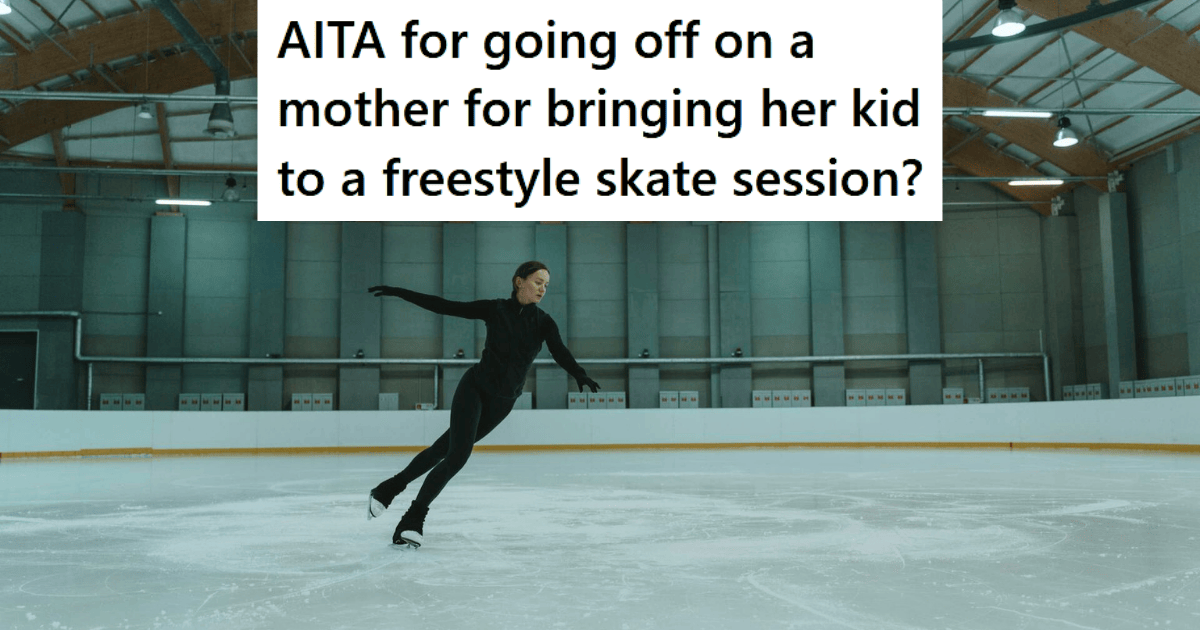

What are your thoughts? Experiences? How would you have handled it?
We've never had those freestyle sessions anywhere I've skated (I've always belonged to clubs and/or rented private ice -- and immediately shooed off people who didn't read the big schedule screen and started to step on the ice assuming it's a nice uncrowded public session), but I can imagine the situation. The skater exploded because she was startled and frightened by the unexpected mid-air collision. But she should have asked a coach or the rink staff to intervene earlier, when the kid started to make a nuisance of himself. And not started her program, knowing the kid was a potential hazard. If there was someone she had to ask to start her music, she should have said then, "I want to run through my program, but not until someone removes that little boy", as it must have been obvious he didn't know the traffic rules.

I've collided twice with other skaters while jumping, and it's not a fun experience. In both cases, the other skater was taller and heavier than I and immediately assumed the blame, helping me up and checking me out and apologizing over and over. Actually, I was more than half at fault, but I was the one sent flying. (Once it was Toller Cranston, who'd dropped in to a club he'd used to train at just to work out while travelling. My fault for forgetting he was a clockwise jumper and he didn't know I'm counter-clockwise, and we both turned to take off for Axels not realizing there was someone right behind.)
 
Boy, does THIS bring back memories!

What should have happened: before things got to an actual crash (and seeing that this kid was a loose cannon), a coach should have gotten on a mic and announced that all skaters need to to stay clear of anyone wearing a yellow belt. (I never had a yellow belt back in my practice days, I'm jealous, lol.)

I do remember that, at least in the rinks I trained, if you got in the way of anyone running their program or dance (usually in a private lesson), you had to get off the rink for 30 minutes before you could go back on. I had to oblige this rule a couple of times when I interfered with someone's program -- not intentionally -- but it was fair. And, at least a few times, other skaters interfered with my programs, and dealt with the same "punishment."
 
In ballroom dancing they have the "no-fault collision rule." The two men (gallant gentlemen that they are) take the lead in each apologizing politely to the other couple (while nevertheless maintaining a body posture -- if it is during an important competition -- that says "you clumsy oaf.") Weaker dancers are expected tp stay in the center allowing the stronger couples to overtake them on the outside.

Figure skating, especially when jumps and lifts are involved, however, is quite different. The risk of serious injury is ever-present, and plus I would imagine that an injured skater could sue the rink owner for not enforcing safety rules.
 
Last edited:
Definitely experienced some annoying kids like that, but sort of on the subject, I would often chance going to public sessions because of how cheap it was. Some days would be lucky, not many people, so I would have more room, but on the crowded sessions I still have a few good memories of doing totally impromptu footwork sequences that I had to make up on the fly to weave inbetween wild kids going every which way in the middle of the rink. It's those rare moments where you're no longer thinking about what's going on, your body just instinctually takes over and you're executing turn sequences that would normally probably be frustrating to practice. One time it astonished a coach who happened to be observing, that was fun.
 
This takes me back to many a practice session. We didn't wear belts, which would have been nice because sometimes it would be hard trying to figure out who was practicing their program with the music (many skaters doing run throughs without music). The rules were not written down anywhere but they were told to us by the coaches or other skaters. It was programs with music had right of way, lessons, then whoever was the fastest on the ice, and after that everyone else. Mind you when I was young and made the jump from group lessons to private I wasn't told this right away. It wasn't till I was almost run over by someone skating their program that my coach then told me. In my years of skating there were many times I ran into a kid or almost ran into them. Can't tell you how many times I would have to say "watch out" or "excuse me" as I tried to maneuver. As time progressed the rinks did split the sessions by club ice and non club ice. Then eventually by skill level, or non jumping sessions for dance and moves.
 
This takes me back to many a practice session. We didn't wear belts, which would have been nice because sometimes it would be hard trying to figure out who was practicing their program with the music (many skaters doing run throughs without music). The rules were not written down anywhere but they were told to us by the coaches or other skaters. It was programs with music had right of way, lessons, then whoever was the fastest on the ice, and after that everyone else. Mind you when I was young and made the jump from group lessons to private I wasn't told this right away. It wasn't till I was almost run over by someone skating their program that my coach then told me. In my years of skating there were many times I ran into a kid or almost ran into them. Can't tell you how many times I would have to say "watch out" or "excuse me" as I tried to maneuver. As time progressed the rinks did split the sessions by club ice and non club ice. Then eventually by skill level, or non jumping sessions for dance and moves.
Where I grew up, figure skating moves weren't permitted at public sessions, only in your club's time. When I went to skating birthday parties (a popular custom for Canadian kids) or, as a teenager, went to the nearest arena with friends after school, I just went round and round like everyone else and that was fine. In club sessions, I must have been told the rules of the road very young and don't remember not knowing them, except for my coach explaining "the skater who's practising a program has the right of way" because I didn't know what a "program" was. An added twist to that was when someone who loved someone else's music would improvise to it, and you didn't always remember whose music it actually was. That led to occasional collisions and arguments between skaters, or their coaches, or their mothers, or everybody all at once :dbana::angry3::angry4:
 
Now that I have had a day to think about what I read yesterday, I will say one thing I wish happened differently. (Well there were of course a couple things, like the kid paying attention to not get in anyone's way for one.) What I wish had happened is that maybe the coach when they finally spoke up after taking entirely too long to, is encouraged the kid and mom to consider taking private lessons and learn to skate. It seems the kid really enjoyed skating. I mean the mom of the kid already sounds like a skater parent, haha. If the coach had spoken up sooner to the kid and parent that whole situation would have been probably better for all involved.
 
Accidents happen even at the super-duper elite level like Mariah Bell and Eunsoo Lim at 2019 Worlds or Jamie Sale mowing down Anton Sikharuilidze at 2002 Olympics.
Yuzuru and Yan Han from China had a really serious collasion in China 2014. It was dangerous situation and Yuzy decided to compete though he was injured.
 
) What I wish had happened is that maybe the coach when they finally spoke up after taking entirely too long to, is encouraged the kid and mom to consider taking private lessons and learn to skate. It seems the kid really enjoyed skating.
What a perfect solution. You should shoot off a suggestion to the USFSA to commiunicate that approach to coaches and rink officials!

Tthat way no one is put on the defensive and the emphasis is on, what your talented and enthusiastic yougsters really needs is some solid instruction that will not only provide him with real technique but also will let him learn the safety and ettiquette rules of the sport. :rock:
 
Last edited:
Yuzuru and Yan Han from China had a really serious collasion in China 2014. It was dangerous situation and Yuzy decided to compete though he was injured.
There are still quite a few videos of the crash and aftermath on youtube, I suggest anyone who takes it all too lightly have a look at Yuzu all blood and bandages - and his terrifying free skate - and they may have a rethink.
 
Yuzuru and Yan Han from China had a really serious collasion in China 2014. It was dangerous situation and Yuzy decided to compete though he was injured.
And quite a few Japanese OGMs from other sports (like judo) sharply criticised JSF and ISU in the Japanese media the very next day for making an injured skater make such a decision - compete or withdraw - when injured. The criticism was very severe, these experienced and older athletes were outraged that JSF and ISU literally risked a teen's life. What they found particularly scandalous was that he was allowed to jump without concussion being excluded first.
Yuzu himself said years later that it was the most stupid thing he did in his life and he did it because his mind wasn't clear after having lost consciousness a few times, and no one told him then what the risks were. He believed there should be a rule for such cases, and that simply leaving it for the athlete to decide on the spot was completely wrong.
 
What a perfect solution. You should shoot off a suggestion to the USFSA to commiunicate that approach to coaches and rink officials!
The problem that USFS has no direct authority over rinks, which are not USFS members, usually privately or municipally owned, and more focused on higher-income uses like hockey and public sessions.

Many rinks have policies that skaters must have passed certain beginning freestyle classes (or tests) to be allowed to skate on freestyle sessions at all, or maybe allow skaters at lower learning levels, including beginning hockey skaters, to skate on these sessions IF they are in lesson with a coach. But a beginner without a coach is only allowed on public sessions.

In this case, the problem would have been avoided if the rink had enforced such a policy.

Otherwise, yes, it is best for coaches to communicate it, and the safety risks, as soon as the skater gets on the ice who clearly doesn't belong there.
 
Back
Top