Thanks a lot, rRainbow!

Translations by a native speaker are much better to have than what autotranslations can produce.
In the meantime, while joining the 'why can't Sota and Kazuki compete together in Finlandia' mood from Kazuki's thread... there's also a new article on Sota. And Chunichi is free and not geoblocked, yay!

Thank heavens for this newspaper that makes my life happier.
フィギュアスケートの新シーズンに向け、山本草太(MIXI)は「新たな自分を見せたい」と意気込む。挑戦の背景には、これまでに2度出演した...

www.chunichi.co.jp
Sota Yamamoto wants to bring the inspiration and lessons he gained from the ice show "Kassouya" produced by Daisuke Takahashi to the competitive arena in the new season, showcasing a "new self" he wants to present.
As the new figure skating season approaches, Sota Yamamoto (MIXI) is determined to "show a new side of myself." A major factor behind this challenge is his experience in the ice show "Kassouya," produced by Daisuke Takahashi, in which he has appeared twice before. Performing alongside Takahashi and others has been a great source of inspiration for Yamamoto, and is the origin of his desire to express a new version of himself.
◆The Milan Olympics season, which I embarked on while feeling that it was the end of my competitive career
Yamamoto had been considering retiring at the end of this season since the beginning of the 2025-26 season, when his ultimate goal was the Milan-Cortina Winter Olympics. However, a series of back injuries made the path to the Olympics much more difficult than he had imagined.
Last September, just before the Kinoshita Group Cup in the Challenger Series, he injured his lower back in a fall during a jump. "When my back hurt, I really couldn't do anything." With his back hurting even when he was just standing, he couldn't practice skating, let alone spins or do any off-ice training, and he recalls, "That period was really tough."
Yamamoto struggled to achieve results in the Grand Prix series, but gradually improved his training and reached last year's All Japan Championships. Starting from sixth place in the short program, mistakes in his jumps and other issues affected his free skate, making him feel that his chances of representing Japan at the Olympics were slipping away. After his performance, Yamamoto remained motionless on the ice for a while. After touching the ice with both hands, he slowly raised her gaze, as if to imprint the cheers and images of the spectators into his memory. At that moment, the only thought that came to mind was "It's over."
He didn't make it to the Olympics. But he got a chance to compete in the Four Continents Championships and won a bronze medal. He was genuinely happy that "the results of his training were finally showing on the ice." And, driven by the desire to "still be able to move and make up for the disappointment of this season," he decided to continue competing.
◆ "Especially in the season after the Olympics, I want to express a new version of myself."
As he headed into the new season, Yamamoto's intuitive feeling was one of wanting to "take on a challenge." Looking back, he recalls that up until the Olympic season, he focused on utilizing his strengths, choosing "beautiful music and moving programs" that showcased his fluid skating.
For example, in his free program "Melting/Sogno di Volare" from the 2024-2025 season, he expressed a dynamic worldview set to a powerful chorus and a magnificent orchestral piece. Regarding this season's free program "Hallelujah," she said, "It's a song that suits me perfectly. I can skate to it naturally."
However, after the Olympics, he felt a strong desire to "challenge himself with difficult pieces rather than sticking to songs that showcase his strengths." He attributes this largely to his experience in "Kassouya."
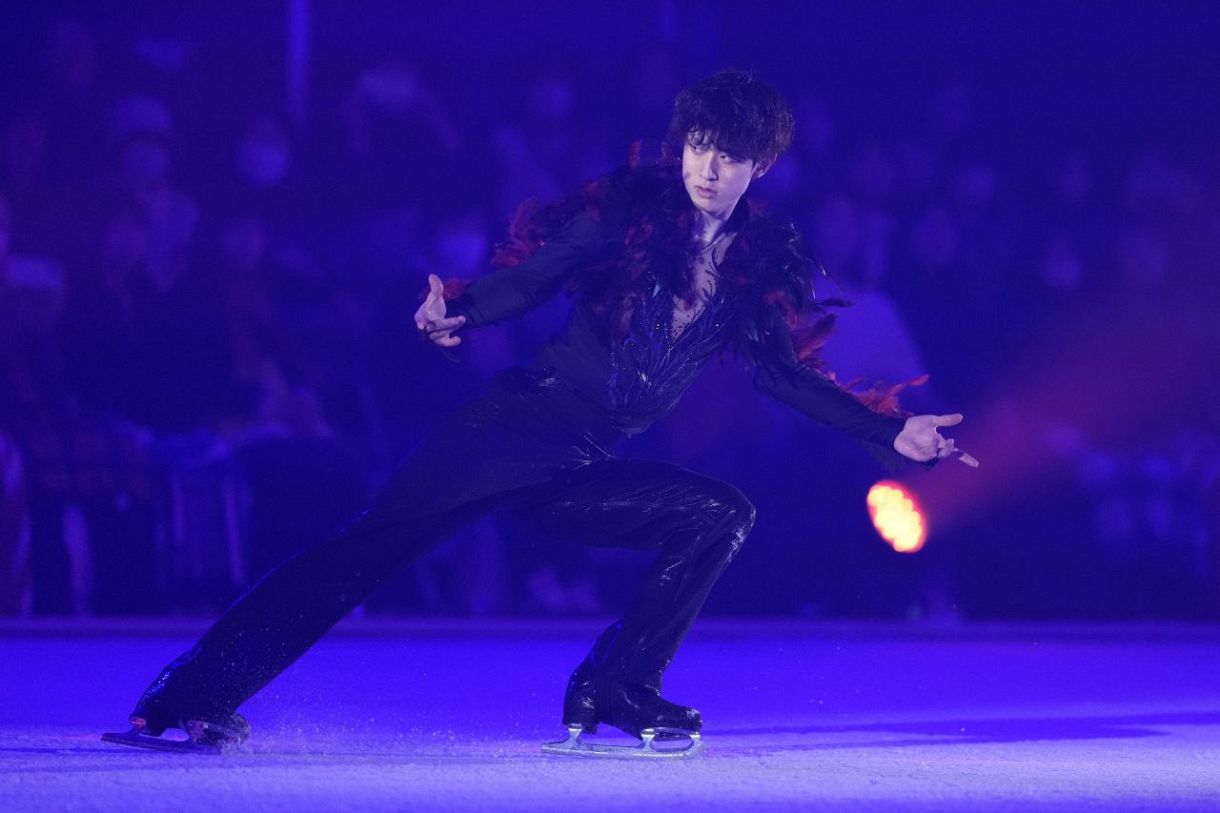
In the show, he performed danceable routines and programs expressing a dark worldview, a stark contrast to his competitive programs. As a result, many of his fellow performers and fans commented that "Sota's image has changed," which made him think, "Maybe I should try challenging myself with competitive programs too."
◆Inspiration and learning from "Kassouya"
His first appearance on "Kassouya" was in 2024. In that episode, he performed tango, a dance he had no experience with, and said, "The passionate melody and expression were a great learning experience." He had to memorize choreography that matched body movements to each individual note, and said, "I was desperate every day." However, just watching Takahashi's body movements, how he interpreted the music, and how he directed his gaze up close was a valuable learning experience. He added, "He has such a strong presence even when he's just skating slowly. His footwork is amazing when he takes steps. It was a real learning experience."
It's not just Takahashi. There's also Oshima Kosho (Fuji Yakuhin), who is "one of a kind and naturally catches the eye," professional skater Murakami Kanako, active skaters, and skaters who won their spots through auditions—"They all have a natural talent." He receives a lot of inspiration from the skating of skaters who usually train in different locations and don't have the opportunity to practice together, and "he naturally felt the urge to absorb it."
His second appearance was in "The Skating Shop - Volume 2" this past March. The show incorporated a story based on the Four Symbols from Chinese mythology—Azure Dragon, White Tiger, Vermilion Bird, and Black Tortoise—and he took on a challenge that further tested his expressive abilities.
In the show, the group was divided into four teams, corresponding to the Four Symbols, and Yamamoto belonged to the "Vermilion Bird" team. He was chosen to perform "Perune" as a solo. Takahashi himself selected the song.
"I think Daisuke-san sensed this dark side in my skating image and the worldview I excel at. It's a worldview that's easy for me to perform, and I felt I was able to show a new side of myself," he said, expressing his satisfaction.
◆I want to incorporate Kana Muramoto's alluring movements.
Throughout practice and the actual show, he cited Kana Muramoto as one of the skaters who inspired him. In the show, Muramoto is the leader of the "Genbu" team, which is made up of female skaters. She creates a unique world with her mysterious aura.
Seeing her graceful and beautiful dance up close, he felt inspired to try a new form of expression, saying, "Kana's movements are so alluring. I'm a man, but I'd like to incorporate what I can. I honestly feel that I can't move like that."
Furthermore, Yamamoto was captivated by the performance of Mayuko Oka (Kinoshita Academy) this season, which was choreographed by Muramoto. "From the moment it started, there were unique and original movements, and the transitions weren't just simple steps. Even after the elements were finished, she kept stepping towards the next jump, which was really amazing," he thought, and at the same time, "I want to incorporate this." This led to him asking Muramoto to choreograph his short program. In addition, Takahashi was put in charge of selecting the music for the program.
◆It's a different style from my original skating...
Originally, Yamamoto's skating was characterized by its fluidity. Previously, he was aware that "many people say that I like my majestic skating, but in competition these days, you are required to capture the music more precisely and take more original positions. There are aspects that are quite different from my own skating, so I have been having seasons where my scores haven't improved as much as I'd hoped. It's something I'm working on."
However, until the Olympic season, he didn't plan to make any major changes to his skating, saying, "I want to improve my score by even one or two points by focusing on small details like performing on a larger scale within the programs I currently have, or leaning my upper body more."
But through "Kassouya", he developed a strong desire to "break through my own skating style and make something that incorporates various transitions my own."
He finished the choreography the other day. Before the choreography, he told Muramoto-san something. He told her that "the dark and sharp worldview of the performance I did at Kassouya felt like a perfect fit for me, and I realized that this kind of musical style suits me surprisingly well."
Muramoto understood the intention, and the choreography proceeded with Takahashi's song selection. "There are a lot of dance moves with a low center of gravity[***]. I want to express myself without being too light, through my gaze and body movements," [Yamamoto] said enthusiastically.
[***] - okay, I'm confused by this part because the Japanese version doesn't mention a 'low' center of gravity or 'dance moves', just a lot of gravity- or balance-related choreo.
◆ "Kassouya" is a "company" that nurtures the next generation of skaters.
"Kassouya" is a show, but it's also a place for skaters to grow. Normally, skaters who have achieved a certain level of success are invited to appear in the show. Yamamoto also said, "Even though Daisuke and Kana could do the show with just those two, the fact that they're featuring so many young skaters is a truly wonderful initiative and a wonderful company." Furthermore, some skaters who have appeared in "Kassouya" have gone on to try ice dancing. It has become an opportunity for them to believe in their own potential and start walking a new path.
For Yamamoto, the skating world was a place of growth. Takahashi was "the first Japanese skater whose name I remembered." Standing on the ice with his idol, he learned about the resolve required to live as a professional skater, and was exposed to Takahashi's unique "expression that makes the air seem to move," absorbing his beloved skating from various angles to the fullest. Now 26 years old, Yamamoto, who is approaching his prime, will take on a new season.
*******
random Surimi train of thought, feel free to skip...
-
until the Olympic season, he focused on utilizing his strengths, choosing "beautiful music and moving programs" that showcased his fluid skating - nope, So-chan, not necessarily. Benoit, Dark Eyes, subdued climax-free Dragon music, and jazz, did nothing for you PCS-wise because they build on good expression skills or dance skills. That's not utilizing your skating... or beautiful music, for that matter, IMHO.
-
after the Olympics, he felt a strong desire to "challenge himself with difficult pieces rather than sticking to songs that showcase his strengths - plz tell me he's just going to focus on the expressive skills then, and sacrifices one 3A or 4S in the jumping passes, and has dropped the 4F for good.
-
"I think Daisuke-san sensed this dark side in my skating image and the worldview I excel at. It's a worldview that's easy for me to perform, and I felt I was able to show a new side of myself," he said, expressing his satisfaction. - I'm feeling satisfaction too. Been saying the same since Jekyll&Hyde, lol.
-
Furthermore, Yamamoto was captivated by the performance of Mayuko Oka (Kinoshita Academy) this season - yes! She was the highlight of the last junior season for me. And the programs really made her stand out.
- P
reviously, he was aware that "many people say that they like my majestic skating" - me, me!

I wrote that many times in fan letters, but no idea if he gets to read those much. He says he doesn't have a lot of time to read fan letters so...
-
"the dark and sharp worldview of the performance I did at Kassouya felt like a perfect fit for me, and I realized that this kind of musical style suits me surprisingly well." - yess

Is that a hint of what the new SP is like? Hopefully so! Just not POTO please, that one's suitable for Sota vibe-wise, but kind of cheap and overplayed

-
For Yamamoto, the skating world was a place of growth. Takahashi was "the first Japanese skater whose name I remembered." - aww, I can so imagine little Sota watching skating on TV with his mom, and cheering for Daisuke




 . He also talked about his new work and plans for the future.





 I've actually been told that some people quite like that too, and also the 2018 free program 'Nobunaga Concerto'. What else would I like.... 'Exogenesis', perhaps.