Coach and Choreographer interview – Marina Zueva
Daisuke is “Zeus”
Marina Zueva, who is based in Florida, USA, teaches the team of Kana Muramoto and Daisuke Takahashi. As a coach and a choreographer, how will she help the couple/team to improve? The world has been paying attention to her skill in raising many top ice dance teams.
Profile: Born in 1956 in the former Soviet Union. As an ice dance coach and choreographer, she has trained many top ice dance teams, including the world-famous Meryl Davis/Charlie White and Tessa Virtue/Scott Moir teams. She is also a trusted advisor to singles skaters and has choreographed for Japanese skaters such as Yukari Nakano and Takahiko Kozuka. Since this season, she has been coaching the team of Kana Muramoto and Daisuke Takahashi.
--What was your first impression when you heard that you were going to be working with Daisuke Takahashi?
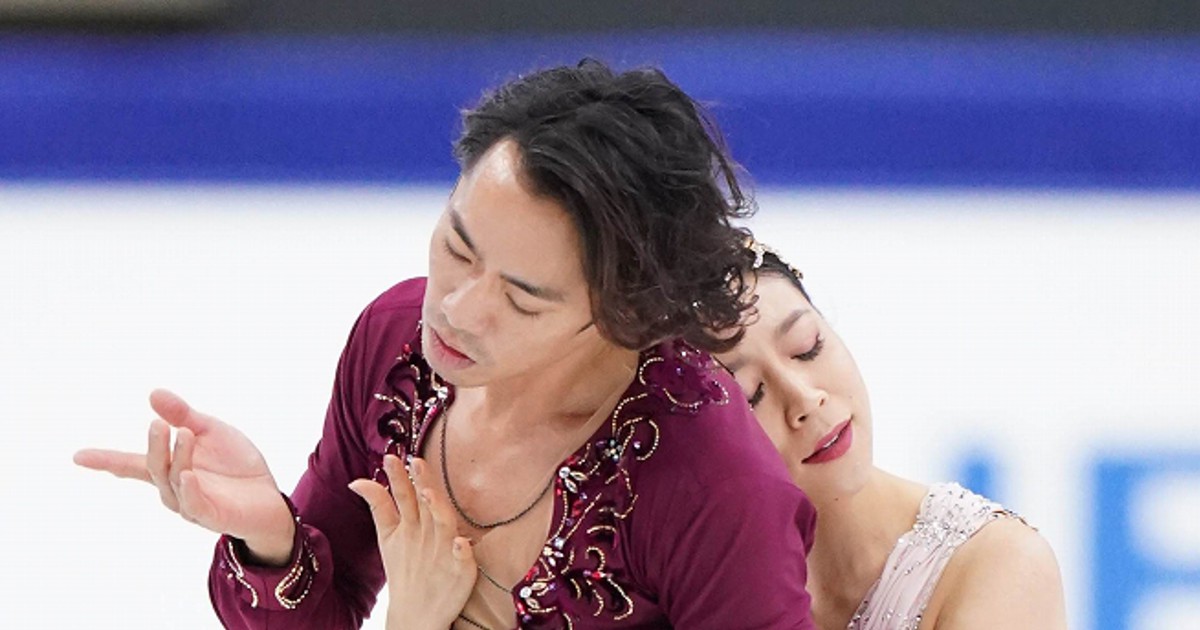
Marina: First of all, the most important thing/story is that the team is based on Daisuke. Kana is his partner, but Daisuke is the one converting to ice dance. When they first walked in, I was transfixed by Daisuke. The way he looked at people, the way he smiled and his richness of expression was so unusual. I think it's great that he can express himself with facial expressions. When I saw him looking at Kana and Kana looking back at Daisuke, I knew that they were already a duet/team. It is difficult for a boy and girl to convey their emotions (to each other) through facial expressions, but the way Daisuke looked at his partner, the way he expressed his feelings, made them both look like that (a couple/team) instantly.
--What was the first step in forming the team?
Marina: When I first saw Kana and Daisuke together, the first thing I thought about was how to bring out the best in Daisuke. The transition to ice dancing is not an easy one. I knew a lot about Kana from our four years together, but this was my first time working with Daisuke. Of course, as a singles skater, I knew that he was a wonderful, beautiful, and extremely versatile skater with a lot of potential. He is very emotional and his skating technique is excellent. Edge control and twizzles are also first rate, not to mention his body language and expressiveness. He has a natural speed and fluidity. I gave him a name: Zeus. Zeus, the ancient Greek god of the sky. His skating is unbelievable. I thought he was the best ice dancer I've ever had. It was the first time I had seen him skate up close and I knew they were going to be a great couple/team. They are very uniqe and not like any other team.
-What does this challenge mean for the former players?
Marina: When I found out that Kana's new partner was Daisuke, I thought it was a dream come true. I couldn't have asked for a more ideal partner for ice dancing. He has all the right ingredients. As I said, his skating technique, his dramatic expression, his ability to express the music, that is a natural talent. And then there is the fluidity of the performance. The list goes on and on. And Kana, when she skates with Daisuke, is able to express herself better. There is a sense of chemistry between the two of them. And her beauty is blossoming, like a flower blooming. I think you'll soon notice. It's difficult to explain in words, but it's a true chemistry. They complement each other very well. What one doesn’t have, the other makes up for, and vice versa. That's what I was conscious of in the choreography. It feels like a dialogue in which Kana accepts what Daisuke expresses, and then Kana reacts to it. Two as one.
--You started full-scale training in the USA in January, were you already in a position to start?
Marina: No, not really. I think not. Daisuke had to compete in Nationals singles competitions and ice shows, so I don't think he skated much. They did skate some numbers together in the shows, but they were just for show, not for real practice. What was interesting was that Daisuke came to me and said "I didn't know ice dancing was so hard until I tried it! It's really hard! When he skated with Kana, he probably only skated hand-in-hand around the rink, but now that he has started training, he realises how hard it is. I was surprised that Daisuke was able to stay on the ice for so long. In general, an ice dancer trains on the ice for more than twice as long as a singles skater. A singles skater trains about 3 hours a day, while an ice dancer trains about 5-6 hours a day. But Daisuke never lost his motivation and concentration, he kept on practicing for a long time. This was because he had realised how difficult ice dancing is. And indeed, it is one, and it has not been a monotonous journey.
--When you started, what did you find difficult?
Marina: First of all, due to the pandemic, we did not have a long time to work together. When the rink closed in April, Kana and Daisuke went back to Japan for a while to continue training (with me) online. We even choreographed some parts online! It was a bit of a surprise that it could be done this way (laughs). But it went really well. The beginning and ending weren't solid, so I completed it remotely, and they came here in June and trained here for about half a year until November.
--It is difficult to have a critical year under a pandemic. When you should have been able to train with a coach or a choreographer.
Marina: Yes, but you have to accept the situation and adapt to it and make the best of it. But they are both very positive. They are always smiling and laughing, and if they make a mistake, they can just correct it, they never get frustrated.
--How did the lifts go? Takahashi has never skated with a partner before, so it must have been very difficult.
Marina: That was a challenge for us too. The skating part was fine, but the lifts were a problem. The other parts came naturally to him, but he said "Only the lifts are a problem." Of course, he had never done it before.
The highly experienced Johnny Johns was in charge. He has worked with Olympic champions Meryl Davies and Charlie White, Tessa Virtue and Scott Moir and also with Tanith Belbin and Ben Agosto, Maia and Alex Shibutani. Based on his extensive experience, he has chosen the most suitable lifts for both of them. We only have two lifts in the La Bayadere programme, I think the next step for Kana and Daisuke will be to develop their creativity in the lifts.
--How do you teach online?
Marina: It was easy to work with them because they understood everything straight away, it was like working face to face. We filmed them on the rink and Johnny practiced the lifts online using FaceTime! It was a bit difficult because of the 14-hour time difference between Japan and Florida. That was a bit of a challenge, because we were up at 3.30-4.00am in the morning to fit in with their training times! They only had a limited amount of time to use the rink. Johnny's lessons started at around 9pm here and were split into a morning and evening session. However, the important thing was that they were able to practice on the rink, so I tried my best to get up early. But I think it went well. When we met again in June, we saw how far they had come.
--When you saw them again in June, how did you feel about their progress?
Marina: They were able to understand each other better. The body line was also beautiful. They skated two times a day, so the results were pretty good. They also did a lot of modern dance training off ice. Above all, the skating was getting stronger and better. The more you skate and the more you practice, the more growth you will see. Under the circumstances, we did as much as we could. The choreography of the RD was completed at the end of September and although it has only been in existence for a short time, we think you will be impressed by what you see. As I said to them, we can focus on improving the performance in the future. I told them, if they continue to improve, they can aim for the podium. Of course, we need more time. It is still a difficult season. This is the year of patience, perseverance and practice.
--I heard that Takahashi is also working on a physical transformation.
Marina: Now is the time for Daisuke to learn how to manipulate the other person's body, and how to use his own body and hands. When he first came to me, he was very slim, with a firm lower body but a very thin upper body (laughs). But then he started to work out. He said, "Marina, I've never worked out my upper body before in my life!” He says he used to only train his lower body and core, but this has completely changed. The muscles around his shoulders have grown stronger, his weight has remained lean and he has the ideal inverted triangle shape now. You can see it when you look at his back. In addition, his face has become firmer. His skin has become so smooth and firm. I couldn't help but ask him if he had had Botox injections. (laughs) Daisuke said, "No, I haven't! I just ate a lot!” (laughs). Kana was also physically trained, and they were always doing their excercises.
--Tell us about the programs. What did you have in mind when choosing the songs?
Marina: I thought it would be good to do rhythm and free dances of very different styles to bring out the different talents that they have. The rhythm dance is more difficult because it has a more rhythmic feel. For this reason, we started with the free dance. I want to show you the many faces of this couple: they can be purely classical and they can dance. In this way, we will be able to show their full potential.
--The free dance is "La Bayadère".
Marina: I thought that ballet would be good for the Free. I have a master's degree in ballet from the Moscow State University of Arts, so I know a lot about ballet music. For the free dance, I thought it would be better to have a ballet piece that was a bit more exotic than a purely classical piece. So we chose "La Bayadère". For the last few years, the mainstream of ice-dance has been modern. The French couple established a great style and spearheaded the tide, followed by ice dancers all over the world. Many of them are now doing a modern style in their free dances. So I dare to say that Kana and Daisuke have a different way of doing it. So I thought it would be interesting for them to have a different style. I played the song to them and they loved it. The ballet is very rhythmic, with waltz and adagio parts, allegro parts and a lot of development. There is also a solo part for the instrumentalists. They are both very musical and have a great ability to express the world of the music. They can skate in any style. This is the reason why “La Bayadère” has been chosen by (for?) them. I thought " La Bayadère" was a great number for them.
--How did you tackle the rhythm dance?
Marina: The rhythm dance is almost all footwork, from beginning to end. Massimo also said that "the greatest challenge for me was footwork", and footwork is as difficult as lifting, because the two of them are in such close position. In order to do this, it is better if you spend more time together and get to know each other's characteristics. If you are still a beginner, you will not be ready. Therefore, before choreographing the rhythm dance, they needed to skate together to understand each other's feelings, to familiarise themselves with each other's skills and positions and get a good feel for each other. We did that first, and when we thought they were ready, we started the choreography.
--The choreography was done by Marina. How did you choose the music?
Marina: The song "The Mask" for the Rhythm Dance was Kana’s and Daisuke’s choice. The theme is "Let's have fun and dance with joy! It is a very white (light?) and fun programme. How can we feel the music in our body and dance? There will be a lot of comical moments in the scenes where the couple will be dancing happily. It's a programme that will make you swoon from start to finish. It's a very exciting programme. My young coach, Ilya Tkachenko, is also involved in the choreography of the programme. It was a lot of fun to work with them. Especially Daisuke, who really understands everything instantly. Believe it or not, Daisuke also came up with his own suggestions for the choreography. It was amazing. So it was a lot of fun.
--When you were choreographing the programs, Takahashi also gave you some ideas.
Marina: Yes, that's right. I always said, "Thank you Daisuke! (laughs). I have always enjoyed working with skaters to come up with ideas for choreography. Partly because I want to see what they come up with, but also because I want them to fall in love with their own program. What I do is not to provide choreography for the sketches. (?) It's about bringing out the best in each couple. It's about what's best for them and at the same time bringing out the best in them. The idea is to create something that makes them look as beautiful as they are (can?). To do this, we chose special songs and movements/shapes that make them look their best. For example, I want to make sure that the proportions are the most flattering. If you watch the free dance, you will know what I mean just by looking at the beginning. Therefore these programs are for these two only, not for any other couple.
--What do you look forward to/expect from the first competition?
Marina: It's the first official competition and it's a Grand Prix series, so I think it's nice to be able to skate in front of your own fans. I'm sure the warm atmosphere will help their performance. Competition is the best training. I think that this unusual challenge has a high degree of attention, so it seems that there will be a lot of media coverage, but since they are (professionals?), it is part of the job to deal with such things. is. It is their mission to do the best performance with that power. Of course, I think it's a difficult task to put together all the elements in the first competition, but if you look at the completeness of each part, it is going to indicate how much potential this couple has. My expectation for the first competition is for them to perform in such a way that people will like them. I hope that they will make people fall in love with them, the judges and the audience. That's how they will be recognised by the ice dance world as a team. And I want them to skate with a lot of love (for skating) and a lot of affluence: if they didn't love skating, Daisuke wouldn't have been able to come back to competition in this way. He loves skating, whether it is singles or ice dancing, he really enjoys it. So I want them both to feel the full force of their love for skating. To move together, feel the music and express themselves to the audience. It would be great if they can do that in their first competition.
-So you think it is important to take part in ice dance competitions primarily to gain experience?
Marina: Yes, of course. This season is the year of experience. It is about learning how to compete. It's one thing to train together, it's quite another to perform together in a competition. The stress and the atmosphere are different and you have to be able to cope with it. It's natural to have one at a competition. (?) You have to cope with that and build on the experience. It is an experience that you need for the future.
--In this respect, wasn't it a pleasant surprise to see how quickly Takahashi was able to adapt?
Marina: Daisuke is a legend. He is my favourite skater of all time. (Did she really say that?) Even in the singles, he had a natural flow and speed. His footwork is very light. His skating ability is amazing. Especially the usage of the knees. His knee bend and body balance are excellent. He is able to do such a wide range of movement because of his excellent body balance.
--Have you ever been involved with Takahashi in any way (before)?
Marina: I like Daisuke's single free program very much, so of course I was interested in him as a skater. I was also involved in the men's competition. My brother, Andre, also skated in the men's singles, so I was usually there for the meetings. (?) Daisuke was in the middle of the competition in men’s singles, where Japanese boys were fighting for the Olympic podium. But he was exceptional in his expression. His jumps were so dynamic that it was as if he was flying over the rink. His performance was always dramatic, and his hair style was always beautiful. He has a unique presence in the world of figure skating, he is like no one else. He's a skater I've been watching for a long time. He's so unique, so different. He is a Japanese diamond. So now I feel like I have a diamond in my hands. You have to take care of it very carefully (laughs). All joking aside, I feel very privileged as a coach. To be in charge of such talented teams. I feel a sense of duty to make them the best they can be.
--Do you see the Beijing Olympics as a future goal?
Marina: Of course. We have that goal. First of all, we need to meet the requirements to participate in the Games in China, but there is still time. If everything goes well, and they continue to train as well as I think they can, and if they continue to develop in this way, they will have a good shot at the podium at the Olympics. They can do it. They still have more than a year to go, but we don't know if the pandemic will be over. The competition may be postponed, but the more time they have, the better for them. I am convinced that the potential is there. As I said before, Daisuke already has the skating skills and he is getting better and better with Kana. By skating with Daisuke, she is able to express herself much better than before. It's like she's moving up to another level. She was also an excellent singles skater. Her skating skill was great and her coordination was good. Her coordination of the triple jump was also very strong. They are both good skaters and I think they could be the best team in the world if they had the time.
--It's great to know that you can grow with the people you work with.
Marina: I think it's great for both of us. And I think they are setting a great example in this world. Just because you can't jump as much as you used to, it doesn't mean you have to end your career. There are still ways to continue skating, such as ice dancing or artistic dancing. It's a shame to quit when you have the ability to skate and the talent to express yourself. Because the basic skill is the same as that of figure skating. If a skater has a high level of skating skills, he or she can go to another category, he/she can still be a high-level skater if he/she obtains the other qualities that are needed there. The best is the best. (?) For example, if you want to change to ice dance, expressiveness is a must. And there must be chemistry between you and your partner. If you have this, there is no reason why you can't aim for the top. You already have the essential skating skills. All you have to do is skate with them and hone your skills. It's all about experience and a willingness to learn.
--Marina, you yourself seem to enjoy working with them a lot.
Marina: Yes, every morning is a pleasure. Every day with them is a celebration for me. There's a lot of work to do, but it's always a pleasure to go to training. The joy is to see the progress. There is always a step forward every day, even if it is a small one. The opposite is not true. There is nothing more fulfilling for a coach than that.
--Thank you very much. Any last words of encouragement for Kana and Daisuke?
Marina: I want them to enjoy the atmosphere of the competition, feel happy to be there and perform and I want them to go into the competition with the love of figure skating in their hearts.
--Do you have a message for the fans?
Marina: Enjoy their skating. Love them and support them. And engage with their performances. Please feel that you are part of their creativity. There will be moments when the audience will simply gasp and be absorbed by the performance, by the sheer movement. It is a very special moment for the audience when they feel that they are part of a skater’s performance. Hopefully, they will be able to give the audience a moment where they too can participate in their performance and creativity and make them and the audience feel a sense of unison. I am sure that Kana and Daisuke will be able to create such moments! I'm looking forward to it!



 They improved their combination spin in comparison to the NHK Trophy! I liked Dai’s bent leg position in the camel and it’s nice they got level 2 this time.
 They absolutely should keep it for next season. I just wonder, if maybe Marina and the coaching/choreo team can come up with an alternative for the StaLi? It requires sooo much strength and seems to be too ambitious for now. I’m sure the rest will come together with practice, experience and resulting higher confidence. It was already so, so good at NHK, just needs a bit more polishing.
www.olympicchannel.com
. Can’t wait to see this team win medals next year

 ) There was some additional footage to the original broadcast on Fuji TV One (close-ups during the 6 minute warm-up, KanaDai’s and Team Koko’s post skate interviews and part of the medal ceremony). My upload on google drive:
 :
:






 )
) (by Marina?).