- Joined
- Aug 8, 2023
I'm surprised 3Lo was the first triple.
I wonder if the difficulty feels different for men versus women. I can only comment on women since thats what I watch. I will do so now.
For triples we have the following order:
3T
3S
3Lo
3F
3Lz
3Lz seems to be the only one that consistently trips up the top girls, even the ones who jump quads.
The only girl I can find who clearly prefers the Lutz to the flip is Sadkova, see the following:


You can also decide what the following means to you in regards to Agaeva:


Muravieva is the only example I can find who actually has a better success rate with the flip than the loop (I'm looking at all the top girls since Zagi/Medo era):


So for triples the Lutz is clearly harder than the flip, with 1 maybe 2 exceptions, and Muravieva the black sheep with the flip/loop disaprity. I would say the trend generally holds for novice, junior and senior alike (I'll touch on this at the end). This is notable because it seems to me that is NOT the case with quads.
Now about quads, the fun part...
For Seniors (or generally mature/grown girls):
4T
4S
4F
4Lz
4Lo
For Junior (moderate maturity):
4T/4S
4Lz
4F
4Lo
For Novice (small girls):
4S
4T
4Lz
4F
4Lo
About the 4Lo, we can just forget about it. Its very obviously the hardest. I think Adeliia is the only one to land it in competition, and its been a while. Not exactly consistent either:

For seniors, 4T seems to remain the easiest as with triples. Its the only quad Kamila and Akateva maintained after growing. Adeliia, Sadkova, Sasha, all also showed it. Notice also how they all stabalized or otherwise improved it as they aged and grew. Is there a quadster who can't jump a 4T? Gorbacheva with the 4S is the only one I believe. Wait... Anna only had a 4F and 4Lz! So strange! What an interesting skater... The only one who jumped quads, but not a 4T or 4S, everyone else has at least either or.
4T also seems to be the jump girls who never jumped any would speak about when suggesting future quads; I've heard Frolova mention trying 4T, and Sinitsyna maybe too (this was when they were extremely consistent, fighting for bronze)? Among others...
4S is a close second, we have: Akateva, Sasha, Valieva, Gorbacheva. However, again, the former 3 also have the 4T, so its a clear favourite, and this will become especially significant when we analyze juniors and delve deeper into the quality of these jumps in regards to age of the performer. The raw correlation here is not particularly significant but still real.
The 4Lz vs 4F is very interesting... Sasha never jumped flip combos, Anna jumped one, however their solo flips had higher landing rates than the solo Lutz despite them jumping it less. Landing means not falling, nothing about edges or rotation. Here are the two athletes respectively:


Consider also Adeliia has a semi-consistent flip but never landed a Lutz... If we consider Dvoeglazova though who is borderline senior, she has a pretty consistent Lutz with no flip (though she landed it in training). So which is harder?? If it weren't for Dvoeglazova it would seem the flip is more manageable based on landing rates. Everyone calls Dvoeglazova a "true senior", however since she never actually skated senior competition and a LOT can change in a year, I am going to leave her out of this discussion. Considering the landing rates of the former champions, and Adeliia's repertoire, I'm calling the flip slightly easier for the quad (IN SENIORS), so keeping the same pattern as the triple but with an almost nonexistent gap whereas the triples had a conspicuous disparity. It is noteworthy that the two approach equilibrium when adding an extra rotation.
So, not much else of interest when comparing triples and quads with the ladies, other than the sudden explosion in difficulty for the loop and the Lutz-flip equilibrium. Another user suggested the loop should be easier if the calling was more strict with the Lutz and flip. I disagree, at least for ladies. Its clear almost nobody can even rotate a loop in any way, while the Lutz and flip, although perhaps often dirty, are clearly doable and what they are supposed to be. For men, maybe there is a rule change which would change things, I dont know.
However, the interesting observation with relative difficulty is not between the triples and quads, but in regards to quads between age groups (at least for ladies).
It is hard to group by direct discipline (senior, junior, novice), since there is a lot of overlap, so I am just going to generalize by apparent physical maturity and size. We can quickly start with Rita and Kostyleva, the famous little quadsters:


To list all the 4S specialists under seniors would take FOREVER, I'll go off the top of my head just quickly: Andreeva, Korchazhnikova, Tsipukhina, Titova, Streltsova (#1 novice currently, I think she has a 4T but the 4S is way better), Gorbacheva (when she was junior), Gordeeva, Milto, Mazur, Stotskaya, Lukasheva, Pleskacheva (is trying), Lebedeva (last year), Zhilina (also has 4T), etc...

The only exceptions I can think of are Prineva and Sadkova, neither of which had consistent toeloops (Sadkova's is stable now, that she is bigger and older). Meanwhile a lot of the Salchow girls are quite consistent. Anna Dokukina has a 4T, I think Sarycheva landed a 4T in novice recently, Zaikina too? Anyways, the preponderance of 4S is enormous with younger girls; the roles are reversed between older girls and younger girls with the 4T/4S. Whereas 4T was the winner with seniors, the younger girls massively prefer the 4S. The bigger and more mature they are the more they lean towards 4T.
Kamila's 4T was probably the best we've ever seen from a woman during that 22/23 season, wow, just gorgeous...
Again Akateva is almost fully rotating that 4T after gaining a lot of size; I think the 4S is gone forever:
When we look at the older/taller juniors it starts to even out right in the middle. We see Dzepka and Dvoeglazova with 4Ts on the podium this year. Its a very smooth correlation shifting from 4S dominance to 4T dominance with age. Gorbacheva is the only senior holding on to the 4S and shes tiny.
Sasha did stabilize the 4S later into her career, but interesting thing is she was already racking up 4S attempts in 2017, 2 years before consistently incorporating the 4T.

Kamila and Akateva are slight exceptions in that they tried the 4T before the 4S in competition, but these two (especially Kamila) became total 4T specialists. Considering again they lost the 4S but hugely improved the 4T (especially with Kamila where it got more beautiful each year), I think this trend is quite ironclad.
Another really interesting correlation is that we never see the 4F from young girls, despite it supposedly being easier for seniors. Return to the earlier Sasha/Anna screeshots and notice the 4F was jumped once each in 2019 while the Lutz was there in 2018, and after 2019 the flip became more landable as they got older. Adeliia only started jumping the 4F in 2023. We have Prineva trying the 4Lz in juniors right now, but nobody with the 4F. Dvoeglazova just starting to try it in training as she enters seniors, but only landed 4Lz in competition. As far as I am aware, nobody has ever tried a 4F below seniors. Sasha and Anna were considered seniors in 2019. Nelyubova and Lukasheva also both tried lutzes (in junior), but never flip!
If we consider the entire female competition then as a whole, across all age ranges (which I think is unwarranted given what we have discovered here) we can actually suggest the Lutz as greater plausibility than the flip when both are rotated quaruply, despite the conspicuous opposite property of their triple versions. Although again we do see the equalization of the two in any case as we enter the quad realm, which is interesting (maybe its because technique becomes less relevant? Just get the rotation out and you win, since nobody else is even trying?).
In conclusion:
The women's triple difficulties are a borderline rule with the Lutz as most problematic, and flip following, over the loop, which is very clear of a salchow, and the solo 3T is easiest being almost never failed. Only Sadkova and Muravieva show exception, maybe Agaeva too depending on how you look at it.
When we look at quads, senior women have a massive preference for the 4T, with the 4S a moderately close second though the gap is real. Looking at younger girls, we see a preponderance of 4S with 4T in second however the gap between both being way bigger than in seniors, and with this reverse correlation. We find it to be a smooth transition towards 4T when considering a large data set including the older teenage girls who are transitioning into young ladies looking forward to soon-coming senior competition. We see that especially size and physical maturity lend themselves to the 4T, with girls jumping their most beautiful 4Ts when they are at their most developed.
We find also an age disparity between the 4F and 4Lz, with the 4Lz being present in young competition but the 4F completely absent, meanwhile the 4F is slightly preferred in seniors to the Lutz.
When comparing with their triple counterparts, the 4F and 4Lz gap equalizes with the Lutz being a virtually exclusive preference in combos for Sasha and Anna however the solo flip being a more successful jump than the solo Lutz. Adeliia also jumps the 4F without a Lutz. Overall if we consider senior competition the flip still seems more stable despite trending towards equilibrium with the Lutz. If we ignore age-correlation we find the Lutz becomes preferred to the flip, contrary to the extremely strong disparity when assessing triples. Again, in any case the flip and Lutz equalize for quads despite that extremely strong disparity for triples, which is significant and interesting.
We see the 4Lo is almost completely absent from female competition barring Adeliia Petrosian, despite the same sort of jump being standard as a triple.
Some analysts suggest a change of rules might affect these patterns. The loop pattern will not be affected in female competition by slight rule changes. The age correlation is also obviously independent of rules changes. The lutz-flip correlation could be affected by rule changes if the lutz becomes less desirable as a combo entry, however the sudden equalization of landability between the lutz and flip from triples to quadruples will still exist, which is interesting.
Of course those same analysists might be speaking about men's competition specifically, which does not matter to this discussion, and they might be totally correct in that regard.
A slight addendum: we do get more exceptions to the triple lutz-flip rule when we look at young girls. The lutz still gives more problems but not in such a drastic manner. We can check a couple examples.
Rita pretty much doesn't even jump the flip. She likes the Lutz a lot:

Prineva leans similarly:

Tsipukhina doesn't like the flip:


The rule is still pretty strong for juniors actually as I look through all the juniors, the majority lean towards the flip, although a lot of them are somewhat borderline and the correlation isnt as jarring as it is with seniors (but still real and clear). We can see above that it was easier to find exceptions as well whereas in seniors Sadkova is sort of a weirdo! It just adds a little bit of weight to the junior-specific 4F 4Lz observation we made earlier.
I wonder if the difficulty feels different for men versus women. I can only comment on women since thats what I watch. I will do so now.
For triples we have the following order:
3T
3S
3Lo
3F
3Lz
3Lz seems to be the only one that consistently trips up the top girls, even the ones who jump quads.
The only girl I can find who clearly prefers the Lutz to the flip is Sadkova, see the following:
You can also decide what the following means to you in regards to Agaeva:
Muravieva is the only example I can find who actually has a better success rate with the flip than the loop (I'm looking at all the top girls since Zagi/Medo era):
So for triples the Lutz is clearly harder than the flip, with 1 maybe 2 exceptions, and Muravieva the black sheep with the flip/loop disaprity. I would say the trend generally holds for novice, junior and senior alike (I'll touch on this at the end). This is notable because it seems to me that is NOT the case with quads.
Now about quads, the fun part...
For Seniors (or generally mature/grown girls):
4T
4S
4F
4Lz
4Lo
For Junior (moderate maturity):
4T/4S
4Lz
4F
4Lo
For Novice (small girls):
4S
4T
4Lz
4F
4Lo
About the 4Lo, we can just forget about it. Its very obviously the hardest. I think Adeliia is the only one to land it in competition, and its been a while. Not exactly consistent either:
For seniors, 4T seems to remain the easiest as with triples. Its the only quad Kamila and Akateva maintained after growing. Adeliia, Sadkova, Sasha, all also showed it. Notice also how they all stabalized or otherwise improved it as they aged and grew. Is there a quadster who can't jump a 4T? Gorbacheva with the 4S is the only one I believe. Wait... Anna only had a 4F and 4Lz! So strange! What an interesting skater... The only one who jumped quads, but not a 4T or 4S, everyone else has at least either or.
4T also seems to be the jump girls who never jumped any would speak about when suggesting future quads; I've heard Frolova mention trying 4T, and Sinitsyna maybe too (this was when they were extremely consistent, fighting for bronze)? Among others...
4S is a close second, we have: Akateva, Sasha, Valieva, Gorbacheva. However, again, the former 3 also have the 4T, so its a clear favourite, and this will become especially significant when we analyze juniors and delve deeper into the quality of these jumps in regards to age of the performer. The raw correlation here is not particularly significant but still real.
The 4Lz vs 4F is very interesting... Sasha never jumped flip combos, Anna jumped one, however their solo flips had higher landing rates than the solo Lutz despite them jumping it less. Landing means not falling, nothing about edges or rotation. Here are the two athletes respectively:
Consider also Adeliia has a semi-consistent flip but never landed a Lutz... If we consider Dvoeglazova though who is borderline senior, she has a pretty consistent Lutz with no flip (though she landed it in training). So which is harder?? If it weren't for Dvoeglazova it would seem the flip is more manageable based on landing rates. Everyone calls Dvoeglazova a "true senior", however since she never actually skated senior competition and a LOT can change in a year, I am going to leave her out of this discussion. Considering the landing rates of the former champions, and Adeliia's repertoire, I'm calling the flip slightly easier for the quad (IN SENIORS), so keeping the same pattern as the triple but with an almost nonexistent gap whereas the triples had a conspicuous disparity. It is noteworthy that the two approach equilibrium when adding an extra rotation.
So, not much else of interest when comparing triples and quads with the ladies, other than the sudden explosion in difficulty for the loop and the Lutz-flip equilibrium. Another user suggested the loop should be easier if the calling was more strict with the Lutz and flip. I disagree, at least for ladies. Its clear almost nobody can even rotate a loop in any way, while the Lutz and flip, although perhaps often dirty, are clearly doable and what they are supposed to be. For men, maybe there is a rule change which would change things, I dont know.
However, the interesting observation with relative difficulty is not between the triples and quads, but in regards to quads between age groups (at least for ladies).
It is hard to group by direct discipline (senior, junior, novice), since there is a lot of overlap, so I am just going to generalize by apparent physical maturity and size. We can quickly start with Rita and Kostyleva, the famous little quadsters:
To list all the 4S specialists under seniors would take FOREVER, I'll go off the top of my head just quickly: Andreeva, Korchazhnikova, Tsipukhina, Titova, Streltsova (#1 novice currently, I think she has a 4T but the 4S is way better), Gorbacheva (when she was junior), Gordeeva, Milto, Mazur, Stotskaya, Lukasheva, Pleskacheva (is trying), Lebedeva (last year), Zhilina (also has 4T), etc...
The only exceptions I can think of are Prineva and Sadkova, neither of which had consistent toeloops (Sadkova's is stable now, that she is bigger and older). Meanwhile a lot of the Salchow girls are quite consistent. Anna Dokukina has a 4T, I think Sarycheva landed a 4T in novice recently, Zaikina too? Anyways, the preponderance of 4S is enormous with younger girls; the roles are reversed between older girls and younger girls with the 4T/4S. Whereas 4T was the winner with seniors, the younger girls massively prefer the 4S. The bigger and more mature they are the more they lean towards 4T.
Kamila's 4T was probably the best we've ever seen from a woman during that 22/23 season, wow, just gorgeous...
Again Akateva is almost fully rotating that 4T after gaining a lot of size; I think the 4S is gone forever:
When we look at the older/taller juniors it starts to even out right in the middle. We see Dzepka and Dvoeglazova with 4Ts on the podium this year. Its a very smooth correlation shifting from 4S dominance to 4T dominance with age. Gorbacheva is the only senior holding on to the 4S and shes tiny.
Sasha did stabilize the 4S later into her career, but interesting thing is she was already racking up 4S attempts in 2017, 2 years before consistently incorporating the 4T.
Kamila and Akateva are slight exceptions in that they tried the 4T before the 4S in competition, but these two (especially Kamila) became total 4T specialists. Considering again they lost the 4S but hugely improved the 4T (especially with Kamila where it got more beautiful each year), I think this trend is quite ironclad.
Another really interesting correlation is that we never see the 4F from young girls, despite it supposedly being easier for seniors. Return to the earlier Sasha/Anna screeshots and notice the 4F was jumped once each in 2019 while the Lutz was there in 2018, and after 2019 the flip became more landable as they got older. Adeliia only started jumping the 4F in 2023. We have Prineva trying the 4Lz in juniors right now, but nobody with the 4F. Dvoeglazova just starting to try it in training as she enters seniors, but only landed 4Lz in competition. As far as I am aware, nobody has ever tried a 4F below seniors. Sasha and Anna were considered seniors in 2019. Nelyubova and Lukasheva also both tried lutzes (in junior), but never flip!
If we consider the entire female competition then as a whole, across all age ranges (which I think is unwarranted given what we have discovered here) we can actually suggest the Lutz as greater plausibility than the flip when both are rotated quaruply, despite the conspicuous opposite property of their triple versions. Although again we do see the equalization of the two in any case as we enter the quad realm, which is interesting (maybe its because technique becomes less relevant? Just get the rotation out and you win, since nobody else is even trying?).
In conclusion:
The women's triple difficulties are a borderline rule with the Lutz as most problematic, and flip following, over the loop, which is very clear of a salchow, and the solo 3T is easiest being almost never failed. Only Sadkova and Muravieva show exception, maybe Agaeva too depending on how you look at it.
When we look at quads, senior women have a massive preference for the 4T, with the 4S a moderately close second though the gap is real. Looking at younger girls, we see a preponderance of 4S with 4T in second however the gap between both being way bigger than in seniors, and with this reverse correlation. We find it to be a smooth transition towards 4T when considering a large data set including the older teenage girls who are transitioning into young ladies looking forward to soon-coming senior competition. We see that especially size and physical maturity lend themselves to the 4T, with girls jumping their most beautiful 4Ts when they are at their most developed.
We find also an age disparity between the 4F and 4Lz, with the 4Lz being present in young competition but the 4F completely absent, meanwhile the 4F is slightly preferred in seniors to the Lutz.
When comparing with their triple counterparts, the 4F and 4Lz gap equalizes with the Lutz being a virtually exclusive preference in combos for Sasha and Anna however the solo flip being a more successful jump than the solo Lutz. Adeliia also jumps the 4F without a Lutz. Overall if we consider senior competition the flip still seems more stable despite trending towards equilibrium with the Lutz. If we ignore age-correlation we find the Lutz becomes preferred to the flip, contrary to the extremely strong disparity when assessing triples. Again, in any case the flip and Lutz equalize for quads despite that extremely strong disparity for triples, which is significant and interesting.
We see the 4Lo is almost completely absent from female competition barring Adeliia Petrosian, despite the same sort of jump being standard as a triple.
Some analysts suggest a change of rules might affect these patterns. The loop pattern will not be affected in female competition by slight rule changes. The age correlation is also obviously independent of rules changes. The lutz-flip correlation could be affected by rule changes if the lutz becomes less desirable as a combo entry, however the sudden equalization of landability between the lutz and flip from triples to quadruples will still exist, which is interesting.
Of course those same analysists might be speaking about men's competition specifically, which does not matter to this discussion, and they might be totally correct in that regard.
A slight addendum: we do get more exceptions to the triple lutz-flip rule when we look at young girls. The lutz still gives more problems but not in such a drastic manner. We can check a couple examples.
Rita pretty much doesn't even jump the flip. She likes the Lutz a lot:
Prineva leans similarly:
Tsipukhina doesn't like the flip:
The rule is still pretty strong for juniors actually as I look through all the juniors, the majority lean towards the flip, although a lot of them are somewhat borderline and the correlation isnt as jarring as it is with seniors (but still real and clear). We can see above that it was easier to find exceptions as well whereas in seniors Sadkova is sort of a weirdo! It just adds a little bit of weight to the junior-specific 4F 4Lz observation we made earlier.
Last edited:


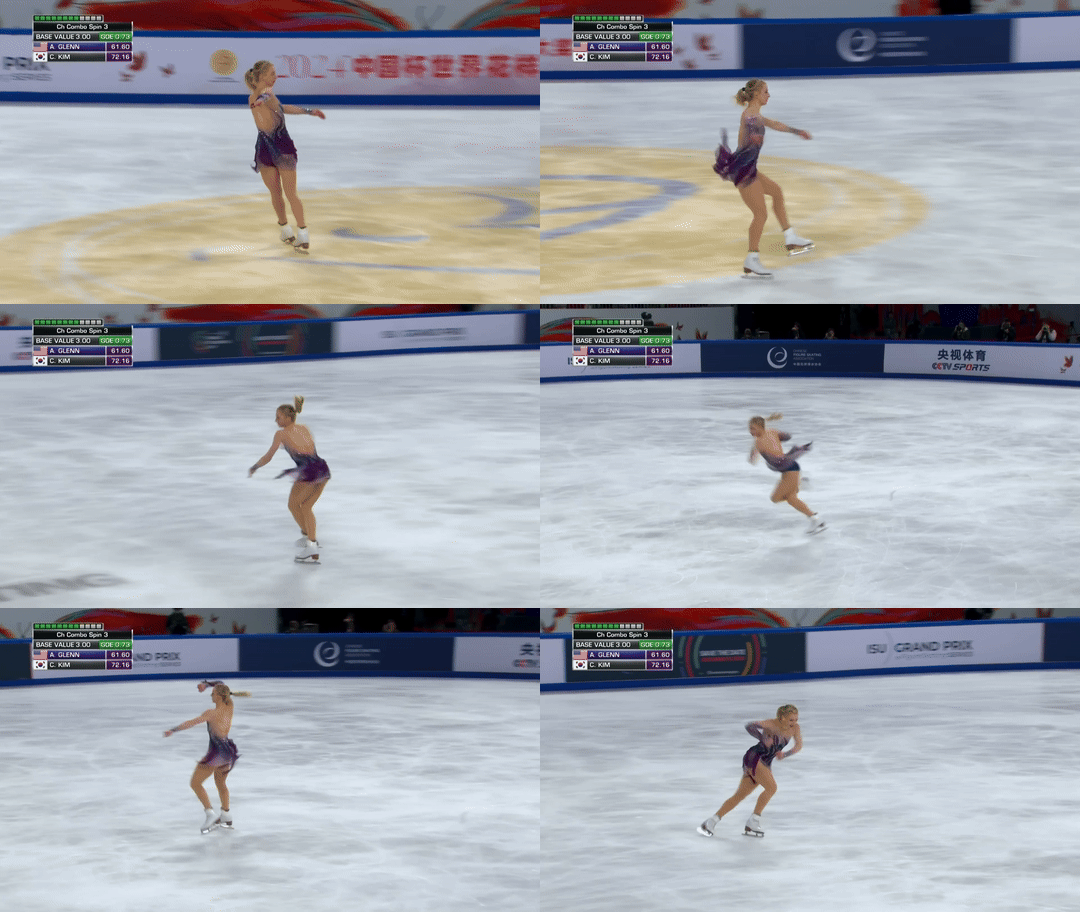


 )
)

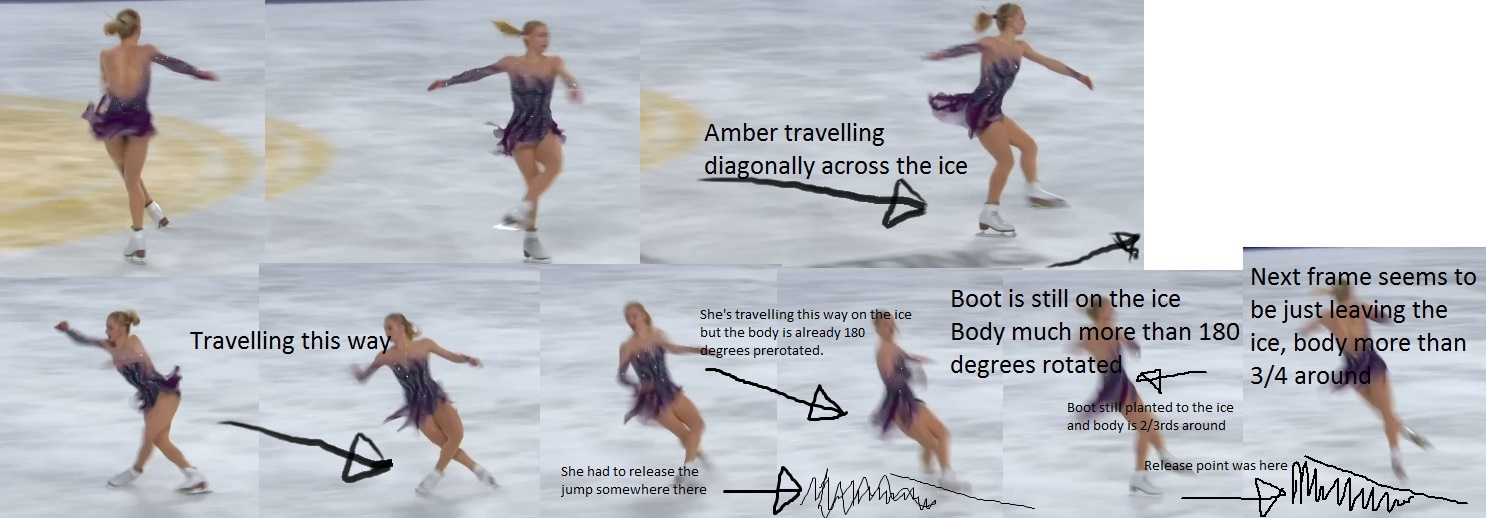
 ). I won't go into the landing or the jump itself which is massively off axis, landing completely on the front of the blade barely holding on. This isn't a once off it is almost always illegally prerotated.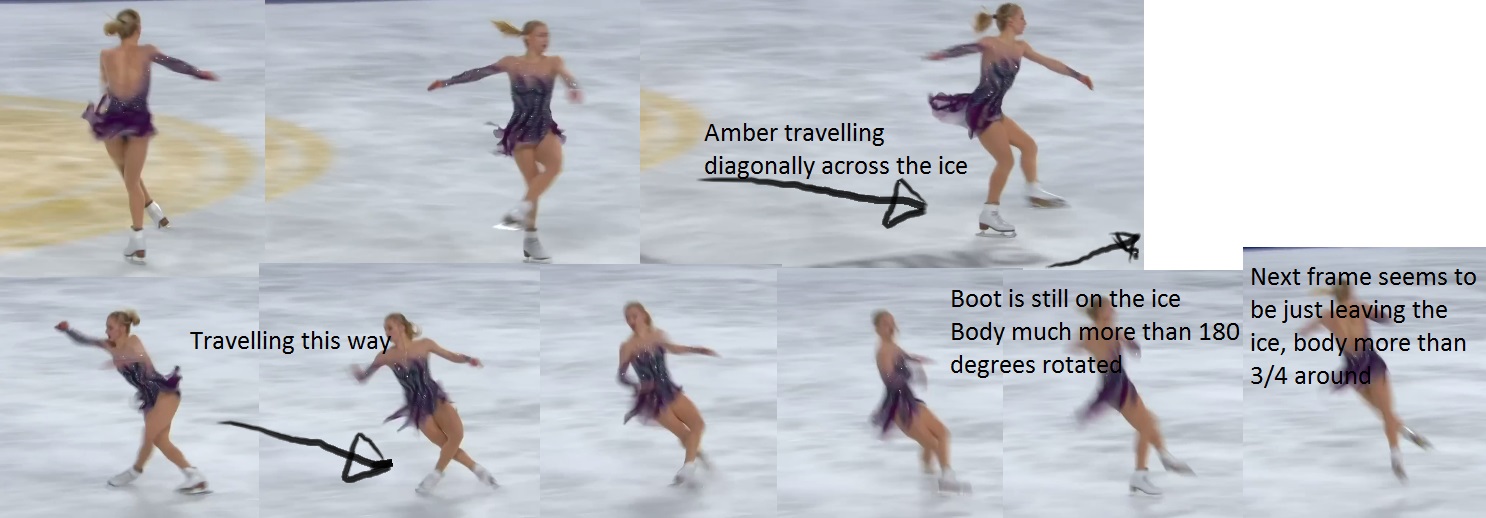
 )
) this dictates the optimal point at which a figure skating short program should hit its musical and choreographic climax for optimal esthetic and emotional effect (about 62% of the way though the program). I am at present hard at work viewing famous and effective short programs of the past to tie check this out.